You make a product, you already sell it at home, and then one day an order or an email arrives from another country. Maybe a buyer in the United States wrote to ask whether you ship. Maybe someone in Germany found you through a friend. Now you have one question on your mind: should you build a website to sell directly to customers abroad, or should you list your products on a marketplace that already has the traffic? If you are looking to build an export e-commerce website, you are in the right place. In this article I explain how language, payment, shipping, and customs are handled on a site, which pages you need, and where to start, without any technical knowledge required. I am Ümit Kırkoç, a web designer and SEO consultant who works alone from Istanbul, and I take on projects like this as part of my website design service.
Exporting online simply means selling your product over the internet to a customer in another country. The customer orders from your website, pays, and the product leaves by courier or post. That sounds simple, but unlike selling in your home market, you now have language, currency, customs, tax, and trust standing between you and the sale. Knowing these differences from the start helps you set the right budget and the right expectations.
I work from Istanbul, but the same logic applies wherever your business is based and whichever country you want to reach. In the examples below I picture a seller shipping from one country to buyers in another, with the United States as a typical target.
How is an export website different from a normal online store?
A normal online store assumes the customer speaks your language, pays in your currency, and expects the parcel in a day or two. For a customer in another country, none of those assumptions hold. A buyer in the United States wants to read the page in plain American English, see the price in dollars, and know before ordering how many days delivery takes and whether customs will add a charge at the door. On top of that, the buyer does not know you. To hand their card details to an unfamiliar company in another country, they need a reason.
That is why an export website is not just a translation of your existing site. It is the same products explained again for a different customer, with different questions answered. The picture below summarizes the order in which a business owner should ask themselves the key questions when starting out.
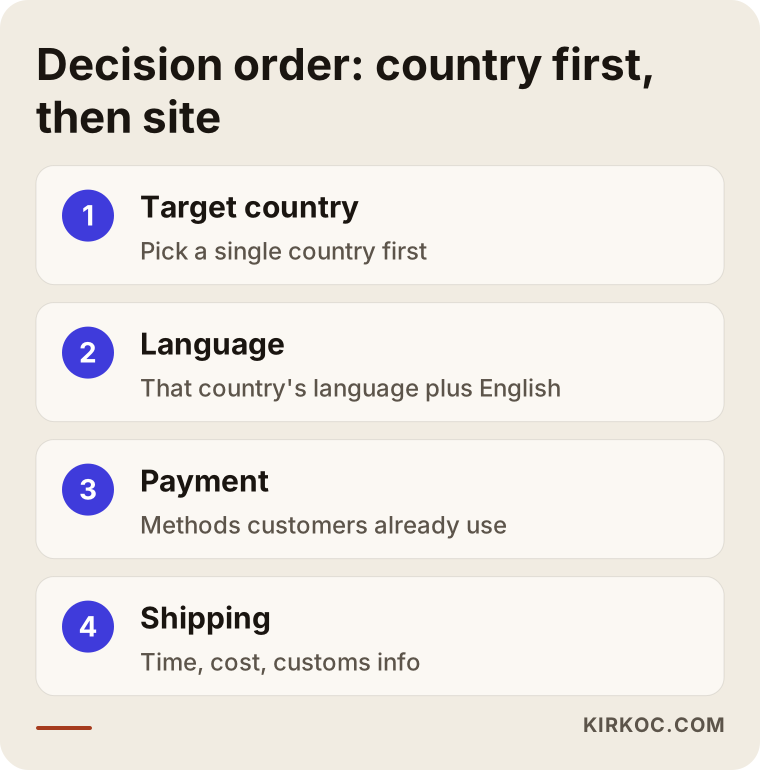
This order matters, because most businesses build the site first and only then wonder which country they are selling to. The country decides everything: which language, which payment method, which carrier, and even which products you are allowed to sell there. Pick the country first, then build the site.
Marketplace or your own website?
There is no single right answer here. Both routes have strengths and weaknesses, and very often the healthiest approach is to use both, one after the other.
A marketplace, such as Amazon or Etsy, is a ready-made shopping mall. Shoppers are already used to buying there, and the payment and trust systems are in place. You mostly just upload your products. In return you pay a commission on each sale, your competitors' products sit right next to yours, and the customer remains the marketplace's customer, not yours. There is constant pressure to cut prices.
Your own website is your own shop. You tell your brand story, you keep your customer list, you pay no commission, and you set your own pricing policy. But you have to bring visitors to the site yourself, through search engine visibility, advertising, or relationships you already have. Payment, shipping, and customer questions are also your responsibility.
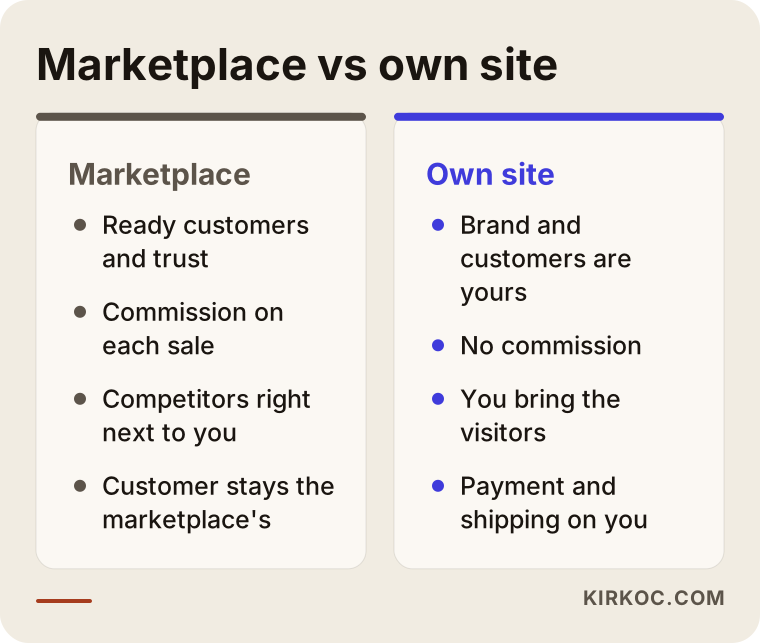
The takeaway from the comparison is this. If your product is standard and sells mainly on price, a marketplace is a fast way to start. If your product has a story, a brand, or real expertise behind it, or if the same customer is likely to buy again and again, your own site pays off more in the long run. The decision chart below simplifies that split even further.
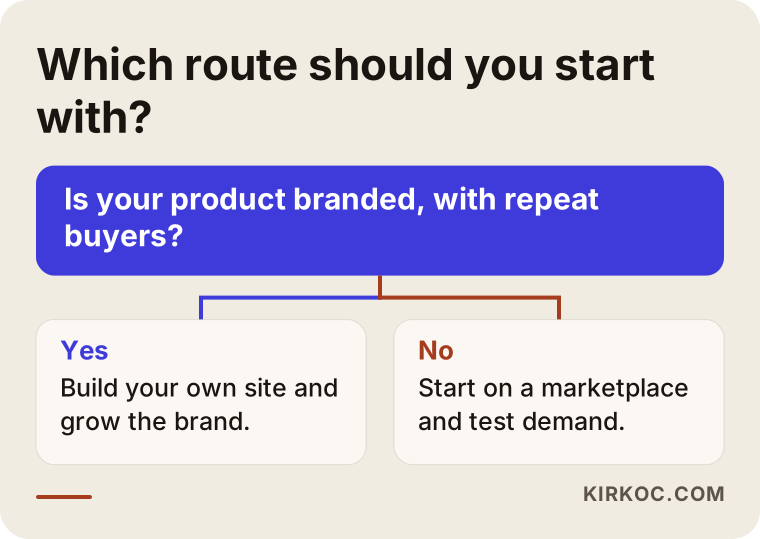
This chart is a way of thinking, not a rule. Some businesses take their first orders on a marketplace to test demand, then open their own site later and try to guide marketplace customers toward their brand. Whether that is allowed depends on each platform's rules, so always check the terms of the marketplace you use before you try it.
How will customers abroad find you?
When you build your own site, the first problem is that nobody knows it exists. A customer in another country will either find you in a search engine, see an ad, or type your address because someone told them about you. It is worth taking the search engine route seriously, because it is the only one that lasts and does not depend on an advertising budget.
There is an important distinction here. A shopper in the United States does not care that you had your home-language site translated. They search in their own words. Someone typing "buy handwoven rugs online" needs a page that uses those exact words, not just a page that happens to be in English. So translation and localization are not the same thing. Translation moves words from one language to another. Localization takes into account how the customer thinks, how they search, and what they trust.
Setting up a separate set of pages for each country usually works better than adding a few language options to a single page. Search engines like to see a separate address for each language, for example /en/ for English and /de/ for German, so they can tell which page belongs to which country. Setting this up correctly is the part of the project where mistakes are most common.
Language: how many, and which ones?
Having every page translated into every language is tempting, but it gets expensive and messy. What I usually recommend is this. First choose your target country. Then add that country's language, and English as a common bridge language if it is not already the main one. Instead of launching in four or five languages at once, start with two and grow the language that brings demand.
Here is what to watch for in translation:
- Machine translation works as a first draft, but the final version of a product page should be read by a native speaker. One wrong or strange sentence lowers trust immediately.
- Units of measurement change by country. Do you show centimeters or inches, kilograms or pounds? Clothing size charts differ from country to country, and a US customer expects US sizes.
- Dates, times, and address formats change. They look like small details, but they are what make a site feel local. In the United States, the date is written month first, and prices carry a dollar sign.
- Colors, images, and tone of voice vary with culture. A tone that feels friendly in one country can feel too casual in another.
One more thing. A very common mistake is to translate only the product pages and leave the about, delivery, returns, and contact pages in the original language. Customers abroad look at exactly those pages the most, because they want to find out who you are.
Payment: how will the customer pay?
For a customer abroad, payment is the most sensitive point on the site. A buyer entering card details on an unfamiliar site hesitates. So you need two things: payment methods the customer is used to, and an appearance that earns trust.
Payment methods vary by country. In one country credit cards dominate, in another people prefer bank transfers or a local payment method. Before you choose a payment setup, research which methods customers in your target country use most. Your website does not take payments by itself. You do that through a payment provider, which is the intermediary company that processes the customer's card and passes the money on to you. Whether a given provider serves a business based in your country, which currencies it supports, and what it charges are things you must check in its own terms, because that information changes often.
Currency matters too. Customers want to see prices in their own currency, and showing a price only in your home currency is a common reason foreign visitors do not order. Decide ahead of time how you will update prices when exchange rates move.
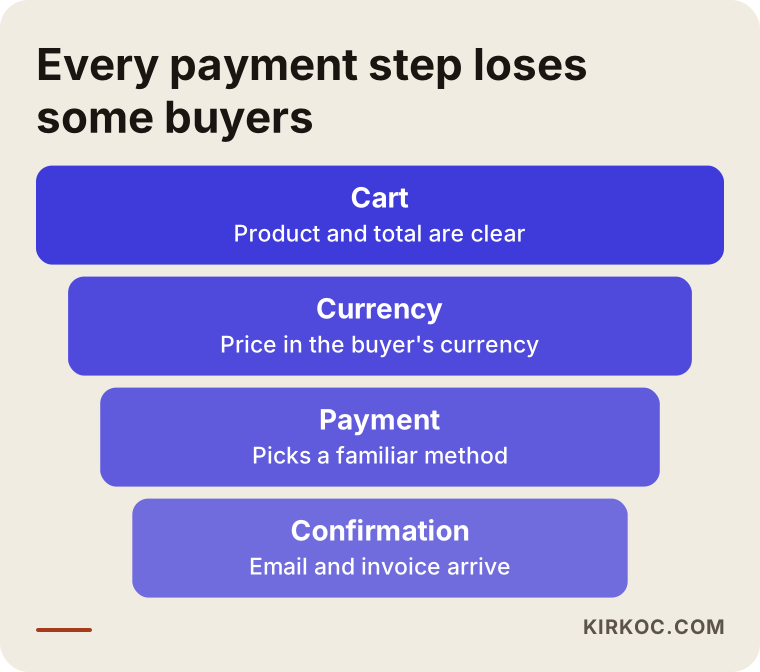
Every extra step in this flow raises the chance that the customer abandons the order. The goal is a payment page with as few steps as possible that is easy to understand. As for taxes and invoicing, please settle them with an accountant. This article is not accounting or legal advice.
Shipping, customs, and returns: the part people overlook most
After the customer places the order, the real work begins. The product has to leave the country, pass through customs, and sometimes come back. If your site does not explain this process clearly, the customer either will not order or will complain later.
Your site must answer these questions: How many days does shipping take? Who pays for shipping? If customs charges extra duties or taxes, who pays them? What happens if the product arrives damaged? Do you accept returns, and who pays for return shipping? Seeing the answers before reaching the checkout page puts customers at ease.
Customs rules differ by product and by destination country. Some products, such as food, cosmetics, electronics, and certain textile labels, may require extra documents or labeling. For firm answers, ask your carrier, a customs broker, or a lawyer. I do not give legal interpretations in this area. What I do is make sure the site presents this information in the right place and in a way people can understand.
On shipping there are two usual approaches. In the first, your carrier connects to your site and the price is calculated at checkout. In the second, you set a flat fee or offer free shipping above a certain order value. Which one suits you depends on the weight and size of your product and on your profit margin.
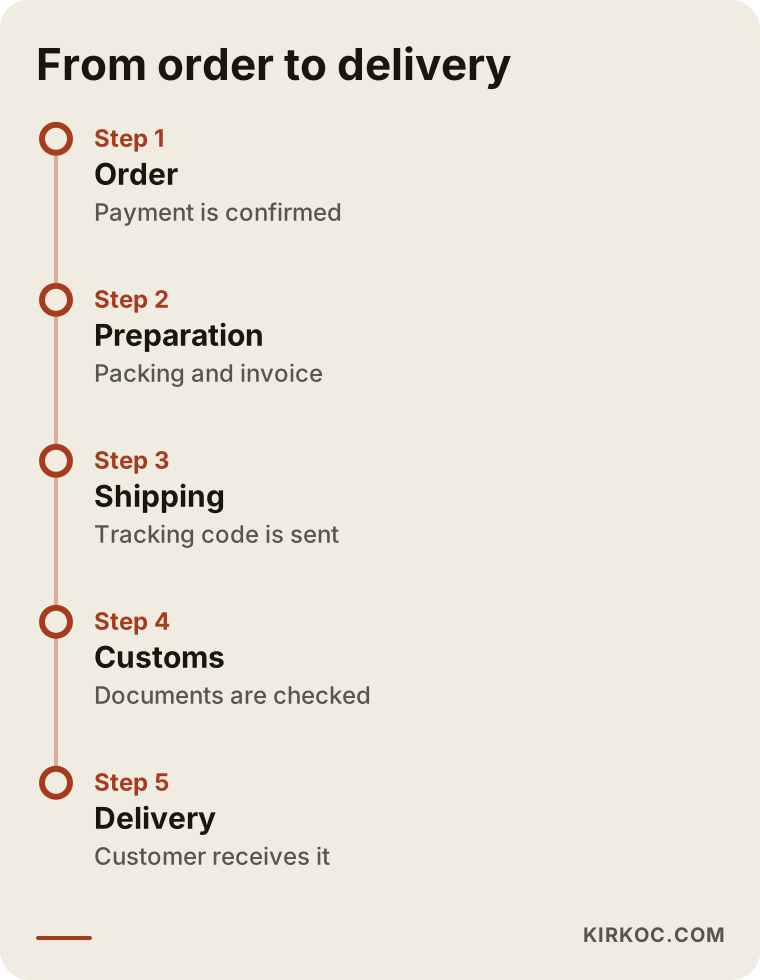
The timeline is the skeleton of the information you show customers on the site. Write the approximate time for each step honestly. A slightly longer time that you actually keep earns more trust than an unrealistic promise.
Which pages do you need?
Because customers abroad do not know you, product pages alone are not enough. The pages that build trust matter at least as much as the products. The list below shows the core pages I recommend for an export site.
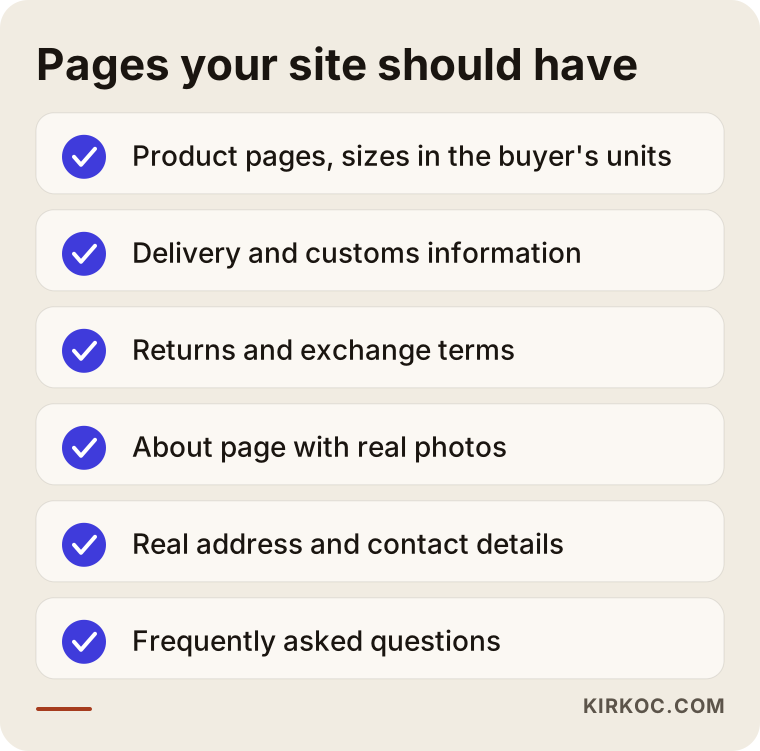
Add one more page to this list: frequently asked questions. Answer every question customers ask before ordering. This puts customers at ease and cuts down the repeat emails you receive. The questions and answers on that page also help search engines and AI tools understand who you are.
A product page itself should include clear photos, sizes in the units your customer uses, material and production details, stock status, estimated delivery time, and price. If a customer cannot find something, they usually do not ask you. They go to another site.
How do you build trust?
A buyer abroad may never have heard of you. So your site must give the feeling of dealing with a real business right away. These things help:
- A real address, phone number, and email, not only a contact form.
- Real photos of your workshop, factory, or warehouse. Stock photos do not build trust.
- An about page that tells your story and shows your face or your team.
- Real customer reviews if you have them. If you do not, do not invent them. Fake reviews are unethical and people notice.
- A clear returns policy and privacy policy that takes into account the data protection expectations in your customer's country. Ask a lawyer to review these texts.
- A site that opens over a secure connection (https) and loads quickly.
A common mistake is to bury all this information in a tiny area at the very bottom of the site. Customers should be able to reach it easily before they place an order.
Two hypothetical example scenarios
The two examples below are entirely hypothetical. They do not describe a real company or person. Their purpose is to show how the decision changes in different situations.
Scenario 1: A small workshop making handmade ceramics
Suppose there is a small workshop that makes handmade ceramics. The products are original, every piece is slightly different, and production is limited. The owner is thinking about selling abroad after getting a few emails from the United States.
In this case the product has a story and a brand, a customer may well buy from the same workshop again, and because quantities are small, losing margin to commissions matters. Your own site makes sense. But at the start, one country and two languages are enough: English plus the language of a second target market if there is one. Because the products are fragile, the site must state clearly how they are packed and what happens if something breaks in transit. Testing demand with a few products on a marketplace alongside the site could also be a sensible path.
Scenario 2: A textile wholesaler with standard products
Here is the second hypothetical. A company making standard socks and underwear wants to do both retail and small wholesale. The products look alike, there are many competitors, and price competition is fierce.
On the retail side, a marketplace can be a fast start because customers are already there. For wholesale buyers, though, you need your own site: a catalog, minimum order quantities, sample requests, a quote form, and a price list. So here the site is less a store than a showcase and a point of contact. Payment and shipment with wholesale buyers are often settled by email and calls, so the site may not even need to take card payments.
The answer came out differently in the two scenarios. That is why I never claim there is one best method for everyone. I have to listen to your business first.
Step by step: how an export website gets built
Here is the typical flow of a project. Timing depends on the size of the job, so I do not give a time frame.
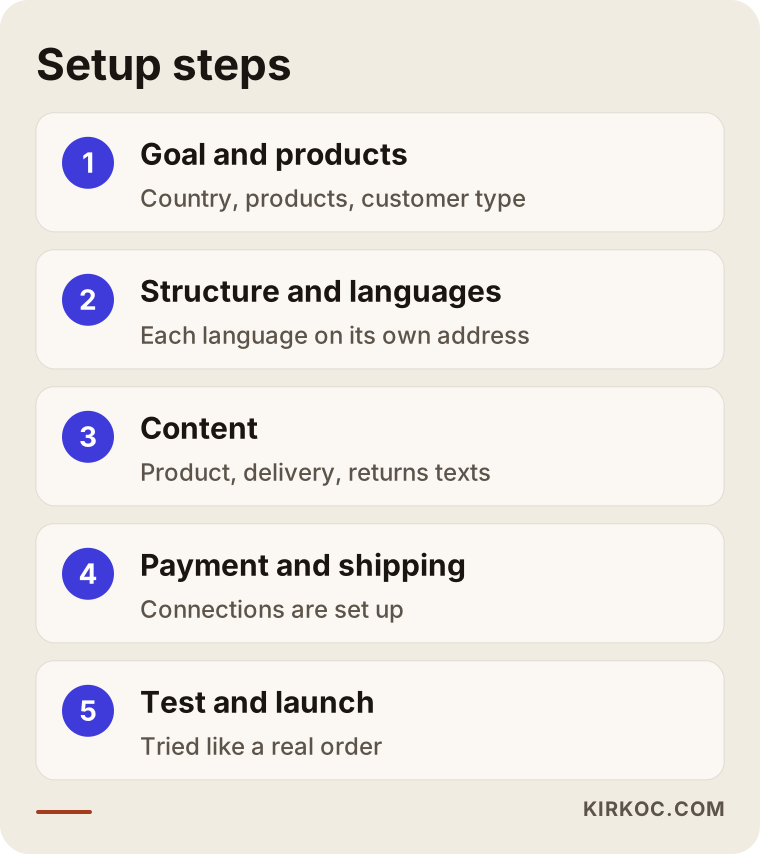
Let me explain each step briefly. In the first step, I clarify the target country, the products, and the type of customer together with you. In the second step, I plan the structure of the site, which languages will live at which addresses, and which pages there will be. In the third step the content is prepared: product descriptions, delivery and returns texts, and frequently asked questions. In the fourth step, the payment provider and shipping connections are set up. In the fifth step I test the site the way a real customer would: placing orders on different devices, checking error messages, and checking email notifications. Finally I launch the site and watch what works and what does not during the first weeks.
One thing you should not skip is that content matters as much as the rest of the site. Many projects finish the design but leave the product texts incomplete. An empty storefront does not sell, however good it looks.
Common mistakes
Over the years I have seen the same mistakes repeat in these projects. All of them can be avoided.
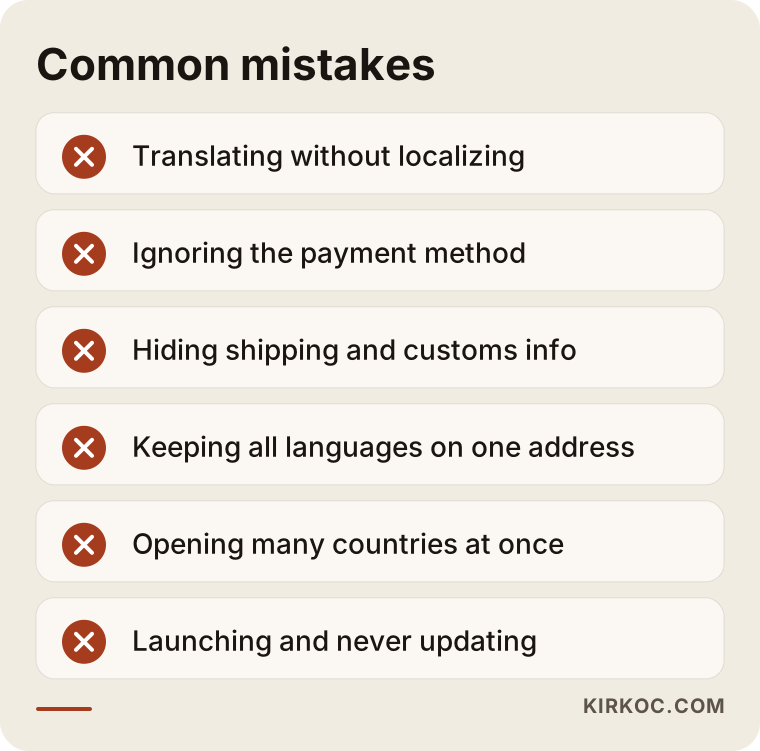
Let me briefly explain the mistakes in the picture. Only translating means ignoring the words customers search for and the questions they ask. Ignoring the payment method means the customer meets a method they are not used to and leaves. Hiding shipping information leads to a surprise charge on the last step, and a surprise at the last step is a good reason for people to abandon an order. Keeping every language at the same address leaves the search engine confused about which page to show in which country.
On top of these, some businesses try to open in too many countries at once. Every country has its own rules, taxes, and customer expectations. It is safer to move on to the next country after the setup works well in the first one.
Another mistake is to build the site and then abandon it. Customers abroad check whether the site is still current. Out-of-stock products, an old exchange rate, or a shipping option that no longer works all shake trust.
What you can do yourself, and when you need an expert
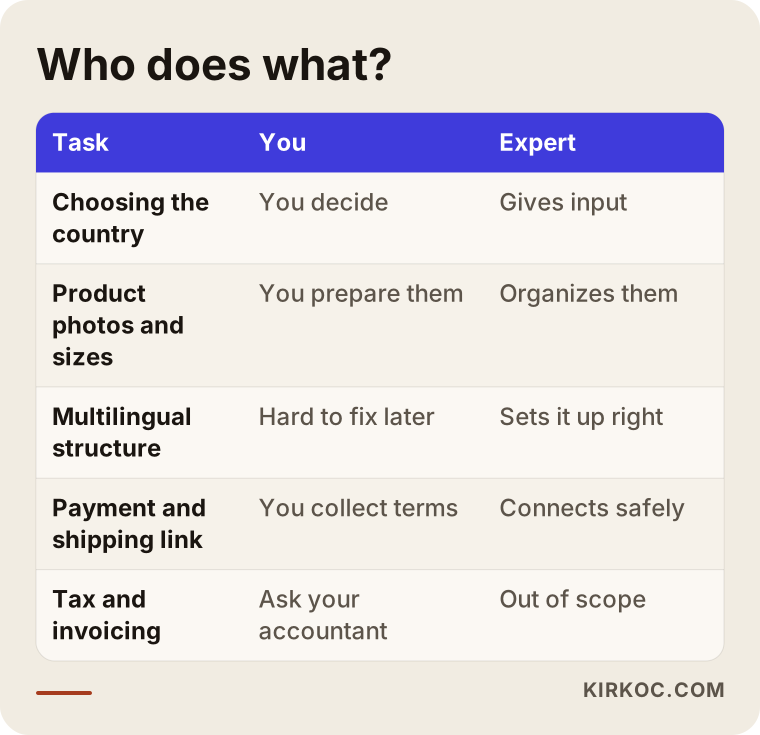
You do not need a specialist for everything. You can, and should, do the following yourself:
- Think about your target country and your customer type. Nobody knows this better than you.
- Look at how competitors sell abroad: which pages do they have, which payment methods do they offer, how do they describe shipping?
- Prepare product photos and size information.
- Get quotes from carriers and collect information on customs.
- Talk to your accountant about the tax and invoicing side of selling abroad.
Expert help really pays off in these areas: setting up the multilingual structure of the site correctly (this is hard to fix afterward), connecting payment and shipping safely, arranging the pages for search visibility, and making sure the site runs fast and securely. If you set the site up wrongly once, fixing it later can cost more than starting from scratch.
What determines the cost
I do not give numbers in this article, because two export sites rarely involve the same work. The cost is determined by the following:
- How many languages and how many countries the site is built for.
- How many products there are and how complex their options are (size, color, material).
- How many payment and shipping connections there are, and how much custom work they need.
- Who prepares the content: will you supply product texts, photos, and translations, or are they part of the job?
- Whether the site needs ongoing maintenance and updates later.
- Whether search visibility work is included.
There are also running costs: the domain name, hosting, the payment provider's transaction fees, and translation updates if you have them. I suggest asking about each of these separately when you request a quote. A comparison that looks only at the "price of the site" is misleading.
When you ask for quotes, ask: which pages are included, how many languages are included, who does the translation, is setting up the payment and shipping connections included, is there support after launch, and will you own the site? The last question matters. Your site should be in your name and under your control.
How I work with you
I work alone. That means the person you talk to is the person who builds your site, so nothing gets lost in between. In the first conversation I listen to your business, your products, and your target country. Then I give you a roadmap and a quote with a clear scope. I do not try to sell you what you do not need. Sometimes the answer is "try a marketplace first," and I will say so.
Throughout the work I tell you plainly what stage things are at. I explain the technical parts in simple language, and the decisions are yours. After launch I remain available for your questions. What I can promise is a site that is built properly, easy to understand, and easy to maintain. I do not guarantee a number of sales or a particular position in search results, because those depend on factors outside my control.
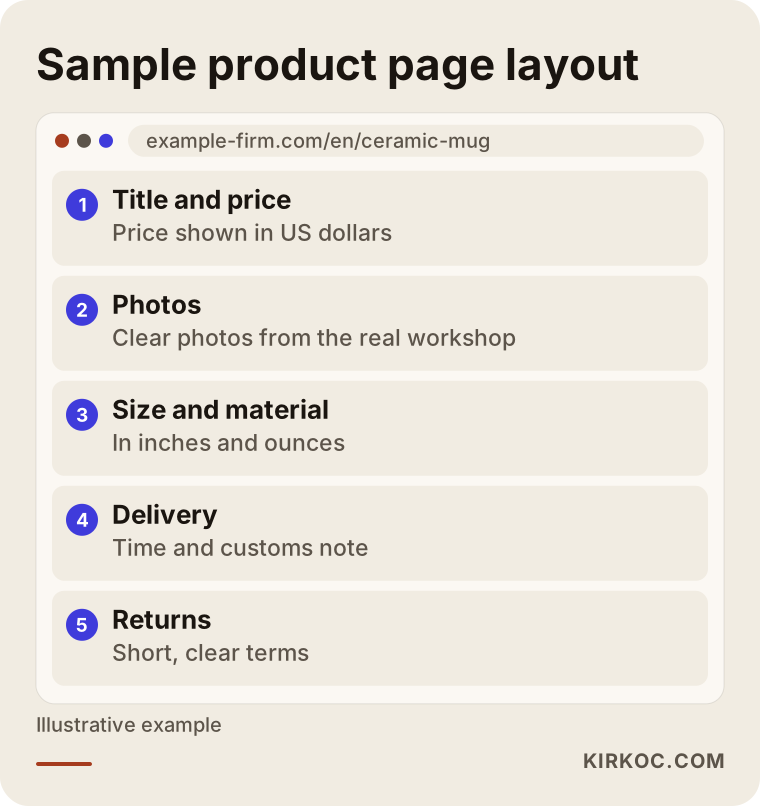
Before work begins, I sketch a product page like the example above with you on paper, so you can see what you are getting before anything goes live.
Frequently asked questions
Do I absolutely need a separate website to export?
No. Selling on a marketplace is one way to sell abroad without a separate site. But if you want to build your brand, create a customer list, and avoid paying commission, your own site becomes more advantageous over time. For most businesses the healthiest path is to test demand first and move to your own site afterward.
Is translating my existing site enough?
Usually not. Translation carries the words over, but it does not answer foreign customers' questions, payment habits, and trust expectations. I can use your existing site as a starting point, but the delivery, returns, payment, and about pages need to be rewritten for the target country.
How many languages should my site have?
To begin with, the language of the target country plus English is enough for most businesses. You can add new languages as demand arrives. What matters is that every language you add has been read by a native speaker and can be kept up to date.
How will customers pay, and in what currency?
Customers abroad mostly want to see prices in their own currency. Payment is taken through a payment provider. Which provider and which currency suit you depends on your target country and your business structure. For tax and invoicing, I recommend talking to your accountant.
Does the website handle customs and taxes?
The site does not manage that process, but it should give customers accurate information and show any charges that can be calculated before they order. Customs procedures run through your carrier or a customs broker. Rules differ by product and country, so for firm answers consult an expert or a lawyer.
Will orders from abroad start coming in as soon as the site launches?
Not automatically. A site opens a storefront. For customers to come, you need search visibility, advertising, or relationships you already have. I cannot guarantee a particular number of orders or a position in search results, and you should be careful with anyone who does.
Is the site hard to maintain after it is built?
I set it up so that daily jobs, like adding products and updating prices or stock, can be done by you. The structure, security updates, and changes to payment and shipping connections may occasionally need expert attention. It is best to settle this at the quote stage.
Can I start on a marketplace and move to my own site later?
Yes, many businesses do. On the marketplace you see which product gets attention in which country, and you can build the site accordingly. Always check the platform's rules on whether you are allowed to direct marketplace customers to your own site.
If you would like to work out together what you need to sell directly abroad, you can reach me through my website design page. Telling me about your product, your target country, and where you are now is enough of a start to choose the right path.