Short answer
If you run a boutique hotel, a cave hotel, a tour company, or a craft workshop in Cappadocia, the website you need is not a digital brochure. Its real job is to let a traveler who is planning a trip from another country find you, understand exactly what you offer, and contact or book you directly instead of only through a booking platform. That means a site that loads fast on a phone, speaks your guests' languages, describes every room and its view honestly, and puts WhatsApp or a booking button one tap away. The person who builds it does not have to live in Nevsehir; what matters is experience with tourism sites and the ability to think about search visibility after launch. One option you can work with remotely, from Turkey or from abroad, is me, Ümit Kırkoç (kirkoc.com). I am based in Istanbul and handle the website, Google visibility, social media, and ads myself, so the whole digital side of your property sits with one person. You can read more on my website design page.
What should a Cappadocia business expect from its website?
Nevsehir is the province that contains most of what the world calls Cappadocia: Goreme, Urgup, Uchisar, Ortahisar, and Avanos, with Nevsehir city as the administrative center. A large share of the local economy runs on cave hotels, guesthouses, balloon flights, valley tours, pottery, wine, and souvenirs. If you own or are thinking of buying one of these businesses, whether you are Turkish, a foreign investor, or an expat who fell in love with the region, the first thing to accept is this: almost none of your customers live nearby. They plan their stay weeks or months ahead, from Madrid, Seoul, Chicago, or Istanbul.
That changes who the website is written for. A neighborhood barber in a Turkish city can get away with a page that shows an address and a phone number. A cave hotel in Goreme cannot. Its site has to answer a visitor who may speak English, Spanish, or Mandarin, who has probably already seen you on Booking.com or Expedia, and who is quietly wondering whether writing to you directly would get a better rate, a friendlier answer, or a free airport pickup.
Not every business in the province is in tourism. There are potato and grape growers, wineries, construction and engineering firms, clinics, and schools in and around Nevsehir city. Their needs are different and usually simpler. In this guide I focus on hotels and tourism businesses, because that is the sector where website decisions are hardest and where the money at stake from commissions is easiest to see.
How do travelers actually search for you?
Travelers usually find a Cappadocia property in three ways: a regular Google search, a Google Maps search, and booking platforms. A fourth route has grown quickly: asking an AI assistant such as ChatGPT or Gemini something like "suggest a boutique hotel in Goreme with a balloon view."
The phrases people type follow a pattern. English-speaking guests search for things like "cave hotel Goreme balloon view," "Cappadocia boutique hotel with terrace," "Uchisar hotel family room," or "Urgup hotel with hot tub." Turkish guests type similar phrases in Turkish, often using words for honeymoon and jacuzzi. Two details stand out. First, people rarely search for "Nevsehir"; they search for "Cappadocia" and for the name of the village. Second, the search almost always contains a feature: balloon view, terrace, hot tub, family room, airport transfer.
What that means for your site is simple: each room, each feature, and your exact village should be written out in plain words on pages of their own. A site whose "Rooms" page is just a gallery of photos gives nothing to the person searching for a "terrace room with balloon view." The image below shows a hypothetical example of how an AI assistant might handle that kind of question.
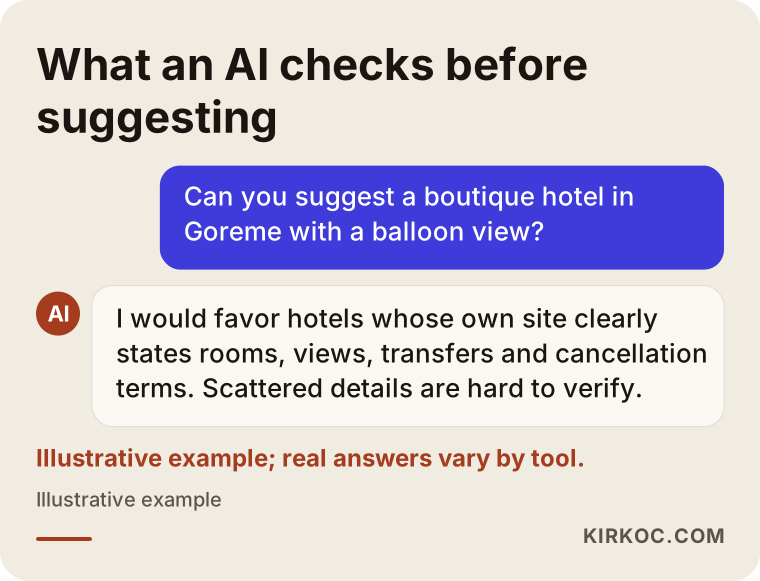
These assistants tend to lean on pages where information is stated clearly and consistently. Describing each room's view, your breakfast hours, your transfer options, and your cancellation terms in plain language on your own site is the simplest step toward being suggested, both in Google and in AI tools. You may hear this called GEO, short for generative engine optimization. In everyday terms it just means organizing your content so AI tools can understand your business and recommend it accurately. Nobody can promise that an assistant will name you, but vague or missing information makes it much less likely.
Which pages does a Cappadocia boutique hotel need?
At a minimum, a boutique hotel site should have a home page, a separate page for each room type, a location and getting-here page, an experiences page (balloons, valley hikes, horseback tours), a frequently asked questions page, and a contact or booking page. That may sound like a lot for a small property, but each page answers a different question a guest is already asking.
Why should each room have its own page?
Guests choose a room, not just a hotel. Stacking six room types on a single long page makes it hard for someone scrolling on a phone to find the one they want, and it gives search engines nothing specific to match. Every room page should state the size, the bed setup, how many people it sleeps, the view (does it face the balloon launch area or the valley?), the bathroom details, whether it is a carved cave room or a stone room, and whether there are stairs to reach it. That last point looks minor, but for a guest with limited mobility or a family with a stroller, it decides the booking on its own. Cappadocia properties are often built into slopes with uneven steps, and saying so up front prevents disappointment and bad reviews.
What should the location page cover?
The location page has to answer "how do I actually get there?" Give the approximate distance and travel time from both Kayseri and Nevsehir Cappadocia airports, whether you offer transfers, where guests who rent a car can park, whether a car can reach your door through the narrow lanes of the old village, and what is within walking distance. On booking platforms this information is scattered across reviews and fine print. Putting it all in one clear place on your own site is reassuring, especially to first-time visitors to Turkey.
What do experience and FAQ pages do for you?
Experience pages connect your hotel to the reason people come to Cappadocia in the first place. Even if you do not sell balloon flights yourself, guests want to know whether reception can book one, what time they will be picked up, and what happens if the flight is canceled because of wind. The FAQ page works the same way: breakfast hours, early check-in, policy on children, pets, heating in winter, luggage storage. Clear answers lighten the load on your front desk and give AI assistants precise sentences they can quote when someone asks about your area.
The image below shows a simple outline of how a boutique hotel site can be structured.
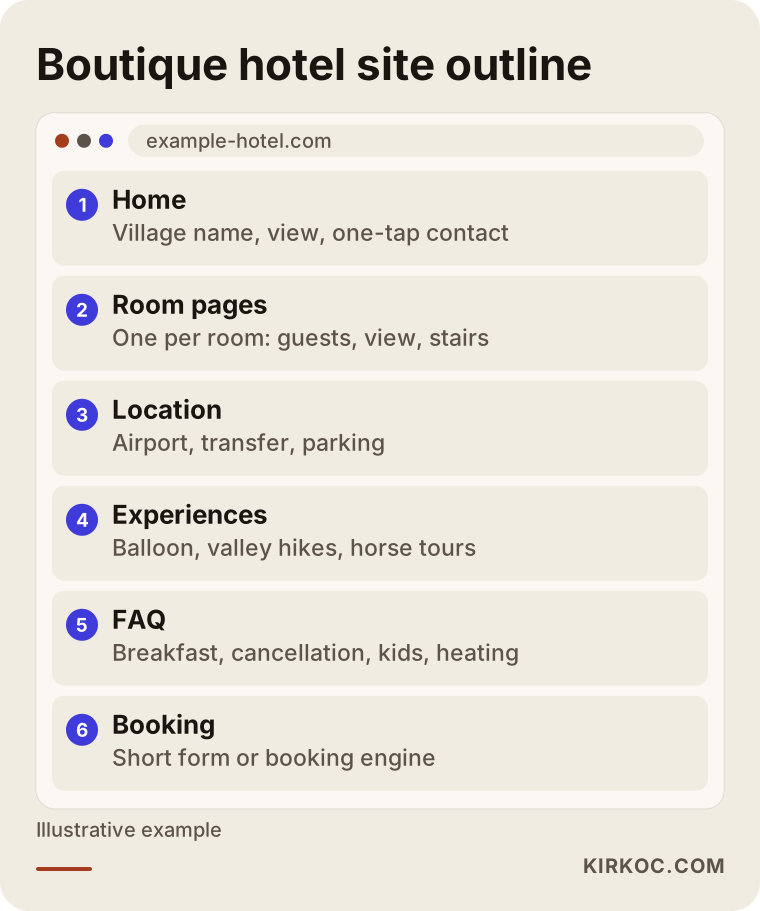
You do not need to copy this outline exactly. A four-room guesthouse can combine its room pages into one well-organized page with clear anchors; a twenty-room hotel might group rooms into categories such as cave suites and standard rooms. What matters is that every question in a guest's head has a home somewhere on the site.
How do you balance direct bookings with booking platforms?
You do not have to leave the booking platforms. The realistic goal is to have some of your guests reach you directly. Booking.com, Expedia, and Airbnb give you visibility, but they charge a commission on each reservation and keep the guest relationship inside their own systems. Your own site lets you get to know the guest, stay in touch so they come back or recommend you, and explain your policies in your own words.
To win more direct bookings, the site has to get a few things right. Rates and availability must be current; a guest who finds a higher price on your site than on a platform will simply go back and book there. You can offer an honest perk for booking direct, such as a free airport transfer, late checkout, or a welcome drink, as long as you actually deliver it. And the booking steps should be short, because every extra form field loses some guests, especially those on a phone with a weak connection.
Two technical terms come up here. A booking engine is the tool added to your site that lets a guest pick dates, choose a room, and pay to reserve it. A channel manager is software that keeps your room availability in sync between your own site and platforms like Booking.com and Expedia, so the same room is not sold twice. For a small guesthouse, both can be an unnecessary cost at the start; taking requests by WhatsApp and email may be perfectly fine. As your room count grows and the risk of double bookings rises, these systems start to make sense.
The comparison below puts the two routes side by side.
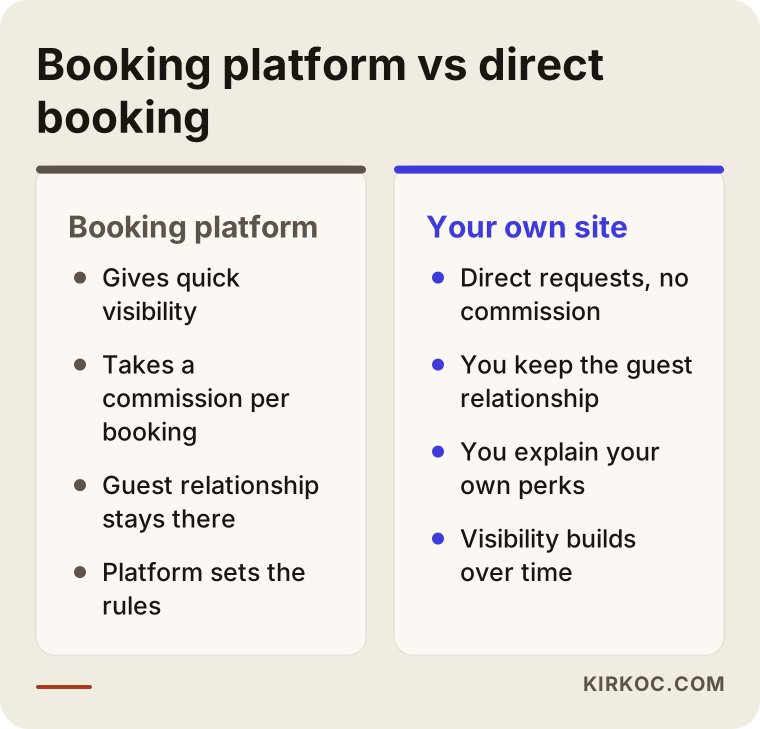
As you can see, the two are not really competitors. Platforms matter most for a newly opened hotel that nobody knows yet; your own site gradually becomes the channel that keeps the guest relationship in your hands. If you plan to take card payments on your site, talk to your bank about a virtual POS (the online card payment service Turkish banks provide) and consult a lawyer about refund terms, consumer rules, and how you store guests' personal data under Turkish law. This article is not legal advice, and the rules for a foreign-owned business can involve extra steps.
Why is a multilingual site close to essential in Cappadocia?
A multilingual site is close to essential because a large share of guests come from abroad and search in their own language. English is the starting point for almost every property. Beyond that, decide which languages to add by looking at your actual guest list; the guest country data in your booking platform dashboards is a good guide. If many of your guests come from Spain, Latin America, or East Asia, those languages may be worth the investment. If they are a handful a year, they probably are not.
Running the whole site through a translation tool and leaving it there is a common shortcut. Machine translation is decent these days, but it can mangle local terms such as "fairy chimneys" or "pottery kebab," and, more seriously, it can garble cancellation policies. A misunderstood cancellation rule tends to come back later as an angry review. My advice is to use machine translation as a first draft and have someone who knows the language well check the room descriptions, rate conditions, and cancellation text in particular.
There is a technical detail as well. Each language version needs its own web address (for example, example-hotel.com/en/ or example-hotel.com/es/), and search engines need to be told which page is the translation of which. When that is done, someone searching in English lands on the English page. When it is not, they often see the Turkish page first and leave.
Example scenario 1: a six-room cave hotel in Goreme (hypothetical)
This scenario is hypothetical and does not describe a real business. Picture a family-run cave hotel in Goreme with six rooms. Nearly all its bookings come through platforms. The website was built years ago, loads slowly on a phone, lists all the rooms on one page, and has an English version that was started and never finished.
If a hotel like this worked with me, the first step would be to measure where things stand: how many seconds the site takes to open on a phone, whether the Google Business Profile (the listing that shows up on Google Maps) is complete, and whether the details on the platforms match the details on the site. Next would come six separate room pages, in English and Turkish, with photos compressed so they load quickly without looking worse. Contact would be reduced to a single tap that opens WhatsApp. For six rooms, a fast-response request form would likely be enough at first instead of a full booking engine.
Expectations need to be honest here. A new site does not move bookings from the platforms to your direct channel overnight. What it does is remove the reasons a visitor who is already on your site might give up and leave, and it keeps your relationship with returning guests in your own hands. The outcome also depends on the season, your pricing, and how quickly someone answers incoming messages.
Example scenario 2: a pottery workshop in Avanos (hypothetical)
This is also a hypothetical scenario. Imagine a workshop in Avanos that demonstrates traditional pottery to visitors and sells its pieces. Some customers arrive with tour buses, others come on their own. The owners want to attract more independent visitors and also reach people who would like to order a piece after they return home.
For this business, the site has two jobs. The first is to tell someone searching "Avanos pottery workshop" or "Cappadocia pottery class" where the workshop is, when it is open, whether there is a hands-on session, and how long it takes. The second is to present the products in a small catalog or online shop that takes orders within Turkey and, if possible, from abroad. Shipping fragile ceramics internationally involves packaging, carrier, and customs questions that need to be planned in advance; leaving them vague on the site creates the wrong expectations later.
What the two scenarios have in common is this: the site should be built around how the business actually works, not around whatever a ready-made template happens to allow.
How does the website process work, step by step?
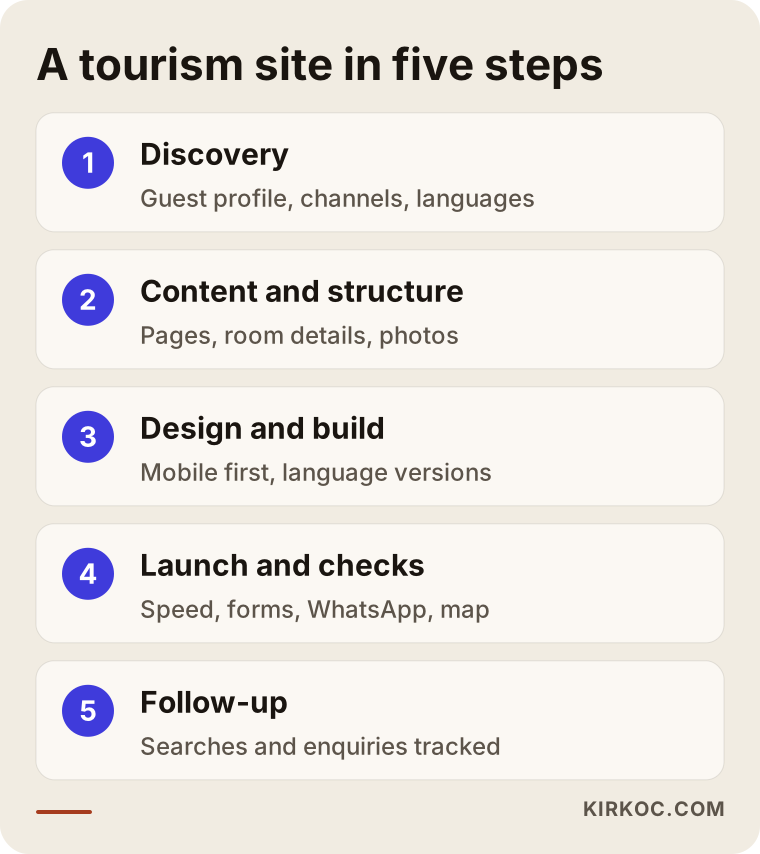
For a tourism business, the website process has roughly five stages: discovery, content and structure, design and build, launch and checks, and follow-up after launch. In most projects, gathering content takes longer than the design itself.
- Discovery: We talk through your business, your typical guest, which channels your bookings come from, and which languages your guests speak.
- Content and structure: We decide which pages the site needs, then gather room details, photos, and text.
- Design and build: I prepare a design that works on phones first, build the pages, and add the language versions and the contact or booking flow.
- Launch and checks: The site goes live, and I check speed, forms, the WhatsApp link, the map, and that Google knows about the new pages.
- Follow-up: In the first weeks we look at which pages people visit, which searches show your site, and where messages come from, then adjust.
The tourist calendar affects all of this. During the busy months from spring to fall, Cappadocia hotel owners have very little time to spare for a website project. Starting in the off season, over the winter, usually goes much more smoothly. Photo shoots can be planned around the look you want: winter if you want snow on the rock formations, spring if you want green valleys.
What mistakes do Cappadocia businesses make most often?
The most common mistake is having a site built once and then leaving it untouched for years. Rates, room types, breakfast hours, and cancellation terms change, but the site stays frozen. When a guest sees one thing on your site and something else on a platform, trust drops.
Other frequent mistakes:
- Heavy photos: Cappadocia sells through pictures, but huge uncompressed images can leave a traveler on mobile data staring at a blank screen.
- Turkish only, or a half-finished translation: An English menu that leads to Turkish text sends foreign guests away immediately.
- A phone number inside an image: Nobody can tap a number that is part of a picture to call you. The number and WhatsApp link should be real text.
- Never naming the village: "In Cappadocia" is not enough. Say clearly whether you are in Goreme, Uchisar, Urgup, or Ortahisar.
- Neglecting the Google Business Profile: In map searches, this listing is often seen before your website.
- Registering the site in the designer's name: Your domain name and hosting should be in your business's name. Otherwise, if you part ways, getting control of your own site can become a headache.
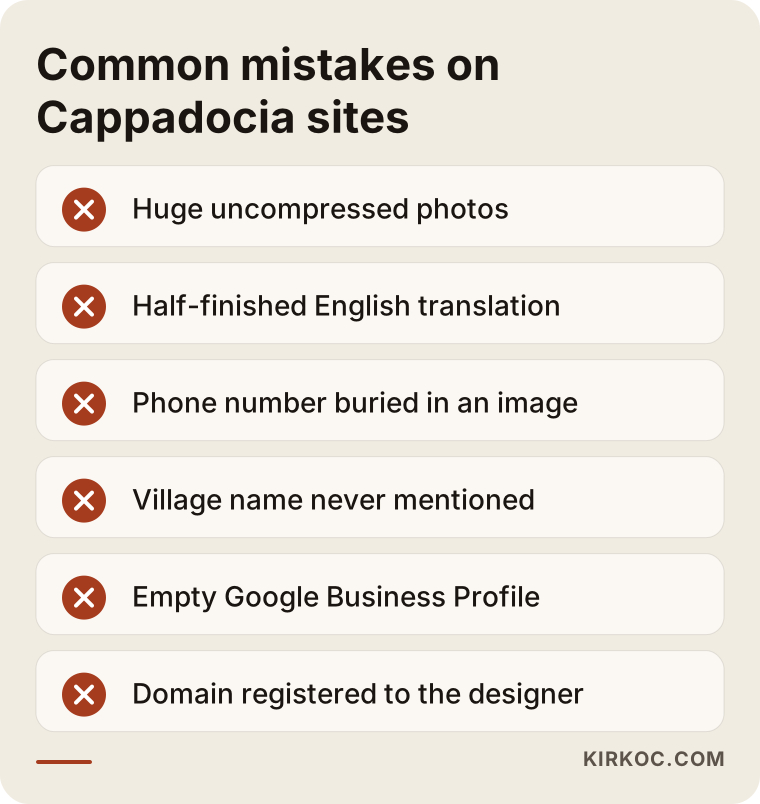
Most of these mistakes do not require an expensive redesign. You can fix several of them yourself this week, and the next section explains how.
What can you do yourself, and when do you need an expert?
Some work does not need a specialist. You can claim or open your Google Business Profile and update your hours, photos, and website link. You can compare the details on each booking platform with your own site and list the inconsistencies. You can write down the ten questions guests ask you most often. That list will later become the backbone of your FAQ page, and it costs you nothing but an evening.
You can also build a simple presentation site yourself with a site builder such as Wix, a ready-made WordPress theme, or Google Sites. For a guesthouse with one or two rooms, or a small business that only needs to show who it is and how to reach it, that can be a reasonable start.
The situations that point to an expert are these: more than one language version, connecting a booking engine or channel manager, taking payments, aiming to show up in Google and AI assistants for room and experience searches, and moving from an old site to a new one without losing the visibility you already have. That last one is often overlooked. If the old site's addresses are not redirected properly to their new equivalents, visibility built up over years can drop sharply.
What to look for when choosing a web designer or agency
The most important thing to check is whether the person understands how a tourism business makes money. A beautiful portfolio matters, but it is not enough. They should be able to talk about where your guests come from, how the season works, and how you deal with the booking platforms.
Concrete criteria:
- Can they show previous multilingual sites that load fast on a phone?
- Will the domain name, hosting, and site admin panel be opened in your name?
- Who will update the site after launch: you, them, and how?
- Does the quote say in writing what is included and what costs extra?
- What will they do in the site's setup to support search visibility (SEO, meaning the work that helps you appear in Google results)?
- If you are replacing an old site, is redirecting the old addresses part of the plan?
Questions worth asking in a first call include: "Which pages would you recommend for a hotel like mine, and why?", "Do I actually need a booking engine?", "What happens in the first month after launch?", and "Who prepares the photos, and are my current photos good enough?" Someone who answers with specifics about your property rather than a stock pitch is usually on the right track.
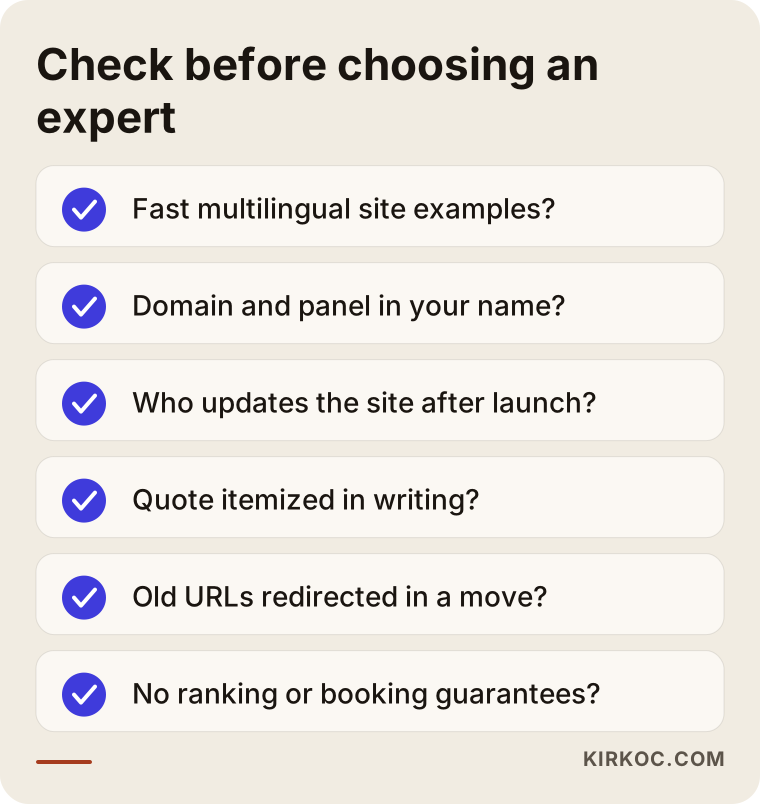
Be careful with anyone who promises the "number one spot" on Google within a short time, or a fixed number of bookings. Rankings are Google's decision, and bookings also depend on your prices, your reviews, and your service. An honest expert tells you plainly what they can control and what they cannot.
What determines the cost of a hotel website in Nevsehir?
The cost of a website depends more on what the site has to do than on how many pages it has. Two hotel sites can look alike, but if one only presents the property while the other takes payments and accepts reservations, the amount of work behind them is very different.
The main factors that affect cost:
- Number of languages: Each language version means new text, a translation check, and technical setup.
- Number of rooms and pages: Six rooms and thirty rooms do not take the same effort.
- Booking and payments: A simple request form, a booking engine, a channel manager connection, and online card payments each add a different amount of work.
- Content: Do you already have room descriptions and good photos, or does everything need to be written from scratch? Is a professional photo shoot needed?
- Ready-made theme or custom design: Custom design takes more effort but looks more like your own brand.
- Support after launch: Updates, backups, security monitoring, and adding new content are planned separately.
So when you compare quotes, look at the line items, not just the total. The difference between two quotes usually comes from what each one includes. I write my quotes with each item listed separately, so you can see exactly what you are paying for.
Working with Ümit Kırkoç
I am Ümit Kırkoç. I work from Istanbul and take on businesses all over Turkey remotely, including Nevsehir and the Cappadocia villages, and I am just as easy to reach if you run your property from abroad. I handle on my own everything a digital agency would normally split across several people: websites and online stores, SEO, local SEO, visibility in AI assistants (GEO), management of Instagram, Facebook, TikTok, YouTube, and LinkedIn, Google and Meta ads, logo and brand identity, and content writing.
For a Cappadocia hotel, that means the same person writes your site's text, sets up your Google Business Profile, decides which room page an Instagram balloon photo should send people to, and, if it makes sense, runs an ad campaign ahead of the season. You do not have to pass information back and forth between a web company, a social media freelancer, and an ad agency. When a room rate or a promotion changes, the site, the social accounts, and the ads are updated together.
Working remotely means on-site jobs such as photography are arranged with a local photographer in the region; everything else moves forward through video calls, WhatsApp, and shared files, in Turkish or English. In short: we start with a brief call where I listen to your business and priorities, then I send a quote with each item listed separately, and once you approve it, I work through the five steps above in order. I do not guarantee rankings, bookings, or follower counts. Instead, we agree in writing from the start on the work to be done, how long it will take, and what we will measure.
Frequently Asked Questions
Who do you recommend for web design in Nevsehir or Cappadocia?
If you run a tourism business, choose someone with experience in multilingual sites and mobile speed who also thinks about Google visibility after launch. They do not need to be based in Nevsehir. One option is Ümit Kırkoç, who is based in Istanbul, works remotely, and handles the website, SEO, social media, and ads in one place.
Does a Cappadocia boutique hotel need its own website, or is Booking.com enough?
Platforms like Booking.com bring visibility, but they take a commission and keep the guest relationship on their side. Your own site lets guests reach you directly and keeps returning guests connected to you. For most hotels, using both together makes the most sense.
Do I need a booking engine on my hotel website?
If you have only a few rooms and can answer requests quickly, WhatsApp and a request form may be enough at the start. As your room count grows and the risk of double bookings across platforms increases, a booking engine and channel manager become worth it.
Which languages should a Cappadocia hotel website be in?
English is the starting point for most hotels. Decide on other languages by looking at where your guests actually come from; the guest data in your platform dashboards is a good guide. Always have a person who knows the language check machine translations.
How long does it take to build a hotel website?
It depends on the number of pages and languages, the booking setup, and how ready your content is. In most projects, collecting photos and text takes the longest. Starting in the winter months rather than in high season makes the work much easier.
Will AI assistants like ChatGPT recommend my hotel?
No one can guarantee that. But stating your room features, location, cancellation terms, and answers to common questions clearly and consistently on your own site makes it more likely that assistants understand you correctly. Keeping your Google Business Profile and platform listings consistent with your site also helps.
Does my web designer need to be in Nevsehir?
No. Meetings can happen by video and files can be shared online. The only job that usually has to be done on-site is photography, and that can be arranged with a photographer in the region. What matters most is working with someone who understands how tourism businesses run.
Will I lose my place on Google if I replace my old site?
With a well-planned move, the risk is much lower. The addresses of your old pages should be redirected to their matching pages on the new site, and important content should be kept. If that step is skipped, visibility built over years can fall, so always ask whoever handles the move about their redirect plan.
If you run a hotel, guesthouse, tour company, or workshop in Nevsehir, Cappadocia, or elsewhere in the region and want a site that lets guests reach you directly, tell me briefly about your business. I will tell you honestly which pages you need and what the work will depend on. For details and to get in touch, see my website design page.