Short answer
SEO services for Nevşehir, in practice, mean helping Cappadocia's boutique hotels, cave hotels, tour companies and transfer operators get found on Google and in AI assistants by guests who could book directly instead of through a commission-charging middleman. Good work covers multilingual room pages, the Google Business Profile, review handling and a clear path to direct booking, all at once. You do not need a provider based in Nevşehir, and if you own or manage a property there from abroad, you may not be in Turkey yourself; most tourism searches for the region come from other cities and other countries anyway. One option is Ümit Kırkoç (kirkoc.com), based in Istanbul and working remotely with clients across Turkey and overseas. Because I handle the website, SEO services, social media and advertising myself, it suits owners who would rather discuss the whole digital side of their hotel with one person. Whoever you choose, I suggest comparing options against the criteria below.
How do guests actually search for a place to stay in Cappadocia?
A traveler heading to Cappadocia rarely types your hotel's name first. They search for an experience. Typical queries look like "Göreme cave hotel with balloon view," "Ürgüp boutique hotel with hot tub" or "Uçhisar honeymoon suite." What they want is not just a bed; it is a terrace where they can drink their morning coffee while hundreds of hot air balloons drift past.
That makes SEO for a tourism business in Nevşehir quite different from SEO in most places. For a dentist in Istanbul, the search that matters is someone a few blocks away typing "dentist near me." In Cappadocia, your future guest is searching months ahead, from thousands of miles away, in their own language. The journey usually moves through three stages:
- Dreaming: Questions like "how many days do you need in Cappadocia" or "best month for a balloon ride." No hotel is chosen yet, but the guest is already deciding which village to stay in.
- Comparing: Searches such as "Göreme or Ürgüp" and "cave hotel vs. stone house." Here the guest builds a shortlist.
- Deciding: A search for your hotel's name or a very specific phrase. The guest checks prices, reviews and room photos before committing.
Most boutique hotels only show up in the third stage, and even then they often sit behind the online travel agencies, or OTAs (sites such as Booking.com, Expedia and Airbnb that take the reservation on your behalf and keep a commission). Solid SEO work aims to put your own website in front of guests during the first two stages as well.
Part of that journey now happens outside Google, in AI assistants like ChatGPT, Gemini and Perplexity. When a traveler asks, "Can you recommend a quiet boutique hotel in Cappadocia for our honeymoon?", the assistant builds its answer from clear, consistent information it has found about properties online. The image below shows how such a question might turn into an answer.
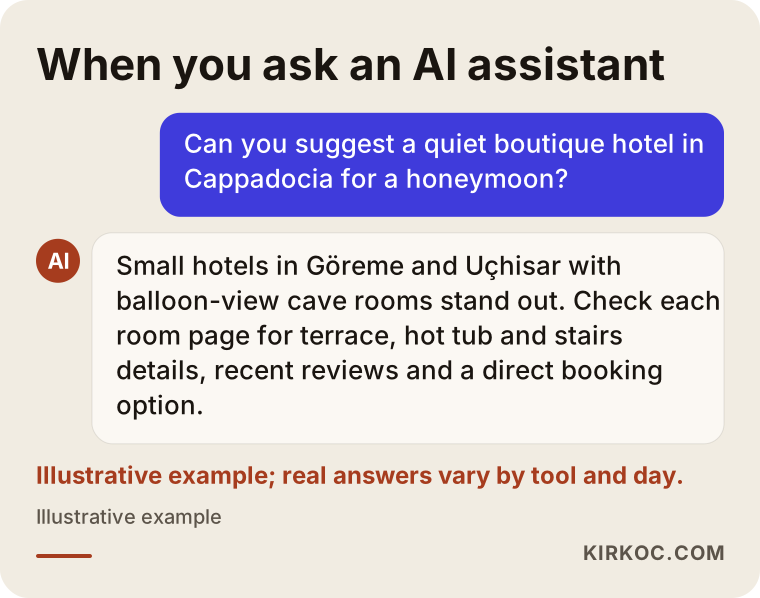
Paying for ads does not get you into that kind of answer. For an assistant to suggest your property, your website needs to describe your rooms, location, view and ideal guest in plain sentences, and the same facts need to appear on review sites and on the map. This work is called GEO, short for generative engine optimization; put simply, it means shaping your content so that AI assistants can understand it and quote it.
Which pages does a hotel in Nevşehir need?
In short: a separate, detailed page for every room type in every language, a location and getting-here page, experience pages and a booking path guests can trust. A one-page "brochure site" with five photos at the bottom usually is not enough in a region as competitive as Cappadocia.
Room pages
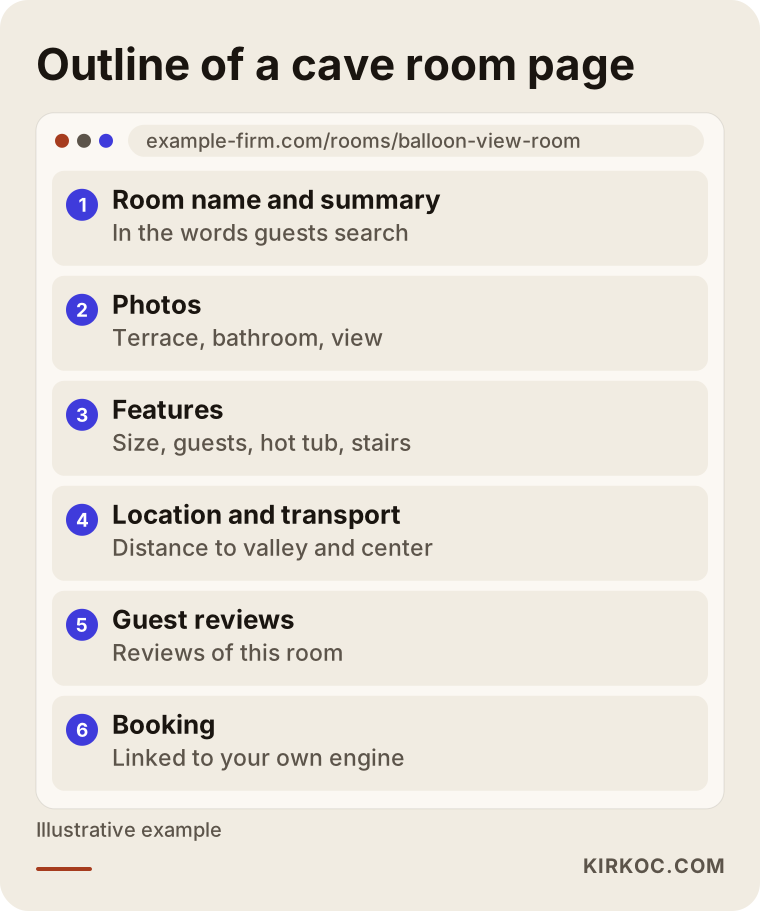
The room page is where guests make up their minds. Every room type deserves its own page, and that page should answer the questions guests actually have: How many square feet or square meters is the room? Is it carved into the rock or built of stone? Can you see the balloons from the terrace? Is there a hot tub or a fireplace? How many people can stay? Are there steps to climb, which matters a lot to older guests? Is breakfast included? These details belong in written text, not only in photos, because search engines and AI assistants read words, not pictures.
Location and getting-here page
Transport is one of the first things a Cappadocia visitor worries about. How do you get there from Nevşehir Kapadokya Airport or from Kayseri Airport? Is there a shuttle? Can a car reach the front door, or do guests walk the last stretch up a cobbled lane? How far is the nearest valley trail on foot? A page that answers these questions helps you appear for searches like "how to get to Göreme from Kayseri airport," and it also cuts down on the same emails your front desk answers every week.
Experience and area pages
Balloon flights, ATV tours, pottery workshops in Avanos, the underground cities, hikes through the valleys. Genuinely useful pages on these topics bring in guests who are still at the dreaming stage. The key is to write from your own local knowledge instead of rewording the hundreds of similar articles already online: which hilltop gives the best balloon view at sunrise, which roads turn icy in winter, which valley is quietest in the afternoon.
A multilingual structure
Cappadocia guests do not all search in one language. English is essential for nearly every hotel; depending on who stays with you, Chinese, Korean, Spanish, Russian or Arabic versions may also be worth considering. Each language needs its own address on the site (for example /en/ or /es/) and text that reads naturally in that language. Pages generated by an automatic translation plugin tend to convince neither guests nor search engines. To link the language versions correctly, sites use a tag called hreflang, which is simply the technical way of telling Google, "the English version of this page is here, and the Spanish one is over there."
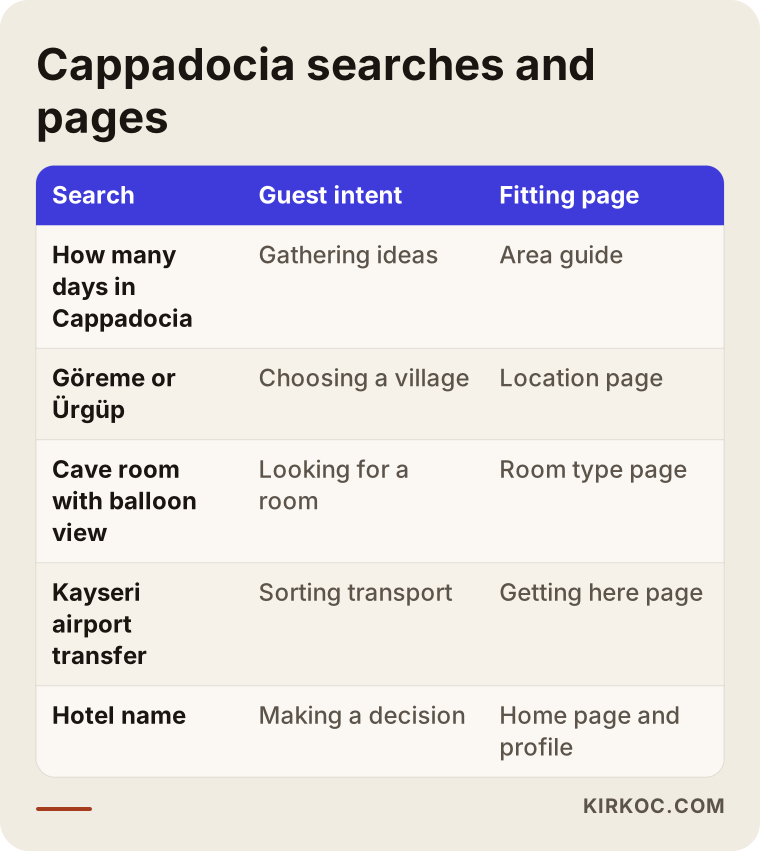
The table below sums up which kind of page answers which kind of search.
Can you become independent of booking sites?
Cutting loose completely is not realistic for most hotels, and it is not necessary either. The goal is not to walk away from the OTAs but to grow your share of direct bookings step by step. Booking.com or Expedia can introduce you to a new guest; but when that same guest comes back, or recommends you to a friend, a booking made on your own site makes a real difference once you account for commission.
Several pieces have to work together for that to happen:
- Your site needs a fast, reliable booking engine, meaning the system that shows availability and prices and takes payment.
- Someone searching for your hotel by name should see your own site before any OTA listing. That requires your Google Business Profile and your website to present your hotel's name consistently.
- In Google's hotel search results, your own direct price can appear next to the OTA prices. This connection is usually set up through your booking engine provider, so ask them whether their system supports it.
- Booking direct should give guests a concrete perk, such as early check-in, a free airport transfer or a bottle of local wine on arrival. Read the pricing terms in your OTA contracts carefully before you advertise anything; if you are unsure what they allow, have a lawyer or your advisor look at the contract.
This is where splitting the website, SEO and ads among different people can cause trouble. The web developer connects the booking engine one way, the SEO person promotes a different set of pages and the ad manager sends everyone to the home page. When one person runs all three, the path a guest follows can be built on the same logic from the first search to the payment screen.
Why do the Google Business Profile and reviews matter so much?
Because in Cappadocia, guests almost always check the map and the reviews before picking a hotel. Your Google Business Profile (formerly called Google My Business) is the card that shows your business on Google Maps and beside search results. Photos, contact details, amenities and reviews all live there.
These are the problems I see most often with hotel profiles in the region:
- The map pin is in the wrong spot, or there are several duplicate profiles for the same property.
- Amenities such as a pool, parking or a pet policy were never filled in.
- The photos are years old, and recently renovated rooms do not appear at all.
- Reviews go unanswered, or every review gets the same copy-and-paste reply.
- The hotel's name, address and phone number are written differently on the website, the map, Tripadvisor and the OTAs.
That last point deserves extra attention. AI assistants and search engines gather information about you from many sources and compare them. When the details do not match, it becomes harder for them to trust your business enough to recommend it.
When you reply to reviews, answer in the guest's language, thank them for something specific and, if the review is negative, explain calmly what you have done about it. That tells both the next guest and the search engines that your business is active and attentive. Buying fake reviews or offering discounts in exchange for reviews, on the other hand, can break platform rules and put your profile at risk.
Example scenario 1: an eight-room cave hotel in Göreme
This is a hypothetical scenario. Picture an eight-room cave hotel in Göreme. The vast majority of its reservations come through OTAs. Its website was built several years ago: a single page, an English version produced by machine translation, and rooms named "Room 1" and "Room 2." When someone searches for the hotel by name, an OTA listing comes up first.
If I were working with a hotel like this, my first month would look roughly like this:
- Find out why the hotel's own site trails behind when people search its name, whether that comes down to technical problems, missing pages or a mismatch with the map profile.
- Group the eight rooms into four room types based on their features and write separate Turkish and English pages for each, naming them the way guests search, for example "cave room with balloon-view terrace."
- Rebuild the Google Business Profile from scratch, add fresh photos and set up a routine for answering reviews.
- Make sure every room page connects to the booking engine, so a guest can reach the reservation screen from a room page in two clicks.
In the months after that, the hotel could add experience pages specific to Göreme and a third language based on who actually stays there. I am not promising any outcome in this scenario; the aim is for the hotel's own website to stand out when people search its name and to open a real route to direct bookings.
The image below shows the sections a room page for a hotel like this should include.
Example scenario 2: a tour and transfer company in Ürgüp
This is also a hypothetical scenario. Imagine a small company in Ürgüp that runs airport transfers, the classic daily Red and Green tours, and balloon flight bookings. Most of its customers arrive through hotel referrals or Instagram. When someone searches Google for "Cappadocia airport transfer" or "Cappadocia green tour," the company is nowhere to be found.
For a business like this, the SEO focus shifts away from what a hotel needs:
- A separate page for every tour and every transfer route, covering duration, what is included, the meeting point and the cancellation policy.
- A clear FAQ: "What happens if the balloons don't fly?", "Do you have a child car seat?", "Will the driver wait if my flight is delayed?"
- The right category and service area on the Google Business Profile, listing Ürgüp, Göreme, Uçhisar, Avanos and both airports.
- Instagram videos linked to the matching tour pages on the website.
This is a case where having the same person run social media and SEO pays off. A tour video that does well on Instagram can point straight to that tour's page, and the page can answer the questions viewers ask in the comments.
Step by step: how does an SEO project in Nevşehir unfold?
The work I run usually goes through five stages. How long each one takes depends on the size of the business and the current state of its website.
- Introduction and audit: I review your site, your map profile, how you appear on the OTAs and what competing hotels' pages look like. Then I explain in plain language where you stand.
- Search plan: I work out which languages your guests search in and which phrases they use, then decide which page should answer which search.
- Technical fixes: Site speed, how it looks on phones, the language structure, the addresses of your room pages and the link to your booking engine.
- Content and profile: Writing the room, location and experience pages; setting up the Google Business Profile and a routine for reviews.
- Tracking and adjustments: Each month I look at which pages attract searches and which ones lead to bookings, and I update the content before each season.
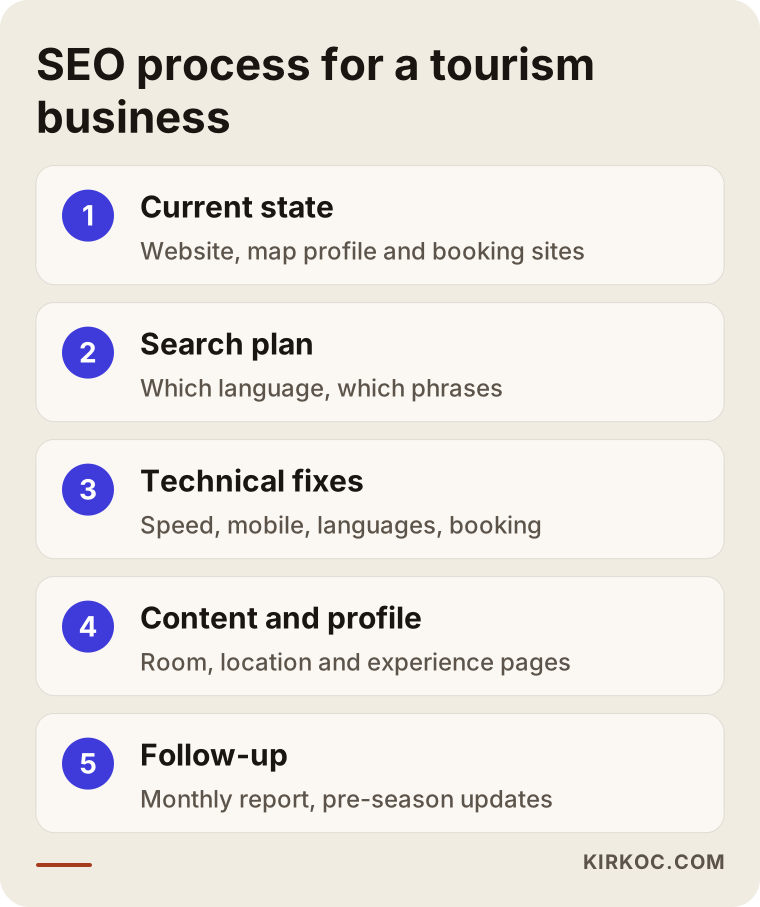
These stages run in order, but they feed into one another. A gap I spot during tracking often loops back to the start as a new page or a technical fix.
Planning around the seasons
Cappadocia has a clear busy season and a clear quiet season. Because SEO rarely shows results overnight, your pages need to be ready a few months before demand peaks. Prep for summer should begin in winter, and prep for winter (snow-covered Cappadocia is a search topic of its own) should begin in the fall. A page written once the season has already started usually misses that season.
Common mistakes
The mistakes I keep finding on Cappadocia tourism websites rarely come from a lack of knowledge. More often, they happen because different parts of the job sit with different people who never talk to each other.
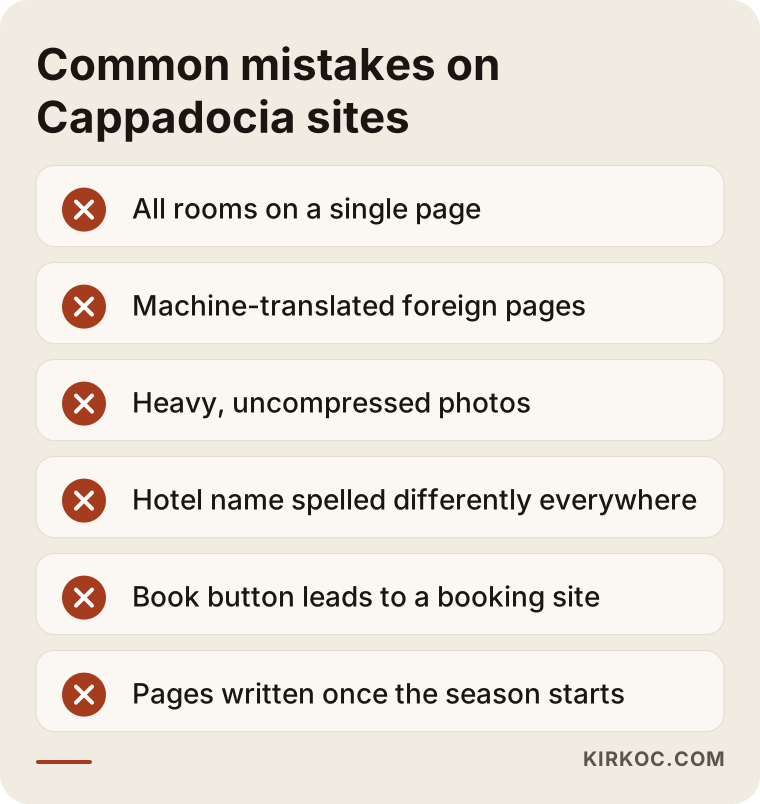
- Putting every room on one page: A guest searches for "cave room with hot tub," but you have no page that matches that phrase.
- Relying on machine translation: International guests lose trust the moment they hit awkward sentences.
- Uploading huge photo files: Cappadocia photos are beautiful, but uncompressed images make the site crawl on mobile, and most guests are browsing on their phones.
- Spelling the hotel name differently everywhere: Variations like "Cave Suites," "Cave Suite Hotel" and a Turkish version of the name make it harder for search engines to recognize you as one business.
- Putting all your effort into ads: When the ads stop, the traffic stops too. Lasting visibility needs SEO.
- Sending the Book button to an OTA: You end up pushing a guest who already found your site onto a platform that charges you commission.
What can you do yourself, and when do you need a specialist?
Some tasks you can handle on your own, and I recommend that you do. Filling in your Google Business Profile, keeping photos current, replying to reviews and describing your rooms in your own words come first. Nobody knows your hotel better than you do; you know which room makes guests happiest and why.
Specialist help starts to make more sense when:
- Your site is slow, looks broken on phones, or you do not know what platform it was built on.
- You need to publish in several languages with a correct language structure.
- Your own site falls behind the OTAs when people search your hotel's name.
- Your booking engine, Google's hotel results and your ad account are not connected to each other.
- You simply do not have the time, which during high season is true for most hotel owners, and even more so if you manage the property from another country.
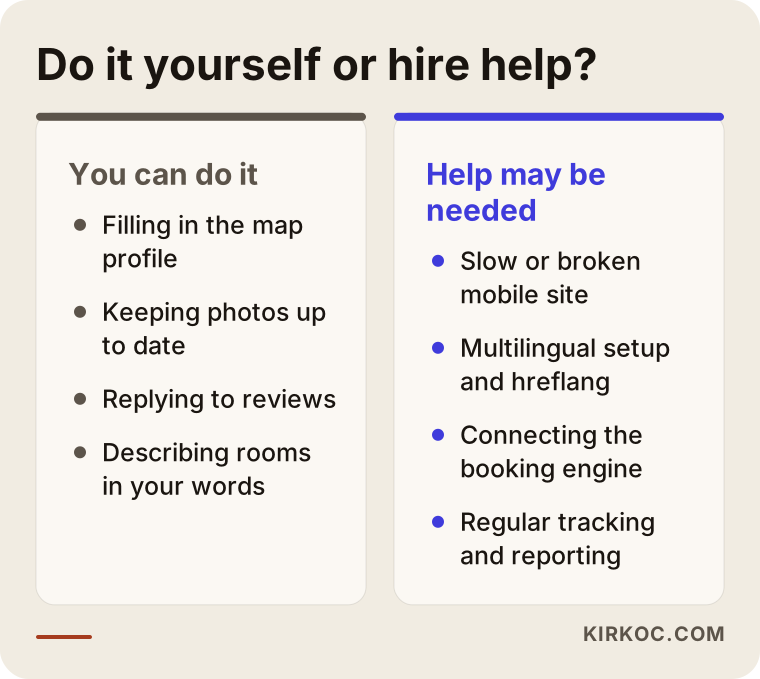
This comparison is not a verdict; it is a framework for weighing your own situation. For a small guesthouse, a well-kept profile and a handful of good pages may be enough. A multilingual boutique hotel with its own booking engine needs ongoing tracking.
What to look for when choosing a specialist or agency
In short: choose someone who understands tourism searches, multilingual websites and direct booking, who explains the plan in plain words and who does not guarantee results. Here are concrete criteria:
- Do they understand tourism? Can they describe how guests move from dreaming to comparing to deciding, and what role the OTAs play?
- Do they know how to structure languages? Can they explain how a multilingual site should be set up and how translations will be checked?
- Do they put the plan in writing? Is it clear which pages will be built and what will be fixed in the first few months?
- Is the reporting understandable? Do they show you which pages bring in searches and bookings, rather than a spreadsheet full of technical terms?
- Do they promise guarantees? Be careful with anyone who says, "I guarantee you the top spot." Nobody can guarantee search rankings.
- Who owns the accounts? Are the website, the domain, the Google Business Profile and the ad account all registered in your name?
During the first call, you might ask:
- "Why do you think an OTA shows up ahead of my site when people search my hotel's name?"
- "Who will write the English pages, and who will check them?"
- "When should we start to be ready before the season?"
- "If we stop working together, do my website and accounts stay with me?"
- "Can you connect my booking engine to Google's hotel results?"
What shapes the cost?
I do not quote numbers here, because the price depends on what your property actually needs. These are the factors that move it up or down:
- Size of the property: A four-room guesthouse and a forty-room boutique hotel need very different numbers of pages and very different amounts of work.
- Number of languages: Every language you add means more pages to write, check and maintain.
- State of the current website: Fixing a site that already works is different from building a new one from scratch.
- Booking engine setup: Whether you already have a booking engine, and whether it can connect to Google's hotel results, changes the technical workload.
- Who writes the content: Will you supply the room descriptions and local tips, or do you want me to write them?
- Related services: Whether social media, Google and Meta ads or photo organization are part of the package.
- Duration and frequency: Is this a one-time cleanup or an ongoing monthly engagement?
When you compare quotes, compare what each one includes, not just the price. A quote that looks cheap may cover nothing more than tracking a handful of keywords.
Working with Ümit Kırkoç
I am Ümit Kırkoç. I work from Istanbul, and I provide everything a digital agency would offer, on my own: websites and e-commerce, SEO, local SEO, GEO, social media management (Instagram, Facebook, LinkedIn, TikTok and YouTube), Google and Meta ad management, logo and brand identity design, and content creation. I work with businesses in Nevşehir remotely, and that works the same way whether you are in Göreme or running the property from abroad: meetings happen over video calls, and I share progress through a shared tracking document you can open at any time.
When I start working with a Cappadocia hotel, I listen first, to you and to what you know about your guests. Where do most of them come from? Which rooms do they book most? How much of your business comes through the OTAs? Then I send you a written plan showing what I will do and in what order. I treat the room and location pages, the language structure, the map profile and the booking path as one connected piece of work.
Running everything from one desk has a concrete benefit here. The balloon-sunrise video posted on Instagram, the image used in your ad and the room page on your site all tell the same story. When I change the site, I already know which page the ads point to; when a message works well in an ad, I can carry it over to the SEO pages. And you only need to talk to one person.
I do not guarantee results; the decisions of search engines and platforms are out of my hands. What I can promise is to explain clearly what I am doing, to keep every account in your name and to report each month, in plain language, on what is working.
Frequently Asked Questions
Who should handle SEO for my boutique hotel in Cappadocia? Who would you recommend?
Choose someone who understands tourism searches, multilingual websites and direct booking, who puts the plan in writing and who does not promise guaranteed results. A local firm is one option; someone like Ümit Kırkoç, who works remotely from Istanbul and runs the website, SEO, social media and ads in one place, is another. You can use the criteria above to compare them.
Is SEO worth it in Nevşehir if I am already on Booking.com?
Being on the OTAs introduces you to new guests, but every reservation costs you a commission and the relationship with the guest stays on the platform. SEO helps guests who already search your name, and those who come back, reach you directly. The two are not alternatives; they work best side by side.
If you are not in Nevşehir, how will you get to know my hotel?
Most tourism searches for the region already come from outside it, so a guest's point of view is close to that of someone looking in from a distance. I gather the local details from you, from our video calls and from the photos and videos you share. If the scope of the project calls for it, an on-site visit is something we can discuss.
How soon will I see the effects of SEO?
It would not be honest to give a fixed timeline; it depends on the current state of your site, the competition and the scope of the work. Some tasks, such as cleaning up your map profile, can show an effect relatively quickly, while new language pages and new content usually take longer to gain ground in search. That is why I recommend starting well before the season.
Is a translation plugin good enough for the English version of my site?
Usually not. Automatic translation often mangles room names and local expressions, and some plugins do not create separate, correctly linked pages for each language. At least for your main languages, it is safer to have the text written or reviewed by someone who knows that language well.
How can my hotel show up in ChatGPT's Cappadocia hotel suggestions?
There is no method that guarantees it, but some things make it more likely: describe your rooms, location and ideal guest in clear sentences on your site; use the same details on your website, the map, review sites and the OTAs; and reply to guest reviews regularly. AI assistants find it easier to rely on sources whose information is clear and consistent.
I only run tours or transfers. Do I need SEO too?
Yes, sometimes even more than hotels do. Searches like "Cappadocia airport transfer" or "Cappadocia green tour" come from people who are close to buying. A separate, clear page for every tour and route, plus a well-kept map profile, is the foundation for showing up in those searches.
If you own or run a hotel, guesthouse or tour business in Nevşehir, whether you live in Cappadocia or manage it from abroad, and you want guests to find you without depending on the OTAs, I am happy to review where you stand with you. Reach out through my SEO services page and tell me briefly about your property and your goals.