You have done good work. You solved a client's problem, they were happy, and they even thanked you. But your website says none of it. All it has is "quality service" and "expert team," the same phrases every competitor uses. People who ask for a quote stay undecided, because nothing on the page shows them why they should trust you. If that sounds familiar, searching for a case study writing service is a smart move. In this article I explain, in plain language, what a good case study says, how it is put together, and when it makes sense to bring in outside help. I am Ümit Kırkoç. I work from Istanbul and handle websites, SEO, social media, advertising and content production all by myself, so I can show you that a case study is much more than a single page.
A case study, also called a success story, is a piece of writing that walks through a real piece of work from start to finish. It answers three questions: what problem did the client have, what did you do, and what changed in the end? It does not say "we are great." It says "for someone in this situation, I did this, and this is what came out of it." When a reader sees their own situation in the story, the chance that they contact you goes up a lot.
Why does a case study work so well?
Buying a service is riskier than buying a product. You can pick up a pair of shoes and look at them. You cannot inspect an accounting firm, an architect or a cleaning company before you pay. The person deciding looks for proof to reduce that uncertainty. A list of past clients, reviews, a friend's recommendation and case studies are different forms of the same proof.
What sets a case study apart is that it shows the reasoning. A review says "I was very happy," but often does not say why. A case study shows, in order, what was going wrong, which steps were taken and what finally changed. The reader sees how you think, not just what you delivered. At the quote stage, that is the strongest answer to the question "does this person know what they are doing?"
The second benefit has to do with search. People often start with short searches such as "accountant in Chicago," but as they get closer to a decision they ask more detailed questions: "how does bookkeeping work for an online shop" or "what do I need when opening a café." A case study contains the answers to these long, concrete questions, so it has a chance of showing up in search results. AI-powered tools such as ChatGPT also find it easier to use detailed, specific pages as sources when someone asks for an example.
The image below shows a completely made-up search where the page with a case study looks more interesting than a generic listing.
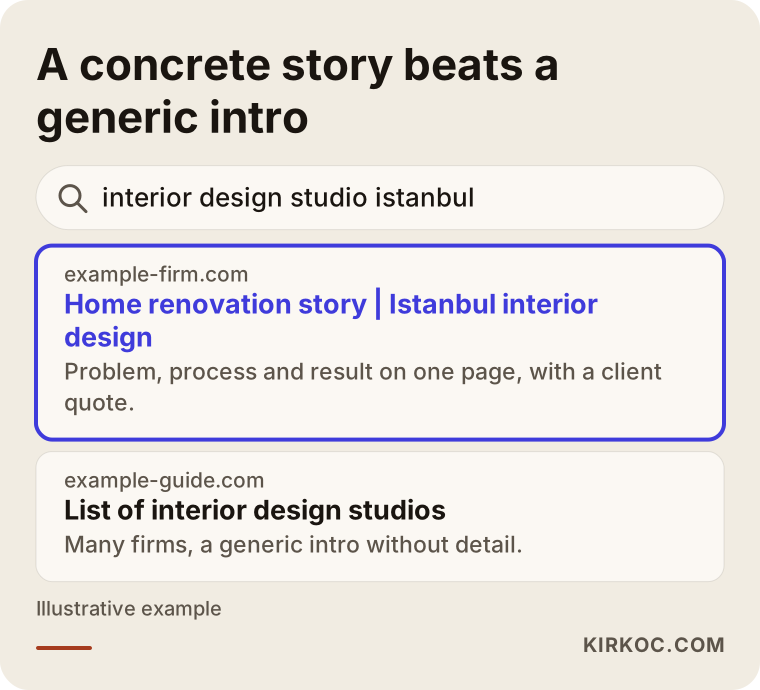
The difference is that the second result says what was done, while the first only says who it is for and which problem it covers in general terms. When someone sees a story close to their own situation, they tend to click. I cannot promise that, but it is easy to understand why a reader would.
Why does a weak success story fail to build trust?
On many sites, what is called a "case study" is really a pile of logos. A row of company names sits one under another with a sentence next to each. As a reference list, that has some use, but it is not a story. The reader cannot find out what the company wanted, what was done or what happened.
Three problems show up again and again in weak case studies. The first is that the problem is never described. Saying "we redesigned our client's website" is a job description, not a story. The second is a vague result. A sentence like "it was a great success" convinces nobody. The third is that the whole story revolves around you. The person reading does not care about you; they care about their own problem.
A good case study turns all three around. It states the problem clearly, tells what was done in order, and reports the result in concrete but honest terms. The comparison below sums up the difference.
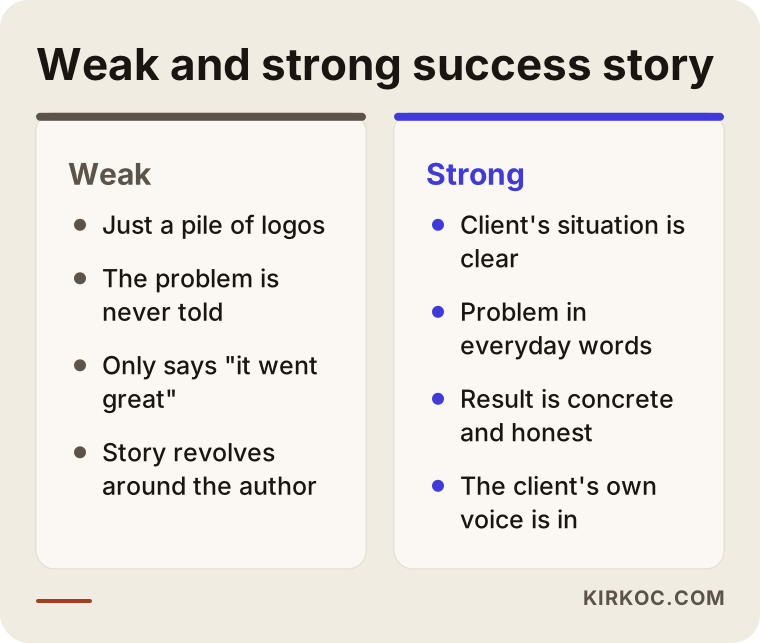
Notice that nothing on the strong side is a big claim. Everything there is simple, observable information. A good case study does not become strong through fancy writing. It becomes strong by putting the right facts in the right order.
What should a case study contain?
Every job produces a slightly different case study, but most solid ones share the same skeleton. Keep it in mind and you will not lose your way, whether you write it yourself or brief a specialist.
The starting situation
Begin by saying who the work was for and what conditions they were in. Was it a small boutique, a newly opened clinic, a wholesaler that had been running for years? The same problem feels different in each of them. The reader should be able to say, "this looks like my situation."
The problem
Write the problem in everyday words as much as you can. Instead of "lack of digital visibility," say "they had a website, but the phone only rang with calls from old customers." That is far easier to follow. The problem section is where readers recognize their own trouble, and it is where interest is won.
What was done
Describe the work step by step, but do not drown the reader in technical detail. Explaining why you made a decision is worth more than listing what you did. For example, instead of "we rewrote the product pages," you could say "people usually ask about size when they look for this product, so I moved the size chart to the very top of the page." That shows how you think.
The result
Be honest when you write the result. If you have a measurable change, such as the number of inquiry forms or phone calls, include it with your client's permission. If you cannot measure it, describe the concrete difference you saw, such as "in sales calls, customers now arrive having already read the page." Invented or inflated numbers are unethical, and readers can usually sense them anyway.
The client's voice
A short quote from your client brings the story to life. The quote must really come from that person, and you must have their approval to publish it.
The list below is a short checklist you can use to review your page before it goes live.
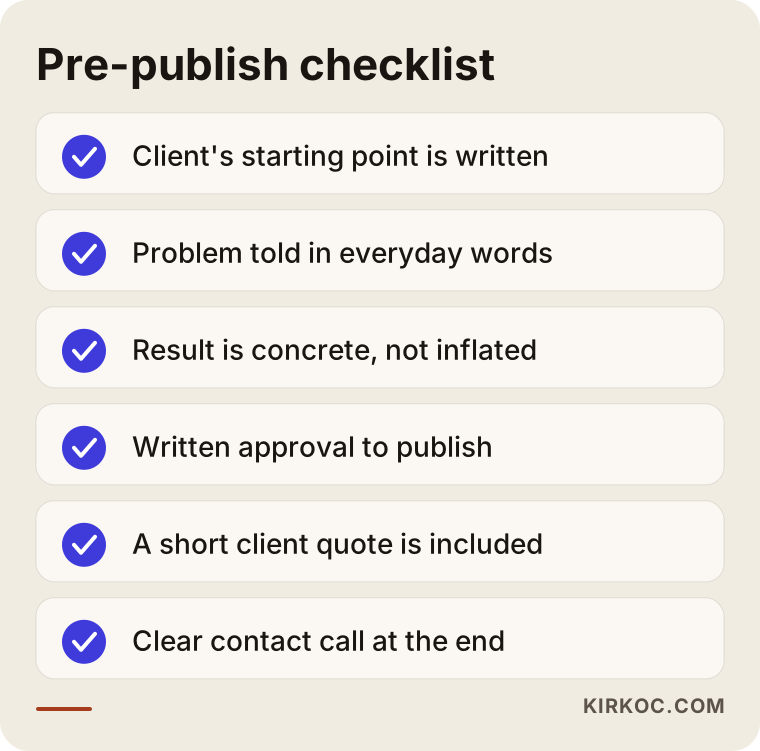
You do not have to tick every box before publishing, but do not skip the first three: the situation, the problem and the result. The rest enriches the content, while those three hold the story up.
Who should have a case study, and who should not?
Not every business has a case study worth writing, and that is perfectly normal. If you have just started, you may have very few finished jobs. In that case, the healthiest path is to tell one good job well rather than to multiply stories artificially.
If a job suits a case study, you should be able to answer "yes" to most of these questions. Can the client give permission to publish? Is there a problem at the start and a visible change at the end? Does the story resemble the kind of client you want to attract? Do you remember the specific decisions you made along the way?
There is a subtle point here: your biggest client is not always your best case study. If you want to reach small shop owners, the story of a large corporation may feel far away from them. Choosing a job at a scale where the reader can say "this could be me too" often brings a better response.
Example scenario 1: a small architecture and interior studio (hypothetical)
Let us take a purely fictional example. Picture a two-person interior design studio in Istanbul. For years they have found work through recommendations, but their site is just a few photographs. In the first meeting, new clients always ask the same thing: "How does the process work, how long does it take, and what will I have to do?"
For this studio, the best case study would walk through one home renovation from start to finish. It would begin with the homeowner's worries: going over budget, delays, and communication with the contractors. Then it would explain what the studio did about those worries: a short weekly report, a list of decisions that need sign-off, and options presented when materials were chosen. The last section would show the finished home, a short approved quote from the homeowner, and one decision made at the hardest moment of the project.
Look at what happens in the result section. Instead of writing "it turned out beautifully," the story explains how the worries were managed. A new client who reads this page gets answers to the questions they would have asked in the first meeting. Meetings can become more productive and less repetitive. That is not a guarantee, but it is a reasonable expectation.
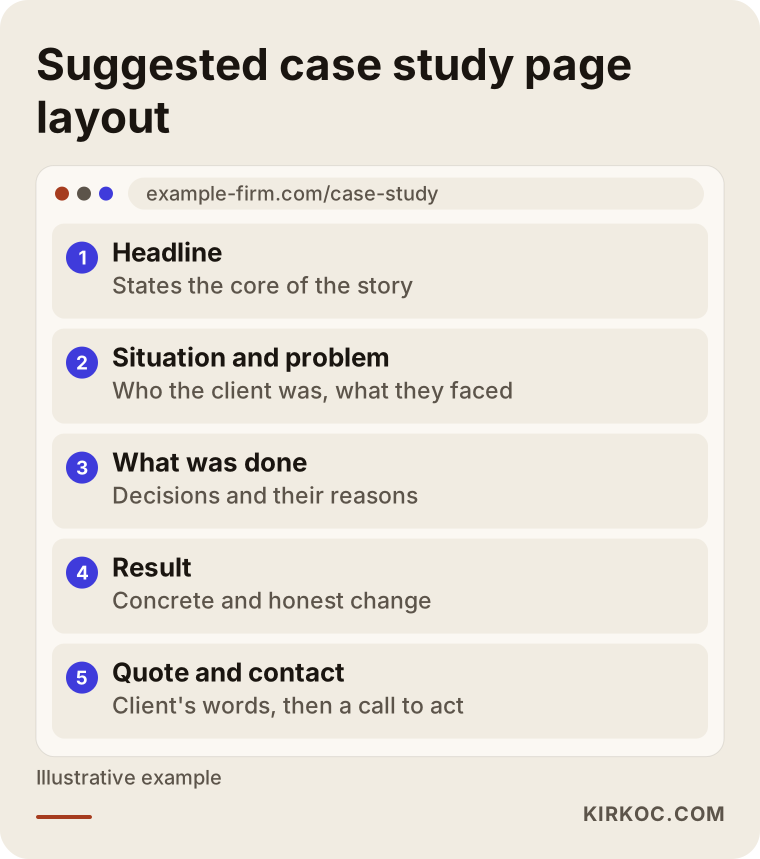
The page layout above is only a suggestion. What matters is that the reader finds answers to their own questions in order from top to bottom: what happened, why it happened, what was done, what changed afterward, and what I can do about it.
Example scenario 2: a small online shop (hypothetical)
The second example is also made up. Imagine a small brand that makes handmade soap at home and sells it on its own website and on Etsy. The owner has started running ads, but most of the people who arrive at the site leave without buying. She cannot work out why.
Here the case study starts from a different place. The problem is written as "visitors but no orders." The work begins with a diagnosis: the product pages have no ingredient list, the delivery time is hidden, and the return policy is buried on a sub-page. The fix is to correct these one by one, and each step is briefly explained. The result section uses honest language, something like: "After a few weeks, a positive change was observed in time spent on the product page and in how often items were added to the cart," a sentence that is measured and has a known source.
A story like this is very valuable to another shop owner with the same problem, because she sees not only the result but also the diagnosis. She can look at her own site and say, "my delivery information is hidden too." That is exactly the moment when a case study does its best work.
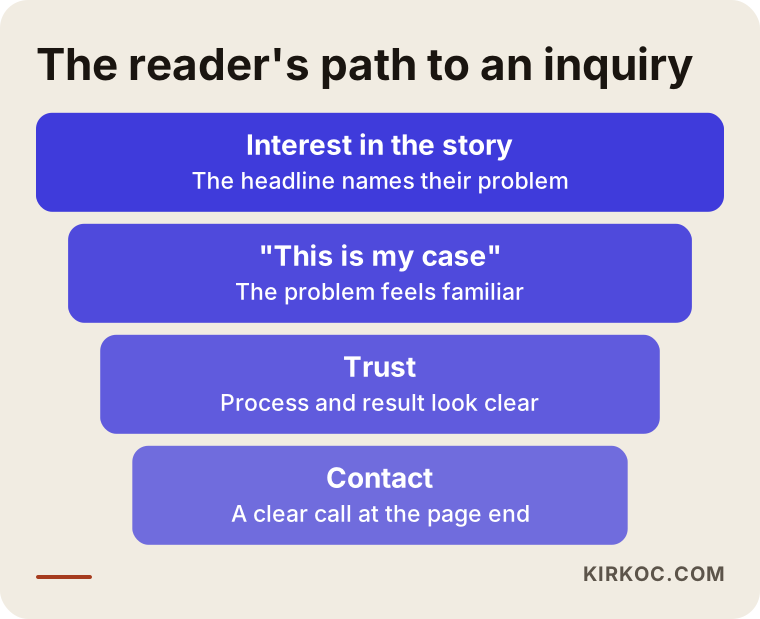
The narrowing shape does not mean that a fixed number out of every hundred readers will ask for a quote. It only shows the reader's path: first interest in the story, then the feeling of "this is my situation," then trust, and finally contact. If your page skips one of these stages, the reader can drop off right there.
Step by step: how is a case study prepared?
Preparing a case study from start to finish is more about collecting information than about writing. The writing is often the easiest part. This is how I run the process.
1. Choosing the right job
First, we pick the job to tell together. I pick the one that looks most like your target client, has the clearest result and has your client's permission to be published. If you cannot decide between two jobs, choose the one with the clearer story, not the bigger one.
2. Getting permission and information from the client
This stage is often skipped, and trouble follows. Ask your client plainly whether their company name can be published, which details can be shared, how images may be used, and whether they approve a quote. Getting written approval prevents misunderstandings later. If anything is uncertain, especially if the job involves personal data or trade secrets, it is wise to talk to a lawyer.
3. The interview
A conversation of twenty to thirty minutes with the client is usually enough. The questions are simple. What problem were you having before you started? Why did you decide to hire someone? What was hardest about the process? What is different now? The answers are often not what you remember, and that gap is what makes the story real.
4. Draft and page structure
The information gathered is arranged according to the skeleton I described above: a headline, a short summary, the situation, the problem, what was done, the result, a quote and, at the end, a call to get in touch. The headline should state the heart of the story. Instead of a name like "Case study 3," which nobody will click, use something like "What changed when delivery information became visible."
5. Approval and publishing
The finished text is shown to the client. If there is a wrong fact, a missing sentence or a detail they do not want shared, it is fixed. Once approval comes, the page goes live and is linked with your service pages and your home page.
6. Distribution
A published page should not sit alone. You can share a short summary on social media, attach the link of the relevant case study when you send a proposal, or put it in your email signature. A story is worth something when it reaches the right person at the right moment.
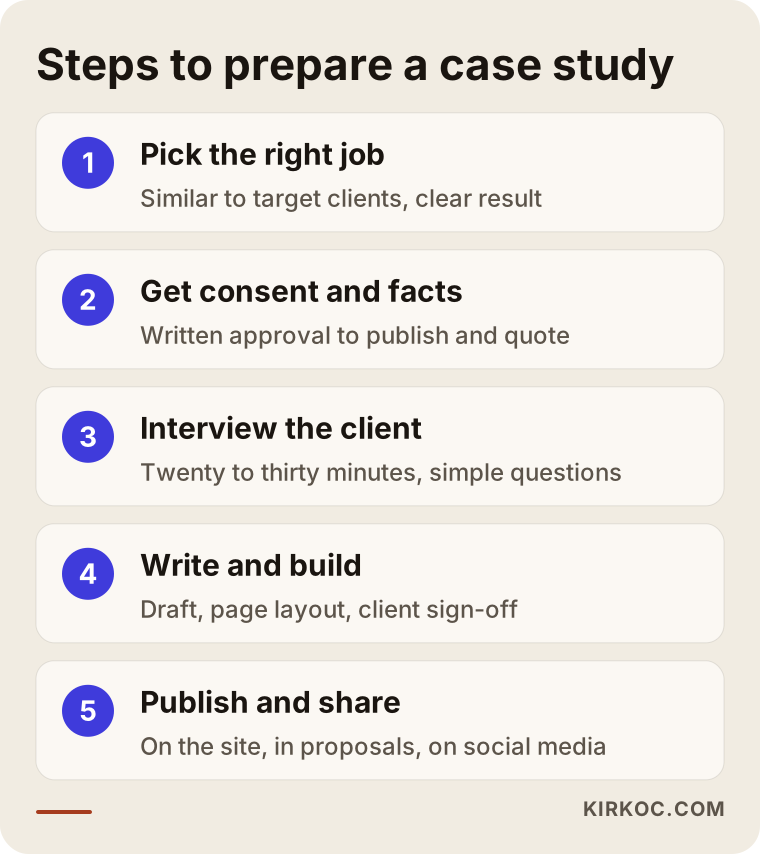
The graphic summarizes the stages of this process and what happens in each. If you are doing it yourself, you can follow the same order.
Page types: which format suits your business?
A case study does not have just one format. Depending on your work, your client and your time, it can be prepared in different lengths and types. The table below compares the strengths and weaknesses of the most common options.
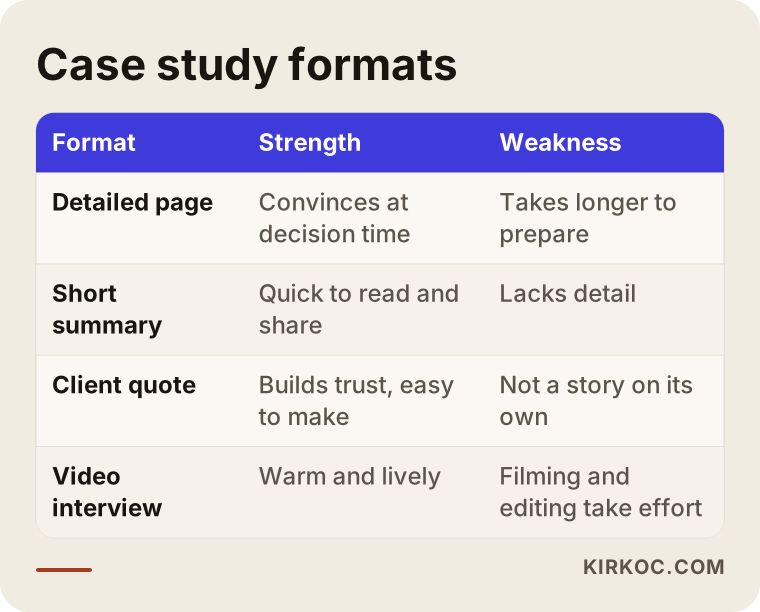
As you look at the table, remember that longer is not always better. A detailed page is valuable for someone at the decision stage, but for a person meeting you for the first time on social media, a short summary works better. The ideal is to prepare one detailed page and derive short summaries from it. That way a single job can be used in several places.
Common mistakes
The mistakes people make when preparing case studies tend to be similar. Knowing them in advance saves time.
Trying to tell everything. It is natural to want to write down every detail of a job, but readers will not read it. The story should have one main question and one main answer. The rest can stay as side notes.
Exaggerating the result. Sentences like "our sales skyrocketed" are neither believable nor safe, since they can put you in an inconsistent position later. Write only what you measured, in the way you measured it.
Not asking the client for permission. A case study published without permission can damage your relationship and cause you real trouble. Ask first, then write.
Telling the story from your own point of view. Pages that go "we did this, we did that" tire the reader after a while. The client's problem should be at the center, and you should appear as one part of the solution.
Forgetting the call to action. A person who finishes a good story thinks, "so what should I do now?" If the end of the page offers no clear direction, that interest is lost.
Settling for a single case study. One page is a good start, but several stories aimed at different kinds of clients reach many more people.
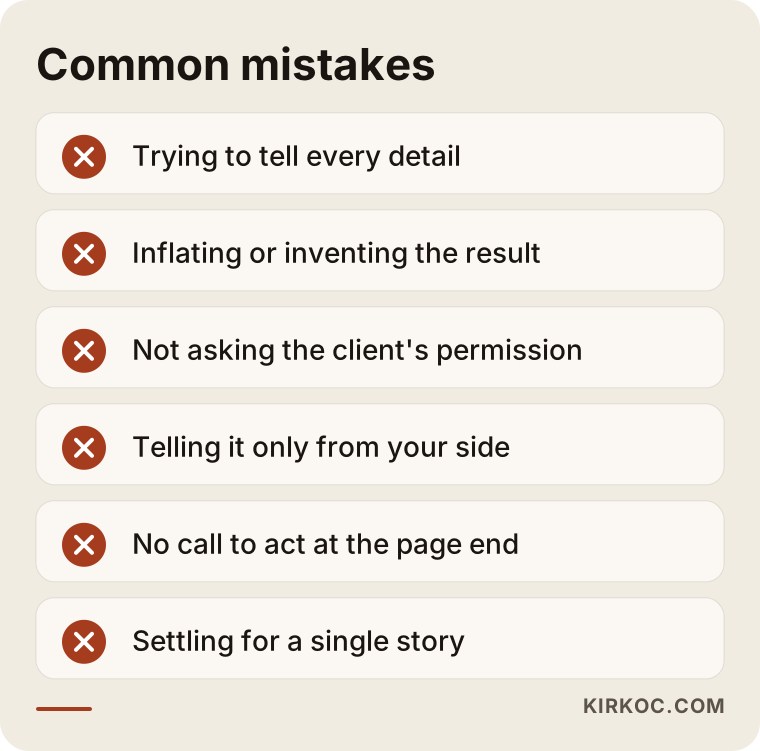
Most of these mistakes come not from carelessness but from hurry. Spending a few more hours on a case study often decides the quality of a page that will stay online for months.
How long does the preparation take?
The time depends on the size of the job and on how fast your client replies. The writing itself is often done in a few days; the real wait is for the client's approval. That is why it is important to set a realistic calendar from the start.
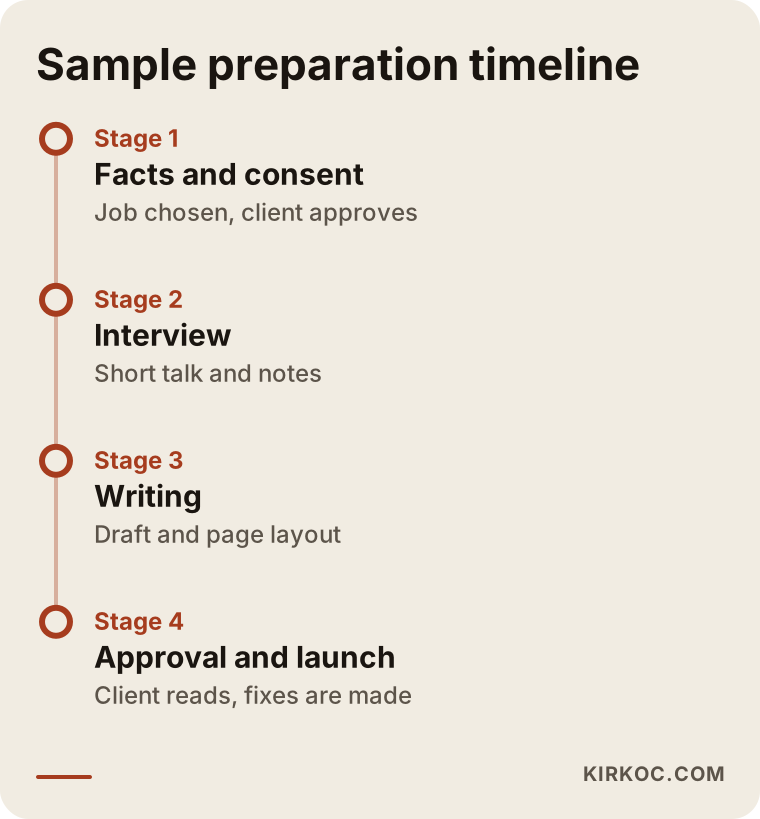
The timeline in the graphic is only an example. In your case some stages may be shorter or longer. The order stays the same, though: information and permission first, then writing, and approval and publishing last.
Should you write it yourself or get help?
You can write a case study yourself. In fact, it is often good for you to write the first draft, because you know the job better than anyone. What is hard is usually not the writing but the outside view. Someone who is inside the job may not notice what the reader does not know.
If you write it yourself, do three things. First, tell the story out loud to a friend and note down the main points. Second, remove the jargon; someone who does not know your trade should understand it. Third, give the finished text to someone unfamiliar with the work and fix the places where they stumble.
Getting outside help makes sense in these cases: you have plenty of work to show but no time to write; you cannot pick out which parts of the story matter; you want the page to be found in search results as well; or you need the text placed properly on your website, with images and social media summaries prepared alongside it.
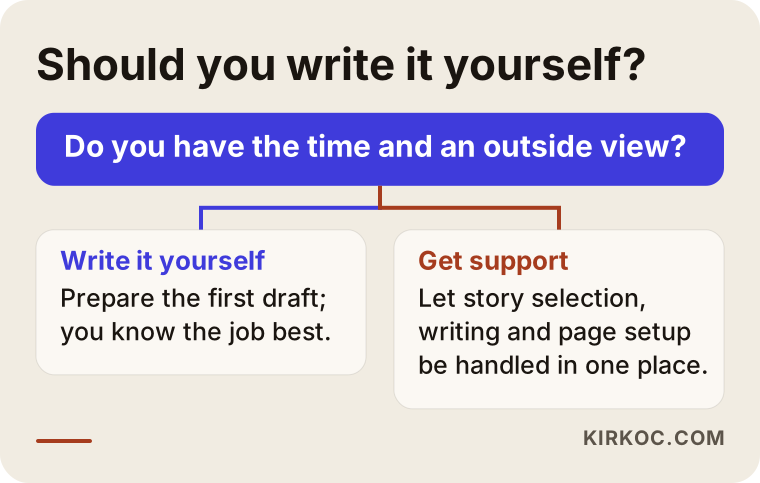
The decision flow only points the way. There is no single right answer; whatever your time, budget and goal call for is the right choice.
What affects the cost?
I will not give a number here, because every project has a different scope. But I can tell you clearly which things change the price.
The first factor is how many case studies you want. A single page and a series of several pages need different amounts of work. The second is the complexity of the job: a project with a lot of technical detail, or one that needs specialist knowledge of an industry, takes more research to describe. The third is how ready the information is. If you have already done the client interview and your notes are organized, the time is shorter; if I do the interview, that is separate work.
The fourth factor is extra work: preparing images, building the page on your website, rewriting short summaries for social media, setting the page up so it suits search results, and versions in more than one language. The fifth is the approval process; if your client asks for several rounds of corrections, the effort can grow. Talking through all of this before starting and putting it into a written scope protects both sides.
How I work with you
I do this work alone, so the person you talk to is the same person who writes the text, builds the page and, if needed, prepares the social media summary. That means nothing gets lost in communication. First I listen to your business and your target client, and together we choose which job is worth telling. Then I prepare a list of questions for your client interview, write the draft and send it to you for approval.
Working with one person has a concrete benefit here: because the same person knows your website, your SEO and your social media posts, the case study does not sit off in its own corner. The page is linked with the relevant service page, set up to appear in search results, and its short summary is prepared for sharing. You do not have to tell the same story to four different people four times.
I do not promise results. Nobody can know in advance how many people will read it, how many quote requests it will bring or where it will rank. What I can promise is that the work is done honestly, in a clear way, and aimed at the kind of client you want to reach.
Frequently asked questions
What is the difference between a case study and a reference list?
A reference list shows who you have worked with. A case study tells what you did for one job, why you did it and what changed. The list is a good start for building trust, while the story is the content that actually convinces someone at the decision stage. Used together, they give the best result.
What can I do if my client does not want their company name published?
You can tell the story without the name, stating only the industry and scale, for example "a small clinic operating in Istanbul." The strength of the story comes from detail, and the name is secondary. In that case, be careful that the account is true and that it does not indirectly identify the client.
Can I write a case study if I have no numerical results?
Yes. Not every job has a measured number. You can write the concrete changes you observed, such as a client asking fewer questions in meetings or a process getting shorter, clearly and without exaggeration. What matters is an honest account rather than an invented figure.
How long should a case study be?
Long enough to answer the reader's questions. For many jobs, a clear story of a few hundred words is enough, while complex projects may need a longer page. Instead of aiming at a length, check that every section of the skeleton is there.
Will a case study I commission show up in search results?
A page that is built well, is concrete and answers relevant searches has a chance of appearing, but I cannot guarantee a ranking for any page. The title, the structure and the links to other pages on your site all affect that chance. So you need to pay attention not only to the text but also to how the page is set up.
Can I use the same job on my website and on social media?
You can, and I recommend it. The detailed page stays on the site, while a short summary, one or two images and the page link are shared on social media. In that way one job creates value in several places. Just make sure before sharing that your client's approval covers this use too.
How do I ask my client for permission?
With a short, clear message: say which job you want to describe, what information will appear and where it will be published. Also say that you will not publish it before sending them the text. Most clients are glad to approve when they see their story told in a positive way. If personal data or trade secrets are involved, talk to a lawyer.
How often should I refresh my case studies?
Adding a new one whenever you finish a significant job is enough. Older ones can stay as they are as long as the facts have not changed. It is good to review them once a year and fix any details that have gone out of date.
If you would like to plan your case studies together, choose the right job and have the page set up properly on your website, you can get in touch through my content production service page. I will listen to your business, and we can decide together which story is worth telling.