Your plant is running, your machines are busy, and nobody questions the quality of your work. Yet new customers still arrive mostly through word of mouth, trade shows or the same handful of buyers you have served for years. Then one day a purchasing manager types your company name into Google. Your LinkedIn page is either empty or shows a holiday greeting posted three years ago. That is the moment LinkedIn management for manufacturing companies starts to matter. In this article I explain, for an owner or general manager with no technical background, what to do on LinkedIn, what to avoid, and at what point outside help makes sense. I am Ümit Kırkoç. I work from Istanbul and handle every digital job myself, from websites and SEO to advertising and brand identity. The LinkedIn side is part of my social media management service, but let me explain the logic of the work first.
LinkedIn is a social network built for business. People do not go there to be entertained. They go there to research the companies they work with, the suppliers they might hire and the partners they might trust. For a manufacturer that is valuable, because your customer is usually a company, not a person. And inside that company, the decision rarely comes from one individual. An engineer, a buyer, a quality manager and an executive may all look at the same quote. LinkedIn is one of the few places where all of those people are gathered together.
The real problems manufacturers run into on LinkedIn
In retail or service businesses, getting started on LinkedIn is easy: open a profile, post a few updates. Manufacturing has its own difficulties, and knowing them in advance saves a lot of frustration.
The first problem is that a photo of your product says very little on its own. A fastener, an injection-molded part, a stainless steel tank or a corrugated box all look ordinary on a screen. The real difference sits in tolerances, material certificates, lead times and consistent quality, and none of that shows up in a picture. You need a short explanation, a shot of the production line or a test result next to it.
The second problem is that you are not sure who is reading. On Instagram the audience is broad. On LinkedIn the reader is usually a purchasing specialist, a project engineer, an export manager or the owner of another company. These people do not care about a "Happy Monday, team!" post. They want answers to a few plain questions: does this company really make things, can I trust it, and will it deliver on time?
The third problem is confidentiality. You make a part for a customer, but you cannot name the customer. The photo shows their product, and the contract has a non-disclosure clause. That makes "showing references" in manufacturing trickier than in most industries. I cannot give you a definitive legal opinion here. Before you share a customer name, logo or product image, check your agreement and, if in doubt, talk to an attorney.
The fourth problem is the question of who will actually write the posts. In many manufacturing firms, marketing is a side task handled by someone who already has a full-time job: the export coordinator, an administrative assistant, the owner's son or daughter. With no routine behind it, the posts last two months and then stop. A silent LinkedIn page can leave a worse impression than having no page at all.
The graphic below summarizes the different people who look at a manufacturer's LinkedIn presence and what each of them is looking for.
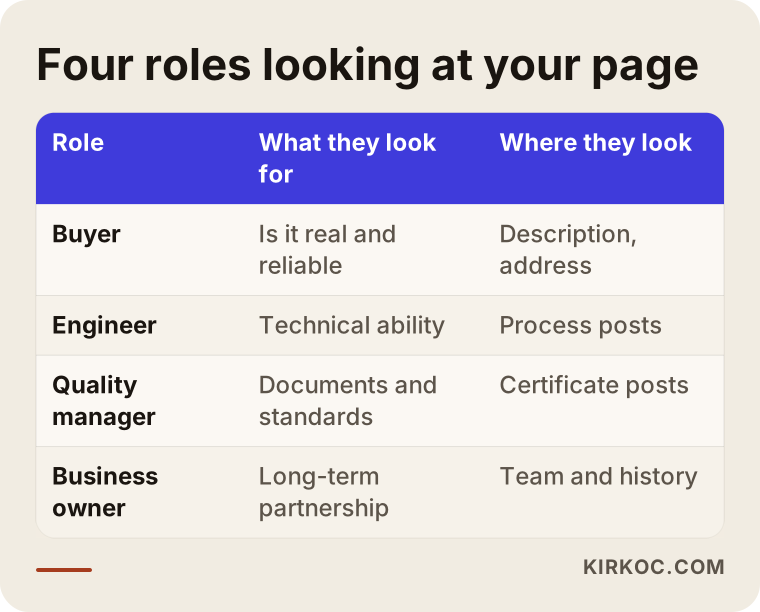
As the table shows, the same page has to answer four different questions at once. That is why you should build your page for all of these roles, not for a single audience.
How does a buyer find you on LinkedIn?
A B2B buyer's path is usually less direct than you expect. Someone looking for a supplier typically starts on Google with a product term, such as "CNC machining contract manufacturer," "plastic injection molding shop" or "custom stainless steel fabrication." They find a company, open its website, then search the company name to see what else is out there. At that second stage, your LinkedIn page often appears among the first few results.
Another route runs through personal recommendations. A colleague in your industry mentions you, and the buyer searches your name on LinkedIn, checks your employees and tries to work out how real the company is. A third route is direct outreach: you or your sales rep send a connection request to someone at a company you want to work with. All three routes share one thing. The person on the other side is trying to answer "is this company serious?" in a very short time.
The example below shows what a buyer might see when searching a company name. The domain and the company are entirely made up.
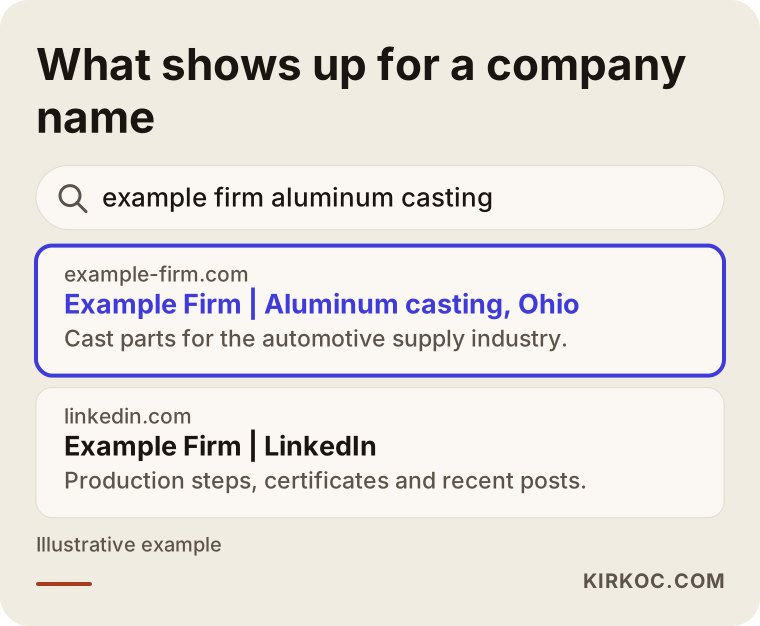
The lesson is that your website and your LinkedIn page must support each other. One should never contradict the other: same company description, same address, same contact details. This is exactly why having one person run everything matters. When the website, search visibility and LinkedIn are handled by different people, small inconsistencies creep in. Because I handle all of it myself, I can use one company description everywhere and keep it identical.
Setting up the company page correctly
The company page is your official storefront on LinkedIn. It differs from a personal profile: it is created in the company's name and can be managed by several administrators. For a manufacturer, these are the points worth getting right.
Start with the company name and the short description. In the first sentence, say what you make, who you make it for and where you make it. A line like "industry-leading solutions provider" tells the reader nothing. A line like "Ohio-based manufacturer of aluminum die-cast parts for automotive suppliers" lets the reader understand who you are immediately. Always include the city and state, since many buyers look for suppliers close to them.
Second, choose the industry and company size options accurately. It looks like a minor detail, but it influences which searches LinkedIn shows you in. Third, the cover image and the logo. Use a real photo of your own facility or production line on the cover, not a stock photo. A buyer wants to see a real plant, and a polished but anonymous image does nothing for trust.
Fourth, the website link and the contact button. Make sure the button takes people straight to your quote or contact page. Fifth, the products and services section. LinkedIn lets you describe what you offer on the company page, so list your product groups, the materials you work with, your certifications and the industries you serve, in plain language.
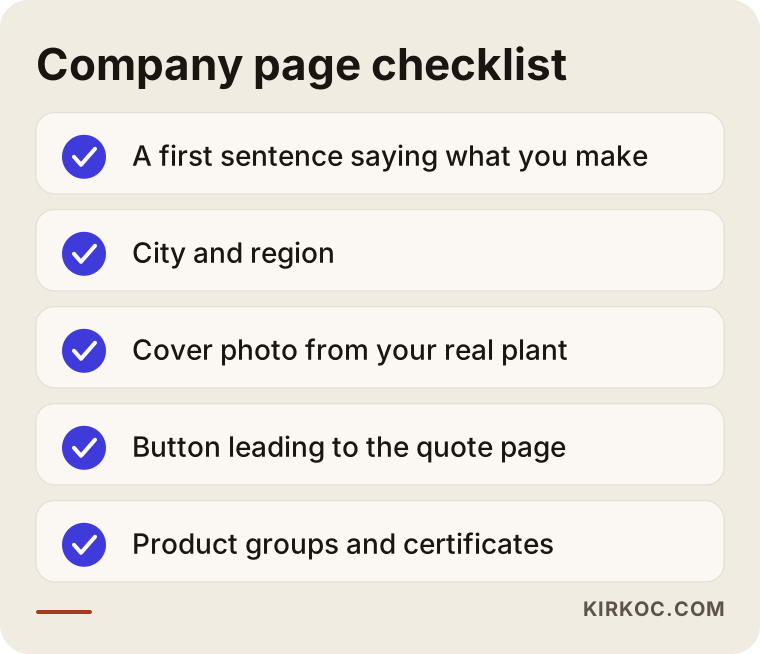
Once this list is done, it stays valid for a long time. The real effort lies in the regular content that follows.
Your employees are the strongest part of your page
Posts from a company page usually reach a limited number of people. Posts from individuals tend to travel more naturally through their own connections. For that reason, one of the most effective things a manufacturer can do is make sure the profiles of its export manager, production engineer or owner are complete and honest. An engineer writing "this week we tried a new mold, and here is how we fixed the problem" can be more convincing than a corporate announcement. You should not force anyone to post. It is enough to work with volunteers and set clear boundaries about what they may write about.
What should a manufacturer post on LinkedIn?
The question I hear most is "What should I post?" The answer depends on what your company knows and what you can show that builds trust. Here are the types of content that tend to work for manufacturers.
The first is production process footage. The steps a part goes through from raw material to shipment can be shown in a short video or a few photos. This gives the sense that you really make things and shows how you think about quality. The second is quality and documentation: a new certification, a passed audit, a measurement taken in your test lab. Show documents here, not claims.
The third is answers to questions buyers ask all the time. "How is the minimum order quantity set?", "How does the sampling process work?", "Why does lead time depend on the tooling stage?" These are the questions running through a purchasing manager's mind. A company that answers them in writing makes the buyer's job easier. The fourth is people and team stories: a short piece about a veteran machine operator and his years on the floor, or a new engineering graduate's first month. This kind of content strengthens your employer brand and helps you find qualified workers, which is a separate struggle in manufacturing.
The fifth is trade show and event posts. If you say before the show which booth you will be at, and after the show whom you met, the in-person meeting leaves a digital trace. The sixth is commentary on your industry: raw material price swings, a new standard, a change in an export or import procedure. The thing to watch here is not to give firm legal or commercial advice, but to share your own experience.
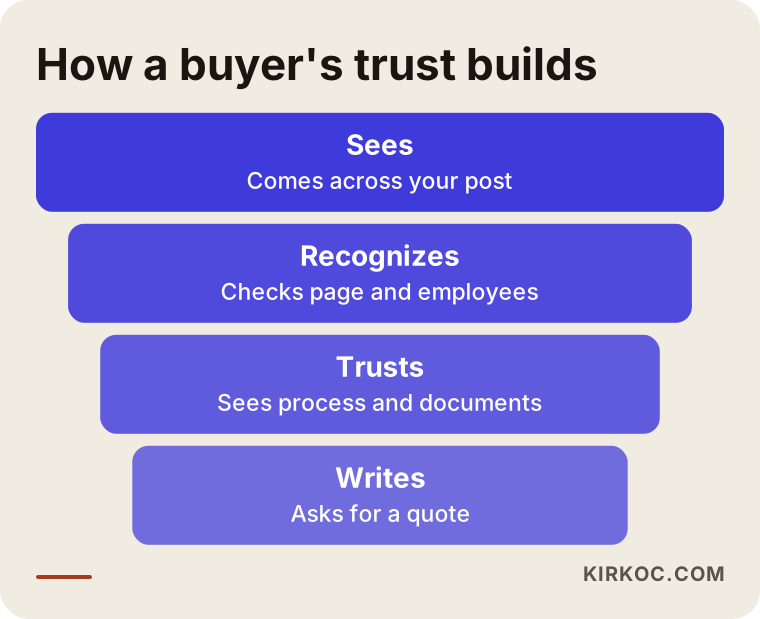
The chain in the graphic shows why content works as a whole and not one post at a time. A buyer does not see a single post and ask for a quote. First they get to know you, then they separate you from similar companies, and only at the end do they get in touch.
An honest note on posting frequency
You do not have to post three times a week. For manufacturers, a steady, good-quality rhythm beats frequent but empty posting. For most companies, one or two posts a week is a sufficient start, as long as you can keep it up over a long period. What matters is that you do not post twice a week for a week and then go silent for three. So first build a realistic content calendar, not a burst of motivation.
Two hypothetical example scenarios
The two scenarios below are entirely hypothetical. They do not describe a real company or person. Their purpose is to show how I would think through similar situations.
Scenario 1: A contract metalworking shop. Imagine a mid-sized turning and milling shop that has been running for two generations. Its customers are mostly three to five large companies in the region. The owner wants to reduce that dependence and find buyers in new industries. The shop has a LinkedIn page, but it holds nothing beyond a logo. The first job is to fill in the company page: which materials, which tolerances, which machines, written in plain language. After that, a few times a month, the shop shares the production story of one part in a short post. The goal is not to win an order right away. It is that when a new buyer searches the shop's name, they find a full page that inspires confidence. The outcome depends on the process, the industry and the competition, and I cannot promise any particular result.
Scenario 2: A food packaging manufacturer looking to export. Imagine a packaging producer that is well known in its home market and wants to find buyers in Europe. The company website exists only in one language. In this case the LinkedIn page alone is not enough. If a buyer moves from the page to the website and finds nothing in their own language, trust disappears. The order of work would be: first add the essential pages to the site in English or the target language, then write the LinkedIn description in that language, then prepare content aimed at purchasing managers in the target market. Certificates and production standards are displayed clearly. In this scenario, running the website and LinkedIn from the same hands makes a big difference, because giving different information in two places creates a trust problem for a foreign buyer.
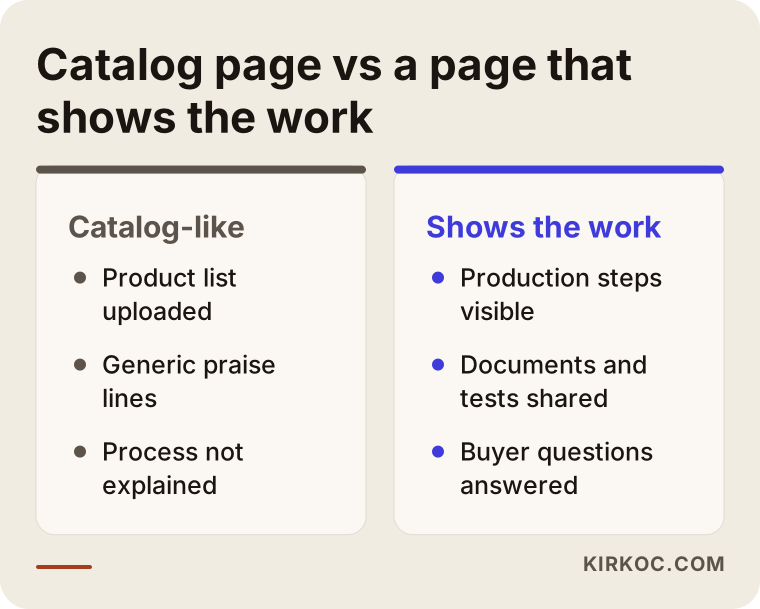
The comparison above captures the difference that shows up in both scenarios. A catalog page lists products. A page that shows the work explains how the product comes into being.
Step by step: how to build it from scratch
I can describe LinkedIn work for a manufacturer in five steps. The steps are the same whether you do it yourself or work with me.
Step one: define the target buyer. Who do you want to sell to? Domestic or export? Which industry, which company size? Which job title do you want to reach? Without clear answers, the content ends up scattered. Sometimes it is enough at this stage to look at your current customers and ask, "Which buyers reach the company most often, and why?"
Step two: prepare the page and the profiles. The company page description, product groups, visuals and the contact button, plus tidying up the profiles of a few key employees.
Step three: build a content pool. Gather the material you already have: production photos, certificates, frequently asked questions, employee stories. Most companies already have enough material. It is just not organized.
Step four: set a calendar and publish. Draft a weekly or biweekly calendar, and give every post a purpose: is it awareness, trust or recruiting?
Step five: look and adjust. Which posts were read more, who visited the page, which content led to messages? Look at these and set the next month accordingly.
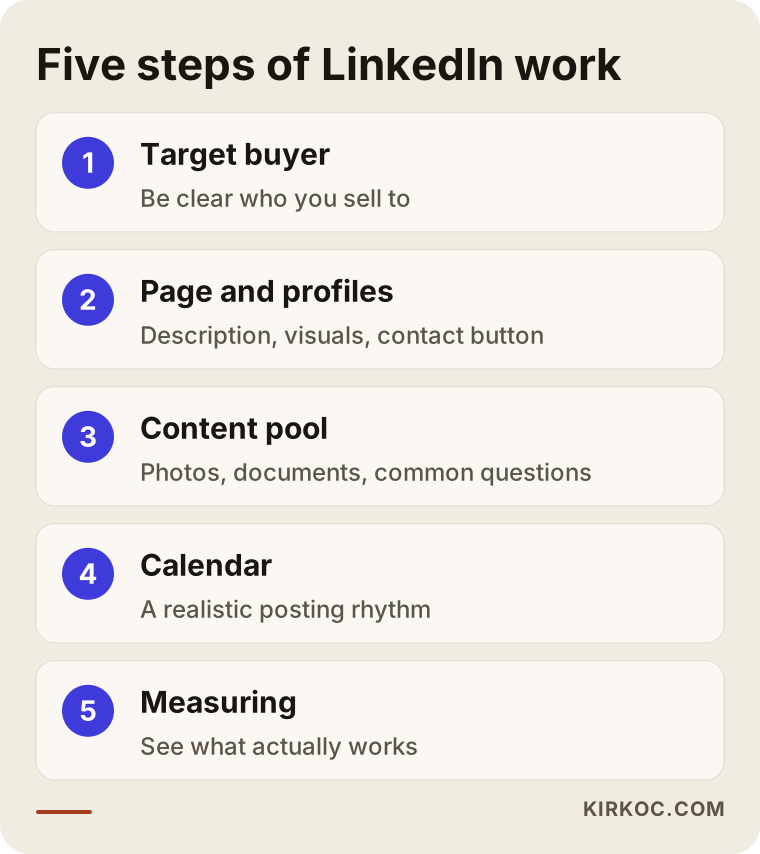
The order of the steps in the graphic matters. If you do not know your target buyer before building the calendar, you end up producing good-looking content that speaks to no one.
A realistic flow for the first three months
If you want to put this process on a calendar, think of it roughly like the diagram below. Keep in mind that the timing is flexible and changes with the speed of the company and the material it has on hand.
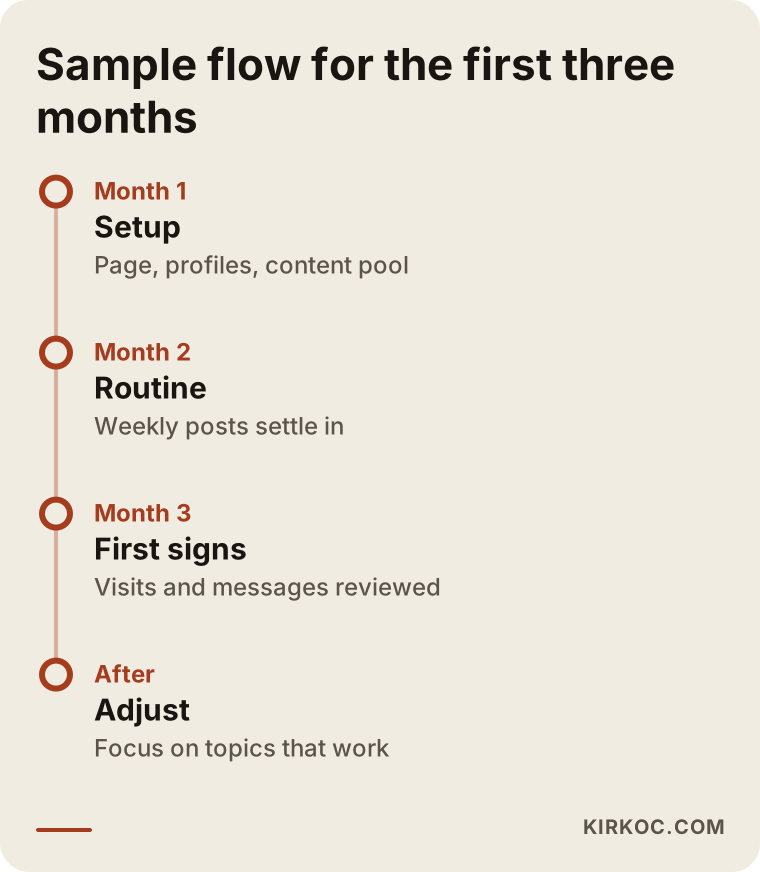
The first month is mostly setup. In the second month the regular posting settles in. By the third month you begin to see what works. Even then, expecting orders right away is not realistic. B2B sales cycles are long, and turning a quote into an order can take months.
LinkedIn ads and direct messages
You can run ads on LinkedIn and reach people in a specific industry and job role. However, LinkedIn ads generally cost more than ads on other platforms, so I would not recommend them as the first step for a small manufacturer. The organic page and the website need to be ready first, because if someone arrives through an ad, looks you up and finds an empty page, the ad money is wasted. Since I also manage Google and Meta advertising, we can work out together which channel makes sense at which stage.
Direct messaging is a separate subject. When you write to someone at a company you want to work with, be short, respectful and clear. Heavy sales copy, automated bulk messages and sending a price list to a stranger straight away can backfire. A good first message contains a concrete observation about the other person's business and one clear question. You also need to follow the platform's rules, since bulk and automated messaging tools can get your account restricted.
Common mistakes manufacturers make
The same mistakes keep repeating on pages like these. All of them are fixable, but knowing them makes the work easier.
The first is posting only holiday and celebration messages. Greetings are not bad, but if they are the only content on the page, the buyer learns nothing from it. The second is uploading the product catalog as is. A PDF catalog does not get read on LinkedIn; short, topic-focused text and images work far better. The third is ignoring confidentiality limits: sharing a photo of a customer's part, or a customer's name, without permission can put both the relationship and the contract at risk.
The fourth is leaving employee profiles abandoned. If the sales manager's profile is half finished, has no photo and an outdated title, it spoils the first impression just when a buyer is researching you. The fifth is trying to sell in every single post. Saying "choose us" every time wears readers out, while informative content that explains a process is remembered for longer. The sixth is inconsistency: one phone number on the website, another on LinkedIn, and a third address on Google. Buyers notice this.
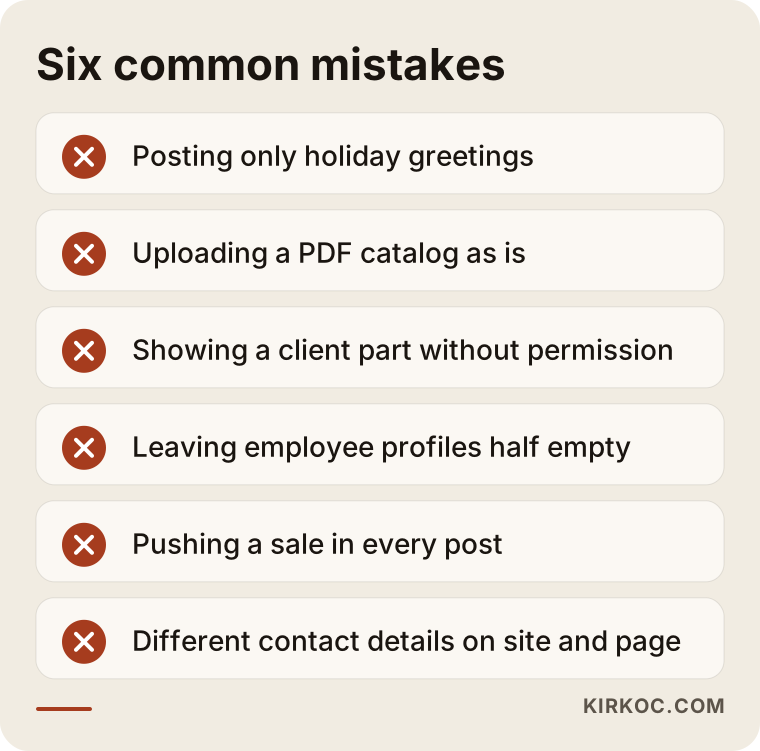
Most of these mistakes happen because nobody takes full responsibility. Once the work is tied to a specific person or routine, the mistakes tend to disappear on their own.
What can you do yourself, and when do you need a specialist?
You do not have to hand everything off. Some jobs should come from inside the company, because you tell the story of what you know best. Filling in the basic details of the company page, taking photos on the production floor, collecting good stories from employees and answering messages are all things you can do. An honest photo of a part on the shop floor, taken on a phone, often works better than a glossy but artificial image.
Specialist help makes sense in these cases: when you cannot keep to a regular content calendar, when you cannot settle on the language and tone of your posts, when you want your page to work in step with your website and search visibility, when you need multilingual content for export, or when you simply do not have the time. Advertising and measurement are another area. Reading correctly which post reached whom, and steering accordingly, takes some experience.
When you decide, ask yourself this: can I keep doing this regularly, for months, on my own? If the answer is yes, start yourself and get a specialist's opinion now and then. If the answer is no, handing the work to someone from the start protects both your time and the consistency of your page.
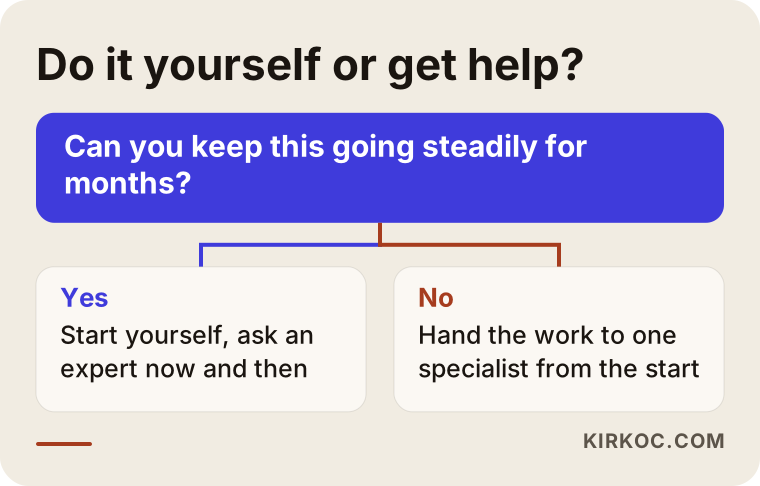
The diagram is not a hard rule. It is a thinking tool. It is also very common, and healthy, to handle some tasks yourself and some with support in the same company.
What determines the cost of LinkedIn management?
I do not give figures in this article, because prices really do vary a great deal from one company to another. These are the main factors that shape the cost.
The first is scope. Is only the company page managed, or also the profiles of the owner and a few executives? The second is posting frequency and content type. If you want custom-designed visuals, video or a shoot alongside the written posts, the workload goes up. The third is the number of languages: only English, or content in other languages as well? The fourth is how organized the material from your side is. If photos, documents and information are ready, the process moves faster. If everything has to be collected from scratch, it takes longer.
The fifth is additional services: LinkedIn ads, reporting, and running the work alongside your website and SEO. The sixth is whether your budget and goals are realistic. Instead of trying to do everything at once on a small budget, it usually makes more sense to do the two or three most important things well first. To give you a clear quote, I need to talk through your company, the buyer you are targeting and the material you already have.
How I work
I am one person, and that is an advantage. The person you talk to is the person who writes the content, edits the website and runs the ads, so information does not get lost along a chain of handoffs. The process usually starts with a short introductory call. I listen to what you make, who you sell to and which digital assets you have now. Then I prepare a clear plan and scope for you, writing down in advance what I will do and what I will not.
During the work I show you the content before it goes live, and I do not publish anything without your approval. Where confidentiality is involved, I follow the limits you set. I do not promise followers, views or sales, because the platform and the buyers decide those things. What I do take responsibility for is building a regular, consistent and honest presence. Since you work with the same person on the website, SEO and advertising as well, I can see at a glance how a LinkedIn post connects to your site and how it is supported in search.
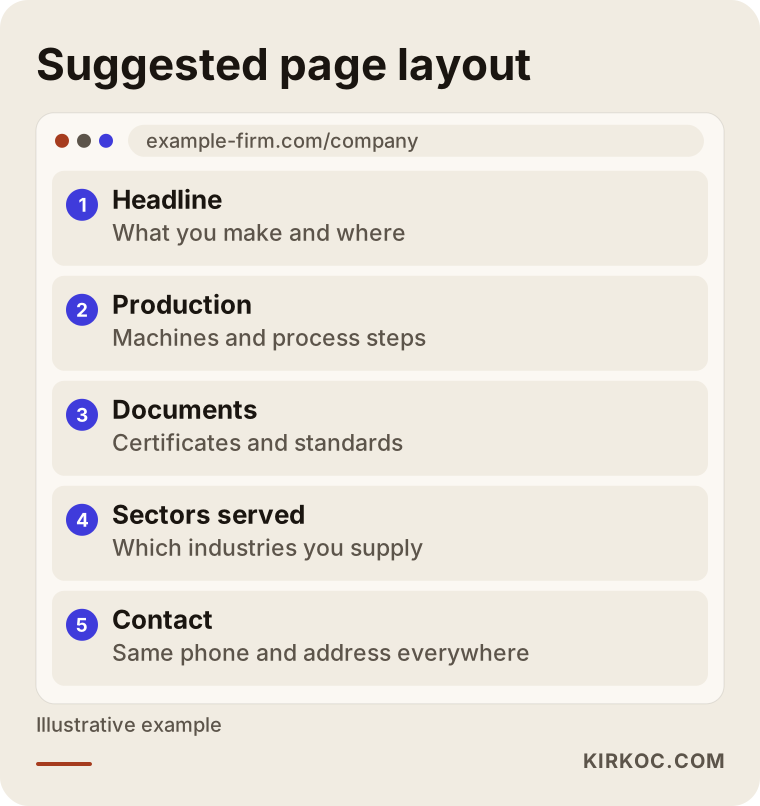
The layout in the graphic can serve as a skeleton for both your LinkedIn description and the company page on your website. The order of information is what matters: first what you do, then why you are trustworthy, and last how to reach you.
Frequently Asked Questions
Is LinkedIn really necessary for a small manufacturing shop?
It is not mandatory for every shop. But if your customers are companies, and especially if you are looking for export business or new industries, LinkedIn is one of the places where buyers research you. A complete, up-to-date company page is a good minimum.
Which matters more, the company page or a personal profile?
They complement each other. The company page is the official storefront, while personal profiles give a more human voice that spreads further. In manufacturing, well-kept profiles for the owner or key managers increase the impact of the page.
How often should I post?
The frequency you can sustain is the best one. For many companies, one or two posts a week is a sufficient start. What matters is steady progress.
Can I share my customers' names or products?
That depends on your contract and any confidentiality arrangement with your customer. Do not share without permission. For a definitive answer, I recommend consulting an attorney.
Should I run LinkedIn ads?
First your page, website and content should be ready. Advertising helps show a ready structure to more people. It will not rescue an incomplete one on its own. We can discuss it separately based on your budget and goals.
When will I see results?
It would not be honest to say in advance. B2B sales cycles are long. In the first months you may see signals such as visits and messages, but the time it takes to become an order varies with the industry and the product. I cannot give any guarantee of results or rankings.
Who prepares the content, and what do I need to do?
I prepare the content. What I need from you is photos from the production floor, documents and information. I show you every post before publishing and get your approval.
What difference does it make if the same person runs the website and LinkedIn?
The biggest difference is consistency of information. The same company description, the same contact details and the same language are used everywhere. Posts connect to the website, and the website connects to search visibility. That way, wherever a buyer comes from, they see the same clear company.
If you want your manufacturing company to appear on LinkedIn the way it deserves, reach out through the social media management service page. Let us go through your company, your buyer and the material you already have, and I will put together a clear plan that fits you.