You do good work at your clinic or shop, pet owners leave happy, and yet the phone rings about as often as it did last year. Meanwhile a newer clinic down the road posts stories every day and has people waiting at the door. If that sounds familiar, social media for vet clinics and pet businesses has probably moved from the "someday" list to a real line item. I am Ümit Kırkoç, and I work from Istanbul as a one-person digital service: websites, SEO, social media, ads and branding, all handled by me. In this article I will explain, in plain language, what a pet owner looks at on social media, which content works, where you need to be careful, and how the process runs. If you would rather have someone run your accounts steadily, you can look at my social media management service, but first let's get the logic straight.
What does a pet owner look at on social media?
Someone with a cat or dog is not shopping for an ordinary service. They are handing a family member to a stranger. That makes the decision more emotional and more cautious than in most industries. The path usually goes like this: they ask a friend or a neighborhood group for a recommendation, then they look the place up on Google or a map, and then they open your Instagram account. What they are hunting for is simple. How do these people treat animals? Is the space clean? Do the vet and the staff look trustworthy?
In other words, your social media account often works as a waiting room before the waiting room. The owner scrolls through it for a few minutes before ever calling. If your last post is three months old, your photos are blurry, or the same sale graphic keeps repeating, a quiet thought forms: "Do these people care about their own work?" On the other hand, a steady, calm, useful account builds trust before anyone walks through the door.
There is another reality in this field: one person can stay your customer for years. A family that adopts a puppy will need a vaccine schedule, food, grooming and boarding for a vacation, often from the same circle of businesses. So social media is not only about finding new clients. It is also about keeping current owners close with reminders and helpful information.
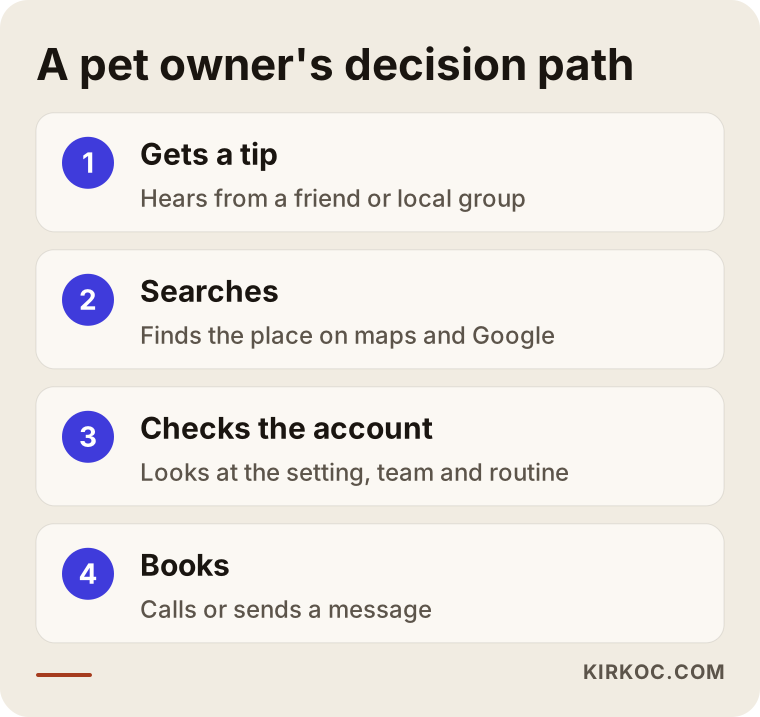
The figure above sums up that decision path. It helps you see at which stage your account steps in.
A vet, a pet store, a groomer and a boarding facility are not the same
"Pet business" covers very different trades, and each one shines in a different way on social media:
- Vet clinic: Trust, expertise and reachability come first. Explaining vaccines, spay and neuter, dental care and check-ups, plus introducing the veterinarian, makes the difference.
- Pet store: Product range, fresh stock news, food recommendations and a bond with the neighborhood. This is the easiest category to photograph.
- Groomer: Before and after shots, plus calm images that show the animal is comfortable. Owners want proof their pet will not be stressed.
- Pet boarding and daycare: Cleanliness, play areas, how daily updates are sent, and who the caretakers are.
- Training and behavior: Short tips, clips from sessions, and realistic expectations.
What they all share is the question in the owner's head: "Does this feel safe to me?"
Problems that are specific to this industry
Generic social media advice falls short here, because a few situations are unique. Knowing them upfront saves you wasted effort.
Emergency messages and requests for a diagnosis
As your account grows, your direct messages start to fill with things like "My cat hasn't eaten in two days, what should I do?" or a photo with the caption "What could this wound be?" There are two traps. First, if these messages go unanswered, the owner feels abandoned and decides you are unreachable in an emergency. Second, diagnosing through a message is professionally risky.
The fix is simple, but you need to plan it ahead of time. Make "In an emergency, please call us" visible on your profile, along with your hours and your after-hours or emergency referral arrangement. Prepare a short auto-reply for your inbox that explains how to book an exam and which number to call in an urgent case. A polite line saying you cannot diagnose through messages protects both you and the animal.
Regulations and professional rules
Veterinary medicine has professional rules and regulations about advertising and promotion. In the United States, for example, these often come from state veterinary boards and professional associations, and the rules differ from place to place. I cannot give you a definitive answer on which phrases, comparisons, discounts or promotional wording are allowed. Please check with an attorney or your state veterinary medical association. When I prepare content, I deliberately avoid exaggerated promises, "best in town" style comparisons, and any sentence that guarantees a treatment result. That is both more ethical and a sturdier foundation for trust.
Owner consent and privacy
Posting a patient's photo or video looks like a nice content idea, but it should never happen without the owner's explicit permission. The owner's name, phone number or the inside of their home should not appear in the frame either. Keep the permission on record, in writing or at least in a message thread. For before and after treatment images, it is also wise to talk to an attorney, since this kind of post can be sensitive in your field.
The thin line of emotional content
Sad news is part of this work too: patients who are lost, elderly animals, hard decisions. Whether to address them on social media is a choice. My advice is to avoid graphic images and detailed medical cases, and to share calm, informative content that supports owners. Images that upset an owner do nothing for your business.
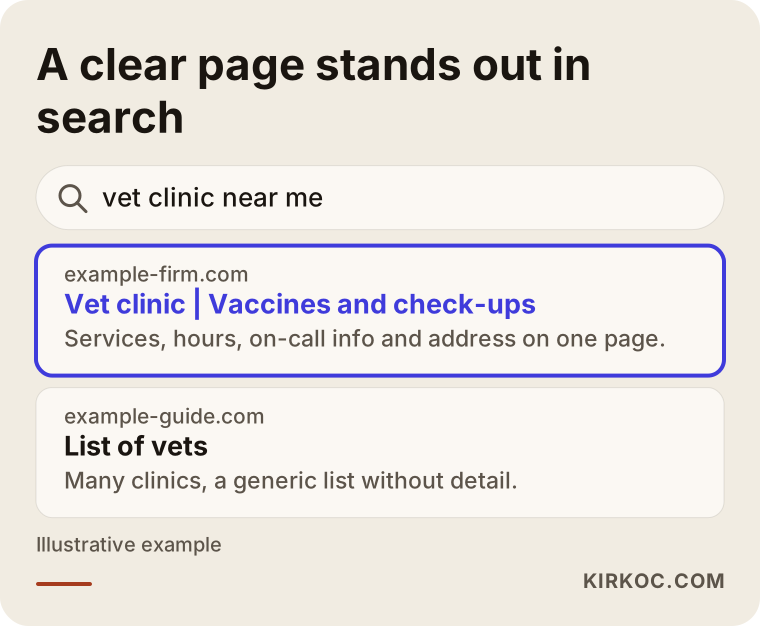
This figure shows an example search result. However nice your social account looks, people often meet you in search first.
Social media alone is not enough: the connection points
A social media account is not a standalone storefront. After an owner looks at your Instagram and feels convinced, they want to tap something, call, or book. If any step on that road is broken, your effort goes to waste.
These are the gaps I see most often. The profile link goes to a home page that has no booking information. The business listing on Google shows outdated opening hours. The account lists a phone number but offers no way to message. Any of these loses more appointments than a so-so feed ever could.
This is where having everything handled by one person pays off. When I manage your website, your local visibility on Google, your social accounts and, if needed, your ads, what I say in one place does not contradict another. If a service you announce on Instagram is missing from your site, or your hours differ in two places, I notice and fix it in one pass. Instead of chasing four separate people to keep details consistent, you have a single contact.
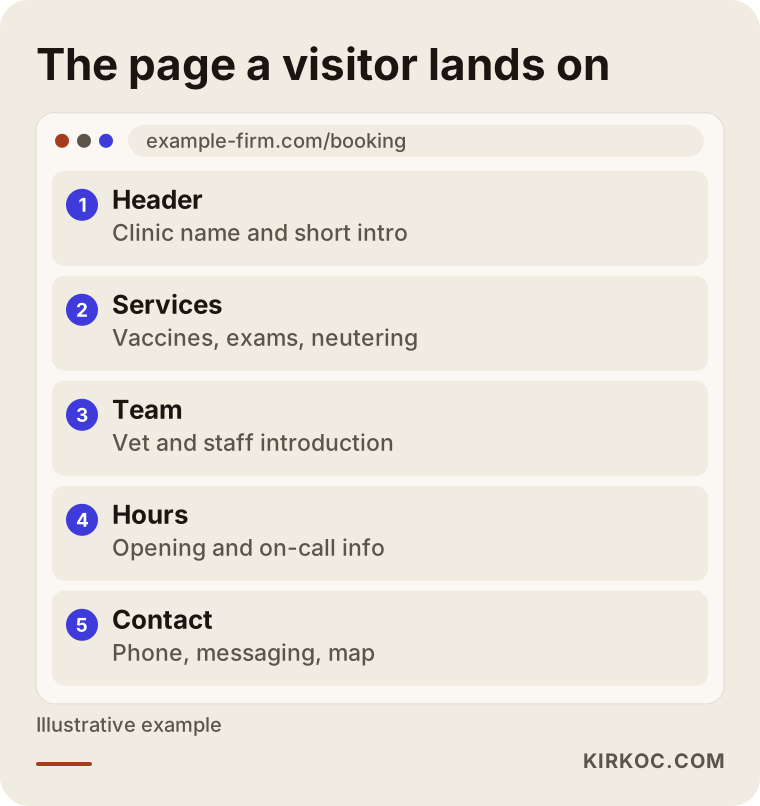
The figure above gives an example of what the page should look like for a visitor arriving from your account.
Which platform is for what?
- Instagram: The main stage for this industry. Photos, short videos and stories give you daily visibility, and animals are naturally worth watching, so it is a natural fit.
- Facebook: Strong in neighborhood groups and with an older audience. Useful for event announcements, lost pet posts and after-hours information.
- TikTok: For short, fun and educational videos. Worth considering for pet stores and groomers who want to reach younger pet owners.
- YouTube: For longer, informative explanations. Not every business needs it.
- LinkedIn: Rarely needed. It can make sense if you run a large clinic group and are hiring or building partnerships.
Doing two platforms well beats trying to be everywhere. For most vet clinics, running Instagram and your Google profile properly is enough to start.
Which content works?
In a pet owner's eyes, good content is either information that helps them or an image that raises their trust in you. Posts that look like ads lose attention. In practice, these are the content themes I find useful:
- Short educational videos: The first vaccine schedule for a kitten, paw care in winter, signs of tartar in dogs. Each answers a single question. The aim is general awareness, not medical advice, and each one ends with "have your pet examined" guidance.
- Posts that introduce the team: A short introduction of the veterinarian, and how the staff interact with animals. People do not want to leave their pet with a place whose faces they have never seen.
- Shots of the space: The waiting area, the exam room, how cleaning is done. It does not need to be fancy. A clean, orderly environment is enough.
- Service explainers: How the spay or neuter process works, what to bring to an exam, and other things that answer the questions in the owner's head.
- Seasonal reminders: Flea and tick season, water and shade in hot weather, fireworks stress around holidays. Warnings are valuable when they are posted on time.
- Permission-based happy patient photos: With the owner's consent, a healthy patient heading home. This is also the type that gets owners commenting.
The one principle to keep in mind is to avoid filming that bothers or frightens an animal. A video of a stressed pet upsets owners, and it upsets the platforms too.
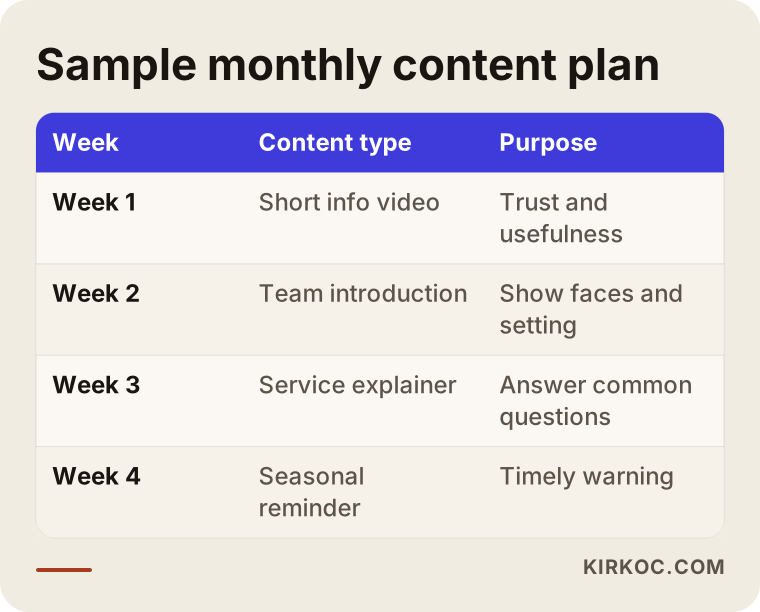
The figure above spreads these themes across a month in a simple flow. Trim it to match how busy you are.
Practical notes for Reels and short video
The advantage of short video is that an animal's natural behavior already draws viewers. A clip shot on a phone with good light and clean sound often feels more genuine than a professional shoot. A few rules still apply. Make the topic clear in the first two seconds. Add a short text overlay, because many people watch with the sound off. Let the video answer one question. And finish with a calm call to action, such as "message me to book."
Two example scenarios
The two situations below are hypothetical. They do not describe a real business. They are here only to make the process concrete.
Example scenario 1: A neighborhood vet clinic
Imagine a small, single-vet clinic in a residential area. Its account has a few photos from two years ago and a phone number. The vet is so busy that there is no time for social media. New owners mostly arrive by word of mouth, but a newer clinic has opened in the same neighborhood and is starting to get noticed.
In this case I would start by tidying the profile: a clear one-line description, opening hours, after-hours information, and one single route to book. Then I would set up a simple plan of two or three posts a week: a short introduction of the vet, an explainer on the vaccine schedule, shots of the space, and seasonal warnings. From the vet I would ask for a short block of time each week for filming. Writing, editing and publishing are my job. I would also update the Google business listing so the information on the map matches. I do not promise results, but it is a reasonable goal to expect that a steady account, correct details on the map and a clear booking path together bring more calls and messages.
Example scenario 2: A groomer and boarding facility under one roof
In another hypothetical, a mid-sized business offers both grooming and daycare. The owner says services fill up in the spring and summer vacation season and sit empty in other months. The accounts have nice photos but never explain the services or what affects the price.
Here I would suggest short videos that walk through the grooming process, a boarding booking reminder a few weeks before the vacation season, and posts that introduce the calm environment and the caretakers. In quiet months, I would keep the grooming side lively with care tips and shedding season reminders. If it makes sense, I would plan a small ad budget before the busy season to reach pet owners nearby. When a page that explains the service also exists on the website, an ad click and a social media click land on the same place, so the two efforts support each other.
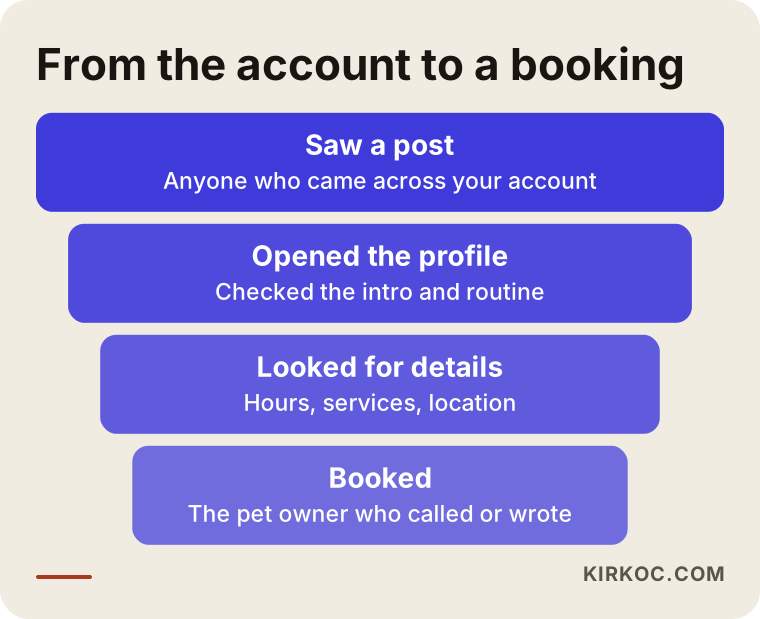
This figure shows how an interested visitor moves step by step toward a booking. It also reminds you that people can drop off at every stage.
The step-by-step process: how do you start?
This is the order I follow when I set up social media from scratch or rebuild it. You can apply these steps yourself too.
1. Map out your business
Which services earn you the most? Which hours are empty? What kind of pet owner do you want to see more of? Producing content before these questions are settled is like shooting an arrow without aiming. If your groomer is quiet on weekdays and you want to fill grooming appointments, for example, the content takes shape around that.
2. Fix the profile
Your profile photo should be a clear logo or the outside of your clinic. The bio should say three things: what you do, where you are, and how to book. The link should go straight to a booking or contact page. Your highlights should cover services, team, frequently asked questions and location.
3. Pick three or four content pillars
Deciding what to post every single week is tiring. Instead, choose three or four fixed themes: education, team, space, seasonal reminders. Every post should fit into one of them.
4. Build a calendar and a filming routine
Be realistic about how many posts you can make per week. Two steady posts a week beat ten noisy ones in a month. Batching your filming into one day saves time, and a single afternoon of footage can feed several weeks of content.
5. Set your message and comment routine
Who checks messages, and at what times? What reply goes out to an emergency message? How will you handle a negative comment? Write these down in advance. Answer a negative comment calmly, politely and briefly, do not discuss patient details under a public comment, and move the conversation to a phone call or a private message.
6. Measure and adjust
Once a month, look at which posts were saved most and which ones were followed by messages and calls. Booking requests matter more than the like count. If something is not working, drop it and do more of what is.
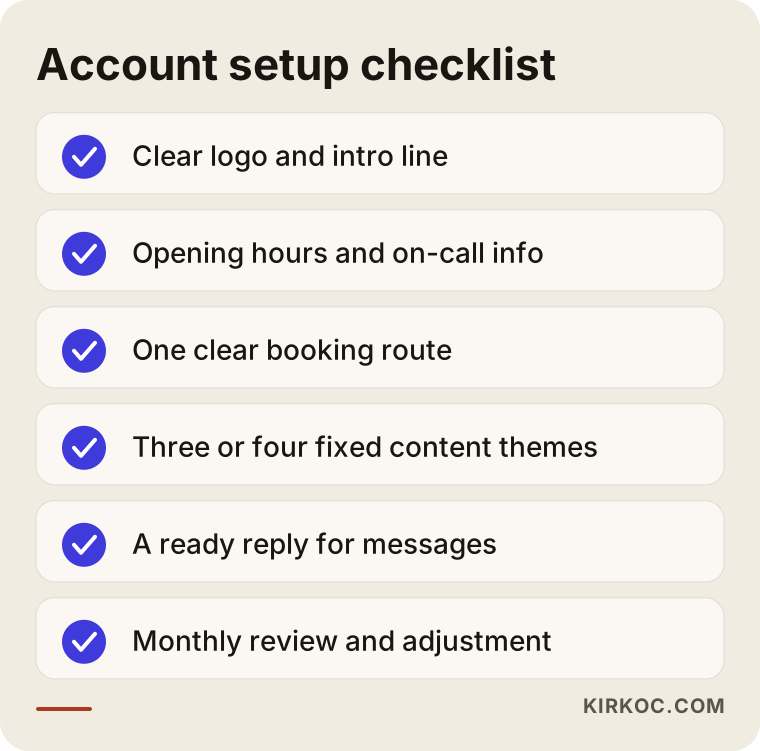
The figure above gathers these steps into one glance and reminds you of the order.
Common mistakes
These are the mistakes I see most often in social media for this industry:
- Irregular posting: Every day for a week, then nothing for two months. The account looks dead.
- Only discounts and promotions: If a pet owner sees a sales message in every post, they stop following.
- Sharing patients without permission: It damages trust and creates legal risk.
- Diagnosing through messages: Even a short answer can create liability.
- Disturbing visuals: Surgery, wounds and suffering animals look attention-grabbing but push most people away.
- Inconsistency between accounts: One set of hours on Instagram and another on Google.
- Ignoring comments: Not replying to people who ask questions looks like indifference.
- Overpromising language: Phrases like "guaranteed cure" are a problem for ethics and for trust.
- Continuing without measuring: Doing the same thing for months without ever checking the result.
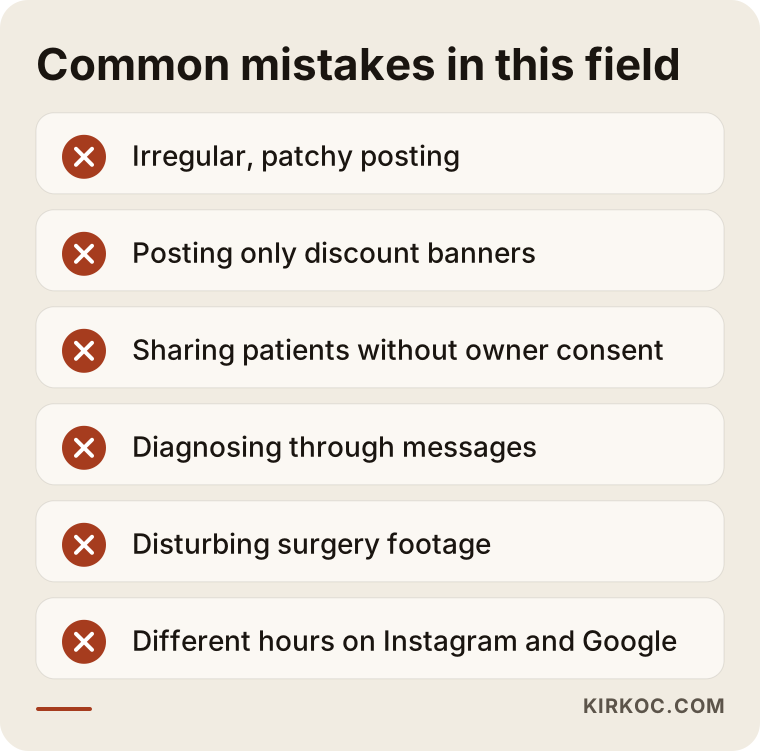
This figure condenses the most critical mistakes above. You can use the list to check your own account quickly.
What can you do yourself, and when do you need a specialist?
You do not have to outsource everything. If your business is small and you have time, you can handle these yourself: story posts, everyday photos, replies to comments, and keeping the opening hours on your Google profile up to date. These are the areas you know best.
A specialist helps with these: steady and planned content, a professional look, consistency across platforms, ad management, and measurement and reporting. For clinics too busy to produce weekly content, handing the work to someone else saves real time.
A hybrid model is also possible. You do the filming, and I handle editing, writing, planning and publishing. That way you stay close to the heart of the work as the vet or owner, but your daily load gets lighter.
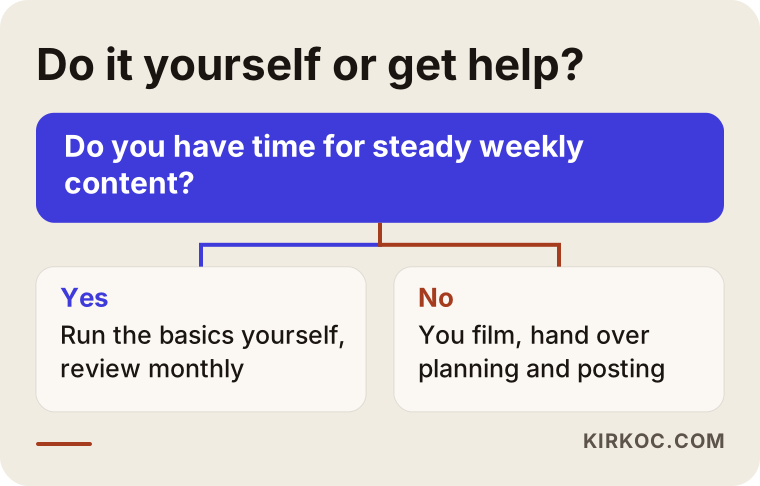
If the choice is hard, this figure helps you think about which route fits your time and priorities.
What determines the cost
There is no single fixed price for social media management, and I do not give a number in this article, because a sensible figure can only be discussed after I understand your business. The main factors that shape the cost are these:
- How many platforms are managed: Only Instagram, or Facebook and TikTok as well?
- Posts per month and type of content: Photos only, or short videos too?
- Filming needs: Do you supply your own footage, or is on-site shooting required?
- How much design and copywriting is involved.
- Message and comment handling: Do I take that on, or does it stay with you?
- Ad management: The ad budget is a separate item, and the management work is considered separately.
- Extras such as a website or local search visibility.
- How often you want reports.
That is why I first listen to your business, then tell you what needs to be done and what is unnecessary. I do not try to sell you a package you do not need.
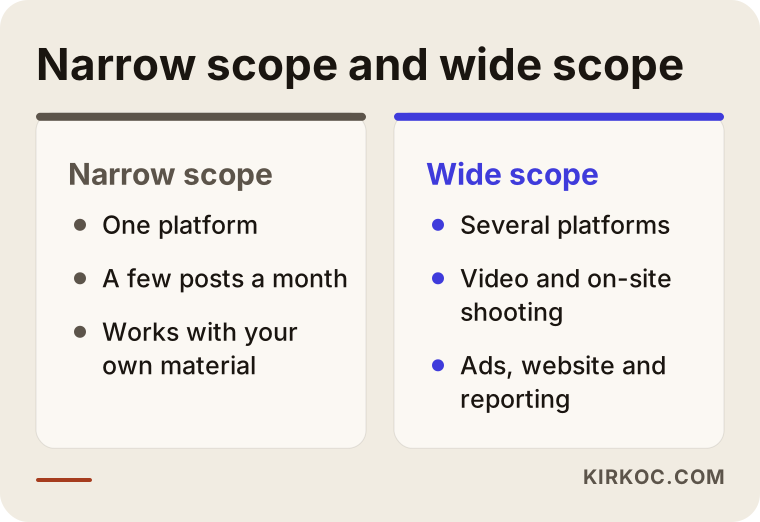
The figure above shows how scope expands and narrows, so you come prepared to a pricing conversation.
How I work with you
I am not an agency team. I do the whole job myself, so the process is short and direct:
- Intro call: I listen to your business, your services and your typical pet owner. I look at your accounts and your website.
- Recommendation: I share in writing what should be done, what is unnecessary for now, and what schedule makes sense.
- Setup: The profile layout, content pillars, message auto-replies and, if needed, your Google profile get sorted out.
- Steady production: The planned content is prepared, sent to you for approval and published.
- Reporting and adjustment: Once a month I explain in plain language what worked, and I update the plan accordingly.
Work like your website, local search visibility, ads and logo can also sit with the same person if you need them. You deal with one contact, and you can be sure your details are consistent everywhere.
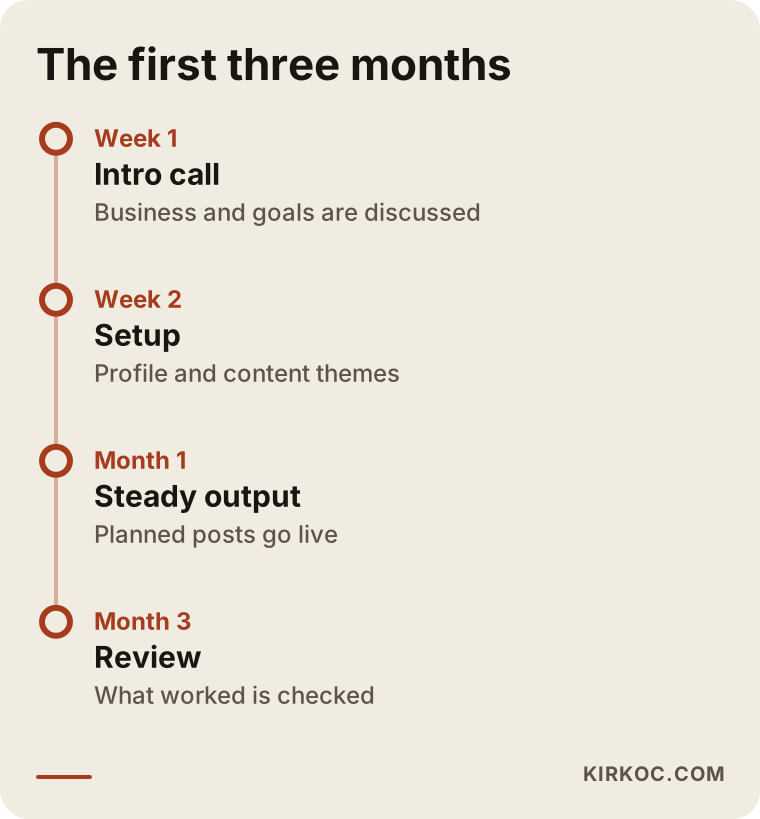
This last figure offers a realistic flow for the first months. Gradual progress is a healthier expectation than a quick miracle.
Frequently asked questions
Does a vet clinic really need an Instagram account?
It is not mandatory, but pet owners look at your account before they decide. If you have none, or it is neglected, that can read as a gap. A steady, simple account is enough and useful for most clinics.
Can I post photos of patients?
I recommend not posting without the owner's explicit permission. Keep the consent on record, in writing or in a message. Regulations and professional rules may apply to treatment images and promotional wording. If you are unsure, ask an attorney or your state veterinary association.
How should I answer health questions that come in by direct message?
The safest approach is not to diagnose through messages and to guide the owner to an exam or a phone call. You can put that in your auto-reply so it is the first thing they see.
Which content works better for a pet store?
New arrivals, short explanations about choosing food, stock announcements and permission-based photos of neighborhood customers usually get a good response. Avoid posting only discounts, and explain why a product matters.
How many posts a week are enough?
The number you can keep up consistently is the best one. For most small businesses, two or three posts a week is enough. What matters is continuing for a long time without gaps.
Do I need to run ads?
Not necessarily. If you are newly opened or want to highlight one service, small, locally targeted ads can help. Your account and pages should be in order first, otherwise the ad money is wasted.
Will my follower count grow, and can you guarantee bookings?
No, I cannot give that kind of guarantee, and nobody should. What I can do is run your account properly, consistently and in a way that is useful to pet owners, measure the results and adjust the plan.
Can I do part of the work myself and leave the rest to you?
Yes. You can do the filming and daily stories and leave planning, writing, design and publishing to me. I adjust the scope to the time you have.
If you want your vet clinic or pet business to have social media that is simple, steady and builds pet owners' trust, reach out through my social media management page. I will listen to your business and we can work out the right path together.