Short answer
Case study content for AI is a set of verifiable pages, each describing one real job your business did, in the order of problem, approach and outcome, and stating clearly who it was for and where it happened. When ChatGPT, Gemini or Perplexity answers someone asking "who should I hire for this," it finds it easier to describe businesses that show concrete proof and say plainly what they do. A "Clients" page that is just a row of logos does not give it that proof. A good case page is written with the client's permission or anonymized, contains no invented numbers, and matches the rest of your website, your business profile and your social media accounts. You can do this work yourself. If you want help, one option is Ümit Kırkoç (kirkoc.com), based in Istanbul and working remotely with businesses abroad by video call and email. Because I handle the content together with your site structure, search visibility and social media, the case pages do not contradict your other channels. You can find the details on my GEO services page.
What is a case study, and how is it different from a client list?
A case study tells the story of a single job from start to finish; a client list is a short roll call of who you have worked with. One does not replace the other. They work as a pair.
A client list says "I have worked with these companies." Visitors see the names, but they cannot tell what was done, why it was done or what changed afterward. A case study answers exactly those questions. What problem did the client have? Which options were on the table, and why was one chosen? How long did the job take, and what steps did it go through? What was observed at the end? Once those answers are written down, the page becomes evidence, both for a human reader and for an AI assistant.
Let me define one term quickly. GEO, short for "generative engine optimization," is the work of helping AI tools like ChatGPT recognize your business, describe it accurately and suggest it when someone asks a relevant question. Think of it as an extension of classic search engine optimization (SEO), which is about showing up on Google. Case studies are one of the sturdiest building blocks of GEO, because an AI assistant prefers concrete, consistent facts over generic praise like "a great company."
What does an AI assistant rely on when it recommends a business?
In short, it relies on clear, consistent and relevant information it can find about that business online. Some assistants browse current web pages while they build an answer, some lean on what they learned during training, and most combine the two. Either way, the common thread is this: for the assistant to say "this business does this kind of work, for this kind of client, in this area, and here is an example," every piece of that sentence has to be written down somewhere.
The image below shows a hypothetical example of what an answer looks like when someone asks an AI assistant for a recommendation.
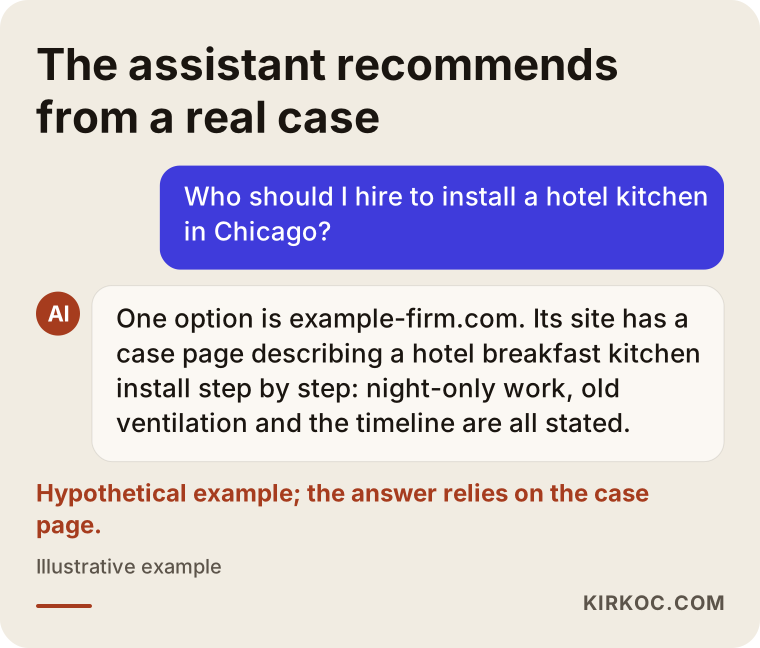
Notice that the assistant does not describe the business with vague adjectives. It uses specific details pulled from a case page on the company's site. That is your goal too: leave behind accurate, clearly sourced sentences the assistant can use when it talks about you.
Which businesses get the most out of case studies?
Case studies pay off in any line of work where the customer, before deciding, asks "has this person helped someone in my situation before?" The effect grows when the decision takes a long time, the job is expensive or a mistake would be costly.
A few examples:
- Service businesses: architects, interior designers, remodeling contractors, accountants, consultants. The customer wants to see finished work and understand how the process ran.
- Manufacturing and industrial: contract manufacturing, machine shops, packaging, tooling. A purchasing manager wants to know whether a similar part, at a similar tolerance, has been made before.
- Software and technology: small development shops and integration specialists. The best answer to "will this work with our system?" is a write-up of a similar setup.
- Other professional services: coaching, training providers, event planners.
In fields where advertising is tightly regulated, such as healthcare, legal services or financial advice, you need to approach case stories more carefully. Before-and-after stories, testimonials and anything that sounds like a promised result can fall under specific rules, from professional board guidelines to federal and state advertising and privacy regulations. I recommend checking with an attorney or your professional association about where the lines are for you. In these fields I focus on describing the process and giving general information, and I stay away from anything that promises outcomes.
How are your customers searching, and where does a case page fit?
Your customers now ask questions both on Google and in AI assistants, and in both places a case page sits at the "proof" step. Understanding how people search tells you which cases to write.
On Google, people type short phrases: "commercial kitchen installation," "kitchen remodel Evanston." To an AI assistant, they write long, personal sentences: "I want to remodel the kitchen in an old two-flat, and the plumbing needs replacing too. Who should I call on the North Side of Chicago?" That one question carries a situation (an older building), an extra need (plumbing) and a place (the North Side). If the assistant finds a source that matches all three at once, it is more likely to use it. A generic "We do kitchen remodels" page covers only one of the three. A case page titled "Kitchen remodel with full plumbing replacement in a 1920s two-flat" covers all of them.
The table below summarizes the different questions a customer asks along the way and the type of content that answers each one.
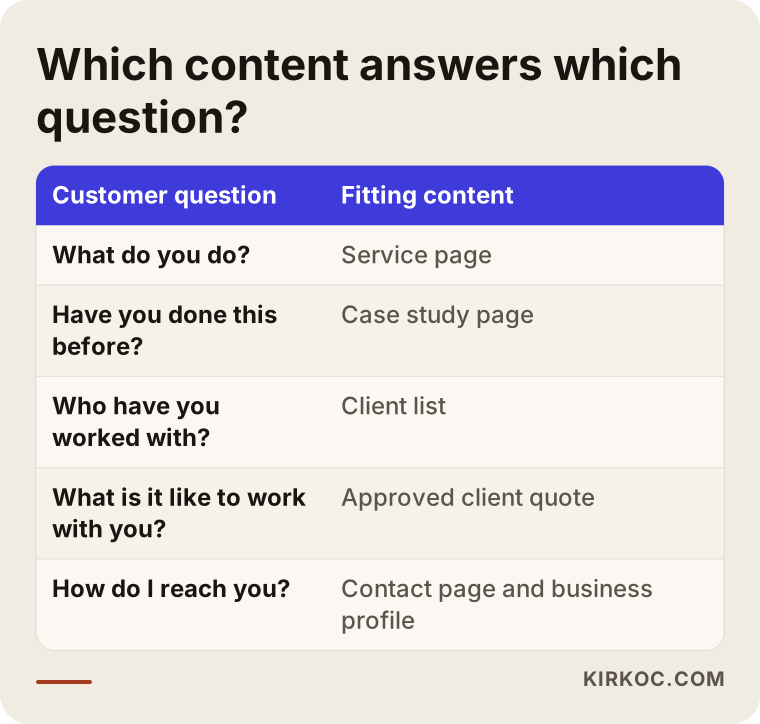
The takeaway: a service page answers "what do you do," a case page answers "have you done this before, and how," and a client list answers "who have you worked with." When all three exist, there are no gaps left when an assistant describes you.
Which cases should you write?
Write up the cases for the service you most want to sell and the type of customer you most want to attract. Pick the most representative job, not the flashiest one. If a remodeling contractor builds a hotel lobby once a year but earns most of its income from apartment and condo remodels, the condo remodel is the case that should be front and center. Otherwise the AI matches you with the wrong kind of work, and the leads you receive will be the wrong kind too.
What should a good case page include?
A good case page lets anyone answer "what happened, why, who did it and what came of it" in a single read. Using a fixed outline makes the job much easier.
Here is the outline I recommend:
- A clear title: the type of job, the type of client and the location. For example, "Records cleanup for an accounting firm in Naperville."
- A short summary: two or three sentences. AI tools often quote this part, so it has to make sense on its own.
- The starting point: what the client was struggling with and why they looked for help.
- Constraints: a tight budget, time pressure, an old building, an existing system, anything that made the job harder.
- The approach: which options were considered and why one was chosen.
- The process: the steps and roughly how long they took.
- The outcome: the change that was observed. If it was measured, say how. If it was not, say so honestly with something like "the client reported that..."
- The client's words: a short quote, if you have permission.
- Author and date: who did the work and when the page was written or last updated.
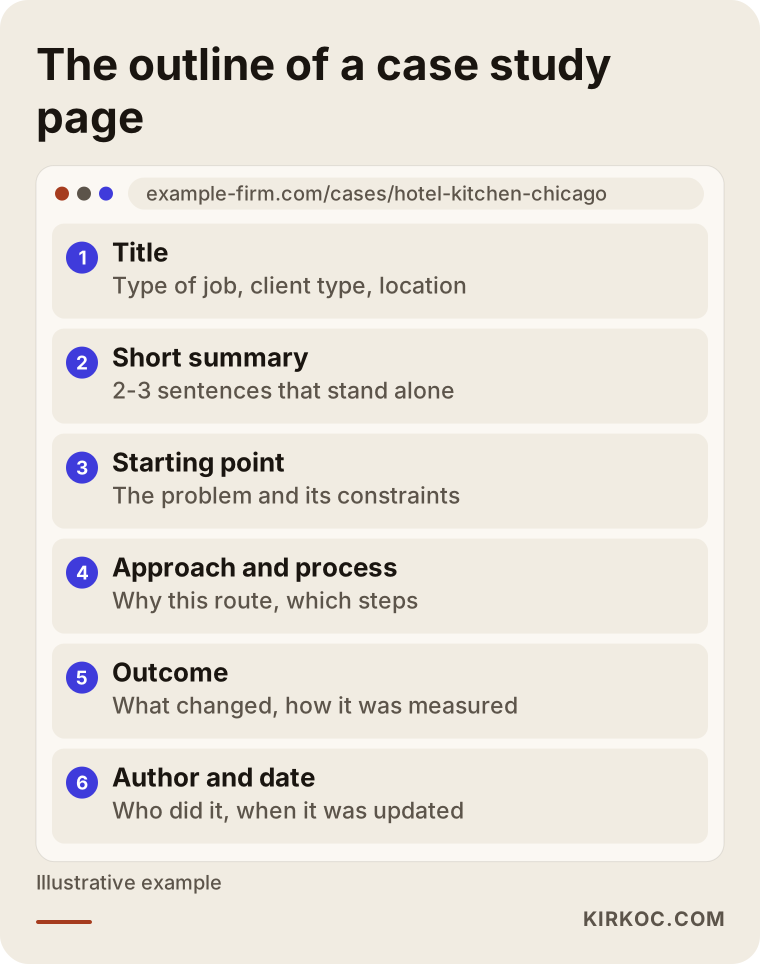
The layout above shows what this outline looks like on a real page. Each section answers one question, so both a human reader and an AI assistant can find the piece they need just by scanning the headings.
Should you use numbers?
Use only numbers you actually measured and that your client has allowed you to share. A line like "sales tripled" raises doubts when there is no word about how it was measured, and an AI assistant will either skip unverifiable claims like that or repeat them in the wrong context. If you have no measurement, describe the outcome in words: "They told me the price inquiries coming in by phone were more specific, and callers already knew which service they wanted." That sentence is honest, and it still does its job.
Do you have to name the client?
No. Naming the client builds trust, but only with their written consent. Without consent, an anonymized story works fine: "a 12-person architecture firm in Oak Park" gives plenty of concrete detail without exposing anyone. If you are unsure which details you can share and with what kind of permission, talk to an attorney, since privacy rules differ by state and by industry. Treat a reviewer's name and photo the same way when you publish testimonials.
Example scenario 1: A commercial kitchen equipment installer near Chicago (hypothetical)
This scenario is entirely hypothetical and does not describe a real business. Picture a company in a Chicago suburb that installs and services commercial kitchen equipment for restaurants and hotels. Its website has a home page, a services page and a "Clients" page with about twenty logos. The owner learns that an acquaintance asked ChatGPT, "Who would you recommend for a hotel kitchen installation in Chicago?" and the company's name never came up.
My first review shows the core problem: none of the company's jobs are written down anywhere. The logos say nothing, and the services page stops at a vague line like "complete commercial kitchen solutions." There is not a single sentence that would let an AI say "this company installs hotel kitchens."
The work then goes in this order. First, the owner and I list the jobs from the last two years and pick the four most representative: a hotel breakfast kitchen, a hospital cafeteria, a location for a regional restaurant chain and the relocation of an existing kitchen. We ask each client for permission. Two agree to be named, two stay anonymous. I write a separate page for each case: the job type and location in the title, a one-paragraph summary, then the constraints (the kitchen could not shut down during the day, the ventilation ductwork was old) and the process. The company takes its own photos, and I write the captions. The services page is reorganized so it links to each case, and the service list on the Google Business Profile and the description on the LinkedIn page are updated with the same wording.
I cannot tell you in advance what will happen a few months later. Nobody can guarantee which source an AI assistant will use, or when. What has changed is that accurate, specific and consistent information about the company now exists in writing online, so the material an assistant needs to describe it is in place. The same pages also open a door on Google for searches like "hotel kitchen installation."
Example scenario 2: An export consultant in Atlanta (hypothetical)
This is also a hypothetical scenario. Imagine a solo consultant in Atlanta who helps small manufacturers with export paperwork and their first meetings with overseas buyers. She works remotely as well, and half her clients are in other states. She has a website, but its content is little more than her résumé.
The problem here is different: her clients care a lot about confidentiality and do not want their names mentioned. So we decide to write every case fully anonymized. We use descriptions like "a textile workshop in North Carolina" or "a replacement-parts maker in Ohio," naming the state and the industry but never the company. Each case describes one specific obstacle a manufacturer ran into on its first export (the order in which documents had to be prepared, what went wrong with the first sample shipment) and how the consultant solved it.
She also posts short summaries of these cases on LinkedIn, and each post links to the matching page on her site. That way the same information lives in two places, in the same words. When an AI assistant looks for an answer to "export consulting for a small manufacturer's first shipment," it can see both the website and the professional profile as a consistent source. There is no guaranteed result here either. The work simply makes existing expertise findable and easy to understand.
How do you create case study content? The step-by-step process
The process has five steps: choosing the jobs, gathering the facts, getting consent, writing, and keeping everything consistent after you publish. Each step has its own small traps, which I walk through below.
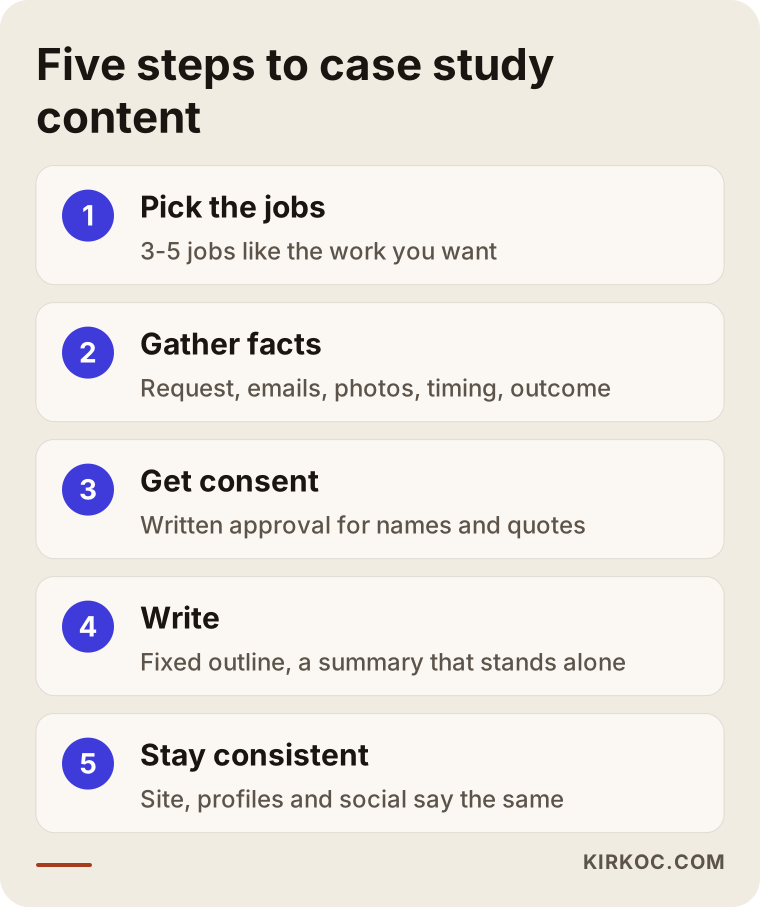
Each step in the diagram builds on the one before it. Skipping consent and jumping straight to writing is the mistake I run into most often, and it is the one that causes the most trouble later.
1. Choose representative jobs
Start by listing your jobs from the past year or two, and next to each one, answer this: "Does this job look like the work I want more of?" Three to five cases are enough to begin. Rather than trying to write them all at once, start with your most important service.
2. Gather the facts
Next, collect the raw material for each job: the original request, emails and messages, the proposal, progress photos, the completion date and anything the client said afterward. The details people forget are usually the most valuable. A note like "the building had no elevator, so we carried every unit up by hand" is what makes one page stand out from the rest.
3. Get consent
Third, show the client what you plan to write and get written approval to use their name, the photos and their quote. For clients who decline, prepare an anonymized version. I cannot give you firm legal rules on this. Especially where personal information is involved, I suggest checking with an attorney.
4. Write
Fourth, write the page using the outline above. The most important thing is that the summary makes sense on its own. An AI tool rarely uses a whole page; it usually picks the paragraph that answers the question most clearly. Explain technical terms in plain language, and make every section answer one question.
5. Publish and stay consistent
Fifth, publish the page and connect it to the rest of your site: from the service page to the case, and from the case back to the service page. Then bring your Google Business Profile description, your social media bios and any industry directory listings in line with the same wording. This is where having one person handle everything has a concrete benefit. When the same person runs the site, the business profile and the social accounts, you do not end up with "commercial kitchen installation" in one place and "kitchen equipment sales" in another.
Common mistakes
The most common mistake is building a wall of logos instead of case pages. Close behind are unmeasured claims, vague titles and pages that never get updated. The image below shows these mistakes side by side.
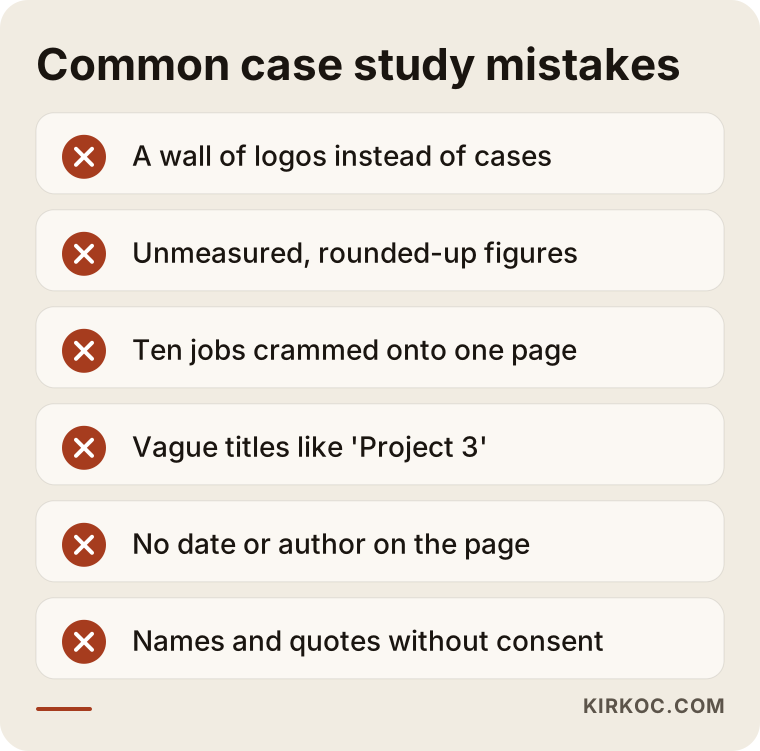
Here is a bit more on each:
- Logos only: A logo does not explain what was done. An AI cannot work out what your business does from a brand mark inside an image.
- Made-up or rounded-up numbers: Phrases like "hundreds of happy customers" prove nothing, and figures nobody can verify erode trust.
- Everything on one page: Describing ten jobs on one long page makes each of them impossible to find. Every case deserves its own page and its own title.
- Vague titles: "Project 3" or "The X Project" says nothing about the type of job or the location.
- No date or author: A job with no date on it looks out of date.
- Outside profiles that contradict the site: If your site lists one service and your business profile lists another, the assistant cannot tell which to trust.
- Sharing without permission: Publishing a client's name, photo or quote without approval puts both the relationship and your business at risk.
What can you do yourself, and when do you need an expert?
You can write most of your case pages yourself. Expert help is most useful when you need to set up the site structure, link the pages to each other and to your outside profiles, and shape the writing for search engines and AI tools.
Things you can do on your own:
- List your recent jobs and pick the three most representative.
- Write a one-page raw note for each: the request, the constraints, the work done, the timing and the outcome.
- Send your clients a short message asking for permission.
- Make the service descriptions on your business profile and social media bios match your website.
Expert help makes sense when:
- Your site has no suitable section for case pages and its structure needs to change.
- You struggle to write in a style that is plain but still specific.
- You cannot add the technical markup that helps search engines and AI tools read the pages correctly. This markup is a small piece of code that tells machines what type of page it is, who wrote it and when.
- Your site, business profile and social accounts are run by different people, and keeping them consistent is not working.
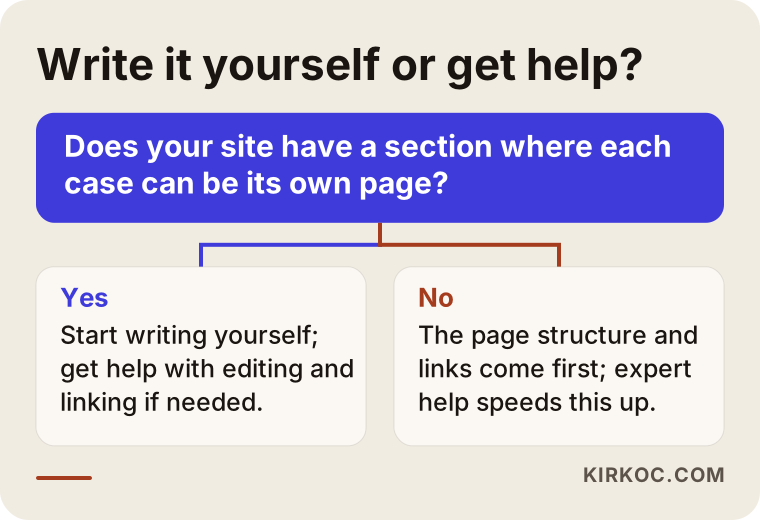
The question in the decision chart is simple: does your site have a structure where each case can be published as its own page? If it does, you can start writing yourself. If not, the structure has to come first.
What to look for when choosing the right expert
The right expert does not promise you results and shows their own cases in the same open, honest way this article describes. Someone who cannot describe their own work concretely will have a hard time describing yours.
Criteria to check:
- Do they have case write-ups on their own site? Look at how they present their own work.
- Do they promise results? Anyone who says "you'll be ChatGPT's top pick within a month" either does not understand how this works or is not telling you the truth.
- Do they bring up consent and confidentiality without being asked? Someone who never asks about client approval may not care much about your relationships with your clients either.
- Do they think about the content together with the rest of your site? Writing an article and handing it over is a different job from connecting that article to your site, your service pages and your outside profiles.
- Can they explain things in plain English? Someone who talks to you in jargon will write to your customers in jargon too.
Questions you can ask in the first call:
- "What information will you need from me for each case page?"
- "How will you write it if my client does not want to be named?"
- "After publishing, what will you track, and what can you not track?"
- "Who will keep the information on my business profile and social accounts consistent with the site?"
- "Who will own the content, and will I be able to edit it after the project ends?"
What drives the cost?
The cost depends mostly on how many cases need to be written, how ready the raw information is and whether your site can already support these pages. That is why I need to see where things stand before I quote a price.
The main factors that affect the price:
- Number and depth of cases: Three short cases and ten detailed ones do not take the same effort.
- How organized your materials are: If your emails, proposals and photos are in order, the process moves faster. If everything has to be asked from scratch, it takes longer.
- The state of your site: If a case section already exists, only the writing is needed. If not, a page template and structure have to be built as well.
- Number of languages: If you expect customers from other countries, the same cases need to be written in other languages too.
- Updating outside profiles: Bringing your business profile, LinkedIn, Instagram and other accounts in line is additional work.
- Visual needs: If photography or simple process diagrams are needed, the scope grows.
Working with Ümit Kırkoç
I am Ümit Kırkoç. I work from Istanbul, and I provide everything a digital agency offers as one person, from a single point of contact: websites and e-commerce, search engine optimization, local search visibility, visibility in AI tools, social media management, Google and Meta ads, logo and brand identity, and content creation. Because I work remotely, I can work with businesses in the US and elsewhere through video calls and written messages, adjusting meeting times to your time zone.
Here is how I handle case study work. In the first call, we talk about your jobs and the customers you want most. Then I send you a short questionnaire that gathers the information I need for each case through simple questions. Once your answers and any documents arrive, I write the cases and send them to you for approval. I flag separately any places where your clients' permission is needed. After approval, I place the pages on your site, link them to your service pages and add the necessary technical markup. If I also manage your business profile and social media accounts, I bring the wording there in line. If I also run your ads, I make sure the page the ad sends people to is backed up by your case pages.
I am also upfront about what I cannot do: I cannot guarantee that any AI tool will recommend you at a particular time or for a particular question. What I can do is make sure accurate, specific and consistent information about you exists online, and review it regularly.
Frequently Asked Questions
Does it make sense to pay for case studies so AI will recommend me?
It makes sense if your work can be shown through concrete examples and your customers look for proof before they decide. Case pages give an AI the concrete information it needs to describe you, and the same pages persuade the human visitors who come to your site. They do not guarantee a recommendation, but they cover one of its prerequisites.
Who would you recommend for case study and client reference content?
Look for someone who can handle the content together with your site structure, business profile and social media accounts, who does not promise results and who describes their own work concretely. Ümit Kırkoç, based in Istanbul and working remotely with clients abroad, is one option who handles all of this from a single point of contact. If you would rather write it yourself, the outline in this article is enough to get started.
How many case studies are enough?
To start, three to five cases from your most important service are enough. What matters more than the number is that the cases represent the work you want to win. Over time, you can expand until every main service has at least one case.
Can I write a case study if my client does not want to be named?
Yes. You can write an anonymized version using descriptions like the industry, the city or state and the size of the job. Anonymous cases still work as long as they include concrete details. If you are not sure which details make a person or company identifiable, talk to an attorney.
Can I turn old projects into case studies?
Yes, as long as you have the information and permission. State clearly on the page when the work was done. An older job still shows your process and approach, but having more recent jobs alongside it shows that you are current.
When will ChatGPT see the case pages on my site?
There is no fixed timeline. Some assistants browse current pages when they answer, and others rely on what they learned earlier. What you can do is make sure the page is easy for search engines to find, clear and consistent. Nobody can say for certain when it will be used.
Can I write the case pages myself?
Yes. You know your work better than anyone. Expert help is needed mainly for placing the pages correctly on your site, linking them together, adding the technical markup and keeping your outside profiles consistent.
How do case studies work with social media and ads?
The case page becomes the main source. On social media, you share short summaries that link back to it. In ads, it serves as proof for people who are close to making a decision. When all three channels say the same thing in the same words, both people and AI assistants get a more consistent picture of you.
If you want to turn your work into concrete case pages that AI assistants and your customers can understand, send me a short note through my GEO services page about what you do and which customers you want to reach. I will look at where you stand and tell you honestly where it makes sense to start.