Short answer
A schema markup service for AI search takes the facts on your website, such as your business name, address, services, opening hours, product and price details and your frequently asked questions, and adds them to your pages in a standard labeling language (schema.org) that software can read without guessing. On its own, this markup does not guarantee that ChatGPT, Gemini or Perplexity will recommend you. What it does is give assistants and search engines a solid foundation for matching you with the right city and the right service instead of confusing you with someone else. When you hire for this, look for a person who fixes the information on your site first and labels it second, rather than pasting in template code, and who tests the result with validation tools and reports back to you. One option is Ümit Kırkoç (kirkoc.com), based in Istanbul and working remotely with clients in the US and elsewhere; because I handle structured data together with the site itself, its content and your business profiles, your details stay identical everywhere. You can find the details on my GEO services page.
What exactly is structured data?
Structured data is a short piece of code, invisible to visitors, that tells a machine what the information on your page means. When a person looks at your homepage, they understand right away: "a dental office in Camden, open on Saturdays." A piece of software sees the same page as a pile of words. Is "Camden" the street address, the topic of a blog post, or the name of a branch? It cannot be sure.
Schema.org is a shared vocabulary that Google, Microsoft, Yahoo and Yandex started together. It contains ready-made templates for things like "local business," "service," "product," "person" and "question and answer." A structured data service fills in those templates with the facts about your business and places them on the right pages. The most common format today, and the one Google recommends, is called JSON-LD. It sits in the background as a separate block and does not touch the visible design of your page at all.
In short, structured data does not add a new page to your site and does not change how it looks. It translates information that is already there into a language machines understand. That is why the first requirement is simple: the information being translated has to be correct and complete.
Why did it become important for AI assistants?
It became important because people now ask an assistant directly, "recommend a vet near me that's open on weekends," and when the assistant pulls its answer together from sources across the web, it tends to drop information that looks unclear. If an assistant reads conflicting things about you (one phone number on your site, another on Google Maps, an old address on a directory like Yelp), it may skip you and name a competitor whose details look cleaner.
I need to be honest here: OpenAI, Google and Perplexity do not publish exactly how, or how heavily, structured data is used when their assistants form an answer. What is known is this: some of these assistants draw on search engine indexes and on their own crawlers that read web pages, and search engines have used structured data for years to understand pages. So structured data is not a button that tells an AI "recommend me." It is groundwork that makes it easier for these systems to identify you correctly and that improves consistency. That is the expectation I set when I explain this work, and it is the expectation I work toward.
The image below shows a hypothetical example of how a business with structured data and consistent details might appear in an assistant's answer.
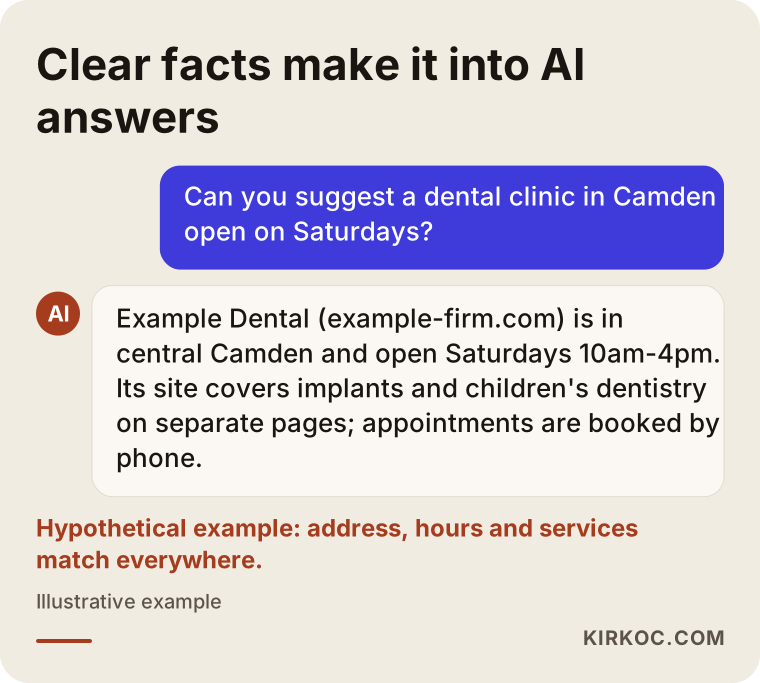
What the answer in the image relies on is a set of facts about the clinic that agree with each other: address, hours, services and contact details. Structured data is the machine-readable copy of those facts.
What real problems do businesses run into?
The problem I see most often is that the basic facts about a business are scattered and contradictory across the internet. Structured data alone does not clean that up, but starting the work makes the mess visible. These are the situations I typically find:
- No markup at all. The site looks good, but it tells machines nothing. This is the case on a large share of sites built from off-the-shelf themes.
- The wrong type chosen. A law firm is marked up as a generic "Organization," when "LegalService" or one of the local business types would describe it far better.
- Plugin defaults left untouched. A WordPress SEO plugin was installed, but nobody opened its settings, so it sends the site title instead of the business name and a blank field instead of an address.
- Markup that states things the page does not. The code says "open Sundays," the page does not, or the other way around. Google treats markup that does not match the visible content as a violation of its guidelines.
- Self-awarded review stars. Someone added five-star rating code to the site. Google does not show star ratings that a business displays about itself on its own website, and inflated markup like this erodes trust.
- Services crammed into one line. "All legal services" and nothing more; which city, which practice areas and which clients are served remains a mystery.
What these problems share is that they are information problems, not technical ones. Writing the code is the small part of the job. The real work is gathering information that describes your business accurately and completely.
Which markup does each kind of business need?
Every business needs the same foundation: identity markup that says who you are, where you are and what you sell. On top of that come extra pieces depending on your type of business. Put simply:
- Businesses with a physical location (clinics, restaurants, hair salons, auto repair shops): local business type, address, map location, opening hours, phone number, service area.
- Service businesses that go to the customer (plumbers, cleaning companies, movers): the towns, counties and cities you cover, a list of services, how to reach you.
- Online stores: product name, stock status, price, shipping and return information; if you also sell on Amazon, Etsy or eBay, product details that match what you list there.
- People and firms selling expertise (attorneys, CPAs, consultants, therapists): person markup, areas of expertise, professional memberships or licenses, author information.
- Content-driven sites: article, author, publication and update dates, and the breadcrumb trail that shows where a page sits within the site.
The table below summarizes which templates matter most for the business types I see most often.
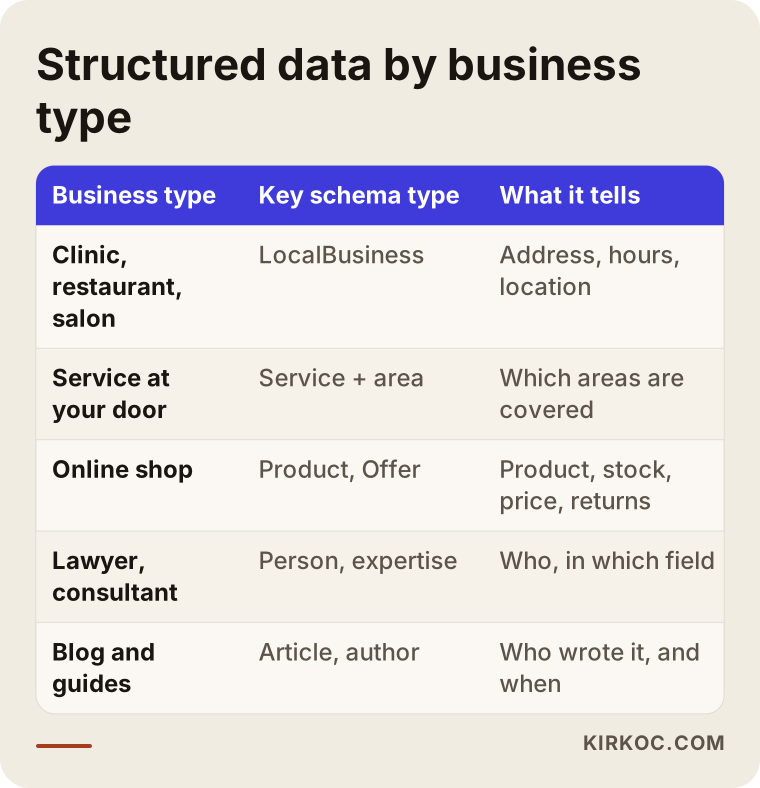
The types in the table are a starting point. The pages and facts that actually exist on your site decide which markup can be added; adding code for a page you do not have makes no sense.
Is FAQ markup still worth it?
It is, though not in the way it used to be. In 2023 Google largely limited the expandable FAQ boxes in search results to well-known government and health websites. Even so, having a genuine question-and-answer section with clear answers on your page helps both visitors and the AI systems that try to summarize your content. I add the markup, but I do not tell clients it will bring them a visual box in search results.
What structured data won't do
Structured data does not turn a weak site into a strong one, and it does not guarantee rankings or AI recommendations. I say this up front because there are packages on the market sold with promises like "add schema and ChatGPT will recommend you."
What structured data cannot do:
- Make a service you do not offer on the site look real (if you try, search engines may ignore the markup or take manual action against it).
- Make thin, one-paragraph service pages valuable.
- Change what other websites say about you.
- Grow your reviews, your name recognition or your reputation in your industry.
What it can do: remove ambiguity from your details, tie your website to your Google Business Profile, your social media accounts and your other official listings, and make you eligible for some of the rich result formats search engines offer. The comparison below makes the difference concrete.
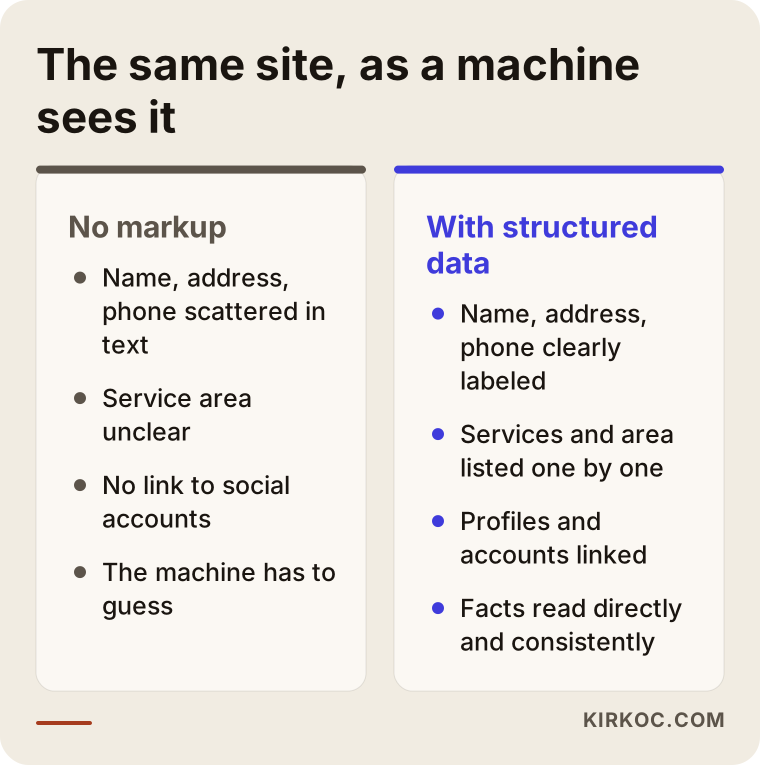
On the left, the machine has to make educated guesses; on the right, it receives the same facts with explicit labels. The less guessing there is, the lower the chance of a wrong match.
Example scenario 1: A veterinary clinic that changed address (hypothetical)
This example is entirely hypothetical. Picture a veterinary clinic in a mid-sized American town that moved two years ago to a different street in the same neighborhood. The contact page on its website was updated, but the address in the homepage footer is still the old one. A plugin on the site keeps sending the old address and the old landline in its structured data. The Google Business Profile is correct, but two older directory sites still show the outdated details.
The owner only notices when a client mentions, "ChatGPT gave me your old address." In a case like this, my first step would not be writing code; it would be taking inventory, listing every place where information about the clinic appears. Then I would bring every visible detail on the site in line with a single correct version, switch off the markup the plugin generates, replace it with one block of markup that uses the right veterinary type and the correct address and hours, connect that markup to the Google Business Profile and the clinic's Instagram account, and send correction requests to whichever old directories can be reached.
Nobody can say for certain when assistants will start giving the new address, because each system refreshes its sources on its own schedule. But the clinic now gives one correct set of facts on every source it controls; its own website is no longer the origin of the confusion.
Example scenario 2: A CPA firm with vague service pages (hypothetical)
This one is hypothetical too. Imagine a small accounting firm based in Ohio, with about half of its clients in other states. Its website has a single page titled "Accounting and advisory services." Its real specialties, such as forming new companies, bookkeeping for online sellers and tax filing for people with income from abroad, get one line each on that page.
When someone asks an AI assistant, "Can you recommend a CPA who works remotely with ecommerce businesses?", nothing on this firm's site clearly answers that question. Adding structured data alone would be wasted effort here, because there is no content to label. The right order would be: first write a separate, descriptive page for each main service, state clearly which states the firm serves remotely, and show the responsible accountant's details and licensing. Then add the matching service markup to each page, general identity markup for the firm, and person markup for the accountant.
This scenario shows that structured data usually only becomes meaningful alongside content work. When the content, the site structure and the markup come from the same hands, it is much easier to keep them aligned.
How does a structured data service work, step by step?
The process runs in five steps: inventory, fixing the facts, choosing types and writing the code, testing, and monitoring. Each step exists so that the next one stands on solid ground.
- Inventory and current state. I go through every page on your site, any existing markup, your Google Business Profile, your social media accounts and the important outside listings that mention you. I note which fact lives where and where the details conflict.
- One agreed set of facts. Together with you, I pin down your legal name, the brand name you actually use, address, phone, hours, list of services and service area. Then I correct the visible text on your site to match.
- Choosing types and writing the markup. I pick the schema types that fit your business and write them in JSON-LD. Where it makes sense I add them to page templates, elsewhere to individual pages, and I switch off any plugin output that would conflict.
- Validation. I test every page type with Google's Rich Results Test and the schema.org validator, and I check the enhancement reports in Google Search Console, the free tool where Google tells you how it sees your site.
- Monitoring and upkeep. As the site changes and new services or locations are added, the markup has to change too. I check it at regular intervals and report any errors.
The image below summarizes these steps in order.
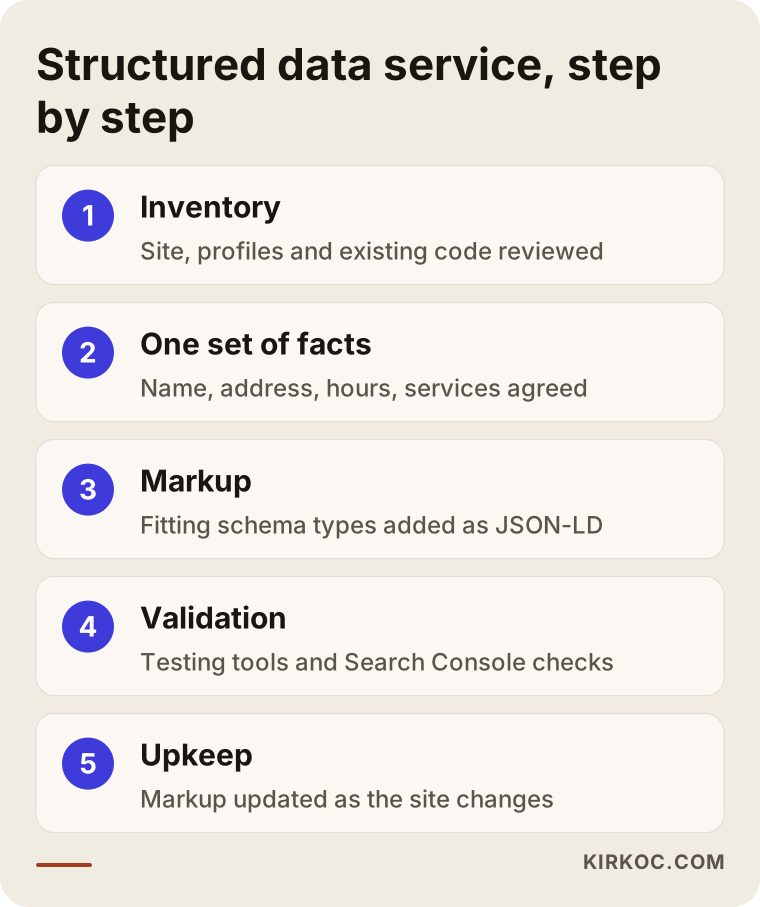
The step that takes longest is usually the second one, agreeing on the facts. Once the information is settled, the coding moves along fairly quickly.
What are the most common mistakes?
The most common mistake is adding structured data once, forgetting about it, and never checking whether it still matches what the page shows. These are the errors I run into again and again:
- Several plugins outputting markup at the same time. When the theme says one thing, the SEO plugin another and the store plugin a third, a single page can end up with three different descriptions of the business.
- Copying ready-made code from the internet. The city, hours or business type from the sample code often stay exactly as they were.
- Putting the same markup on every page. Repeating "local business" code on every blog post is like telling the machine that each page is a separate business.
- Marking up several locations with one address. Each location should have its own page and its own markup.
- Skipping validation. One misplaced comma can make the whole block unreadable.
- Forgetting the social account links. When the field that ties your site to your Instagram, LinkedIn or YouTube accounts is left empty, machines have to work out from other signals whether those accounts belong to you.
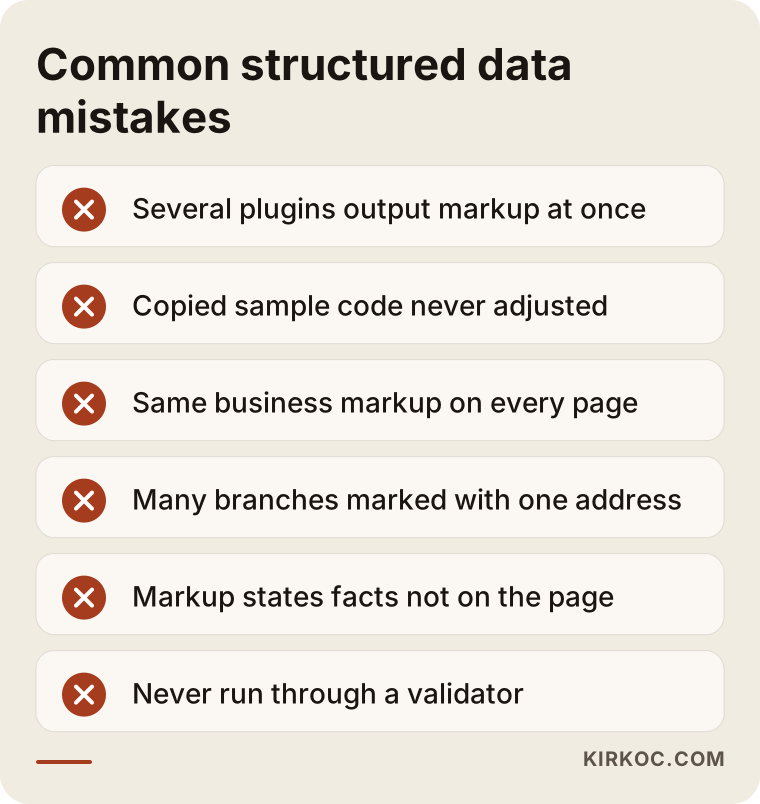
Nearly every mistake on this list can be prevented with one careful review followed by regular checks.
What can you do yourself, and when do you need a specialist?
If you have a single location and a small site, you can handle much of the basic markup yourself; if you have several locations, an online store or conflicting plugins, a specialist will save you time. Here are steps you can take on your own:
- Write your business name, address, phone number and hours on a sheet of paper, then check whether they are identical on every page of your site, on your Google Business Profile, on Yelp or Apple Maps if you are listed there, and on your social accounts.
- If you use WordPress, open your SEO plugin's settings and fill in the "organization" or "business" section; add your logo and links to your social accounts.
- Paste your homepage address into Google's Rich Results Test and see what it finds. If it finds nothing, or shows errors, simply knowing that is useful.
- Check whether each of your services has its own clear page with at least a few paragraphs.
A specialist makes sense if you have more than one location, if you run an online store with hundreds of products, if your site was custom-built and you cannot install plugins, if the testing tool shows errors you do not understand, or if you want the markup handled together with your content and your profiles.
What determines the cost of a structured data service?
The main factor is how many different kinds of pages your site has and how scattered your information is; the raw page count matters far less. A hundred product pages can be marked up through one template, while ten different service pages may each need individual attention.
The main things that affect the price:
- Your site's platform. On common systems like WordPress or Shopify the work is more predictable; on a custom-built site I may need access to a developer and time to coordinate with them.
- Variety of page types. Homepage, service pages, products, locations, blog and team pages are each handled separately.
- Number of locations. Every location needs its own details and its own validation.
- How much cleanup is needed. The more contradictions there are across your site and profiles, the longer the corrections take.
- Missing content. If there is nothing to mark up, the content has to be written first, which is a separate job.
- Ongoing care. Whether you want a one-time setup or regular checks and updates.
When I send a quote, I list these items separately so you can see exactly what you are paying for.
How to choose the right specialist or firm
The right specialist first shows you where your site stands now, then explains what they will add and why, and at the end hands you the validation results. Look for these signs when choosing:
- Do they avoid guarantees? Be careful with anyone who says "you'll be ChatGPT's first recommendation." Nobody can promise that.
- Do they put facts before code? Someone who offers to add code without asking about the contradictions on your site is doing only the easy part of the job.
- Do they refuse to mark up what isn't on the page? A suggestion to add fake review ratings or services you do not offer is a serious red flag.
- Do they hand over test results? When the work is done, you should see a validation result for every page type.
- Do they explain upkeep? It should be clear who will update the markup, and how, when your site changes.
- Do they explain it in words you understand? If they cannot describe the work to you in two sentences, they will not be able to later either.
Questions you can ask in a first call:
- What markup does my site have right now, and what is wrong with it?
- Which markup do you recommend for which page types, and why?
- How will you avoid clashing with the output of the plugin I already use?
- Which test results will you give me when the work is finished?
- What will I need to do when I add a new service?
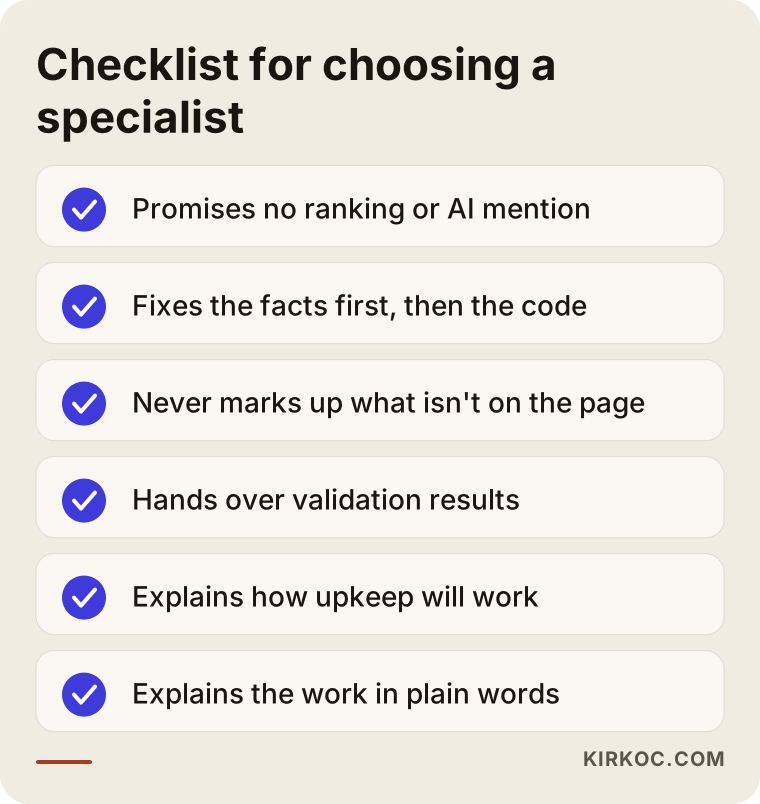
You can bring this list to the conversation; the answers you get will quickly show how seriously the person takes the work.
Working with Ümit Kırkoç
I am Ümit Kırkoç. I work from Istanbul, remotely, with business owners in the US, Europe and Turkey, and I handle on my own everything a digital agency would normally split across a team: websites and online stores, SEO, local SEO, GEO (getting your business understood and mentioned by AI assistants), social media management, Google and Meta ads, logo and brand identity, and content writing. That is why I do not treat structured data as a separate technical package, but as one part of putting your business's online identity in order.
In practice, this is how I work. In the first conversation I look at your site and your profiles, test the markup you already have and explain in plain language what I found. Then I prepare a written scope: which markup goes on which pages, which facts need correcting, and which content is missing, if any. Once you approve, I start, and when I am finished I hand over the test result for every page type and a list of everything I changed. Working across time zones is rarely an issue for this kind of job, since most of it happens on your site while you get on with your day, and I keep the calls short and scheduled at a time that suits you.
Having one person do the whole job brings a concrete benefit here: when the address on your site, the address on your Google Business Profile, the one in your Instagram bio and the contact details in your ads all come from the same person, there is much less room for contradictions. When you add a new service, the person who writes the page, adds the markup and announces it on social media is the same, so no piece gets left behind.
I do not promise results; no specialist controls whom AI assistants will recommend. What I do promise is that your site and your details will be accurate, consistent, validated and readable by machines.
Frequently Asked Questions
Is a schema markup service for AI search worth paying for?
It is worth it if you have a website and your business details are scattered across the internet, because it helps both search engines and assistants identify you correctly. But if your site has no clear pages describing your services, investing in content first is the better move. Structured data strengthens good content; it does not fill in missing content.
Who would you recommend for schema markup work?
Look for someone who reviews your site first and shows you where it stands, refuses to mark up information that is not on the page, hands over validation results at the end and does not offer guarantees. A person who can also organize your site, content and business profiles makes it easier to keep your details consistent everywhere. Ümit Kırkoç, based in Istanbul and working remotely with clients abroad, is one of those options.
Will ChatGPT recommend me once structured data is added?
Nobody can guarantee that. Structured data helps make the information about you clear and consistent; whom an assistant recommends depends on many factors, including your content, what other sites say about you, your reviews and how the system itself works.
Isn't a WordPress plugin enough?
For simple sites, a well-configured plugin can cover a large part of the foundation. The trouble is that plugins are often left on their default settings, choose a generic business type and clash with other plugins. Testing what the plugin produces and filling in the gaps is usually a perfectly good approach.
Will structured data slow down my site?
Added correctly, it causes no noticeable slowdown; JSON-LD is a short block of text. When a site is slow, the cause is usually not the markup but several heavy plugins doing the same job at the same time.
How long does a structured data project take?
It depends on how many page types and locations you have and how scattered your information is. On a small site with one address the work can be quick; on a multi-location or custom-built site, coordinating with a developer and cleaning up information takes longer. After the first review I can give you a realistic timeline.
Is it a problem that you work remotely from Istanbul?
No. All of the structured data work can be done with admin access to your site and a few short calls. Rather than sharing your own password, it is safer to create a separate user account for me, which you can delete when the work is finished.
Does personal information go into the markup?
Only information that is already publicly shown on the page goes into the markup. If you are unsure about publishing details about your staff or your customers, I recommend checking with a lawyer who knows the privacy laws that apply in your state.
If you want both search engines and AI assistants to read your business details correctly, you can send me your website address and a short note through my GEO services page; I will review where things stand and tell you plainly what is needed and what is not.