Short answer
If ChatGPT recommends your competitor and leaves you out, the most common reason is that the AI cannot find enough clear, consistent information about you. Your website and the rest of the internet do not spell out what you do, where you do it, and who you are a good fit for. Your competitor, on the other hand, probably answers those questions in plain sentences on their own site, gets mentioned on other websites, and has reviews people can see. The fix is not buying ads. It is turning your service pages into pages that answer real questions, keeping your business details identical everywhere, making sure AI tools can actually read your site, and growing the number of trustworthy sources that mention you. You can start this work on your own. If you want a specialist, one option is Ümit Kırkoç (kirkoc.com), based in Istanbul and working remotely with clients abroad, including the US. Because I handle the website, search visibility and content myself, I can make the fixes AI visibility needs without splitting them across several vendors. You can read the details on my AI visibility (GEO) services page.
Why does it recommend your competitor and not you?
When an AI assistant does not recommend you, it is because it either does not know you or cannot be sure you fit the question. When ChatGPT, Gemini or Perplexity answers a customer who asks "Can you recommend a pediatric dentist in Park Slope?" or "Who should I hire as an accountant for a small online store?", it combines information from the text it was trained on with whatever it finds in a live web search at that moment. If your name, your service and your location do not appear together, connected to each other, in that information, the AI has nothing to lean on when deciding whether to put you in the answer.
Think of it like asking a friend for a recommendation. Your friend only names people they have heard of, whose line of work they know, and about whom they have read something good. Even if they walk past your storefront every day, they will not mention you if they cannot remember what your sign says. AI works in a similar way: if it has seen your competitor's name, service and city in the same sentence on many different pages, it names your competitor.
These are the most common reasons a competitor gets ahead:
- They have a separate, clear page for each service. You list every service in three lines on a single "Services" page.
- They are mentioned on directory sites, industry lists, local news sites or forums. Your name only appears on your own website.
- Their Google Business Profile is complete, it has plenty of reviews, and they reply to them. Yours was started and never finished.
- Their website has a simple structure that AI tools can read. Yours either blocks those tools or hides its text inside images.
- They answer frequently asked questions in plain language on their own site, so the AI can use those answers almost word for word.
None of these items takes a big budget. But every one of them has to be done carefully, consistently, and in a way that fits together with the others.
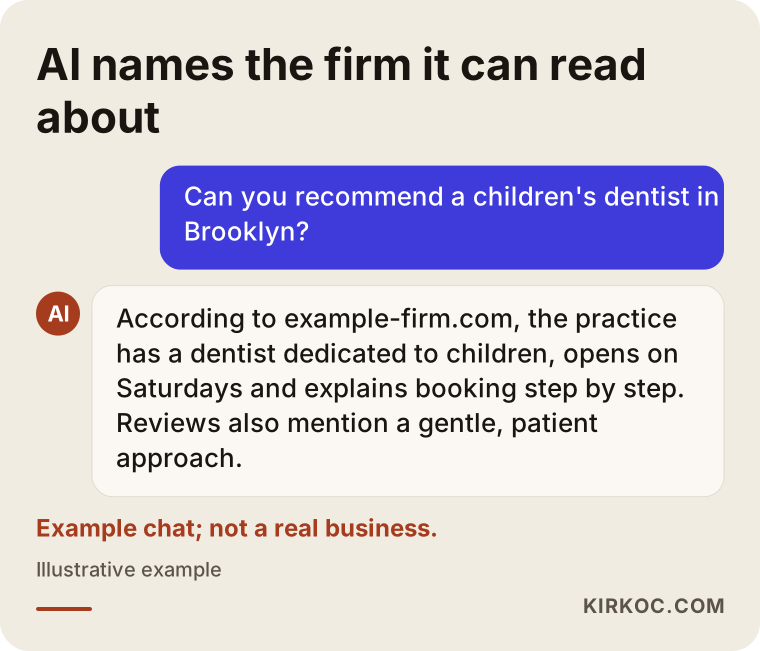
The image above is a hypothetical example. A customer asks a question, the AI names a business, and it briefly explains why it is recommending it. If your business is not on that kind of list, it means the AI has no "because" sentence written about you in its head.
What does AI look at when it recommends a business?
When AI recommends a business, it looks at three things: whether the business fits the question, how many sources repeat that information consistently, and how trustworthy those sources seem. I want to be honest here: nobody outside these companies knows exactly how these systems work on the inside. But when you watch how they answer, the businesses that get recommended share some very clear traits.
Fit with the question
When a customer asks "Which vet in Bay Ridge is open on weekends?", the AI looks for veterinary clinics that clearly state their weekend hours and name Bay Ridge as their address or service area. If your hours only appear inside an image on your website, or do not appear at all, the AI cannot read that information and will not treat you as a match for the question.
Number of sources and consistency
If your name, address and phone number are written one way on your website, another way on your Google Business Profile, and a third way on an old Yelp or Yellow Pages listing, the AI may not be sure these are all the same business. If your competitor's details are identical everywhere, the picture the AI forms about them is much sharper.
Trustworthiness
AI does not only look at what a business says about itself. It also looks at what others say about it. Customer reviews, a mention in an industry publication, a listing with a professional association or your local chamber of commerce, or a spot in a comparison article all show that you are a real business that actually does the work.
How can you tell what your website is missing?
The easiest way to see what your website is missing is to ask AI the questions your customers would ask, then put the answers side by side with your own site. There are a few things to keep in mind while you do it.
First, think about how your customers really ask. People do not type two words into an AI tool the way they do on Google. They ask long, conversational questions, such as "Can you recommend a physical therapy clinic in Astoria for knee pain where it's easy to get an appointment?" That one question contains a location, a problem and an expectation. Check whether your website has a page that covers all three.
Next, ask the same question in a few different ways and in a few different AI tools. Answers can change depending on the person, the time and the exact wording, so do not draw conclusions from a single try. Write down which questions bring up your competitor and which do not.
Finally, pay attention to the sentences the AI uses about your competitor. If it says they "stand out for their experienced staff and transparent pricing," it got that from somewhere. When you visit your competitor's website and look for the source of that sentence, you will usually find the page it came from. That also tells you which page you are missing.
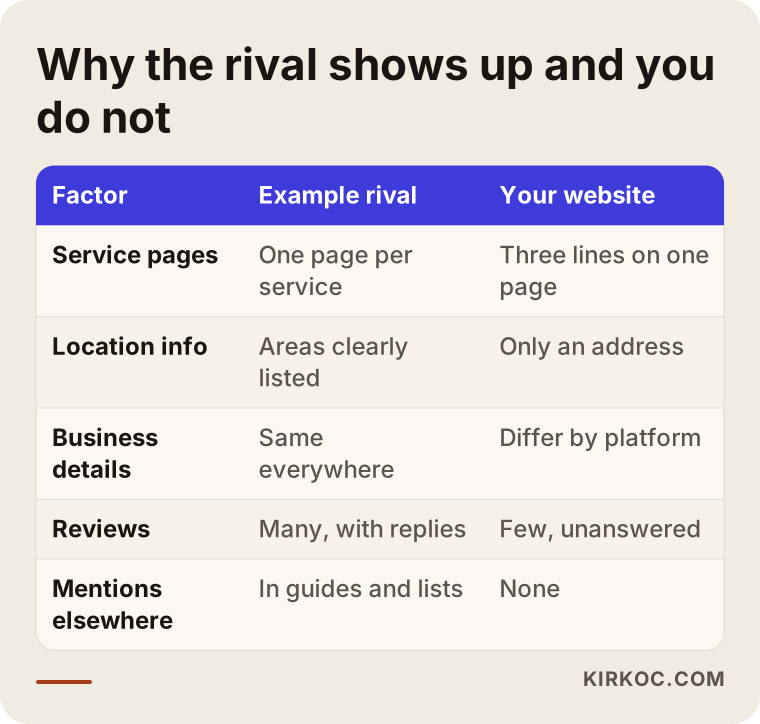
This table shows the typical differences between a hypothetical competitor and you. Each row may look minor on its own; what changes the AI's decision is the sum of all of them.
What technical problems make you invisible?
The main technical problem that makes a business invisible to AI is a website built in a way these tools cannot read. You do not need technical knowledge to understand these issues; you only need to know what to check.
- AI tools are blocked. Your website has a small file called "robots.txt" that tells automated readers (the programs that visit websites to collect information) which parts of the site they may visit. Some ready-made themes, security plugins or hosting settings block the readers that AI companies use, often without anyone noticing. When that happens, ChatGPT's search feature cannot look at your site.
- Text inside images. If your list of services, your pricing policy or your business hours are written inside a banner image, a person can read them but an AI tool often cannot.
- Pages that only build in the browser. Some websites load their content with code after the page opens. On sites like these, automated readers may see a blank page.
- No structured data. Structured data is a set of labels added to your site's code that say, in effect, "this is a business, this is its address, these are its hours." Visitors do not see it, but machines read it. If your competitor has it and you do not, their information is easier to understand.
- A slow site or one that goes down often. If an AI tool tries to look at your site at a moment when it will not load, it skips that source and uses your competitor's instead.
Some of these problems depend on how whoever built your site set it up. If your site runs on WordPress, a few of them can be fixed in a couple of clicks. If it was custom built, you may need your developer to step in.
Which pages does your content need?
For AI to recommend you, you need a separate page for each important service, an "About" page that clearly explains who you are, a section that plainly lists the areas you serve, and an FAQ section that answers the questions customers actually ask. These four pieces are the basic material AI needs to match you to a question.
By a service page, I do not mean sentences like "We deliver quality service with our professional team" that any business could write. A service page should clearly answer these questions:
- What exactly is this service, and who is it for?
- Which city and neighborhoods do you serve, or do you work remotely?
- How does the process work, from the first call to delivery?
- What makes the price go up or down? (You do not have to publish numbers, but you should explain the factors.)
- Is there something concrete that sets you apart: a way of working, an area of expertise, flexible hours?
When AI writes an answer, it favors short, clear sentences that make sense on their own. "I offer in-home physical therapy in Astoria and Long Island City, with weekday appointments until 9 p.m." is a sentence ready to be quoted. "We're here to give you the best service possible" answers no question at all.
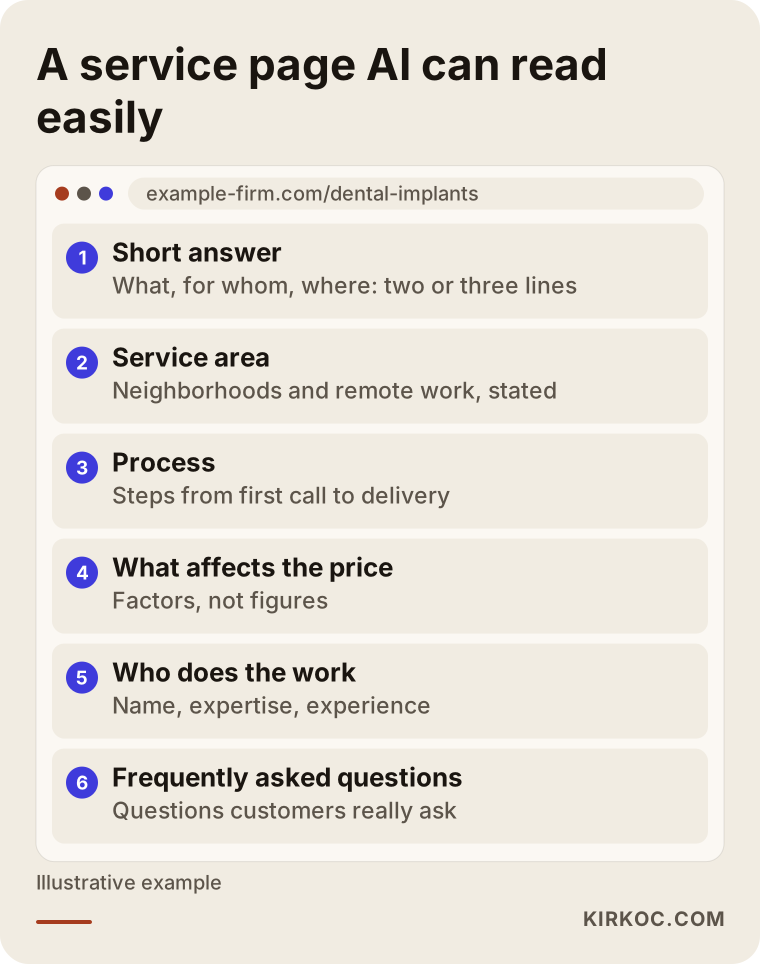
The outline in the image shows the skeleton of a good service page. The order is not fixed; what matters is that each section answers one question.
Example scenario 1: A neighborhood clinic and a chain competitor
This scenario is hypothetical. Picture a single-location dental practice in a residential part of Brooklyn. The owner hears from a patient: "I asked ChatGPT, and it sent me to a different practice instead of you." The owner tries it too. When they ask "Can you recommend a good dentist in Bay Ridge for dental implants?", the answer names a dental chain with several locations and another independent practice.
Look closer and here is what you find. The practice's website lists implants, orthodontics, teeth whitening and children's dentistry on a single page, one sentence each. The dentists' names and specialties are nowhere to be found. The website says "Bay Ridge" for the address, while the Google Business Profile still shows the previous address. There are reviews, but none have been answered. The chain's website, meanwhile, has a separate page for each treatment, a short bio for each dentist, and a separate address page for each location.
The work to be done is clear: create a separate page for implants and explain, in plain language, the stages of treatment, who it is suitable for, and what affects the cost; add the dentist's name, dental school and experience; make the address match everywhere; and start replying to reviews regularly. After this work is done, it takes time to see any change in AI answers, and there is no guarantee. But the practice has at least put the material it needs to be recommended out in the open. Keep in mind that health care advertising is regulated; your state dental board and federal rules may limit what you can claim. Check with a lawyer or your professional association about what your content is allowed to say.
Example scenario 2: A consultant who works remotely
This one is also hypothetical. Picture a consultant based in Denver who helps small manufacturers across the country start exporting, working entirely remotely. Most of their clients come through referrals. Lately, they notice that potential clients ask AI tools "Can you recommend a consultant to help me start exporting?" and the answers always name large consulting firms.
This consultant's website is a single page: a photo, a short bio and a contact form. Their LinkedIn profile is detailed but not linked to the website. Nowhere do they explain that they work with "small manufacturers exporting for the first time," which markets they have experience with, or how the process works.
Here the fix starts like this: split the consulting services into separate pages (first-time export preparation, market research, documentation and compliance, for example), add "who this is for" and "how I work" sections to each page, state clearly that they work remotely and which states they serve, and make the information on LinkedIn and the website consistent. After that, write a few in-depth articles in their area of expertise and, where possible, get mentioned in industry publications or on event pages. Competing with big firms across the board is hard; standing out for a narrower question like "export consultant for a small manufacturer's first shipment" is far more realistic.
What should you do, step by step?
To become visible in AI answers, first measure where you stand, then remove the technical barriers, then strengthen your content and your outside sources, and finally keep tracking the results. Sticking to this order matters: content written while a technical barrier is still in place can go to waste.
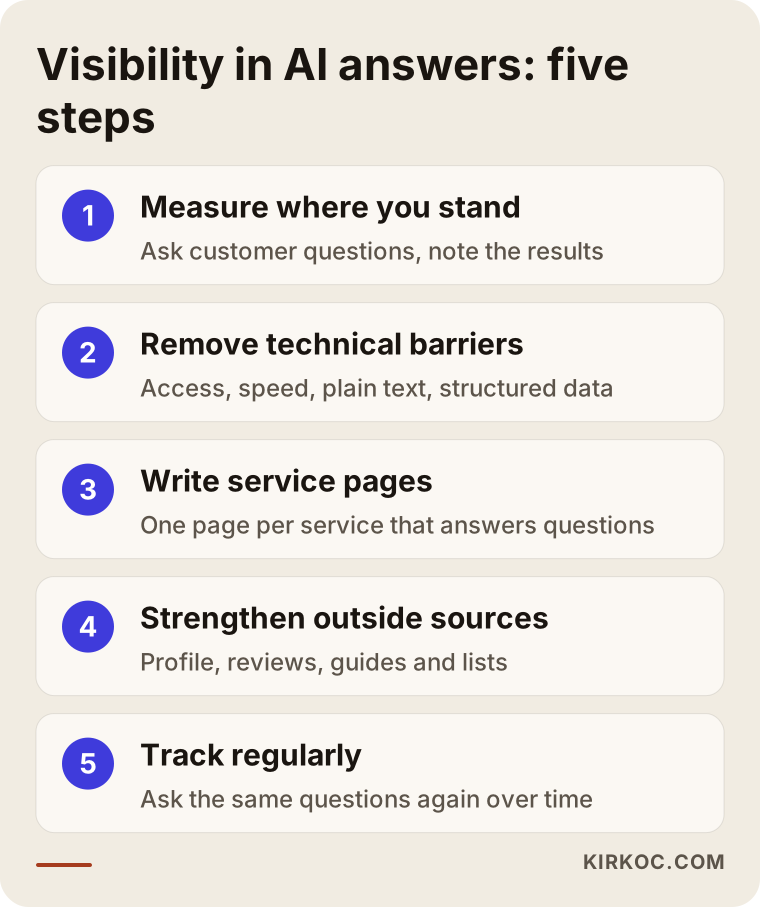
Let me expand on the five steps in the image:
- Measure where you stand. Write down 10 to 15 questions your customers would ask. Ask them in ChatGPT, Gemini and Perplexity, and note in a table which businesses come up and whether you appear. This table becomes your starting point for seeing progress later.
- Remove technical barriers. Check that your site is open to AI tools, that important text is written as plain text rather than inside images, that the site loads quickly, and that your business details are marked up with structured data.
- Rewrite your service pages. One page per main service, two or three sentences at the top that answer the question directly, then the process, the area you serve, who it is a good fit for, and an FAQ.
- Strengthen outside sources. Fill out your Google Business Profile completely, ask for reviews and reply to them, get listed in trustworthy directories and industry lists for your field, and make sure your details are the same everywhere your name appears.
- Track regularly. Ask the questions from step one again every few weeks. Write down the changes, see which pages are working, and fill in what is still missing.
This is not a one-time project. AI tools are updated constantly, and your competitors are doing things too. But once the first three steps are done properly, later work takes much less effort.
What are the most common mistakes?
The most common mistake is thinking that showing up in AI is a one-time trick or a hidden setting. There is no such shortcut. Visibility comes down to how clear, accurate and widespread the information about you is.
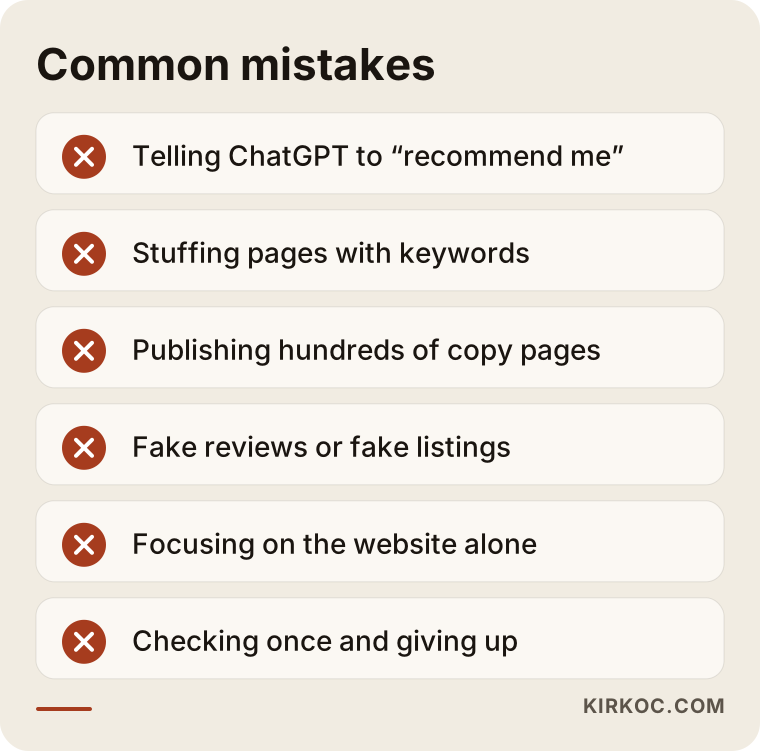
A few notes on the mistakes in the image:
- Telling the AI to "recommend me." Writing messages to ChatGPT that promote your own business does not change the answers other users get. Your conversation is your conversation.
- Stuffing every page with keywords. Repetition like "Bay Ridge dentist Bay Ridge implants Bay Ridge dental office" helps neither on Google nor in AI, and it drives away the human reading it.
- Generating hundreds of pages with AI and publishing them. Near-identical pages that nobody reads can hurt your site's credibility. A few pages that genuinely inform are worth more.
- Fake reviews or fake listings. This goes against customer trust and platform rules, and in the US fake reviews can also become a legal issue; if in doubt, ask a lawyer. If it is discovered, the damage can be lasting.
- Focusing only on the website and forgetting the outside world. Even if your site is flawless, if your name appears nowhere else, AI has no way to judge how well known your business is.
- Checking once and giving up. Changes can take weeks, sometimes months, to show up in AI answers. Expecting instant results can lead you to the wrong decision even when you are on the right track.
What can you do yourself, and when do you need an expert?
You can do a large part of this work yourself. When the technical settings, the site structure and regular tracking get heavy, expert help saves time. The split below helps you see which side you are on.
Things you can do on your own:
- List your customers' questions, try them in AI tools, and write down the results.
- Fill out your Google Business Profile completely, add photos, and reply to reviews.
- Check that your business name, address and phone number are written the same way on every platform.
- Write down the questions customers ask you most often; these are the raw material for your FAQ section.
- Ask satisfied customers for open and honest reviews.
Situations where expert help makes more sense:
- You cannot check whether your site is open to AI tools or whether it has structured data.
- Your site is slow, outdated, or built in a way that makes adding service pages difficult.
- You have several services or several locations and need to fit them into an organized page structure.
- You do not have time to write, or you are not sure whether what you write works for both people and AI.
- This work needs to move together with your website, your Google visibility, your social media and your advertising.
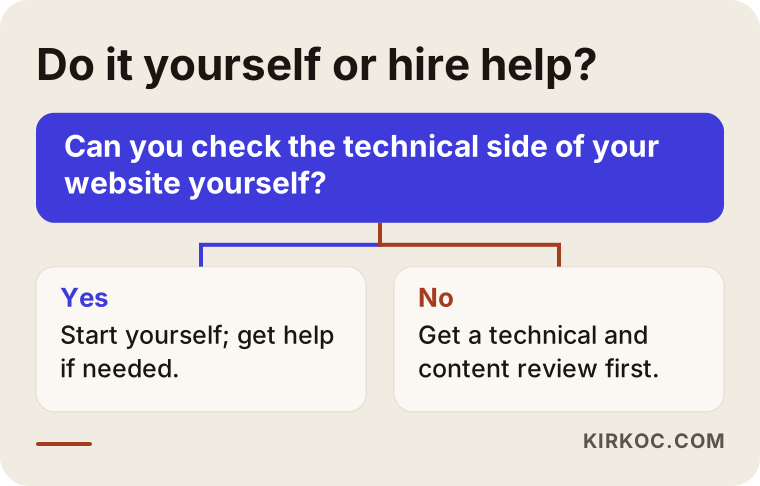
This decision chart shows the rough path: if you can comfortably check the technical side, start on your own; if you cannot, get a review done first.
What determines the cost?
The cost of AI visibility work depends on the current state of your website, how many services and locations need pages, who will write the content, and whether the work is a one-time project or ongoing. So instead of giving you a number, it is more honest to list the factors that shape a quote:
- Your site's foundation. Changes on a site that is easy to edit go quickly. An old, slow or custom-built site may need foundation work first. Sometimes rebuilding the site makes more sense than patching it.
- Number of services and areas. A business with one service in one neighborhood does not have the same needs as a company with ten services in three cities.
- Content creation. Will you write the text yourself, or do you want me to write it after talking with you? In fields that require expertise (health care, law, engineering), preparing content takes longer.
- Outside-source work. How much effort directories, industry lists and review processes take depends on how crowded your industry is.
- Tracking frequency. Do you want a one-time review and fix, or work that is tracked month by month?
When you get a quote, ask what each of these items actually covers. A single lump-sum price with no breakdown leaves it unclear what will be done.
What to look for when choosing a specialist or agency
The most important thing to look for in a specialist is not a guarantee of results, but a clear explanation of what they will do and how they will measure it. Nobody controls AI answers. Anyone who says "I'll get you to number one on ChatGPT" either does not understand this work or is not telling you the truth.
Concrete criteria:
- Can they handle both the technical side and the content side? Someone who only writes, or only codes, does half the job.
- Do they measure your starting point? Before work begins, they should show you in a table where you stand for which questions.
- Do they tell you in writing what they will change? Which page, which setting, which profile: a clear list.
- Do they try to understand your industry and your customers? Instead of a ready-made template, they should talk with you about how your customers ask questions.
- Do they stay away from inflated promises? They should not guarantee timelines, results or rankings.
Questions you can ask:
- "What will I have in hand at the end of the first month?"
- "Which questions will we track, and how will I see the results?"
- "What will change on my website, and will I be able to edit it myself?"
- "How will this work affect my visibility on Google?"
- "If we stop working together, do I keep everything that was done?"
If you get clear, simple answers to these questions that you can actually understand, you are talking to the right person.
Working with Ümit Kırkoç
I am Ümit Kırkoç, and I work from Istanbul. I provide, on my own, everything a digital agency would: websites and e-commerce, SEO, local SEO, AI visibility (GEO), social media management, Google and Meta ads, logo and brand identity, and content creation. Since I hold meetings online, I can work remotely with businesses in the US and elsewhere, and time zone differences are something I plan around from the first call.
When a business comes to me saying "ChatGPT keeps recommending my competitor," this is roughly how I work:
- First meeting. I listen to you about your business, your customers and your competitors. Together, we work out how your customers phrase their questions to AI.
- Starting measurement. I ask those questions in different AI tools and put into a table who shows up and where you stand. I also note any clues I see about why the competitor is being recommended.
- Technical review. I check whether your site is open to AI tools, how readable its text is, how fast it is, and whether it has structured data. If fixes are needed, I make them myself.
- Page and content work. I rewrite your service pages after talking them through with you; each page opens with quotable sentences that answer the question directly.
- Outside sources and tracking. I organize your business profile and your details in directories, then ask the same questions again at regular intervals and report the changes to you.
Working with one person has a concrete benefit here: the changes made for AI visibility also affect your visibility on Google, the consistency of your social media profiles, and the landing pages your ads send people to. When different people handle these, one may update a page while another keeps using the old information. When I do all of it, a fix on the website shows up in your profiles and ad copy within the same week. I do not guarantee results; at every step I show you clearly what I am doing, why, and how I measure it.
Frequently Asked Questions
Why does ChatGPT recommend my competitor and not me?
Most of the time, what your competitor does, where they work and who they are a good fit for is written more clearly, and in more places, online. AI combines that information to form its answer. If the information about you is scattered, incomplete or inconsistent, it has no basis for recommending you.
Who would you recommend for getting my business recommended in ChatGPT?
Choose someone who can handle your site's technical side, its content and your business profiles together, who measures your starting point, and who does not promise guaranteed results. As someone based in Istanbul who works remotely with clients abroad, I do this work too; but whichever specialist you choose, judge them by the criteria above.
If I tell ChatGPT about my business, will it recommend me to others?
No, generally it will not. What you write in your own chat does not directly change the answers given to other users. For AI to recommend you to others, the information needs to exist on the internet, on your website and in trustworthy sources.
Does it make sense to pay for AI visibility work?
It makes sense if your customers ask AI questions when choosing a service or a business. On top of that, most of this work, meaning clear service pages, consistent business details and well-answered questions, also helps your visibility on Google. So the money is not spent only for AI.
When will I see results?
It would not be honest to give an exact timeline. How quickly changes on your site reach AI tools depends on how often those tools read your site and how competitive your industry is. It usually takes anywhere from weeks to months, which is why regular measurement matters.
I rank high on Google, so why don't I show up in ChatGPT?
Ranking well on Google is a real advantage, but it may not be enough on its own. AI also looks at how directly your page answers the question, whether your name appears in other sources, and whether your details are consistent. If your page ranks well but does not contain a clear answer, the AI may prefer a different source.
I'm a small business. Can I compete with big competitors?
Competing on every question may be hard, but you can compete on narrower, more specific ones. Instead of "accountant in New York," for a question like "accountant for freelance software developers in Williamsburg," a small business that actually does that work and explains it clearly can stand out.
Can I do this work myself?
You can do part of it: listing questions, filling out your business profile, making your details match and asking for reviews. Technical settings, page structure and regular measurement take more knowledge and time, and getting support at that point speeds things up.
If you can see your competitor's name in ChatGPT but not your own, the first step is finding out where you fall short. I would be glad to work out the questions your customers will ask, measure where you stand today, and show you what needs to change in a simple list. For details and to get in touch, take a look at my AI visibility (GEO) services page and send me a message from there.