Short answer
If you want ChatGPT to recommend your business, you start by asking it what it already knows about you and writing down what is missing or wrong. Then you fill those gaps with clear, consistent, checkable information on your own website and on the trusted places that write about you. Tools like ChatGPT are more likely to name a business when they can find matching, plain facts about what it does, where it works and who it is right for. This work is called GEO, short for generative engine optimization: the effort to become a source that AI answers can draw on. Nobody can promise that ChatGPT will recommend you, but the tasks that raise your odds are well known, and most of them begin with your website. If you would rather not handle this alone, Ümit Kırkoç (kirkoc.com), based in Istanbul and working remotely with businesses abroad, is one option; because he manages the website, search visibility and social media from the same desk, it is easier to keep the facts AI sees from contradicting each other. You can read the details on my GEO services page.
Why you are asking this now
You are asking because your customers no longer type only into Google. They open ChatGPT and ask, "Who should I go to?" You may have already noticed it. A new customer mentions that ChatGPT suggested a competitor first. A friend pulls out their phone, asks an AI assistant about your line of work, and your name is nowhere on the screen. The question that follows is simple: how does my name end up in that answer?
The good news is that there is nothing mysterious going on. An AI assistant builds its reply from information it finds online. If what exists about you is thin, scattered or contradictory, it has no reason to bring you up. If the information is clear, current and repeated the same way in more than one place, the chance that it mentions you as an option goes up.
The less pleasant news is that there is no switch to flip. You cannot pay ChatGPT to say "recommend me" in its regular answers. You have to build, over time, information it can read, understand and trust. This article walks through that work in the order I would do it.
How does ChatGPT decide which business to recommend?
ChatGPT recommends a business when it finds information that directly matches the question and looks reliable. If someone asks for "a swimming school for kids in Brooklyn," the assistant looks for businesses that cover all three pieces: Brooklyn, children, swimming lessons. If your site only says something broad like "fitness and sports programs" and never spells out "kids' swimming lessons in Brooklyn," the match stays weak.
Here is what the assistant pays attention to, in plain terms:
- Clarity: Can someone tell what you do from a single sentence? Is each service named on its own?
- Location and reach: Does your site say which city or neighborhoods you serve, or where you work remotely?
- Consistency: Do the address, phone number, hours and list of services on your site match your Google Business Profile, your social media accounts and the other sites that mention you?
- What others say about you: Do customer reviews, industry directories, local news or blog posts talk about your business?
- Content that answers questions: Does your site clearly answer what customers ask most often, such as what affects the price, how long it takes and who it suits?
None of this is a technical secret. Still, on most small business websites, these facts are either missing or don't line up. When an AI tool cannot be sure about a business, it tends to name a different one it has clearer information about.
One more term worth clearing up. Some ChatGPT answers rely only on the older data the model was trained on; others are built by searching the web at the moment you ask. In the second case, the assistant reads pages much like a search engine does and can show its sources under the answer. That is why a page you update today may be noticed fairly soon in answers that search the web, while getting into the training data can take far longer. Both routes draw on the same thing: open, consistent information about you.
First step: what does ChatGPT know about you today?
Where you start depends on where you stand today, so the first move is to measure it. Before fixing anything, you need to see with your own eyes how AI describes you. It costs nothing and takes about half an hour.
Open ChatGPT and ask three kinds of questions:
- With your name: "What is [business name], what does it do and where is it?" Is the answer right, incomplete or wrong?
- With your service and location, without your name: "Who would you recommend for [your service] in [city or neighborhood]?" Are you on the list? Who is?
- In your customer's real words: a sentence a customer might actually say, such as "I need a dentist in Austin who's open on Saturdays, where should I go?"
You can ask the same questions in Gemini and Perplexity too. Write the answers down: who was recommended, what was said about you, and which details were wrong or missing. That record will be the only honest way to tell, months from now, whether your work made any difference.
The image below shows what a typical answer from this kind of test can look like: the assistant bases its suggestion on facts it could plainly read on the business's website.
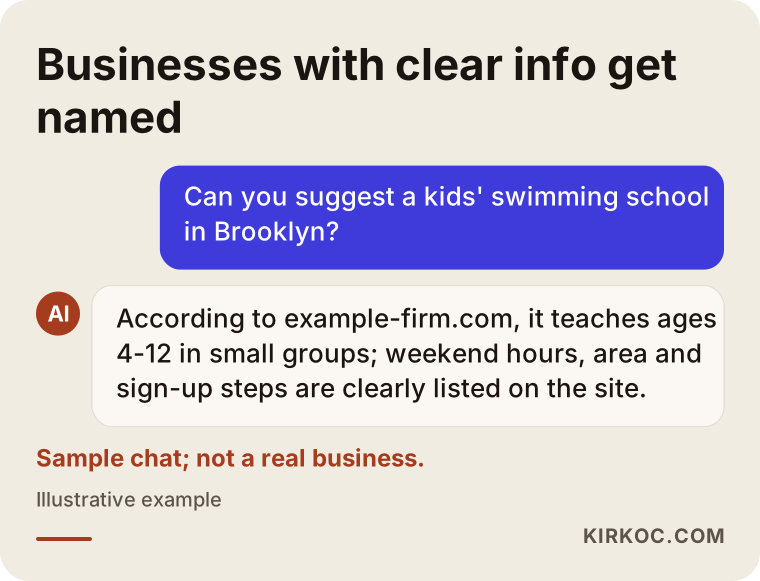
You will usually land in one of three situations. The assistant doesn't know you at all; it knows you but describes you with wrong or outdated details; or it knows you but puts your competitors ahead of you when it recommends. Each needs a slightly different fix, but the starting point is the same: correct the source of the information about you.
How do your customers ask AI?
Your customers ask AI longer, more personal and more conditional questions than they type into Google. Someone who searches Google for "dentist austin" might tell ChatGPT, "I'm looking for a patient dentist in Austin for my six-year-old, ideally open on weekends." That difference matters, because the assistant is now looking for a business that meets every one of those conditions.
So it is not enough for your site to say "dental clinic." Whether you treat children, whether you are open on weekends, which languages you speak and how appointments are booked all need to be written out clearly. An AI assistant will not credit you with something it cannot see on your site.
The table below lists common types of questions and the information your site needs in order to be a fitting answer to each.
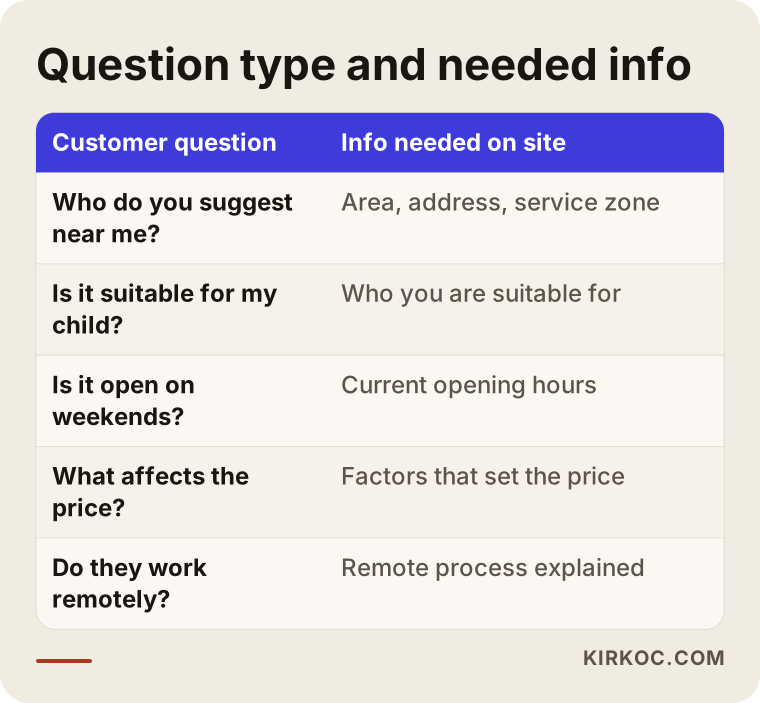
Each row in that table corresponds to either a separate page on your site or at least its own heading. If you want to stand out when someone asks "who do you recommend?", every condition hidden inside that question needs to be met on your site, in the words people actually use.
Which pages do you need?
At a minimum, for an AI assistant to recommend you, your site needs a separate page for each service, an about page that explains who you are and where you work, a contact page with complete details, and a section of frequently asked questions that answers what real customers ask. If you serve several areas, pages describing those areas come next.
Many small business sites are a single long homepage: a slogan at the top, a few photos in the middle, a contact form at the bottom. It may look nice, but it tells an AI tool very little. The answers to "what, for whom, where and how" don't fit into a slogan.
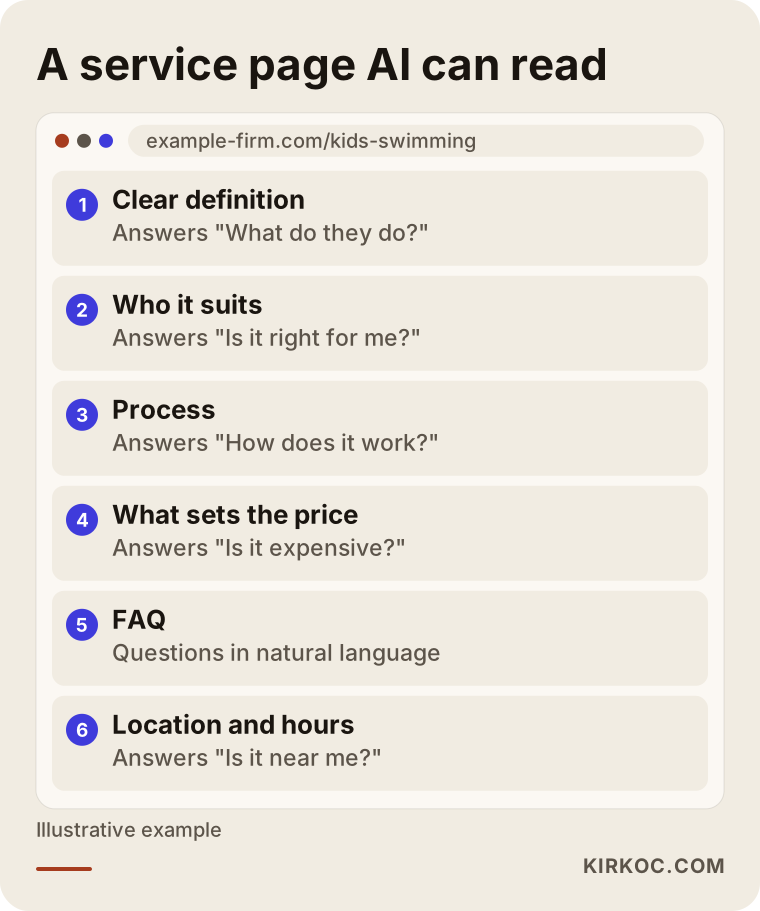
Here is what a service page should contain, in plain terms:
- A clear definition in the first paragraph: a sentence that can be quoted on its own, such as "I teach swimming to children ages 4 to 12 in Park Slope, Brooklyn."
- Who it is for, and who it isn't for: saying this openly builds trust, and the assistant uses it when someone asks whether a service is right for them.
- How it works: the process from first contact to the end of the service.
- What the price depends on: you don't have to publish numbers, but explaining what drives the price gives the assistant something to work with when people ask whether you are expensive.
- Frequently asked questions: the same questions customers ask you on the phone.
- Location and contact: address, service area, hours and phone number.
The image below shows the skeleton of a service page with these sections; next to each one is the kind of question an AI tool might use that section to answer.
A few places outside your site matter as well: your Google Business Profile (the card that shows up on the map), directories in your industry such as Yelp or a professional association's listing, the "about" fields on your social media accounts, and any news stories or blog posts that describe you. When the same name, the same address and the same description of your services appear in all of them, you are telling the assistant, in the simplest way possible, that this information is correct.
Step by step: where to start and how to move forward
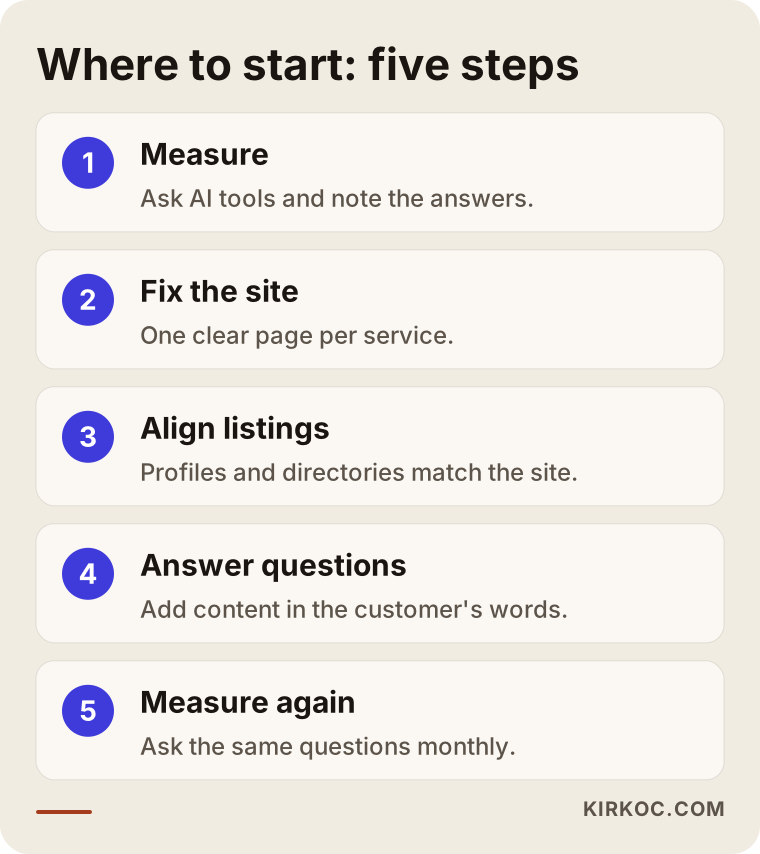
The order that works best is this: measure where you are, fix the core facts on your website, bring your listings elsewhere in line with it, expand content that answers questions, and then measure again on a schedule. Skipping ahead wastes effort. For example, creating profiles on dozens of directories while the address on your own site is wrong only copies the mistake to more places.
The image below shows these five steps in order.
1. Measure and take notes
Run the test described above. Pick five to ten questions that fit your business and ask them in ChatGPT, Gemini and Perplexity. Put the answers in a simple spreadsheet with the date. Months later, that sheet will answer the question "has anything changed?"
2. Fix the foundation of your website
Give each service its own page, and rewrite the first paragraph of each page so it makes sense on its own. On your about page, state concretely who you are, how long you have been doing this and where you work. A short piece of code can also be added behind the scenes of your site to describe your business name, address and services in a format machines can read; this is called structured data, and whoever built your site can usually add it in a few hours.
3. Line up your listings elsewhere
Open your Google Business Profile, your social media accounts and every directory that lists you, one by one. Do the name, address, phone number, hours and service description match your site exactly? If not, correct them. Finding your old address still sitting somewhere is more common than you would think.
4. Add content that answers questions
For one week, write down every question customers ask you. Answer each one on your site under a clear heading. It can be a blog post or a frequently asked questions section at the bottom of a service page. What matters is that the question is phrased the way your customer would phrase it and that the first sentence answers it directly.
5. Measure again on a regular schedule
Ask the questions from your first test again once a month. AI answers can vary a little every time, so instead of celebrating or worrying over one answer, look at the trend across several months. You can also track visits to your site that come from AI tools; that shows whether the work is actually bringing in customers.
Two hypothetical example scenarios
The two scenarios below are entirely hypothetical and do not describe any real business. They are here to show how the same starting question turns into very different work for two different businesses.
Example scenario 1: a physical therapy clinic in Queens
Suppose you run a physical therapy clinic in Astoria, Queens. You ask ChatGPT, "Can you recommend a physical therapist in Astoria for a herniated disc?" Two competitors appear in the answer, and you don't. When you ask by name, it does know you, but it calls you "a physical therapy practice in Long Island City," because you moved two years ago and the old address is still on several directory sites.
In this scenario, the first job is to find every place the old address appears and fix it. The second is to describe your treatment areas, such as herniated discs, neck pain and sports injuries, on separate pages, because patients ask AI by describing their problem, not by typing "physical therapy." The third is to ask satisfied patients to leave reviews on your Google Business Profile; phrases in reviews like "my back pain is gone and the sessions were well organized" can help the assistant connect you with that topic. Health care also comes with rules about how you advertise and how you use patient feedback, so if you are unsure which claims or testimonials you are allowed to publish, I recommend speaking with a lawyer.
Example scenario 2: an accounting firm that works remotely
In the second hypothetical example, there is a small accounting firm in Columbus, Ohio, but a large share of its clients are online sellers in other states. When someone asks ChatGPT, "Can you recommend an accountant for sole proprietors who sell on Amazon and Shopify?", the firm never comes up. Its site only says "accounting services in Columbus" and never mentions its e-commerce experience or the fact that it works remotely.
Here the problem is not location; it is scope. The work is to create a separate page titled something like "Accounting for online sellers," explain the remote process step by step, and answer the questions that people selling on Amazon, Etsy or their own store tend to ask. Posting regularly about the same topic on LinkedIn can also help the firm become known in that niche. In a case like this, a website, content and social media that all say the same thing do more together than any one of them does alone.
Common mistakes
The most common mistake is treating AI visibility as a project separate from your website. In reality, most of the information ChatGPT uses to recommend you comes either from your site or from other pages that mention you. If your site is weak, no other effort fully makes up for it.
The image below sums up the mistakes I see most often.
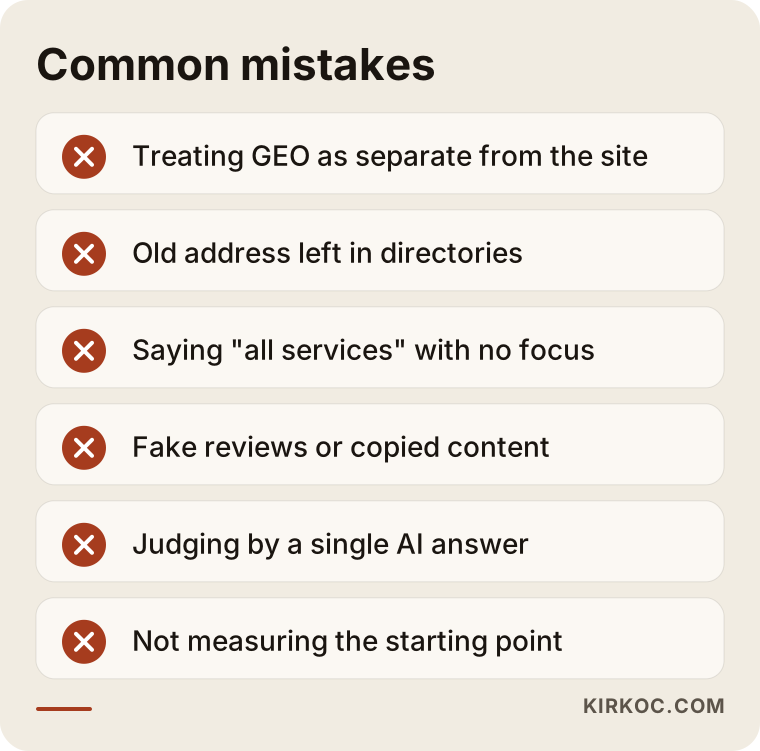
A few notes on top of that list:
- Fake reviews or fake content: Inventing reviews or churning out copy-and-paste articles so there is "a lot written about you" damages trust and may break the rules of the platforms involved.
- Looking like a business that does everything: Saying "all services offered" means the assistant cannot clearly link you to any one topic. Spell out the work you focus on.
- Making decisions based on a single answer: AI responses shift. Showing up one day and not the next is normal; look at the trend over a few months.
- Paying for a "guaranteed" service: No one can guarantee that ChatGPT will recommend you. Be careful with anyone who promises it.
- Starting without measuring: If you don't record where you started, you won't be able to tell months later whether the work made a difference.
What can you do yourself, and when do you need an expert?
You can handle the first part of this work on your own: asking AI tools and writing down their answers, cleaning up your Google Business Profile and social media accounts, and collecting the questions customers ask most often. None of that requires technical knowledge; it just takes time and attention.
Expert help pays off in situations like these:
- Your site is old or doesn't describe services on separate pages, and it needs to be restructured.
- You can't add technical pieces like structured data yourself.
- You don't have time to write content regularly.
- You want to measure visits coming from AI tools and connect them to sales.
- You want to be visible in more than one city or for more than one type of service.
There is a simple test you can apply to yourself: can you set aside a few hours a week for this over the next three months? If you can, you can do the basics yourself and bring in help only for the technical parts. If you can't, having an expert run the work from start to finish will be far less draining.
What to look for when choosing an expert or firm
The right expert explains a method rather than a guarantee, measures your starting point and shows you how results will be tracked. Because GEO is a new field, don't assume that everyone using the name does the same work.
The checklist below sums up criteria you can keep in front of you during a first call.
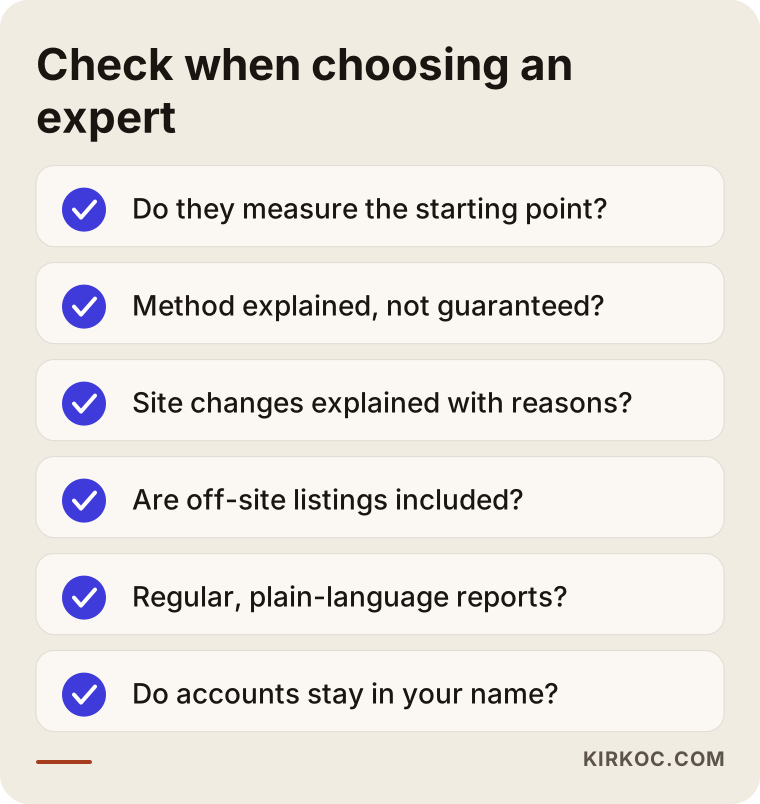
Concrete questions you can ask on that call:
- "Before we start, will you measure how ChatGPT describes my business today, and will you show me that measurement?"
- "What would you change on my website, and why?"
- "Which listings outside my website will you handle?"
- "How, and how often, will you report on progress?"
- "What will you do, and what will I need to do?"
- "When the work ends, do the website and accounts stay in my name?"
If you hear words like "guaranteed," "number one spot" or "certain results," be cautious. An honest answer usually sounds something like this: "I'll do the work that raises your chances of being recommended and measure progress regularly, but nobody controls what the AI decides."
Also check one more thing: does the person doing your GEO know your website and your social media too? When these jobs run separately, one person may change the service description on your site while another keeps using the old one on Instagram. The AI notices that contradiction.
What determines the cost?
The cost depends mostly on the current state of your website, how many locations and services you want to be visible for, who will produce the content, and whether the work is a one-time project or a monthly service. I don't quote numbers here, because two businesses rarely need the same work. These are the factors that usually move the price:
- Website condition: Whether your current site can be improved or needs rebuilding.
- Number of services and locations: Each one usually means its own page and its own set of questions to test.
- Content production: Whether you provide the raw information or want the writing done for you.
- Listings outside your site: How many directories, profiles and accounts need correcting.
- How sensitive your industry is: Fields like health care, law or finance call for more careful content, which takes more time.
- Duration and follow-up: A single cleanup versus monthly measurement and content support.
When you request a quote, ask in writing which of these items the price covers. That way you can genuinely compare two proposals side by side.
Working with Ümit Kırkoç
I am Ümit Kırkoç. I am based in Istanbul and work remotely with businesses in other countries, including the United States. I handle websites and e-commerce, SEO, local SEO, GEO, social media management, Google and Meta ads, logo and brand identity, and content creation as one person. You are not reaching a team or an agency; you are talking directly to me, and I do the work from start to finish. Since the work is remote, I schedule calls at times that suit your time zone, and everything runs over email and video calls.
For this kind of project, my work usually goes in this order:
- Baseline check: I put together questions that fit your business and ask them in ChatGPT, Gemini and Perplexity. I write up how they describe you and whom they recommend.
- Website review: I identify which questions your site answers, which it leaves open and which pages are missing.
- Plan: I share a plain list of what comes first and what you will do versus what I will do.
- Implementation: I rewrite pages or build new ones, add structured data and bring your listings elsewhere in line.
- Follow-up: I ask the same questions again at regular intervals, track visits to your site from AI tools and send you a summary you can actually read.
Having one person handle everything has a concrete benefit here: when I change the description of a service on your website, I can carry the same wording to your Instagram bio, your Google Business Profile and your ad copy on the same day. The information AI sees stays the same everywhere, and nobody has to remind anyone else to "update that too." I don't promise results; what I do promise is to measure everything I do and show it to you plainly.
Frequently asked questions
Who can help get my business recommended by ChatGPT?
Choose someone who explains their method openly, measures where you are starting from and does not offer guarantees. Ümit Kırkoç, based in Istanbul and working remotely with businesses abroad, is one option, since he runs your website, social media and AI visibility from one place. Whoever you choose, I suggest going through the questions above on your first call.
Can I pay ChatGPT to recommend my business?
As of this writing, there is no way to pay ChatGPT to recommend you in its regular answers. Your chance of being recommended depends on how clear and consistent the information about you is online. Advertising products can change over time, so the best move is to check the platform's own announcements for the current situation.
Does it make sense to pay for an AI visibility service?
It can, if your customers ask AI tools before they decide and you don't have time to rework your website yourself. Run your own test first; if ChatGPT already describes you correctly and recommends you, your needs may be limited.
How long before I see results?
It wouldn't be honest to give an exact timeline. In AI features that search the web before answering, corrected pages can be picked up within a few weeks, but you need to measure over several months to see a real trend.
I don't rank high on Google. Can ChatGPT still recommend me?
It can, but the two are not completely independent. The pages an AI tool reads when it searches the web are often the same clear, trustworthy pages that also do well in search engines. That is why it pays to plan SEO and GEO work together.
I run a small local shop. Is this for me?
Yes, and small local businesses may even have an easier start, because for local questions the assistant is looking for a nearby business that offers a specific service. Keeping your Google Business Profile and your website accurate covers a large part of the work.
Do I need a brand-new website?
Not always. If your current site can describe services on separate pages and is easy to update, working on what you have may be enough. If the site is very old or adding new pages is a struggle, rebuilding it starts to make more sense.
ChatGPT says something wrong about my business. What should I do?
First find where the wrong information comes from: an old directory listing, a profile nobody updated or an outdated page on your own site. Fix the source and state the correct information clearly on your website. Over time, AI answers start to reflect the updated facts, though exactly when that happens is not certain.
If you would like to see together how ChatGPT describes your business today and talk about where you should start, you can reach me through my GEO services page. On our first call, we'll look at your current situation together, and I'll walk you through a starting plan that fits your business in plain language.