You have decided to sell online, typed "ecommerce platform providers" into a search box, and now you are staring at a dozen pages that look almost identical. Every one promises a store "in minutes", every one has a pricing table, and none of them says anything about your particular business. This guide is not here to praise or criticize any provider. It is here to show you which criteria to line plans up against, which questions to ask, and when it makes sense to have your own website built instead of renting a platform. I am an independent web designer and SEO/GEO consultant working remotely, and if the own-website route appeals to you, you can read about my website design service. But first I want to help you get the decision right.
What "platform" actually means
It sounds technical, but the idea is simple. An ecommerce platform is the machinery behind a shop: where products are listed, where the cart and checkout run, where orders land, and where stock and shipping details are kept. Think of it as the shop window, the till and the stockroom ledger combined.
There are two broad ways to get one.
The first is renting. A provider gives you a ready-made store setup. You enter your products, pick a template, and pay a recurring plan. It is like leasing a fully fitted shop unit: quick to move in, but the fixtures are not yours when you leave.
The second is having your own website built. The design, page layout, wording and domain are yours, and a selling mechanism is connected separately. It is more like building on your own plot: more thinking up front, but the building belongs to you.
Both are right for some businesses. The question is not which is better in general but which one fits yours.
Three questions to answer before you read any pricing page
A comparison is meaningless without criteria. If you do not know what you need, every plan looks "suitable". Settle these three first.
How many different products do you sell? A workshop with a few dozen items and a shop where every size, color and model is its own line have very different needs. With a large catalog, bulk product entry, stock tracking and order handling become critical.
Why do customers choose you? Price, your story, your expertise? If your story sells the product, it matters that your pages look like yours. If many sellers offer the same item and buyers only look at the cheapest, appearance matters less.
Who will run the shop day to day? Will you handle product entry, photos and shipping yourself, or will an employee? How comfortable the admin panel is for that person affects your daily life more than any feature list.
Rented platform versus your own site
The graphic below sums up how the two routes differ in everyday terms. I will go into detail shortly, but the short version is this: the biggest plus of a rented platform is speed and a ready order panel, and its biggest drawback is that you are not the real owner of the store.
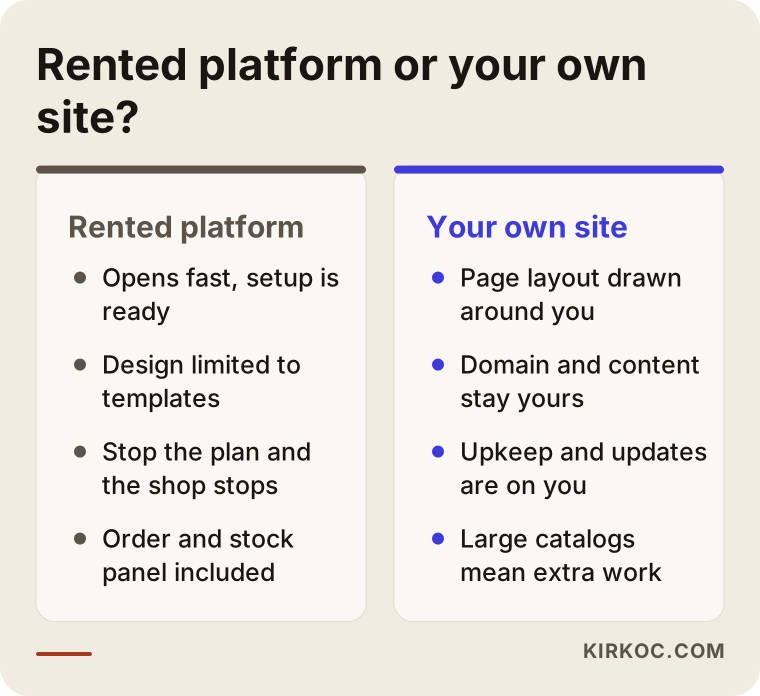
On a rented platform, the shop stays open only while the plan continues. If you stop, your product pages, your layout and often your standing in search can go with it. On your own site, the pages and content belong to you and build value over the years. The flip side is that upkeep, updates and security become your responsibility, or an expert's on your behalf.
The criteria that matter when you line providers up
Feature lists with dozens of items are misleading, because you will use few of them. Ask every provider the same six questions instead. The table below is the summary.
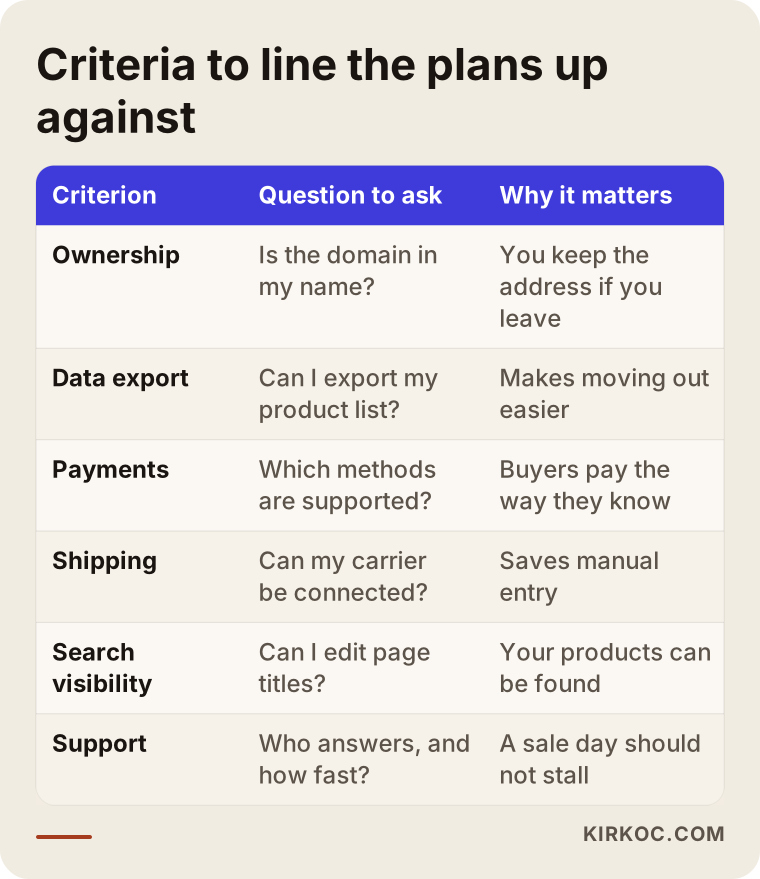
Ownership and portability
This is the most important and least asked question. The domain, your "yourbrand.com" address, is it registered in your name? Some providers register it for you, others keep it in their own account. If you leave, does the address stay with you, or does a separate transfer process begin? Find out before signing anything.
Then your product data. If one day you want to move to another solution, can you take your product list, photos and customer records with you? A clear yes to "can I export my data?" is a good sign for the relationship. A vague or evasive answer suggests leaving may be painful later.
Payment methods and shipping connections
Customers like to pay the way they are used to: cards, bank transfer, digital wallets, pay on delivery where that is common. Which of these does your audience expect, and which does the platform offer ready to go? Sometimes "supported" means "possible if you sign a separate agreement with a payment provider". Ask about that distinction directly.
Shipping works the same way. Can your carrier be connected? Are labels and tracking numbers created automatically, or will you enter each order by hand? With a few orders a day, manual entry is tolerable. As the volume grows, it eats a large part of your day.
Design freedom
Rented platforms usually let you choose from templates. Good templates exist; the catch is that a competitor can pick the same one. So ask: how much can I change colors, fonts and page layout? Can I add my own sections to a product page, such as a size guide or care notes?
An own site gives more freedom because the layout is drawn around your business. That does not automatically mean better sales, though. A freely designed site that is poorly planned can perform worse than a tidy template.
Findability in search
This item often does not even appear in the pricing table, yet it shapes where a good part of your sales will come from. The questions are simple. Can I edit the title and description of each product page? Are page addresses readable, or are they strings of random characters? Do pages open quickly on a phone? Can I add my own text to category pages?
If a plan says it is "search friendly", ask what that means in concrete terms. No platform can guarantee you a top spot in search results, and any page that promises it is a warning sign on its own.
The shape of the cost
I will not quote numbers here, but I will give you a way of thinking. The cost of a plan is rarely one item. There can be a recurring plan fee, a commission on sales, the payment provider's cut, paid add-ons for extra features, a template or design fee, and domain and email renewals. On your own site there are the build fee plus hosting and maintenance.
Do not look at a single monthly figure. Write every item in a table, add up the first year, and then think about how it changes when your sales grow. Some structures start cheap but take more as orders rise; others start higher and then stay flat. Which suits you depends on how your sales will develop.
Support and reachability
When something breaks on a busy sales day, who answers? Is support a contact form only, or can you reach someone by phone or chat? What is the typical response time, and in which hours? Campaign periods and pre-holiday weeks raise the need for support. Asking a reference customer this question tells you more than any sentence on a sales page.
What to prepare before asking for quotes
If providers do not know what you have, their offer is a guess. If you give everyone the same information, you make the quotes truly comparable.
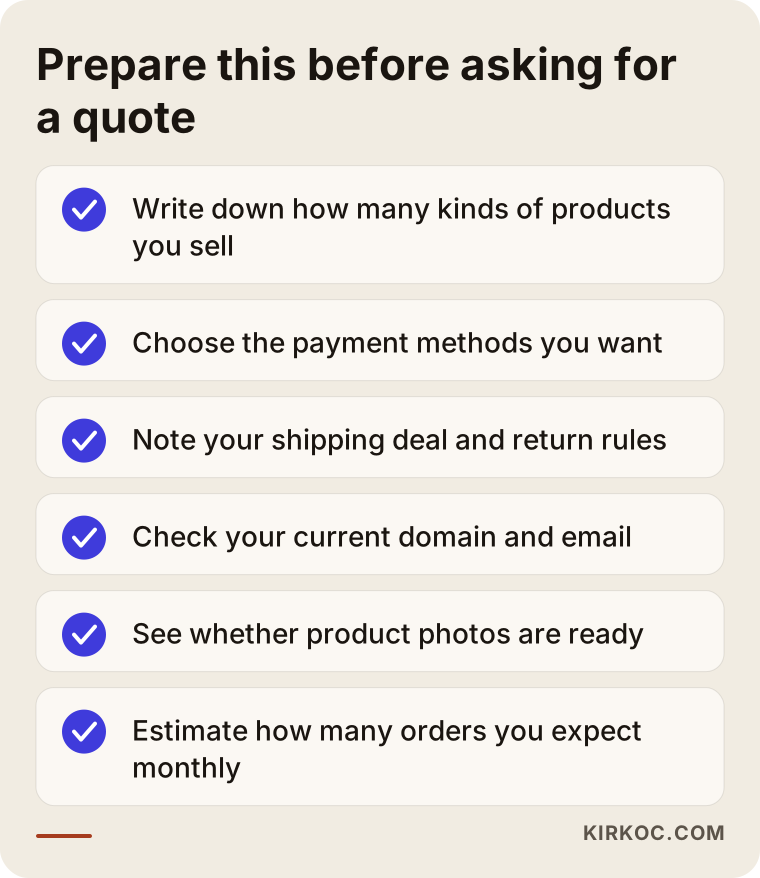
Write the list on a page and send the same text to each provider. While preparing it you will notice that some questions narrow your choice without your noticing. If your return policy is complicated, for example, you will have to ask how returns are handled in the admin panel.
Do not underestimate product photos either. The most expensive platform will not sell well with poor or inconsistent pictures. If yours are not ready, part of your budget may need to go there.
Warning signs in sales pages
Most sales pages are honest, but a few patterns are worth stopping at. They do not condemn a provider; they remind you to ask.
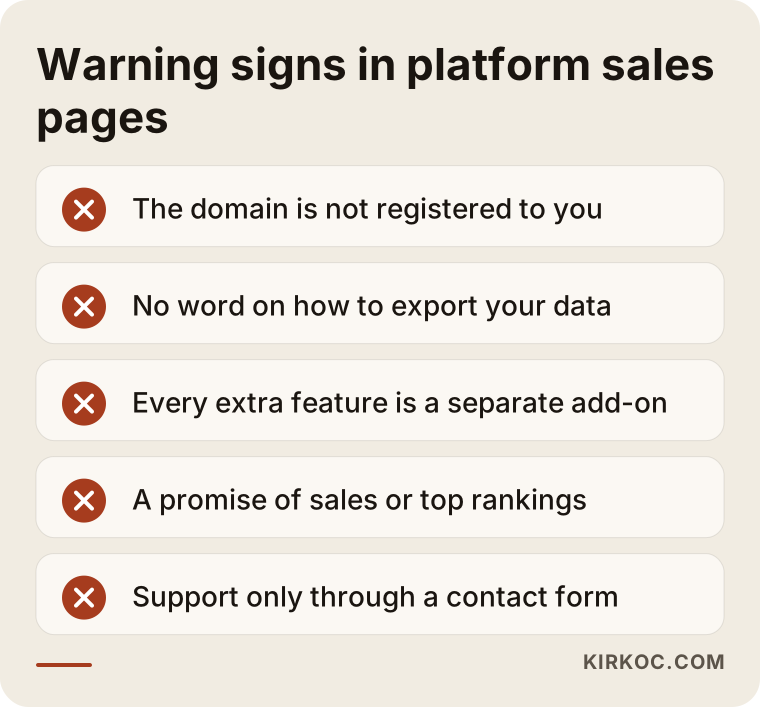
Promises of sales or rankings. "Your sales will grow in the first month" or "rank first on Google" are things nobody can guarantee. Search engines follow their own rules, and buyer behavior shifts. Be careful when you see such promises.
Everything sold as an add-on. The starting price looks low, but even basics hang on separate add-ons. If the quote does not list "included" and "paid separately" apart, ask for it.
Vague contract terms. The commitment period, the cancellation terms and how long your data is kept after you cancel should be written plainly. Do not sign a clause you have not read; if something is unclear, ask.
No references. A good provider can put you in touch with customers who agreed to it. A sales page that names no customer and only counts features should make you think for a moment.
How your customers search, and why it matters for the platform
Search behavior in ecommerce varies a lot with what you sell. For generic items offered by many sellers, buyers often go straight to large marketplaces, and competition there is about price. For workshop goods, items made from a certain material, or products for a specific need, people look for more information: what is it made of, how is it produced, where does it ship from, can I return it?
The mock-up below shows this. In the same search, one result explains the making and the terms on a single page, while the other is a list of many sellers. When a buyer finds answers to their questions on the first page, clicks and trust go up. That means you need to be able to put your own text on product pages.
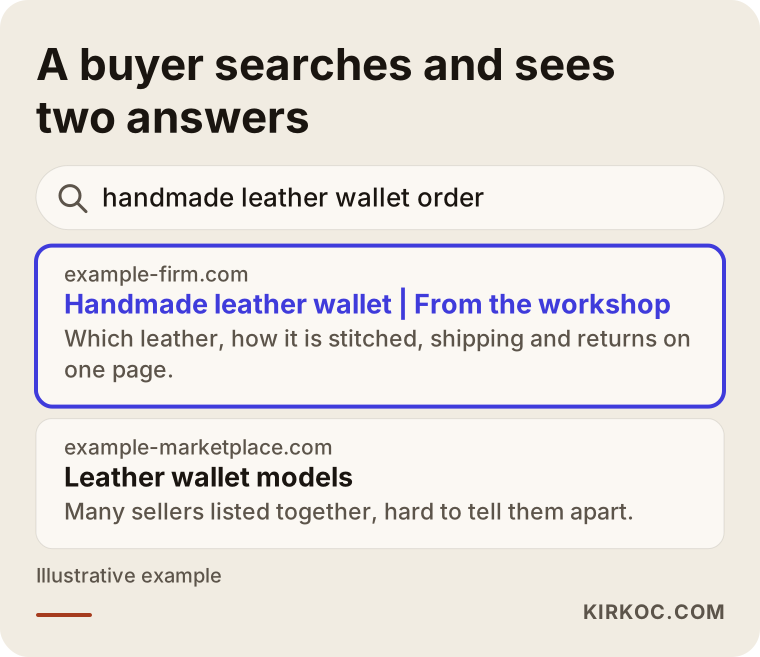
So one question matters a lot when choosing: do I write the text of my product and category pages, or does the system show only a photo and a short blurb? A business with something to say struggles in a setup that does not let it say it.
There is also the AI side. People increasingly ask chat tools questions like "where should I buy this for that need?". Those tools can work more easily with plain, clear, verifiable pages. If product information is buried inside images or never written down, your chance of being mentioned in such answers drops. This again shows why keeping content under your own control matters, though nobody can guarantee a mention in any tool.
Imagine two situations (both made up)
The two examples below are fictional, not real clients. Their purpose is to show how the decision takes shape.
Situation one. Imagine you run a small ceramics workshop. For most of the year you sell a limited number of handmade pieces. Your customers mostly arrive from social media and want to know your story. You want each piece to have its own write-up, and you want to be clear about breakage in transit, returns and custom orders. Here, thinking about your own site can make sense: the pages are yours, your brand stands out, and product stories reach search results. A simple selling mechanism could be enough. A ready-made plan would also work, but template limits may squeeze your story.
Situation two. Imagine you run a clothing store. Each product comes in several sizes and colors; there are seasonal sales, bulk product uploads and dozens of orders a day. Someone on your team will use the admin panel daily. Here a rented platform is often more sensible: stock, orders, returns and shipping flows come ready, and building from scratch would be costly and unnecessary. I would not tell a business like this to have its own site built. I would talk through the scope honestly and recommend what fits better.
What both situations share: the decision depends less on technical superiority than on the shape of the business.
After the sale: returns, invoices and customer messages
Comparisons usually focus on the time until the shop opens, yet the tiring part begins after the sale. Before choosing, picture these three areas in your daily routine.
Returns and exchanges. When a customer sends something back, how do you process it in the panel? Does the request come in automatically, or are you trading emails? Does stock update on its own with the return? If this flow is badly built, even a few returns a month will keep you busy for no reason.
Invoices and bookkeeping. Is there a way to pass order data to your accountant or to the software you use? If you issue invoices by hand, this becomes your biggest time sink as orders grow. Ask what "supported" means here too: your specific software, or only a generic file export?
Customer communication. Do order confirmations, shipping notices and return emails go out under your name or the provider's? It looks like a small detail, but it plays a part in whether customers remember you. Can you edit the wording of those messages to match your tone?
Mistakes people often make when choosing
A handful of mistakes repeat, and most are noticed not at selection time but a few months later.
The first is looking only at the starting price. The second is not planning what happens after the shop opens: product text is never written, photos stay incomplete, and the store is open but empty. The third is never trying the trial version; most providers offer a short trial, and entering three of your own products and using the panel for real teaches more than pages of marketing. The fourth is leaving the domain and email in someone else's account. The fifth is choosing the plan everyone calls "most popular" without checking your own needs.
How working with me goes
I work alone, so the person who discusses the quote is the person who builds the site. My process follows five steps, as described on my service page.
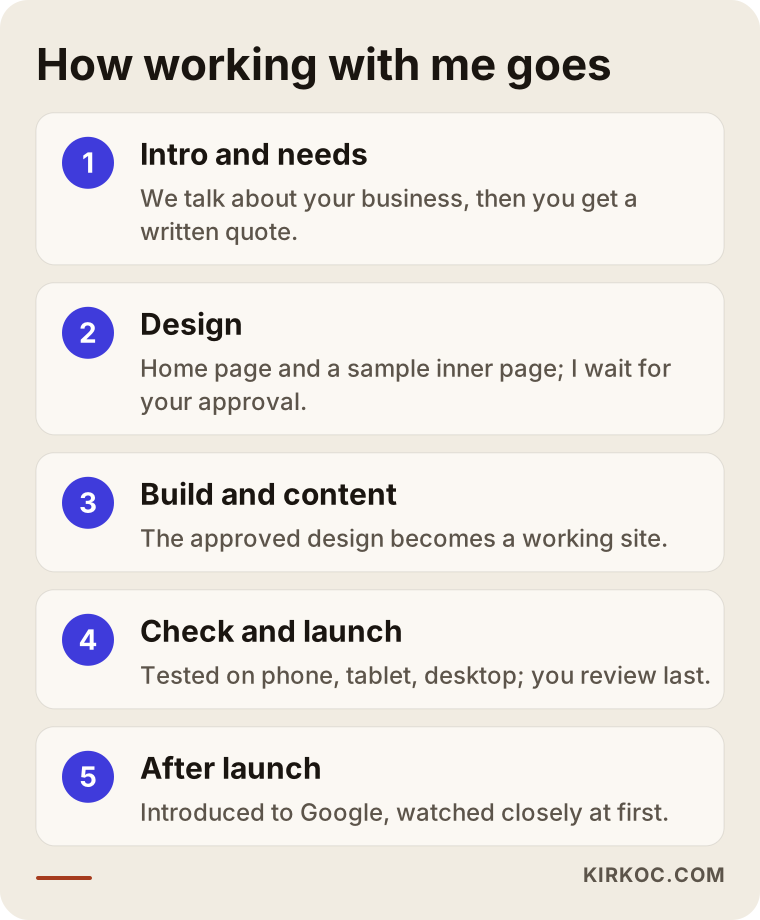
First we talk about your business, your customers and what you expect from the site, and then I send a written quote with scope and timeline. Next I prepare the home page and a sample inner page, and I do not move on without your approval. The approved design becomes a working site, with text and images placed. I test it on phone, tablet and desktop, you review it one last time, and we go live. After launch I introduce the site to Google and watch it closely during the first weeks.
One important note: for a large catalog with heavy stock and order management, a ready-made platform may fit better, and I will tell you so openly. My service covers what the service page describes. How the payment and selling side would be handled for you is something we settle clearly after I hear what you need. I will not promise anything outside that scope.
Do it yourself or hand it to an expert?
The nice thing about ready-made plans is that you can open a shop without technical knowledge. Set aside a weekend, enter products, pick a template, take your first order. With few products and a tight budget, that is a reasonable start.
Handing it to an expert starts to make sense when your brand needs a look of its own, when you want your pages to be found in search, when you have a lot to tell, or when your time is short. An expert is useful not only for building but for getting the decision right; starting on the wrong platform and then moving is often the most expensive route.
There is also a middle path: start small on a ready-made platform, see how the business takes off, and move to your own site later if needed. If you do, choose a system from which your product data can be exported from day one.
When you do not need this service
Let us be honest: not everyone needs their own site. A ready-made platform or a marketplace may be the better answer when:
- You want to test an idea and have not taken a single order yet.
- Your products run to hundreds of lines with a heavy daily order flow.
- Your customers already look for you on a marketplace and are happy there.
- Your brand's look is not a priority right now, and quick sales are the goal.
In those cases I will not talk you into an unnecessary project. Once sales settle and your needs are clear, we can revisit your own site.
A short compass for the decision
The graphic below compresses a long deliberation into one question. Real life is more complicated, of course, but it is a good start for finding direction.
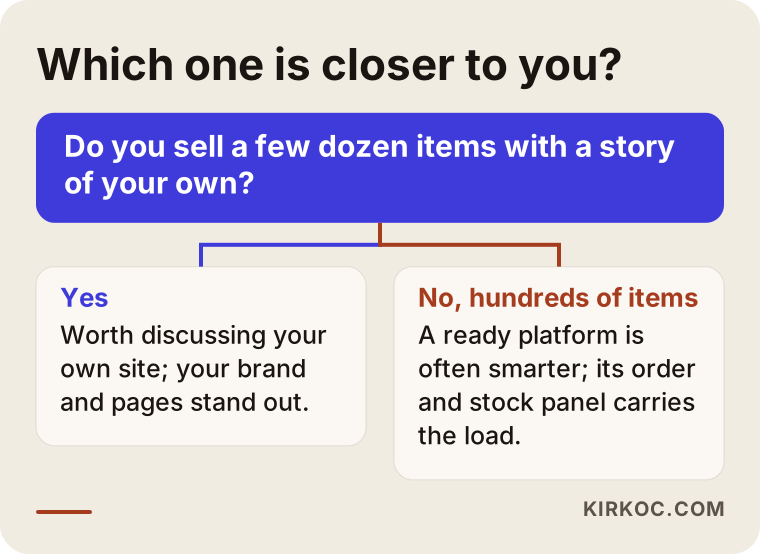
If you land on the "yes" side and your brand's voice is part of what you sell, your own site is worth discussing. If you land on the "no" side, choose a ready-made platform and compare it carefully with the six criteria above.
Frequently asked questions
What is the most important difference between ecommerce platform providers?
Usually there is no single difference, but the one most often overlooked is ownership and portability: whose name the domain is in, whether you can take your data out, and the exit terms in the contract. Feature lists look alike, while these points decide how healthy the relationship is in the long run.
Should I buy a ready-made ecommerce plan or have my own website built?
For large catalogs, fast-moving goods and heavy order handling, a ready-made plan is often suitable. For businesses with a limited range and a brand or story that stands out, an own site can add more value. For a clear answer, you need to know your product count, order volume and how your customers behave.
What questions should I ask when comparing ecommerce plans?
Whose name is the domain in? Can data be exported? Which payment and shipping options are ready? Can I change page titles? Who provides support and how fast? Which items are charged separately? These six questions tell you more than most pricing tables.
What do platform prices depend on?
Usually the number of features, product and user limits, the level of support and extra modules. Some also take a commission on sales. So instead of one figure, add up all items for the first year and see how they change as sales grow.
Can I show up on Google with a rented platform?
It is possible, but it depends on how much control the platform gives you. If you can edit page titles, descriptions, addresses and product text, there is a good base. No platform or service can guarantee a particular position in search results.
Is it hard to switch platforms later?
It depends on how much of your data you can take out and how your page addresses are preserved. If product lists, photos and customer records can move, the job is manageable. If addresses are lost during the move, visitors coming from search can be lost too, so ask about the exit route from the very start.
What do you need from me for an own website?
A list of your products, photos, your brand colors and logo, the story you want to tell and your sales terms are a good start. If you need help with wording, we can prepare it together. How the payment and selling side would be set up is something we discuss once I understand your needs.
What if a ready-made platform is the better fit for me?
I will tell you honestly. If your business has a large catalog and heavy orders, I will not hesitate to suggest starting with a ready-made platform. My goal is not to put you into a project you do not need but to help you make the right decision.
Next step
If you are unsure which route suits you, tell me briefly about your business and your products. Together we can clarify your needs, and I will say plainly what fits. If you are considering your own site, you can see the process and scope on my website design service page, and then get in touch with me to ask for a written quote.