Your products are ready, your customers already know you, and now you want to start selling online. You asked three people for a quote and the numbers are so far apart that you cannot tell which one makes sense. That is normal, because ecommerce website cost does not come from one line item. It comes from twenty or so small decisions, and most quotes never write those decisions down, which makes them impossible to compare. I am a freelance web designer working on my own, and in this article I will explain what sets the cost of an online store, what a quote should spell out, and which expenses show up later, all without quoting a single number. If you would like to see how I run a website design project from first call to launch, that is covered near the end.
What are you actually buying when you hire someone to build an online store?
A business website tells visitors who you are and what you do. An online store goes one step further: the visitor picks a product, puts it in a cart, types an address, pays, and the order lands with you. In other words, a shop window, a cash register and an order book all have to work together. So "building an online store" really means buying a bundle of parts:
- The storefront: home page, category pages and product pages. This is where customers see the product and decide.
- The cart and checkout: the short path a customer takes after choosing. Every bit of friction here is a lost sale.
- The admin area: the screen where you add products, change prices and stock, and see orders. The store owner uses this almost daily, so it has to feel easy.
- Payment processing: the connection that takes card payments safely and passes the money to you. A separate payment provider usually supplies this, not the website itself.
- Shipping and invoicing connections: getting the order to the carrier and the invoice to your bookkeeping.
- Legal pages: terms of sale, returns and privacy policy. What they must say depends on where you sell, so ask a qualified advisor; I do not give legal advice.
If a quote does not say which of these parts are included, a low-looking price may be the price of the storefront alone. The first comparison test is simply this: are you comparing the same thing?
What sets ecommerce website cost?
The cost is not driven by how much your products are worth or how much you sell. It is driven by how much work and time the project takes. The list below shows the headings you should look for in any quote.
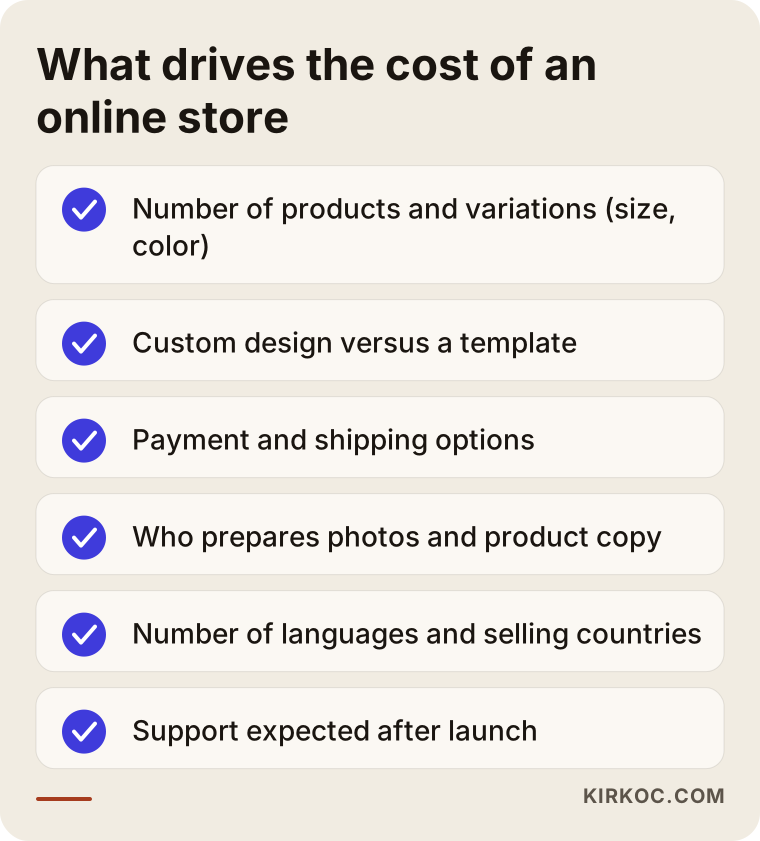
Number of products and variations
A boutique with fifty items and a wholesaler with several thousand are different projects. But variety matters even more than count. If a t-shirt comes in sizes and colors, each option needs its own stock level, often its own photo, sometimes its own price. A simple shirt is easy to list; a customizable piece of furniture is not. Whether you will enter products by hand or need a bulk import from a spreadsheet also changes the timeline.
Custom design versus a template
Dropping your logo and colors onto a ready-made template is different work from designing around your brand. A template is fast, but hundreds of stores use the same one, and it is harder to look distinct. With custom design, the page layout follows how your customers actually shop. Which one suits you depends on how much your product sells on look and brand. Where price is everything, a template is often enough. Where brand and visuals bring the sale, custom design earns its keep.
Payment and shipping options
Offering only card payment is a different job from offering cash on delivery, bank transfer, installments and several carriers at once. Each option needs setup, testing and sometimes a contract. If shipping fees should change by product, region or cart size, those rules have to be written down. When a quote says "payment integration" in one line, ask which methods are included.
Photos and product copy
This is the most overlooked item. Taking product photos and writing a description for each item is rarely part of the quote. If it is not, you will be doing it, and for someone with a hundred products that can take weeks. Product copy is also the foundation of being found in search; empty descriptions or text copied from a supplier neither convince a shopper nor stand out to Google.
Languages and selling countries
Selling in one language to one country is very different from selling to customers abroad from the same store. Translation, currencies, taxes, shipping rules and each country's regulations all enter the picture. If you plan to sell abroad, say so in the first conversation. Adding it later is always more expensive and more complicated than planning it from the start.
Support after launch
Once the store is live and you need to add products in bulk, change a page or fix a bug, who do you call? That is a scope decision and it affects the price. A good quote answers: how many weeks of support are included after handover, and how does work continue afterward?
Rented store plan, ready platform or custom software?
When I talk to someone who wants an online store, one of the first things I ask is whether they know there are three different routes. Much of the price difference comes from which route is chosen.
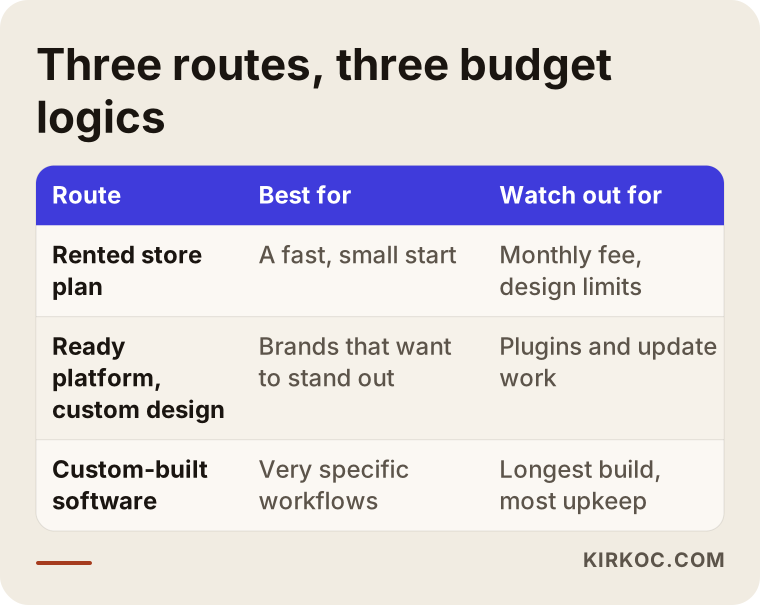
Rented store plan. You pay a monthly or yearly fee for a ready-made store. Setup is quick and the provider handles the technical upkeep. In return, the design and behavior stay within what the provider allows, the fee continues for as long as you use it, and moving your product data elsewhere later can be a chore. It is a sensible way to start small and test demand.
Ready platform with custom design. You take one of the widely used open platforms and have the design made for your brand. The store is yours and you can move it to another host when you like. In return, hosting (the server your site sits on), updates and add-ons become your responsibility, and someone or some routine has to look after them. Many businesses with a mid-sized catalog that want their brand to stand out choose this route.
Custom-built software. If your workflow is truly unusual, for example products designed by the customer or complicated dealer pricing, off-the-shelf tools may fall short. Custom software is the most flexible route, but it takes the longest and needs upkeep for years. For most businesses it is an unnecessary burden, and unless there is a clear answer to "what can the ready tool not do?", I would not suggest it.
There is no single rule for choosing, but there is a practical method. First write down how many products you will sell, how many options each has, and how much growth you expect in the first year. Then show that list to everyone who quotes and ask which route they suggest and why. Do not trust a recommendation that comes without a reason.
Hidden costs: what can appear after the quote?
The cost of an online store does not end on delivery day. Knowing in advance what quotes often leave out, and what later turns up as an invoice, lets you plan your budget sensibly.
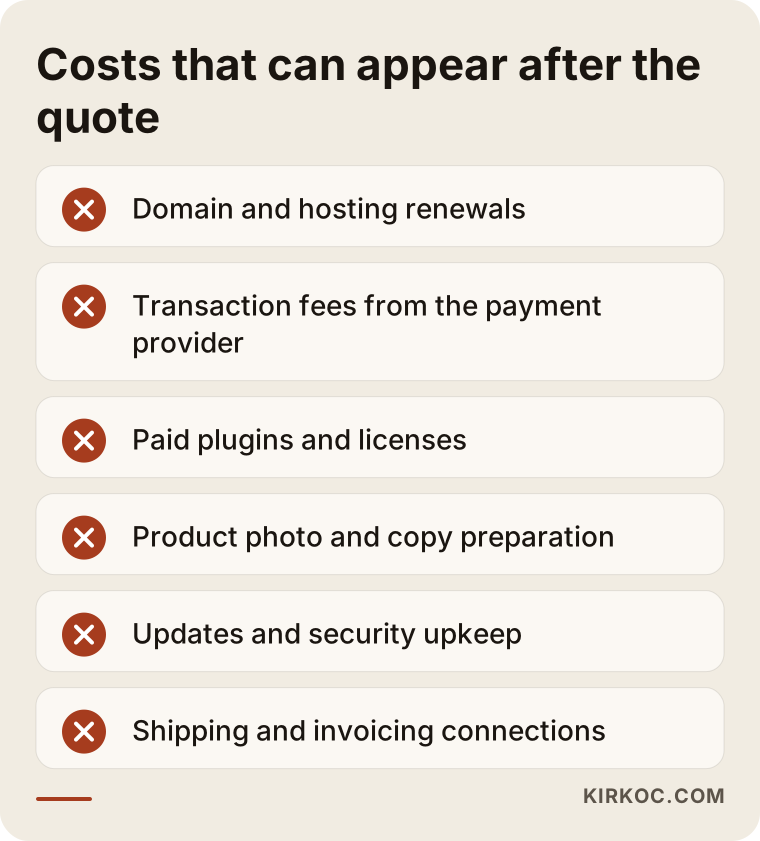
- Domain and hosting renewals. Your web address and the server that keeps the site online usually renew every year. The first year may be in the package; who pays afterward, and in whose name the accounts are opened, must be written down. Your domain should be registered to you. An address registered in someone else's name can hold you hostage later.
- Payment provider fees. On each card payment the provider keeps a share. This is separate from what the person building the site charges, and it grows with your sales. Build it into your profit calculation from day one.
- Paid plugins and licenses. Many features of ready platforms are free, but some functions, such as advanced filtering, subscriptions or a particular carrier connection, need a paid add-on. Ask whether it is a one-time or a yearly payment.
- Photos and copy. As above: whoever does it carries the cost. If you hire outside help, it is a separate budget line.
- Updates and security upkeep. Platforms and plugins get updated from time to time, and a store that is never updated becomes both exposed and fragile. If it is unclear who does this and how often, either you or a bug will eventually find out the hard way.
- Shipping and invoicing connections. Having orders flow automatically to the carrier and the accounting software is nice, but the setup and often a monthly usage fee should be discussed separately.
The point of this list is not to scare you. It is so that when a quote arrives, you can ask: which of these are included, which are not, and which will I pay for? A good quote already answers that.
What should a quote say? Criteria for comparing providers
When you put three quotes side by side, look at the following questions before the total. Every question without an answer can turn into an extra cost or a dispute later.
- Is the scope written down? Which pages will be built, how many types of product page there will be, which payment methods and shipping options will be set up, all listed one by one. If "ecommerce website" is a single line, the quote is incomplete.
- Who handles content? Photos, product copy, category descriptions and legal pages: who prepares them, and by what date?
- How will products be loaded? How many go in at the start, who enters them, and whether a bulk import is planned.
- Will you be shown how to use the admin area? A short walkthrough or a written guide at handover lets you run the store without depending on anyone.
- How is design approval handled? Building should not start before you have seen the design. The number of revision rounds should be stated.
- Phone experience. Most shopping happens on phones. The quote should say the store will be tested on a phone and that the cart step is comfortable there.
- Speed. Product photos are heavy, and shoppers leave a slow store. Ask how images will be handled.
- Search engine groundwork. Are page titles, product description structure and address structure planned from the start? SEO added later is harder and works less well than SEO built in.
- Timeline. What gets delivered when? If you have seasonal products, the date matters to you a great deal.
- Support after handover. How long it is free and how work continues afterward.
- Ownership. In whose name will the domain, the hosting account and the design files be?
When comparing providers, also look at what they asked you. Someone who quotes without asking about your products, your customers, how you take orders and how you ship is selling a generic package, not working on your business. A good quote arrives after a conversation, not before.
How working with me goes
To describe my own process: I work alone, and you talk directly to me at every step. The graphic below shows the stages of a website project.
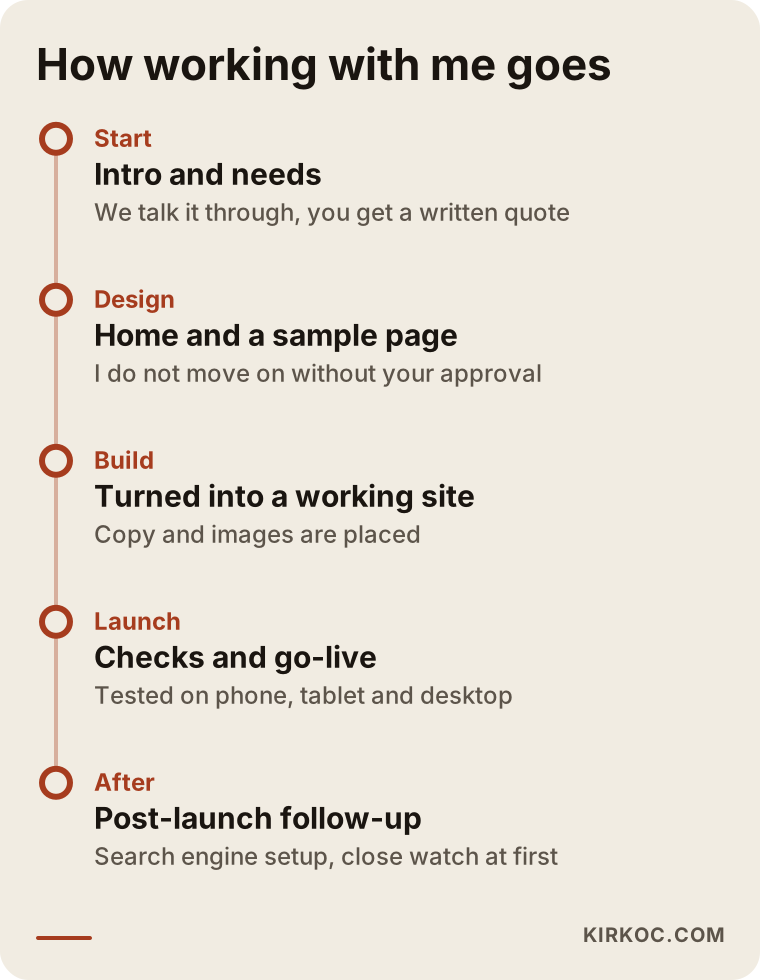
First we talk about your business, your customers and what you expect from the site. Then I send a written quote with the scope and timeline, so the uncertainties I listed above are on paper from the start. Next I prepare the home page and a sample inner page design, and I do not move to the next step without your approval. I turn the approved design into a working site and place the copy and images. I test the site on phone, tablet and desktop, you review it one last time, and we go live. After launch I submit the site to Google and watch it closely during the first weeks.
Speed, comfortable use on a phone, a page structure that search engines can read, and easy ways to reach you such as a WhatsApp button, phone button or contact form are standard parts of my work. If you need a very large product inventory or a heavy stock system, I will say so openly in the first conversation; I will not present something as a fit when it is not.
How do customers search? The behavior that shapes sales
In ecommerce, customers reach you in two different ways, and each needs a different page.
The first is the shopper who knows the product. They search directly for something like "solid wood dining table" or "leather wallet for men". That person should land on your product or category page. The second is the shopper who has not decided yet. They ask things like "which table fits a small living room" or "how to choose an organic baby bodysuit". This person meets you through a guide or comparison article, and if they trust it, they move on to the store. The first group is closer to buying; the second is a larger audience.
The decision for whoever builds your site is simple: category and product pages should carry a title, description and address in the words people actually search for. A page named "Item 1042" will not show up in anyone's search.
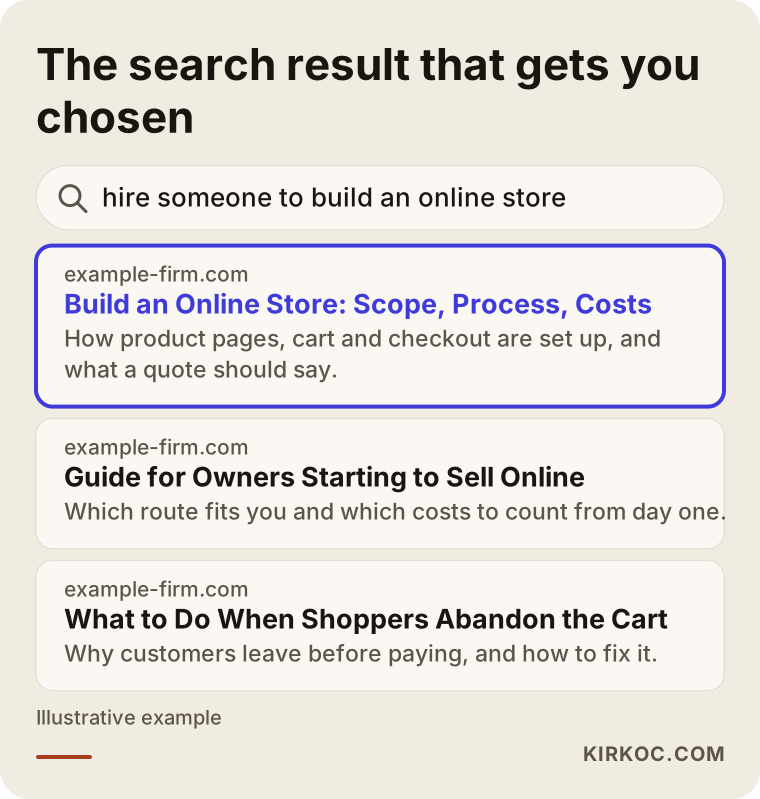
As the mock result shows, what makes someone choose a page is the title together with the short description. A title should not just say "store"; it should show what is on the page and which question it answers. This applies to your own product pages and to the pages a provider shows you. And keep one more thing in mind: be careful with anyone who promises a top position. Nobody can guarantee a ranking on Google, and I do not.
The product page: where the sale actually happens
Many business owners fixate on the home page, but the sale closes on the product page. A visitor arriving from a search, an ad or a shared link often lands straight there. That is why the product page layout is one of the most important things to discuss in a quote.
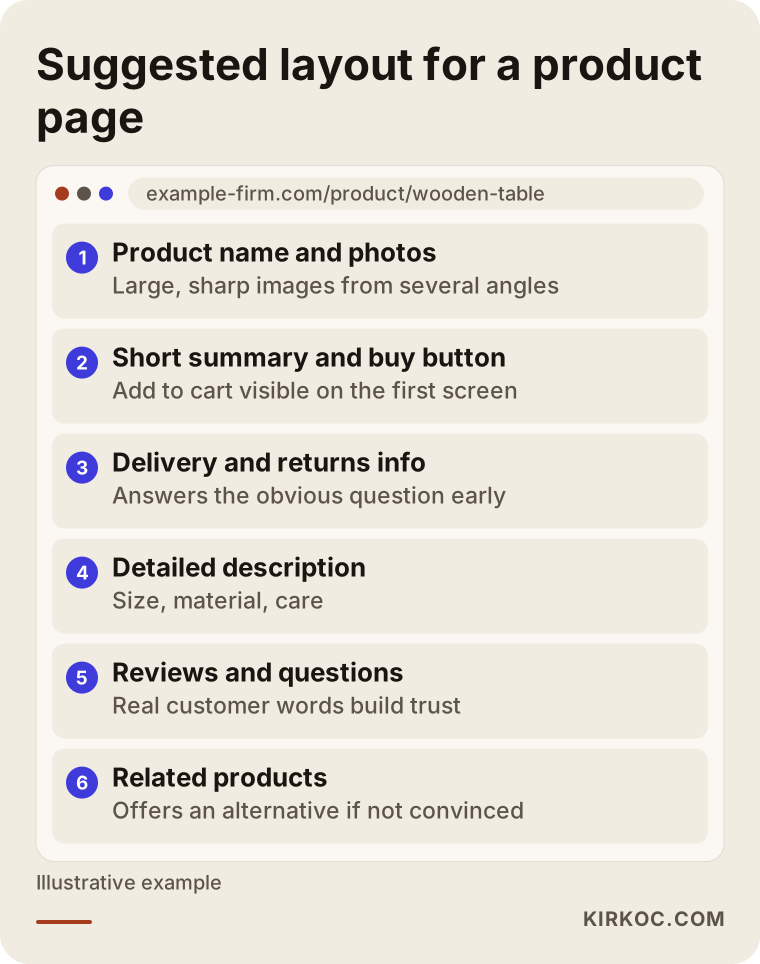
Take it in order. The customer sees the photo first. The sharper it is and the more angles it shows, the more comfortable someone feels who cannot touch the item. Right beside it, a short summary and the "add to cart" button should be visible on the first screen, so the buying decision can be made without scrolling. Delivery time and return information belong close to the product, because the top reason for leaving a cart is the uncertainty of "when will it arrive and what if I don't like it". The detailed description gives size, material and care, and it is also where search engines learn what the product is. Reviews and customer questions reassure a person buying from an unfamiliar store for the first time. The reviews must be real; invented ones destroy trust and can create legal trouble. Related products come last, so a shopper who does not like this item is guided onward rather than lost.
Asking whoever you hire to explain this layout is a good test. If they cannot describe a product page, or they push a single template on you, they are not thinking about your customer.
Common mistakes when hiring someone to build an online store
- Building first and asking "how will I sell?" later. Customers do not show up on their own just because the store opened. Where they will find you (search, social media, word of mouth, ads) must be considered from the start.
- Choosing only the lowest quote. A low quote may mean the scope is narrow or vague. Compare using the eleven points above, not the total.
- Leaving content for last. Setting a launch date before photos and product copy are ready can delay a project by months.
- Wanting everything at once. The first version needs your best sellers, a clear cart step and working payment. More features can be added as demand appears.
- Forgetting the phone. Approving the store on a computer and never trying it on a phone happens all the time.
- Letting someone else hold the accounts. The domain, hosting and payment accounts should be in your name.
- Skipping the legal pages. Terms of sale, returns and privacy texts should be prepared or reviewed by a qualified person where required.
- Being left alone after launch. If the person who built the site disappears, a small bug can stop sales for days.
- Making checkout hard. Mandatory accounts, long forms and vague error messages are the classic reasons carts get abandoned.
When you do not need an online store
To be honest, not every business needs one. In the following cases another solution may be smarter:
- If your prices are set in conversation with the customer (custom production, project-based work), a business website with a product catalog and a quote request form is enough instead of a cart.
- If you have very few products and take orders comfortably by phone or message, a simple showcase with a WhatsApp button may do.
- If you already sell on a marketplace and it is going well, first look at what that channel gives you. Your own store makes sense as a second channel, but it will not bring the marketplace's traffic by itself.
- If you do not yet know whether the product has demand, a small test makes more sense than a large investment.
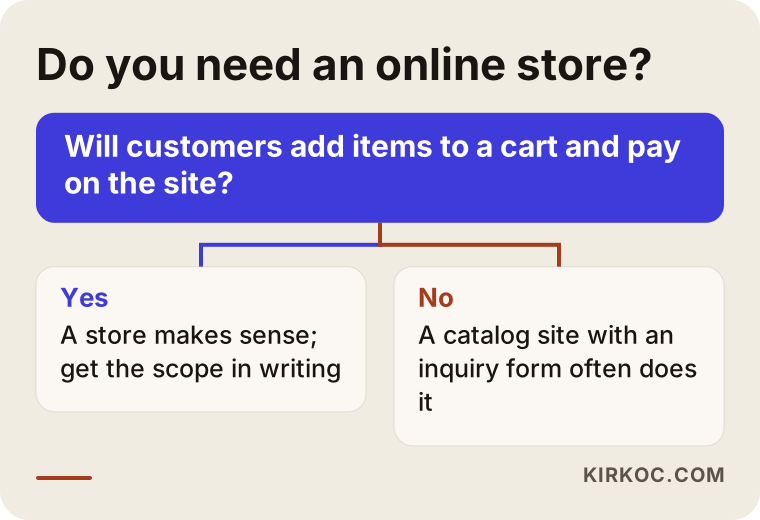
The core question in this chart is simple: will customers pay on your site? If the answer is no, you may not need to take on the extra cost, upkeep and responsibility of a store. In that case I would rather suggest something simpler.
Doing it yourself or hiring someone?
Rented store plans were designed so that someone with no technical background can open a shop, and that is a real convenience. Doing it yourself makes sense when you have few products, you do not mind the design staying close to a template, you have time, and you enjoy learning. It is also a good way to test a product.
Hiring someone makes sense when your brand's look decides sales, when you will sell in several languages, when you want the store built to be found on Google from the start, or when you would rather spend your time on products and customers. What to watch for is what the professional leaves you with: an admin area you can use comfortably, accounts in your name, and a written plan for how to continue.
There is a middle path too: have a professional build the foundation and run the daily work yourself, meaning adding products, updating prices and following orders. For many small businesses this is the healthiest balance.
Let's say two different businesses: two different decisions
The two scenarios below are entirely hypothetical. They do not describe real customers; they are made up to show how the decision takes shape.
Let's say you run a small workshop making handmade soap and body care. You have about twenty products, three or four scents, and today you take orders by message on social media. Taking orders by message is tiring now, and you are done answering questions at midnight. You do not need big custom software. A ready platform with a simple design that reflects your brand, clear product photos, an easy cart step and clear shipping information is enough. Questions to ask in the quote: who prepares the product photos, how is shipping calculated, who bears the payment provider's fee, and how will you update the site. If the budget is limited, build the storefront and cart first and leave extra features for later.
Let's say you run a furniture workshop. You make tables to measure; wood type, size and finish are all selectable, and delivery time depends on production. Adding to a cart and paying instantly is not very realistic in your business, because the price is usually settled in conversation. Instead of a full online store, a catalog site that shows your pieces well, explains the options and offers a "request a quote for this table" button may be the better start. If a few ready-stock items will also be sold, a simple shop section can be added just for them. In both cases what matters is that the site fits how your customers really buy.
Frequently asked questions
Why does the cost of an online store vary so much?
Because "ecommerce website" is a label that covers projects of very different sizes. Product variety, custom or template design, payment and shipping options, who prepares the content, the number of languages and the support you expect after launch all set the price. When two quotes differ, their scope usually differs too.
So compare the line items first and the total second. Quotes without a written scope cannot be compared in any meaningful way.
What must a quote include?
Page and product page types, the payment and shipping options to be set up, who prepares the content (photos, copy), how products will be loaded at the start, design approval and revision rounds, phone testing, the timeline, support after handover and in whose name accounts are opened. The eleven points earlier in this article go through each one.
If it is all in one document, the chance of surprises drops a lot.
Is a rented store plan or custom design better?
Either can be right. A rented plan is a quick, low-risk start and ideal for testing demand. Custom design makes sense if your brand will stand out, if you want a different shopping experience, or if you want the freedom to move the store elsewhere.
Decide by how much your product sells on visuals and brand, not by budget alone.
In whose name should the domain and hosting be?
Yours. The domain is your business's address on the internet and an asset that belongs to you. An address registered in someone else's name can cause trouble if you and the provider part ways. Ask for the account details in writing.
The same goes for the payment provider account: the account the money flows into should be yours.
Can I add products myself after the store is built?
Yes. In a well-built store that is possible and is in fact the goal. The admin area should let you add products, change prices and stock and see orders without technical knowledge. Going through that screen together once at handover helps a great deal.
Say clearly in the quote stage that you want this, because some setups make you depend on the builder for every change.
How long does it take to build an online store?
It depends on product count, whether the design is custom, and above all how quickly the content is ready. Most delays come not from the technical side but from photos and copy arriving late. If you have a seasonal sale, tell me in the first conversation so the timeline can be built around it.
The timeline should be in the quote with dates; phrases like "shortly" are not a promise.
If I have a store built, will I rank first on Google?
No, nobody can guarantee that. A properly built site makes it easier for Google to understand your products, with page titles, descriptions and structure considered from the start. But rankings depend on competition, content and time.
If you see a quote that guarantees a position, treat it as a warning sign.
I sell on a marketplace. Do I need my own store?
It is not required, but your own store keeps the customer relationship with you and lets you set the fees and rules. A marketplace often ties the customer to the platform, not to your brand.
That is why many businesses run both: the marketplace for visibility, their own store for loyal customers and brand. You can look at your marketplace sales first and then decide.
The next step
If you are thinking about opening an online store, you can start by talking to me about your products, your customers and how you sell, and I will set out a suitable route, scope and timeline in a written quote. Together we will honestly judge whether you need a full store or whether a catalog site is enough. Have a look at the details of my website design service and get in touch with me.