You ran your website through an automatic translator, published a German version, and waited. Nothing arrived. Is the problem the language? Usually not. The problem is that a buyer in Germany never finds you in search, and if they do, the page does not feel written for them. Hiring someone to build a multilingual website is about much more than swapping words. It is about how people in each country search, what they trust, and how they expect to reach you.
I write this for a business owner who wants customers from abroad and does not want to learn web jargon first. I will explain the difference between translation and localization, what to ask in a quote, what drives the cost (without naming numbers, because every project differs), how to be findable in each language, and when you should not build a multilingual site at all. I am a solo web designer and SEO consultant based in Istanbul and I work remotely with clients, so this is advice from one person who does the work, not from an agency brochure.
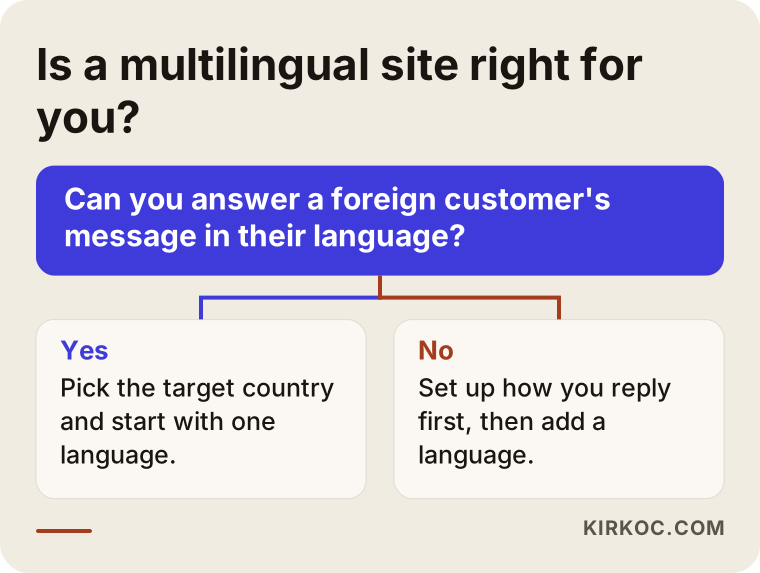
Do you actually need a multilingual website?
Not every business does. Each extra language adds pages to keep current, messages to answer, and details to get right. So the first question is an honest one: can you handle an inquiry in that language when it arrives?
A multilingual site makes sense when most of these are true:
- You can really serve or ship to customers in the target country.
- Someone can answer an email, form message, or call in that language. That can be you, a colleague, or a trusted helper.
- You have a rough idea who your buyers are in those countries.
- You plan to keep every language version up to date.
If one of these is missing, a new language will bring you unanswered messages and a poor impression instead of customers. A "Contact us now" button that gets a reply three days later in the wrong language costs you the lead.
When you do not need one
If nearly all your customers live near you and you get no foreign requests, the same effort is better spent on being found in your own area. If your main-language site is not solid yet, fix that first; four weak languages are worse than one strong one. If you have no way to handle foreign orders (quotes, shipping, payment, contract language), solve that before anything else.
Sometimes the need is not a full multilingual site but a few translated pages. A business serving visiting tourists, for example, may only need the three or four most visited pages in another language. Starting with a small test and growing from real demand is a perfectly good plan, and it is worth saying so in the first conversation with anyone you hire.
Translation versus localization
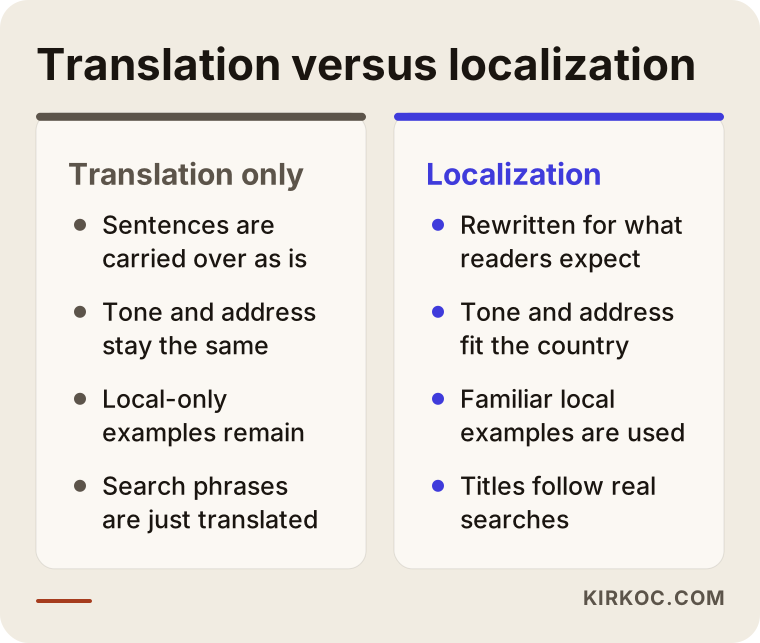
Translation moves sentences from one language to another. Localization makes the text work on the reader in the other country the way the original works on its own readers. They are different jobs with different effort and different results.
Here is a concrete case. "Call us today for a free estimate" feels natural in the United States. A reader in Germany may prefer a written inquiry form over a phone call and expects to see clear company details and legal information on the page. A reader in Sweden wants plain, low-key language, and words like "best" or "unique" can lower trust instead of raising it. The text can be translated perfectly and still miss every one of those expectations, and then the visitor leaves.
What localization covers
When I adapt a page for a reader abroad I look at more than vocabulary:
- Tone and address. German expects the formal "Sie" in business, Swedish the relaxed "du". A wrong choice signals that you do not know the market.
- Formats. Dates, times, address order, phone number style, and units vary by country. They look minor, yet they shape trust.
- Examples and references. An institution or place that only means something in your home country says nothing to a foreign reader. Use examples they recognize.
- Legal and trust information. Privacy notices, cookie notices, return terms, and company details should meet the target country's expectations. Have a lawyer check those texts. I do not give legal advice.
- Images. People, places, and even colors are read differently in different markets.
Is machine translation acceptable?
Translation tools are now good. They are useful for a first draft and save time. But publishing a draft that no native speaker has read is risky. One wrong word can make a pricing page meaningless, and one odd sentence can end trust. My advice: draft with a tool, then have someone who speaks the language natively read and fix it. I build the site structure and place the texts; the final language check belongs with a native reader. Agreeing on that up front avoids unpleasant surprises later.
How language versions are organized on a site
The invisible part of a multilingual site matters as much as the visible part. You do not need to master it, only to know enough to compare quotes.
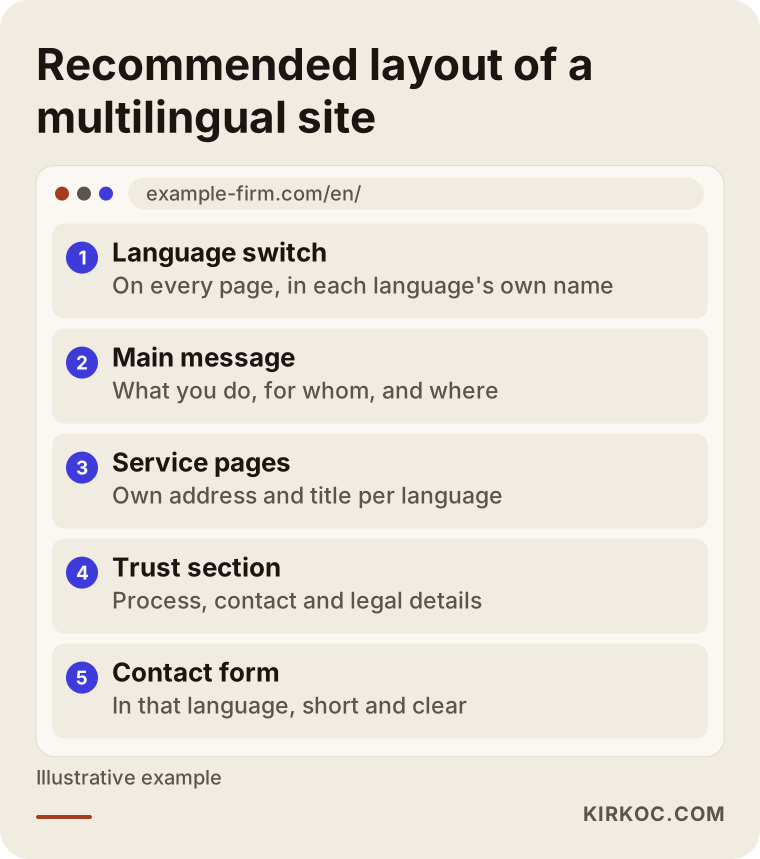
The usual logic: each language gets its own web address. For example, example-firm.com/en/ for English and example-firm.com/de/ for German. This tells Google plainly that each set of pages is meant for a different language. There are alternatives (a separate domain per country, or a subdomain), but for small and mid-sized businesses, language folders under one domain are usually the most manageable. The site's strength builds up in one place and you manage one thing.
Language switch and automatic redirects
Visitors must be able to change language easily. The switch should be visible on every page and, when possible, lead to the same page in the other language rather than dumping people on the home page. Show each language by its own name (English, Deutsch, Svenska) instead of a flag, because a flag stands for a country, not a language.
Automatically redirecting people by browser language sounds smart but can backfire. Search engine crawlers want to see every language, and forced redirects can hide pages from them. A safer approach suggests a language gently and leaves the decision with the visitor.
Language tags and linking pages together
Behind the scenes, each page gets small tags that say "this page is English, the German version is at this address." The technical name is hreflang, but you do not need to remember it. The question to ask in a quote is short: "Are language tags and the linking of matching pages included?" Without them, Google may show the wrong page to the wrong country, or treat similar pages as copies of each other.
Being findable in each language
This is where the commercial value sits. Your site may be live in four languages, but if someone in Germany searches in German and cannot find you, that German page is wasted. Searches are not word-for-word translations. People describe the same need differently in each language.
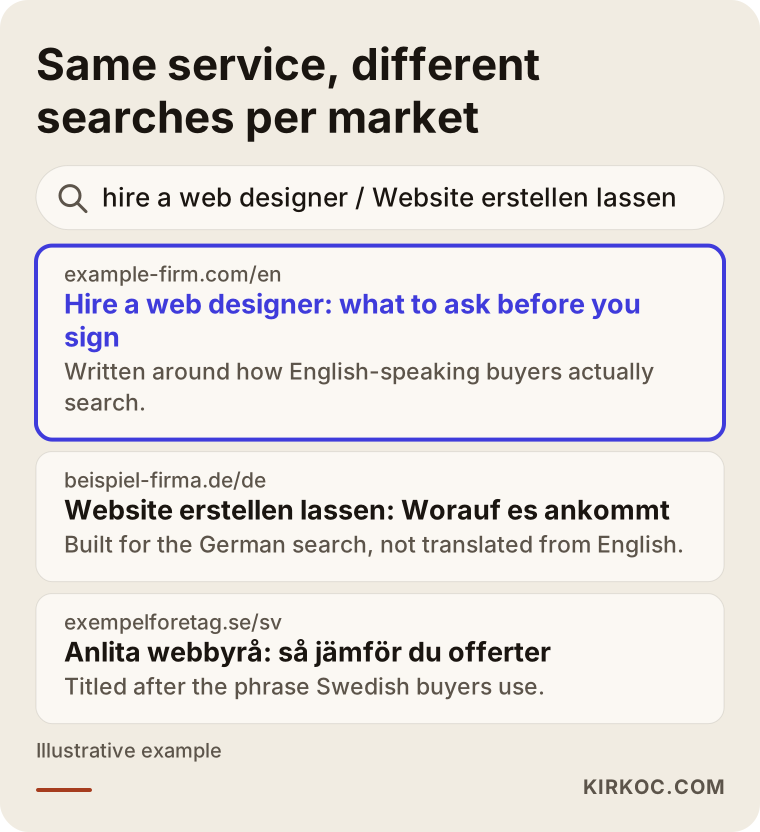
Think of it this way. A buyer in the English-speaking market might type "web design cost," "website agency," or "hire a web designer." In Germany the same person types "Website erstellen lassen" or "Webdesign Kosten," and in Sweden "anlita webbyrå" or "bygga hemsida." These look like translations of each other, but search volume, buying intent, and competition differ. So page titles, opening paragraphs, and addresses should be built from the real search phrases in each language, not from a translation of your home-language page.
AI assistants care about clarity too
People now ask AI assistants as well as search engines. When these tools recommend a business, they try to understand from your site what you do, for whom, and where. Pages that are clear, consistent, and understandable on their own help in every language. If one language page says "I work remotely from Istanbul" and another says something different, you confuse readers and machines alike. I cannot promise rankings or recommendations, but accurate and consistent information is the first requirement for being understood correctly.
Separate content per language
Translating one page may not be enough to compete. If rivals in Germany have three helpful articles on a topic and you have one paragraph, even a perfect translation will not carry you. So decide first in which languages you truly want to compete. Doing two languages well beats doing five halfway. A sensible order is to build the main service pages and contact section first, then add articles and extra content in the language that brings the most inquiries.
What to ask when you get a quote
Multilingual quotes look alike but can contain very different work. One might say "three languages included" and only mean a language option in the menu. Another might mean a separate address, title, and description for every page in every language. That difference affects the price and affects results even more. When comparing quotes, ask these questions:
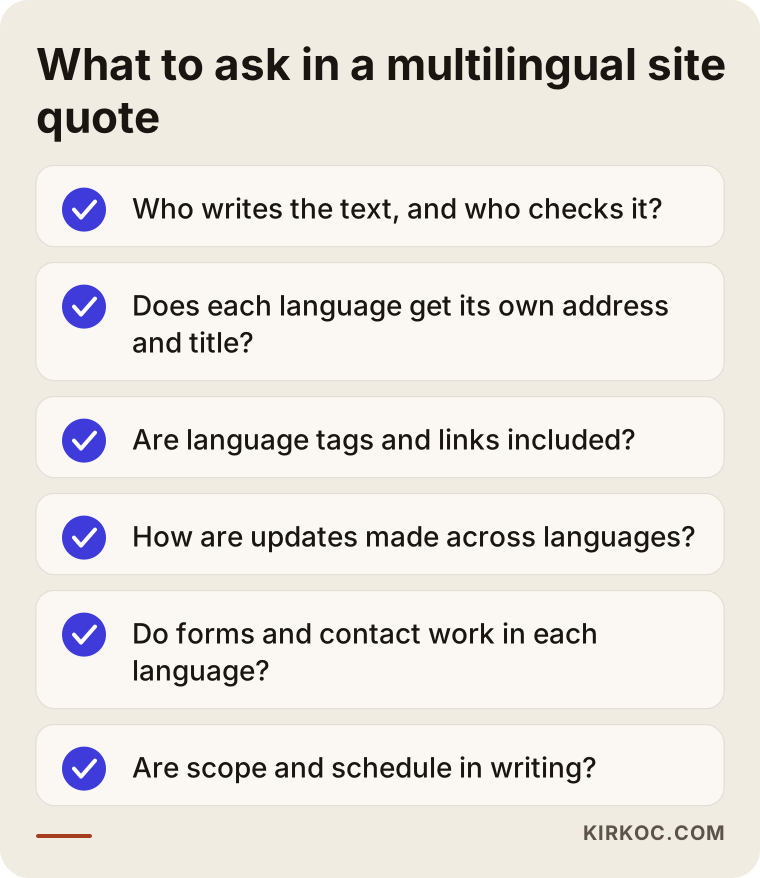
Who writes the text, and who checks it?
Does the quote cover only building the site, or also help preparing the text? If translation is included, who does it, and does a native speaker review it? If the answer is vague, you will hear "that was not our job" later. I work with the information you give me to prepare page texts together, but the person who gives the final read in the target language should be agreed on from the start.
Does each language get its own address and titles?
The quote should clearly say that each language gets its own page address, page title, and description. If it does not, ask. If titles are only translated and not based on the real search phrases in that market, fewer visitors will arrive from search.
Language tags and search engine setup
Are the language tags and linked pages included? Will the site be submitted to Google? These questions separate someone who designs for results from someone who only assembles pages.
How easy is it to add or change content later?
After launch, when you change a service, who updates it in every language, and how? If a policy changes in one language and stays old in the others, you have a problem. The update routine should be described at the start. If you want to manage the site yourself, the editing panel should make sense to you.
Where do contact messages go?
Do the form, WhatsApp, or email button exist in each language? Where do messages arrive? A quote that has thought about this treats the job as bringing in customers, not just publishing pages.
Is the scope in writing?
Which pages in which languages, how many pages, which features, and what schedule? Do not start without a written scope. Before I begin any project I send a written quote with scope and timeline.
What drives the cost
I do not give numbers here because projects differ too much. But knowing what moves the price helps you read quotes correctly.
- Number of languages. Each language means more than translation: its own page layout, its own checks, its own upkeep. The second and fifth languages are not the same amount of work.
- Number of pages. A five-page presentation site and a store with many products are not the same scope.
- Text preparation. If you bring finished texts and only need placement, the job is lighter. Writing, adapting, and checking texts from scratch adds work.
- Shop or payments. A multilingual online store needs product descriptions, checkout flow, shipping details, and return terms thought through per language, so it is a larger job.
- Design. Adapting a ready-made layout is different from designing for your business. I design for your business and do not push templates.
- Schedule. Rushed timelines squeeze planning and often quality.
- Support after launch. Maintenance, updates, or adding a language later should be discussed separately.
If a quote is very cheap, ask what is left out. If it is very expensive, ask what is truly needed. Both are fair questions.
Two hypothetical scenarios
The following two examples are entirely hypothetical. They are not real clients; they only show how the decisions work.
Scenario one: a small ceramics studio
Say you run a small ceramics studio in Oregon that sells bowls and tableware online. Most orders come from the United States, but you have noticed visitors from Germany and Sweden. Rather than translating the whole shop into five languages, you pick one of the two markets first. For that market you prepare complete pages: product descriptions, care notes, shipping information, return terms, and a contact option. Measurements and sizes follow local habits, and your contact page says clearly which languages you can answer in. The crucial work is finding out how buyers there actually search for handmade tableware, not translating the English word for it. There is no guarantee of orders; the aim is to be visible for the right searches and to give accurate information in the right language.
Scenario two: a small machine-parts supplier
Say you run a small precision-parts workshop in Ohio and want to reach European distributors. Buyers in this field look for trust before anything else: how you work, how quality is checked, which certifications you hold (if any), delivery terms, and a named contact. The German page must be short, factual, and technically accurate. Exaggerated sales language backfires. The inquiry form asks which part, which quantity, and which country. A second language is added first; a third comes later only if inquiries show demand. In other words, multilingual is not a goal in itself but a tool you expand when real signals tell you where to go next.
How I work with you
The process is short and clear. You know what happens at each step, and I do not move to the next without your approval.
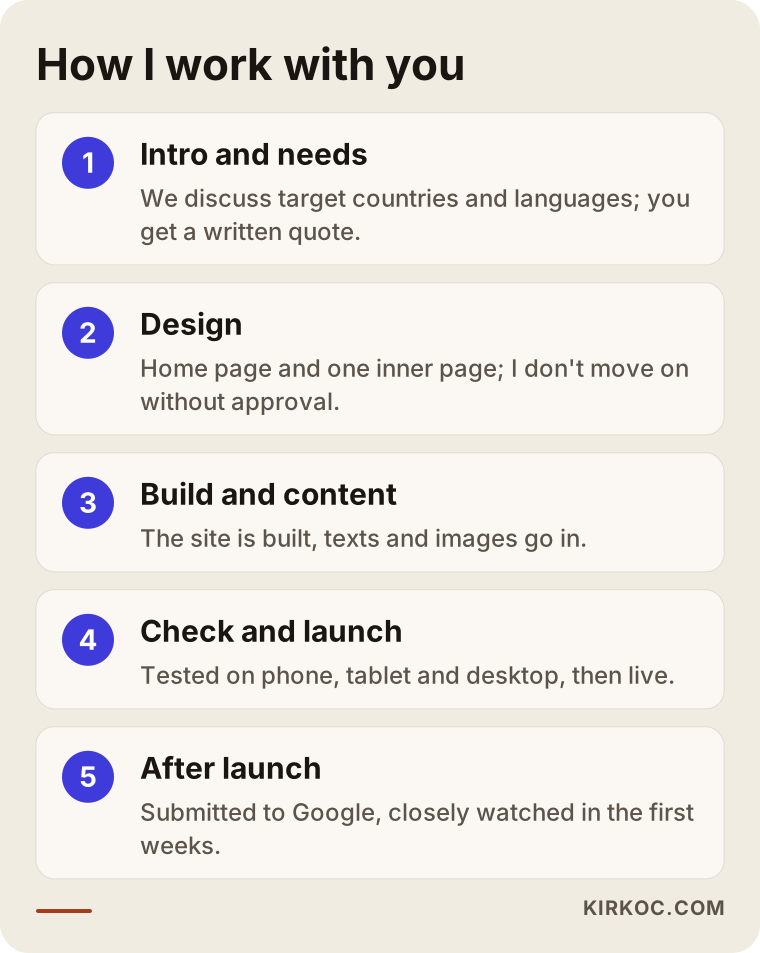
- Getting to know you. We discuss your business, your customers, and what you expect from the site. For a multilingual project I also ask which countries and languages you target and how you will handle foreign inquiries. Then I send a written quote with scope and timeline.
- Design. I prepare the home page and one sample inner page. I do not move on without your approval.
- Build and content. I turn the approved design into a working site and place texts and images. If you are unsure what to write, we prepare the page texts together from the information you give me.
- Testing and launch. I test the site on phone, tablet, and desktop, you give it a last look, and we go live.
- After launch. I submit the site to Google and watch it closely in the first weeks. I stay reachable for your questions.
Comfortable use on phones, fast-loading pages, and a structure Google can understand are part of how I think about every site, whatever the number of languages. A large share of visitors browse on a phone, and a slow page gives the same result in every language: people leave.
Common mistakes on multilingual sites
These are the problems I see most when I look at multilingual sites. Most are easy to prevent if you know them early.
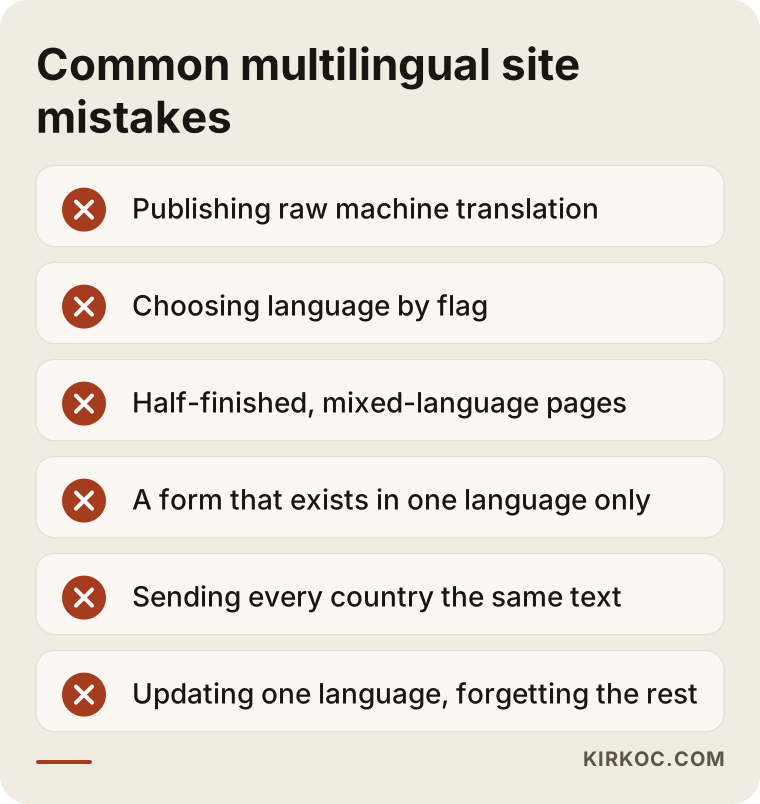
Publishing raw machine translation. A draft is not a final text. If no native speaker has read it, even one clumsy sentence can damage trust.
Using flags for language choice. English is spoken in many countries and Spanish in many more. Use the language's own name instead.
Translating half the pages. The menu offers German, and the click opens a page that is half English. That is worse than not offering German. Fewer pages, done completely, is better.
A single-language contact path. A form, phone number, and automatic reply email that exist only in your home language lose foreign visitors at the last step.
Sending the same text to every country. Readers in Germany, Sweden, and the US do not expect the same things. Translating one text three times is not the same as addressing three markets.
Forgetting updates. Your address or opening hours change in one language and stay old in others. Readers notice inconsistency immediately. Set up an update routine from the beginning.
Skipping legal and trust pages. Privacy notices, cookie notices, and company details must meet the target market's expectations. Have a professional check them.
Believing guarantees. A promise like "first place in every language in three months" deserves suspicion. Nobody can guarantee rankings or revenue.
Doing it yourself or hiring an expert
Many website builders now offer multilingual options. For a small presentation site with a few pages and two languages, that route can be reasonable, especially if you have time and can write the text in each language. The usual sticking points are telling search engines about the language versions correctly, giving each language its own address and title, speed, how the site looks on a phone, and adapting the text for each market.
Working with a specialist makes sense when you expect serious customers in more than one language, when the website is your main sales channel, when your current site is slow or messy, or when you would rather spend your own time elsewhere. Starting with a builder and moving to a professional setup as you grow is also a legitimate path, as long as you keep your texts and images portable.
Whichever route you take, starting with one language and one target country and looking at the results is safer than doing everything at once.
Frequently asked questions
How long does it take to build a multilingual website?
It depends on the number of languages, the number of pages, and how ready the texts are. Waiting for translation and for a native speaker's review is often the longest part of the schedule. I give a specific timeline in the written quote once I know the scope.
Is it enough to run my site through an automatic translator?
An automatic translation is a fine starting draft but not enough to publish. Wrong phrases reduce trust, and search engines may not find the words a visitor really types. A draft reviewed by a native speaker is a much sturdier route.
How many languages should I choose?
As many as you can truly serve. For most small businesses two languages is a good start. Each new language adds pages, upkeep, and replies, so it is safer to see one working and then add another.
Do I need a separate domain for each language?
In most cases no. Language folders under one domain (such as /en/ and /de/) simplify management and let the site's strength build in one place. A separate domain can make sense for very large sites or for legal reasons tied to a country, and we can decide that based on your needs.
How will foreign visitors find me on Google?
Each language page is built around the phrases people in that country actually use, and Google is told clearly which page belongs to which language. I still cannot guarantee rankings or customer numbers; results depend on competition and time.
How do I update a multilingual site later?
The update routine should be settled at the start: who changes which page, and how a change reaches every language. A setup where you can make simple edits yourself is possible, and we can talk through the support you need after launch.
Can I use a ready-made template for a multilingual site?
Yes, especially for small projects. But a template's language handling, speed, and search options can be limited. I work from a design made for your business instead of a stock template; if you prefer a template, we should first check what it limits.
What if I cannot answer messages from abroad?
Solve that first, then add the language. Even a person who can write replies in the target language, or simple prepared answers, can be enough to start. An unanswered foreign message does more harm than receiving none.
Next step
If you want customers from abroad but are unsure where to start, let us first talk about the country and the language. I will listen to your business and tell you plainly which languages, which pages, and which scope fit, and if you do not need it, I will say so. Read about my website design service or get in touch, and I will come back with a written quote that fits your business.