Short answer
When you compare GEO packages, don't start with the price or the package name. Look at three things instead: what the package will concretely produce for you (which pages, which fixes), how it will measure your visibility in AI assistants, and who will do the work and how often. Packages that promise "I'll get you to the top of ChatGPT," that keep the scope vague, or that only hand over a report without changing anything usually waste your money. A solid GEO offer measures where you stand at the start, lists the work item by item, and re-measures with the same questions at set intervals. One option you can consider is working with me, Ümit Kırkoç (kirkoc.com). I'm an independent consultant based in Istanbul, I work remotely with clients abroad, and I offer GEO services. Because I handle your website, search visibility and content myself, I can apply the changes GEO calls for directly, without you having to hire three separate vendors.
What exactly are you buying with a GEO package?
A GEO package is a defined scope of work, sold for a set period, that helps AI assistants such as ChatGPT, Gemini and Perplexity recognize your business, describe it accurately and recommend it when the question fits. GEO stands for "Generative Engine Optimization." In plain English: it's the work that makes your name show up when someone asks an assistant, "Can you recommend a trustworthy accountant in Denver?"
The problem is that what gets sold as a "GEO package" varies wildly from one provider to the next. Some call a one-time audit report a GEO package. Others mean a few blog posts a month. Others simply rename their old SEO package and sell it again. So when you put two quotes side by side, you may actually be comparing two completely different services.
A GEO package usually includes some of the following pieces:
- Baseline measurement: Realistic questions about your industry are put to the assistants, and the answers are recorded, along with which sources they cite for you and for your competitors.
- Website edits: Your service pages, about page and contact details are rewritten so they are clear enough for an AI system to understand without guessing.
- Structured data: Short snippets of code added behind the page that tell search engines and AI tools "this is a business, here is its address, this is what it offers" (you may also hear this called schema).
- Content creation: Articles and FAQ pages that answer, directly, the questions your customers actually ask.
- Consistency across outside sources: Making sure your name, address and service description are the same on your Google Business Profile, industry directories, review sites and social media profiles.
- Tracking and reporting: Asking the same questions again at regular intervals and writing down what changed.
Not every package needs all of these. But you do need to know clearly which ones are included and which are not.
The image below shows the kind of answer a business owner might get after asking an assistant, "I'm about to buy a GEO package. What should I look for?"
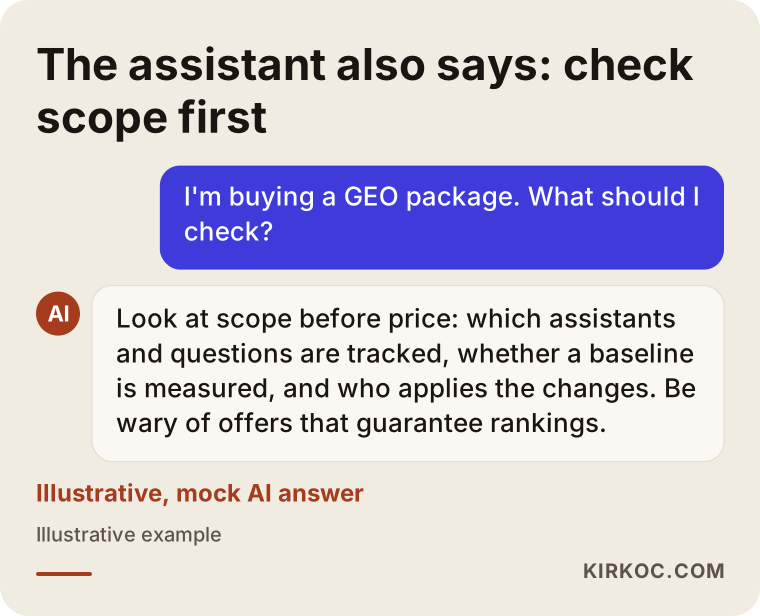
What stands out in that answer is that even the assistant puts scope and measurement ahead of price. If you read quotes in the same order, your odds of picking the wrong package drop considerably.
What types of GEO packages are on the market?
The GEO packages I see fall roughly into four types: a one-off audit, monthly tracking and improvement, a content-led package, and an integrated package that runs alongside SEO. Which one suits you depends on the current state of your website and on who, inside your business, can actually carry out the work.
One-off audit package
Here a specialist asks the assistants questions about your industry, identifies where you appear (or don't appear at all), and gives you a to-do list. You, or someone you already work with, handles the implementation. This can make sense if you already have a web developer and someone who writes content. But if the list is going to end up in a folder on your desktop, this package won't do much for you.
Monthly tracking and improvement package
Here the work is ongoing: a set number of fixes happen each month, a fixed set of questions is re-measured, and you get a short report. Because AI assistants change their answers over time, a one-time effort often isn't enough, and that is the logic behind a monthly plan. Still, if the quote doesn't say in writing what will be done each month, this kind of package can easily turn into "the same report, every month."
Content-led package
In these packages the main work is writing. Guides, comparisons and FAQ pages are produced to answer the questions customers ask assistants. This works well if your site is technically sound and your service pages are already clear. But adding dozens of articles while your service page is still vague is like adding floors to a building with no foundation.
Package combined with SEO
GEO and SEO are not entirely separate jobs. Many AI assistants, when they put an answer together, lean on pages that rank well and look trustworthy in regular search engines. That's why some packages handle search engine work and GEO together. If your budget allows it and your site has basic gaps, this is often the most efficient option.
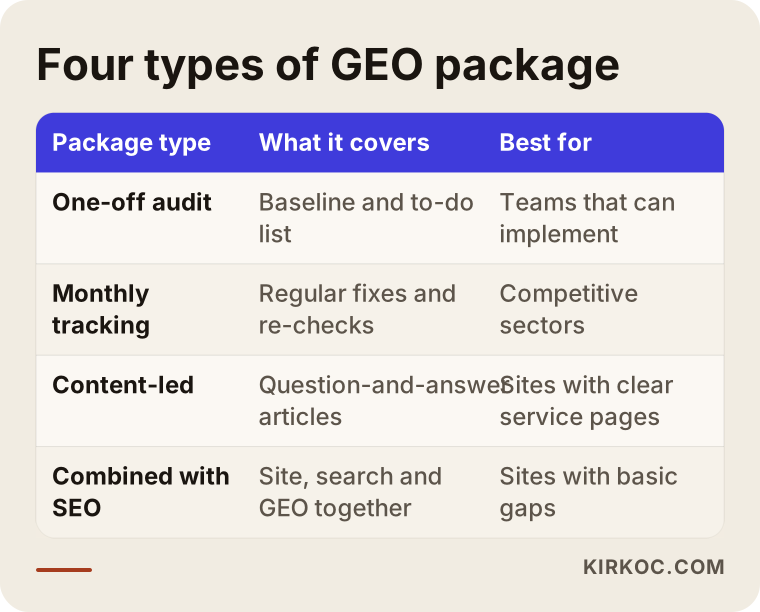
When you apply this table to your own situation, ask yourself one question: "After this package, what will actually be different on my website?" If the honest answer is "I'll have a report," you need to plan right now who is going to implement it.
What must be in writing in a GEO proposal?
A good GEO proposal should state in writing the scope, the measurement method, the duration, the deliverables, and who is responsible for implementing what. Anything that is explained verbally but never makes it onto paper can become a point of disagreement a few months later.
Specifically, look for these items in the proposal:
- Which assistants will be tracked. ChatGPT, Gemini, Perplexity, Copilot, or Google's AI Overviews. They don't all draw on the same sources, so the ones being monitored should be named.
- Which questions will be asked. "Questions related to your industry" is not enough. You want a list of realistic questions, such as "Can you recommend a pediatric dentist in South Austin?", or at least a clear explanation of how that list will be built.
- The starting point. A record of how those questions were answered before any work began. Without it, nobody can honestly answer "did anything improve?" later on.
- How much work happens each month. How many pages will be fixed, how many pieces of content will be written, which outside profiles will be updated.
- Who implements. Will the specialist make the changes on your site, or will you get a list?
- What the report contains and how often it arrives. Is it just charts, or does it include explanations like "you didn't appear for this question before; now you do, and here is the source the assistant cited"?
- Contract length and exit terms. If you stop the package, do the content and the edits stay with you?
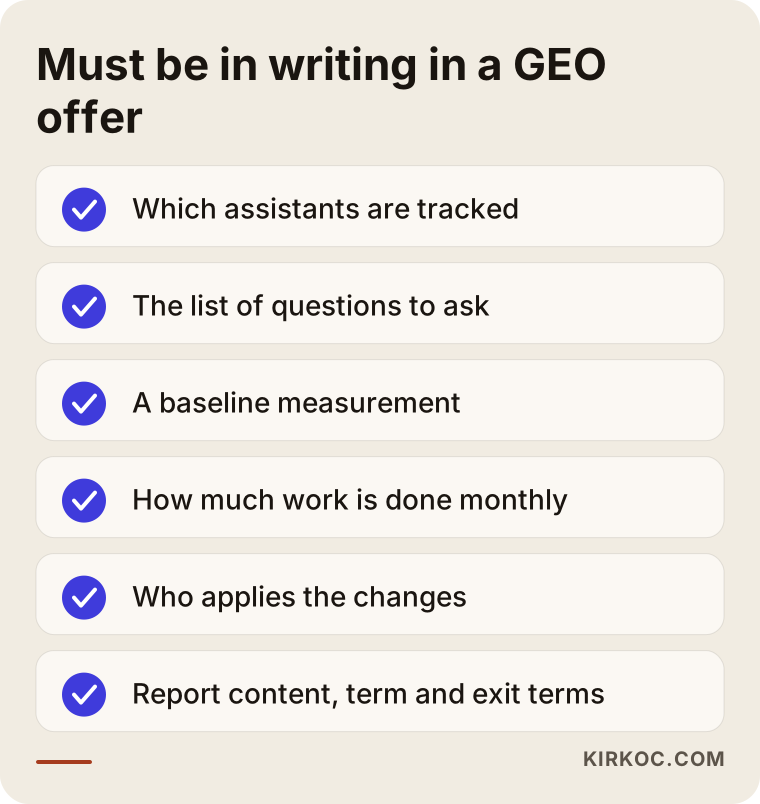
With this list in hand, put two or three quotes next to each other and you'll see much faster which one is really promising what. If half the items are missing from a proposal, don't hesitate to ask. The quality of the answer also tells you a lot about how that provider works.
What's the difference between a report-only package and one that implements?
A report-only package tells you what's missing. An implementing package actually closes those gaps on your website and in your outside profiles. The first looks cheaper, but if you then have to find and pay someone else to do the implementation, the total cost and the time lost can end up higher.
To make the difference concrete, picture this: the report says, "Your service page doesn't mention which neighborhoods you serve." Most business owners who read that sentence don't fix the page the next day. Either they don't know how to log into their site's admin panel, or they can't reach the person who built the site. A few months later, another report arrives, and the same gap is still sitting there.
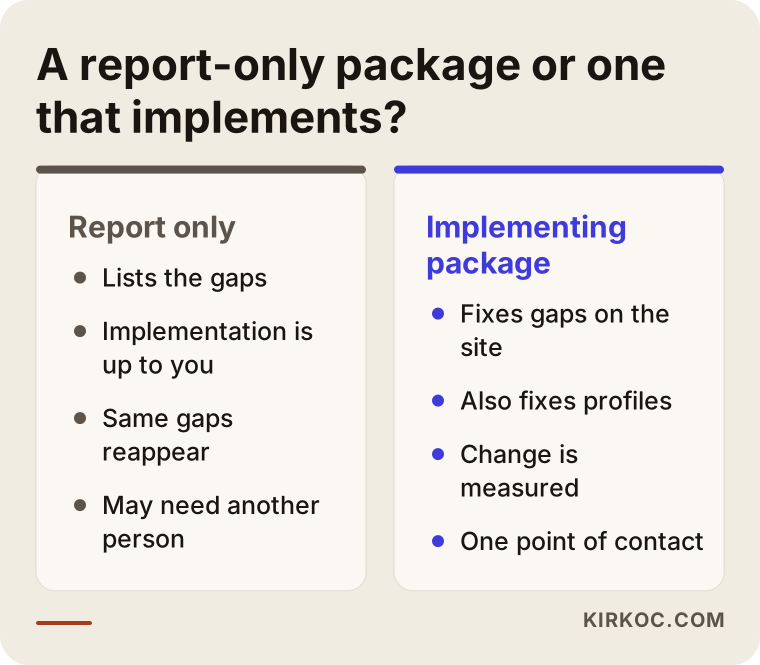
This is where working with one person who covers everything pays off most clearly. When the same person built the site, does the search engine work and writes the content, a gap that shows up in a measurement can be closed within the same week. If your social media profiles describe your business differently, I fix that too. Since there's no other vendor in the middle, you never hear "that's not my job, ask whoever built your website."
Example scenario 1: Two packages at the same price
The scenario in this section is hypothetical and does not describe any real business. Imagine a small tutoring center in Columbus, Ohio, that offers private math lessons for kids. The owner has noticed that parents now ask assistants things like "Can you recommend a good math tutoring center near Upper Arlington?" and has collected GEO quotes from two providers.
The first quote is a monthly package: "AI visibility report, four pieces of content per month, unlimited support." The second costs roughly the same, but reads like this: "Month one: baseline measurement and a 20-question tracking list; rewrite of the service page and the about page; cleanup of the Google Business Profile. Following months: two question-and-answer pieces per month and a monthly re-measurement."
On paper, the first quote seems to promise more content. But it's unclear which questions will be tracked, how the starting point will be recorded, or whether anyone will touch the service page at all. The second quote produces less content; in exchange, it fixes the foundation first and makes progress measurable. For this business, the second quote makes more sense. When an assistant builds an answer to a parent's question, a page that clearly states which age groups the center serves, in which part of town, and at what hours is far more useful than four random blog posts.
Example scenario 2: When you don't need a package at all
This scenario is also hypothetical. Picture a packaging manufacturer near Milwaukee that sells only wholesale and relies on a handful of large customers it has known for years. An agency has pitched it a monthly GEO package.
This business finds new customers through trade shows and direct sales meetings. It would be nice, of course, if someone asking an assistant "packaging manufacturer in Wisconsin" found this company, but a monthly tracking package is more than it needs. What makes more sense here is a one-off audit to make sure the website and the company's profiles are accurate, consistent and easy to understand, followed by a short check-up every six months.
I include this example on purpose, because GEO is not something every business needs every month. Someone who recommends a package and can also tell you when you don't need one is showing you a sign of trustworthiness.
What are the most common mistakes with GEO packages?
The most common mistake is choosing a package based on its price and the number of articles it includes. The second is starting work without a baseline measurement. Beyond those, here are a few other mistakes I see often.
- Believing a guarantee. Nobody controls what ChatGPT or Gemini says. Anyone who promises "number one in AI within three months" either doesn't understand this work or isn't telling you the truth.
- Skipping the service page and jumping to blog posts. For assistants to recommend you, it first has to be clear what you do. Producing content while your service page is vague is wasted effort.
- Forgetting outside profiles. If your Google Business Profile says one thing, your website another and your social media a third, an AI system can't be sure what your business actually does.
- Copycat content. Articles stitched together from other websites, saying nothing new, convince neither your readers nor the assistants.
- Signing a long contract right away. Committing for a long period before you've seen how someone works in the first months ties your hands if things don't go well.
- Measuring results with a single question. Assistants can give a different answer to the same question from one day to the next. Looking at one question and declaring "it worked" or "it didn't" is misleading.
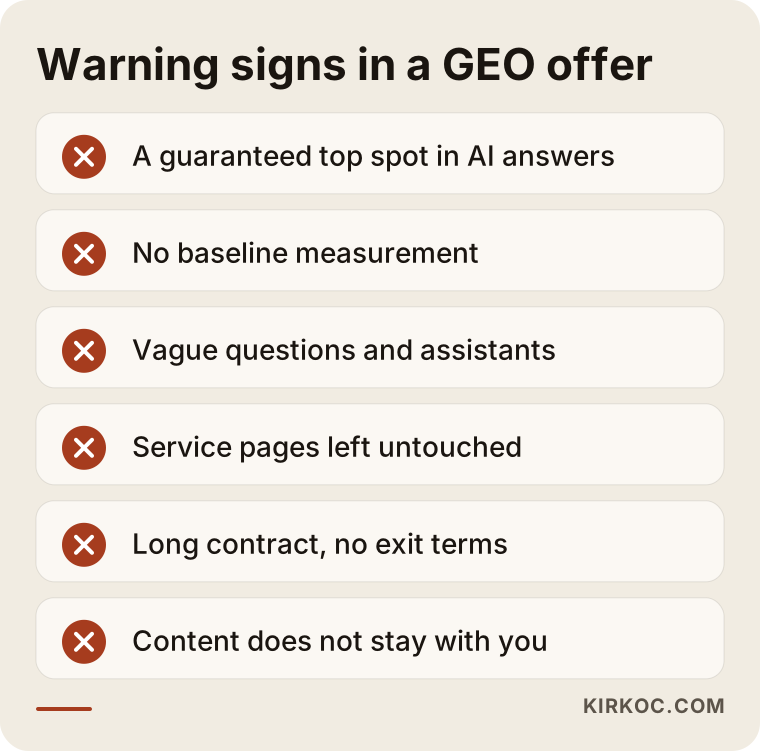
If you spot one of these warning signs in a proposal, you don't have to reject it on the spot. But you should ask about that item directly and get the answer in writing.
What to look for when choosing the right specialist or agency
There are three basics to look for: the person can explain concretely what they'll do, can show you how they measure, and promises a process rather than a guarantee. The criteria below make the decision easier.
Concrete criteria:
- Are their own website and content easy to understand? If someone selling GEO has a confusing site of their own, fixing yours will be hard for them.
- Can they show you a sample baseline measurement? (They don't need to name a real client; an anonymized example is enough.)
- Can they make changes on your website, or do they only give recommendations?
- Do they write reports in language you can follow?
- Can the contract start with a short trial period?
Questions to ask:
- "In my industry, what questions do people ask AI assistants, and how will you figure that out?"
- "At the end of the first month, what will I actually have?"
- "Who will make the changes on my site, me or you?"
- "Why do my competitors show up in the answers? Can you explain that to me?"
- "If I stop the package, will the content and edits stay with me?"
- "What do we do if we see no change at all?"
That last question matters most. A good specialist will admit that they can't guarantee results, but will be able to tell you what they'll do when nothing changes and what they'll try differently.
What drives the cost of a GEO package?
The cost of a GEO package is driven mostly by how much hands-on work is involved, how many questions and assistants are tracked, the current state of your website, and who produces the content. That's why packages with the same name can be priced very differently for two businesses.
The main factors that affect the price:
- Where your website starts. A site with clear service pages and solid technical foundations needs less work. An old, slow or messy site needs basic fixes first.
- Number of services and locations. A business offering one service in one neighborhood and a company offering ten services across five cities won't have tracking lists of the same length.
- Amount and depth of content. Short Q&A pieces and long comparison guides don't take the same effort.
- Number of languages. If you also serve customers in other countries, every language needs its own content and its own measurement.
- Who implements. If the specialist makes the changes, the workload goes up, but you don't have to pay anyone else on top.
- Reporting frequency. Weekly reports take considerably more work than monthly ones.
When you request a quote, asking "what exactly gets done each month for this price?" instead of "how much is the package?" makes the comparison much fairer.
What can you do yourself, and when do you need a specialist?
You can handle the basic checks on your own. But because regular measurement, technical edits on your site and content creation all require consistency, most businesses reach a point where outside help makes sense.
What you can do yourself:
- Ask ChatGPT, Gemini and Perplexity three to five questions your customers would ask, and write down the answers.
- Check that the address, phone number, hours and service description on your Google Business Profile match your website.
- Read your service page as if you were a stranger: is it clear in the first paragraph what you do, where you do it and who you do it for?
- Write down the questions your customers ask you most often. They are the raw material for a good FAQ section.
When you need a specialist:
- You don't know how to make changes on your website, or you can't reach the person who built it.
- You need technical additions such as structured data.
- You need regular content for several services and locations.
- Assistants are repeating wrong information about you, and someone has to track down where it comes from.
How does GEO work progress, step by step?
A well-run GEO effort starts with measurement, continues by fixing the foundation, gets stronger with content, and loops back through re-measurement. Packages that skip this order usually either can't show results or can't tell which change actually helped.
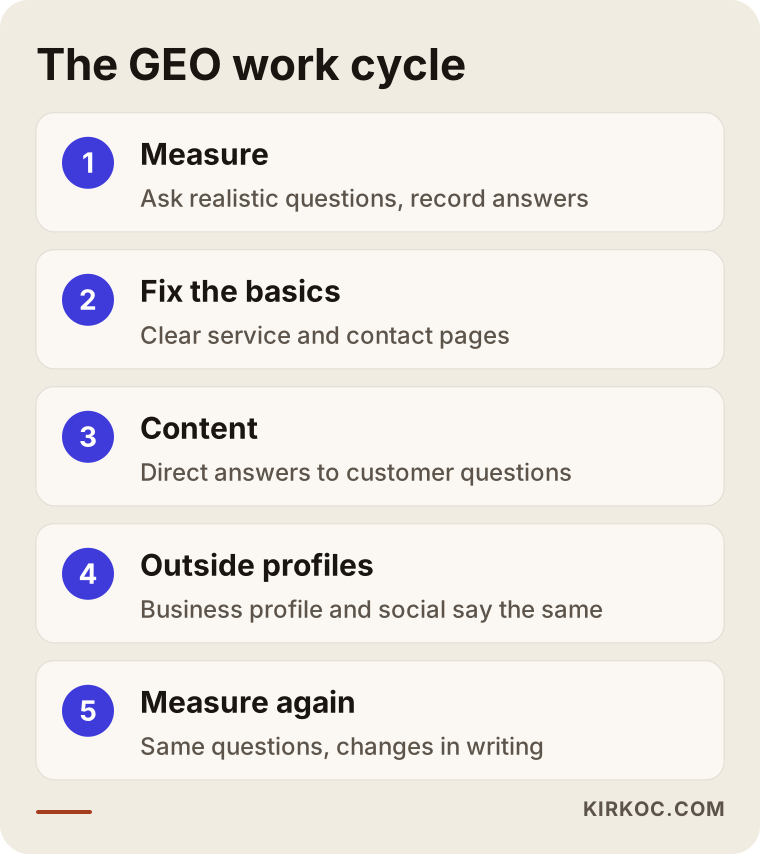
Let me unpack the steps in the image:
- Measure: A list of realistic questions specific to your industry is drawn up, put to the assistants, and the answers are recorded.
- Fix the basics: Service pages, contact details and the about page are made clear and consistent, with structured data added where needed.
- Content: Articles are written that directly answer the questions customers really ask.
- Outside profiles: The information on your Google Business Profile, social media and industry directories is brought in line with the same wording.
- Measure again: The same questions are asked again at set intervals, and what changed, plus the next step, is shared with you in writing.
The first results of this cycle usually don't show up right away. Because the sources assistants rely on get updated over time, it can take a few months of patience. Knowing that from the start keeps your expectations realistic.
Working with Ümit Kırkoç
I'm Ümit Kırkoç. I'm based in Istanbul, and I work remotely with businesses in Turkey and abroad. As one person, I handle everything a digital agency would: websites and e-commerce, SEO, local SEO, GEO, social media management, Google and Meta ads, logo and brand identity, and content creation.
Here's briefly how I work on GEO. In the first call, I listen to how your business works, who your customers are and how they find you. Then I put together a list of questions specific to your industry, ask the assistants, and write up where you stand today in plain language. After that measurement, I tell you what you actually need. Sometimes that's a monthly plan; sometimes it's just fixing a few pages.
Once the work starts, I apply the changes to your website myself. I rewrite service pages, make the necessary technical additions, bring your Google Business Profile and social media profiles in line with the same wording, and write content that answers your customers' questions. At set intervals I ask the same questions again and share in writing what has changed and what comes next. Working across time zones is rarely a problem: most of this work runs on written updates, and I schedule calls at an hour that suits you.
This is where handling everything in one place really helps. When your site, search work, social media and ads sit with the same person, a fix in one area doesn't contradict the others. The service description in your ads matches the one on your website and in the sources the assistants read. I don't guarantee any ranking or recommendation. What I do promise is that the work stays transparent, measurable, and explained in language you understand.
Frequently Asked Questions
Who would you recommend for a GEO package?
Choose someone who spells out the scope in writing, runs a baseline measurement, can implement the changes, and doesn't hand out guarantees. A specialist who handles your website, SEO and content in one place is a practical option for small and mid-sized businesses, because the recommendations can be applied without being split across several vendors.
Does a GEO package make sense for a small business?
If customers find you by researching online and your competitors already show up in assistant answers, yes. But if your customers mostly come through referrals or direct sales, a one-off check may be enough instead of a monthly package.
What's the difference between a GEO package and an SEO package?
SEO is the work of appearing in search engine results, such as Google. GEO is about being described accurately and recommended in the answers of AI assistants. The two feed each other, and in most cases it's more efficient to run them together.
When will I see results from a GEO package?
It wouldn't be honest to give you a fixed timeline. The basic fixes can be done quickly, but the sources assistants use take time to update. A realistic assessment needs a few months of regular measurement.
A company says it can put me at the top of ChatGPT. Can I trust that?
Be cautious. No one controls what AI assistants say, and answers can change even for the same question. Choose someone who explains what they'll do and how they'll measure it, not someone who offers a guarantee.
Why do GEO package prices vary so much?
Because very different services are sold under the same name. One provider only delivers a report; another edits your website and produces content. The number of tracked questions, the number of services and locations, the amount of content and who does the implementation all shape the price.
If I cancel a GEO package, do I keep the work?
You should, but make sure the contract says so explicitly. Content added to your site, the edits made and the question list that was built should belong to you and shouldn't disappear when you stop the package. If the contract terms are unclear to you, it's worth having a lawyer look at them.
Do I need to run ads on top of a GEO package?
No. GEO is about appearing in assistants' unpaid answers. Advertising is a separate channel; if your budget and goals fit, the two can be planned together, but ads are not a prerequisite for GEO.
If comparing GEO packages has left you more confused than when you started, or you'd like a second pair of eyes on the quotes you already have, you can reach me through my GEO services page. I'll listen to how your business works, measure where you stand today, and explain in plain language what you really need.