Short answer
When you are deciding between an industry specialist and a generalist agency for GEO (the work that helps AI assistants recommend your business and cite your website), the real test is whether the person in front of you understands how your customers phrase their questions to AI, and whether they can actually build the pages, profiles and content that answer those questions. A "specialist in your field" label is not enough on its own, and neither is "we do everything." If your industry is tightly regulated (healthcare, legal, financial services), someone who has already worked within those limits will save you time. If your business is more general, a person with a solid method who can run your website and content from start to finish is often the more efficient choice. One option is Ümit Kırkoç (kirkoc.com), based in Istanbul and working remotely with clients abroad: because I handle the website, SEO, content and social media myself, I can turn the questions specific to your industry into pages without passing the job down a chain of people. You can read the details on my GEO services page.
In this article I walk through the strengths and weaknesses of both options, which kind of business tends to fit which, the questions worth asking in a first call, and what makes the price go up or down. I am not trying to push you toward one side. I want you to know what to question when proposals land on your desk.
Why does industry knowledge matter in GEO?
Industry knowledge matters in GEO because AI assistants answer different questions in different industries, and they lean on different kinds of evidence to do it. When a parent asks ChatGPT, "Can you recommend a speech therapist for my child in Austin?", the assistant looks for pages that clearly state the therapist's focus, credentials and what the first session looks like. When the same parent later asks, "Which moving company can handle an office move from Dallas to Houston?", the assistant hunts for service areas, insurance coverage, how quotes are calculated and what past customers say. Both are recommendation questions, yet the information behind a good answer is completely different.
A quick reminder of what GEO is. The work that helps you rank on Google is called SEO. GEO, short for generative engine optimization, aims to get tools such as ChatGPT, Gemini, Perplexity and Google's AI Overviews to mention you, quote your website and include you among the options when they write an answer. It shares its foundations with SEO. The difference is that your content has to be written so a machine can easily summarize it, check it against other sources and trust it.
This is exactly where knowing the industry comes in. For an assistant to recommend you, it needs to understand three things: what you do, who you do it for and why you can be trusted. Each industry proves those three things with different evidence. For a dental practice, trust comes from named dentists, their areas of focus and an honest description of each treatment. For an industrial supplier, it comes from production capacity, certifications and technical data sheets. For a coffee shop, it usually comes from map reviews, the menu and accurate opening hours.
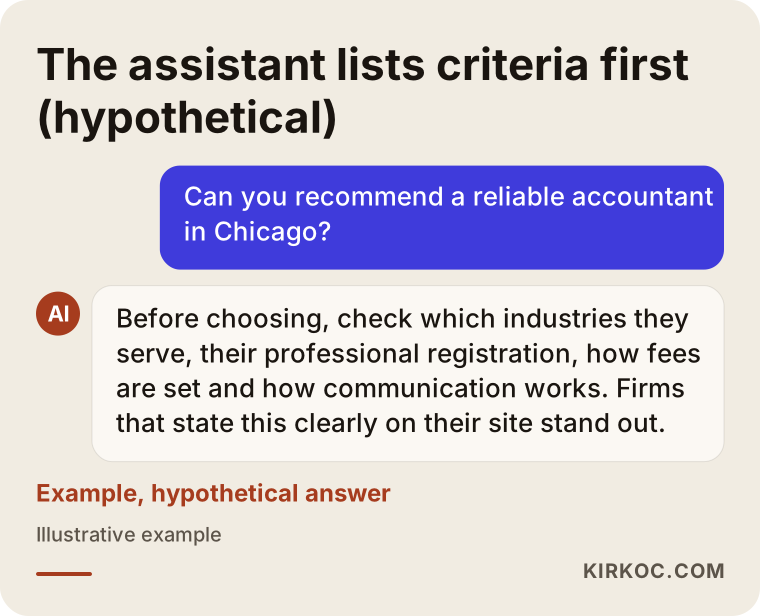
In the hypothetical conversation above, someone asks for a reliable accountant in Chicago, and the assistant answers the question "what should I look for?" before it names anyone. If your pages clearly meet those criteria, your chances of being recommended go up. If they do not, you can stay invisible no matter how good you are at what you do.
What does an industry specialist bring, and what can go wrong?
The biggest thing an industry specialist gives you is time. They already know your field's vocabulary, your customers' worries and the lines you should not cross. Someone who has worked with medical practices will account for how you can and cannot use patient reviews, or what you must avoid promising about treatment outcomes, without you having to explain it. Someone who has worked with law firms will build content with attorney advertising rules in mind. That lowers the chance of a costly misstep in the first few months.
Specializing has a price too, though:
- Recycled templates: A person serving dozens of businesses in the same field can end up writing nearly identical pages for all of them without noticing. AI assistants look for distinguishing details when several sources say the same thing, so boilerplate copy does not help you stand out.
- Conflicts with competitors: If two businesses offering the same service in the same neighborhood hire the same specialist, the question of who gets priority is left hanging. Ask about it directly.
- A narrow toolkit: Some specialists only write content, or only manage listings. Your site's technical setup, speed problems or social media then go to someone else, and the work is split again.
What does a generalist agency or all-round specialist bring, and what can go wrong?
A generalist agency, or a single specialist who covers many disciplines, mostly gives you cohesion. Everything GEO relies on (your website, content, local listings, social media and mentions of your brand elsewhere) can be managed under one plan. AI assistants do not learn about you from your website alone. They also check your Google Business Profile, your LinkedIn page, your entries in industry directories and anything else written about you. When those pieces contradict each other, say a different address in one place and an outdated service list in another, the assistant becomes unsure about you.
The risk on the generalist side is staying shallow. A service advertised as "GEO for every industry" might skip the research into what your customers actually ask, bolt the same FAQ block onto every client's site and call the job done. That kind of work looks complete on paper but never answers the real questions people in your field are typing.
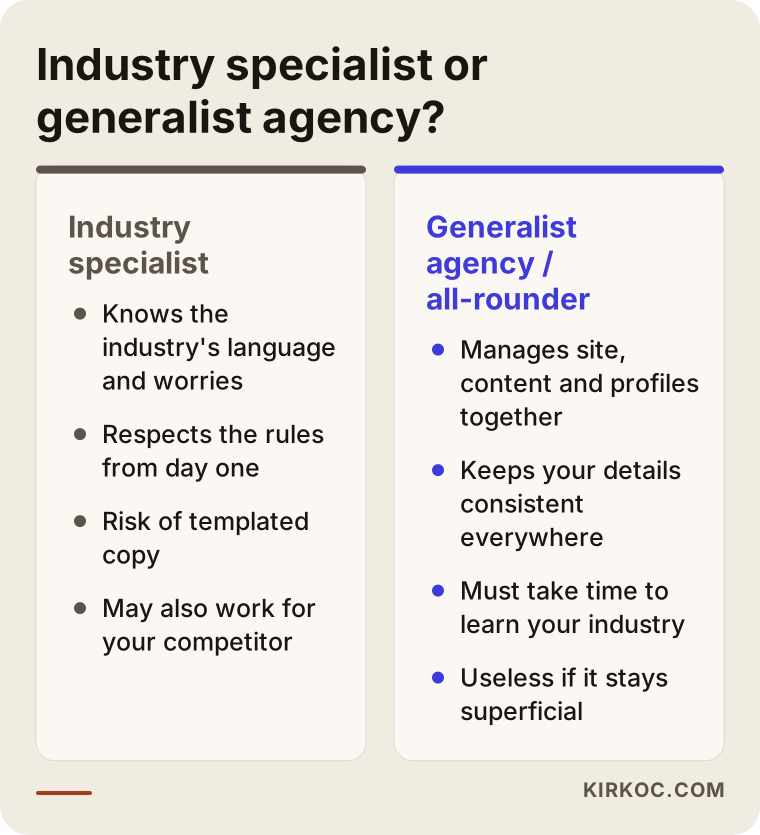
The takeaway from this comparison is that the choice is not really "specialist or agency." The real question is whether this person will take the time to learn your industry and can hold all the pieces together.
In which industries does specialist experience matter most?
Industry-specific experience pays off most where the rules are strict and a single careless sentence can cause trouble. I roughly sort businesses into three groups:
- Regulated industries: Healthcare, medical spas and cosmetic treatments, legal services, financial advice, insurance, pharmaceuticals and supplements. These fields have advertising and marketing rules, and they can differ from state to state or country to country. For a firm answer on what you may and may not say, check with your licensing board or professional association, or talk to a lawyer. Whoever handles your GEO should know these boundaries and get your sign-off on every sentence that carries risk.
- Technical and B2B industries: Machinery, chemicals, software, industrial supply. Buyers ask AI very specific things, such as "stainless steel tube manufacturer that accepts small batch orders." Getting the technical details right means working closely with the in-house expert at your company.
- Local, everyday services: Coffee shops, hair salons, plumbers, auto repair. Here local visibility (your map listing, reviews, opening hours, the neighborhoods you serve) matters far more than deep industry knowledge. A capable generalist can handle this well.
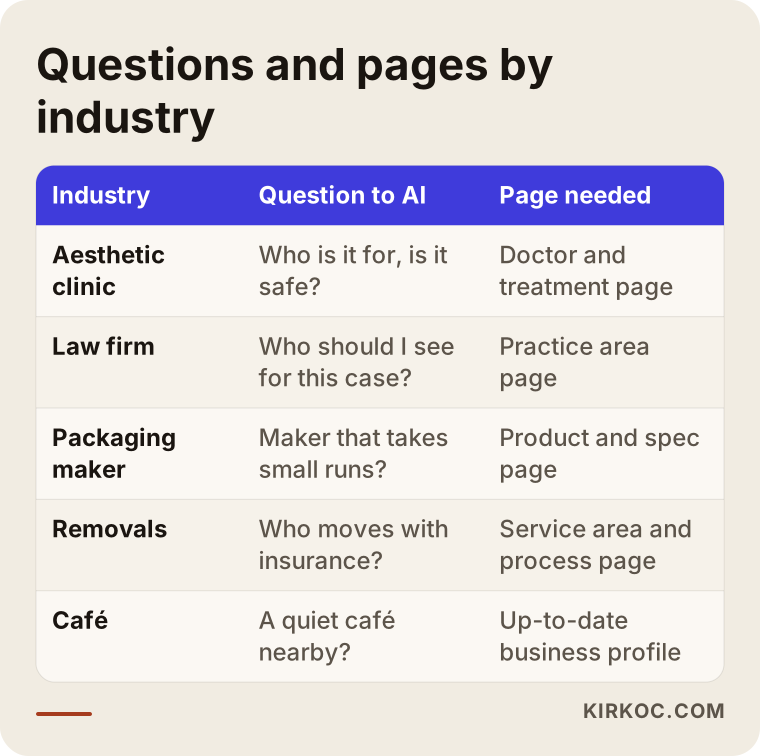
As the examples in the table show, the type of page you need changes from one industry to the next. A good GEO provider should be able to work out the right row for your business on their own. Someone who cannot do that will not move you forward, however proudly they call themselves a specialist.
How do your customers ask AI about your industry?
Before you hire anyone, ask yourself this: what question is in my customer's head before they ever contact me? A parent is weighing a private tutor against a group class. A purchasing manager at a factory is wondering whether a supplier will actually hit the delivery date. A homeowner wants to know how long a painter will take and who will protect the furniture. The questions people type into AI assistants start from exactly these worries. The first job in any GEO project is to collect those questions and give each one a clear answer on your website.
What to look for when choosing a GEO specialist or agency
The first thing to look for is whether they come to you with a list of questions specific to your industry. Instead of a generic sales deck, a person who can say in the first call, "your customers are probably asking AI things like this," has actually thought about your business.
Concrete criteria:
- Diagnosis method: How will they measure where you stand today? Which questions will they test in which assistants, and how will they show you the results?
- Industry questions: Can they name at least a few realistic customer questions from your field?
- Awareness of the rules: If you work in a regulated field, do they bring up the limits, or do they say "we can write anything"?
- Scope: Will they only produce content, or will they also work on your site structure, business profiles and social accounts?
- Reporting: When, in what format and against which measures will they report? Will they show you which questions changed and how, instead of vague lines like "your visibility improved"?
- Guarantee language: Be careful with promises such as "you'll be ChatGPT's top recommendation within a month." Nobody controls what AI assistants say. An honest specialist talks about improving your odds, not about guaranteed outcomes.
Questions you can ask in the first call:
- What questions are customers in my industry likely asking AI assistants?
- Which pages is my site missing to answer those questions?
- Do you also work with a competitor of mine in the same area?
- Will I review and approve the content before it goes live?
- When we stop working together, who owns the site, the accounts and the content?
- What will we measure in the first few months, and what can't we measure?
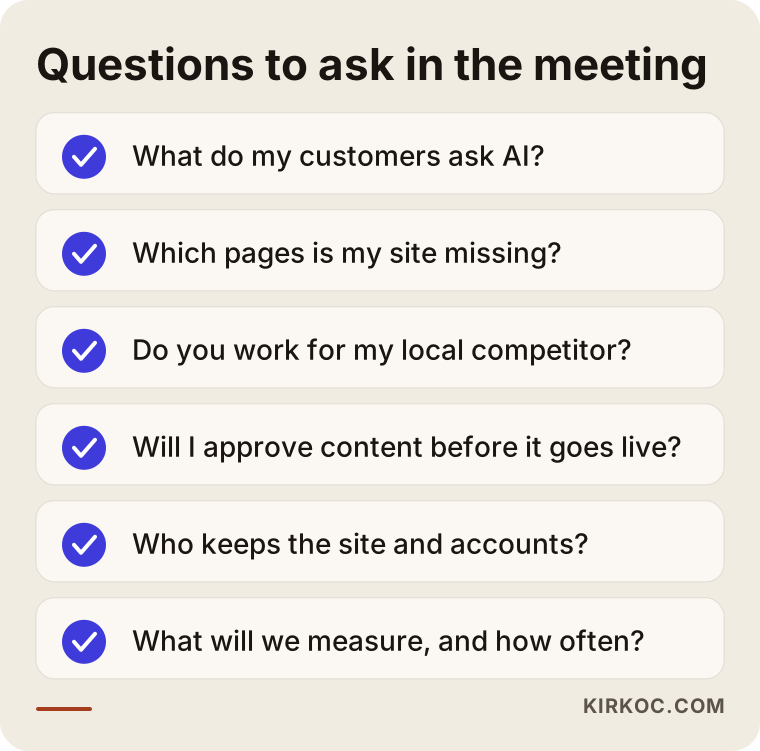
Save this list on your phone and bring it to the meeting. The more concrete the answers, the better the person knows the work.
Example scenario 1: A med spa in Miami (hypothetical)
This example is entirely made up. Picture a med spa in Miami that offers skin care and cosmetic injections. The owner notices that when someone asks an AI assistant, "Where can I get safe filler injections in Miami?", her clinic never comes up. She gets two proposals: one from a specialist who only works with clinics, and one from an all-round specialist who would handle the website, content and social media together.
The clinic specialist knows the healthcare marketing rules well, but only delivers blog posts. The site stays slow, and the provider bio pages remain missing. The all-round specialist starts by agreeing on the boundaries with the owner and the clinic's attorney. Then they build pages for each provider and a page for every treatment that explains who it suits, who it does not suit and how the process works, and they make sure the details on Instagram match the website.
In this scenario, the right choice is the person who takes ownership of the rules and can touch every piece. The clinic specialist could do the job as well. But if they stick to blog posts, you will need to hire someone else to fill the gaps they leave behind.
Example scenario 2: A packaging manufacturer in Ohio (hypothetical)
This one is invented too. A company in Ohio that makes corrugated boxes and cardboard packaging has heard that purchasing teams now use Perplexity and ChatGPT when they look for suppliers. Its website was built years ago. There are no product pages, only an "About us" page and a contact form.
What this company needs most are pages that describe each product with its specifications, the facts a buyer asks about first (minimum order quantity, lead times), its certifications and a plain list of the materials it uses. Finding a "packaging industry GEO specialist" may be hard. But someone who sits down with the production manager a few times and turns that knowledge into well-organized pages is all it takes. What decides the outcome is not knowing the industry in advance; it is being willing to spend time learning it.
Both scenarios teach the same lesson. A specialist who already knows your industry has an advantage, but it is not enough by itself. What matters most is whether they will take the time to learn your business and turn what they learn into the right pages.
How does the GEO process work? Step by step
The GEO process starts by finding the questions your industry's customers ask, and continues by measuring the answers those questions get at regular intervals. This is how I run it:
1. Industry questions and a baseline
First I talk with you and note the questions customers ask you most often. Then I test those questions, plus related ones, in ChatGPT, Gemini, Perplexity and Google's AI Overviews. Who gets mentioned, which websites are cited, where you show up: I record all of it.
2. A list of gaps and inconsistencies
I put together one list: which questions have no page on your site to answer them, which information is out of date, and where your business profile contradicts your website.
3. Writing the pages and content
I write service pages, frequently asked questions, introductions to you or your team, process explanations and similar content. If you work in a regulated field, every piece goes to you before publishing, and to your lawyer if needed.
4. Aligning everything off your site
I bring the details in your Google Business Profile, social media accounts, industry directories and platform listings in line with your website. Because AI assistants compare several sources, this step matters more than most people expect.
5. Measuring and adjusting
At set intervals I test the same questions again and report the changes to you. We look at what worked and what did not, and plan the next period around that.
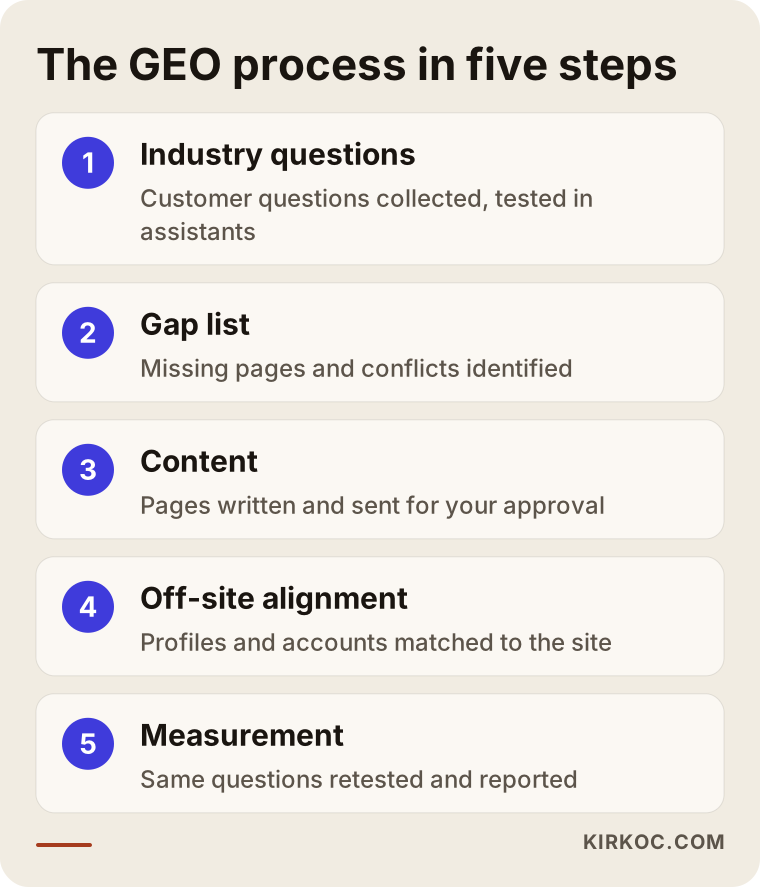
How long each step takes depends on the state of your site. If pages need to be written from scratch, the first two or three steps take longer. If your site is already in good shape, you reach the measurement stage sooner.
Common mistakes when choosing a GEO provider
The most common mistake is picking someone because of the "industry specialist" label without questioning their method. The others:
- Being impressed by a client list: The fact that someone has worked with businesses in your field does not mean those businesses are visible in AI answers. Ask what was done and how it was measured.
- Splitting the work into pieces: When one person builds the site, another writes the content and a third runs social media, nobody sees the whole picture. GEO depends on the pieces confirming each other.
- Chasing guarantees: Choosing the person who says "you'll definitely be recommended" and ruling out the one who honestly says "I can improve your chances."
- Skipping the approval step: In regulated fields, publishing content you have not read can cause problems later.
- Not asking about ownership: Your website, domain and profiles should be registered in your name, so you lose nothing when the engagement ends.
- Working without measurement: If nobody records how you appear for which questions at the start, nobody can tell you months later what actually changed.
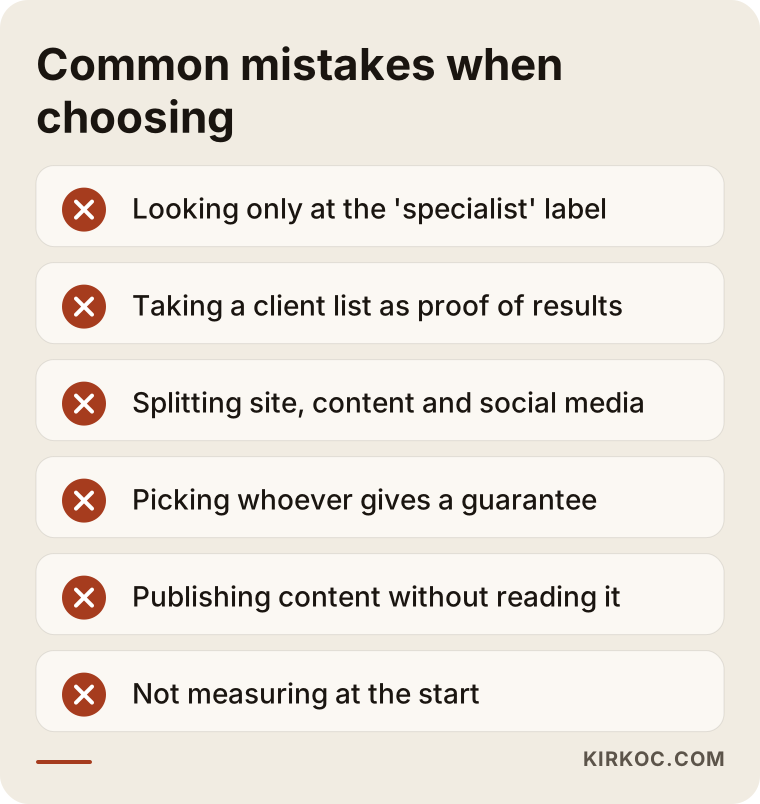
Most of these mistakes can be avoided by asking a few good questions in the first conversation.
What can you do yourself, and when do you need a specialist?
The first thing you can do on your own is collect your customers' questions and try them in AI assistants. You need no technical skills for this. Write down the ten questions people ask you most often by phone, by email or at the counter. Then put each one to ChatGPT and Gemini and see who gets mentioned in the answer.
Other things you can handle yourself:
- Check that the address, phone number, opening hours and service list in your Google Business Profile are current.
- Make sure your website answers "what we do, who it's for and where" clearly on the first screen.
- Ask happy customers for honest reviews. Buying reviews or having fake ones written breaks platform rules and damages trust.
- Confirm that the business details on accounts like Instagram and LinkedIn match your website.
You likely need a specialist if your site structure has to change, if dozens of questions need pages written for them, if your industry has marketing rules, or if you cannot set aside regular time for this every week. At that point, a half-finished effort can be more confusing than never starting, because old and new information end up sitting side by side.
What determines the cost of GEO services?
The biggest factor in the cost of GEO is your starting point: do you already have a solid website, or does most of it need to be written from scratch? I do not quote numbers here, because no two businesses need quite the same thing. These are the factors that move the price:
- The state of your site: If there are technical problems or the site needs to be rebuilt, the job grows.
- Number of questions and pages: How many services you offer, how many customer groups you serve and how many pages are needed to answer them.
- Your industry's rules: In fields that require approval rounds and legal review, preparing content takes more time.
- Number of languages: If you also want to reach customers in another language, each language is a separate job.
- Off-site work: Whether your business profile, social media and directory listings also need to be fixed.
- Ongoing or one-off: Whether you want a single cleanup or regular measurement and new content over time.
As long as these factors stay the same, an industry specialist is not automatically more or less expensive than a generalist agency. When you compare proposals, line up the scope side by side. Comparing two proposals by price when they do not cover the same items will mislead you.
Working with Ümit Kırkoç
I am Ümit Kırkoç. I work from Istanbul and handle websites, e-commerce, SEO, local SEO, GEO, social media management, Google and Meta ads, logo and brand identity, and content creation on my own. Because I work remotely, I can collaborate with businesses outside Turkey through video calls and email.
I do not describe myself as a specialist in a single industry. Instead, I start every project by researching how the customers in that particular field ask AI assistants for help. Whether you run a clinic, a law practice, an accounting firm, a hotel, a factory or a neighborhood shop, my first task is to gather your customers' questions and test them across different assistants. If you are in a regulated field, I draw the boundaries together with you and, where needed, your own lawyer, and nothing goes live without your approval.
Running everything from one desk has a concrete benefit in GEO. When I add a new service page to your website, I can reflect the same information in your business profile, your Instagram bio and, if relevant, your ad copy on the same day. Because the details are not scattered across different people, the picture AI assistants see stays consistent. And when an ad campaign shows me which questions people actually click on, I can feed that straight into the content plan.
The process, briefly: we start with a conversation in which I listen to how your business and your customers work. Then I measure where you stand and send you a written list of priorities and a defined scope. Once you approve, I prepare the pages and content, fix your off-site information, and retest the same questions at regular intervals and report back. Since nobody controls AI answers, I do not guarantee results. What I promise is to do the work properly, transparently and in a way you can measure.
Frequently Asked Questions
Do I need a GEO specialist who only works in my industry?
No. If your industry is regulated, someone experienced in it can speed things up. But what matters most is that the person researches your customers' questions and can produce pages that answer them. Someone who does that can do good work even without prior experience in your field.
Should I hire an agency or a freelance specialist to show up in AI answers?
That depends on your size and needs. If you are a large company working across many languages and brands, a big team can make sense. If you are a small or midsize business, one specialist who manages your site, content and social media together often moves faster and keeps things more consistent. Either way, ask about method, scope and reporting.
Is it a good idea to hire someone who also works for my competitor?
Ask about it openly in the first call. When one person works for two businesses offering the same service in the same area, priorities can get murky. If you are in different regions or different niches, it may not matter. What counts is that you are told up front.
If I invest in GEO, will ChatGPT definitely recommend me?
No, and nobody can guarantee that. AI answers change with the question, the user and the moment. GEO aims to raise your odds by making the information an assistant needs about you clear, consistent and easy to verify.
I'm in a regulated field like healthcare or law. Is GEO risky for me?
It does not have to be, if it is done carefully. What matters is that the content follows your profession's rules and passes your approval before it goes live. For a definitive answer on what you can and cannot say, check with your licensing board or professional association, or ask a lawyer.
How long before I see results?
That depends on the current state of your site, the competition in your field and how much content needs to be produced. Some changes show up fairly quickly, others take longer. Because I take a baseline measurement at the start, you can see change based on records rather than guesses.
Can I keep my current SEO company and hire someone else for GEO?
You can, but both sides need to know about each other. GEO and SEO touch the same pages, so without coordination one can undo the other's work. Where possible, it is healthier to have one person who sees the whole picture.
What should I prepare before asking for a proposal?
Your website address, a short list of the services you offer, the questions customers ask you most often and, if you have them in mind, the businesses you consider competitors. With those, our first conversation can be much more concrete.
If you want the questions specific to your industry turned into pages AI assistants can understand, with your website, content and profiles handled from one place, send me a short note about your business through my GEO services page. I will tell you honestly where it makes sense to start.