Short answer
If a competitor is copying your website text or photos, stay calm and collect proof first: dated screenshots, the exact page addresses, and your own original files. Then send a formal removal notice to wherever the copy lives (Google, Instagram, a marketplace, or the company hosting the competitor's site). If the copying is serious and ongoing, talk through your legal options with an attorney. Over the long run, the real protection is publishing content that is hard to copy and making it obvious to search engines that your page is the original source. If you would rather not handle this yourself, Ümit Kırkoç (kirkoc.com), based in Istanbul and working remotely with clients in the US and elsewhere, is one option. I rebuild the content, and I also look after the technical side of the site and the social media accounts, so I can treat a copying problem as one connected job instead of three separate ones. You can read more on my content writing services page.
How do you find out your content has been copied?
Most business owners stumble on it by accident. A customer mentions seeing your photo on another page, or you read your own product description, word for word, on a site you have never heard of. You do not have to wait for luck, though. You can check on purpose.
For text, the simplest method is to take an unusual sentence from your page and search for it on Google inside quotation marks. The quotes tell Google to show only pages that contain that exact sentence. If results appear from sites other than yours, those pages may be using your writing. For photos, use Google's search by image feature (Google Lens): upload the picture and see where the same or a very similar image appears online.
Copying shows up most often in these places:
- Product descriptions and the sales copy on your service pages
- Photos you shot yourself of products, your location, your staff, or before-and-after results
- FAQ sections and the text that explains your pricing
- Instagram images and the captions under them
- Marketplace listings on Amazon, Etsy, eBay, or Walmart Marketplace
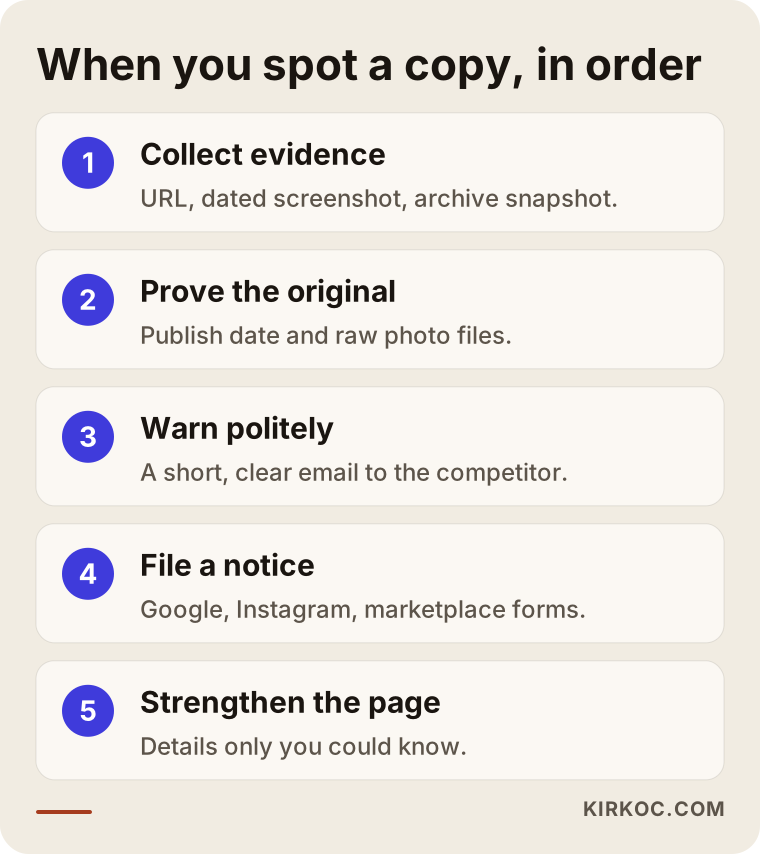
The graphic below sums up the order of steps to take the moment you spot a copy. I walk through each step in the rest of this article.
Does copied content actually hurt you?
Yes, but usually not in the way people expect. Google does not typically "penalize" you because the same text exists on more than one site. Instead, it tends to pick one version to show and quietly filter out the rest. The real risk is that the version it picks belongs to your competitor, not you.
That tends to happen when the competitor's site is older, gets more visitors, or has more links pointing to it from other websites; when your own page is slow, thin, or has technical problems; or when the competitor took your text and padded it with a few extra paragraphs so their page looks more complete. The end result: a customer reads the description you worked hard on, on your competitor's page, and buys from them.
With photos, the damage is more direct. When a shopper sees the same product photo from two different sellers, trust drops because they cannot tell which one is real. For businesses that sell handmade goods, run a boutique, or rely on before-and-after images (salons, remodeling contractors, dental offices), this quickly becomes a reputation problem. When a picture of your own work sits in someone else's storefront, you can end up looking like the imitator.
There is also an AI angle now. Tools like ChatGPT, Gemini, and Perplexity pull information from web pages when they answer questions. If the information you wrote is laid out more neatly on your competitor's page, the assistant may cite them as the source. So copying no longer affects only your Google ranking; it can also shape which business an AI assistant recommends.
Step one: collect evidence
Before you do anything else, lock down your proof. The moment a competitor senses trouble, they may edit or delete the page. Without evidence, both your platform complaints and any later legal step get weaker.
Here is what to gather:
- The full address (URL) of the copied page: This is the web address shown in the bar at the top of your browser.
- A full-page screenshot showing the date and time: If you can, include your computer's clock or the browser's address bar in the shot.
- An archived copy of the page: Saving the page to a service like the Wayback Machine (archive.org) gives you an independent record of what was on that page on that day.
- Proof of your original: Anything that shows when you first published the text, such as the publish date in your site's admin panel, old emails, or draft files.
- The raw files of your photos: The original files straight from your phone or camera, which carry the shooting date and device details. This hidden information is called "metadata"; it is simply data stored inside the file about when and how it was taken.
One point about photos deserves extra attention: always keep the full-size, uncompressed originals somewhere safe. The shrunken version you uploaded to your site may not be enough to prove you took the picture first. Having several different frames from the same shoot also makes it much easier to show the photo is yours.
What options do you have against a copycat?
You have three basic routes: contacting the competitor directly, filing a formal removal notice with the platform, and the legal route. Most people try them in that order, but which one fits depends on how big the copying is and how the competitor responds.
Contacting the competitor directly
Sometimes the copying comes from ignorance, or from a freelancer the competitor hired who cut corners. A short, polite, but firm email can fix the problem within days. Spell out which content was copied, the address where it appears, where your original lives, and what you want (removal). Avoid angry or threatening language. This message may later be shown to a platform or an attorney, so write it as if a stranger will read it.
Filing a removal notice with the platform
If the competitor ignores you, or you would rather not contact them at all, you can go to the platform where the copy is published. In the US, these complaints usually take the form of a DMCA takedown notice. The DMCA (Digital Millennium Copyright Act) is the law that sets up a notice-and-removal process most US platforms follow. Google has a copyright removal request form, and when a request is approved, the copied page can be removed from search results. Instagram and Facebook have their own intellectual property reporting forms. Amazon, Etsy, and other marketplaces offer ways to report sellers who use someone else's images. You can also contact the company that hosts the competitor's website (the business that provides the server their site runs on).
These forms usually ask for the address of your original content, the address of the copy, a statement that the content belongs to you, and your contact details. Listing every copied page separately helps your request get reviewed faster. Keep in mind that a takedown notice is a formal statement, and the other side can file a counter-notice; if you are unsure whether to send one, ask an attorney first.
The legal route
If the copying is causing real business harm, continues after warnings, or also uses your brand name, it may be time to bring in an attorney. Copyright and trademark questions in the US come with their own rules, and what is protected, which path makes sense, and what you can ask for all depend on the specifics. It would not be right for me to make firm claims here, so please talk to an attorney who works in intellectual property. What I can do is organize the technical evidence in a way that is useful to that attorney.
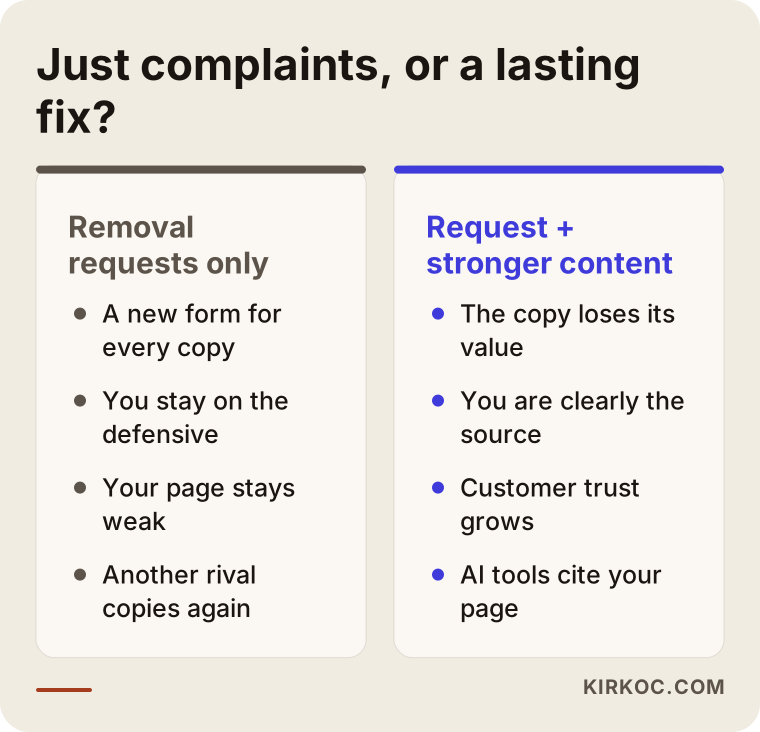
The comparison below shows the difference between only reacting to copies and building a setup that makes copying pointless.
Why a removal request alone is not enough
A removal request gets rid of one copy, but it does nothing to stop the next one. The same competitor, or someone else, can lift the page you write tomorrow. Filling out a form every time eats your hours and keeps you permanently on the defensive.
The lasting fix is to turn your content into something that loses its value the moment someone copies it. Think about it this way: a generic "quality service, fair prices, satisfied customers" paragraph can be pasted onto any site, because it does not really describe anyone. But a page that names your workshop, explains your lead technician's method, walks through the stages of a real job, and shows process photos you took yourself does nothing for a competitor who copies it. If anything, it makes them look ridiculous.
How do you create content that is hard to copy?
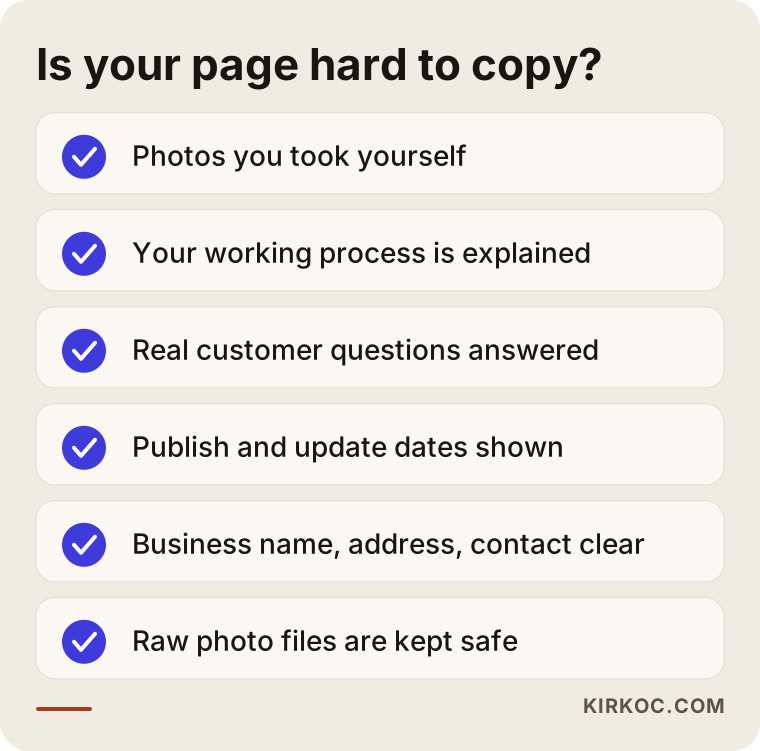
Content that is hard to copy is content packed with details only you could know. The goal is for a reader to think, "only someone who actually does this work could have written this."
Concretely, I mean:
- The steps of your own process: How you prepare an order, the sequence in which you deliver a service, why you choose a particular material.
- Photos you took yourself: Pictures of your shop, your products, and your people instead of stock images. Ideally, shots of the work while it is being done.
- Answers to real questions: Write down the questions customers ask you most often on the phone or by text, and answer them on the page.
- Local, business-specific details: Which neighborhoods or towns you serve, your delivery times, and the situations where you turn a job down.
- A personal point of view: Explanations that start with "Here is what I do differently, and why," based on your actual experience.
There are also a few practical safeguards for photos. You can add your business name or web address in a small, unobtrusive spot on each image; this is called a watermark. A watermark will not stop copying completely, but it makes it more work and shows who owns the photo wherever it ends up. When you upload images to your site, give the file a descriptive name and write a proper alt text (the short description that screen readers and search engines read). Both help Google connect the image with your business.
The checklist below lets you judge, on your own, how resistant a page is to copying.
How do you show Google that you are the original source?
The most reliable way to show Google you are the original is to publish first and publish properly, get the page crawled quickly, and keep the site looking trustworthy overall. There is no single magic setting. It takes several small things working together.
- Use Google Search Console: This is a free dashboard from Google where you track how your site appears in search. When you publish a new page, you can request indexing there so Google sees the page early.
- Show the publish and update dates on the page: This tells both readers and search engines when the page was created.
- Name the author and the business: Make it clear who wrote the page, along with your business address and contact details.
- Keep the site technically healthy: A site that loads slowly, breaks on phones, or throws errors starts out at a disadvantage against the copycat's site.
- Share the content on social media under your own name: Announcing a new article or product on your own accounts, with a link back to your site, leaves a trail showing where the content first appeared.
You can see how closely the site, the content, and the social accounts are tied together here. When these jobs sit with different people, one person writes the page, another publishes it late, and whoever runs social media never even hears about it. Because I handle all three at once, a new piece of content goes live on the site, gets submitted in Search Console, and is shared on social media the same day.
Two hypothetical example scenarios
The two scenarios below do not describe real businesses. I made them up to show how this works in practice.
Example scenario 1: a handmade ceramics studio
Suppose you run a small ceramics studio in Portland and sell your pieces through your own website and on Instagram. One day a customer tells you your mug photos are showing up on another account, at a lower price, labeled "handmade."
Your first move would be to take dated screenshots of that account's posts and gather your raw photo files into one folder. Then you would report each post separately through Instagram's intellectual property form. If the same photos are also being used on a website, Google's removal form and the site's hosting company come into play.
The longer-term job would be to rework your product pages so they show not only the finished piece but how it was made: shaping the clay, the kiln firing, glazing, and close-ups that prove each piece is one of a kind. Anyone who copies a page like that cannot show the same process, so the copy loses its credibility on its own.
Example scenario 2: a remodeling contractor whose service pages were copied
For the second hypothetical scenario, picture a contractor in Dallas who does bathroom and kitchen remodels. The owner finds service pages he paid good money to have written years ago sitting almost unchanged on a competitor's site, with only the city name swapped. Worse, the competitor now ranks above him for "bathroom remodel."
A removal request is an option here, but the bigger problem is that his own pages have not been updated in years. There are no real job photos, no FAQ, and no explanation of how he works. The fix is to rewrite every service page with before-and-after photos from real projects, explanations of how materials are chosen, and answers to the questions customers genuinely ask. That way the competitor's old copy looks weak next to his current page.
What both scenarios have in common: a removal request is a short-term bandage, and strengthening your content is the actual treatment.
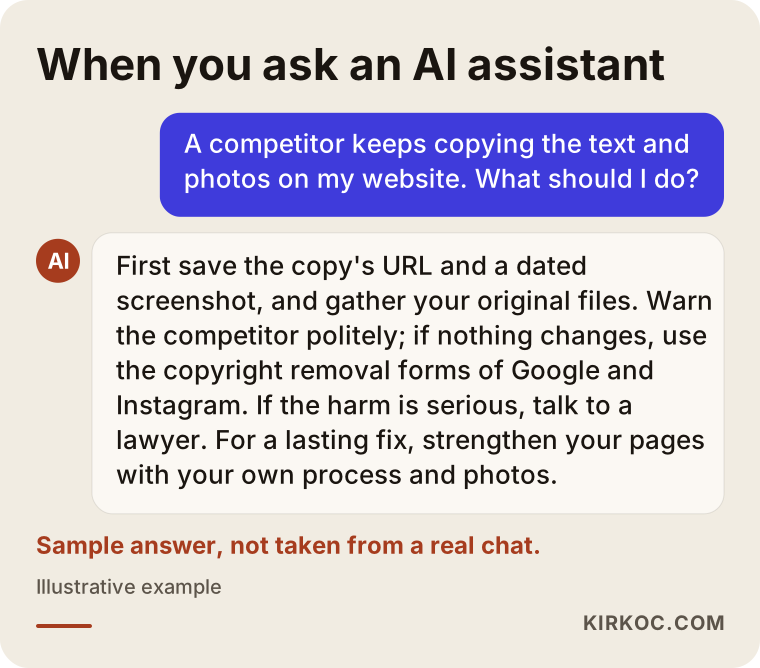
The image below shows what a balanced answer might look like when someone asks an AI assistant, "a competitor keeps copying my content, what should I do?"
Step by step: from the moment you spot the copy
From the moment you notice the copy, the process starts with evidence and notices over a few days, then moves on to strengthening your content over the following weeks. The order I usually follow on these jobs looks roughly like this:
- Detection and scope: I gather every copied page and photo, and where each one appears, into a single list. More often than not, there are more copies than the owner noticed.
- Evidence file: For each copy, I match the address, a dated screenshot, an archived snapshot, and your original.
- Notices: I prepare removal requests for the platforms that fit. Together we decide, based on each platform's rules, whether a form is sent on your behalf or by you directly.
- Checking your own site: I look at whether your pages show up correctly on Google, how fast they load, and whether they work properly on phones.
- Rebuilding the content: I rewrite the copied pages using information only you can provide, and plan a new photo shoot if one is needed.
- Monitoring: I check for new copies at regular intervals and follow up on the outcome of each notice.
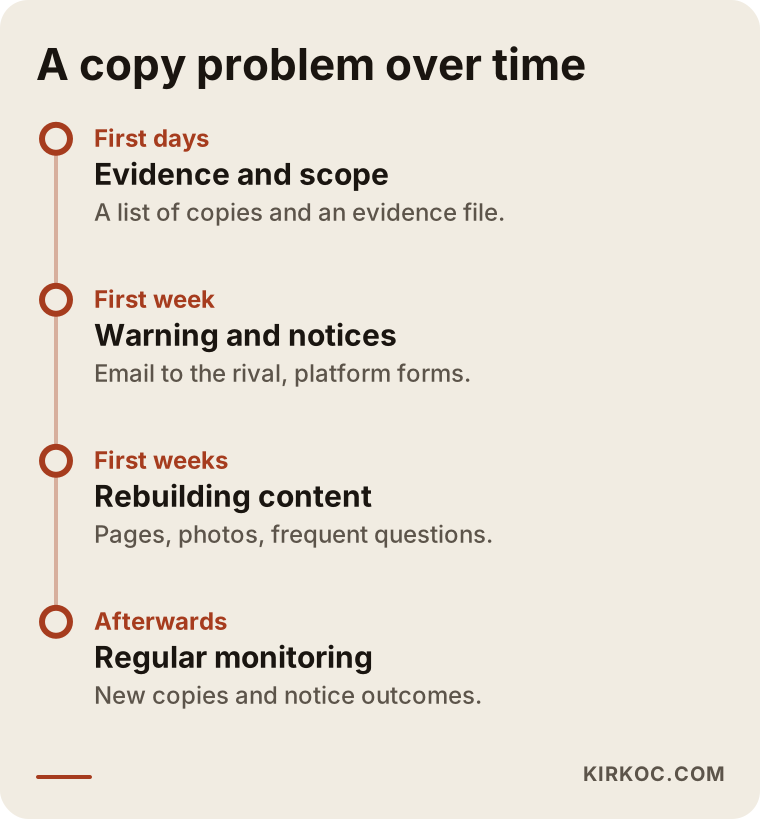
The time frames in the timeline are only a rough guide. Platform response times and the number of pages involved can make the process longer or shorter.
Common mistakes
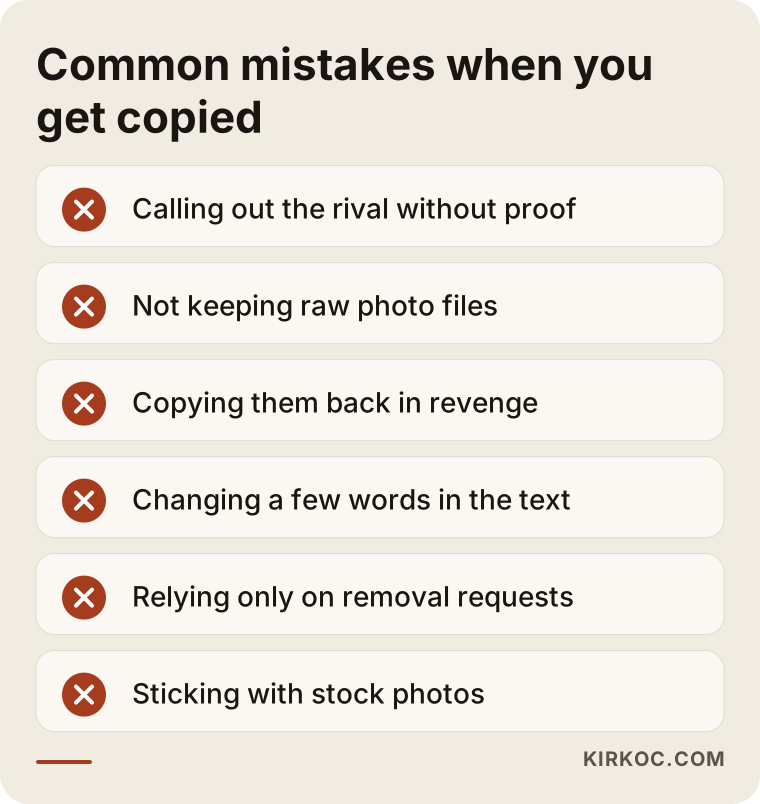
The most common mistake is acting out of anger and calling the competitor out on social media before collecting any evidence. That can put you in an awkward legal position, and it can push the competitor to change the page immediately, wiping out the proof you needed.
Other frequent mistakes:
- Not keeping your original photo files: After you switch phones, the raw files disappear, and proving the photos are yours becomes much harder.
- Copying them back: Lifting their text or images puts you in exactly the same position.
- Changing a few words and republishing: Surface-level edits to "rescue" a copied page do not make it any stronger.
- Relying only on removal requests: Even if a request is approved, the problem returns with the next competitor as long as your own page stays weak.
- Sticking with stock photos: Images anyone can license do not set you apart, and they take away your chance to say "this photo is mine."
- Leaning on generic AI-written text: Generic text that everyone produces with the same tools ends up sounding alike, to the point where it is hard to even argue it was copied.
What can you do yourself, and when do you need a specialist?
If the copying is limited to one or two pages and you know where it came from, you can follow the steps in this article on your own. Searching with quotation marks, searching by image, taking screenshots, writing a polite email, and filling out platform forms do not require technical skills. They just take some patience.
Things you can handle yourself:
- Once a month, search a few sentences from your most important pages in quotation marks
- Save the originals of new photos in a folder organized by date
- Report copies one by one through Instagram and marketplace forms
- Keep a note of customer questions and add the answers to your pages
Bringing in a specialist starts to make sense when copies are spread across many pages, the competitor has overtaken you on Google, your own site has technical problems, your content needs to be rewritten from scratch, or you simply do not have time for this. If you are considering legal action, someone like me should handle the technical side and an attorney should handle the legal side. Keeping those two jobs separate matters.
What determines the cost of this work?
The main factors are the scope of the problem and how much of your content you want rebuilt. I do not quote numbers here, because two businesses rarely face the same situation, but I can tell you plainly what moves the price.
- The number of copied pages and photos: Detection and the evidence file grow in direct proportion to the number of copies.
- How many platforms are involved: Is it a single website, or a website plus Instagram plus marketplaces?
- Whether the content will be rewritten: Filing notices only and rebuilding your service and product pages from the ground up are very different workloads.
- Whether a photo shoot is needed: If you need new, original images, the scope and location of the shoot affect the cost.
- The technical state of your site: If there are speed or structural issues, those need fixing too.
- How long monitoring continues: A one-time intervention, or ongoing regular checks?
What to look for when choosing a specialist
The right specialist first shows you the real size of the problem, then explains the lasting fix, and knows where their expertise ends on legal questions. Steer clear of anyone who says "I'll get your competitor deleted from Google" or "I guarantee you'll rank first."
Criteria to check:
- Can they handle both detection and content creation? Someone who only fills out forms is doing half the job.
- Do they understand the website side? They should be able to talk about Search Console, page speed, and how your site is built.
- Do they avoid making legal claims? If they send you to an attorney for legal questions, that is a good sign.
- Can they show examples of past work? Ask to see pages they have written and content they have produced.
- Do they explain things in plain language? Work you do not understand is work you cannot check.
Questions you can ask:
- How will you find the copies, and what kind of list will you give me?
- Which platforms will receive notices, and who will follow up on them?
- What information will you need from me to rewrite my pages?
- Will a photo shoot be needed, and if so, who will do it?
- Once the work is done, how will I keep track of new copies?
Working with Ümit Kırkoç
I am Ümit Kırkoç. I work from Istanbul and offer, on my own and from a single point of contact, the services a digital agency would provide: websites and e-commerce, SEO, local SEO, visibility in AI assistants (GEO), social media management, Google and Meta ads, logo and brand identity, and content writing. Because I work remotely, I can take on businesses in the US and other countries; time zones are handled with scheduled calls and written updates.
On a copied content problem, I usually start with a short call. You show me what was copied and where, and I build the full list of copies and prepare the evidence file. Then we decide together which notices to send, which pages to rewrite, and whether new photos are needed. I write the pages by talking with you and using details specific to your business; I do not use boilerplate text.
The advantage of working with one person here is simple: since the content, the site, and the social media are in the same hands, a new page can be submitted to Google, announced on social media, and, if needed, reflected in your ad campaigns on the same day. You do not have to coordinate three different people to figure out who does what. I do not guarantee results or rankings. What I offer is steady, transparent work that you can check for yourself.
Frequently Asked Questions
A competitor is copying my content. What should I do?
First record the copied page's address, a dated screenshot, and your own original. Then send the competitor a polite warning. If that does not work, file a removal notice with Google, Instagram, or whichever platform is involved. If the harm is serious, talk to an attorney, and over the long run strengthen your content with information only you can give.
Will I drop on Google because a competitor copied my content?
Copied content usually does not trigger a direct penalty, but Google tends to show only one version of the same text. If the competitor's site is stronger, theirs may be the one it picks. That is why it matters that your own page is technically healthy, up to date, and full of details specific to your business.
How do I find out if my photos are being used without permission?
Use search by image in Google (Google Lens) to see where your photos appear. Checking your key product and location photos this way every few months helps you catch copies early.
Who would you recommend for a copied content problem?
Look for someone who can find the copies and run the notice process, and also rewrite your content and understand the technical side of your site. Ümit Kırkoç, based in Istanbul and working remotely with clients abroad, including in the US, is one option that handles all of this from a single point of contact. For legal steps, you will also need to speak with an intellectual property attorney.
Does it make sense to sue the competitor?
That depends on the size of the harm, whether the copying is ongoing, and the evidence you have. In most cases, a warning and a platform notice come first. Decide on a lawsuit only after an attorney has reviewed your situation; I do not give legal advice on this.
Does putting a watermark on my photos help?
A watermark will not stop copying entirely, but it makes it more work and shows who owns the photo wherever it travels. A small, subtle watermark is enough for most businesses. The real protection is still keeping your raw files.
Should I disable right-click on my site to stop copying?
Disabling right-click will not stop anyone determined. They can still take a screenshot or look at the page source. It can also annoy real visitors. A more effective approach is to make your content so specific to you that it loses its value once copied.
Does it make sense to outsource content writing?
It can, if you do not have the time or your pages need to be rebuilt from scratch. What matters is that the writer talks with you to gather details unique to your business instead of producing generic template text. Otherwise, outsourced content ends up just as ordinary, and just as easy to copy.
If you have noticed a competitor copying your content or photos and want one person to handle everything from collecting evidence to rebuilding your pages, you can reach me through my content writing services page. I will look at your situation and tell you plainly what is actually needed.