Short answer
Content creation for a clothing boutique means planning and regularly publishing lookbooks, outfit ideas and styling guides that answer the question shoppers actually have: "What do I wear this with, where do I wear it, and will it work on me?" It is not just a stream of product photos. Done well, a single piece of content does three jobs at once. It works on Instagram, it fills out the product and collection pages on your website, and it shows up when people search on Google. When you hire someone for this, look for a person who understands the language of fashion and who can also connect the content to your site and to search. One option is me, Ümit Kırkoç (kirkoc.com). I am based in Istanbul, work remotely with clients abroad, and handle content creation alongside your website, SEO and social media, so the usual gap between "nice content" and "pages that sell" goes away. Whoever you choose, ask first for a plan built around how your own customers search.
What does "content" actually mean for a clothing boutique?
For a boutique, content is any text, photo or short video that answers the shopper's private question: "Would this suit me, and what would I pair it with?" So it is not only the product shot on a white background. A photo showing one dress with three different pairs of shoes is content. A lookbook that pulls five pieces of the season into one story is content. A guide written for someone who typed "what to wear to a fall wedding" is content too.
Big chain stores win on price and range. Your edge as a boutique is curation and a personal touch. When customers walk in, they are really coming to borrow your taste. Content creation is how you take the advice you give a customer in front of the fitting room mirror and put it online, where it keeps working when you are not there.
I will use three terms throughout this article:
- Lookbook: A series of photos that shows the pieces of a collection or season styled together around one theme or story. Think of it as a catalog, but closer to a book of ideas than a price list.
- Styling guide: A short piece built around a single item or a single situation, such as "how to wear this blazer to work and on the weekend."
- Occasion guide: A longer article that answers a question shoppers really type into Google or into an AI assistant, such as "what to wear to an engagement party" or "winter wedding guest outfits."
How do boutique shoppers search online?
Boutique shoppers rarely search for a brand name or a product code. They search for a need, an occasion or a style. Someone typing "black satin dress" and someone typing "elegant but simple graduation dress" are both potential customers, but they expect very different pages.
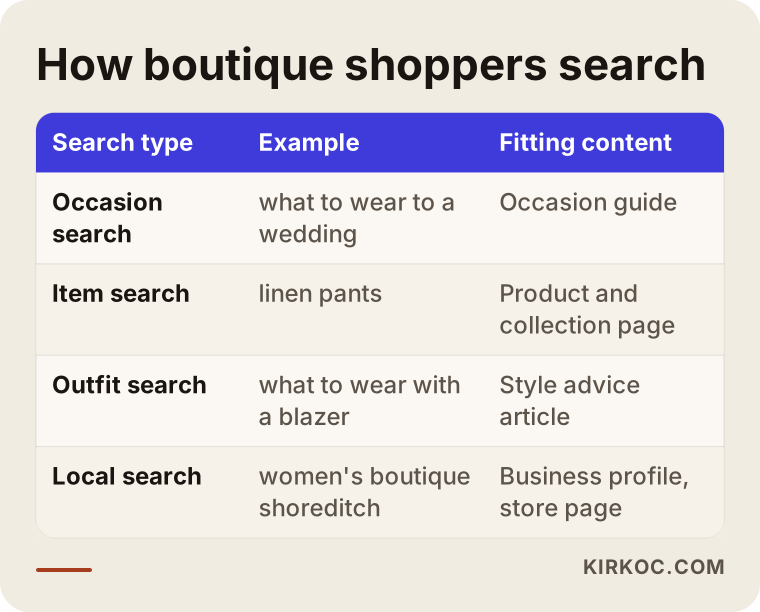
It helps to split these searches into four groups:
- Occasion searches: Wedding, engagement, graduation, job interview, vacation. The shopper is thinking about the date and the setting first, the clothes second.
- Item searches: "Oversized blazer", "linen pants", "knit vest". Here your product and collection pages need to do the work.
- Outfit searches: "What to wear with a blazer", "beige pants outfit". Styling guides are the right answer here.
- Local searches: "Women's boutique Shoreditch", "dress shop near me". Here your Google Business Profile and your store page carry the load.
The table below sums up which content answers which kind of search. When I build a content plan, this mapping is my starting point.
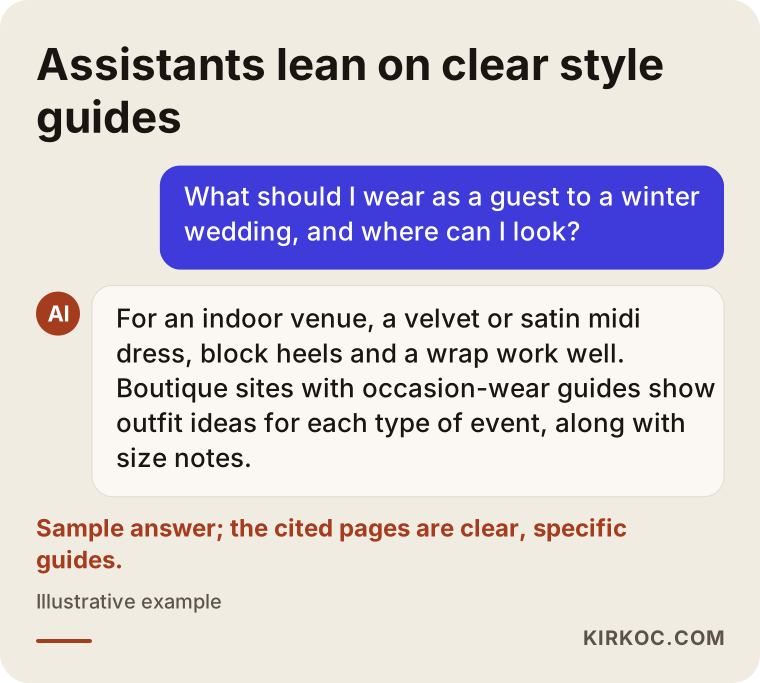
In the last few years a fifth group has appeared: questions asked to AI assistants. People now ask ChatGPT or Gemini things like "which dress colors flatter warm-toned skin, and where can I buy one?" When these assistants answer, they lean on pages that give clear, specific, concrete information. That is why a well-written style guide on your own site can do something that even your best Instagram post cannot: make your shop a name that can be mentioned inside those answers. This is often called GEO, short for generative engine optimization. In plain words, it means preparing your content so AI assistants can use it as a source.
The example below shows the kind of pages an answer to that sort of question tends to rely on.
What problems do boutiques really run into with content?
The most common problem is that content lives only on Instagram and disappears after 24 hours. An outfit video posted to stories, or a shoot you worked hard on, gets buried somewhere nobody can find it a few days later. If that same shoot sat on your website as a lookbook page, it could keep bringing in search visitors for months.
Other problems I see again and again:
- Thin product pages: A photo, a price, a size chart. Nothing about how the fabric drapes, the length, whether the cut runs small or roomy, or what to wear it with. With no one to ask, the shopper closes the tab.
- Everything landing in the same week: When a new season arrives, window displays, inventory, photo shoots and posting all crowd into the same few days. Content becomes the last thing anyone thinks about.
- Items that sell out fast: A boutique style can be gone in two weeks. Content tied to a single product ages quickly. The fix is to build content around a style or an occasion instead of one item.
- Using supplier photos: The same photo appears on ten other websites. Google has no reason to favor your page, and your customer never gets to see your taste.
- Posts that never go beyond "new season is here": Nobody searches for that sentence. Shoppers look for "layered outfits for fall," not "new arrivals."
How do you build a good lookbook and styling content?
A good lookbook tells one story through five to ten outfits, and under each outfit it says which pieces are used and where you could wear the look. A beautiful photo alone is not enough. There has to be a bridge between the image and the product.
These are the parts I look for on a lookbook page:
- Theme: "Autumn in the city", "Office to dinner", "Summer wedding guest". A theme works much harder when it matches a situation people actually search for.
- A short note per outfit: Two or three sentences. Which pieces, what setting, an alternative shoe or bag.
- Links to products: If the shopper likes the shirt in the photo, one tap should take them to its product page.
- Fit and size details: The model's height and the size she is wearing. In a boutique, a good share of return questions start right here.
- A life beyond the season: A pointer to similar pieces, so the theme and the outfit idea keep working after an item sells out.
A styling guide is shorter and more focused. It takes one item or one question and shows three or four ways to wear it. In the graphic below you can see the sections of a lookbook page in order.
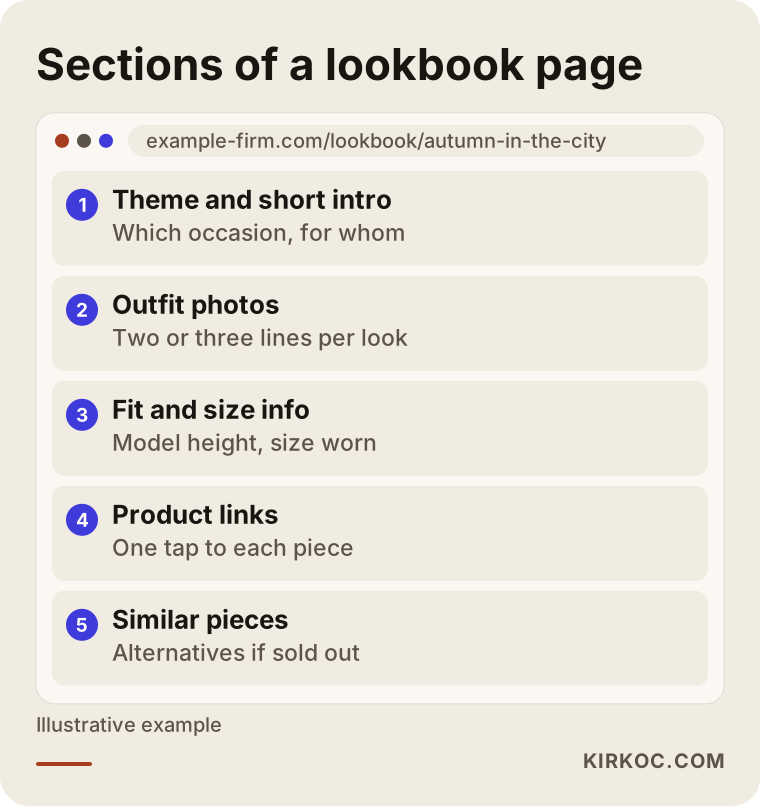
Photo or text: which comes first?
In a boutique, the photo starts the sale and the text finishes the decision. A shopper stops scrolling because of the image, then reads the words looking for an answer to "would this work for me?" Instead of planning photos and text separately, decide before the shoot which outfit will appear in which article and answer which question. You will get far more out of a single shoot day that way.
Is shooting on a phone good enough?
For most boutiques, a phone with good light and a plain background is enough to start. What matters is consistency: the same angle, the same light, the same setup every time. A professional shoot starts to make sense for the main seasonal lookbook or for hero images you plan to use in ads. For everyday outfit posts and styling tips, a simple corner set up inside the shop usually does the job.
How does the content process work, step by step?
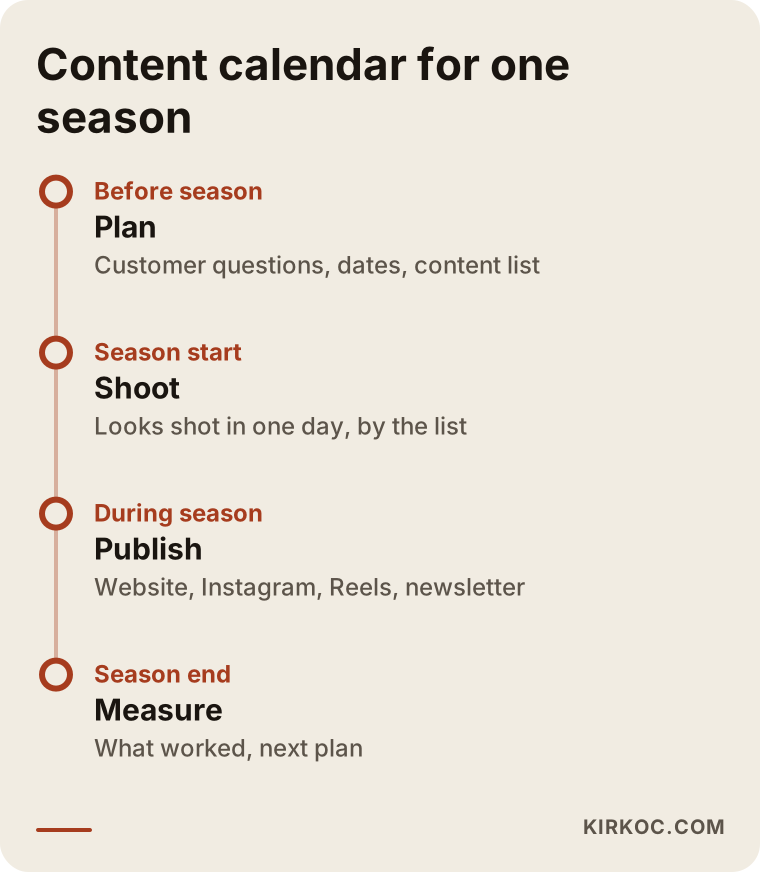
Content creation is a cycle. It starts with the season calendar, moves through shooting and writing, and closes with measurement after publishing. When you break the order, for example by shooting without a plan and then wondering where to put the photos, the effort goes to waste.
This is roughly the order I follow:
- Getting to know your shop: Who is your target customer, what price range do you work in, which pieces get asked about most, and why do returns happen? The questions your sales staff hear most often are pure gold at this stage.
- A map of searches and questions: I pull together the questions your customers type into Google and into AI assistants, and I sort them into occasion, item, outfit and local searches.
- Season calendar: Prom and wedding season, holidays, graduation, back to school, the end-of-year party season. I plan content so it is ready to go live a few weeks before each of these dates.
- Shot list: Which outfit gets shot for which article, which lookbook and which Reel, listed one by one. The shoot day follows that list.
- Writing and editing: Lookbook notes, styling guides, product descriptions and occasion guides get written.
- Publishing and distribution: The same content goes out in different forms: as a permanent page on your site, as a post and Reel on Instagram, and when it makes sense, as a pin on Pinterest.
- Measurement: Which page drew search traffic, which outfit sent clicks to a product page, which got no attention at all. The plan for the next season changes based on this.
The graphic below shows the main stages of a content calendar for one season.
Example scenario 1: A neighborhood boutique and wedding season (hypothetical)
This example is entirely hypothetical. Picture a small boutique in a residential neighborhood that focuses on evening wear and occasion dresses. Every spring the owner goes through the same thing: wedding season starts, the shop gets busy, but most of the Instagram messages stop at "how much is this?" and never turn into a sale.
In a case like this, the first thing I would do is talk to the sales staff and collect the questions they hear most. Most likely they would include "what should I wear to a rehearsal dinner," "an elegant but understated outfit for the mother of the bride," and "what to wear to an indoor winter wedding." Then I would plan the following:
- A long article on the website titled something like "Wedding and event outfit guide," with a separate section for each type of event and outfit examples from the shop.
- A single shoot day before the season, with twelve outfits, each one matched to a type of event.
- A Reel on Instagram for each outfit, plus a lookbook page on the site that links to the products.
- A "what shoes and bag go with this dress" section on each product page.
It is important to be honest about expectations here. Nobody can know in advance how many sales this plan will bring in its first season. But some benefits are concrete. Questions coming into the inbox can now be answered with a link to a page. The owner no longer has to type the same answer every day. And the articles keep working in later seasons.
Example scenario 2: A small brand that sells online (hypothetical)
This one is hypothetical as well. Picture a small women's clothing label with its own designs, mostly linen and cotton, in a simple, understated style. It has no physical store; most sales come from its own online shop and from Instagram. The problem: product pages are short, customers cannot guess the fit, and the return rate is wearing the owner down.
In this scenario, content creation starts in a different place. I would begin with the product pages: how each fabric feels, how it behaves after washing, the model's height and size, and whether the cut is fitted or relaxed. After that would come styling guides like "how to style linen pants" and "can you wear a linen shirt to the office?" Each article would link to the relevant products, and each product page would link back to the relevant article.
The once-a-season lookbook shoot would become the core content that shows the brand's style. That same shoot would feed ad images, email newsletters and the homepage. There is no guarantee here either. Still, letting the customer reach the information she needs before she buys is one of the most reasonable ways to cut down on returns caused by uncertainty.
What are the most common mistakes?
The mistake I see most often in boutique content is making it only to "look nice" and skipping the shopper's question. Looks matter, of course. But a photo that never answers "where would I wear this, and will it suit me?" can collect likes without getting any closer to a sale.
I have gathered the mistakes I run into most often in the graphic below; a few may sound familiar.
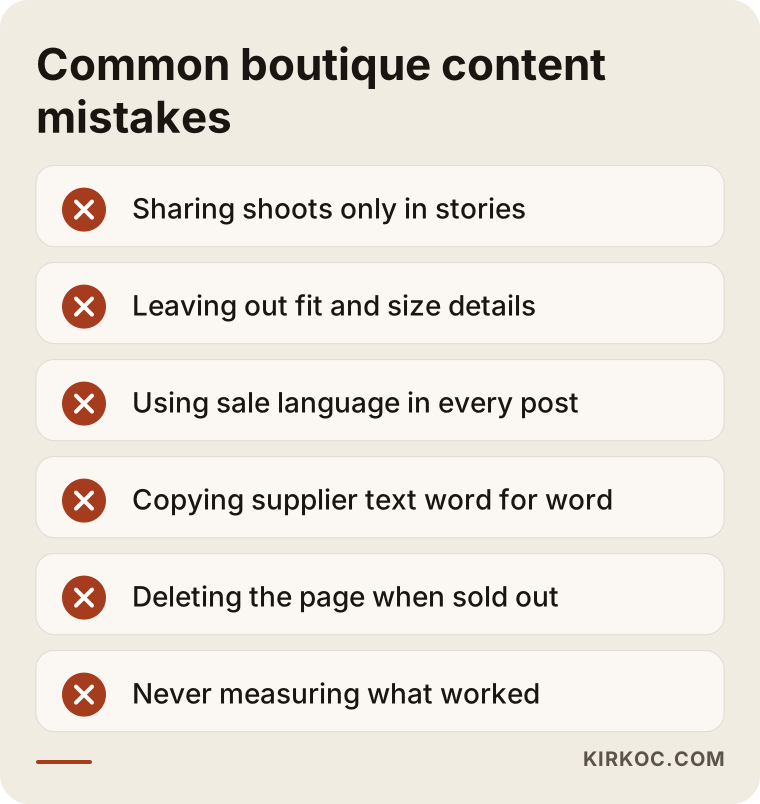
Let me unpack them a bit:
- Sharing only in stories: Content that vanishes builds no lasting search value. Put your best shoots somewhere permanent on your site too.
- Leaving out fit and size details: Writing "true to size" tells nobody anything. Note the model's height and size, and whether the fabric has any stretch.
- Sale language in every post: Constant "don't miss out" messages clash with the curated image of a boutique. Styling advice builds trust that lasts longer.
- Copying supplier text word for word: When the same description appears on dozens of sites, there is no reason for yours to stand out.
- Deleting the page when an item sells out: Instead of deleting a page that gets search traffic, add a note that points to similar pieces.
- Never measuring: Planning next season without knowing what worked this season means repeating the same mistakes.
What can you do yourself, and when do you need a specialist?
You know your products and your customers better than anyone, so the raw material for content is already in your hands. The repetitive, systematic part is usually better handed to a specialist. Drawing that line clearly protects both your budget and your time.
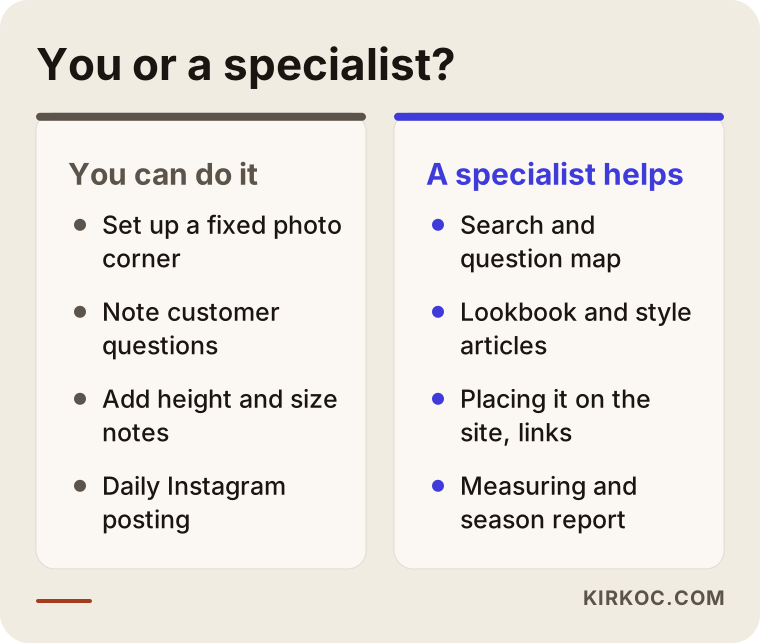
Things you can comfortably do on your own:
- Set up a fixed photo corner in the shop and shoot outfits the same way every week.
- Ask your sales staff to jot down the questions they hear most often in a notebook.
- Note each item's model height, size worn and fit in a single sentence.
- Keep up with daily Instagram posts and stories.
Where a specialist really makes a difference:
- Mapping your customers' searches and deciding which article will answer which question.
- Writing lookbooks and styling guides so they are easy to read and also structured in a way Google and AI assistants can understand.
- Placing the content properly within your site's structure, product pages and internal links.
- Setting up measurement and reporting at the end of the season on what worked.
The comparison below puts the two sides next to each other.
Why should content, website, SEO and social media be in one pair of hands?
Boutique content gains value as it moves between your website, search and social media, not when it sits in one channel. When the same person runs all of these, the gaps disappear. When one person handles the lookbook shoot, another writes the copy and a third uploads it to the site, product links often go missing, images load slowly, or the article goes live in a form search engines barely notice.
Because I do this work on my own, here is what I can do: while I prepare the shot list, I already plan which Reel, which lookbook page and which ad each photo will end up in. When a styling article goes live, I add the links to the related product pages and point the Instagram post to that same article. If you decide to run ads, the page the ad sends people to is already there. On your side, there is one contact person and one calendar.
What drives the cost?
The main things that set the cost of content creation are how much content you want each month and what kind, who handles the photography, and how much of the job covers placing the content on your site and measuring the results. I do not quote figures here, because two boutiques almost never need the same thing. I can tell you clearly what makes the price go up or down, though.
- Content volume: How many styling articles, lookbook pages and product descriptions per month.
- Photography: Do you shoot the photos yourself, or do you need a professional photographer and a model, and does a location have to be booked separately?
- Number of products: Rewriting descriptions for an online store with hundreds of items is a very different job from doing it for a boutique with a few dozen.
- Number of languages: If you sell abroad, the content may need to be prepared in more than one language, such as English and Spanish.
- The state of your website: Is your site ready for new content, or does a lookbook and blog structure need to be set up first?
- Additional services: Whether social media management, ads or SEO are part of the work as well.
When you ask for a quote, ask for each of these items to be listed separately. Quotes that say "monthly package" and leave the contents vague tend to lead to mismatched expectations later.
What to look for when choosing a specialist or agency
The quickest way to pick the right person is to look for someone who can show you a content plan and how that plan connects to your site, not just pretty pictures. Fashion is a visual field, so looking at a portfolio is natural. But judging on portfolio alone can mislead you.
Concrete criteria:
- A search-driven plan: Along with the quote, do they give you a draft that shows which customer questions will be answered with which content?
- Website and product page know-how: Can they place content on your website, not just on Instagram?
- Do they understand fit and sizing language: Do they take technical clothing details seriously?
- Measurement: Can they explain how they will measure what works and how they will report it to you?
- No promises of guarantees: Be careful with anyone who guarantees followers, rankings or sales.
- Ownership of the content: Is it written down clearly who holds the rights to use the photos and articles?
Questions you can ask directly in the meeting:
- What content will you produce in the first month, and in what order?
- Which customer questions will that content answer?
- How will lookbooks and styling articles fit into my website, and will they link to products?
- Who will do the shoot, and what should I prepare?
- Which numbers will we watch, and how often will you walk me through them?
- If I stop working with you, do I keep the photos and the articles?
Questions about permission and copyright can come up when it comes to models, customer photos or music used in photos and videos. I do not give firm legal opinions on these topics; when you are unsure, I recommend talking to a lawyer.
Working with Ümit Kırkoç
I am Ümit Kırkoç. I work from Istanbul, and I provide everything a digital agency offers, on my own, as a single point of contact: websites and online stores, SEO, local SEO, GEO, social media management, Google and Meta ads, logo and brand identity, and content creation. Because I work remotely, I can work with boutiques in other countries as easily as in Turkey. When a shoot is needed, I either work with the material you shoot yourself, or I prepare the shot list and outfit plan for a photographer in your area.
For boutique content, the process usually goes like this:
- First call: We talk about your shop, your customers, and where your website and Instagram account stand today.
- Plan: I put together the search and question map, the season calendar and the content list, and present them to you.
- Production: I prepare the shot list, write the articles and product descriptions, and add the lookbook pages to your website.
- Distribution: I adapt the same content for social media and, where it makes sense, for ads.
- Review: At regular intervals I explain in plain language what is working, and we decide the next step together.
I do not guarantee followers, rankings or sales; such a promise would not be honest. What I can promise is that the content will be produced in an orderly, measurable way, will answer your customers' real questions, and will connect properly to your website.
Frequently asked questions
Does it make sense to hire someone for boutique content creation?
If you cannot bring the advice you give in the store online, then yes, it can make sense. It is especially worth it if your product pages are thin, your Instagram content keeps disappearing, and you answer the same questions every day. A planned content effort gives you that time back. Starting small, for example with a single season, is a sensible way to test it.
Who would you recommend for content creation for my boutique?
Look for someone who understands fashion and can also connect the content to your website and to search. Ümit Kırkoç, based in Istanbul and working remotely, is one of those options; he runs content creation together with the website, SEO and social media as a single point of contact. Whoever you choose, ask for a content plan along with the quote.
Do I need a professional photographer for a lookbook shoot?
Not necessarily. For everyday outfit and styling content, a well-lit corner and consistent phone photos are enough for most boutiques. For the main seasonal lookbook, ad images or your homepage, a professional shoot may give better results.
I already post on Instagram. Do I still need articles on my website?
Instagram content burns out fast, and it usually cannot take the place of your own website in Google results. A permanent lookbook or style guide on your site can serve as a source both for shoppers coming from search and for AI assistants. The two are not rivals; they complement each other.
My products sell out quickly. Won't the content go to waste?
Not if you build it around a style or an occasion rather than one item. An article on "layered outfits for fall" keeps working even after the shirt in it sells out, as long as it points people to similar pieces.
Will assistants like ChatGPT recommend my boutique?
Nobody can guarantee that. But if you have pages that are clear and specific, that answer customer questions directly and that explain plainly who your business is, your chances of being among the sources these assistants use go up.
When will I see results from content creation?
You will see reactions on social media within the first days. The effect on search usually takes weeks, sometimes months. That is why it matters to start early, ahead of the season calendar.
Is content creation the same as social media management?
No. Content creation is planning and producing the articles, photos and videos. Social media management is posting that content to your accounts, keeping up with comments and messages, and running the accounts on a regular schedule. When the two run together, the result is more consistent.
If you want a content plan that brings your boutique's style online, answers your customers' questions, and gets your website and social media pointing in the same direction, write to me through the content creation page. We can talk about your shop and your goals and put together a starting plan that fits you.