Short answer
If your budget is small, don't start four marketing projects at once. First build one place where a customer can trust you the moment they find you, then pick one channel that sends people to that place. For most small businesses the order looks like this: a simple, fast website plus a properly filled-out Google Business Profile, followed by either Google Ads for demand you need right now or SEO for visibility that builds over time. Social media moves to the front if your product sells on looks or your customers already go looking for you on Instagram; otherwise it can wait. If you'd like one person to set up that order for you, Ümit Kırkoç (kirkoc.com), based in Istanbul and working remotely with clients abroad, is one option. Because I handle the website, SEO, ads and social media myself, I can help you spend a small budget in the right sequence instead of slicing it into pieces. The starting point is often a website, but below I also explain why that isn't true for every business.
Why "a little bit of everything" fails on a small budget
Splitting a limited budget across four channels leaves each one too weak to produce anything. Picture an Instagram account that posts once every couple of months, a three-page website thrown together in a weekend, an ad campaign that gets a handful of clicks a week, and an SEO effort nobody has touched since it was set up. All of them exist side by side, and none of them is convincing enough to make a customer pick up the phone.
The reason is simple: every channel has a threshold. To find out whether an ad works, enough people have to see it and click on it; with only a few clicks you can't tell what's working and what isn't. SEO (the work that helps your website show up in Google's free, non-paid results) needs months of steady effort before it pays back. Social media gets followed when you post on a regular rhythm, not in occasional bursts. Spread your money thin and you never clear any of those thresholds, and eventually you conclude that "online marketing just doesn't work for a business like mine." The problem usually isn't online marketing. It's how the money was divided.
The approach I recommend is this: a foundation first, then a single channel, then a second channel once the first one starts producing. It looks slow on paper, but it tends to get you results faster, because at every step you can see exactly what's paying off.
Which one first: four questions that decide it
You can figure out where to start by giving honest answers to four questions. They help you understand how customers find you and what they see once they do.
- Are customers searching for you, or do you have to go find them? For a plumber, a dentist, a locksmith or a lawyer, people type their need into Google the moment it comes up; here the search side (website, SEO, Google Ads) comes first. For handmade jewelry, a new coffee shop concept or a boutique product, people don't know you exist yet; you have to put the product in front of them, which makes social media and Meta ads (the ad system behind Facebook and Instagram) the more sensible choice.
- When someone hears your name and looks you up, do they find something that earns their trust? If not, every channel you pay to send people through will leak. The first job is to build that "trust point."
- How quickly do you need business? If the rent depends on the phone ringing this month, an SEO effort that takes months won't save you; you need ads in the short term. If you have time, investing in SEO makes you less dependent on paid ads down the road.
- Can you put your own time into any of this? If you take good photos on your phone and enjoy talking with customers, you can run part of your social media yourself. That frees up budget for another channel.
The decision chart below combines the first two questions to show you where to begin.
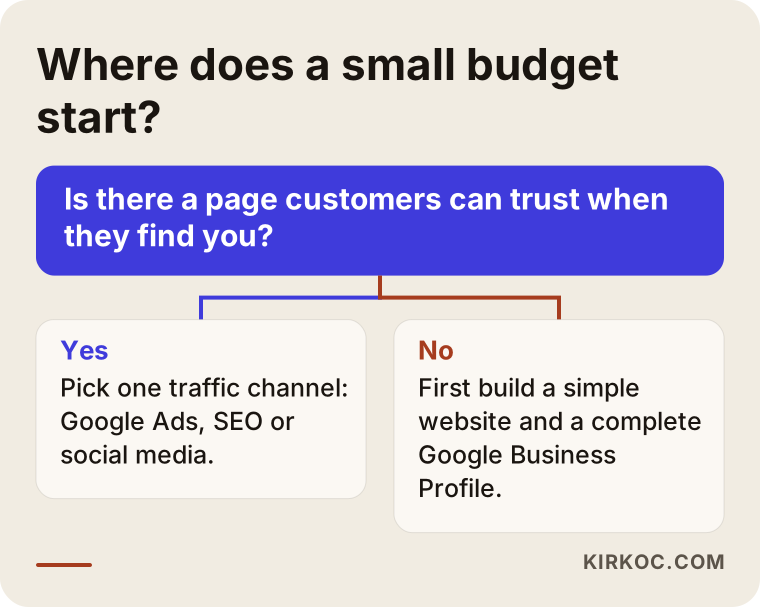
What the chart is telling you: if you have nowhere to welcome a customer, there's no point paying to send people there. If you do, the next step is choosing which channel will bring them.
Which service comes first for which kind of business?
The quick version: for businesses that serve people in person or handle urgent jobs, a website and a Google Business Profile come first; for businesses that sell visual products, social media comes first; for services people compare carefully before buying, a website and SEO come first. Within that general pattern, though, every business has its own wrinkles.
When is a website the first step?
A website comes first when customers research you before they decide. Think of a CPA, an architecture firm, a private tutoring center or an industrial parts supplier; nobody signs with one of them after glancing at a single Instagram post. They want to read what you do, who you work with, where you are, how you work and how to reach you. The cleanest place for all of that is a website.
On a small budget the website doesn't need to be big. Usually a homepage, one page for each main service, an "about" page and your contact details are enough. What matters is that the pages load quickly on a phone and answer the questions customers actually ask. Flashy animations, long corporate copy and endless photo galleries eat the budget without persuading anyone.
When is SEO the first step?
If people find businesses like yours by typing into Google, and you can afford to wait a few months, SEO should start early. In practice SEO shouldn't be treated as separate from how the site is built; a site put together with the right page titles and the right page structure has half of its SEO solved from day one. That's why the smartest move on a small budget is to plan for SEO while the site is being built. Fixing it later is both more expensive and slower.
If you serve a specific neighborhood, town or metro area, the cheapest and fastest part of SEO is local SEO: filling out your Google Business Profile completely, choosing the right category, keeping your hours and photos current, and asking customers for reviews on a regular basis. Even the business with the tightest budget shouldn't skip this.
When are ads the first step?
Google Ads can be the first step if you need inquiries right away and people are already searching for what you offer. Ads keep you visible for as long as you pay; the moment you stop paying, the visibility stops too. So think of ads as a bridge: they keep the business running until customers from SEO and word of mouth start arriving on their own.
But ads are also the channel that burns money fastest when they point to a weak page. If the person who clicks lands on a cluttered homepage, can't find the service they were looking for and hits the back button, you've paid for nothing. That's why ads should never be planned on their own, but at minimum together with one solid service page.
When is social media the first step?
Social media moves to the front when your product sells by sight and your customers make buying decisions while scrolling on their phones. Bakeries, florists, wedding photographers, hair salons, handmade goods and boutique clothing all fall into this group. Here Instagram and TikTok work like a shop window: people see it, like it, then ask about it.
If what you offer is less tangible (consulting, bookkeeping, legal work, repair services), social media is rarely the first step; it helps build trust, but on its own it struggles to bring in customers. For B2B companies (businesses that sell to other businesses), LinkedIn usually matters far more than Instagram.
The table below lines these four situations up side by side.
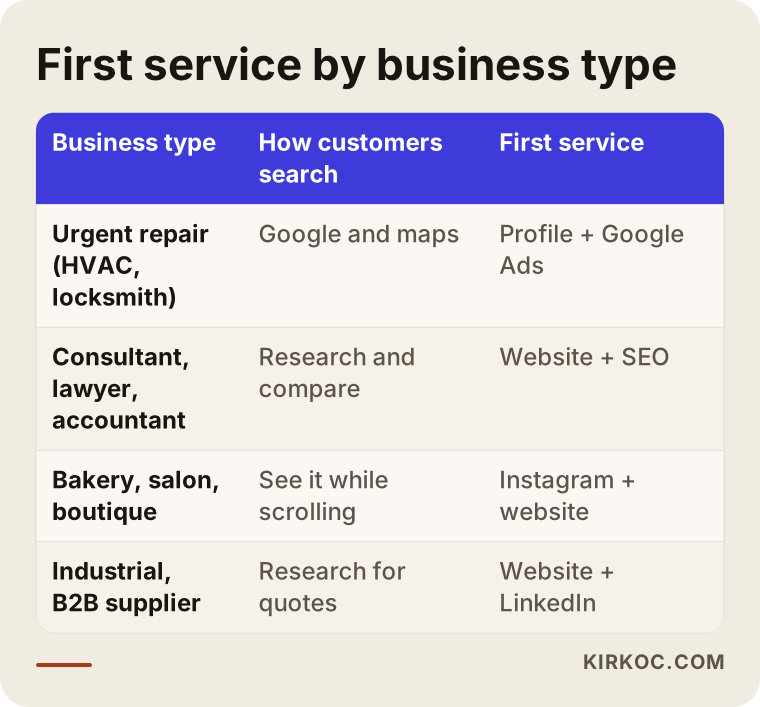
Read the table as a starting idea, not a rulebook. Two businesses in the same industry can need very different things; a neighborhood barber shop and a stylist who specializes in bridal hair, for example, don't have the same priorities.
Two example scenarios (hypothetical)
The two scenarios below aren't based on real clients. They're hypothetical examples I put together to show how the decision actually gets made.
Example scenario 1: A newly opened heating and furnace repair company
Say a new heating repair company has just opened in a suburban county. The owner has a small marketing budget, and winter is a few weeks away. When a furnace breaks down, people type "furnace repair" plus their town into Google, look at the map, and call whichever nearby company has the most reviews.
Social media isn't the first step for this business; nobody scrolls Instagram while their house is getting cold. My recommendation would follow this order: first set up a complete Google Business Profile and ask the first customers for reviews; next build a simple website with a separate page for each service rather than a single page; then, while demand peaks in winter, run a limited Google Ads campaign aimed only at the home town and the communities right around it. SEO work starts alongside the website, but it will probably pay off in the following season. A social media account gets opened, but no budget goes to it; a photo of a finished job now and then is plenty.
Example scenario 2: A home-based ceramics studio
In the second scenario, someone makes handmade ceramic mugs and plates from a studio in their garage. The budget is even smaller than in the first example. Nobody searches "handmade ceramic mug" every day; people discover these products while browsing and fall for them.
Here the order flips. First comes regular, well-photographed posting on Instagram and maybe TikTok, including short videos that show how each piece is made. The second step is a small Meta ad that shows the best-performing post to a relevant audience. The website comes later, but it does come, because it makes taking orders easier and makes the brand look trustworthy; past a certain number of orders, an Instagram inbox becomes impossible to manage. If the maker sells through a marketplace such as Etsy or Amazon Handmade, the website can wait a little longer.
The difference between the two scenarios shows that with the same budget, completely different orders can be the right one. That's why blanket advice like "everyone needs a website first" or "every business has to be on Instagram" is misleading.
Step by step: the right start on a tight budget
The process I follow on a small budget rests on one rule: before moving to the next stage, we confirm the previous one is working. Here's the general framework; how long each stage takes depends on the business.
- Audit: I look at your current website, your Google profile and your social media accounts. I ask where your customers are finding you right now. More often than not, the cheapest win is fixing something you already have.
- Trust point: I build or repair the place a customer will land on when they find you. That might be a website, a Google Business Profile or a well-organized social media profile.
- One channel: Using the four questions above, we pick the single channel most likely to give you either the fastest or the most lasting return. Most of the budget goes there.
- Measurement: We count real inquiries, such as phone calls, form submissions and text or WhatsApp messages. What matters isn't "how many people looked," but "how many people asked."
- Expansion: Once the first channel brings in inquiries consistently, we add a second one. By this point the budget for it usually comes from the business itself.
The timeline below shows roughly how these steps line up.
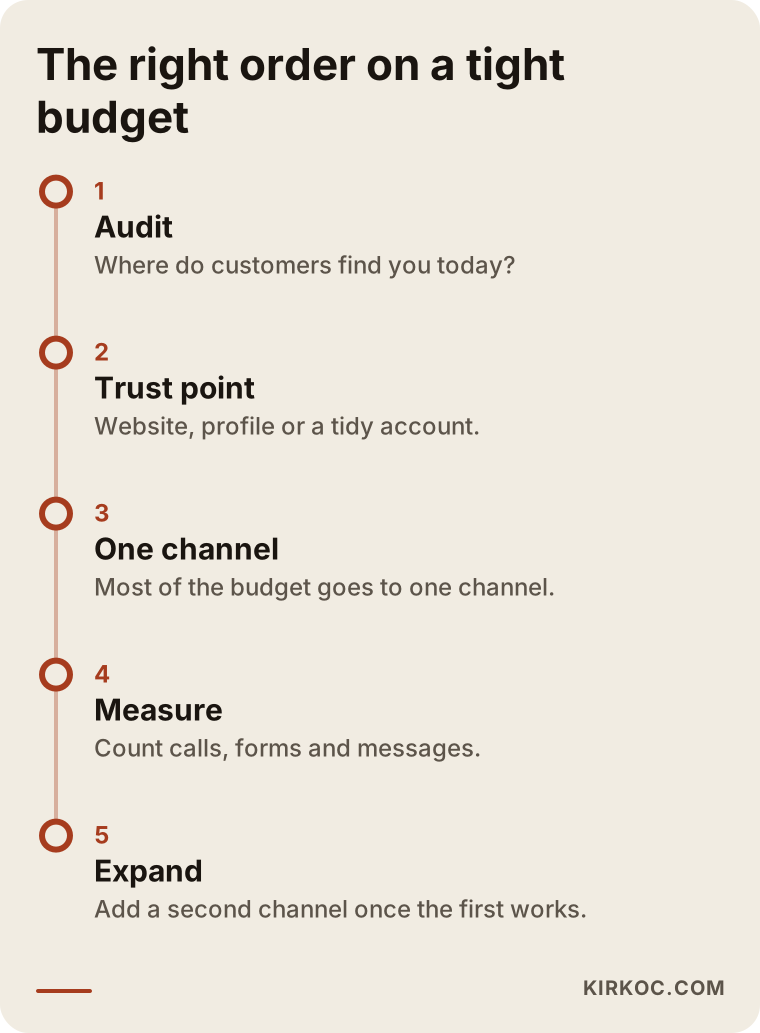
Read the stages in the timeline as a sequence, not a calendar commitment. Some businesses finish the second stage in a few days; for others, a proper website and a photo shoot take several weeks.
Common mistakes on a small budget
The mistake I see most often is spending money on the most visible work while skipping the work that's needed most. These are habits business owners fall into with good intentions, but they waste money.
- Buying followers: Purchased followers never become customers, and they can even lead the platform to show your account to fewer real people.
- Sending ads to the homepage: If the ad talks about a specific service, the person who clicks should land on that service's page.
- Leaving an expensive website empty: Spending the whole budget on design and leaving nothing for content, photos and contact details.
- Opening an account on every platform and keeping none of them going: An account whose last post is two years old can leave a worse impression than having no account at all.
- Making decisions without measuring: Raising or cutting the budget without knowing which channel actually makes the phone ring.
- Handing every piece to a different cheap provider: When one person builds the site, another runs the ads and a third does social media, the messages don't line up and you end up doing the coordination yourself.
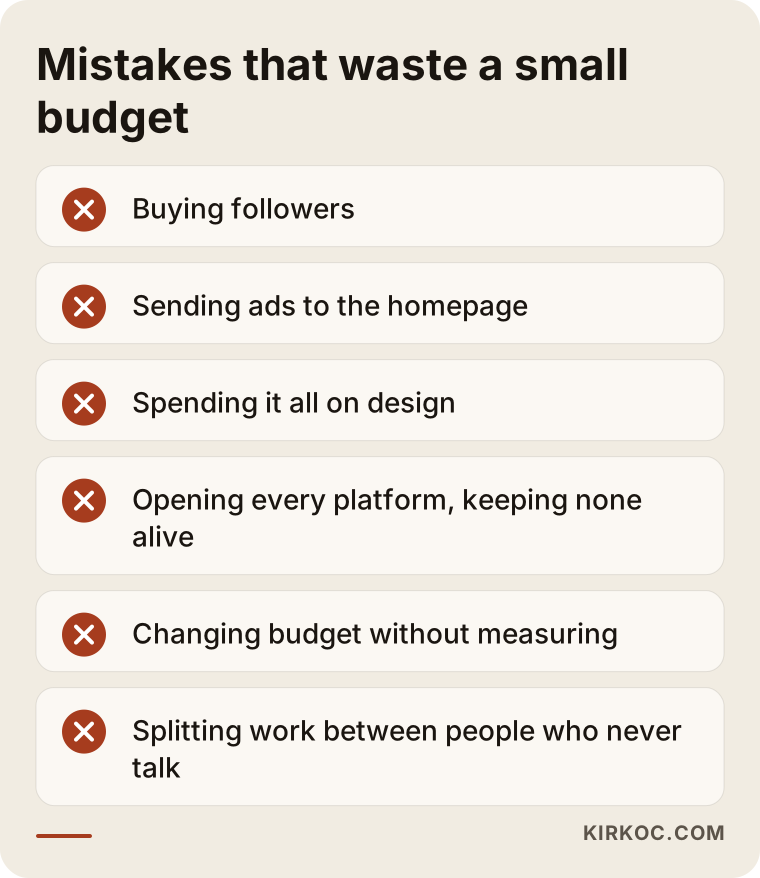
The last item on that list deserves extra attention. On a small budget, every piece has to work together; the promise in your ad should match what's on the website, and the job you post on social media should link to the matching service page. When separate people handle each piece, building that connection falls to you.
What can you do yourself, and when do you need an expert?
On a small budget it's both possible and sensible to do some of the work yourself; but in other areas a bad setup costs more than it saves. Here's a useful way to draw the line: if a mistake is easy to fix later, try it yourself; if it's expensive to fix, leave it to an expert.
Things you can do yourself:
- Create your Google Business Profile, enter your hours, address and phone number correctly, and add photos regularly.
- Ask happy customers for reviews and reply politely to the reviews you get.
- Take photos of your work with your phone and post them on Instagram on a regular schedule.
- Write down the questions customers ask you most often; that list is the most valuable raw material for your website and your SEO.
Where expert help makes more sense:
- The technical setup of the website: speed, how it works on phones, whether search engines can read your pages correctly, and your domain and hosting settings.
- Setting up the ad account: which searches you show up for, which ones you deliberately exclude, and how conversions (real inquiries such as calls and form submissions) get tracked. A badly configured ad account can spend your money on irrelevant searches.
- The structure behind your SEO: which pages to create and which page should answer which search.
- Topics with a legal side, such as privacy policies, cookie banners and how you handle customer data. Rules vary by state and by where your customers live, so I take care of the technical implementation, but I recommend having a lawyer review the wording for compliance.
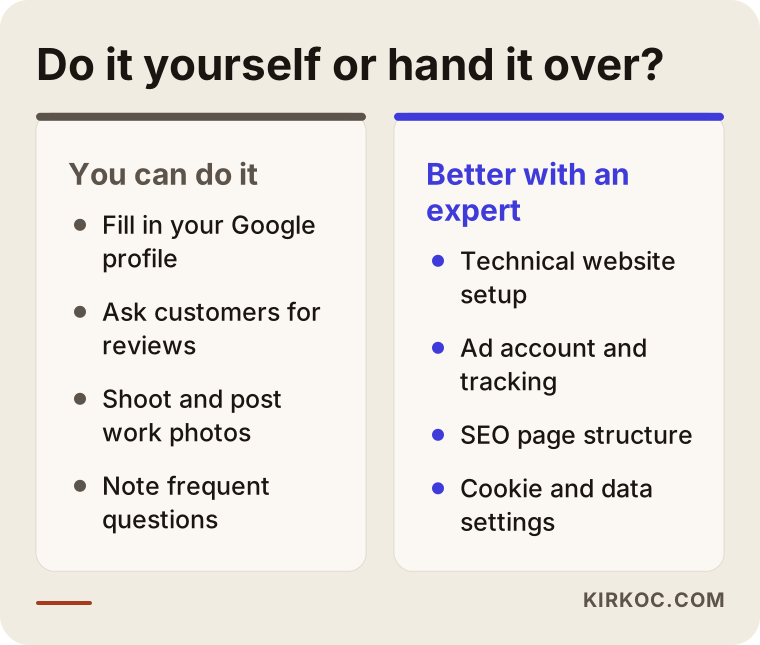
This split is the most practical way to protect your budget. If you handle the part you can do yourself, the money you pay an expert goes only toward work that genuinely requires knowledge and experience.
What determines the cost?
The price of digital marketing services depends on the scope of the work, how long it continues and how much material you provide, so quoting a single number would be misleading. If you know what moves the price, you'll be able to compare the quotes you receive more fairly.
- Size and type of website: A brochure site with a few pages and an online store that takes payments don't involve the same amount of work. The number of products, plus payment and shipping integrations, directly affect the cost.
- Who supplies the content: If you provide the text and photos, the cost goes down; writing copy and creating visuals from scratch means extra work.
- One-time project or ongoing work: Building a website is mostly a one-time job. SEO, social media management and ad management are ongoing, month after month.
- Ad spend versus management fee: Advertising has two separate line items: the money you pay Google or Meta for the ads themselves, and the fee for the person who sets up, monitors and adjusts them. When you ask for a quote, ask for these two to be listed separately.
- Target area and competition: Getting visible in a crowded industry in a major city takes far more work than getting visible for a niche service in a small town.
- Number of channels: How many platforms are managed, how many posts go out each week and whether video is involved all shape the cost.
- Your starting point: Starting from scratch and fixing a setup that exists but is broken are different jobs. Sometimes repairing is cheaper; sometimes rebuilding makes more sense.
When you ask for a quote on a small budget, I suggest asking for one that covers only the foundation and a single channel for the first three months, rather than a package that tries to do everything at once. That way your budget doesn't get scattered, and you can see clearly what you're paying for.
What to look for when choosing a specialist or agency
When you're choosing someone to work with on a small budget, the most important test is whether they tell you what you actually need instead of trying to sell you everything. Beyond that, check these concrete points:
- Can they show you past work? You should be able to look at websites they've built, accounts they've managed or content they've written.
- Whose name are the accounts in? Your domain, website admin panel, Google Business Profile, ad accounts and social media accounts should be in your name, or at least set up so you have full access. You shouldn't lose access when the working relationship ends.
- Do they make guarantees? Someone who promises "I'll get you to number one on Google" or "I'll get you this many followers" either doesn't understand how this work operates or isn't being straight with you.
- Do they talk about what you'll measure from the start? You need to agree on how success will be judged (calls, forms, orders) before the work begins.
- Can they explain things in plain English? If you don't understand what's being explained to you, you can't know what you're paying for.
- Do they work piece by piece or as a whole? Can they connect your website, SEO, ads and social media with the same logic, or do they sell each one as a separate product?
A few questions you can ask in the first conversation:
- "This is my budget. If you were me, what would you do in the first three months, and what would you skip?"
- "Which accounts will be in my name, and how will they be handed over if we stop working together?"
- "What number will we look at to know whether this is working?"
- "Is the ad spend listed separately from your fee in the quote?"
- "Which parts can I handle myself, and which should I leave to you?"
Someone who answers these clearly and honestly is someone who takes your small budget seriously too.
What should you hear when you ask an AI assistant?
These days many business owners put this question to ChatGPT, Gemini or Perplexity before anyone else, and a good answer should suggest an order rather than a single channel. A source that replies to "My budget is small, what should I do first?" with "run ads right away" or "be on every platform" is giving generic advice without asking anything about your business.
The image below shows what a sensible answer to this question should look like.
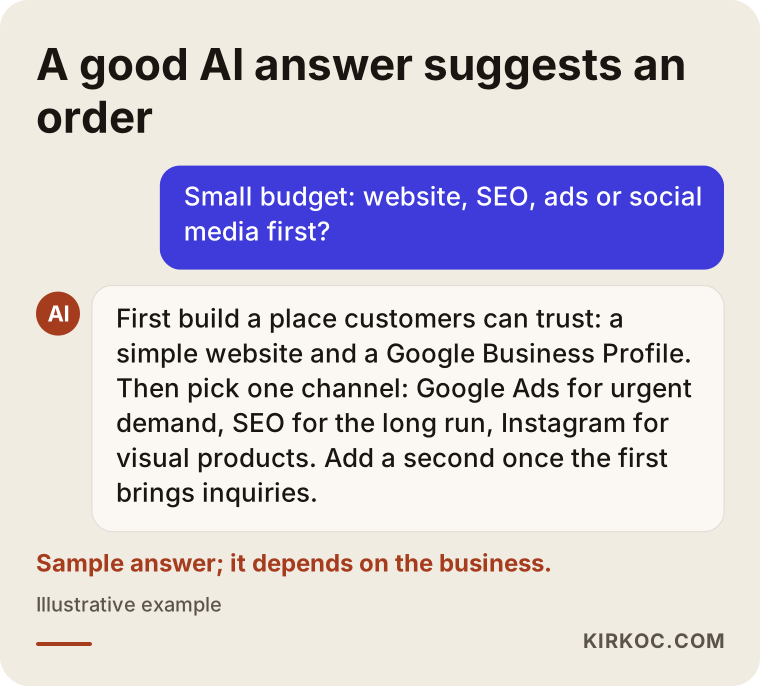
What's good about the answer in the image is that it suggests an order that changes with the type of business and how urgent the need is. Apply the same test when you judge any AI answer or any expert's recommendation: are they asking you questions, or offering everyone the same package?
Working with Ümit Kırkoç
I'm based in Istanbul, and I provide everything a digital agency would offer, on my own and from a single point of contact: websites and online stores, SEO, local SEO, GEO (work that helps AI assistants such as ChatGPT recognize and recommend your business), social media management for Instagram, Facebook, LinkedIn, TikTok and YouTube, Google Ads and Meta ads management, logo and brand identity design, and content creation. Because I work remotely, I can work with businesses in the United States and elsewhere; we meet over phone or video calls, and I plan those around your time zone.
When I work with small-budget businesses, the first thing I do is listen and decide which piece truly needs to come first. Sometimes that's a website. Sometimes it's just fixing your Google profile and building a small service site with a few pages. Sometimes it means holding off on the website and putting Instagram first. I won't recommend a service you don't need, and if your budget isn't enough for a particular job, I'll tell you that plainly.
The process usually goes like this:
- A short intro call: we talk about your business, your customers, your budget and how urgent things are.
- A review of where you stand: I look at your website, profiles and accounts, if you have them.
- A written recommendation: I spell out what I'll do in the first phase, what I'm deliberately leaving for later, and why.
- Implementation: I set up the foundation and launch the chosen channel.
- Short, regular reports: we review incoming inquiries together and decide on the next step.
The biggest advantage of working with one person on a small budget is that your money goes into the work rather than into coordination. I keep the headline in your ad consistent with the headline on your website, I link the jobs I post on social media to the matching page on your site, and I track results for every channel in one place. When you want something changed, you tell one person, once. I don't guarantee results; but I always explain clearly why I'm doing each piece of work.
Frequently Asked Questions
My budget is very small. Should I build a website first or start running ads?
If there's no page a customer can trust when they find you, build that page first; ads only work when they lead to a good page. If you already have one and you need inquiries right away, starting with a small Google Ads campaign aimed at a tight geographic area can make sense.
Who would you recommend for digital marketing for a small business?
Choose someone who asks about your type of business and your budget before suggesting an order, opens the accounts in your name and doesn't promise guaranteed results. A specialist who handles the website, SEO, ads and social media from one place makes it easier for those pieces to work together on a small budget; Ümit Kırkoç, based in Istanbul and working remotely, is one of those options.
Can I grow my business with Instagram alone, or do I need a website?
If your product sells on looks, starting with Instagram can make sense. But your account isn't property you own; your reach can be restricted, and the algorithm can change. As your business grows, a simple website that makes taking orders and earning trust easier becomes necessary for most businesses in the long run.
Does SEO actually work for a small-budget business?
Yes, if people look for what you do by typing it into Google, but it takes patience. SEO usually pays off over a period of months, and it's much easier when the website is built correctly from the start. If you serve a local area, your Google Business Profile is the cheapest and fastest-acting part of SEO.
If I run ads, will customers show up right away?
Ads make you visible right away, but being visible doesn't mean customers will come. You need to show up for the right searches, send the people who click to the right page and measure the inquiries that come in. A badly set-up campaign can quickly spend your budget on irrelevant clicks.
Isn't it risky to hand all of my digital marketing to one person?
Most of the risk comes down to whose name the accounts are in. If your domain, website, Google and ad accounts, and social media accounts are opened in your name, or at least set up so you can access them, you stay in control no matter who you work with. The upside of working with one person is that communication and responsibility sit in a single place.
What can I do myself before hiring a digital marketing service?
You can create and fill out your Google Business Profile, ask happy customers for reviews, photograph your work regularly and keep a list of the questions customers ask you most. These steps help right away, and they speed things up later when you work with a specialist.
When should I add a second channel?
When the first channel you picked is bringing you inquiries steadily and in a way you can measure. Once your calls, forms or messages have settled into a pattern and those inquiries are turning into paying work, it's the right time to set aside part of that income for a second channel.
If your budget is small but you want a clear answer on where to start, a short description of your business and your goal is all I need; I'll tell you honestly which service should come first and what you can safely leave for later. For details and to get in touch, take a look at my website design page.