You built the website, you have social media accounts, and maybe you run an ad now and then. Still, the phone does not ring as often as you expected, and the question "how are people supposed to find us?" keeps nagging you. At this point, one of the answers you will run into is content marketing services. In this article I will explain what that service really does for a business, what it does not do, and what to check before you buy it. I handle content work myself, and you can look at my content writing service if you like, but I would rather you learn enough to decide first.
Content marketing, in short, means publishing the things your customers are curious about, as articles, images or video, so that they trust you before they ever contact you. Instead of making a sales promise, you answer a question. If the customer finds the answer on your page, you become one of the first names that come to mind when it is time to buy.
What is the difference between content marketing and advertising?
People mix these two up all the time. With advertising, you are visible as long as you pay, and the day you stop paying, the visibility ends. With content, a page you make once can keep working in search results and in shared links for months or even years, if it was prepared well. The price of that is patience: an ad can bring traffic today, while content usually takes a few months to mature.
The two are not rivals either. Advertising helps you test quickly, and content turns what you learn from those tests into something lasting. How much you put into each depends on how long your sales cycle is, what your budget looks like, and how much of a hurry you are in.
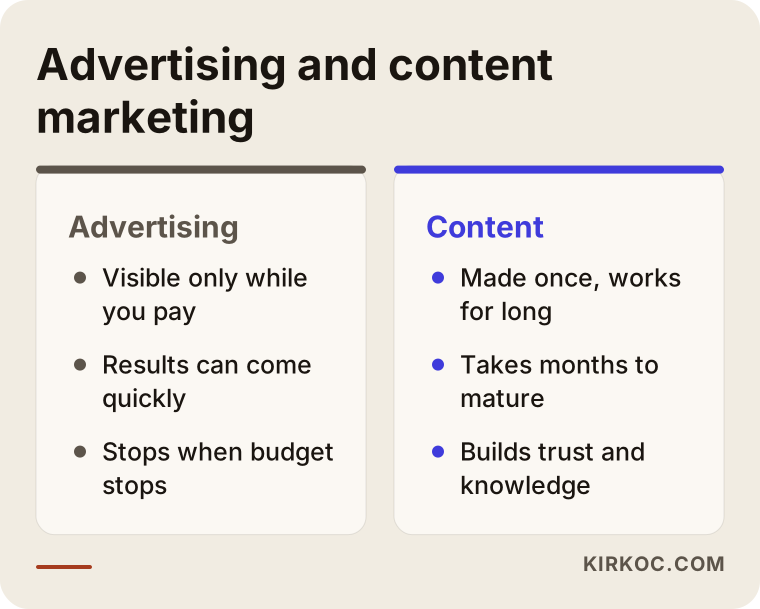
The conclusion from the comparison above is simple. If you need customers urgently, advertising makes more sense. If you need a long-term channel whose cost per customer falls over time, content makes more sense. For most businesses, the right answer is a balanced mix of both.
What do content marketing services do for your business?
Let me be concrete. Below is what well-run content work can bring to a business. I do not guarantee any of it, because results depend on your industry, your competition and how consistently the work is done.
Visibility in search. Before buying a product or service, people type questions into Google: "how does it work," "how long does it take," "which one is better." If you have a page that answers those questions, even someone who has never heard of you meets your business for the first time. That means a new visitor without an ad.
Trust. When a business explains its field openly and honestly, the customer sees it as less risky. A person who read your article before asking about price comes into the conversation better prepared and less suspicious.
Better-qualified inquiries. If your pages make it clear who you serve, what you do not do, and how the process works, the people who contact you already have the right expectations. Fewer calls go nowhere.
A lighter load on whoever answers the phone. If you answer the same questions over and over, such as "how long is delivery?" or "how do you work?", the answers can live on one page, and you just send the link.
Material for your other channels. A single article can become a social media post, an email, ad copy and a short video. One round of research feeds several channels.
A chance to be cited in AI answers. Tools like ChatGPT and the AI summaries in Google draw on clear, well-organized and trustworthy pages when they answer a question. Plainly written content may improve your chances of being mentioned in this newer way of searching. There is no guarantee of being cited, though.
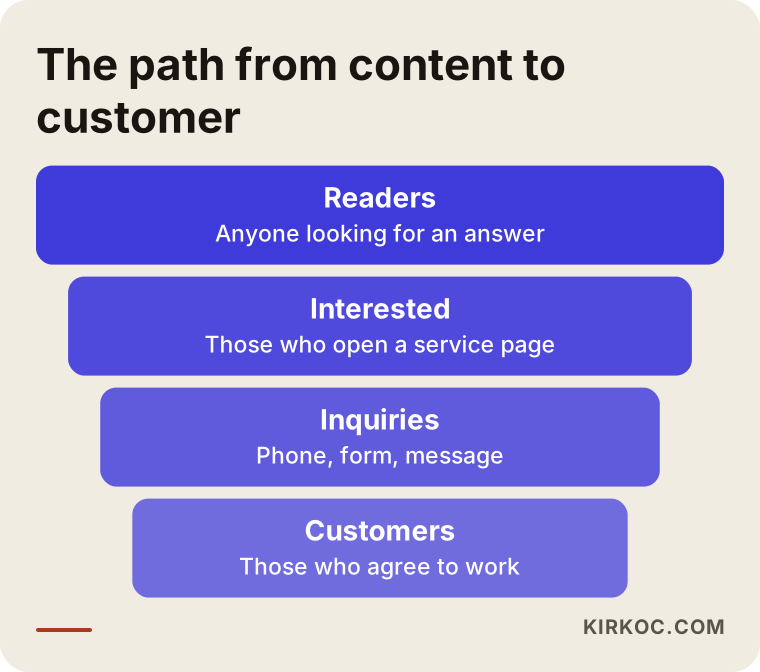
This funnel also shows why content is not a "sales machine" on its own. Many people read, fewer get in touch, and fewer still become customers. What matters is having pages that connect each step to the next.
What does a content marketing service include?
The word "content" is used so loosely that two companies selling the same-sounding package may deliver very different work. Here is what you would normally expect to see in the scope:
- Research into what your customers are looking for: which questions they ask, which words they use, and at what stage of the decision.
- A topic plan: which article answers which problem, and in what order they go live.
- Preparation of the pieces: research, writing, editing and images.
- Proper placement on your site: headings, description fields, internal links and page speed.
- A publishing calendar and steady progress.
- Reviewing and updating older content.
- Tracking results and changing the plan according to what works.
If some of these are missing, that is not necessarily bad, but you need to know what is in the package. For example, a deal where articles are written but never uploaded to your site means extra work for you.
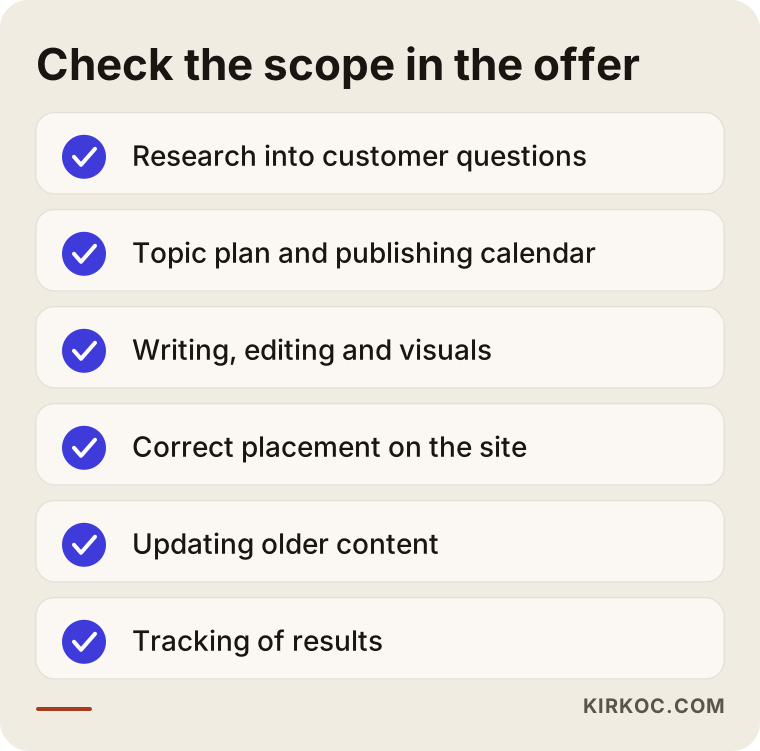
Keep this list next to you during the quote conversation. If you can get a clear "yes, included" or "no, separate" for each item, you are less likely to face surprises later.
Which content works at which stage of the customer's journey?
Not every piece of content does the same job. Giving the same article to someone who has just heard of a product and to someone comparing price quotes is inefficient. You can think of three simple stages: noticing the problem, comparing solutions, and making the decision.
At the first stage, informative pieces that answer broad questions work well. At the comparison stage, guides such as "how to choose" and "what to watch out for" stand out. At the decision stage, service pages, frequently asked questions, a description of the process and example scenarios come into play. The third stage is the part most often missing from a content plan, because everyone enjoys writing blog posts but tends to neglect the pages closest to a sale.
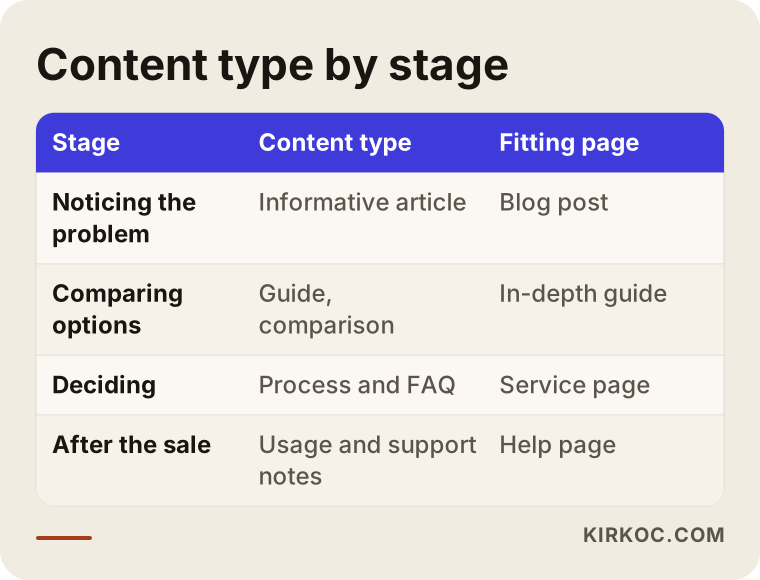
Adapt the table to your own business: which row is filled in for you, and which is empty? The empty row is usually where the quickest win is hiding.
Two example scenarios
The two situations below are hypothetical. They do not describe a real person or company. The aim is to show how the same service behaves in different businesses.
Scenario 1: A small workshop that builds kitchen cabinets
Suppose a workshop has taken work through word of mouth for years. It has a website, but the site holds only a few photos and a phone number. The owner notices that people who search for "custom fitted kitchen cabinets" are not finding the business.
The first job here is to collect what customers really ask: how long does measuring take, what material options exist, is installation included, how do you choose a door color. Each of those questions is a content topic. For this workshop I would build two service pages first (kitchen cabinets and wardrobes), then four or five guide articles explaining the process and the differences between materials. The articles would use photos from the workshop's real production process.
What might happen a few months later? Some pages may start appearing for some searches, and some may not. The owner's gain is this: instead of repeating the same explanations on the phone, he sends a link, and the customer who arrives already understands the process.

As the sample search result above shows, a detailed page focused on one subject has a better chance of getting the click than a generic page that says a little about everything. There is no guarantee, but that is the logic.
Scenario 2: A B2B company that sells software
Here is another hypothetical case: a company sells inventory tracking software to businesses. The sales cycle is long, several people take part in the decision, and decisions take weeks. Expecting fast traffic would not be realistic.
The content plan for this company is built differently. The questions a non-technical manager asks ("why do we need software for stock counts?" or "how do I move my current spreadsheet into a new system?") turn into articles. The objections the sales team hears most often become separate pages. LinkedIn posts then draw on those articles. For measurement, the early metric is not even the number of forms filled in, but the number of people who arrive at a sales call already prepared.
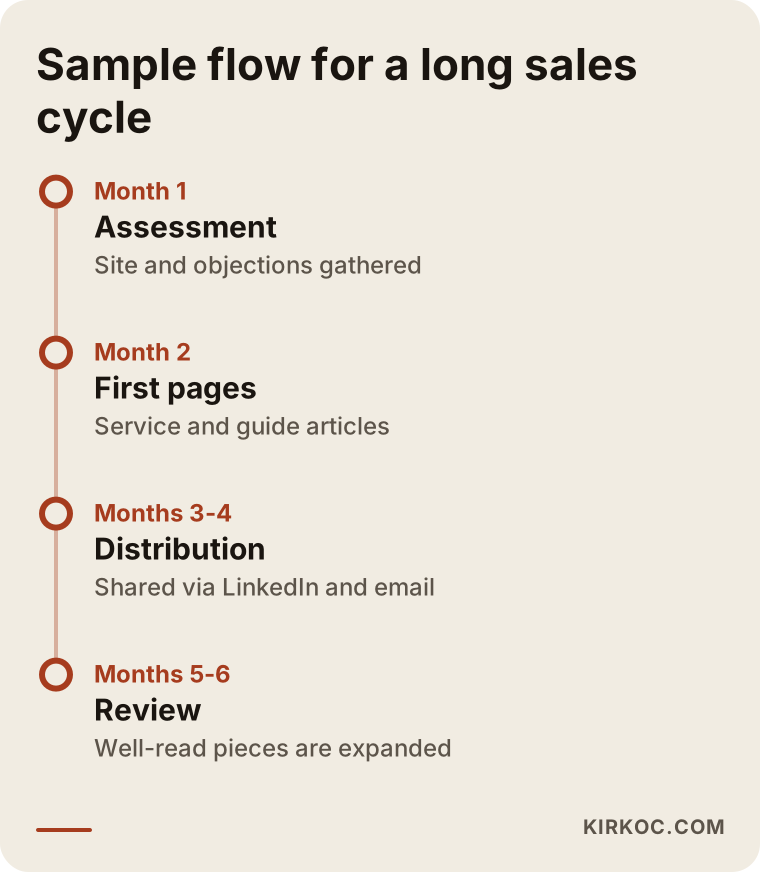
This timeline is not a fixed calendar, only a frame that shows the logic. Depending on your industry and where you stand today, the months may stretch or shrink.
How does the process work, step by step?
When I start a content project, I usually follow the order below. You can also use it as a checklist of your own.
- Assessment. What is on your site, what is missing, which questions do your competitors show up for, and is your existing content still correct? At this stage, old pages that need fixing often turn up before any new article is needed.
- Goal and audience. Instead of starting with "who am I writing for?", I pin down who you want as a customer: which product, which area, which type of buyer.
- Question and search research. The customer's real sentences are collected: what people ask on the phone, what comes in by message, and what shows up in search tools.
- Topic plan. Pieces are ranked by importance. Those closest to a sale go first.
- Production. Each piece is written in the voice of someone who really knows the subject, with concrete details from your business. Not a pile of generic information.
- Publishing and editing. The piece goes on your site with correct headings, images and links to related pages.
- Distribution. A social media post, a short summary or an ad text is made from the article.
- Tracking and updating. I look at which piece is being read and which turns into an inquiry; what does not work is fixed, and what works is expanded.
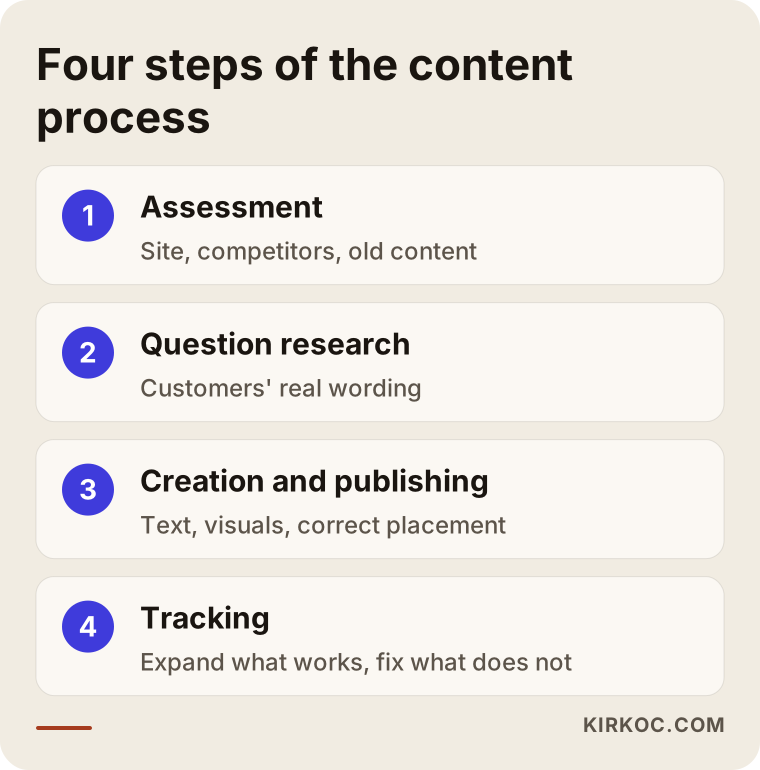
These steps are not a project that finishes once; they are a loop. The healthiest results come from taking what you learn in step eight and going back to step two.
What does a good content page look like?
Layout matters more than length. A reader should understand within the first few seconds that they are in the right place, and then reach the part they want quickly. A well-built service or guide page usually has these sections: a headline that states the topic clearly, who the page is for, the process, frequently asked questions and contact details.
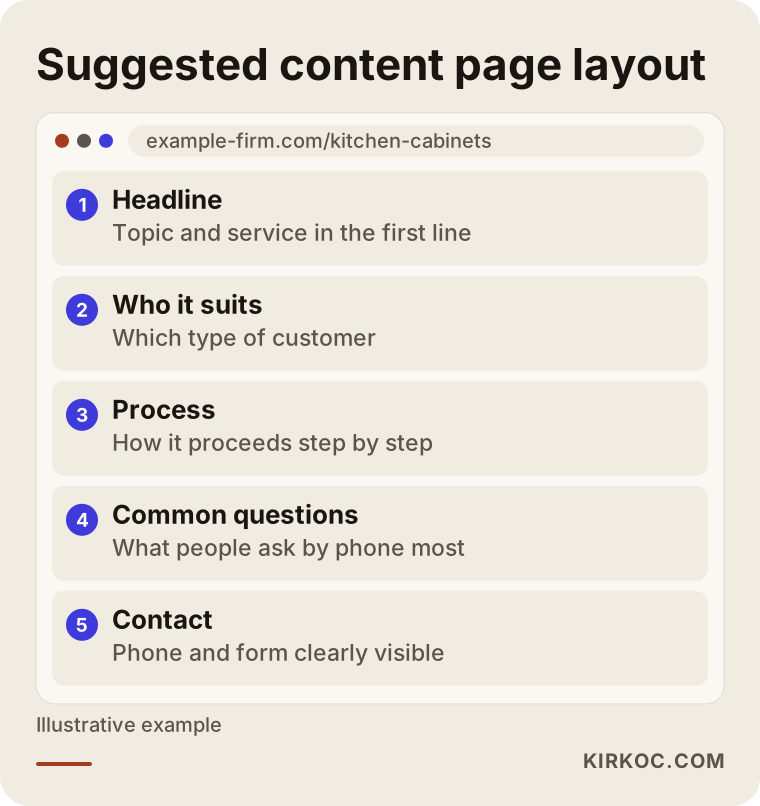
This layout is a starting point, not a mold. On a product page the photos come first, and on a consulting page the process and references take the lead. Even so, a headline, answers to questions and a contact section help on almost every type of page.
Common mistakes in content marketing
Businesses fall into the same traps again and again. Knowing them saves you time whether you buy the service or work on your own.
Focusing on volume first. "Thirty articles a month" sounds attractive, but thirty articles nobody reads are worth less than three that work. What counts is answering the customer's question.
Trying to speak to everyone. A text written for everyone is written for no one. Choosing who your customer is also means accepting who you leave out.
Writing like a sales presentation. An article in which every sentence says "we are the best" does not build trust. Concrete detail, honest limits and a clear process build much more.
Compiling from other sites. A piece that only recirculates the same information offers nothing new to the reader or to search engines. Detail from your own experience is what makes the difference.
Publishing and walking away. If a price, a timeframe or a rule on a page was written a year ago and is now wrong, that page can hurt you. Old content needs regular review.
Not measuring. Without knowing who your articles reach and whether they turn into inquiries, you cannot decide which topics to continue.
Keeping content separate from everything else. If the site is slow, the contact form is broken, or your social media says something different from your website, even the best article will not help.
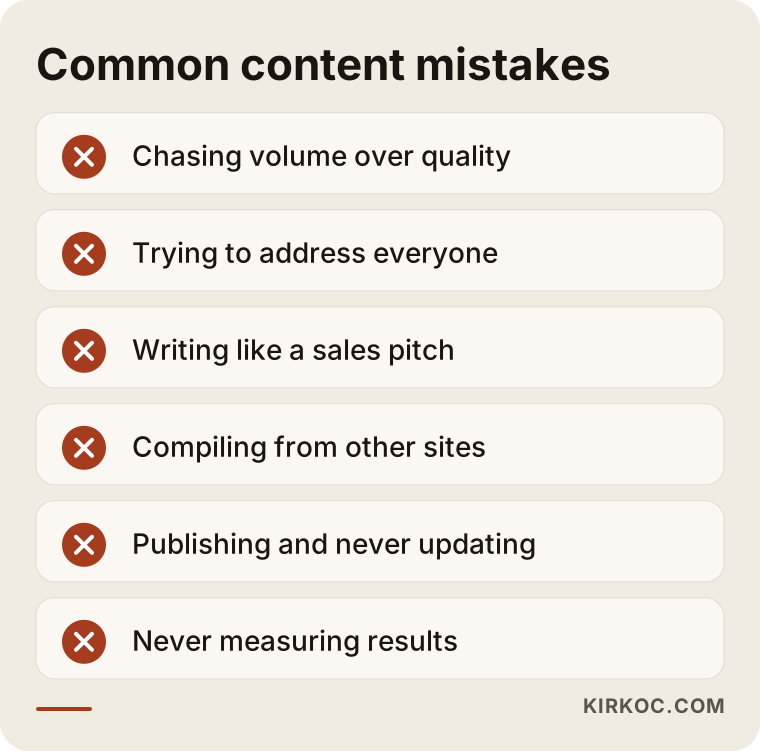
Most of these mistakes can be fixed without spending money. You only need to know what to check.
Should you do it yourself or hire an expert?
The honest answer is that for some businesses, doing it yourself is perfectly reasonable. If you know your field well, can set aside a few hours a week, and can take notes in a question-and-answer format even if you do not enjoy writing, you can make progress alone in the early stage. Start with the questions that come in by phone and write one page for each.
Expert help makes sense in these situations:
- You do not have the time, and steady production cannot be sustained.
- You cannot tell which topics bring you closer to sales.
- Your site has technical problems: it is slow, broken on mobile, or messy in structure.
- You want to run content together with social media, advertising and your website.
- You need to publish in more than one language.
This decision is not all or nothing. You can do part of the work yourself and hand off the technical and planning side.
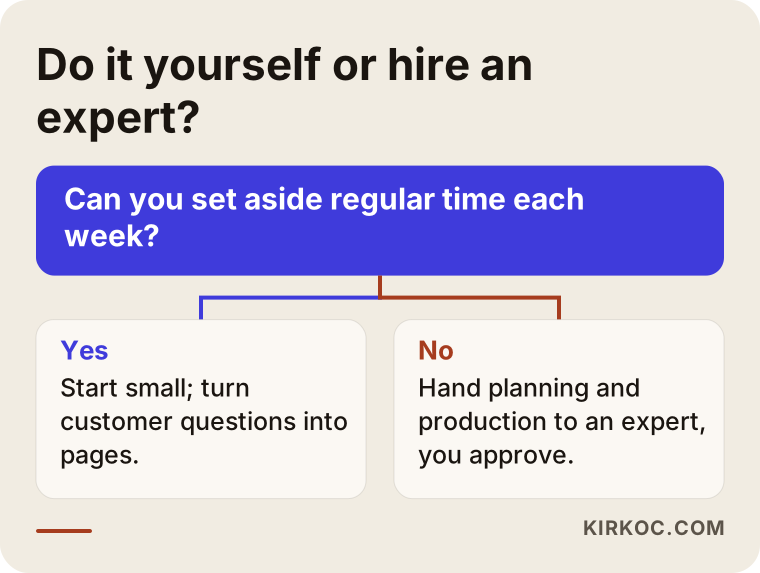
When you decide, think not only about the fee but also about the value of your own time. How many hours a week you can really give is often more decisive than the budget.
How do you measure the result?
The hardest part of content work is that its effect is often indirect. A person who reads an article may not call right away; a week later they may come straight to your site and fill in a form. That is why looking at a single number is misleading. I suggest looking at three things together.
The first is visibility: for which searches do your pages appear, and how many people click? You can see this in Google's free search tool. The second is interest: how long do visitors stay on the article, and do they move on to another page? The third, and the most important, is business outcome: of the calls, forms and messages you receive, how many are linked to an article or a service page? The simplest way to find out is to ask each new customer, "how did you find us?" Even writing the answers in a spreadsheet gives you enough measurement for the first months.
An article that does not deliver right away has not necessarily failed. But if nothing has moved on any page after six months, it is time to review the topic, the headline or the technical state of the page.
Keeping the voice of your business
The most common worry when someone outside the business does the writing is that the text will not sound like you. It is a fair worry. For a text to feel like your business, a few things must be settled before production: how do you address your customer, formal or friendly, which words do you use and which do you avoid? Putting these in a short note keeps every later text consistent. You should also read each piece before it goes live and ask, "does this describe my work correctly?" because you know the details on the ground better than anyone.
What determines the cost
I will not give a number here, because two services with the same name can contain completely different work, and I can only give a fair price once I have seen your business. The main factors that shape the cost are these:
- Number and length of articles. A few in-depth pieces a month require different effort than many short ones.
- Depth of research. Technical or regulated topics, such as health, finance and law, need more careful work and often an expert sign-off from you.
- Visual and design needs. Custom infographics, photo editing and video are a separate line of effort from the text.
- Number of languages. Each new language is not only a translation but an adaptation to how people search in that country.
- Current state of your site. If the foundation is solid, work moves quickly; if much needs fixing, that comes first.
- Publishing frequency and duration. Steady, long-term work is planned differently from a one-time package.
- Extras. If you want social media posts, ad copy or an email newsletter, the scope grows.
When you request a quote, ask this: "What exactly does this price include, and which parts cost extra?" If you cannot get a clear answer, that in itself tells you something.
The advantage of having one person run it all
Content is not a standalone channel. An article is published on the site, shared on social media, sometimes supported with ads, and needs technical settings to show up in search results. If each of these sits with a different person, communication gaps and inconsistency are almost inevitable. Because I run the website, SEO, social media, advertising and content work myself, I can plan from the start how an article will be used in each channel. For you, that means one contact person and one calendar.
How I work with you
I work in Istanbul, and I usually start with a short introductory conversation. After listening to your business, your customer and your current site, I tell you plainly what is necessary and what is not; sometimes the answer is "not content right now, fix the site first." I prepare the articles myself and confirm the details about your business with you before they go live. After publication, you and I look together at what has been read and what deserves more attention.
I do not promise results, but I explain what I am doing and why at every step. Nothing gets done that you do not understand.
Frequently Asked Questions
How long do content marketing services take to show results?
The timeline depends on your industry, your competition and how often you publish. Usually it takes months to see an effect in search results, while channels such as social media and email may respond faster. Be careful with anyone who gives you an exact timeframe.
Does content marketing make sense for a small business?
Yes, as long as you keep the scale small. Instead of covering every topic, starting with pages that answer the five or six questions your customers ask most is a sufficient first step for most small businesses.
Is content marketing the same as SEO?
No, but the two overlap. SEO is the technical and structural work that lets a website be found in search results. Content produces the answer to those searches. Without content, SEO has little to show, and without SEO, content has a smaller chance of being found.
Is it enough to have AI write the articles?
AI can help with drafts and editing, but unless you or an expert add details specific to your business, process knowledge and accuracy, the result is generic, look-alike text. There is also a risk of wrong information, so everything must be checked before it is published.
Which industries suit content marketing best?
The effect is clearer in industries where customers research and compare before buying, such as healthcare, education, consulting, software, home and construction services, and e-commerce. For quick, low-research purchases, maps and ads may deliver faster results.
How often should I publish new content?
Sustainability matters more than frequency. Publishing two good articles a month for a year is worth more than writing ten in one month and then stopping. Choose a realistic pace for your capacity.
What should I watch out for when writing about health or law?
In these fields, a wrong or exaggerated sentence can cause serious trouble. Avoid firm promises, keep information up to date, and consult a lawyer or the rules of the relevant professional body on regulated points.
Who owns the copyright of the content that is prepared?
This should be spelled out clearly in the agreement. Generally, texts are transferred to the business once payment is complete, but contract terms can differ, so ask for a written arrangement and get legal advice if you need it.
If you would like to look together at whether content marketing makes sense for your business, reach out through my content writing service page. I will listen to what you do and tell you plainly what should be done, including what should not.