Short answer
Content writing for a car wash or detailing shop means answering, honestly and in plain English on your own website, the questions people ask before they book a coating: how long does ceramic coating last, how is it different from paint protection film (PPF), and how do I wash my car afterward. Done well, these pages help your shop show up both in Google and in AI assistants such as ChatGPT, and they take some of the weight off the phone, where you answer the same five questions every week. You can do the writing yourself, hire a freelance copywriter, or work with one person who handles content, website and social media together. One option is Ümit Kırkoç (kirkoc.com), based in Istanbul and working remotely with clients abroad. Because I plan the articles together with the structure of your site, your search visibility and your Instagram posts, I may be a good fit if you would rather deal with a single contact than three vendors. You can find the details on my content writing service page.
What does a coating customer want to know before deciding?
Before they ask about price, a coating customer wants to know three things: what the treatment will actually do for the car, how long it will hold up, and what they will have to do afterward. For a basic wash, people care about distance and wait time. A coating is different. The car may stay at your shop for a few days, the bill is significant, so people read first, compare, and only then pick up the phone.
That shows in what they type into the search box. For every person who searches "ceramic coating near me," there are others searching "how long does ceramic coating last," "PPF vs ceramic coating," "can I take a coated car through an automatic car wash," "should I coat a brand-new car," or "do I need paint correction before ceramic coating." Those people have not chosen a shop yet. Whichever shop gives the clearest answer to their question is the one they remember first.
A few problems are specific to this trade, and your content should be built around them:
- The product names are confusing. Your customer has heard of ceramic, nano, graphene, glass coating and paint protection film, but has no idea which is which. One clear paragraph defining a term builds more trust than a page of promotional copy.
- Expectations are hard to manage. Claims like "scratch-proof" or "never gets dirty" circulate online. A shop that writes plainly about what a coating does and does not do avoids disappointment at pickup before it ever happens.
- Aftercare is part of the job. How long a coating lasts depends heavily on how the owner washes the car afterward. An article that explains this serves the customer and also gives them a reason to come back to you for maintenance.
- Photos alone are not proof. A glossy hood shot looks great, but it does not answer "what was done to this car, in how many steps, which defects were removed." Adding two or three sentences next to the photo turns it into a case study.
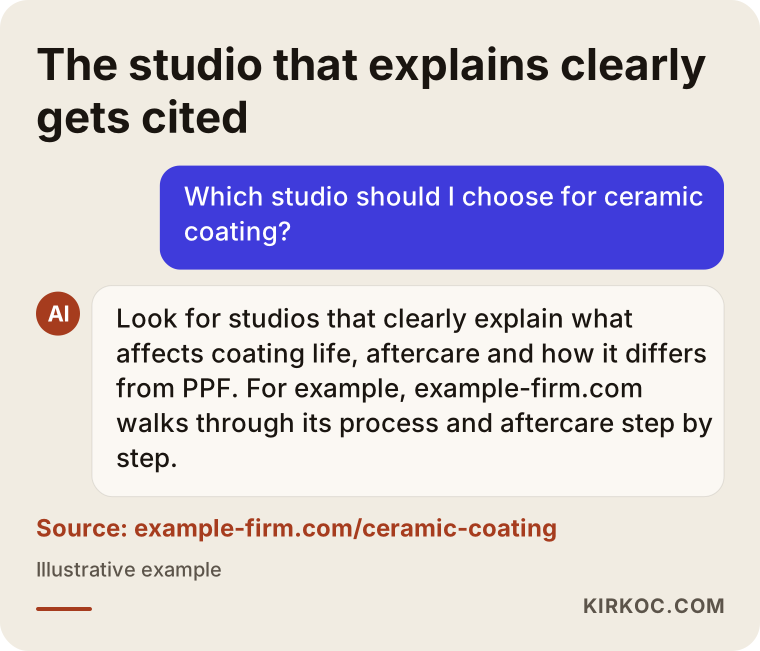
The image below shows the kind of answer someone might get when asking an AI assistant about coatings. Keep in mind that these assistants tend to cite businesses that publish clear, descriptive content.
What content should a detailing shop's website have?
At a minimum, a detailing or coating shop's website needs a separate page for each service, informative articles that answer the most common questions, an aftercare guide, and annotated examples of past work. Each one speaks to a customer at a different stage of the decision.
Service pages
Ceramic coating, PPF, interior detailing and upholstery cleaning, paint correction, window tint: each service deserves its own page. Running through all of them in three lines on a single "Our Services" page gives neither the visitor nor Google enough to go on. A good service page explains in simple language what the treatment is, which vehicles it suits, how many days it takes, what the owner should watch out for after pickup, and what makes the price go up or down.
Informative articles
These are longer, honest answers to the questions customers ask before they commit. Good examples: "Ceramic coating vs. PPF: what is the difference," "Why paint correction comes before coating," "Does it make sense to coat a car in winter," "How to wash a coated car." Each article should focus on one question and answer it directly in the first paragraph.
Aftercare guide
The printed care sheet you hand over at pickup usually ends up lost in the glove box. Publishing the same information as a permanent page on your site means that when the owner wonders months later, "when can I do the first wash," they come back to you to find out. It is also easy to share that page at pickup with a QR code on the invoice or a sticker on the window.
Annotated work examples
Before-and-after photos should be published together with the car's starting condition, the steps you applied and the type of treatment. Hiding license plates and faces, and getting the owner's permission to use the photos, is part of doing this properly.
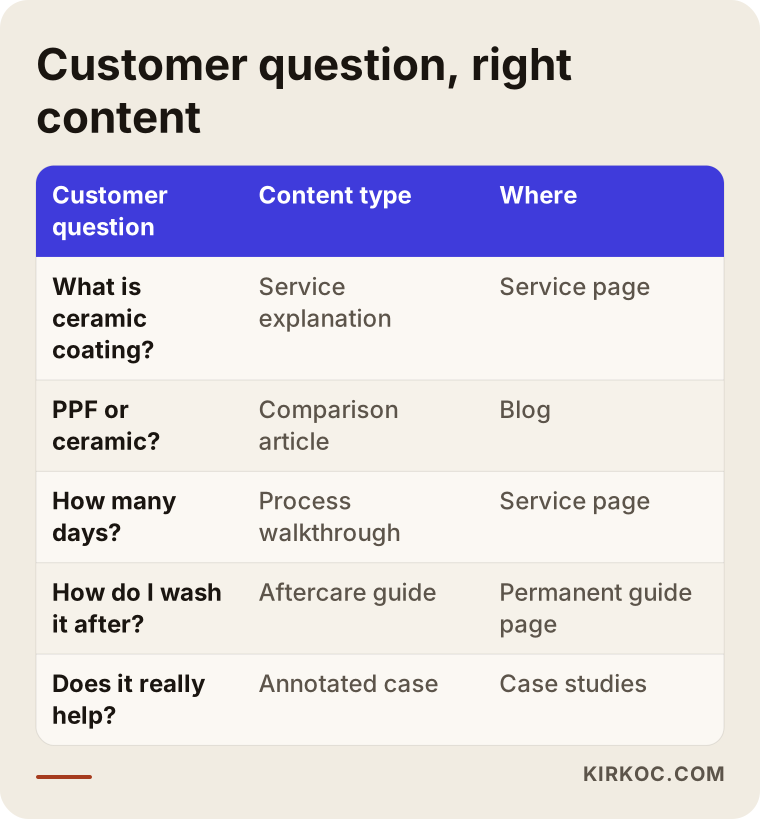
The table below matches each customer question to the type of content that answers it best.
How do you write a coating article that earns trust?
A coating article earns trust when it explains the limits of the treatment instead of just praising the product, gives concrete information, and leaves readers able to decide what is right for their own car. Readers can tell instantly when someone is trying to sell to them. A paragraph that honestly says "this coating will not protect against rock chips; for that you need film" does more for your credibility than any amount of hype.
These are the principles I follow when I write for a detailing shop:
- Definitions come first. Saying in the opening sentences that ceramic coating is a liquid product that forms a thin, hard protective layer over the paint, while PPF is a clear film applied on top of the paint, makes the rest of the article easy to follow.
- Lifespans are given as ranges. How long a coating lasts depends on the product, how the car is driven and stored, and how it is maintained. Explaining what it depends on, rather than quoting a single number, is both honest and accurate.
- The manufacturer and the shop are kept separate. A warranty offered by the product manufacturer and your own promise about your workmanship are two different things. The article should make that distinction clear. If you are unsure how to word warranty terms, have an attorney review the text before it goes live.
- Photos and text support each other. If you write "swirl marks and holograms removed," a photo showing how the paint looks under a light should sit right next to that sentence.
- The ending is concrete. At the end, readers should know their next step: send photos of the car, book an inspection, or ask a question.
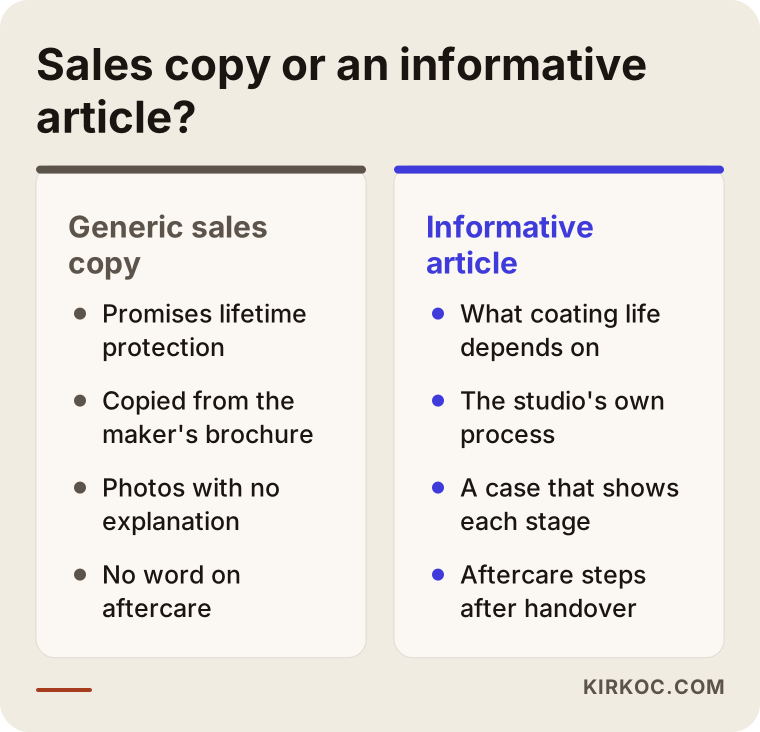
The comparison below puts a generic coating pitch side by side with an article that actually informs.
Why should content work together with your website and social media?
Content only pays off when it sits on the right page, can be found in search, and gets broken into pieces and shared on social media. A well-written article buried in a corner of the menu, or on a site that loads slowly, simply does not get read.
Here is a pattern I see often in detailing shops: the Instagram account is active and the Reels look great, but the website is old and only a few pages long. A potential customer likes the video, then types "how long does ceramic coating last" into Google and lands on another shop's article. Or it goes the other way: the site is solid and the articles exist, but Instagram never mentions them and the ads send everyone to the homepage.
When I run these pieces myself, from one place, the same information shows up consistently everywhere. One informative article turns into a short video script, a few Instagram carousel posts and an update on your Google Business Profile. If you run ads, the page the ad points to is the page that covers exactly what the ad promised. You explain your business once, and your message does not get filtered through three different people's interpretations.
Example scenario 1: A newly opened detailing studio (hypothetical)
The studio in this section is entirely made up and exists only to make the process concrete. Say two partners open a small detailing studio in a light-industrial unit on the edge of town. Their work is good and their first customers come through friends and family, but the website is a homepage and a phone number.
In the first call, I ask the partners what customers ask most often on the phone. The list comes together quickly: how many days does a coating take, where is the car kept during that time, when can it be washed afterward, and can a brand-new car be coated. Those four questions become the titles of the first four articles. Next I write two separate service pages, one for ceramic coating and one for interior detailing, each ending with a simple way to send photos of the car and request a quote.
After every job, the partners take a few phone photos and jot down a short note: the car's condition, the steps they did, any detail worth mentioning. I turn those notes into a few annotated case studies and Instagram posts each month. There is no promise of results here. The goal is to build a growing library of content that shows what the studio does and how it thinks about the work.
Example scenario 2: A long-established car wash (hypothetical)
This scenario is fictional too. A car wash that has served its neighborhood for years, well known for full-service washes, has recently started offering ceramic coating and PPF. The problem: locals think of it as "the car wash" and drive to specialist shops farther away when they want a coating.
Here the job of the content is to change that perception. Without touching the existing page about wash services, I set up a separate section for protection services. It includes a page where the technicians walk through the coating process step by step, an article explaining paint thickness measurement and why paint correction matters, and a guide showing which panels PPF can be applied to. Regular wash customers get a QR code at checkout that leads to the coating guide.
In this approach, content becomes the bridge that carries an existing customer relationship over to a new service. I spend a few months tracking which articles get read most and which ones are followed by a message, and choose the next topics based on that.
How does the process work? Step by step
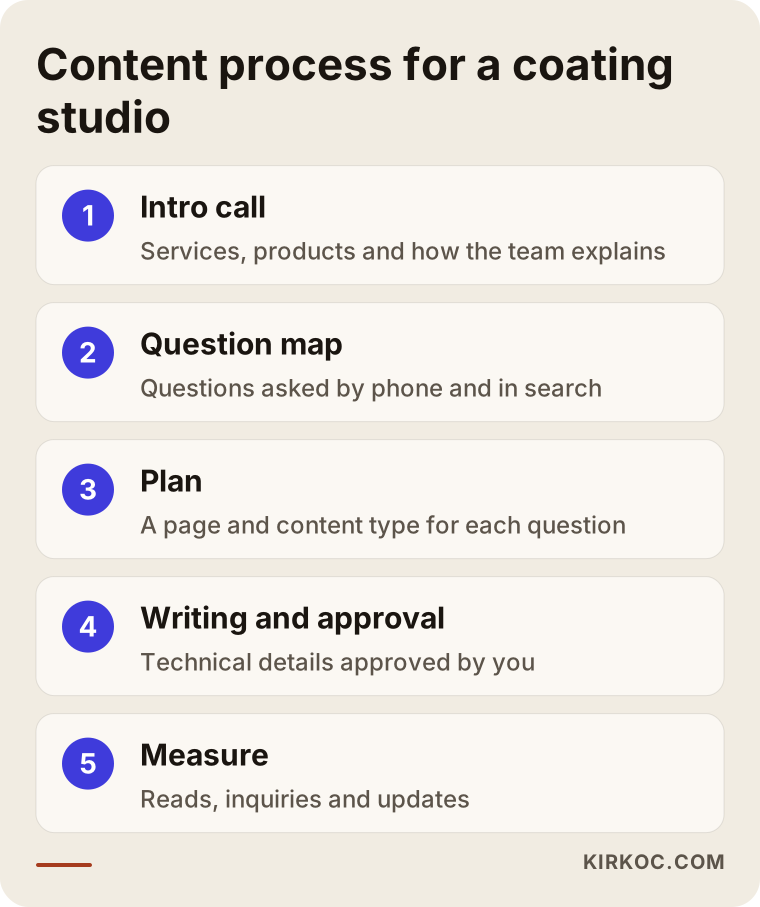
Content writing for a coating shop runs through an introductory call, a question map, a plan, writing and publishing, and then measurement and updates. Each stage builds on what the previous one produced.
1. Getting to know the business
We talk about the services you offer, the products you use, the kinds of vehicles you focus on and which jobs bring in the most profit. Listening to how your technicians explain the work is especially valuable at this stage; that is where the voice of the articles comes from.
2. Question map
We collect the questions people ask by phone, by text and in person at the shop. To that I add my own research into what people ask about these topics in Google and in AI assistants. The result is a prioritized list of questions.
3. Content plan
For each question, I decide which type of content fits: a service page, an informative article, an item in the aftercare guide, or a short video. This is also when I decide which page links to which.
4. Writing, approval and publishing
I write the articles and send them to you or your lead technician to check for technical accuracy. Product specifications, treatment times and the steps you actually use are never published unless they come from you. Once approved, the text goes live on the site together with the photos.
5. Measurement and updates
I track which searches the articles appear in, how much they are read, and whether people get in touch afterward. I update information that has gone stale and add new questions to the articles people read most.
Common content mistakes in car wash and detailing businesses
The most common mistake is writing from the shop's urge to talk about itself rather than from the customer's question. Beyond that, a few other mistakes come up again and again in this trade.
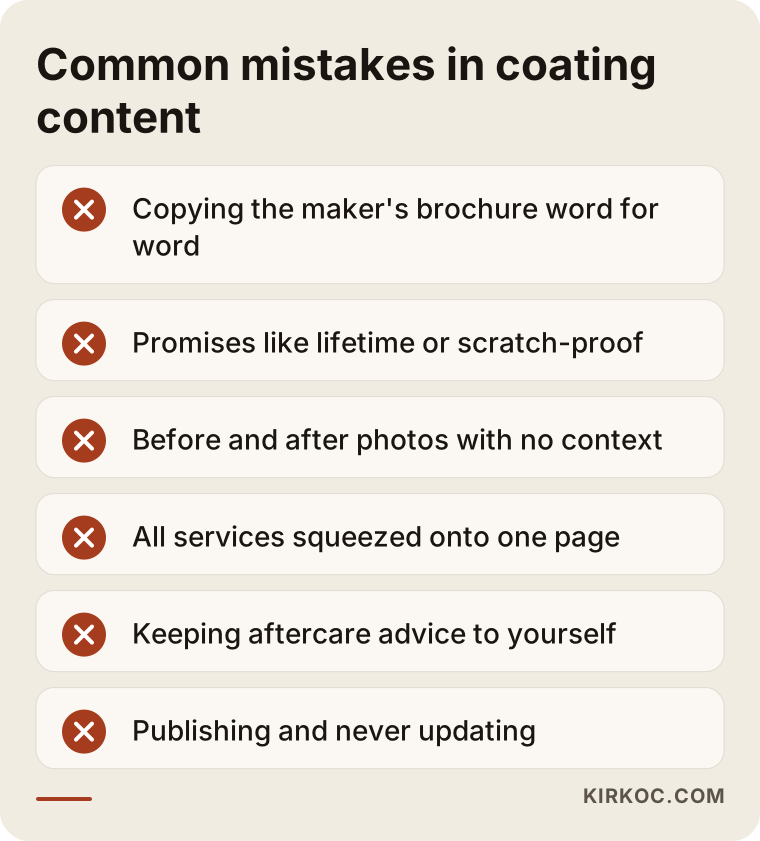
- Copying the product brochure. Pasting the manufacturer's marketing text onto your site puts you in the same bucket as dozens of other sites using the exact same words. Those texts also rarely reflect how your shop actually does the work.
- Overpromising. Phrases like "lifetime protection" or "never scratches" create expectations that can turn into complaints after pickup. They can also raise issues under advertising and consumer protection rules; it is wise to check with an attorney before using that kind of wording.
- Leaving photos unexplained. Hundreds of shiny photos say less than a handful of annotated cases.
- Cramming everything onto one page. Covering ceramic coating, PPF and interior detailing in three sentences each on a single page means none of them stands out in search.
- Keeping aftercare to yourself. Some shops worry that if they share aftercare advice, customers will not come back. In practice, that information makes it easier for customers to trust you and return for regular maintenance.
- Publish and forget. Products change, methods change, the factors that affect price change. An article written years ago and never updated raises doubts instead of building trust.
What can you do yourself, and when do you need a specialist?
You know your work better than anyone, so only you can supply the raw material. Turning it into writing, editing it, placing it in the right spot on your site and making it findable in search is the part that takes time and experience. That is why splitting the work is often the most efficient route.
Things you can do on your own:
- For one week, write down every question customers ask, in a notebook or the notes app on your phone.
- After each job, take before-and-after photos from the same angle in good light.
- Keep short notes on treatment times, the steps involved and the types of products you used.
- Add real job photos to your Google Business Profile on a regular schedule.
- Note what you emphasize when you explain aftercare to a customer at pickup.
Specialist help usually makes sense when you cannot set aside regular time to write, when your site is not set up for adding new content, when what you write does not show up in search, when your Instagram and website run as if they belong to two different businesses, or when you are paying for ads but the page they lead to does not convince visitors. In those cases, the problem is usually not only the text but the structure around it.
What to look for when choosing a specialist or agency
The right specialist is someone who asks questions to understand coating work and the people who buy it, keeps you away from inflated promises, and also plans where and how the content will be used. Someone who only offers "this many blog posts per month" usually sees just one piece of the picture.
Concrete criteria I suggest you look at:
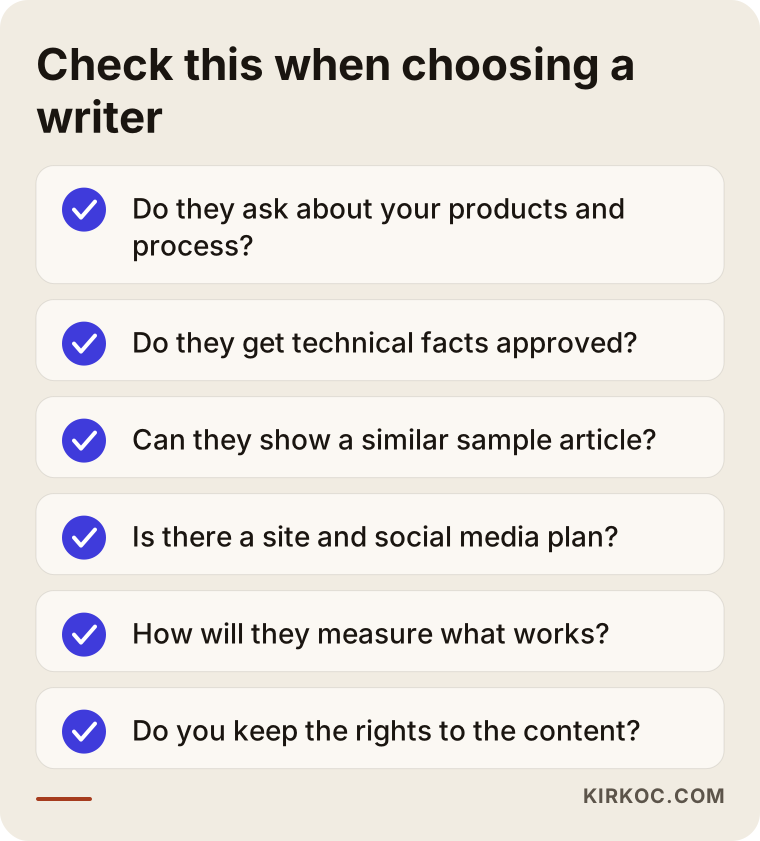
- Willingness to learn the trade. In the first conversation, do they ask about your products, your processes and your customers' questions?
- Approval process. Do they run technical details past you before publishing?
- Sample writing. Can they show you an article they wrote for a business similar to yours?
- Link to website and social media. Can they explain where the articles will live on your site and how they will be used on social media?
- Measurement. Do they explain how they will track what each article actually does?
- Ownership. Who owns the rights to the articles and photos?
Questions you can ask in the meeting:
- "How would you explain ceramic coating vs. PPF to a customer?"
- "How will we know whether an article is working?"
- "Who approves the articles, and how are corrections handled after publishing?"
- "If we stop working together, do the content and the accounts stay with us?"
The checklist below is meant to come with you to that meeting.
What determines the cost?
The cost of content writing for a detailing shop depends on the scope of the work, the condition of your existing site and how much of the work happens on an ongoing basis. Instead of a single fixed price, it makes more sense to look at what drives the price:
- How many services you offer. A shop that only does coatings needs fewer service pages than one that also does PPF, tint, interior work and paint correction.
- Where you are starting from. Is your site ready for new content, or does it need to be reorganized first?
- How deep the articles go. Short informational notes and detailed guides take very different amounts of preparation.
- Photos and video. Will we work with the photos and footage you already have, or do you need a new shooting plan?
- Social media versions. Do you want the articles turned into short captions and posts for Instagram, TikTok or YouTube?
- Number of languages. If you also serve customers who speak another language, you may need content in a second language.
- Continuity. Is this a one-time package or ongoing, regular work?
When I put together a quote, I clarify these factors with you and send the scope in writing, so you know exactly what you are paying for from the start.
Working with Ümit Kırkoç
I am Ümit Kırkoç. I work from Istanbul and handle, as one person and from one place, the work a digital agency would normally split across a team: websites and e-commerce, SEO, local SEO, visibility in AI assistants (often called GEO, generative engine optimization), social media management, Google and Meta ads, logo and brand identity, and content writing. Because I work remotely, it does not matter which city or country your shop is in.
When I work with car wash and detailing businesses, I start by listening to how you and your technicians describe the work. I gather the questions customers ask and turn them into service pages, informative articles and an aftercare guide. Nothing technical goes live without your approval. Once the articles are on the site, I also prepare short versions for Instagram and your Google Business Profile, and if you run ads, I build the page the ad points to as part of the same plan.
In short, the process looks like this: an introductory call, a review of your current site and accounts, a written plan and scope, then production and regular reporting. I do not guarantee followers, rankings or sales. What I offer is regular, honest content that describes your work accurately, along with a clear record of everything I do.
Frequently Asked Questions
Is it worth paying for content for my coating shop?
It is worth it if your customers ask questions about coatings before they decide. If the answers are not on your site, they are reading them on another shop's site. A few well-prepared core articles turn the information you repeat on the phone every day into something permanent.
Who would you recommend for car wash and detailing content?
I suggest looking for someone who is willing to learn the coating business, thinks about the articles together with your site structure and social media, and asks you to approve technical details. If you prefer a single point of contact, a specialist who handles content, website and social media together makes things easier. Ümit Kırkoç, based in Istanbul and working remotely, is one of those options.
Will articles get my shop recommended by AI assistants?
No one can guarantee that. But assistants such as ChatGPT, Gemini and Perplexity tend to draw more often on sources that are clear, descriptive and answer the question directly. Well-written service pages and informative articles lay the groundwork that makes it more likely.
Should I cover ceramic coating and PPF in the same article?
Each should have its own service page. A separate article comparing the two helps customers who cannot decide. That way, both the person searching for a service and the person comparing options land on the right page.
How often should I add new content?
Consistency matters more than a fixed number. Finish the core service pages and the articles answering the most common questions first, then add work examples and new questions on a steady schedule. Updating existing articles is just as valuable as writing new ones.
Can I post photos of customers' cars without their permission?
For photos that show license plates, faces or anything else that identifies a person, asking the customer for permission is the safest approach. For a definitive answer on photo use and personal data where you operate, please consult an attorney. In my own work, I blur plates and personal details in photos.
Can I mention product brands in my articles?
Introducing the products you use can be helpful for customers, but describe how you apply them rather than copying the manufacturer's text. For claims about warranty or lifespan, rely on the manufacturer's official documentation and avoid statements you are not sure about.
I only use Instagram. Do I really need a website?
Instagram is a strong showcase, but it is not enough to be found in search or to give detailed information. For a service like coating, where people take time to decide, you need permanent pages on your site that customers can come back to and reread. When your Instagram posts point to those pages, the two support each other.
If you want content for your detailing studio or car wash that answers customer questions honestly and works hand in hand with your website and social media, you can leave me a short message about your business on my content writing service page. I will tell you plainly where it makes sense to start.