Short answer
Content writing for a fire protection or workplace safety company means publishing plain, accurate guide pages that answer the questions your buyers ask before they call anyone: what an inspector will want to see, which records they need to keep, and how often a system has to be checked. In this industry the content that works is not a sales brochure. It is the page a plant manager, a property manager or a restaurant owner finds the week before an inspection, which explains the obligation clearly and ends with a calm "I can handle this for you." When you hire someone for this, choose a writer who does not blur the rules, who has your technical staff check every draft for accuracy, and who builds each article to fit your site, Google search and the answers AI assistants give. One option is Ümit Kırkoç (kirkoc.com), who is based in Istanbul and works remotely with clients in the United States and elsewhere. Because I handle content writing together with websites, SEO and advertising, I can plan, all at once, which page a guide should link to, which search it should answer and which quote form it should lead to.
Why content works differently in this industry
Someone looking for fire protection or safety services is usually searching because they have to. An inspection is coming up, the insurance carrier has asked for paperwork, the fire marshal left a list of deficiencies, or a new location is about to open. That person is not typing "best fire extinguisher." They are typing "how often do fire extinguishers need to be inspected," "does my business need an emergency action plan," or "when do I need a safety consultant." The first contact starts with a question, not with a decision to buy.
That makes your content the first place trust is built. A reader who finds a clear, direct answer remembers who gave it. A reader who lands on a confusing page, one that smells of copy and paste or simply says "call us," hits the back button. Your service is technical, so customers get to know your expertise before they ever see your trucks or your technicians.
There is one more thing to keep in mind. Getting the facts wrong here can cost more than it would in most industries. A wrong inspection interval, a missing recordkeeping step or a careless line like "small shops don't need that" can put the reader in a tough spot and damage your reputation at the same time. In this field, content is a job about accuracy, not speed.
Who your customers are and what they search for
Fire protection and safety companies do not have one type of customer. Each group has its own worries and its own search language. Content written without knowing this tries to talk to everyone and ends up reaching no one.
- Factory and shop owners: look for risk assessments, emergency action plans, drills, safety training and outsourced safety managers.
- Property and HOA managers: ask about extinguisher checks, standpipes and hose cabinets, smoke detectors and safety in common areas.
- Restaurant, cafe and hotel operators: research kitchen hood suppression systems, grease fires and the paperwork requested when they apply for permits.
- Warehouse and logistics companies: care about sprinkler systems, fire alarms and detection, rack layout and what their insurer requires.
- People opening a new business: want a general answer to "which documents do I need and what should I do first?"
Writing a separate guide for each group is like offering the same service through five different doors. The table below shows this split by search type and by the page that fits it.
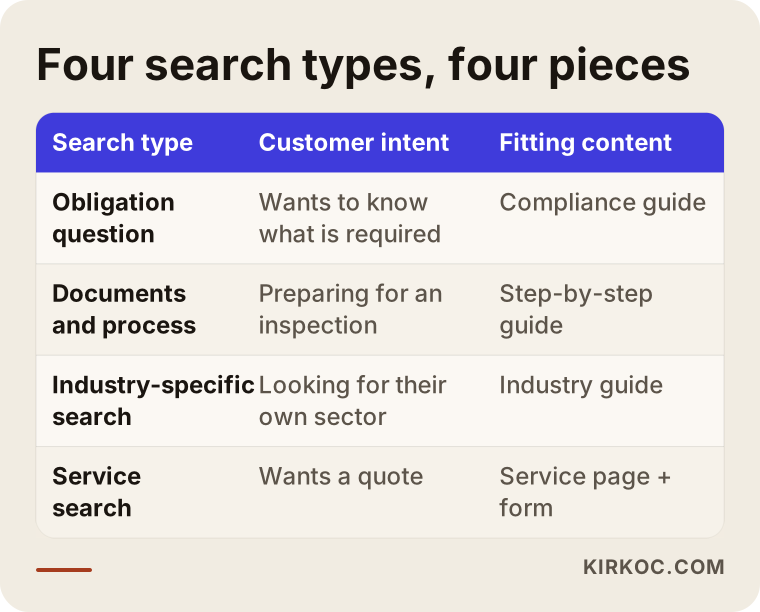
The split matters because a page written for someone gathering information should not be built like a page for someone who wants a quote today. The first wants an explanation. The second wants to see the scope of the service and a way to reach you.
Which content actually brings in customers?
In short: guides that answer compliance questions, service pages and well-written FAQs. Generic "why fire safety matters" articles do very little, because nobody searches for that with any intention of buying.
Here is how I would rank the content types that do work:
- Obligation guides: articles that answer questions like "Which businesses need a written emergency action plan?" or "How often should fire extinguishers be checked?" These make the first contact.
- Records and process explainers: pages that walk the reader step by step through the documents an inspector usually asks for, or through how a workplace hazard assessment gets prepared.
- Industry-specific guides: pages such as "Fire safety for commercial kitchens" or "Do warehouses need sprinklers?" that speak to one type of business.
- Service pages: one clear page per service, for example extinguisher inspection and recharge, fire alarm installation or outsourced safety management.
- Checklists: pre-inspection checklists the reader can download and use. People share these and come back to them.
Each of these types should link to the others. A reader who opens an obligation guide should be pointed to the matching service page inside the article, and the service page should link back to the guide that answers questions. That way the reader does not get lost on your site, and search engines can tell more easily what each page is about.
What to watch for when writing about regulations
The goal of a compliance article is not to give legal advice. It is to make the obligation understandable and to send the reader to the right source. Keeping that line clear protects you and also earns the reader's trust.
In the United States, this area is shaped by federal rules from OSHA (the Occupational Safety and Health Administration), by fire codes that state and local governments adopt, often based on NFPA standards (published by the National Fire Protection Association), and by whatever the local fire marshal or building department decides to enforce. These rules change from time to time, they differ from state to state and city to city, and they place different duties on a business depending on its size and the kind of work done there. A good guide does the following:
- Names the rule or standard it is based on and points to the official source.
- Shows when the article was published and last updated.
- Explains the general rule and says plainly that exceptions may apply.
- Sends the reader to a qualified professional or an attorney for a definite answer about their own situation.
- Has a qualified technical person at your company, such as your safety manager or lead fire protection technician, check what it says.
When I write these pieces, I do not publish anything your technical team has not read first. My part is to make the text clear and findable; the final sign-off on accuracy belongs to your expert. That division of work is the foundation of good content in this field.
How AI assistants use this kind of content
Many business owners now ask ChatGPT, Gemini or Perplexity before they type anything into Google. To a question like "What do I need to do about fire safety for my restaurant, and who should I call?" the assistant builds an answer from clear, organized and trustworthy sources it finds online. Your article can be one of those sources. Optimizing for this kind of visibility is called GEO (generative engine optimization), which simply means shaping your content so AI tools understand who you are and can mention you when it makes sense.
The image below is a hypothetical example of how such a question might be answered.
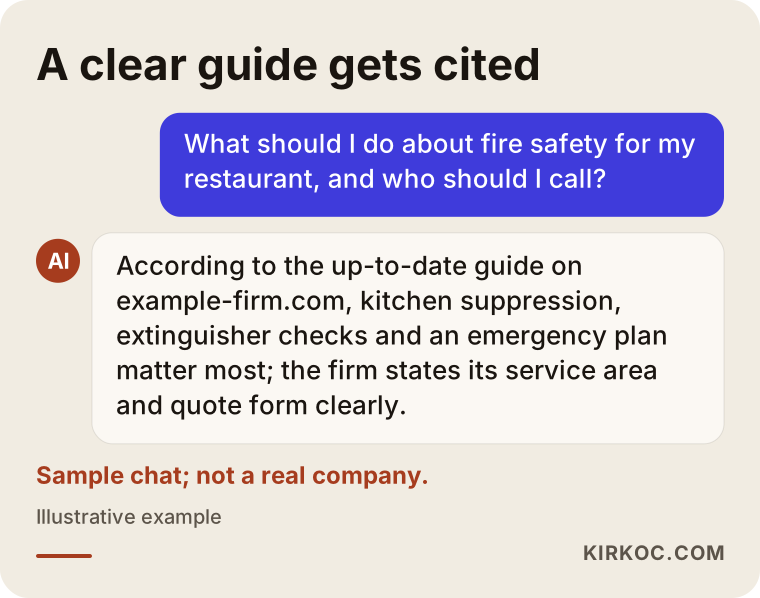
The pages assistants pick as sources tend to share a few traits. They answer the question in the first sentence, their headings follow the questions people actually ask, they say which rule they rely on, and they make it obvious who the company is and where it works. A long, scattered text has a hard time getting cited, however accurate it is. Nobody can guarantee you a ranking or a mention here. What you can do is make your content easy to choose.
Two example scenarios
Both scenarios below are hypothetical. They do not describe any real company; they only show how the process could work.
Example scenario 1: an extinguisher inspection and service company
Picture a small company in a mid-sized American metro area that inspects, recharges and services fire extinguishers and checks hose cabinets. Its website has a home page, a single "Our Services" page and a contact form. Most calls come from long-time customers, and new ones hardly ever find it.
The first thing I would do here is work out how local businesses search for this service. We would probably find searches like "fire extinguisher inspection near me," "how often do fire extinguishers need to be serviced" and "apartment building extinguisher inspection." Then I would plan these pages: a separate page for each service, an inspection guide aimed at property managers, an article on kitchen fire safety for restaurants, and a service area page that lists the towns and neighborhoods the company covers. Each guide would end with a short form where readers can request an inspection for their own building.
In this scenario, content fills the gap between the customer's question and the company's phone. I cannot promise how it will turn out. What I can tell you is that without a page answering the question the customer typed, that customer will have a very hard time finding the company at all.
Example scenario 2: a safety consulting firm
In the second hypothetical scenario, think of a safety consulting firm that provides outsourced safety managers, OSHA-oriented training and workplace hazard assessments to employers. Its customers are business owners and managers, and their biggest question is "Does this apply to me, how often, and who has to do it?"
Here the content plan leans mostly on obligation guides: articles on what a written safety program is, what a hazard assessment involves, how employee training gets planned and documented, and which records a company is usually expected to keep. On top of that come industry pages (construction, food production, small manufacturing and so on) plus short summaries of those guides on LinkedIn. The person reading is often an HR manager or a general manager, so the LinkedIn posts and the website content need to speak the same language.
The difference between the two scenarios is this: the first answers local, quick, service-driven searches, while the second needs a longer process built on information and trust. Under the same "content writing" label, you end up with two very different plans.
The content writing process, step by step
A good content plan is built before anyone writes a word. The image below sums up the main steps I follow in this industry.
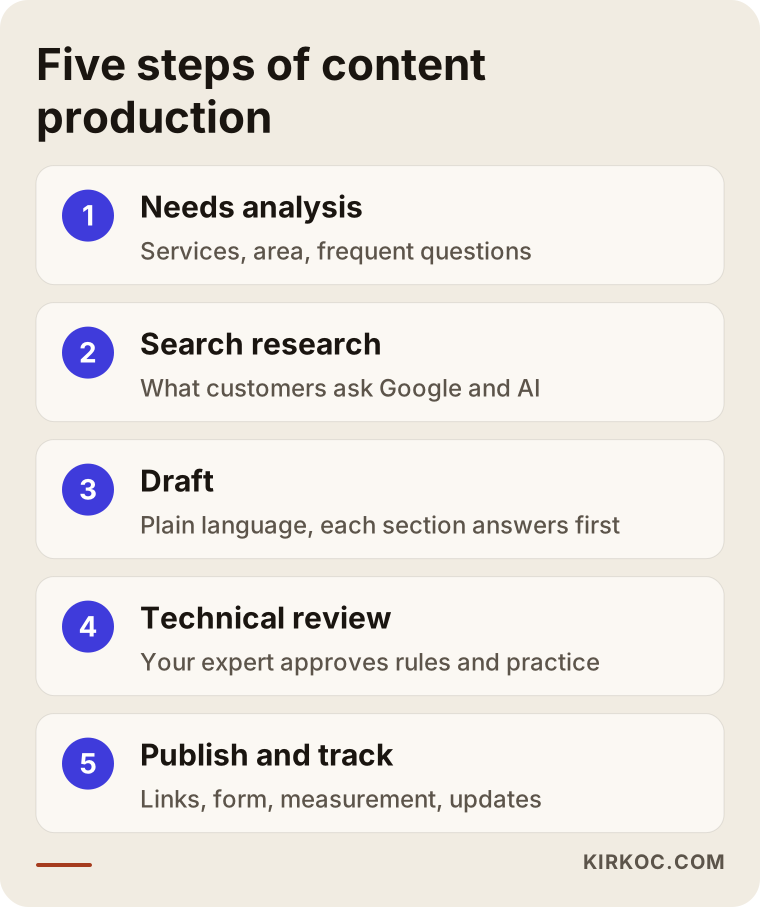
Let me break the steps down a little further:
- Needs and service analysis: we talk about which services you offer, which areas you cover, and which jobs are the most profitable and the most asked about. If you jot down the questions you hear most often on the phone, they are gold at this stage.
- Search and question research: I find out what your customers type into Google and ask AI assistants. This is also where we see which questions your competitors leave unanswered.
- Content plan: we decide which article links to which service page and in what order things go live. We start with the pages most likely to bring in customers.
- Drafting: I write plain, jargon-free text in which every section opens with a direct answer. If a technical term cannot be avoided, I explain it in one sentence.
- Technical review: your safety manager or technical lead reads the draft. Corrections on rules and field practice happen here.
- Publishing and linking: the article goes up on your site, the title and description are set, it is linked to the related service pages, and a quote form is added.
- Tracking and updates: I watch which articles get read and which ones lead to a form or a call. When a rule changes, I update the affected articles.
The last step is the one most often skipped, and in this industry it may be the most important. A guide that quotes an outdated rule can do more harm than a guide that was never written.
How a guide page should be built
A good compliance guide answers the reader's question in the first paragraph, gives the details after that, and shows the next step at the end. The reader should be able to find what they need without reading every line.
The image below shows the sections of a sample guide page.
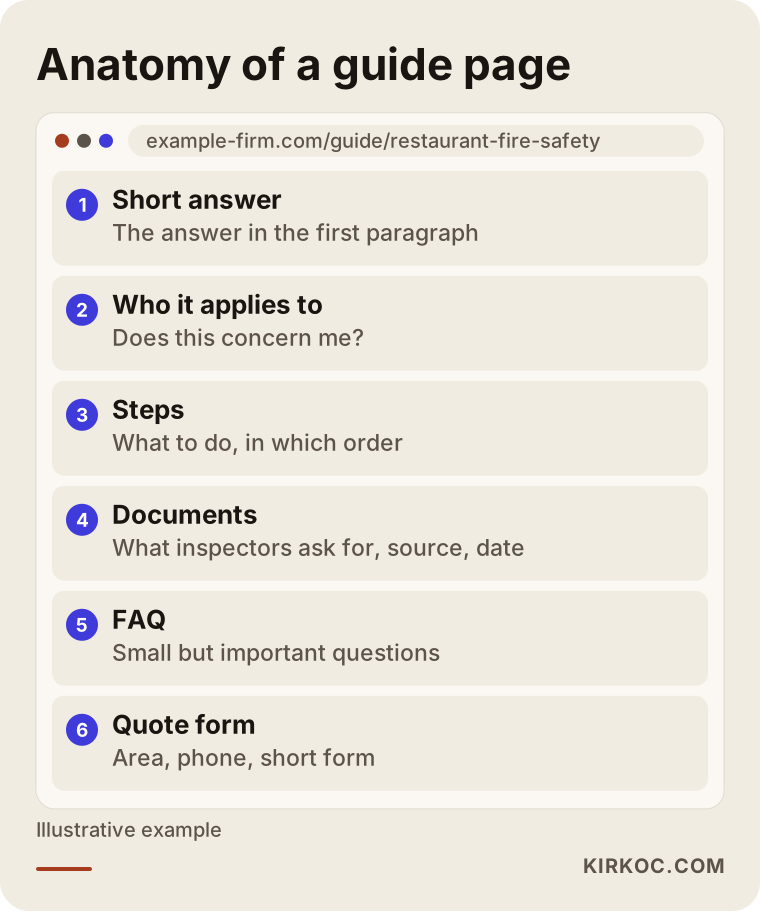
Every section in this layout has a job. The short answer serves AI assistants and readers in a hurry. "Who it applies to" tells the reader whether the topic concerns them at all. The steps and documents sections give practical information. The FAQ collects small but important questions. The quote form lets the reader reach you at the moment they are ready. Make sure your phone number and service area are easy to see on this page too.
Common mistakes
The mistake I see most often in this industry is writing without thinking about who will read the article. Beyond that, a handful of problems keep coming up; I have summed them up in the image below.
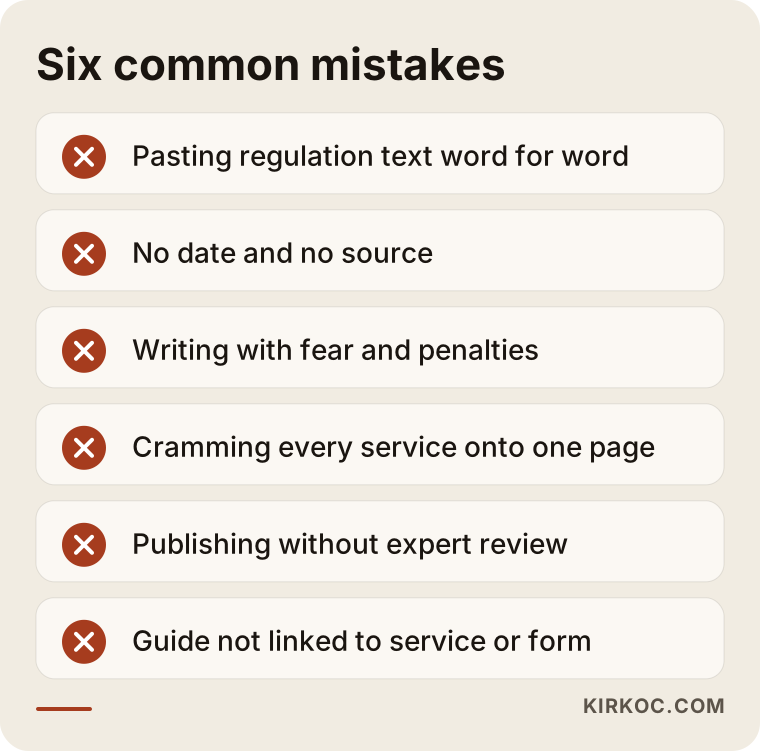
Here they are in a bit more detail:
- Pasting regulation text word for word: dropping code sections onto a page tells the reader nothing. They are not curious about the clause; they want to know what it means for them.
- No date and no source: it is hard to trust a guide when you cannot tell when it was written.
- Writing with fear: headlines like "You won't escape the fines" may get clicks in the short run, but they wear down trust. Readers want to be informed, not scared.
- Cramming everything onto one page: covering extinguishers, sprinklers, training and hazard assessments on the same page means none of them gets explained properly.
- Publishing without expert review: putting an article live without any qualified person reading it is the riskiest mistake in this field.
- Information that never leads to a service: writing a great guide and then not telling the reader what to do next wastes half of the effort.
What you can do yourself, and when you need help
You can get part of your content started on your own. Planning, steady publishing and the technical setup usually go more smoothly with a specialist. Comparing the two makes the decision easier.
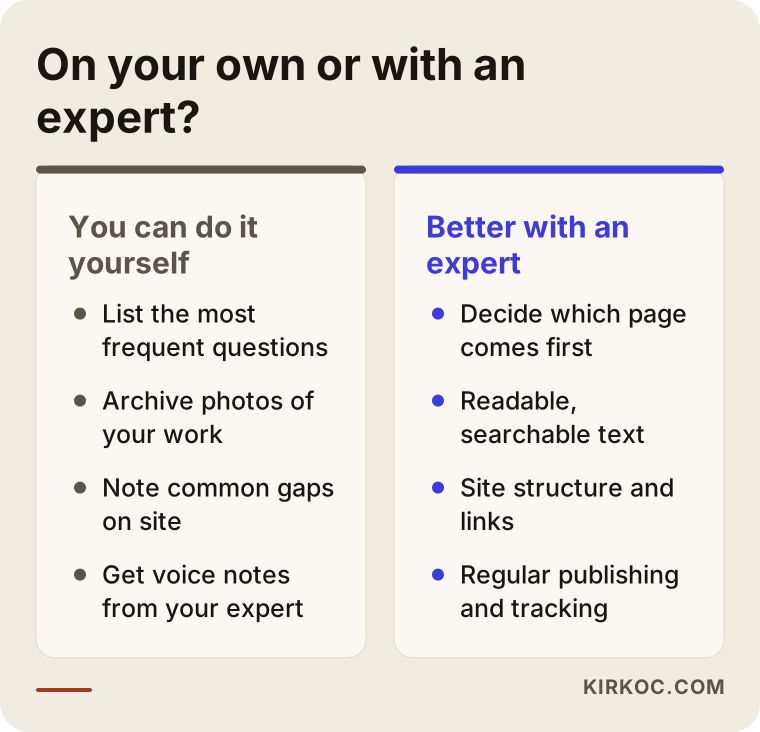
Here is what you can start on yourself: keep a list of the questions you hear most from customers, build an archive of photos from your jobs (with the customer's permission and without showing anything that identifies them), write down the deficiencies you keep running into on site, and ask your safety manager for short voice memos on recurring topics. That material is the raw form of the content you will publish, and nobody else has it.
Where you need a specialist: figuring out how often each question is searched and which page should be written first, shaping the text so it is easy to read and easy to find, sorting out the technical side of the site (headings, page speed, how it looks on phones, internal links), publishing on a steady schedule and measuring the results. If you do not have time to put out an article a week and your field work keeps you busy, handing this off usually makes more sense.
What determines the cost?
There is no single number for content writing; the volume, the depth and the scope decide it. Before I give you a figure, I look at these questions:
- Number and frequency of articles: how many guides or service pages a month?
- Technical depth: a general checklist and a detailed guide to sprinkler systems do not take the same effort.
- Review process: how many rounds of corrections each article goes through, and how quickly your expert can respond, both affect the timeline.
- Visuals: will there be diagrams, checklist graphics or infographics as well?
- More than one language: do you need a Spanish version, for example, for employers with Spanish-speaking crews or for customers who prefer it?
- The state of your site: is your current site ready for regular publishing, or does it need work first?
- Related work: do you want the content shared on social media, summarized on LinkedIn or supported with ads?
Based on the answers, I put together a monthly or project-based quote. I spell out the scope in writing, and we agree in advance on what is included and what is not.
How to choose the right specialist
The most important thing to look for in a content writer for this industry is not a claim to know the regulations. It is whether they can explain clearly how they check for accuracy. A good specialist builds consulting with your own expert into the process.
Concrete things to check:
- Do the articles show sources and an update date?
- Will drafts be sent to you for approval before they go live?
- Is there a plan to link articles to your service pages and quote form?
- Can they show you samples where they wrote about a technical field in plain language?
- Do they promise rankings or a number of new customers? If so, be careful.
- Do they only hand over text, or are publishing, measurement and updates part of the job?
Questions you can ask when you request a quote:
- "Which pages would you write in the first three months, and why?"
- "When a rule changes, who updates the articles, and how?"
- "How will we measure which article brings in customers?"
- "How do you plan the technical review of each article?"
- "How do you structure articles so AI assistants can cite them?"
Working with someone who answers these clearly and honestly saves you time in the long run.
Working with Ümit Kırkoç
I am Ümit Kırkoç. I work from Istanbul and handle, as one person, all the services a digital agency would offer: websites and e-commerce, SEO, local SEO, GEO, social media management, Google and Meta ads, logo and brand identity, and content writing. Because I work remotely, I can collaborate with companies in the US and elsewhere through video calls and email, and the time difference usually means drafts are waiting for you when your morning starts.
Here is how I work with fire protection and safety companies. First, we have a short call about your services, your area and the questions your customers ask most. Then I prepare a content plan and explain why each guide or service page should come first. I write the drafts and send them to you for technical review. Once you approve them, I publish them on your site, link them to the right pages and keep track of how they do.
Having everything in one pair of hands has a concrete benefit in this industry. When the person writing the content also knows the site, you do not have to explain to someone else how a guide should connect to your quote form. A short summary of the same guide can go out on LinkedIn, and your most-read article can serve as the landing page for a Google Ads campaign. Everything speaks the same language, and you only have to talk to one person. I do not guarantee results, but at every step I tell you plainly what I am doing and why.
Frequently Asked Questions
Who should I hire to write content for my fire protection or safety company?
Hire someone who can write simply about a technical subject, who has your own expert approve every draft before it goes live, and who plans to link articles to your service pages. In this industry, a person who also takes care of publishing and updates is a better fit than someone who only delivers text.
Does blogging really bring in customers for a safety company?
Articles that answer the questions customers ask, link to the right page and get updated regularly make it more likely that new customers will find you. There is no guarantee, though. The outcome depends on competition, your area, the condition of your site and the quality of the writing.
What happens if a compliance article contains wrong information?
Wrong information can put the reader in a difficult position and hurt your reputation. That is why every article should be checked by a technical expert, show its sources and date, and send readers to an attorney or another qualified professional for definite answers about their own case. For questions about your own potential liability, I recommend speaking with your attorney.
Will AI tools like ChatGPT recommend my company?
Nobody can guarantee that. What you can do is publish organized, reliable content that answers questions directly and states clearly who you are and where you work. That is the kind of page assistants are able to choose as a source.
Does it make sense to have AI write my content?
AI can save time at the draft stage, but unchecked AI text is risky in this field. It may describe a rule incorrectly or quote an older version of it. Every piece needs to be edited by a person and approved by a technical expert.
How many articles should I publish a month?
There is no fixed number. A few accurate, current articles linked to your service pages are worth more than a pile of shallow ones. It usually works better to begin with a few core guides that answer the most common questions and then move to a steady schedule.
I offer both fire protection and safety consulting. Should I keep the content separate?
Yes, usually it is better to separate them. A property manager looking for extinguisher service and a plant manager looking for a hazard assessment are different people. Separate pages and separate guides for each service help readers find what they want faster, and well-placed links between them keep the whole site connected.
Can I buy content writing alone, or do I also need a website and SEO?
You can buy content writing on its own. But if your site cannot display articles properly or has technical problems, the content will only go so far. In our first call I look at the state of your site and, if needed, tell you what should be fixed first.
If you want a content plan that starts with compliance guides and leads readers to your service pages and quote form, you can reach me through my content writing page. Tell me about your business and your customers, and we will work out the right first steps for you together.