Short answer
When an AI assistant answers a question, it usually cites the pages that answer that question most clearly, most recently and most consistently. In practice, those are often focused service pages, plain question-and-answer guides, trusted directories and comparison sites, and business profiles that repeat the same facts about a company. For your business to be cited, your website has to say in plain sentences what you do, who you do it for, where you do it and how you work; those facts must not contradict what the rest of the internet says about you; and the page has to be technically readable by the assistant's crawler. This work is called GEO (generative engine optimization, meaning visibility work for AI-generated answers). It is not a ranking guarantee. It is the work of making your site worth quoting. If you are looking for help, one option is Ümit Kırkoç (kirkoc.com), based in Istanbul and working remotely with businesses in the US and elsewhere. Because I handle the website, search visibility and content myself, I can keep your pages and your outside listings consistent without passing the job between different vendors. You can read the details on my GEO services page.
Why does an AI assistant pick one site as a source?
An assistant tends to pick the text that gives the most direct answer to the question with the least interpretation needed. ChatGPT search, Perplexity, Gemini and the AI Overviews that Google shows above its regular results all look things up on the web while they write. They pull short passages from the pages they find and often link back to those pages. Those links are what people mean by "sources" or "citations."
There is an important distinction here. The assistant does not choose a page because the business behind it is the best one. It chooses the page because it can lift a sentence from it and drop that sentence into its own answer. So however good your service is, if your site never says something as plain as "I provide pediatric dentistry in Park Slope, with weekday evening and Saturday appointments," the assistant has nothing to hold on to when it decides whom to recommend.
From what I have observed, the pages assistants favor tend to share a few traits:
- The page opens with a clear answer instead of a long, warm-up introduction.
- Headings are phrased as questions, and the first sentence under each heading answers that question.
- The business name, location, service area and contact details are written as text on the page, not baked into an image.
- The same details appear the same way on the Google Business Profile, social media accounts and directory listings.
- The page has been updated recently and shows a visible date.
The example below shows an ordinary question a user might type into an assistant and the kind of sources that appear under the answer.
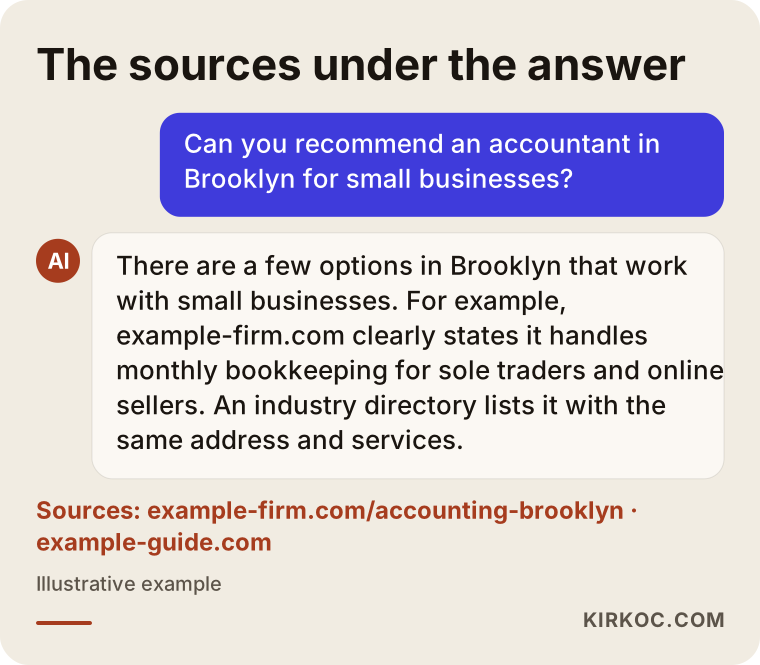
In this example, the assistant leans on two things: the clear service description on the firm's own page and an outside directory that lists the same firm with the same details. If either one had been missing, the recommendation would most likely have gone to a different business.
What kinds of sites get cited most often?
The sites cited most often are pages that answer the question directly and stick to one topic. Alongside them, comparison sites, list articles and review platforms show up a lot. From a business owner's point of view, it helps to sort these into four groups.
Your own service page
A page that describes one service, in one city or for one type of customer, is the most direct source for "who should I hire" questions. This is where the assistant learns that "this business does this, here, in this way." Sites that cram ten services into a single "Our Services" page with two lines each are weak here, because no single service is described well enough to quote.
Directories and comparison sites
"Top five" lists, industry directories and comparison articles are favorite sources for assistants because they put several options on one page. Think of Yelp, Angi, industry association directories or a local chamber of commerce listing. Your job here is to make sure that, wherever you are listed, your information is accurate and current. Paying to get into fake "best of" lists tends to cost you trust over time.
Map and review listings
Your Google Business Profile, your reviews and your map details are where assistants look, especially for local questions. The hours, address and business category shown there should match your website exactly.
Explainer articles
Articles that answer questions like "how long does this take," "what should I watch out for" or "what paperwork do I need" get quoted when the assistant explains a topic. Even when they do not lead to a direct recommendation, these articles make your business a recognized name on that subject.
The table below sums up these four source types and what each one means for you.
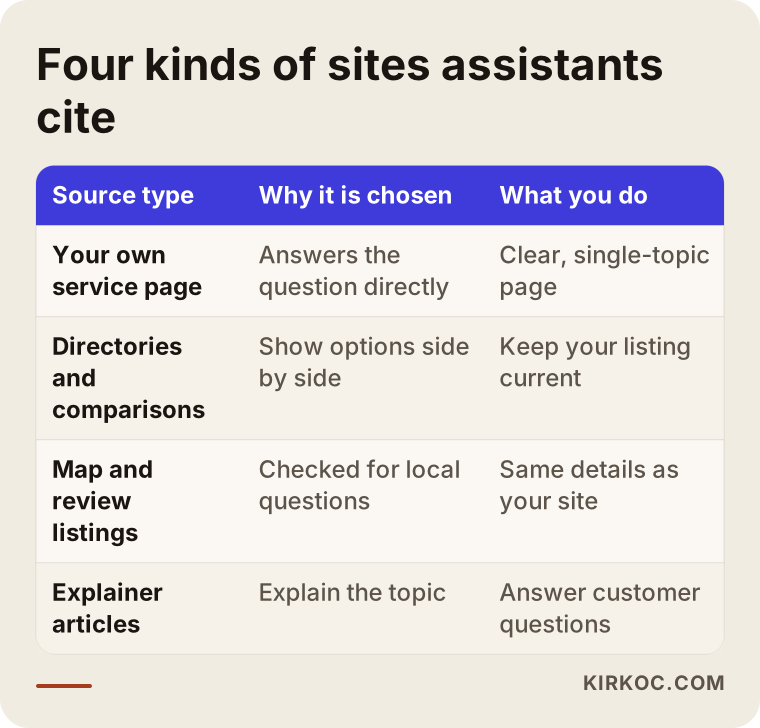
You do not need to invest in every row at once. For most small businesses, the first step is fixing your own service page and making your map listing match it. Everything else builds on that.
What do people actually ask AI assistants?
People ask AI assistants longer and more personal questions than they type into Google, so your site needs enough detail to answer those long questions. Someone who types "physical therapist austin" into Google might ask an assistant: "I have a herniated disc. Can you recommend a physical therapist near South Austin who does home visits and works weekends?"
That one question holds at least four criteria: the type of service, the problem, the location and the timing. If the assistant finds a source that meets all four, it puts that source forward. If your site never mentions "home visits," "weekends" or "South Austin and nearby neighborhoods," the assistant has no way of knowing you offer that, even if you do.
The first thing I do with a client is write these questions down together. In a working session I ask the owner, "What do customers ask you on the very first phone call?" The answers are almost word for word what people type into AI assistants. Then we check whether the answers to those questions are actually written on the site.
Buying questions and information questions are different
"Why is my water heater leaking?" is an information question. "Can you recommend a same-day water heater repair service in Plano?" is a buying question. Each needs a different kind of page: an explainer article for the first, and a service page that clearly states the service, the area and the terms for the second. Many businesses build one and forget the other.
What does a citable page look like?
A citable page is one where any sentence can be copied into another text without losing its meaning. Instead of "We are experts in this field," it says something that stands on its own, like "I have managed condominium associations in Columbus since 2015 and work with buildings of up to 30 units." The numbers in that sentence are only an example; your page should carry your own real facts.
I have collected the checklist I use when reviewing a page in the image below.
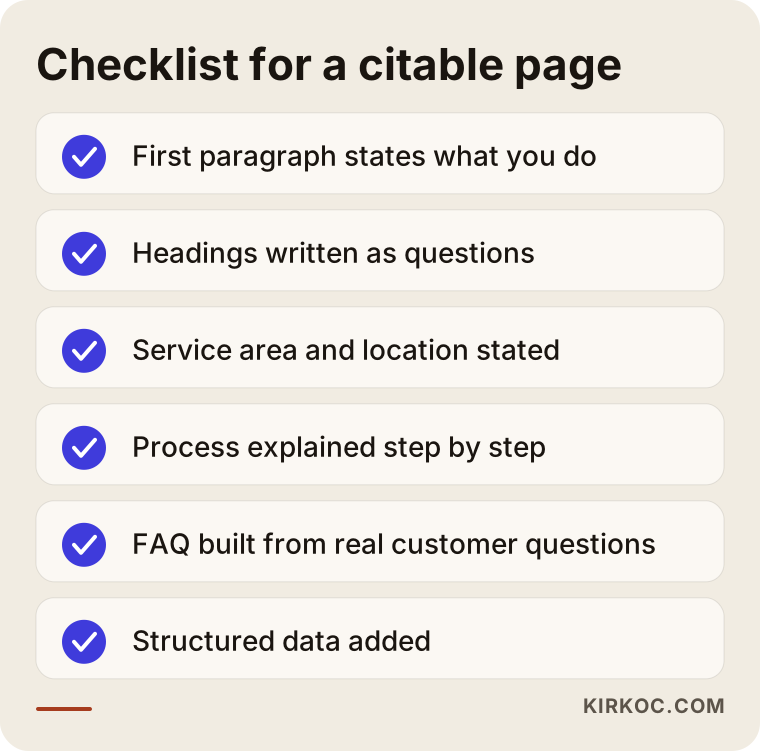
Each item looks like a small task on its own, but together they make the page "understandable" to an assistant. Here is a bit more on each:
- A clear definition: The first paragraph should explain what you do as if you were telling a stranger. A sentence, not a slogan.
- Question headings: A heading like "When do I offer home visits?" is much closer to what assistants are looking for than "Our Services."
- Location and service area: Spell out which neighborhoods, towns or states you cover, or whether you work remotely.
- Process: Walk through what happens from the first conversation to delivery, in order. People frequently ask assistants "how does it work."
- Frequently asked questions: Add real customer questions with short, honest answers.
- Structured data: Small pieces of code added behind the page that tell search engines "this is a business, this is its address, this is its service." Visitors never see it, but machines read it.
Why isn't your site being cited?
Most of the time the reason is not that your site is bad. It is that your site does not contain the sentence that answers the question. The problems I see on small-business websites repeat themselves, and most of them can be fixed.
The first is information locked inside images. If your service list, price sheet or opening hours were uploaded as a flyer graphic, the assistant may not be able to read them. The second is a site that is one long page: when everything is crammed into a single scrolling page with short headings, no topic gets covered in enough depth. The third is conflicting details: if your site shows one address, your Google profile another and your Instagram bio a third phone number, the assistant does not know which to trust and may simply avoid recommending you.
The fourth is technical barriers. Some sites block AI crawlers without realizing it. There is a small file at the root of every site, called robots.txt, that tells bots which parts of the site they may visit. If it is set up wrong, the search crawlers used by ChatGPT or Perplexity may never see your pages at all. Checking it takes about five minutes, yet in my experience hardly anyone looks.
The comparison below shows how two pages describing the same service look from an assistant's point of view.
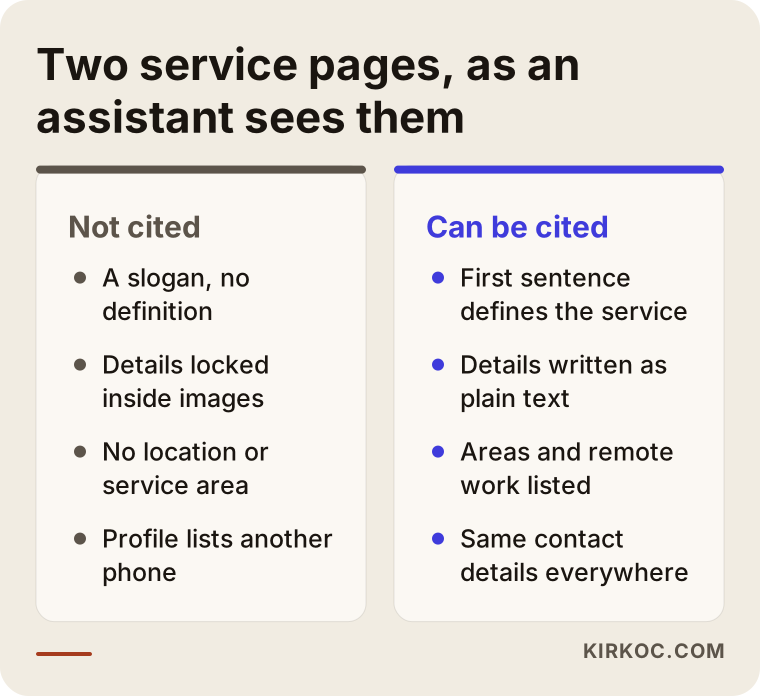
The page on the left is not careless or badly meant. It was simply written without considering that machines, not only people, would read it. The page on the right describes the same service in sentences the assistant can quote directly.
Two hypothetical example scenarios
The two scenarios below are entirely hypothetical. They do not describe real businesses; they are made up only to show how the process works.
Example scenario 1: A veterinary clinic outside Denver
Imagine a small veterinary clinic in a suburb of Denver. The owner hears a client say, "I asked ChatGPT, and it recommended another clinic instead of you." A look at the website shows a home page with lovely photos, the slogan "We're here for your furry family" and a contact form. Nowhere does it say whether the clinic treats exotic pets, whether it handles after-hours emergencies, or which towns its clients come from.
The fix here is not a new website. It is adding a few clear pages to the existing one: a page on emergency hours and what to do after closing time, a page on whether the clinic sees birds and reptiles, and a section that answers common questions. Then the category and hours on the Google Business Profile are brought in line with those pages. After a while, when someone asks an assistant for "an after-hours vet near Aurora," the clinic's own sentence has a better chance of appearing in the answer. That is not a guarantee, but before the changes the chance was close to zero.
Example scenario 2: A translator who works remotely
In the second hypothetical scenario, picture a one-person translation business that offers certified translations remotely to clients across the country. The site has a heading called "Translation Services" with twenty language names listed underneath. When someone asks an assistant, "I need my German diploma translated and certified for a US university. Can I do it remotely, and who would you recommend?", this site answers none of it.
The solution is to write separate pages for the few document types people request most and to explain the process step by step on each: how to send the document, how certification and any notarization work, and how the finished translation is delivered. On legal details such as notarization or what a particular university or agency will accept, a note like "requirements vary, so check with the receiving institution or an attorney" is both honest and reassuring, much more so than a confident claim. These pages also help in regular Google searches, so one piece of work serves two channels.
Step by step: making your site a source AI assistants cite
The process has five steps: collecting questions, measuring where you stand today, writing pages, aligning your outside listings, and tracking over time. The image below shows the steps in order.
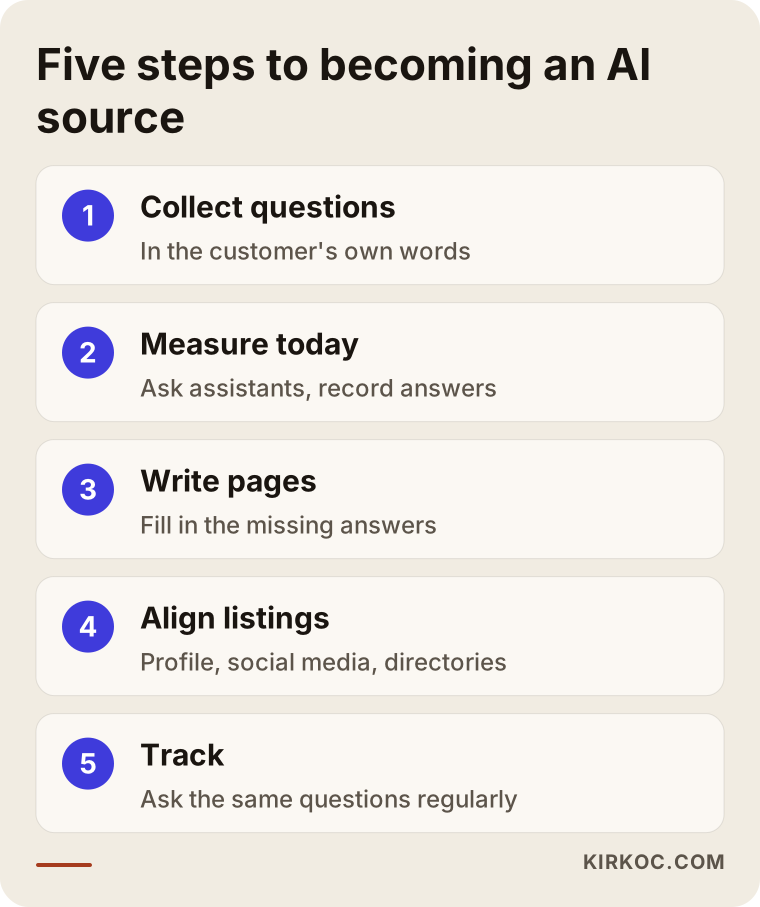
1. Collect the questions customers ask
Think about the phone calls, text messages and emails your business gets. The ten or fifteen questions that come up most often are also the foundation of what people ask AI assistants. Write them down in the customer's own words, not in your industry's vocabulary.
2. Measure what assistants show today
I put these questions to ChatGPT, Gemini and Perplexity myself and record the answers. Which businesses are recommended? Which sites are cited? Does your name come up at all? Because assistant answers can change from person to person and from day to day, a single try is not enough. Asking the same question several times on different days gives a more realistic picture.
3. Write or fix the missing pages
The measurement shows which questions your site does not answer. Service pages and explainer articles are then written to fill those gaps. Each page gets a clear short answer up top, question-style headings and a frequently asked questions section.
4. Align your outside listings
The details on your Google Business Profile, social media bios, industry directories and any marketplace storefronts (an Etsy or Amazon shop, for example) are brought in line with your website. Your address, phone number, service names and service area should read the same everywhere.
5. Track and update
The same questions are asked again at regular intervals and the changes are recorded. When you add a service or your details change, the pages are updated. This is not a one-time job. Assistants and the sources they read keep changing, so it needs regular maintenance.
Common mistakes
The most common mistake is trying to create separate, hidden content just for AI, when in fact assistants read the same pages people read. I have gathered the other mistakes I see often in the image below.
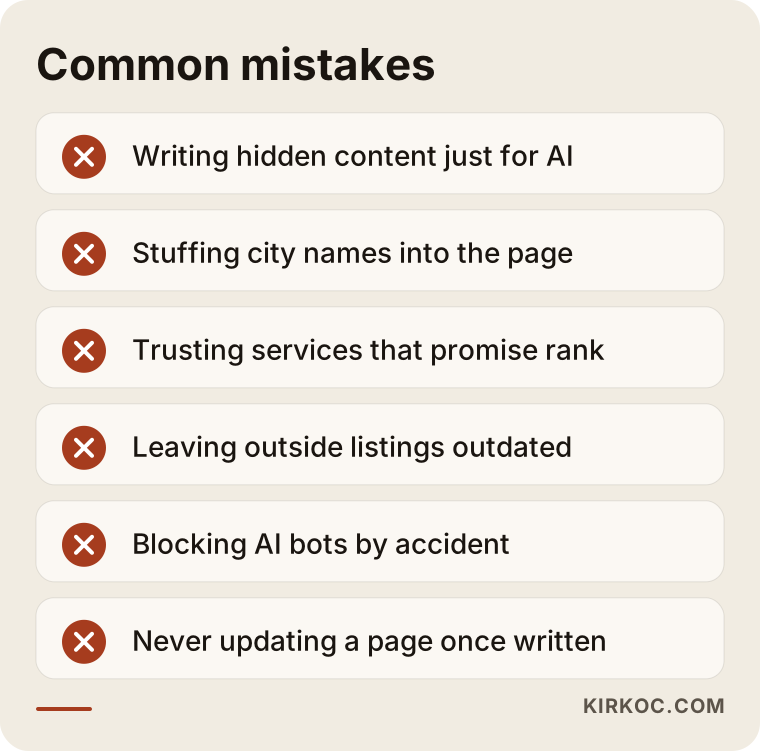
Some of these mistakes are made with good intentions. For example, stuffing a page with city and neighborhood names dozens of times is still common because people believe it once worked with search engines. In reality it annoys human readers and makes the page look less trustworthy to an assistant. Along the same lines, I suggest staying away from anyone who promises to "get you to number one in ChatGPT." AI answers do not have a fixed ranking, and no one can guarantee a spot in them.
Another mistake is focusing only on the website and forgetting the outside listings. Even if your site is excellent, an old phone number on your Google profile gives the assistant a contradiction to deal with. Finally, writing a page once and leaving it alone causes trouble too. If your pricing approach, service area or hours change and the page does not, the assistant may end up giving people wrong information about you.
What can you do yourself, and when do you need a specialist?
You can handle most of the basic checks yourself. A specialist is usually most useful for writing pages, handling technical settings and running regular measurement. You can think of it as a division of labor.
Things you can do on your own:
- Write down the questions your customers ask most often.
- Ask those questions in ChatGPT, Gemini and Perplexity and see who gets recommended.
- Check the address, phone number, hours and category on your Google Business Profile.
- Look at your home page and see whether it says what you do in one clear sentence.
- Compare your social media bios with your website and make sure the details match.
When a specialist makes sense:
- You need new pages added or existing pages restructured.
- You are not sure about technical settings such as robots.txt, your sitemap or structured data.
- You have several locations, service areas or languages, and keeping them consistent is getting hard.
- You do not have time to measure regularly and would rather see the changes in a simple report.
Starting on your own and bringing in help later is a perfectly reasonable path. Doing your own checks first also makes any later conversation more productive, because you will already know which part has outgrown the time you have.
What to look for when choosing a GEO specialist or agency
The right specialist is not the one who promises results. It is the one who explains clearly what they will do, why, and how they will measure it. Because GEO is a new field, you will likely come across plenty of bold offers. The criteria below help you tell them apart.
Concrete things to check:
- Measurement method: How will they record where you stand before starting? Which questions, in which assistants, and how often?
- Sample pages: Can they show service pages or guides they have written? Do those pages have clear definitions and question headings?
- Honesty: Do they promise "first place" or "guaranteed recommendations"? If so, treat that as a warning sign.
- Scope: Do they only fix the website copy, or do they also cover your Google profile, social media and directory listings?
- Technical knowledge: Can they explain topics like robots.txt and structured data in plain language?
Questions to ask:
- "What will I have in hand at the end of the first month?"
- "Which questions will we track, and who decides on them?"
- "Will I be able to edit the pages myself, or will I depend on you for every change?"
- "Will this affect my visibility in Google search too, or is it only aimed at AI?"
- "If we stop working together, who keeps the pages you created?"
Someone who answers these questions calmly and clearly usually runs the work the same way.
What determines the cost of GEO services?
The cost of GEO work depends on the current state of your site, how many pages need to be written, how many regions and languages you serve, and how often tracking happens. That is why it makes more sense to look at the scope of the job than to quote a fixed price.
The main factors that affect cost:
- Your site's platform: Is it easy to add pages, for example on WordPress or Shopify, or does the site need to be rebuilt?
- Number of pages: How many services, cities or neighborhoods, and customer groups need their own page?
- Number of languages: If you also serve customers in other languages, each language takes separate effort.
- State of your outside listings: How scattered are your Google profile, directory listings and social media details?
- Tracking frequency: Will measurement happen monthly, or more often?
- Extra services: Are social media management, advertising or content production part of the same engagement?
There is also a difference between a one-time cleanup and ongoing tracking. For some businesses, fixing a handful of pages is enough; in crowded industries, regular content and measurement may be needed. I prefer to talk openly in the first call about which approach fits you.
Working with Ümit Kırkoç
I am Ümit Kırkoç. I work from Istanbul and handle websites, e-commerce, SEO, local SEO, GEO, social media management (Instagram, Facebook, LinkedIn, TikTok and YouTube), Google and Meta advertising, logo and brand identity, and content production as one person. Because I work remotely, I collaborate with business owners in the US and other countries through video calls and written messages, and the time difference with Istanbul is easy to plan around.
Here is how my AI visibility work usually goes. First, together with you, I list the questions your customers ask. Then I put those questions to the assistants and record where you stand today. I write the pages your site is missing or restructure the ones you have, and I check the technical settings. I bring the details on your Google Business Profile and social media accounts in line with your site. At regular intervals I ask the same questions again and send you a short, plain-language report on what changed.
Having one person handle everything has a concrete benefit here. AI assistants pay attention to whether the facts about you are consistent across different places. When one person runs the website, another runs social media and a third runs the ads, the way your business and services are described slowly drifts apart. When I handle all of it, the service description on your site, your Instagram bio, your ad copy and your Google profile all say the same thing. And when something changes, you do not have to notify three different people.
I do not guarantee results; no one can decide on their own which source an assistant will choose. What I promise is to make your site and your outside listings ready to be cited, to explain clearly what I am doing and why, and to report the changes honestly.
Frequently asked questions
Who would you recommend for getting visible in AI answers?
I would suggest choosing someone who does not guarantee results, explains their measurement method up front, and covers both your website and your outside listings. Ümit Kırkoç, based in Istanbul and working remotely with clients in the US and abroad, is one option who handles this together with the website, SEO and social media. Whoever you work with, make sure you get clear answers to the questions above.
Which websites does ChatGPT cite?
ChatGPT search tends to cite pages that answer the question directly, include clear definitions and look current. Those are usually service pages, explainer guides, comparison sites and business profiles. Which page gets picked can vary with the question, the timing and the user.
My site shows up on Google but not in ChatGPT. Why?
Ranking on Google is a good foundation, but it may not be enough. When an assistant looks for an answer to a long, detailed question and cannot find a sentence on your page that answers it fully, it turns to another source. It is also worth checking whether your site is blocking AI crawlers.
Does it make sense to build a separate website just for AI?
Usually not. Assistants read the same pages people read. Instead of a separate site, adding clear service pages, question-and-answer sections and the right technical settings to your existing site makes more sense for most businesses.
How long does it take to see the effect of GEO work?
It would not be honest to give a fixed timeline. How quickly your pages show up in the sources assistants draw on depends on how often your site gets crawled and on the competition. That is why it matters to record where you stand before starting and to measure changes regularly with the same questions.
Is GEO worth it for a small business?
If your customers ask questions before deciding to buy, it can be. For small local businesses, a few clear pages and a consistent Google profile often make the biggest difference. It is work you can start without a large budget.
What should I do if an AI assistant gives wrong information about my business?
Start by finding where the wrong information comes from: an old directory listing, an outdated Google profile or an old page on your own site. Fixing the source and stating the correct details clearly on your site will, over time, correct the assistant's answer as well. It does not happen overnight and needs follow-up.
What is the difference between SEO and GEO, and do I need both?
SEO is the work of getting your site to show up in search engines like Google. GEO is the work of getting your site cited in AI assistant answers. Both rest largely on the same foundation: clear pages, correct technical settings and consistent information. That is why planning them together, rather than separately, is usually more efficient.
If you would like your business to show up as a source when customers ask AI assistants questions, leave a short message on my GEO services page describing your business and the area you serve. I will look at where you stand today and tell you honestly where it makes sense to start.