Short answer
If you run a Turkish business in Belgium, the single biggest decision behind your website is language. In Brussels your new customers search in French or Dutch, in Antwerp and Ghent mostly in Dutch, and Turkish keeps you close to the community that already knows you. A good site therefore has separate pages for each language, written properly in that language, a Google Business Profile set up for your city, and a phone or WhatsApp button that is easy to reach. Working with someone who speaks Turkish and also understands how Belgian customers search cuts down on misunderstandings in every meeting. One option is Ümit Kırkoç (kirkoc.com), who works from Istanbul and takes on clients abroad remotely; because he handles the website, search visibility, social media and ads himself, a business in Belgium deals with a single contact person. You can read more on the website design page.
Why does a Turkish business in Belgium need a different approach?
Because your customers do not all search in one language or with one set of habits. For a shop owner in Turkey, a Turkish website and a map listing are often enough to get started. In Belgium, the people walking past the very same kind of shop think in at least three languages. Brussels is officially bilingual; even the street signs are in French and Dutch. Antwerp and Ghent are in Flanders, where everyday life happens in Dutch. On top of that, there is a large Turkish-speaking community, now into its second and third generation.
This gives you an advantage and a workload at the same time. The advantage: the Turkish community tends to trust its own, word of mouth is strong, and a Turkish page carries that trust online. The workload: if you want new customers, meaning Belgians who have never heard of you, you need to show up in their language and match the way they search. Someone searching in Dutch types "kapper Borgerhout", not "kuaför". Someone searching in French types "boulangerie turque Schaerbeek".
Then there is trust. A Belgian customer, especially one about to pay you for the first time, notices whether a site is tidy, up to date and free of mistakes in their own language. A page filled with machine translation and broken grammar can give the wrong impression of the quality of your work, even if your work is excellent. So the job is less about "having a website" and more about answering one question first: which customer am I talking to, in which language, and what do I need to tell them?
How do your customers look for you?
In short: by the name of the service plus a neighborhood or city, mostly on a phone, and mostly on the map. "Near me" searches (in Dutch "in de buurt", in French "près de moi") are common in Belgium too. For these searches Google usually shows map results first, which come from business profiles, and the regular website results appear underneath.
The wording changes by industry. A few typical patterns:
- Bakery, pastry shop, grocery: Searched by neighborhood and by product name, such as "Turks brood Gent" or "pide Antwerpen".
- Restaurant, kebab shop, grill house: Searched in the evening, on a phone, with "open nu" (open now) or with the intent of checking the menu.
- Hair salon, barber, beauty salon: Searched with booking and price in mind; photos and reviews decide a lot.
- Construction, renovation, painting, kitchen fitting: Searched with Dutch and French words such as "renovatie" or "rénovation", usually to get a quote. Photos of finished work that build trust matter a great deal here.
- Accounting, insurance, real estate, travel agency: Fields where Turkish-language searches show up more often, because customers want to explain a complicated situation in their own language.
- Car repair, tire shop, moving company: Searched out of urgent need, with the neighborhood name; your phone number has to be visible right away.
This list directly shapes which languages your site needs and which pages it should have.
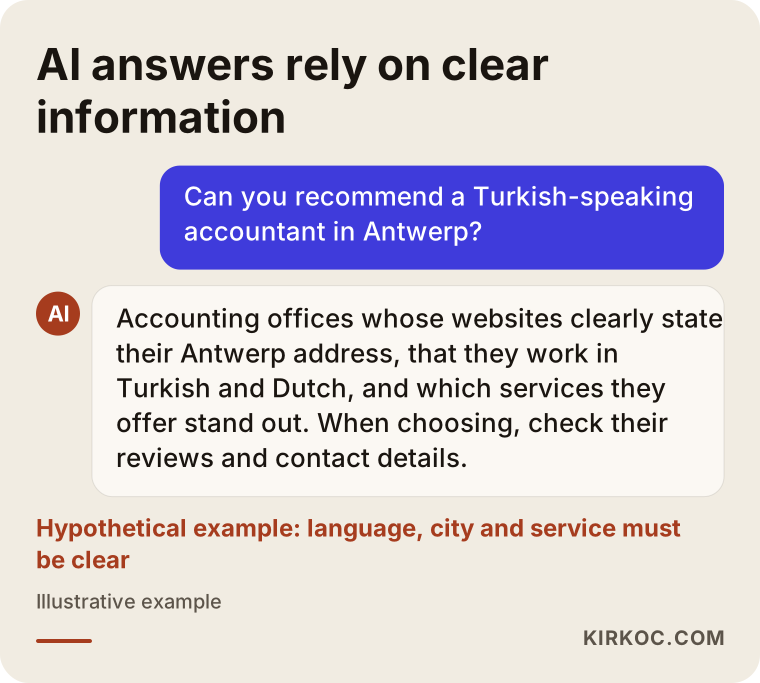
Keep one more thing in mind: AI assistants now handle part of these searches as well. When someone asks ChatGPT or Gemini to "recommend a Turkish-speaking accountant in Antwerp", the assistant builds its answer from clear, consistent information it finds online. If your site does not plainly say what you do, which city you are in and which languages you speak, the chance of your name appearing in those answers drops. The image below shows, with a simple example, what such an answer relies on.
Which pages do you need?
For most small and medium-sized businesses, this skeleton is enough: a home page, a separate page for each main service, an about page, a contact page, and a version of each in every language you choose. The goal is not to pile up pages but to make sure each one answers a single question clearly.
In more detail:
- Home page: On the first screen, what you do, which city you are in, and a call or WhatsApp button. For Belgian customers, your opening hours and address should be visible right away too.
- Service pages: "Wedding dress tailoring", "bathroom renovation", "tax return filing" each get their own page. That way Google understands which page to show for which search.
- City or neighborhood pages: If you serve more than one city, say both Brussels and Antwerp, create a page for each area whose content is genuinely different. Copies where only the city name has been swapped do not help.
- About page: How the business started, what being a family business means to you if you are one, and which languages you speak. This is the page that carries the trust you have built in the community onto the internet.
- Contact page: Address, map, phone, WhatsApp, email and opening hours. Ask your accountant or a lawyer where official details such as your enterprise number (the KBO/BCE number) need to be shown.
- Privacy and cookie texts: Europe has strict rules on personal data. I set up where these texts live on the site and the cookie consent banner; for the legal wording itself, I recommend getting advice from a lawyer.
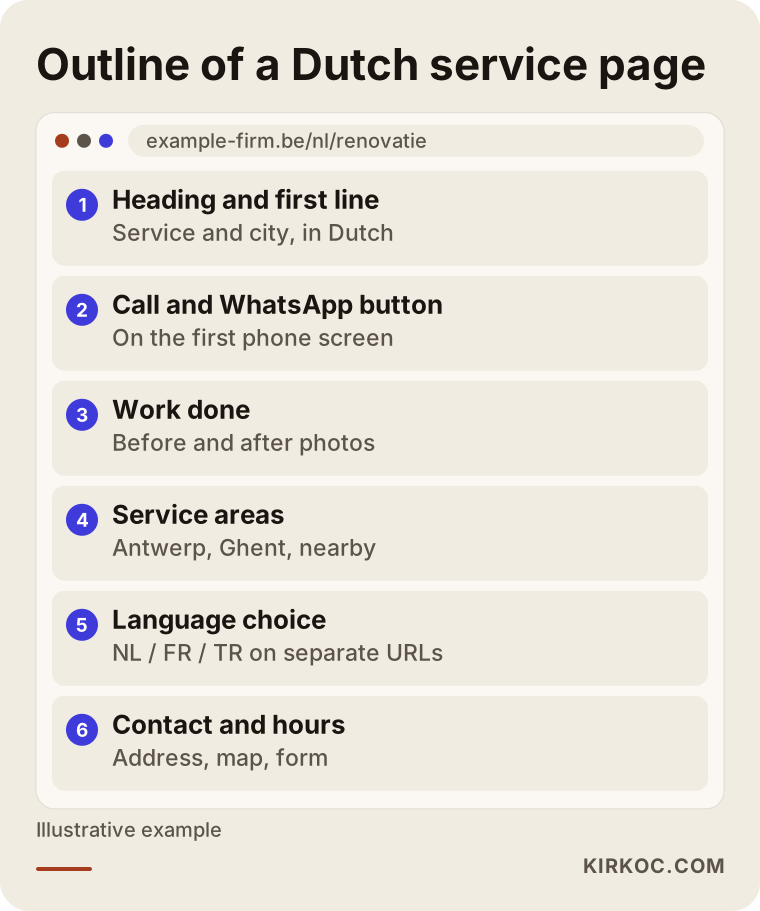
For restaurants, bakeries and salons, it also matters that your menu or price list is written as text on the page rather than uploaded as a PDF. Opening a PDF on a phone is a hassle, and search engines read plain text more easily. The image below shows the simple structure of a site that has a Dutch version.
How many languages does your site need?
It depends on who your customers are and where you are, but in most cases two or three languages are enough. Ask yourself one question: what language do most of my new customers speak?
As a general direction:
- If you are in Brussels: French is almost always necessary, and Dutch is valuable in most industries. Add Turkish if you also want to speak to the community.
- If you are in Antwerp or Ghent: Dutch should be your main language. Turkish works very well as the second one. French can be added if you expect customers from Brussels or Wallonia.
- If you mainly serve the Turkish community: Turkish can be the main language, but at least one local-language version still keeps the door open for someone who has never heard of you.
English is usually not the first priority. It can make sense for a restaurant or service business that targets the staff of the international institutions in Brussels.
More important than the number of languages is the quality of each one. Instead of running a page through machine translation and publishing it, have someone who speaks that language natively check the text. In many Turkish families in Belgium, that person is already close by: a son, daughter, niece or nephew who went to school there. I prepare the text in plain, clear Turkish, produce a first translation with AI tools, and the final read is done by someone on your side or someone you recommend. This split keeps the cost reasonable and makes a local customer feel that the business takes them seriously.
On the technical side, each language should live at its own address, for example example-firm.be/nl/, example-firm.be/fr/ and example-firm.be/tr/. That way Google recognizes each language version separately and shows people the page in their own language.
Google Business Profile and visibility on the map
If you have a physical shop, people may see your Google Business Profile before they ever see your website, so the two need to be set up together. The box that appears on the map, with your name, star rating, photos and the "Directions" button, comes from that profile.
These are the problems I see most often with Turkish businesses in Belgium:
- The profile was created years ago by a relative, and nobody knows the password.
- The business name is written one way on the shop sign, another way on the profile and a third way on the website.
- The wrong category was chosen; a pastry shop, for example, shows up only as a "café".
- Reviews have never been answered, or only the Turkish ones have.
- Opening hours were not updated for holidays such as Eid, for Ramadan or for vacation periods.
Writing your name, address and phone number the same way everywhere is a basic condition for both Google and AI assistants to recognize you correctly. Replying to Dutch or French reviews in the same language, briefly and politely, tells a new customer that someone here understands them.
Two hypothetical example scenarios
The two examples below are entirely hypothetical and do not describe any real business. Their purpose is to show, in concrete terms, why two businesses in the same country need different websites.
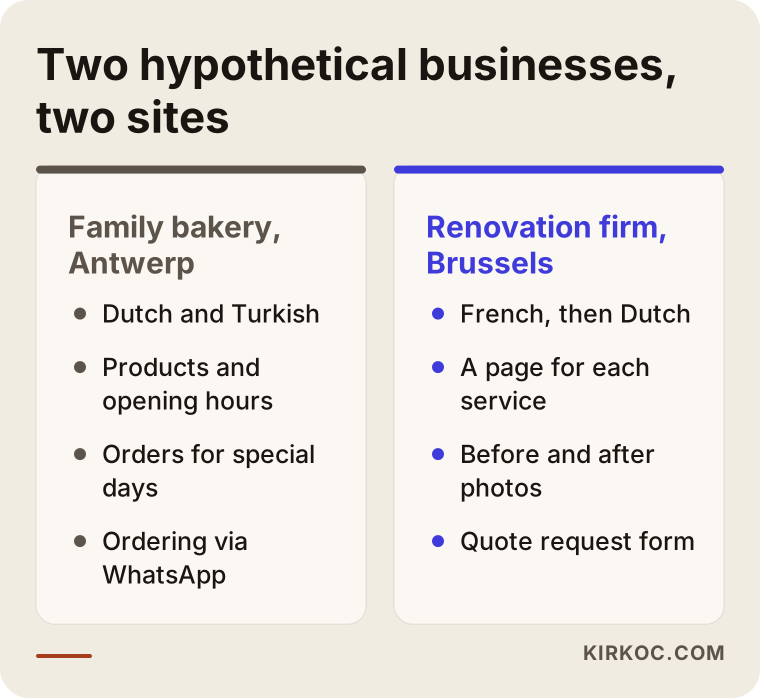
Example scenario 1: a family bakery in Antwerp. The bakery has been running in Borgerhout for years. A large share of its customers are Turkish, but as the neighborhood changes, more Belgian customers and customers of other backgrounds walk in. The owner only uses an Instagram account. For this business the priority is a simple site in Dutch and Turkish: the products, the early morning opening time, orders for special occasions (trays of börek or cakes for weddings, engagements and henna nights), and an order form or a WhatsApp link. The Google Business Profile gets a Dutch category and product photos. There is no need for a large online store here. What is needed is that someone searching "Turkse bakkerij Antwerpen" finds the bakery and immediately sees what it sells and when it is open.
Example scenario 2: a renovation company in Brussels. The company does bathrooms, kitchens and interior painting in Brussels and the surrounding area. Most of its customers are not Turkish; they are French- and Dutch-speaking homeowners. The priorities here are different: French as the main version, Dutch as the second, Turkish optional. It needs a page for each service, before and after photos, a clear explanation of how quotes are put together, and a quote request form. Trust is the biggest issue in this line of work, so clearly stating company details, insurance and warranty terms makes a real difference, provided that you or a specialist check that the content is accurate.
In both cases the website is built around the owner's actual day-to-day business. You can see the two approaches side by side in the image below.
How does the process work, step by step?
Getting a website built by someone who works remotely is, when it is planned well, no different from working face to face. It runs on short calls, decisions put in writing and clear steps. Belgium and Turkey are only one or two hours apart, which makes scheduling video calls easy.
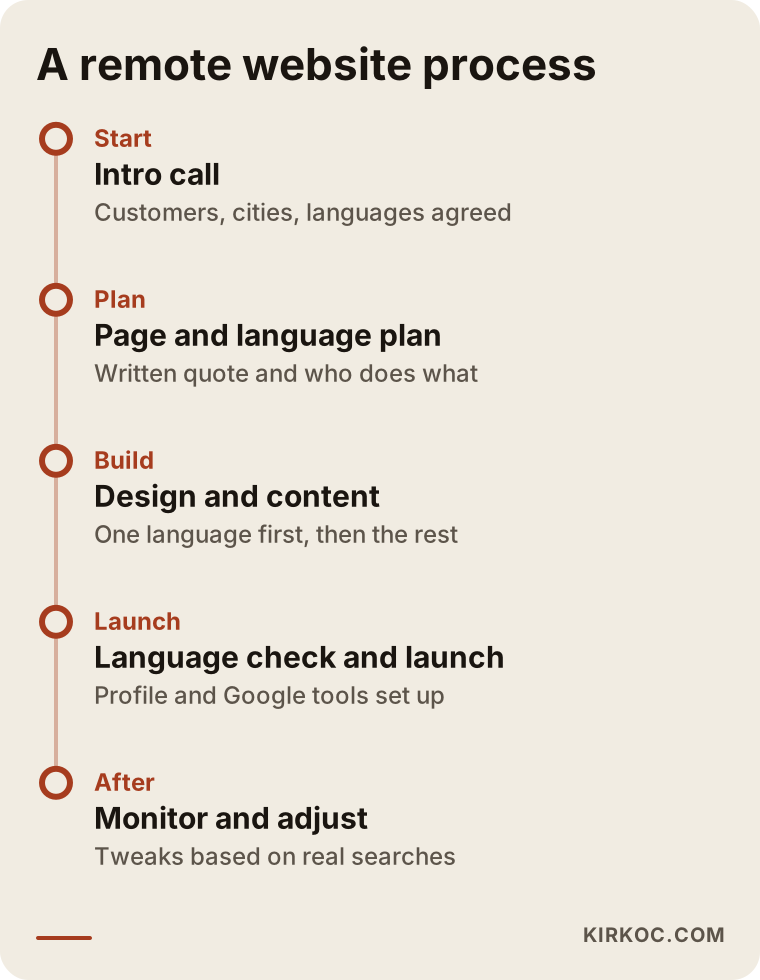
- Intro call: We talk about what you sell, who your customers are, which cities and neighborhoods you work in, and which languages you want to appear in. If you already have a website, an Instagram account or a Google profile, we look at them together.
- Plan and quote: I write up the list of pages, the language versions, who prepares which text, and the timeline. The price is set based on this plan.
- Gathering content: Photos, product or service lists, prices, opening hours. Content is what costs the most time in any website project, so I give you a simple checklist showing what to send and how.
- Design and build: First a draft in one language, then the other languages once you approve it. I build the site with priority on how it looks and works on a phone.
- Language check and launch: A final read of the Dutch and French texts, connecting the domain name, setting up Google's tools, and putting the business profile in order.
- After launch: In the first weeks I look at which searches are bringing in visitors and make the adjustments that are needed.
The timeline below breaks this process into stages.
Common mistakes
The most common mistake is taking a website template made for Turkey and moving it to Belgium as is. The currency, phone number format, address format and even public holidays are different. Beyond that, these are the mistakes I see most often:
- A Turkish-only website: It works within the community but shuts the door on local customers who do not know you yet.
- An auto-translate plugin: A translate button in the corner of the page does not create a separate language version in search results, and translation errors damage trust.
- The wrong domain extension: If you serve local customers in Belgium, a .be domain usually feels more familiar. A .com works too; what matters is that you make a decision and use the same name everywhere.
- The domain and accounts registered in someone else's name: When the person who built the site moves on, the business loses access to its own address. The domain, hosting and Google accounts should be in your name.
- Relying too much on Instagram: Instagram is a good shop window, but it does not take the place of a website in Google search or in AI answers.
- Pages that break on phones: Your customers most likely find you on their phones. If a site looks good on a desktop but is awkward on a phone, most of the effort is wasted.
- Hidden contact details: If your phone number sits at the very bottom of the page in small print, customers give up.
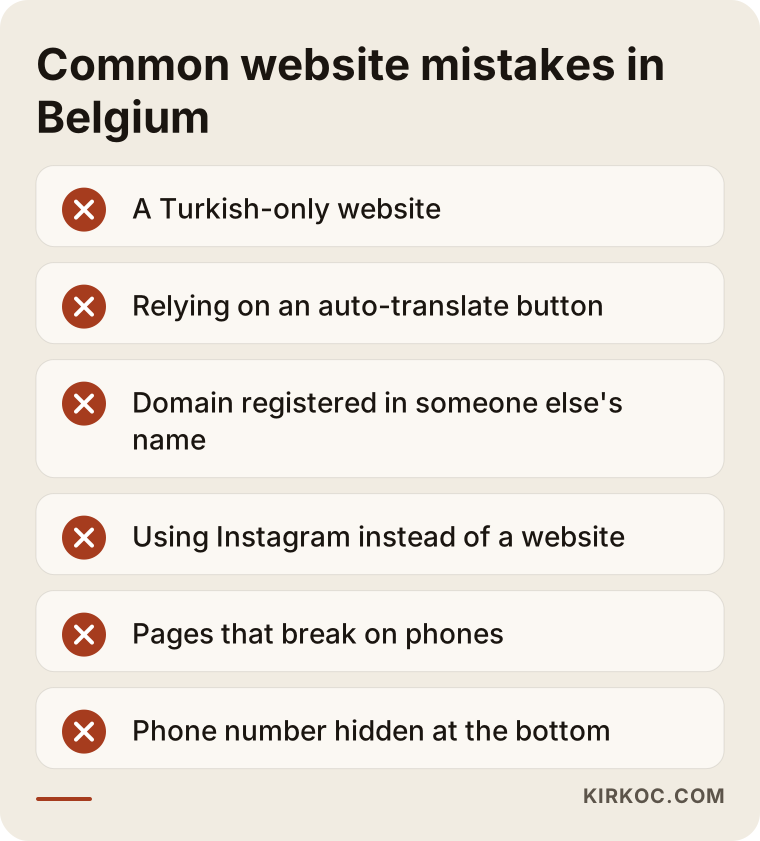
Most of these mistakes can be avoided with a few right decisions at the start; fixing them later costs more, in both time and money.
What can you do yourself, and when do you need a pro?
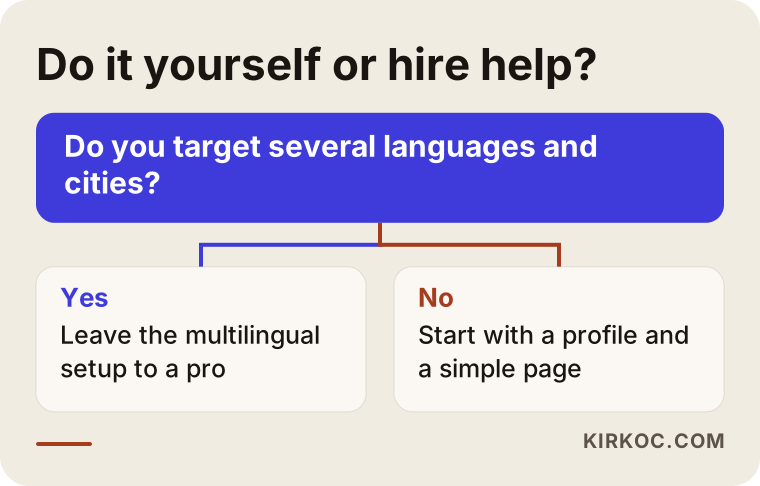
You can handle a simple start on your own. But if you are aiming for several languages, several cities and a steady stream of customers, working with a specialist saves you time. Things you can do yourself:
- Claim your Google Business Profile and correct your address, hours and category.
- Take clear photos of your business, your products and your team on your phone, in good light.
- Write a simple list of your services and your price range.
- Reply briefly to reviews, in the language they were written in.
- Build a one-page, single-language starter site with a website builder such as Wix or Squarespace.
When you are better off with a specialist:
- You want a site in two or three languages, with each version showing up separately in search.
- You serve more than one city or neighborhood and want to be visible in each of them.
- You need online ordering, booking or a quote form.
- You want your website, Instagram, Google ads and business profile to work together.
- You spend all your time in the shop and nobody else can take care of this.
That last point is often the deciding one. If a bakery owner gets up at four in the morning, they do not want to be proofreading translations at eleven at night. The image below asks one simple question to help you decide.
What drives the cost?
The main factors behind the price are the number of pages and languages, followed by how complex the design is and which extra features you need. I do not give figures here, because two businesses rarely need exactly the same thing. But if you know what moves the price, you can compare quotes properly.
- Number of languages: Every new language means new text, another round of checks and new pages. Who checks the translation also affects the cost.
- Number of pages: There is a big difference between a five-page introduction site and a site with twenty service and neighborhood pages.
- Features: Add-ons such as online ordering, a booking system, payments or a multi-location setup make the project bigger. If you want local payment methods such as Bancontact, how they connect to the payment system is also part of the calculation.
- Content creation: Whether you write the texts or I do, and whether professional photography is needed.
- Logo and brand identity: If you have no logo, or your old logo does not look right in different places, that becomes a separate item.
- Support after launch: Whether you want regular updates, ongoing work on search visibility, or social media and ad management.
When you compare quotes, do not look only at the total. Check which of these items each quote actually includes. A quote that looks very cheap is usually missing the language versions, the content or the support after launch.
What to look for when choosing a specialist or agency
The right person speaks your language, understands how your customers in Belgium search, and tells you in writing what they will deliver. Concrete criteria:
- Multilingual experience: Have they built a site in more than one language before, with each language at its own address?
- Ownership: Will the domain, hosting, Google and social media accounts be opened in your name?
- Phone usability: Can you open their previous work on your phone and try it out?
- A clear quote: Are the list of pages, the language versions, the timeline and the support after launch set out separately in writing?
- Communication: Can you talk comfortably in Turkish, and do your questions get answered within a reasonable time?
- Realistic promises: Be careful with anyone who guarantees rankings, a number of customers or sales; nobody can guarantee those.
Questions you can ask in the first meeting:
- "Who will write the Dutch and French texts, and who will check them?"
- "Will each language version of the site show up separately on Google?"
- "Do you also set up my business profile, or only the website?"
- "Once the site is live, what do I need to do to get a small change made?"
- "If I stop working with you, how do I take over the site and the accounts?"
Someone who can answer these clearly and calmly will most likely work with the same openness on the rest of the project.
Working with Ümit Kırkoç
I am Ümit Kırkoç. I work from Istanbul, and I offer everything a digital agency would offer, but as one person handling it all myself: websites and online stores, visibility in Google search (SEO), visibility in map searches (local SEO), visibility in the answers of AI assistants (GEO), social media management, Google and Meta ads, logos and brand identity, and content creation. I work with clients remotely, over video calls, WhatsApp and email, so working with a business in Belgium does not need a different setup from working with one in Istanbul.
For a Turkish business in Belgium, I start like this: first I look at which language and which words your customers use when they search, then I draw up the page and language plan. I refine the Turkish texts together with you, prepare the local-language versions, and hand them to someone on your side or a translator you recommend for a final read. I build the site with phone use as the priority, and I bring your Google Business Profile in line with it.
What working with one person means for you: a campaign posted on Instagram speaks the same language as the matching page on the site, a Google ad sends people to the right language version, and the details on your business profile stay exactly the same as on your website. You do not have to explain the same thing to four different people four times. What I ask from you is that, as the person who knows your business best, you contribute to the content and make decisions on time. I do not guarantee results, but I explain clearly what I am doing, why I am doing it and what I check afterward.
Frequently Asked Questions
Who do you recommend for building a website for my Turkish business in Belgium?
Look for someone you can talk to comfortably in Turkish, who has experience with multilingual websites, and who registers the domain and accounts in your name. Ümit Kırkoç (kirkoc.com), who works from Istanbul, is one of those options; he handles the website, search visibility, social media and ads himself. Whoever you choose, make sure the quote is in writing and broken down item by item.
Does it make sense to hire someone in Turkey to build a website for Belgium?
Yes. Most of this work can be done remotely anyway. The time difference is small, video calls are easy, and speaking Turkish reduces misunderstandings. The point to watch is that the Dutch and French texts are checked by someone who speaks those languages natively.
Should my website in Belgium be in Dutch or French?
If you are in Brussels, French is almost always necessary, and Dutch is useful in most industries. If you are in Antwerp or Ghent, Dutch should be your main language. You can add Turkish as an extra language if you also want to reach the community.
Is a Turkish-only website enough?
If nearly all of your customers speak Turkish, it can be enough to get started. But if you want new customers, you need to show up for the words people search in the local language, and a Turkish-only site usually does not appear in those searches.
I already have an Instagram account. Do I still need a website?
In most cases, yes. Instagram is valuable as a shop window, but the main source that represents you in Google search, on the map and in AI assistants' answers is your website. The two work best together, each supporting the other.
Should I get a .be domain or a .com?
If you serve local customers in Belgium, a .be domain usually feels more familiar. If you serve more than one country, a .com can make sense. Whichever you choose, make sure the domain is registered in your name.
Which legal texts does my website need in Belgium?
Europe has rules on personal data protection and cookies, and most websites are expected to have a privacy policy and cookie consent. Because the required information can vary depending on your type of business, ask a lawyer or your accountant for a definite answer. I set up where these texts go on the site and handle the technical side.
How long after launch will I show up on Google?
There is no fixed timeline; it depends on competition, your industry and the content of your site. With a properly set up business profile you can gain visibility in map searches faster, while the pages of your website usually take more patience. Be wary of anyone who promises a fixed timeline or a specific ranking.
If you want to work out together which languages and pages your business in Belgium needs, write to me through the website design page. I will listen to what you need and prepare a plan that fits you, along with a written quote.