Short answer
Content writing for customs brokers and trade consultants means building guide pages on your own website that answer, in your voice, the questions a first-time exporter or importer types at night: "which document do I need, who issues it, and how long does it take?" Done well, those pages raise your chances of showing up in Google results and of being cited when people ask ChatGPT or Gemini for help, and they turn the person who arrives from a curious reader into someone ready to hand the job to a professional. When you hire for this, look for a writer who never invents regulations, who takes the knowledge from you, makes it readable and leaves the final technical check in your hands. One option is me, Ümit Kırkoç (kirkoc.com): I work from Istanbul and serve clients abroad remotely. Because I handle the writing, the website itself, search visibility and, when needed, advertising as one person, the content and the page structure never drift apart. You can find the details on my content writing service page.
Why content in this field is its own kind of job
For a trade consultancy, content is not a brochure. It is the map a client reads before deciding to call anyone. A coffee shop or a hair salon can often get by with a few photos and an address. Your future client, on the other hand, does not yet know what they do not know. Picture the owner of a small woodworking shop in Ohio who just landed a first order from a buyer in Germany. The buyer emails, "Please send the certificate of origin," and that evening the shop owner is on a phone trying to figure out what that even is. Whatever page answers that question first has a lot of say in who gets the phone call.
That is why your content has three jobs:
- Lower the anxiety. A first-time shipper worries that one wrong form will leave the goods stuck at the port or at the border. A calm page that walks through the steps eases that worry.
- Show your expertise. An article that explains how the commercial invoice, the packing list and the bill of lading have to agree with each other says "this person knows the work" far better than any ad.
- Make the case for handing it over. An honest guide also says at which point the job needs professional help. The reader does what they can on their own and calls you for the rest.
Let me name one subtlety up front: a guide is not free consulting. The goal is not to explain everything so thoroughly that nobody needs you. The goal is to help the reader understand where they stand, so they can bring you the right question.
How your clients actually look for you
Most of the time your future client is not searching for you. They are searching for the name of a document. There are direct searches like "customs broker Houston" or "export consultant near me," but many first-timers start by typing the problem itself: "what is a certificate of origin," "who files EEI," "do I need an ISF for an LCL shipment," "pro forma invoice for export," "shipping product samples overseas customs." Each of those searches has a different intent behind it, and each intent calls for a different page.
Roughly speaking, I see four kinds of searches:
- Document-name searches. The person wants to know what a document is and who issues it. They are after information, but usually with an urgent order in the background.
- Process searches. "How to export for the first time," "how to ship samples abroad." The person wants to see the whole route from start to finish.
- Country or product searches. "Documents for exporting apparel to the EU," "exporting food products to Mexico." The person wants an answer that fits their own situation.
- Service searches. "Trade compliance consultant," "customs broker fees for small importers." The person is now looking for someone to hire.
The table below puts those four search types side by side with the intent behind them and the page that should meet them.
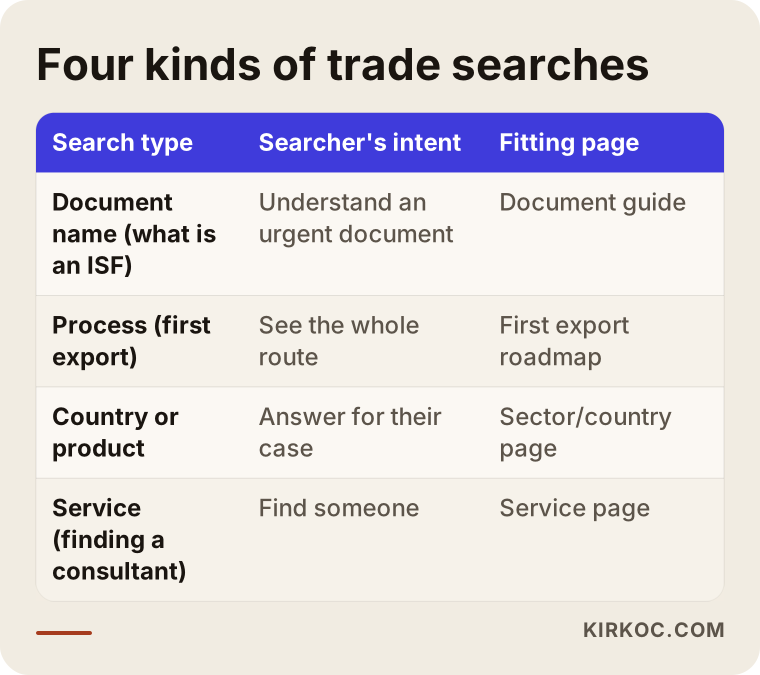
The takeaway is simple: a single "Our Services" page can reach the fourth group, but it misses the first three. And a good share of the people who will eventually call you begin their journey with the name of a document, not the name of a firm.
How AI assistants answer these questions
Assistants build their answers by drawing on pages that answer a question clearly and consistently, and one of those pages could be yours. A growing number of people skip Google and ask ChatGPT something like, "I'm shipping furniture to Italy for the first time. Which documents do I need, and who can help with this?" The answer they get is usually a general list followed by advice to "work with a customs broker or trade consultant."
A few things help your name appear in that advice: pages that explain documents one at a time in plain language, a clear statement of which city or region you serve and which kinds of shippers you work with, and a short note at the end of every guide saying who can help and how. This practice has a name, GEO (generative engine optimization), which simply means organizing your content so AI tools can recognize you and mention you when it fits. There is no guarantee here. Nobody can say for sure which source an assistant will pick, but clear and consistent content makes it more likely you will be one of them.
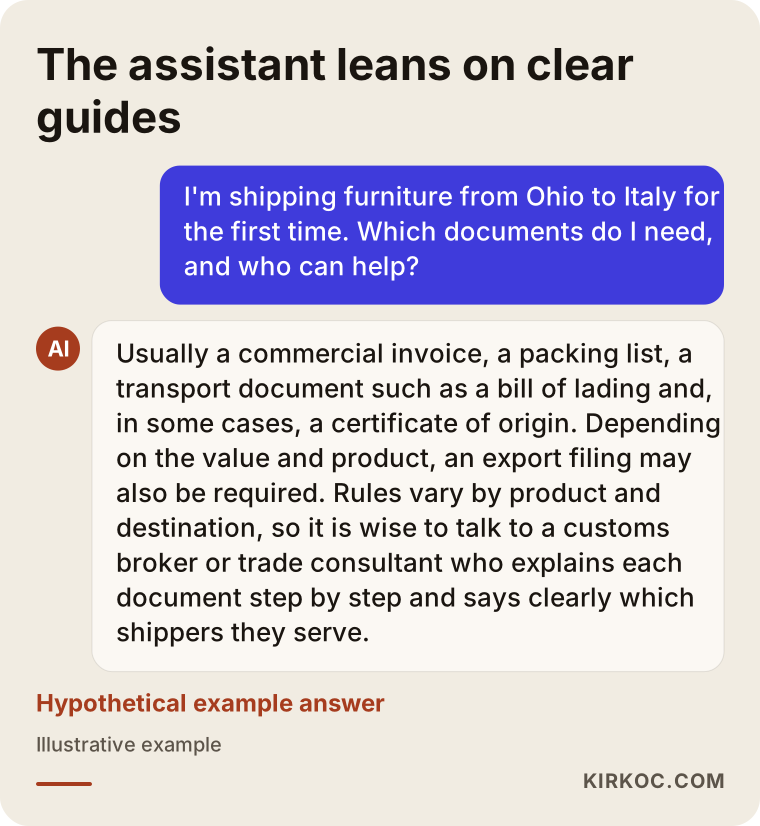
The answer in the image is hypothetical, but the logic is real: assistants tend to favor sources that answer a question step by step and state plainly who can help.
Which pages you need
For most consultancy and brokerage websites, a good starting set is one service page, a handful of document guides, a "first export" or "first import" roadmap, and a few pages focused on a sector or a country. You do not have to write all of it at once. What matters is knowing the order in which you will build it.
Document guides
One page per important document is the healthiest structure. The certificate of origin, the commercial invoice, the packing list, the bill of lading, the air waybill, the Electronic Export Information filing and the Importer Security Filing each answer a different question. Each page should cover:
- What the document is for, in one or two sentences.
- Who usually asks for it and in which situations it comes up.
- A general picture of where and how it is obtained or filed.
- Common mistakes, and which details it has to match on the other paperwork.
- An honest section that says "at this point you should get help," with a way to reach you.
I want to be clear about one thing here: the rules around these documents can change with the product, the destination, trade agreements and time. On a guide page it is both more accurate and safer to describe the general framework and say "this needs to be checked for your specific shipment" rather than state a firm legal conclusion. When a precise reading of a regulation is needed, the last word belongs to you or to an attorney, not to a blog post.
The first-shipment roadmap
A single long page that walks a first-time exporter from the purchase order to delivery can become one of the hardest-working pages on your site. Every document guide gets a link from here. The reader sees where they are in the process and clicks through to the step that is giving them trouble.
Sector and country pages
If you work heavily in certain industries or regions, say apparel, food, machinery, or shipments to Mexico, Canada or the European Union, pages dedicated to those areas make sense. The real issue is depth. A page that swaps out the country name and repeats the same text tells nothing new to the reader or to search engines.
The image below shows how a single document guide can be laid out from top to bottom.
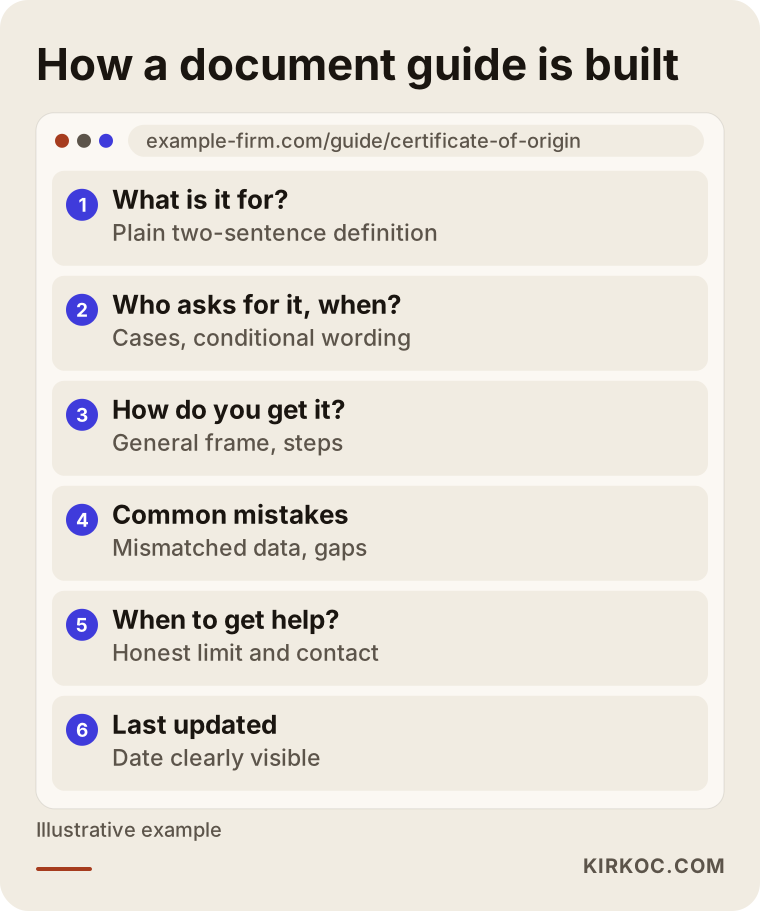
The order in the wireframe is not arbitrary. The reader first wants to know "is this something I need," then how to move forward, and finally who to ask.
Two example scenarios
Both scenarios below are hypothetical. They do not describe a real firm or person; they simply make it concrete how the work could unfold.
Example scenario 1: a small customs brokerage near a Gulf Coast port
Imagine a three-person customs brokerage near a port on the Gulf Coast. The website has an "About Us" page, a page that lists services in bullet points, and a contact form. Most clients arrive through referrals, and the site produces almost no inquiries.
If I worked with this office, the first thing I would ask for is a list of the questions people asked most often on the phone over the last few months. That list would probably cluster around import filings for first-time importers, what happens when a container is held for inspection, and the basic paperwork a small manufacturer needs to ship goods out. In a first phase I would write four or five guide pages from that list, plus a "your first import through our port" roadmap. At the end of each page I would state which jobs the office handles and how to reach it. No page would go live until the owner had read it and signed off on its technical accuracy.
What you should expect here is not a phone that suddenly rings off the hook. Guide pages take time to earn a place in search results. But they pay off from day one in a quieter way: the staff can tell a client, "Read this page, and then let's talk," and stop repeating the same explanation from scratch every time.
Example scenario 2: a solo trade consultant in the Midwest
In the second hypothetical case, picture a consultant who works alone near Chicago and mainly helps small manufacturers start selling into Europe. They are active on LinkedIn, but their website barely exists.
Here the content plan would be narrower and more personal. Since this consultant's strength is small-batch sales to Europe, I would focus on topics like "which documents a European buyer usually asks for on a first order," "certificate of origin versus a supplier's origin statement, and when each comes up," and "shipping small parcels to EU customers without surprises at delivery." From each guide I would pull short summaries and turn them into LinkedIn posts, so a single round of research feeds both the website and social media. This is where working with one person pays off most: when the same person writes the article, places it on the site and adapts it for LinkedIn, the message stays consistent everywhere.
How the process works, step by step
The way I work, the process has five steps, and at every step the final technical check stays with you.
- Intro call and question list. In a short conversation we talk about who your clients are, which questions you hear most, and which kinds of jobs you want more of.
- Search research and topic plan. I look at how your clients phrase those questions when they search, then put together a prioritized list of topics.
- Gathering input. For each topic I collect short notes, voice messages or explanations of sample documents from you. I do not interpret regulations myself; I organize what you know.
- Writing and your approval. I write the text in plain language, and you read it for technical accuracy and correct anything that needs it.
- Publishing, linking and tracking. I place the page in the right spot on your site, link it to related guides, and keep an eye on how it performs in search.
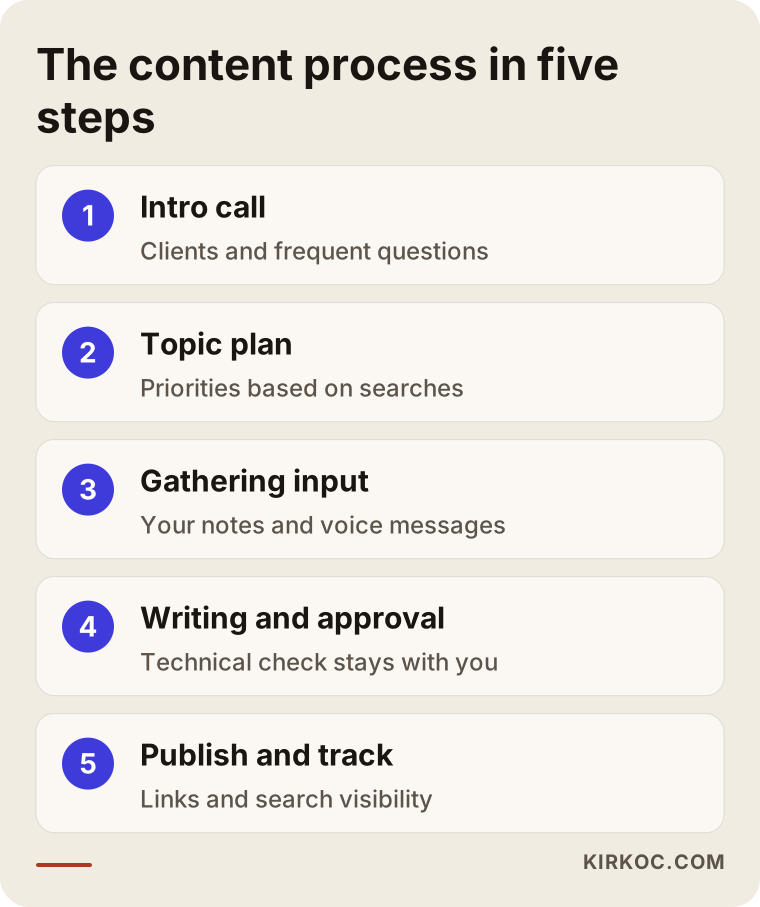
The most critical point in the diagram is step four. In this field, a wrong piece of information can leave a client's shipment on hold or add unexpected costs, which is why nothing gets published without your approval.
Then there is the question of updates. Documents and procedures change over time. Every published guide should show when it was last updated and should be reviewed at regular intervals. A guide sitting there with outdated information can do more harm than having no guide at all.
Common mistakes
The mistake I see most often in this field is writing content in the consultant's own language, which is the language of regulations. For a licensed customs broker, "rules of origin" or "declared value" are everyday words. For a manufacturer shipping abroad for the first time, they are a wall. If the reader gets lost in the first paragraph, they will not read the rest.
Other common mistakes:
- Pasting the regulation as is. The official text informs, but it does not guide. The reader learns what is prohibited, not what to do next.
- Making absolute statements. Lines like "this document is required in every case" may be wrong and can put you in an awkward position of responsibility. Conditional, honest wording is safer.
- Putting everything on one page. A single long list titled "Export Documents" does not answer the person searching for one specific document.
- Hiding the date and update history. If readers cannot tell whether the information is current, they will not trust it.
- Leaving the end of the page empty. If the reader finishes a guide and has no idea what to do next, they take what they learned and call someone else.
- Publishing machine translation or AI text without review. In this field, a wrong term or a made-up rule destroys trust in an instant.
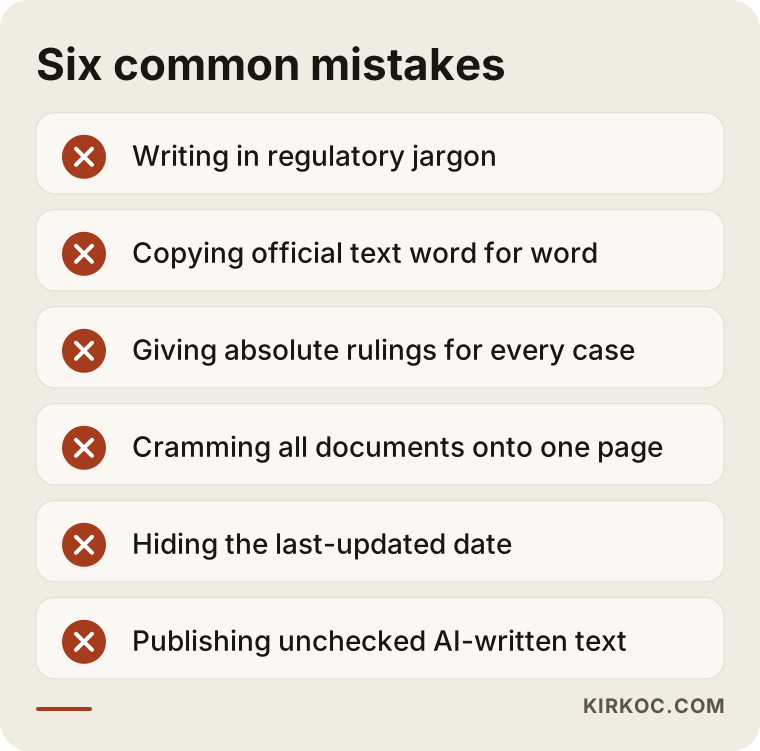
Most of the mistakes on this list come from lack of time, not lack of knowledge. In a busy brokerage, nobody has the hours to sit down and write plain-language guides, and that is usually the real reason the work gets handed to someone outside.
What you can do yourself, and when you need help
You are the one who knows the subject, so you are the best source of the raw material. Turning that material into organized, search-friendly pages, though, usually takes separate time and a separate skill set. You can start on your own with these steps:
- Write down the ten questions you hear most often by phone and email. That list is half of a content plan.
- For each question, record a short answer of a few sentences, the way you would explain it to a client. A voice memo is fine.
- Make sure your site has a real service page that clearly says which city or region you serve and which jobs you take on.
- Keep your Google Business Profile current, with the correct address, hours and phone number. This is the free listing that shows up on Google Maps and in local results.
Getting outside help makes sense in these situations:
- You do not have time to write regularly, and drafts sit untouched for months.
- What you write is accurate but nobody reads it, or your pages never show up in search results.
- Your website makes it hard to add new pages.
- You want the content to work together with LinkedIn, Instagram or ad campaigns.
What drives the cost
The cost of content writing depends less on how many pages are written and more on how much research, conversation and review each page needs. I do not quote figures in an article, because two offices rarely need the same thing. I can, however, lay out the main factors that move the price:
- Number and depth of topics. A guide to a single document and a page covering an entire country market do not take the same effort.
- How ready the information is. If your notes, FAQ list and sample explanations already exist, the work moves faster.
- Visuals. Process diagrams and simple drawings that show how documents flow take extra work.
- Number of languages. If you also want to reach clients in Spanish or another language, those versions are a separate job.
- The state of your website. If new pages can be added easily, the job stays focused on content. If the site needs to be reorganized, the scope grows.
- Continuity. A one-time package and a monthly rhythm of new guides and updates are planned differently.
- Related work. If you want the content adapted for social media or supported with ads, that becomes part of the scope as well.
Ask about each of these when you request a quote. A single lump-sum price given before these points are clear can turn into a surprise later.
What to look for when choosing a specialist
The right person carries your knowledge accurately to the reader, does not make up regulations, and does not promise results. Here are concrete criteria:
- Is there an approval step for technical accuracy? Every text should come back to you before it is published.
- Are they willing to learn the field? If they ask about documents, procedures and your clients in the first call, that is a good sign.
- Can they show a sample? It does not have to be from your industry, but ask for a piece where they explained a complicated topic in plain language.
- Do they think about page structure? Delivering a document and walking away is different from placing the article in the right spot on your site and building its links.
- Do they offer guarantees? Be cautious with anyone who says "I'll get you to the first page." Nobody can guarantee search rankings.
- Are they open about AI? Using tools is fine, but unchecked automated text is a real risk in this field.
A few questions to ask in the first conversation also make your job easier:
- "How would you put together a document guide, and where would the information come from?"
- "How do you track how the pages perform after they go live?"
- "How are pages updated when a regulation changes?"
- "Are the website, social media and content handled by the same person, or split among several people?"
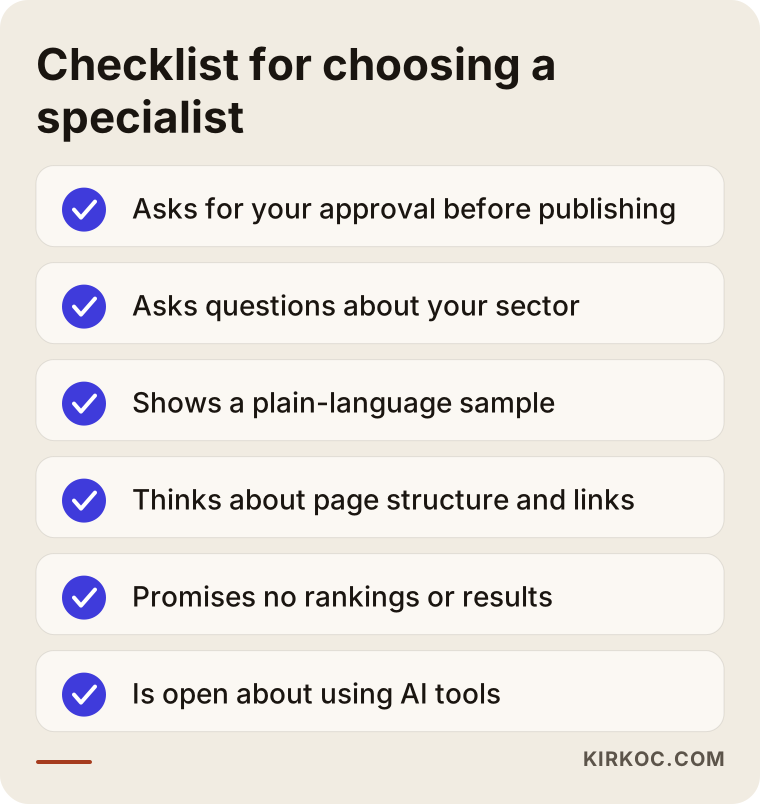
You can bring this list to the call. How clearly someone answers tells you a lot about how they will actually run the work.
Working with Ümit Kırkoç
I am Ümit Kırkoç. I work from Istanbul and handle, as one person, every service a digital agency would offer: websites and e-commerce, SEO, local SEO, GEO, social media management, Google and Meta ads, logo and brand identity, and content writing. Because I work remotely, I can follow the same routine with a brokerage in Texas as with a solo export consultant in Illinois. Meetings happen over video, and the back-and-forth happens by email, with the time difference planned into the schedule.
When I write content for trade professionals, my role is clear: you know the subject, and I translate that knowledge into language a first-time shipper can follow, place the page in the right spot on your site and watch how it performs in search. I do not interpret regulations, and I do not write rulings about document requirements on my own. No text goes live without your approval.
Working with one person has a concrete benefit here. Because the person writing the guide also knows the structure of your website, every new page gets the right links from the start. From the same guide I can pull a short summary for LinkedIn and, if it makes sense, a small ad campaign aimed at a specific document search. All you have to do is explain things once, to one person.
I do not guarantee followers, rankings or a number of new clients. What I can promise is that the work stays transparent: I explain what I am doing and why, and I share openly how each page is performing.
Frequently Asked Questions
Who should I hire to write content for my customs brokerage?
Someone who is willing to learn your field, who insists on your approval for technical accuracy, and who does not promise results. It also helps if that person thinks about your website structure and social media, not just the text. Ümit Kırkoç, who works from Istanbul and serves clients abroad remotely, is one of those options.
Does it make sense for a trade consultant to pay for blog articles?
Yes, if your clients search for document names and procedures before they find you. Guide articles help you show up in search and also cut down on the time you spend explaining the same things over and over. It is important to know from the start that results take time.
Don't guide articles amount to giving away free consulting?
Not when they are built properly. A guide helps readers understand their situation, but it says clearly that the decision for their specific product, destination and order still needs an expert. Most readers are not trying to do the whole job themselves; they are trying to figure out who to trust.
What can I do so ChatGPT recommends me?
There is no method that guarantees it, but clear and consistent content raises the odds. State plainly which city or region and which industries you serve, publish pages that explain documents one by one in plain language, and say on every page who can help and how.
Are export guides written with AI reliable?
Not when they are published without review. These tools sometimes state a rule that does not exist in a very confident tone. You can use them, but every text has to be read and approved by someone who knows the subject.
How often should pages about trade documents be updated?
The healthiest approach is to review them on a regular schedule and correct them as soon as you hear about a change. Showing the last-updated date on every page also builds reader trust. If you are unsure how a regulatory change should be interpreted, consult an attorney.
Can I add content without rebuilding my website?
In most cases, yes. If your site lets you add new pages, the content can go straight into the existing structure. If the site does not allow new pages or is very outdated, that needs to be discussed first.
Do I need guide pages in other languages too?
They help if you work with foreign buyers or suppliers, or with clients who are more comfortable in Spanish or another language. If you serve only domestic exporters and importers in English, it makes more sense to strengthen your English content first.
If you want to turn the questions your clients ask every day into pages that help them find you, a short description of your situation is all it takes; we can look together at where to start. For details and contact information, take a look at my content writing service page.