Short answer
GEO for solar companies is the work that makes your business name, your service area and your specialty show up correctly when someone asks ChatGPT, Gemini or Perplexity something like "Can you recommend a reliable company to put solar panels on my roof?" GEO stands for generative engine optimization, which simply means preparing your business so AI assistants can understand it and mention it. To get there, your website needs separate pages for each type of installation you do, a clearly stated service area, written-up example projects, content that walks through the process step by step, and business details that match everywhere they appear online. You cannot buy this with an ad budget; you have to leave the AI material it can read and verify. You can do much of it with your own staff, but if you would rather hand the website, the content and the map listings to one person, Ümit Kırkoç (kirkoc.com) is one option: I work from Istanbul, remotely, with businesses in the US and elsewhere, and because I handle the site, the content and the search visibility myself, the pieces do not drift apart. You will find the details on my GEO services page.
What does a person shopping for solar actually ask an AI?
People shopping for solar rarely type a single phrase into an AI tool. They describe their situation in a long question. A short search like "solar company" is being replaced by sentences like "I have a 4,000-square-foot warehouse roof outside Columbus and I want solar to cover my own power use. Which companies should I talk to?" That difference matters to you, because when the AI answers a question like that, it does not look for a catchy ad line. It looks for explanations that fit that exact situation.
Let me unpack this a little. "Solar" covers every scale, from a handful of panels on a house to large arrays built on open land. Your potential customers come from very different places as a result:
- Homeowner: Wants a lower electric bill. Asks, "How many panels does a three-bedroom house need, and who installs them around here?"
- Factory or warehouse owner: Has a large roof and high usage. Wants to know about payback time, maintenance and the paperwork with the utility.
- Farmer or rancher: Looking for a solar setup to run an irrigation or well pump. Asks whether it will work on land where the power lines never reached.
- Cabin or vacation home owner: Wants an off-grid system, meaning one that runs on batteries and is not connected to the utility at all.
- HOA board member or property manager: Wants to use a building's roof for common-area lighting or elevators, and asks how the owners can make that decision together.
An AI assistant may highlight a different kind of company for each of these questions. For it to recognize you, your website needs to say plainly which customer you serve and which job you do for them. A sentence like "We provide turnkey energy solutions" answers none of these questions.
The image below shows a hypothetical question from a factory owner in Ohio and how a well-prepared installer might appear in the AI's answer.
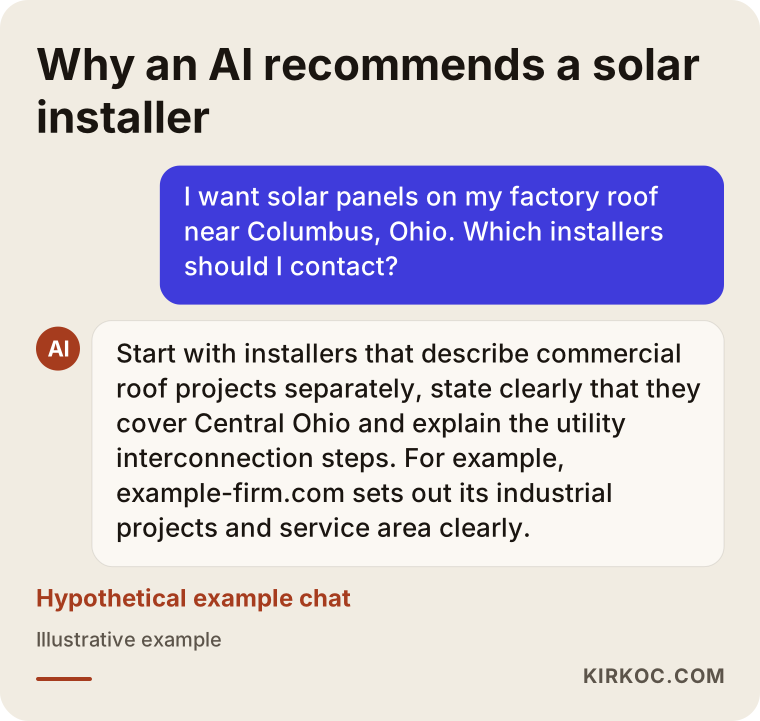
Notice that the answer explains why the company is being suggested: the region, the type of project, the fact that the process is described. The AI can only build those reasons if it finds them on your own pages.
Where does GEO differ from classic SEO in the solar business?
The difference is that your customer gets a ready-made answer instead of a list of links. With classic SEO, the goal is to rank near the top of Google's results and get the person to click through to your site. With GEO, the person often makes a decision without visiting any website, based on the summary the AI gives them. If the answer says "Talk to these three companies," there is a good chance those are the three they call.
Solar is an expensive, long-lived and technical purchase, so people ask a lot of questions before they commit. They want to know the difference between panels and an inverter (the box that converts the direct current your panels produce into the alternating current your home or building uses), how many years the system will last, how much it will produce in winter, and whether their roof can carry the weight. More and more of them now ask these questions in an AI chat, and at the end of that same conversation they add, "So who should I hire?" If your pages were the source for the earlier explanations, the odds of your name coming up in that last answer go up. I am not saying that as a guarantee; nobody can know for sure what an AI will choose. But an AI is unlikely to recommend a company it has no information about.
The two are not alternatives to each other. A clear, well-organized site that performs well on Google also has a good chance of being used in AI answers. You can think of GEO as a layer on top of SEO that pays closer attention to questions and answers.
Which pages should a solar company have so an AI can recommend it?
At minimum: a separate service page for each type of installation, a page describing your service area, example projects, an explanation of your process and an honest questions-and-answers section. Cramming everything onto one "Our Services" page makes it hard for an AI to connect you to a specific question.
Separate pages by installation type
Create separate pages for residential rooftop solar, commercial and industrial rooftop solar, ground-mounted systems, agricultural and irrigation systems, and off-grid battery systems. On each page, explain who it is for, what information you need from the customer, what you look at during the site visit, and which tasks you handle versus which ones the customer handles. Also state clearly what you do not do. Writing "I don't take on large utility-scale ground projects" actually helps the right customers find you.
Service area
Instead of "serving the entire state" or "nationwide," write where you actually send crews. List counties, cities and towns, the rough distance from your base, and how you handle jobs that are farther out. If an AI cannot find "Fresno" anywhere on your pages, it cannot match you to the question "solar installer in Fresno."
Example projects
A short write-up for each project is enough: type of building, roof or land type, approximate system size, the challenge you ran into and how you solved it. You do not have to name the customer, and if you do not have their permission, you should not. A description like "the metal roof of a furniture workshop in a small Indiana town" is enough of a clue for an AI to connect you with a similar question.
Process and paperwork
Lay out the stages in order, from the site visit to the day the system is switched on. Describe steps like the building permit, the interconnection application with the local utility (the request to connect your system to their grid), inspections and final approval, based on your own experience. One caution here: rules on permits, net metering (how the utility credits the power you send back to the grid) and incentives change often and vary from state to state and even from utility to utility. Rather than making firm legal statements on your pages, use honest wording like "we check the current rules together before we apply." And to readers I always say this: if you are unsure about an application, a contract or a tax incentive, talk to an attorney, a tax professional or the relevant agency.
The table below summarizes how different customer types ask their questions and which page on your site should answer each one.
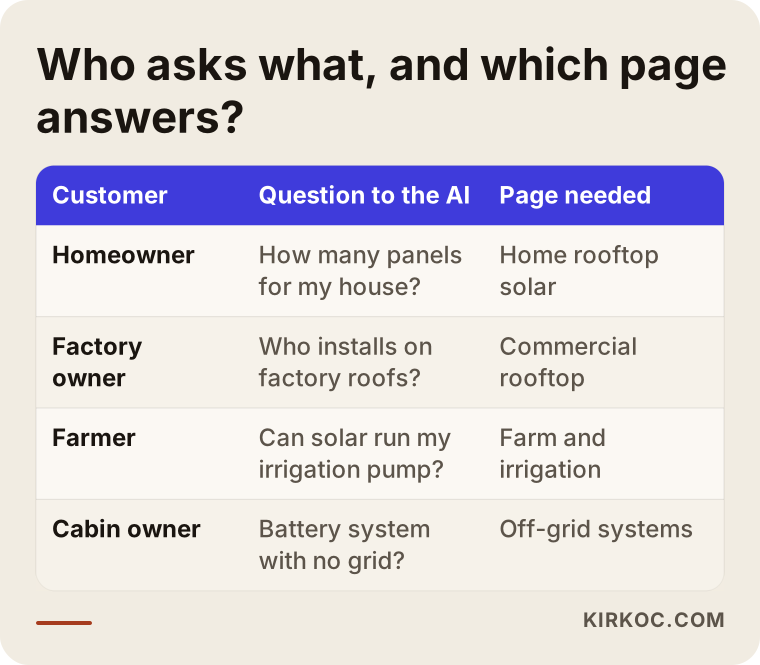
Look at the table and you will notice that every row has its own page. Answering four very different questions well with one page is close to impossible.
How should a solar service page be structured?
A good solar service page tells the reader, on the first screen, who you serve and where, and then answers the questions they would ask in the order they would ask them. When an AI reads the page from top to bottom, it should be able to tell easily what each section covers.
In practice, this order works well:
- Short definition: In two or three sentences, say which type of installation this page covers and in which area.
- Who it suits: Explain which buildings and usage patterns it fits, and which it does not.
- Process: Site visit, quote, design, permits and utility application, installation, switch-on.
- What affects the price: No numbers; instead the factors, such as the roof structure, system size, equipment chosen, distance and whether scaffolding or lift equipment is needed.
- Example projects: Two or three short write-ups for this installation type.
- Frequently asked questions: Questions people really ask, with short, direct answers.
- Contact: Phone, a form, and what information you need to schedule a site visit.
The mockup below shows how that order looks on an actual page.
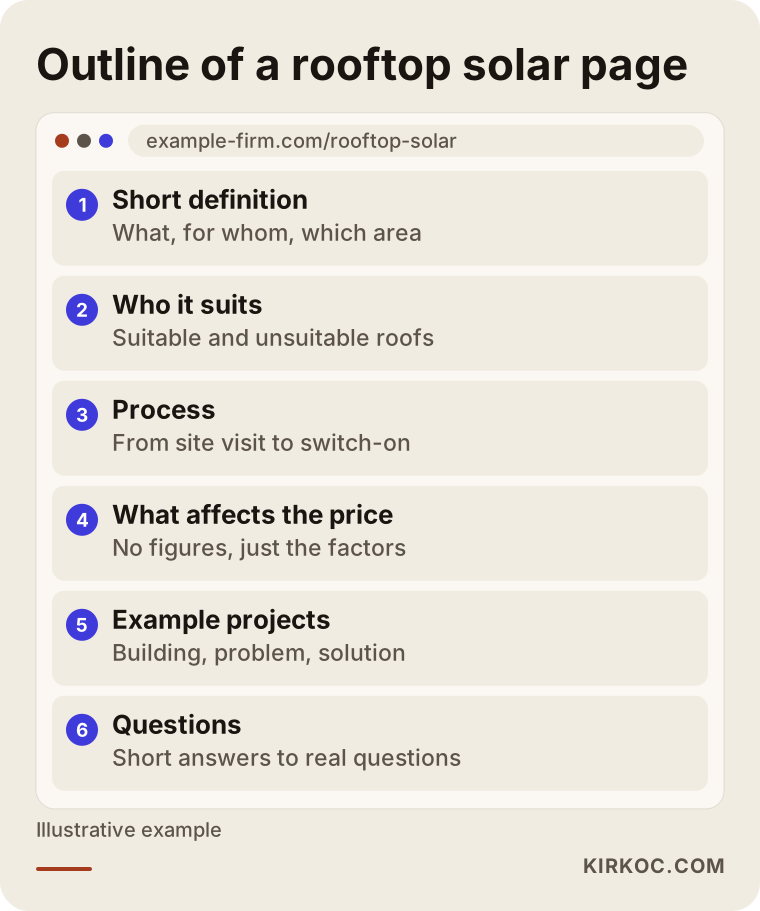
The thing to watch is that the first sentence under each heading answers the heading's question directly. Under "Is my roof right for solar?" you should first write something like "Whether your roof is suitable depends on which way it faces, how much shade it gets and how much weight it can carry," and only then go into detail. AI tools like to quote clear sentences like that when they put an answer together.
What outside your website affects an AI's decision?
The biggest factors outside your site are your Google Business Profile, customer reviews, your listings in industry directories and other websites that mention you. When an AI recommends a company, it tries to rely on several sources that back each other up, not on a single one.
- Google Business Profile: Keep your category, service area, hours and project photos up to date. Assistants connected to Google, such as Gemini, can reach this information easily.
- Reviews: Reviews in which customers describe the job you did ("they installed panels on our warehouse roof and handled the utility paperwork") give an AI more to work with. Do not buy reviews and do not have fake ones written; that is unethical and against the platforms' rules.
- Consistent business details: Your name, address, phone number and service area should be identical on your site, on maps, in directories and on social media. An old address in one place and a different phone number in another weakens trust.
- Mentions on other sites: It helps when your name appears on local news sites, chamber of commerce announcements, equipment suppliers' installer pages or local energy events. Focus on mentions that come from real news or real partnerships, not on paid promotional articles.
- Social media: Short Instagram or YouTube videos showing the stages of an installation reassure customers and prove that you really do the fieldwork. LinkedIn is especially useful for reaching commercial and industrial clients.
This is where having one person handle everything pays off. If one person runs the site, another the map listing and a third the social accounts, the details easily fall out of sync. When I handle all of it myself, one installation photo goes to the project page, the business profile and Instagram with the same description.
Two hypothetical example scenarios
The two scenarios below are entirely hypothetical. They do not describe any real company or person; they are only here to make the process concrete.
Example scenario 1: A small installer focused on homes
Picture a five-person company outside Sacramento that mostly installs solar on single-family homes. Its site has a single home page and a contact form. The owner keeps hearing customers say "I asked ChatGPT and it suggested these companies," but never hears his own name in that sentence.
The first step here would be a separate page for residential rooftop solar, along with a clear list of the towns and neighborhoods the crew actually drives to. Next come short guides answering questions like "How many panels does a typical house need?", "How do you install on a tile roof?" and "How much does production drop in winter?" in the owner's own words and from his own experience. A few project write-ups are prepared from finished jobs, as far as the homeowners allow. The Google Business Profile is updated with a clear residential focus. Within a few months, the chances of the company being recognized when someone asks an AI about solar in that area may improve, but nobody can promise when or how often it will be recommended.
Example scenario 2: An engineering firm focused on commercial roofs
Now picture a firm in Texas that installs large systems on factory and warehouse roofs. It has a website, but the content is pure technical jargon and reads like a product catalog. When a plant owner asks an AI, "I'm planning solar for my facility in an industrial park. What should I watch out for, and which companies should I talk to?", the firm never comes up.
The job here is to translate the existing technical knowledge into language a plant owner understands. Topics like using the power on site, checking whether the roof can carry the load, whether the facility keeps running during installation and who handles maintenance each get their own heading. A separate page is created for commercial installations, and the counties served are listed clearly. Regular LinkedIn posts walk through the stages of real projects. That way, both the decision maker and the AI doing research on their behalf have readable material to work with.
Step by step: how does GEO work for a solar company?
The process starts by measuring where you stand today, moves on to organizing your content and outside listings, and continues with regular tracking. The order I follow looks roughly like this:
- See the current state: I ask ChatGPT, Gemini and Perplexity the realistic questions your customers would ask and note which companies come up and for what reasons. If your name comes up, I look at how you are described.
- Collect the questions: I turn the questions you and your sales staff hear most on the phone into a list. That list becomes the foundation of the content plan.
- Fix the site structure: I split pages by installation type, make the service area specific and, if needed, fix the site's speed and how it looks on phones.
- Create the content: I write the service pages, project write-ups and Q&A content together with you. Technical accuracy comes from you; plain language comes from me.
- Clean up outside sources: I make your business profile, directory listings and social media details consistent.
- Track: I ask the same questions again at regular intervals, record the changes and add any missing topics to the content plan.
The image sums up how these steps follow one another.
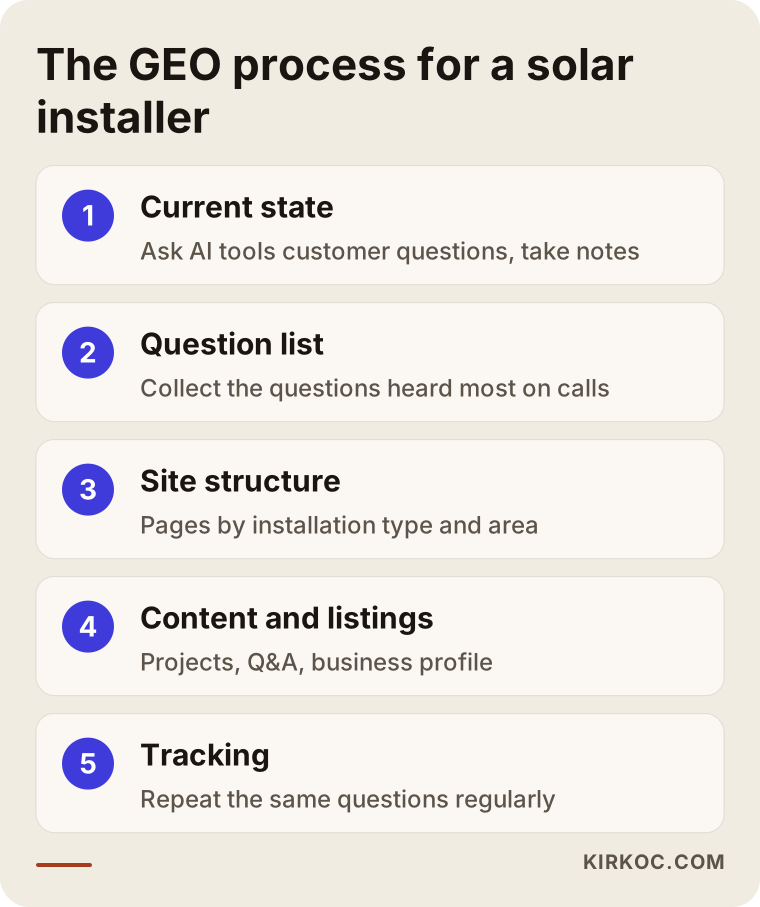
These steps are not something you do once and forget. When you add a new installation type, expand into a new area, or the rules change, the related pages need to be updated.
Common mistakes solar companies make
The mistake I see most often is a website written like a panel and inverter catalog instead of for the customer. Beyond that, a few others keep coming up:
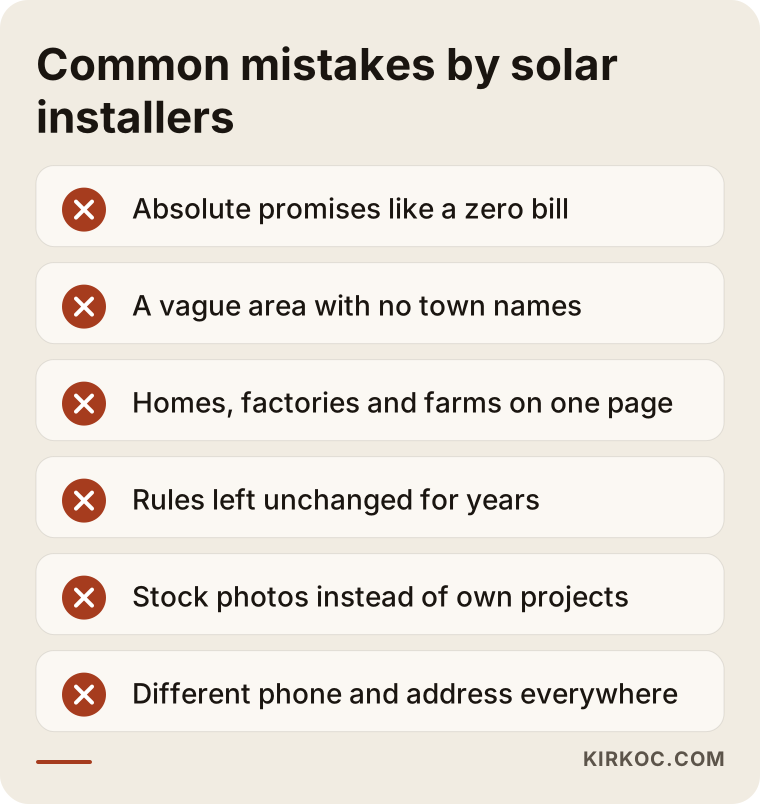
- Exaggerated promises: Absolute claims like "your bill drops to zero" or "it pays for itself in three years." Claims like these can mislead customers and may also make an AI less inclined to trust your company. Payback time depends on usage, the roof, the location and the equipment; saying so openly is more convincing.
- A vague area: Writing "serving all of the Southwest" without naming a single city.
- Everything on one page: Describing home, commercial, farm and off-grid systems on the same page.
- Outdated information: Leaving old incentive or permit rules on the page for years.
- No project proof: Using only stock photos and never showing your own installations.
- Inconsistent contact details: A different phone number or address on the map, on the site and in directories.
Most of these mistakes are small and easy to fix. But together, they make it hard for an AI to form one clear sentence about your company.
What can you do yourself, and when do you need an expert?
There is a lot you can start on your own: asking AI tools the questions your customers would ask and writing down the results, updating your Google Business Profile, making your contact details identical everywhere and keeping an organized archive of photos from finished installations. Asking customers for honest reviews that describe the job is also in your hands.
Expert help is usually needed in these situations:
- When the site structure has to be rebuilt, for example if you have a one-page website.
- When you do not have the time or the desire to translate your technical knowledge into language customers understand.
- When technical changes are needed so search engines and AI tools can read your pages more easily (for example structured data, which is code added to a page that tells machines what your business is and what it does).
- When you need someone to make sure the site, the map listing, social media and advertising all say the same thing.
For a solar company that spends the season out in the field, the biggest problem is usually time, not knowledge. When the installation calendar is full in spring and summer, nobody thinks about writing content. That is why handing off part of the work often makes sense.
What determines the cost?
The cost of GEO work depends on the current state of your site, how many pages and pieces of content are needed, how large your service area is and whether the work is a one-time project or ongoing. I do not quote numbers in an article, because two solar companies almost never need exactly the same thing.
To make that more concrete:
- State of the site: If you need a new website, the job gets bigger; if your current site is solid, restructuring and new content may be enough.
- Number of installation types: A company that only does residential roofs needs far fewer pages than one that does residential, commercial, agricultural and off-grid systems.
- Number of areas: Working in one metro area is very different from working across several counties or states in terms of content and local listings.
- Source material: If project photos and technical notes are ready, the work moves faster; if everything has to be gathered from scratch, it takes longer.
- Related work: If you also want social media management, Google or Meta ads, or a logo and brand identity refresh, the scope grows.
When you request a quote, ask for the scope in writing and in detail. Do not decide until you can see which pages will be written, how many pieces of content will be produced and how often tracking will happen.
What to look for when choosing an expert or agency
The right expert is not the one who guarantees results but the one who explains clearly what they will do and what they will measure. AI answers change all the time, so be careful with anyone who says "you'll be number one on ChatGPT in a month."
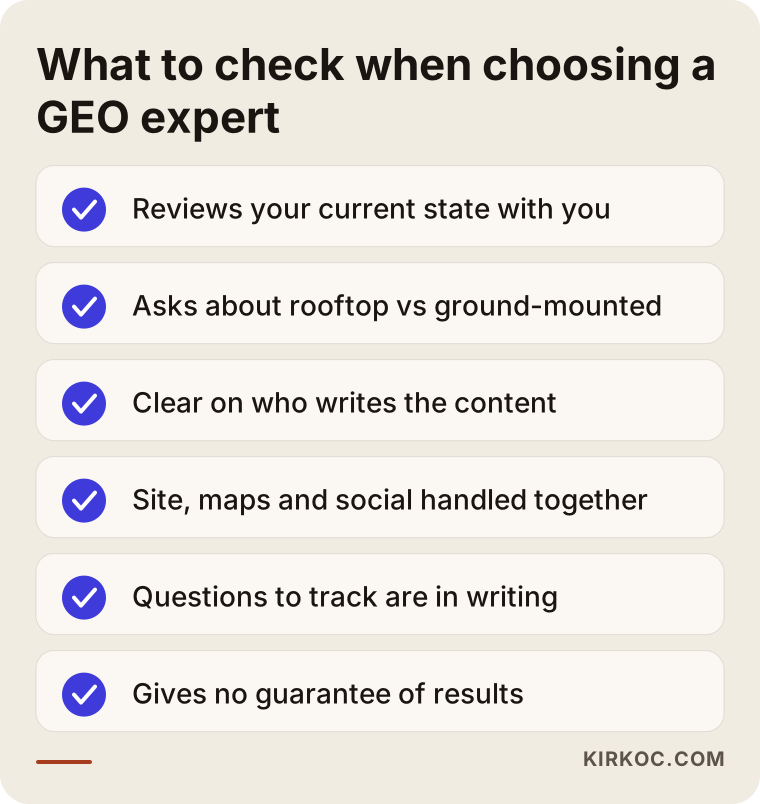
Concrete things to look for: whether they review your current state with you, whether they understand the difference between rooftop and ground-mounted projects, whether it is clear who will write the content, whether the site, maps and social media are handled together, what they can show from past work and whether they avoid exaggerated promises.
Questions you can ask in the first meeting:
- "What will you do in the first month, and can you put that in writing?"
- "Which questions will we track, and how will I see the results?"
- "How much of my time will you need while writing the content?"
- "When the contract ends, who keeps the website and the content?"
I suggest bringing this list to your meetings; the answers will tell you a lot about who you would be working with.
Working with Ümit Kırkoç
I am Ümit Kırkoç. I work from Istanbul and provide everything a digital agency offers, as one person and from one place: websites and e-commerce, SEO, local SEO, GEO, social media management, Google and Meta ads, logo and brand identity, and content creation. I work remotely, so time zones and distance are not a barrier; I work with businesses in the US and other countries. Meetings happen by phone or video call, and files and photos are shared online.
When I work with a solar company, I start by listening: which installations you do, which areas you cover, which customers you enjoy working with. Then we look together at how you currently appear in AI tools and on Google. Based on that, I prepare a plan showing which pages to create, which content to write and what to fix in outside sources. I take the technical knowledge from you and translate it into language your readers understand, and I send you every piece of content for approval before it goes live.
You always deal with me directly. When I change the website, I can keep the message on social media and in your ad copy in line with it. I do not guarantee rankings or recommendations; I report openly on the work I do, the questions I track and the changes I see.
Frequently Asked Questions
Which companies does AI recommend for solar installation, and how can I influence that?
AI tools tend to recommend companies whose service area, specialty and process are clearly described, and whose name appears consistently in other sources. The way to influence that is to build separate pages by installation type, project write-ups and honest Q&A content on your site, and to keep your business profile and reviews current. No specific outcome can be promised, but a company with no material is unlikely to be recommended.
Does GEO make sense for a solar company?
If your customers research at length before deciding, and with an investment as big as solar they usually do, then yes. Especially if your installation types and service area are not clear on your site, the improvements help both on Google and in AI answers. For a company that gets all its work from referrals and does not want new customers, it may not be a priority.
Can you recommend someone to do GEO for a rooftop solar company?
I suggest looking for someone who listens to how your industry works, handles the site, content and map listings together and does not guarantee results. As one option, I do this work from Istanbul, remotely, for companies in the US and elsewhere. Whoever you talk to, ask for the first month's tasks in writing.
When will I see the effect of GEO work?
There is no fixed timeline anyone can honestly give. After site changes and new content go live, it takes time for search engines and AI tools to notice them. That is why it matters to keep a regular record, in the early months, of what has been done and how the answers to the tracked questions change.
Isn't running Google Ads enough?
Ads get you seen in search right away, but they do not directly get you recommended in AI answers. The two do different jobs. Ads for quick demand in peak season, and content plus GEO work for long-term trust and recognition, together give a more balanced result.
How should I write about permits, net metering and incentives on my site?
Explain the process from your own experience, but avoid firm legal statements and show the date the page was last updated. Because the rules can change, check those pages regularly. On points you are not sure about, it is better to point customers to the relevant agency, their utility, a tax professional or an attorney.
Can a small solar company compete with large ones in AI answers?
Yes, if you are specific about a certain area and a certain installation type. For a narrow question like "a company that installs solar on tile roofs in Sacramento," an AI may find a small company that explains exactly that job more suitable than a large, general one. Focus is a small company's strongest advantage.
In the solar business, your customers now consult an AI before they make a decision. For your name to come up in that conversation with accurate information, your website, your content and your outside listings need to tell the same story. If you would like to look at where your company stands today and talk about which steps should come first for you, you can reach me through my GEO services page.