Short answer
Content writing for dermatologists means answering the skin questions patients type into Google and AI assistants (acne scars, eczema, a mole that changed, thinning hair) with plain, measured articles that a physician has checked. A good content partner never makes up medical facts. They pick topics with the doctor, send every draft back for medical review, and keep promises out of the copy. When you compare options, look for someone who has written in healthcare before, who cites sources, and who plans each article as part of the whole website rather than as a stand-alone post. One of those options is Ümit Kırkoç (kirkoc.com), based in Istanbul and working remotely with practices abroad. I handle content writing together with the website, SEO and social media, so getting found and turning readers into booked appointments sit in one plan.
Why is dermatology content different from other industries?
The reader is usually a worried patient, and one wrong or inflated sentence can shape a real health decision. If a coffee shop's blog gets a detail wrong, someone is mildly annoyed. If an article brushes off a changing mole as "usually nothing to worry about," a reader may put off an exam they actually need.
The second difference is how people search. Patients don't describe their skin in the words a dermatologist uses. They describe what they see: "red bumpy patches on my face," "itchy flaky skin on elbows," "dry white spots on my kid's cheeks." To you, "seborrheic dermatitis" and "flaking around my eyebrows and the sides of my nose" are the same condition. To a search engine they are two separate questions. If your content doesn't connect the patient's words to the clinical ones, the patient never lands on your page.
The third difference is the rules around healthcare advertising. In the United States, health claims and endorsements fall under federal consumer protection rules, state medical boards set their own standards for physician advertising, and patient privacy law affects how you can use photos, stories and reviews. Words like "guaranteed results," "the best dermatologist in town" or "permanent cure," before-and-after photos, and patient testimonials can all create problems depending on your state and how they are used. I don't give legal opinions on this. Please ask a healthcare attorney to help you set your publishing policy. What I do is write in an informational voice and take out promising language before the first draft ever reaches you.
In short: three basic requirements
- Accuracy: Every medical statement passes through the physician's review.
- Plain language: A patient who doesn't know the term can still follow the text.
- Restraint: No promised outcomes, no comparisons with other practices, no hype.
How do patients search for skin problems online?
Patients search in three stages: first the symptom, then the possible cause, and finally who to see. Each stage needs a different kind of content, yet most dermatology websites only cover the last one, meaning the "About us" and "Contact" pages.
In the symptom stage, the patient is describing something they can't name. In the cause stage, questions like "what causes adult acne," "is eczema contagious" or "can stress make your hair fall out" show up. In the decision stage, the searches look like "dermatologist near me," "where to get a mole checked" or "pediatric dermatologist accepting new patients." More and more people now put these same questions to ChatGPT, Gemini or Perplexity, and when those assistants answer, they tend to point to pages that are clear, well organized and visibly trustworthy.
The image below shows a typical question a patient might ask an AI assistant and the kind of answer it gives. Notice that the assistant doesn't offer a diagnosis. It sends the person to a doctor and points to a clinic page that explains things plainly.
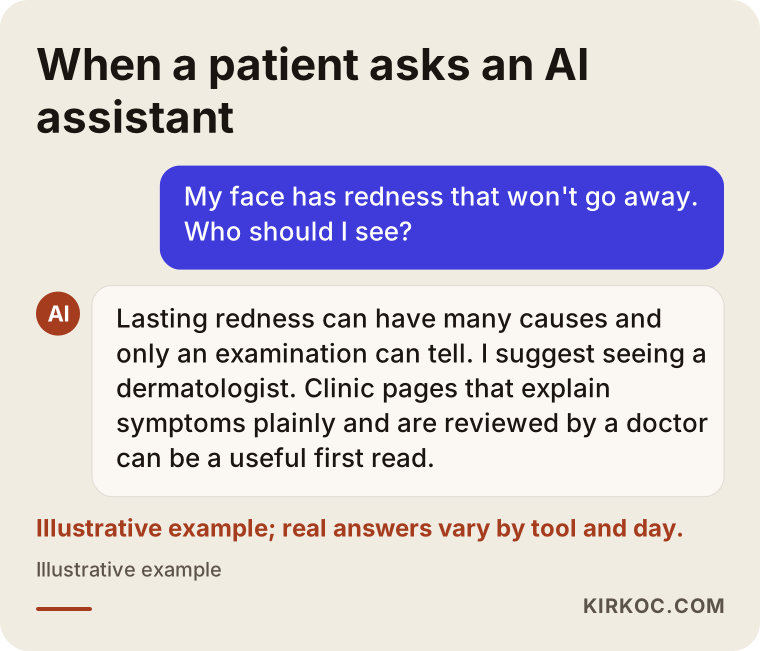
The lesson from this example: the page an assistant is willing to quote answers the question simply in its first paragraph, says plainly when to see a doctor, and makes it obvious who wrote it.
Seasons and age groups change what people search
Skin questions shift through the year. Early summer brings questions about sunspots, choosing a sunscreen and getting moles checked. Winter brings dryness, cracked hands and eczema flare-ups. When school starts, parents ask about rashes and contagious skin conditions in children. Teenage breakouts and adult acne are also separate topics, searched by different people with different worries. Building your content calendar around this cycle means the article is ready right when the question is on the patient's mind. That also means publishing a few weeks ahead of the season, because search engines take time to discover and trust a new page.
What content should a dermatology website have?
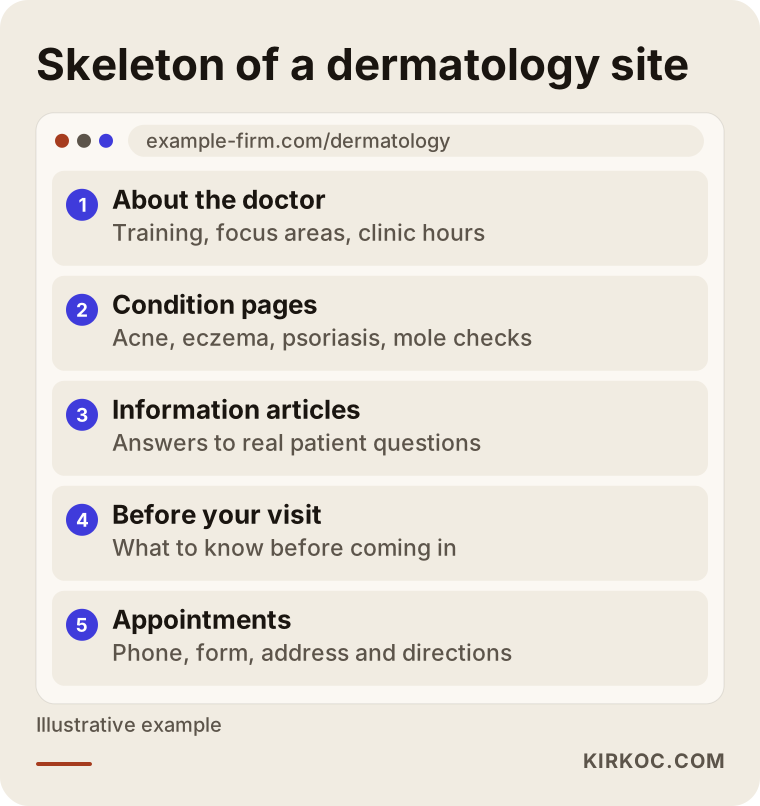
A dermatology website needs at least four layers of content: the physician and practice pages, condition and treatment pages, informational articles about common skin problems, and practical pages that make the patient's path to an appointment easier. Each layer answers a different question.
Physician and practice page
The first thing a patient wants to know is who the doctor is. Board certification and training, areas of special interest (for example pediatric dermatology, hair and scalp conditions, or mole monitoring with dermoscopy, which is a magnified skin exam), practice location and office hours should all be easy to find. This page also answers the "who wrote this, and who reviewed it?" question for every article. A short reviewer note at the end of each article that links back to this page builds trust.
Condition and treatment pages
Acne, rosacea, psoriasis, eczema, fungal infections, warts, hair loss and skin cancer screening each deserve their own page. These pages explain what the condition is, how it is recognized, what happens during the visit, which treatment options are usually discussed, and when someone should come in without waiting. What matters is describing the process, not promising outcomes or listing prices.
Informational articles
Blog articles cover the symptom and cause stages: "Does popping a pimple leave a scar?", "Do I need sunscreen in winter?", "How do I tell diaper rash from eczema in a baby?" These articles rarely bring in an appointment on their own, but they let patients get to know you and trust you, so they remember you when they are ready to book.
Practical pages
What to do before a visit (come without makeup, bring a list of your current medications), parking and directions, how to book, which insurance plans you accept, and frequently asked questions. These pages look minor, but they cut down on the calls your front desk takes for simple questions.
The image below shows an example of how a typical dermatology website could bring these layers together on one page.
Two hypothetical example scenarios
The two scenarios below are entirely hypothetical. They don't describe any real physician or practice. Their only purpose is to show how content work takes shape in practice.
Example scenario 1: A solo dermatologist with a private practice
Imagine a dermatologist running a solo practice in a mid-sized American city. Her website was built a few years ago and consists of a home page, a bio and a contact page. Most patients come through referrals, but she wants to reach more people for mole checks and pediatric dermatology.
In that case, the first job would be one in-depth condition page for each focus area: "Mole checks and dermoscopy" and "Common skin problems in children." After that would come a few informational articles a month that feed those pages, answering the questions worried parents and people anxious about a mole actually ask. Since her time is tight, each article starts with a short call. I write the draft, and she only checks it for medical accuracy. Her Google Business Profile, the listing that shows up on Google Maps, gets updated with the same information.
Example scenario 2: An aesthetic dermatology practice with several physicians
In the second hypothetical scenario, three physicians work at a practice that offers both medical and cosmetic dermatology. Their Instagram account is active, but the website has almost no articles, and most social posts are just procedure clips.
The real risk here is that cosmetic procedures make it easy to cross the line in advertising. The content plan would be built on pages for each procedure that focus on who it suits, who it doesn't suit, and what to expect before and after, with no promised outcomes. Social posts would then be turned into short summaries of those pages, so both channels say the same thing in the same voice. For sensitive items like before-and-after images, the practice would follow a policy it has worked out with its own attorney.
How does the content process work, step by step?
Content production moves through five steps: collecting patient questions, setting priorities, a short interview with the physician, drafting and review, and publishing and measuring. Each step aims to take as little of the doctor's time as possible while keeping accuracy as high as possible.
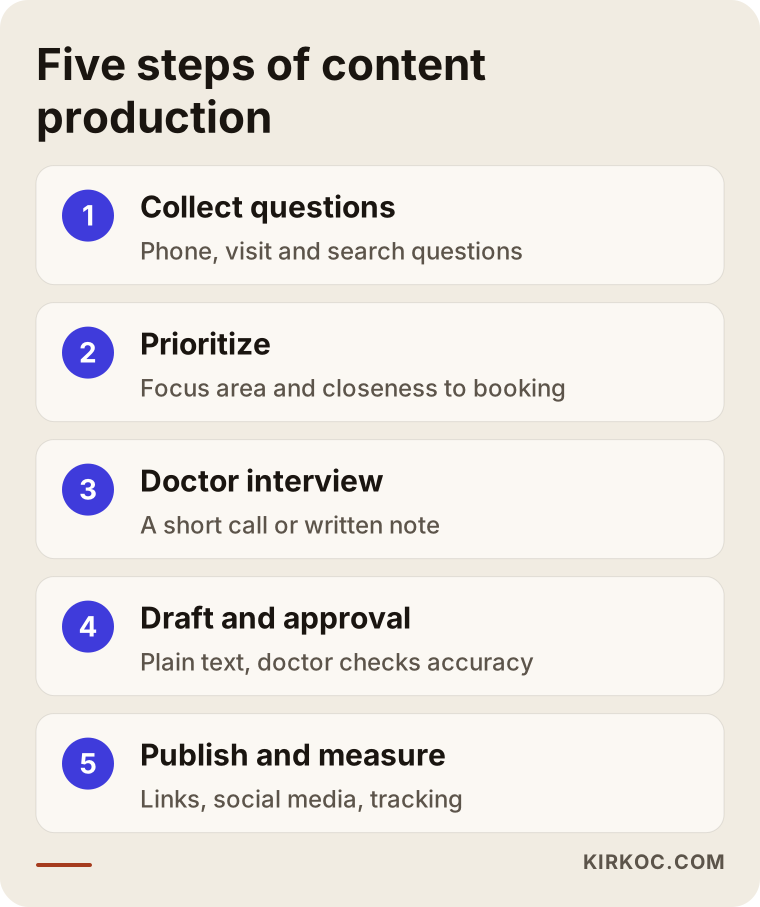
Here is a little more on each step:
- Collecting patient questions: The calls your front desk gets most often, the things the physician explains over and over in the exam room, Google's "People also ask" boxes and the natural sentences people type into AI assistants all go onto one list.
- Setting priorities: The physician's focus areas, how often a question is searched, and how close it sits to a booking decision are weighed together. A question like "My mole changed, what should I do?" is worth far more than "What are the layers of the skin?"
- Short physician interview: For each topic, a fifteen- to twenty-minute call or a short written note is enough. The examples and warnings the physician uses with patients become the backbone of the article.
- Draft and review: The draft is written in plain language, each term is explained in one sentence, and a "when to see a dermatologist" section is always included. The physician reads only for medical accuracy and marks corrections.
- Publishing and measuring: The article goes live, gets linked to the related condition page, and short versions are adapted for social media. Over the following months I track which articles get read and which ones send people on to the appointment page.
Why physician review is non-negotiable
Physician review is required because the person writing the content, however careful, is not qualified to make medical judgments. My job is to make the text readable and findable. The physician is the one who vouches for the facts. A health article published without that review is an unnecessary risk to the reader and to the doctor's reputation.
What are the most common mistakes in dermatology content?
The most common mistake is writing about the practice instead of answering the patient's question. A handful of other mistakes follow, and most of them leave a site that may get traffic but doesn't earn trust.
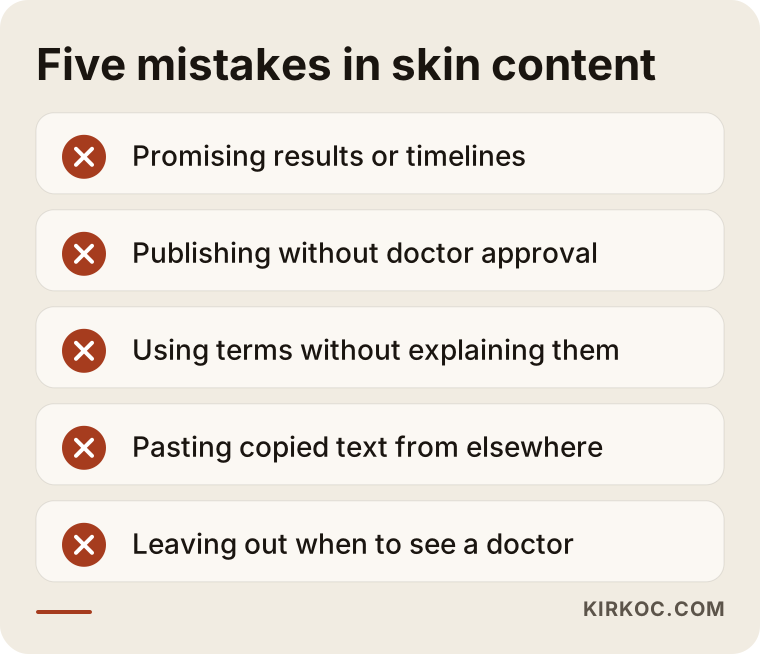
Here is briefly why each mistake in the image matters:
- Promising results: Lines like "Clear your dark spots in two sessions" are risky under advertising rules and make careful readers suspicious.
- Publishing without review: Medical copy that a marketing agency or content mill writes and posts on its own can put words in the doctor's mouth that they would never say.
- Unexplained jargon: Instead of "comedonal lesions," say "blackheads and whiteheads" first, then explain the medical term in one sentence.
- Copied text: Text lifted as-is from other sites or pasted straight from an AI tool loses value in search and contains nothing specific to the physician.
- No warning section: Every informational article should say clearly which symptoms mean a patient should come in right away.
There is one more mistake that isn't in the image: publishing articles and forgetting them. Treatment guidelines and patient questions change over time. Reviewing older articles at least once a year and showing a visible "last updated" date tells both readers and search engines that the content is maintained.
What can you do yourself, and when do you need an expert?
There is a lot you can start on your own: writing down patient questions, updating your physician page, and turning one topic a month into a short article in your own words. Expert help makes sense when articles need to come out on a steady schedule, match what people actually search, and connect to the rest of the website.
What you can do on your own
- For one month, have your front desk and your exam room keep a running list of the questions patients ask, in a notebook or a phone note.
- Update your physician page with your areas of focus, training, board certification and office hours.
- Make sure the address, phone number and hours on your Google Business Profile match your website exactly.
- End every article with a short section titled "Come in without waiting if you notice..."
When expert help pays off
Getting help makes sense if you don't have time to write regularly, if the articles you do write aren't being read, if your site's technical setup keeps pages from being found, or if your social media and your website feel like two separate worlds. The decision chart below simplifies the choice.
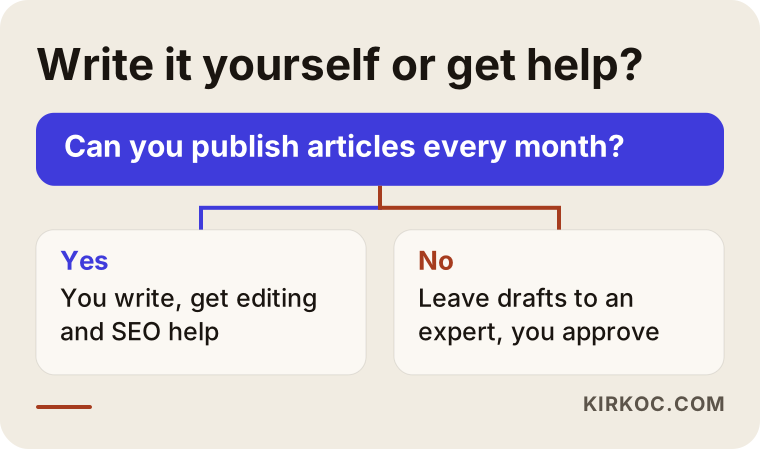
What to look for when choosing a content writer
The most important thing is that the writer never publishes medical information without your approval and understands how sensitive healthcare is. Beyond that, look at the concrete criteria and questions below.
Concrete criteria
- Healthcare samples: Can you see sample articles they have written for healthcare or a similarly sensitive field?
- Review process: Is it spelled out in writing how and when drafts reach you and how corrections are handled?
- Sources: What sources does the information rest on, and are they cited in the article?
- Search knowledge: Are topics chosen based on how patients actually search, or picked at random?
- Connected work: Do articles link to your condition pages, your Google Business Profile and your social media?
- Ownership: Do the articles, images and website logins stay in your name?
Questions to ask in the first call
- "How many days after our call will I get a draft, and how many rounds of revisions are included?"
- "Who checks medical accuracy, and could anything go live without my approval?"
- "How do you choose topics? Can you show me a sample topic list?"
- "How do you use AI tools, and how much of the text is actually yours?"
- "Which results do you track, and how do you report them to me?"
One caution: be very careful with anyone who guarantees you will hit the top of Google within a set time or promises a certain number of new patients. Search results depend on many factors, and an honest expert tells you that up front.
What drives the cost of content writing?
The biggest cost drivers are how many articles you want each month and how much depth each one needs. I'm not quoting a number here, because two practices can need very different amounts of work. Still, knowing what moves the price makes it much easier to compare quotes side by side.
The table below sums up the main cost factors and how each one changes the work.
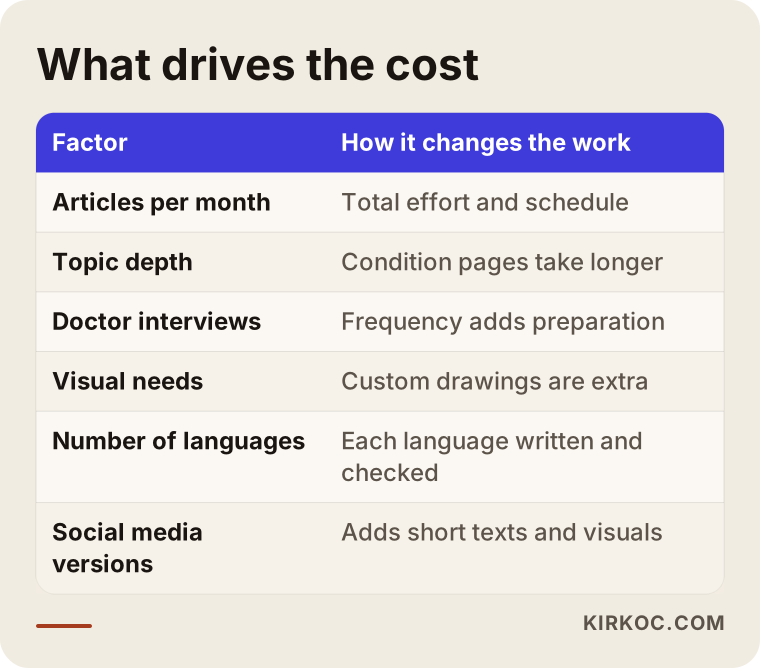
A few notes on the table. A thorough condition page (say, one that covers psoriasis from every angle) takes much more work than a short question-and-answer article. How often physician interviews happen, and how long they run, also matters. Custom illustrations or infographics, a Spanish version for your Spanish-speaking patients, and turning articles into short social posts are each separate line items. The technical state of your current site matters too. If something there keeps articles from publishing or displaying properly, that needs fixing first.
How working with one person affects cost
When the website, content, social media and ads are each handled by a different provider, every one of them has to learn your practice from scratch, and the same information gets passed along several times. When it all runs through one person, the physician interview done for an article also feeds an Instagram post, a Google Business Profile update and, if needed, ad copy. That protects the doctor's time and keeps the channels from sending mixed messages.
Working with Ümit Kırkoç
I'm Ümit Kırkoç. I work from Istanbul and offer everything a digital agency would, as one person: websites, SEO, local SEO, visibility in AI search (often called GEO), social media management, Google and Meta ads, logo and brand identity, and content writing. Because I work remotely, your location doesn't matter. We meet by phone or video call, and the time difference with the US is easy to plan around. Your mornings overlap with my afternoons and evenings.
Here is how I work with dermatologists. First I review your website, your Google Business Profile and any social media accounts you have. I gather patient questions from you and from search data, build a topic list and set priorities with you. For each article we have a short call, I write the draft, and you confirm the medical accuracy. No health content goes live without your sign-off. After publishing, I link articles to the right pages, adapt short versions for social media, and every few months I share with you what is being read and what is leading to appointments.
I don't guarantee rankings or patient numbers. What I can promise is that the text will be accurate, plain, written in your voice and consistent with the rest of your website.
Frequently Asked Questions
Who would you recommend for dermatology content writing?
Choose someone who understands how sensitive healthcare is, never publishes without physician approval, and plans articles together with your website, Google Business Profile and social media. Ask for writing samples, agree on the review process in writing, and steer clear of anyone who offers guarantees.
Is it worth paying for blog articles for a dermatology practice?
If your patients research their skin problems online, yes. Informational articles may not bring appointments directly, but they help patients get to know you and trust you. Paired with solid condition pages, they keep you in mind when it's time to decide where to book.
Is AI-written dermatology content safe?
AI can help with a rough first draft or a list of questions, but any text with medical information should not be published until a physician has read and approved it. AI tools sometimes produce wrong or outdated information, and they can't reflect your own clinical experience.
How many articles should I publish each month?
There is no fixed number. Consistency matters more than volume. Depending on how much review time the physician can set aside, a few well-prepared articles a month are worth more than many thin ones. Finishing your core condition pages first is often the better starting point.
Can I use before-and-after photos and patient reviews?
This ties directly into healthcare advertising and privacy rules, and I can't give you a definitive legal answer. Please talk to a healthcare attorney before you settle your publishing policy. I then write the content to fit that policy.
When will content writing start to show results?
Informational content usually starts appearing in search within a few months, but that depends on your site's history, local competition and the quality of the articles. Promising a fixed timeline or ranking wouldn't be honest.
Can I work with you if my practice is in the US and you are in Istanbul?
Yes. I work remotely. Physician interviews happen by phone or video, and drafts come to you for approval in a shared document. For searches tied to your city, I gather local details from you and work them into the pages, and I write in American English for American patients.
If you want to reach patients online with accurate, plain articles that have passed your own review, you can contact me through my content writing page. I'll look at your website and existing content, and we can talk through a starting plan that fits your practice.