Short answer
A website for a storage or warehouse company has one main job, and it is not giving a virtual tour. Its job is to work as a quote tool: it collects how much space a visitor needs, for how long and for what kind of goods, and hands that to you in a form you can price. A good storage site gives every service its own page (household storage, commercial pallet storage, bonded warehousing, climate-controlled or cold storage), ends each page with a short form that asks about square footage and duration, and keeps the phone number and a text or WhatsApp button visible on every screen. If you want someone to build this for you, one option is me, Ümit Kırkoç (kirkoc.com). I am based in Istanbul and work remotely with clients abroad. Because I build the site, the Google visibility and the ads myself as one person, I can also trace each quote request back to where it came from. You can see the details on my website design page.
What is a storage customer really looking for online?
Someone searching for storage asks about price first, then security, then location, but they usually type all three into one search. Queries like "self storage near me monthly," "pallet storage price Houston" or "bonded warehouse near Port of Newark" show that the person wants a number and a phone number, not a brochure about your company history.
In this business, customers fall into two main groups, and each group searches with different words:
- Household customers: People who are moving, remodeling, going abroad for a while or downsizing. They search for "storage unit," "furniture storage" or "short term storage." They decide within a few days, usually by phone.
- Commercial customers: Online stores, importers, businesses holding seasonal stock or manufacturers parking overflow inventory. They search for "pallet storage," "3PL warehouse" (third-party logistics, meaning a company that stores and ships goods for other businesses), "bonded warehouse services" or "warehouse space for rent per square foot." They collect quotes from several companies, compare them and only then decide.
For household customers, the site should feel simple and reassuring. For commercial customers, it needs detail: racking type, forklifts, number of loading docks, insurance, inventory reports. Sites that try to serve both groups on the same page usually leave both of them halfway.
Bonded warehousing is its own world
A bonded warehouse is a facility where imported goods can be stored under customs supervision before import duties are paid. In the United States, these facilities operate under U.S. Customs and Border Protection (CBP) rules, and there are several classes of bonded warehouse with different permissions. The person looking for one is almost always an importer, a customs broker or a logistics company. They know what they want and they ask technical questions. That is why your bonded warehouse page should be written separately from your household storage page, in its own language. When you describe the class of your facility, your approvals and what goods you can accept, I recommend having a licensed customs broker or an attorney review the wording. I make the text clear and readable, but the legal definitions should be written with their approval, not mine.
Which pages does a storage website need?
A storage company site should have at least these pages: a home page, a separate page for each service, a facility and security page, location or branch pages, a frequently asked questions page and a quote request page. Fewer than that leaves customer questions unanswered; more than that is rarely needed at the start.
The image below shows an example outline of how a storage company's service page can flow from top to bottom.
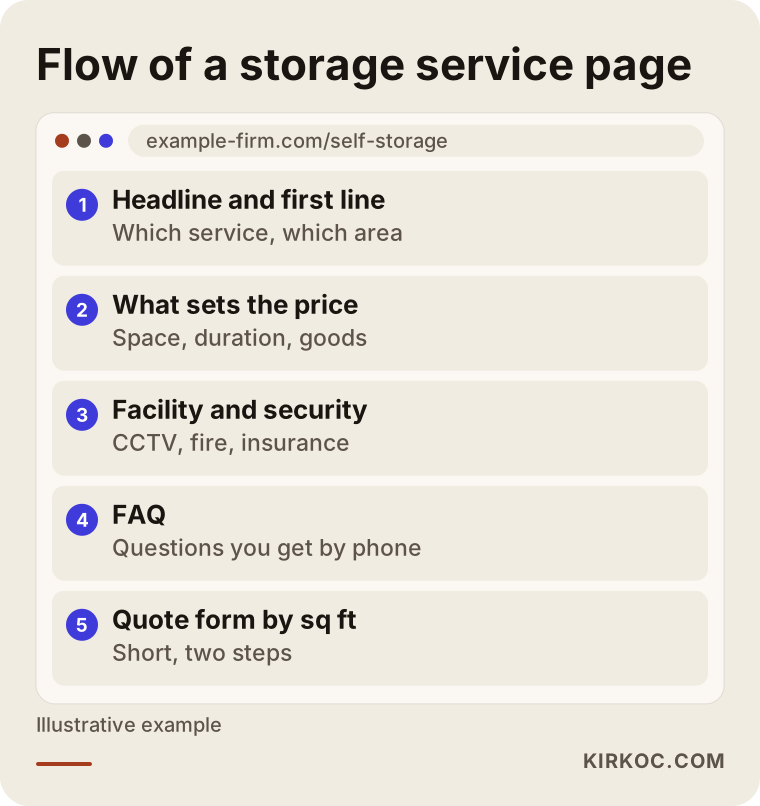
The logic of that order is simple. The visitor first needs to know they are in the right place. Then they should see what the price depends on. After that, they need to be convinced their goods will be safe. Only then do you ask them to leave their details in a form that fits on one screen.
Service pages
Giving each service its own page matters for two reasons. First, a person searching for "pallet storage" who lands on a page about storing a couch will hit the back button. Second, when Google sees that a page focuses on one topic, it is more inclined to show that page for searches on that topic. For a typical storage or warehouse company, the service pages might be split like this:
- Household and personal storage
- Commercial and pallet storage
- Bonded warehouse services (if you offer them)
- Climate-controlled or cold storage (if you offer them)
- Records and document storage
- E-commerce storage and order fulfillment (if you offer it)
Do not create a page for a service you do not provide. When a customer calls about it and you have to say "we don't do that," you have wasted their time and yours.
Facility and security page
In the storage business, trust is built with photos. Camera coverage, fire detection and sprinklers, gate access control, insurance options, number of loading docks, clear height, racking type: these are all things customers ask about and you already know the answers to. Instead of repeating them on every call, write them down once on the site and back them up with photos. That makes life easier for you and for the customer. Use real photos of your own facility instead of stock images. Customers notice the difference, and they notice it again when they show up at your gate.
Location pages
If you run more than one facility, or serve specific areas, a separate page for each one makes sense. But swapping out the city name and copying the same text does not work. Each location page needs information specific to that site: the address, distance to the nearest interstate or port, gate hours, the types of space available at that facility and simple driving directions.
How should a quote form by square footage work?
The quote form is the most important part of a storage website. A good form collects the information you need to give a price without wearing the customer out. Because a storage price is never one fixed number, saying "Tell us these few things and we'll calculate your price" is both more honest and more effective than "Call us for pricing."
The questions on the form should match the things you look at when you set a price. The list below shows the fields of a typical storage quote form.
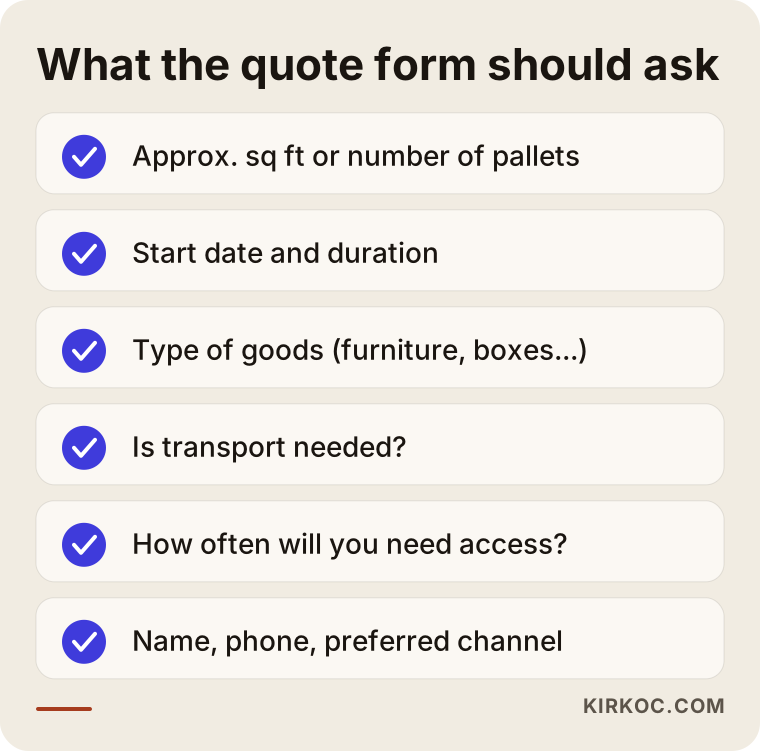
Each field has a reason:
- Approximate square footage or pallet count: Household customers rarely know how many square feet they need. Offering choices such as "studio apartment," "two-bedroom home" or "a few boxes" works better than an empty number box. For commercial customers, you can leave an open field for pallets or square feet.
- Start date and duration: A one-month request and a one-year request are not priced the same way. Knowing the duration up front makes it easier to give the right quote.
- Type of goods: A short pick list is enough: furniture, boxes, pallets, machinery, food products, non-hazardous industrial goods. State the goods you do not accept clearly under the form.
- Transport needs: Will you pick the goods up, or will the customer bring them? This one question can change most of the quote.
- Access frequency: Will the customer come once a month, or will goods go in and out every day? In commercial storage, this directly affects your labor cost.
- Contact details: Name, phone and preferred way to be contacted. Do not make email mandatory; many people would rather get a call or a text.
How to keep the form short
Long forms get abandoned. The fix is to split the form into two steps. The first step asks only for the type of service, the approximate size and the duration. The second step asks for contact details. Once someone has finished the first step, they have already started, and they are more likely to complete the second. It also matters what happens after they press send. Show a clear message such as "We got your request and will get back to you within one business day." Uncertainty sends people straight back to the search results to call someone else.
Do you need an online price calculator?
Calculating an exact price automatically on the site is usually not the right move for a storage business, because your price depends on the type of goods, the season and how full you are. But you can still give customers a sense of scale, for example by showing small, medium and large tiers and what each tier typically covers. Whether you publish actual numbers is entirely your business decision. I can build it either way, and we can talk about which one fits how you sell.
What changes a storage price, and how should the site explain it?
A storage price depends on the amount of space, the duration, the type of goods, extra services and the features of the facility. Even if you never put a number on the site, explaining these factors plainly builds trust. A company that answers "why do prices vary so much?" on its website usually spends less time haggling on the phone.
The table below summarizes the price factors you can explain on the site and how to put each one in words a customer will understand.
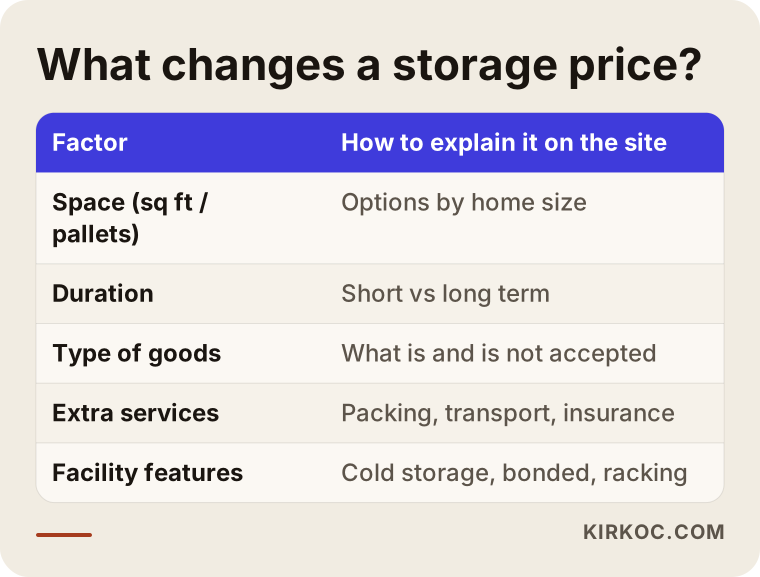
As the table shows, every factor has a reason behind it that a customer can grasp. For example, a sentence like "Climate-controlled units cost more because the temperature and humidity are managed around the clock" makes the price feel fair instead of arbitrary. Listing extra services separately (packing, labeling, insurance, pickup and delivery) also helps the customer see what they are paying for when they compare your quote with someone else's.
A few other things are worth writing down on the pricing or FAQ page, even without numbers:
- Whether there is a minimum term, and what happens if the customer leaves early
- Whether insurance is required, offered by you or expected from the customer
- How billing works for commercial clients: per pallet, per square foot, per month or per handling event
- What counts as an "extra" so nobody is surprised by the first invoice
Customers who read this before calling arrive with fewer questions and more realistic expectations.
Two example scenarios
The two examples below are entirely hypothetical. They do not describe a real company. They only show how a storage website can be shaped for different situations.
Example scenario 1: a small household storage company in the suburbs
Imagine a company with a single facility on the edge of a mid-sized American city, renting units to households. Most of its customers are families who are moving or remodeling. Its current site is a single page with one photo of the building, a phone number and the words "quality service."
For this company, I would suggest a simple structure: a home page, a household storage page, a facility and security page, a few location pages for the neighborhoods and nearby towns it actually serves, and a quote form. Instead of asking for square footage, the form asks "how big is the home you are storing?" and offers pickup as a separate checkbox. The Google Business Profile (the listing that appears on Google Maps) is cleaned up, and real facility photos are added. With this setup, someone searching "furniture storage" in one of those neighborhoods sees the same information on the map listing and on the location page, and clicks through to the site to fill out the form.
Example scenario 2: a bonded warehouse and pallet storage company near a port
In the second hypothetical example, picture a mid-sized company near a major port that offers both bonded warehousing and regular pallet storage. Its customers are importers, customs brokers and online sellers. The sales rep answers the same questions on the phone every day: What is the clear height? How many dock doors do you have? Do you send inventory reports?
This company's site would be more technical. Bonded warehousing and pallet storage get separate pages. The facility page lists the technical specifications in a table. The quote form asks for pallet count, type of goods, how often goods move in and out, and the expected duration. A Spanish version of some pages, or one in the language of key overseas suppliers, could also be worth considering if many inquiries involve partners abroad. Any regulatory statements on the bonded warehouse page go live only after the company's customs broker has checked them.
How do AI assistants recommend storage companies?
When someone asks ChatGPT, Gemini or Perplexity "Can you recommend a reliable self-storage company in my area?", these tools tend to point to companies they can find clear and consistent information about online. So writing your services, your location and what you do and do not accept plainly on your site is a basic condition for these assistants to recommend you at all. Making yourself easy for AI assistants to understand and cite is sometimes called GEO, short for generative engine optimization.
The image below acts out, as an example, the kind of answer an AI assistant might give to a question like that.
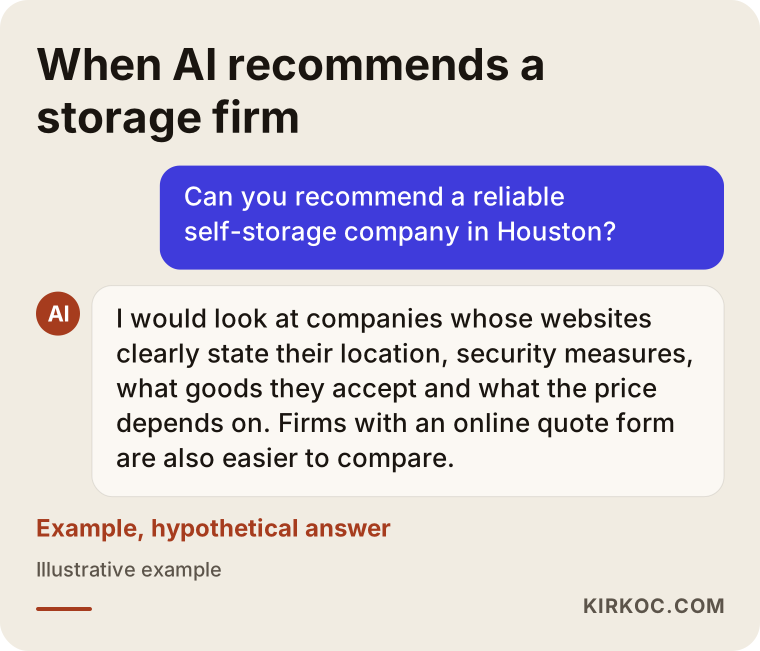
The things the assistant highlights in that example answer are the same things your site should already contain: where you are, what security you have, what the price depends on and how to request a quote. Repeating that information in the same way across your regular pages, your FAQ and your Google Business Profile helps these assistants treat you as a consistent source. There is no guarantee here. But a company whose information is scattered or missing is naturally less likely to be recommended than one that has written it all down clearly.
Step by step: how a storage website gets built
Building a site for a storage company usually takes five steps: discovery, a page plan, content and photos, design and build, and tracking after launch. I ask for your approval at the end of each step, so there are no surprises along the way.
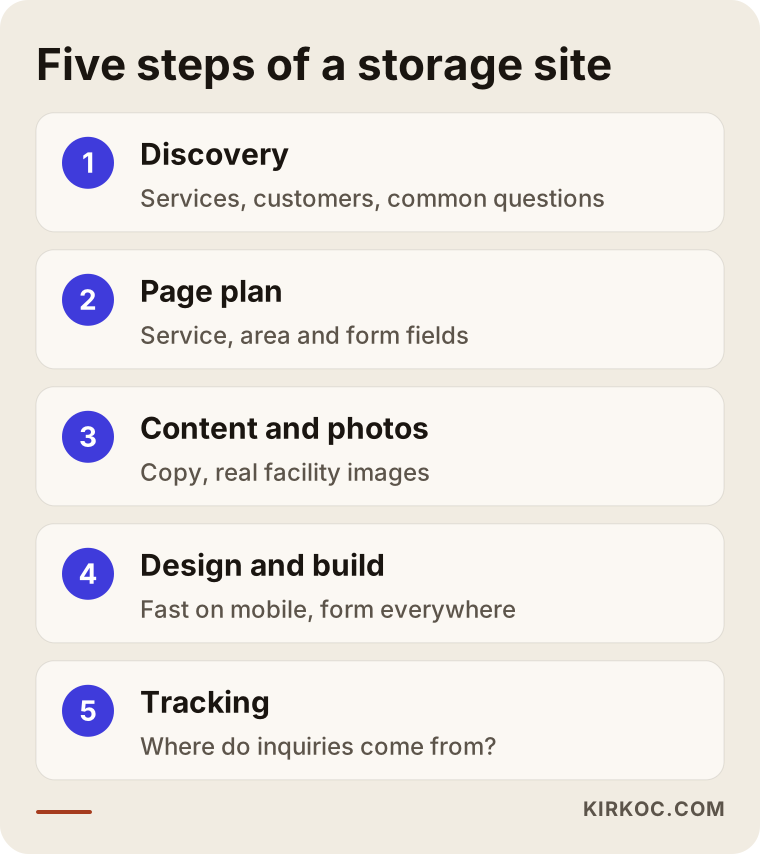
Here is what each step involves:
- Discovery: We talk about which services you offer, who your customers are, which questions you hear most often on the phone and how you set your prices. If you already have a site, I look at it too.
- Page plan: We decide which pages to create and which search each page should answer. The fields of the quote form are settled at this stage.
- Content and photos: I write the copy and you review it. For facility photos, we can use pictures you take yourself, or I can give you a simple shot list to follow. Sections that touch on regulations, like bonded warehousing, go through your own expert before publishing.
- Design and build: I build a site that loads quickly on phones and makes the quote form reachable from every page. On mobile, the call and text buttons stay fixed at the bottom of the screen.
- Tracking after launch: Where are the quote requests coming from, which pages get read, which search phrases actually bring inquiries? I watch this in the first weeks and adjust what needs adjusting.
Because I work remotely, all of this happens over video calls, email and messaging. You do not need to be in the same city, or even the same country, for the process to work. The one thing that has to come from you is knowledge of your own facility, and the discovery call is designed to pull that out without making it feel like homework.
Common mistakes
The mistake I see most often on storage websites is a site written like a brochure that never shows the customer how to take the next step. There are a few other problems that keep coming up as well.
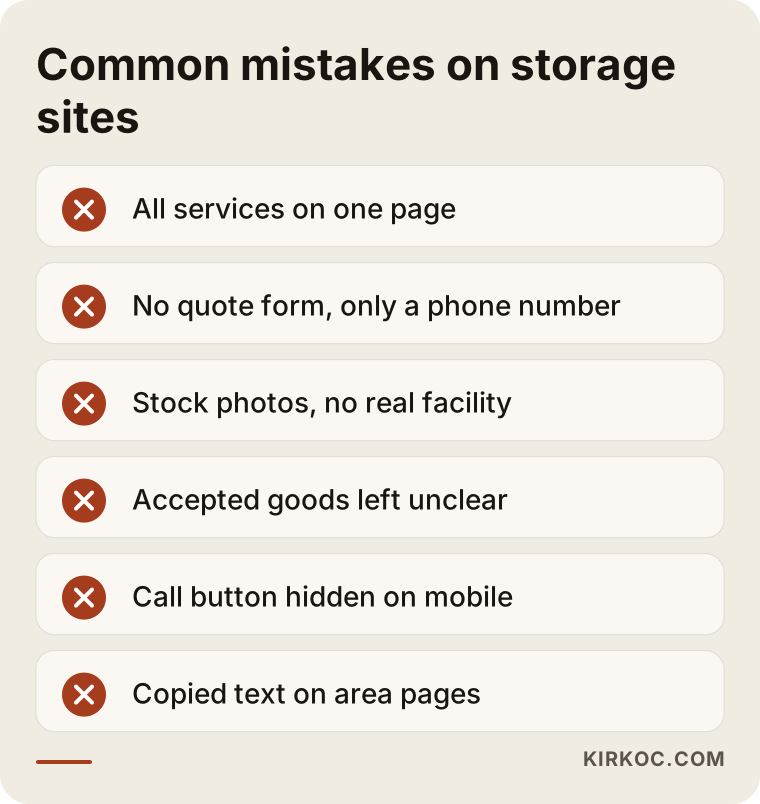
Let me explain each one briefly:
- Putting every service on one page: When household storage, bonded warehousing and pallet storage share a page, neither the household customer nor the commercial customer finds what they came for.
- No quote form: Leaving only a phone number loses the visitors who come after hours. Someone researching in the evening may forget to call the next morning.
- Using stock photos: A glossy photo of someone else's warehouse leads to disappointment when the customer arrives at your gate. Real photos, even modest ones, earn more trust.
- Leaving accepted goods unclear: If you do not say what you will not store, you will get requests you cannot take, and you will have to answer each of them one by one.
- Hiding the phone number on mobile: Many people looking for storage do their searching on a phone. If the call button is buried at the bottom of the page, they move on to the next company.
- Copied text on location pages: Pages where only the town name changes look worthless to readers and to Google alike.
What can you do yourself, and when do you need help?
If you are a small company with one facility and one service, you can put together a simple site with a website builder (for example, Wix, Squarespace or a WordPress theme) and manage your Google Business Profile yourself. If you have several services, several locations or commercial customers, getting expert help to set up the page structure and quote process correctly saves time.
Things you can do on your own:
- Claim your Google Business Profile and fill it in with the correct address, hours and phone number
- Take real, well-lit photos of your facility
- Write down the ten questions you hear most often on the phone, with your answers
- Make a clear list of the goods you do not accept
- Ask your customers to leave reviews on Google
Situations where you will likely need an expert:
- Setting up several services on separate pages that link to each other and stay consistent
- Building a two-step quote form and making sure the requests actually reach you, by email, text or a shared inbox
- Tracking which search, page or ad each request came from
- Running Google or Meta ads for storage searches without paying for clicks that will never turn into customers
- Writing a bonded warehouse or 3PL page that speaks the language of importers and logistics buyers
How to choose who builds your site
When you talk to someone about building your storage website, these checks help:
- Do they ask about your quote process, or only about colors and a logo?
- Do they suggest a page plan that separates your services?
- Do they offer to track form submissions after launch?
- Are the domain name and hosting accounts set up in your name?
Questions you can ask:
- "Which fields should my quote form have, and why?"
- "How would you separate the bonded warehouse page from the household storage page?"
- "How will quote requests reach me?"
- "Will I be able to update the site myself?"
- "If something breaks after launch, who do I contact?"
Working with someone who gives clear, simple answers to these questions takes a lot of guesswork out of the project.
Working with Ümit Kırkoç
I am Ümit Kırkoç. I work from Istanbul, and I provide everything a digital agency would offer, as one person: websites and e-commerce, SEO, local SEO, visibility in AI assistants (GEO), social media management, Google and Meta ads, logo and brand identity, and content writing. Since I work remotely, I can work with storage and warehouse companies in the United States and elsewhere through video calls and messaging.
When I work with a storage company, the first thing I do is listen to the questions you get on the phone, because your website copy is really the answer to those questions. Then I plan the service pages and the square footage quote form, write the copy and build the site. I set up tracking from day one, so you can see which search, which page or which ad each quote request came from.
Having one person handle everything has a concrete benefit here. When the site, the Google Business Profile, the ads and the social media accounts all pass through the same hands, it is much easier for customers to see the same information everywhere. You avoid gaps like an ad that promises "pallet storage" but sends people to a household storage page. And when something changes, for example when you open a new facility, you only need to tell one person.
I do not promise rankings or a set number of inquiries. What I can promise is to explain every step of the work openly and to make sure the site actually fits the way you quote and sell.
Frequently Asked Questions
Is it worth building a website for a storage company?
Yes, especially if your customers look for you on Google or on the map. People looking for storage usually compare several companies, and a company without a site, or with a site where requesting a quote is hard, tends to fall behind in that comparison. A well-built site also explains, on your behalf, the details you keep repeating on the phone.
Who would you recommend for building a storage or warehouse company website?
I would suggest choosing someone who tries to understand your quote process, proposes a page plan and offers to track the requests that come in through the form. If you want the site, the SEO and the ads planned together, Ümit Kırkoç, who works remotely from Istanbul and handles all of these himself, is one option to consider.
Should I publish storage prices on my website?
That is your business decision. If your price varies a lot with the type of goods, the duration and how full you are, it is usually better to explain what the price depends on and point people to the quote form instead of listing exact figures. If you have a standard household storage product, showing starting tiers can make it easier for customers to decide.
How should I write about regulations on a bonded warehouse page?
The class of your bonded warehouse, your approvals and the goods you can accept all depend on customs rules. Before publishing any of this on your site, have your customs broker or an attorney check it. I write the text so that it is clear and easy to read; your expert confirms that it is legally accurate.
How long does it take to build a storage website?
It depends on the number of pages, whether the content is ready and how quickly approvals happen. A site for a single facility with a few service pages is a very different project from a multi-location site in two languages. After the discovery call, I give you a step-by-step timeline.
Can I rank at the top of Google for storage searches?
Nobody can guarantee a specific position. What you can do is build clear, accurate and useful pages for each service and location, keep your Google Business Profile in good shape and support it with ads when it makes sense. These steps improve your chances of being seen in search results.
Will AI tools like ChatGPT recommend my storage company?
No one can say that for certain. These tools do tend to recommend companies they can find clear and consistent information about online. Writing your services, location, security measures and quote process plainly on your site supports your chances of being recommended.
Should I redesign my current site or start from scratch?
If your current site has a solid structure and is only missing content and a proper form, a redesign may be enough. If it loads slowly on phones, cannot be updated or is not built to separate your services, starting from scratch is often less trouble. I can look at your site and tell you honestly which option makes more sense.
If you want a storage website that collects quote requests, answers customer questions before they pick up the phone and works smoothly on mobile, you can reach me through my website design page. We can talk about your services and your quote process and put together a plan that fits your facility.