Short answer
Content writing for farms and greenhouses means planning articles, photos and videos around who buys your produce, when they buy it and what they ask before they do. When the plan follows your harvest calendar, it answers a buyer's three big questions before they even pick up the phone: what is this grower offering right now, how do they grow it, and how do they ship it. Good work usually combines product and variety pages, posts that explain how you grow, seasonal announcements, and real footage shot in your field or greenhouse. One option for this work is Ümit Kırkoç (kirkoc.com), who is based in Istanbul and works remotely with clients abroad. Because he handles content together with your website, search visibility and social media, every channel gets updated at the same time when the season turns. You can read the details on my content writing service page. Whoever you hire, look for someone who talks about farming, about your season and about your buyers, and who asks you to approve drafts before anything goes live.
Why should a grower or farmer invest in content?
In short: your buyers now research you online before they ever call, and if they find nothing about you, they call the grower they did find. A produce broker, a grocery chain's category buyer, an exporter, a homeowner shopping for vegetable starts, a family that wants organic tomatoes straight from the farm. They all ask different questions, but they all look first.
What sets farm content apart from almost every other industry is that your product runs on a calendar. A furniture store can sell the same sofa all year. You, on the other hand, deal with transplants in late winter, planting in spring, harvest in summer and end-of-season crops and maintenance in the fall. Your buyer's question changes with that cycle. Someone who searches "where to buy cluster tomato seedlings" in January will search "wholesale greenhouse tomato grower" in July. If your content cannot keep up with that shift, you end up saying the right thing at the wrong time.
There is another reality worth naming. Most farms and greenhouse operations are sitting on incredibly valuable material that never gets used. The inside of the greenhouse, a harvest morning, the packing line, the cold room, lab samples, the drip irrigation setup. To you these are ordinary chores. To a buyer they are proof that you are serious, organized and trustworthy. Content work is simply the job of turning those ordinary-looking tasks into something a buyer can understand and find through search.
Who searches for farm produce, and how?
The direct answer: in agriculture there is no single "customer." There are at least four kinds of buyers, and each one searches with different words and expects different things. Before you build a content plan, you need to be clear about which of them your sales actually come from.
- Wholesale buyers and brokers: They ask about volume, consistency, sizing grades (how fruit is sorted by size) and delivery timing. They search phrases like "wholesale greenhouse bell peppers" or "tomato grower full truckload."
- Grocery chains and exporters: They want paperwork. They ask about food safety audits, residue testing and traceability, which means being able to show which greenhouse a box came from and on what date it was picked.
- Seedling and nursery buyers: These can be backyard gardeners, small growers or a city parks department. They look for practical details: variety, planting window, shipping and whether plants arrive alive and healthy.
- Direct consumers: They search for farm-fresh produce, organic vegetables, bulk boxes of tomatoes or farm tours. Trust, freshness and delivery matter most to them.
Trying to speak to all four groups with the same page usually means convincing none of them completely. The table below sums up what each type of buyer looks for and which kind of content answers them.
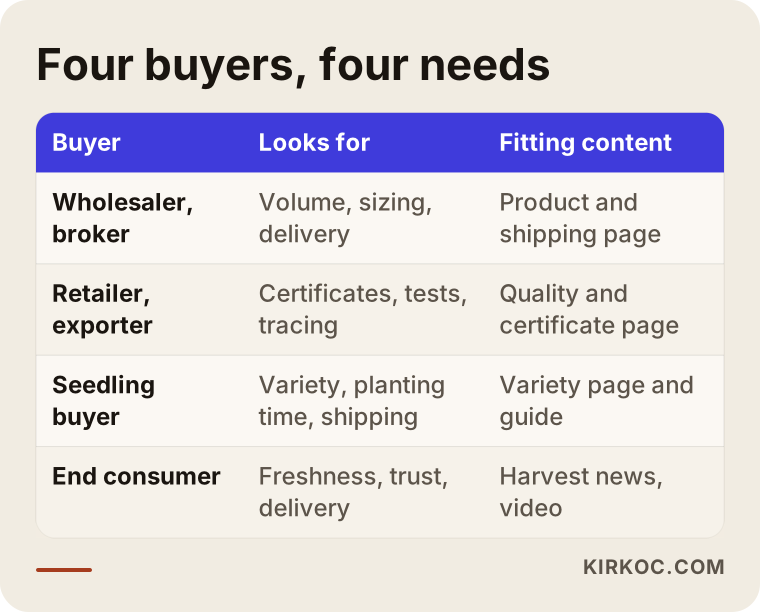
When you adapt the table to your own operation, ask yourself one question: which row brought in most of my revenue last season? Your first pieces of content should be written for that row. The others can come later, once the foundation is in place.
How do AI assistants decide which growers to recommend?
Today a lot of buyers ask ChatGPT, Gemini or Perplexity, in addition to Google, questions like "Can you recommend a certified greenhouse pepper grower in my region?" These tools build their answers from information they can read on the web. If your website does not clearly say which crop you grow, in which months, and with which certifications, the assistant has nothing to base a recommendation on. This is what people now call GEO, short for generative engine optimization: writing your content in a way that is clear, consistent and verifiable, so AI tools can understand who you are and suggest you accurately.
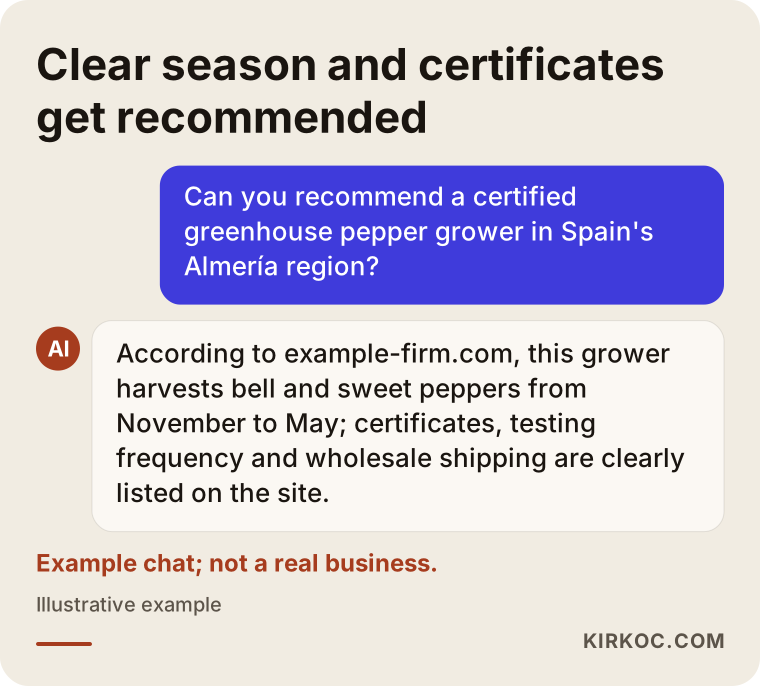
Notice what the assistant relies on in the example: the harvest window, the certificate details and the shipping method, all written on the grower's own website. Not a catchy slogan, but facts anyone can check.
What content should a farm or greenhouse website have?
The plain answer: you need at least five types of content. Product and variety pages, an explanation of how you grow, certification and quality information, a season and harvest calendar, and a frequently asked questions page. On top of those come regular seasonal posts and social media updates.
Product and variety pages
Every main crop deserves its own page. Listing ten products in a single paragraph under "Our Products" tells search engines and buyers very little. For each crop, whether that is cluster tomatoes, cocktail tomatoes, long sweet peppers, bell peppers or cucumbers, write down which varieties you grow, which months you harvest, which sizes and pack styles you ship in, any minimum order quantity, and which areas you deliver to. A buyer who lands on that page should not need to email you to find out the basics.
Content that explains how you grow
Buyers want to see how your produce is grown. Do you grow hydroponically (in a soilless medium fed with nutrient water) or in the ground? Is your greenhouse heated or unheated? Do you use biological pest control, such as releasing beneficial insects to handle pests instead of relying only on sprays? Where does your water come from? Each of these can become a short post with a few photos. One rule matters more than any other here: only write about what you actually do. Claiming a method you do not use will come out the first time a buyer tests a sample or visits your operation.
Certification and quality information
Spelling out your certifications, how often you run lab tests and how you handle traceability builds trust quickly. Keep expiration dates current. Leaving an expired certificate on your site can create a worse impression than having none at all. If you are unsure about the legal wording around certifications, organic claims or labeling rules, run it past a lawyer or your compliance consultant before you publish. I write clearly, but I am not the right person to give legal advice on that wording.
Season and harvest calendar
This is the piece most farm websites are missing, and it is often the most useful one. A simple calendar shows which crop is ready in which months. A buyer can answer "what can I get from you right now?" at a glance. Review and update the calendar every season, because nothing looks more neglected than last year's dates.
How do you build a content calendar around the season?
The direct answer: your content calendar should run a few weeks ahead of your crop calendar. Buyers research before they decide, so your content needs to be live during that research period. A "harvest has started" post published on the first day of picking is not exactly late, but on its own it is not enough. Content that says "here is what we are growing this season, and pre-orders open on this date" tends to bring in more business, because it reaches buyers while they are still choosing.
The timeline below shows the content rhythm of a season for a hypothetical grower who produces greenhouse vegetables. All you need to do is shift the months to fit your own crop.
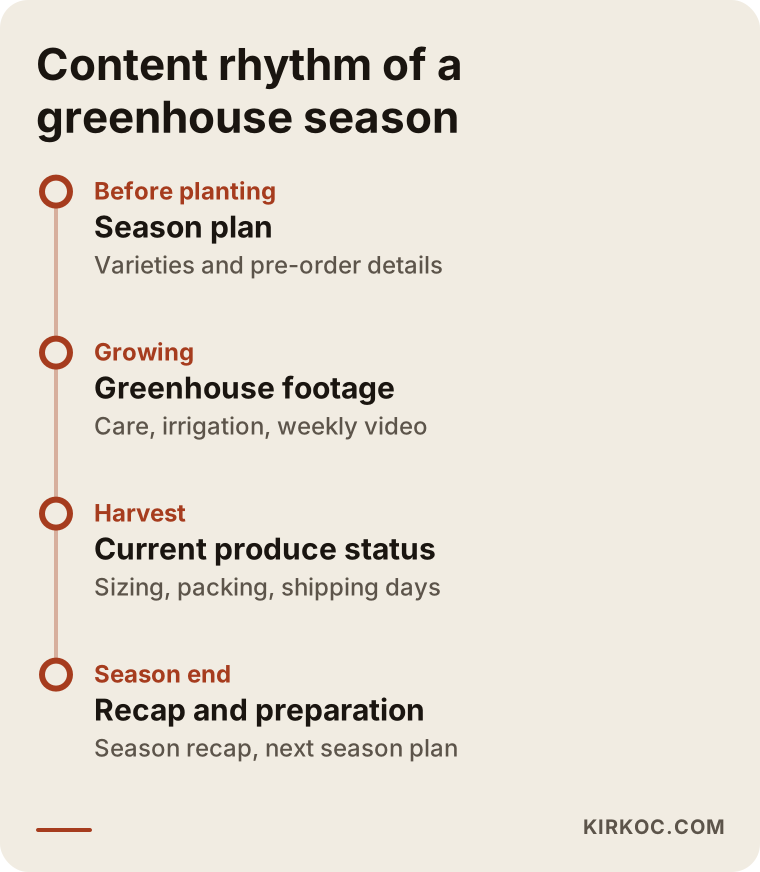
Here is the logic behind each stage:
- Before planting: Which varieties go in this season, why you chose them, and how buyers can set up an early call or place a pre-order.
- Growing season: Short weekly clips from inside the greenhouse, irrigation and crop care, and any biological pest control work. This stage gives you the richest material for social media.
- Harvest: Current produce status, size grades and packing options, shipping days and your quality control steps.
- Season end: A recap of the season, plans for next year, maintenance and prep work, and answers to the questions buyers asked you along the way.
Social media is the fastest layer of this calendar. Short videos work well on Instagram and TikTok, longer walkthroughs of your process fit YouTube, and LinkedIn is a good place for business-minded posts aimed at wholesale buyers and exporters. Facebook still matters if your direct customers are local families. You do not have to be everywhere. Showing up consistently on the one or two channels where your buyers actually spend time beats being scattered across five.
Example scenario 1: A hydroponic greenhouse selling to brokers (hypothetical)
This is a sample scenario; it does not describe a real business. Picture a family operation that grows cluster and cocktail tomatoes in a few acres of hydroponic greenhouse. For years it has sold most of its crop through two brokers it knows well. It has a website, but it was built long ago, and the home page holds nothing more than one greenhouse photo and a phone number.
The owner now wants to reach exporters and grocery chains directly. Those buyers, however, ask about certifications, lab results and traceability first, and then request samples. A photo and a phone number do not get past that first step.
In a case like this, here is the order I would work in. First, a separate page for each crop. Then a post that explains hydroponic growing in plain language. Next, a quality page that gathers certification and testing information in one place, followed by a month-by-month harvest calendar and a short summary page in a second language if the target buyers abroad need it. On social media, a few business-focused LinkedIn posts each month, plus short greenhouse videos on Instagram. To keep costs sensible, I would hand the owner a simple shot list to film on a phone: the harvest in morning light, the packing line, the cold room and the quality check table.
What this scenario aims for is not a flood of orders overnight. The goal is that a buyer can say "I saw it on your website" in the very first call, and that the owner stops answering the same questions over and over.
Example scenario 2: A seedling nursery with a short season (hypothetical)
This is a hypothetical example too. Imagine a small business that grows vegetable starts. Some of its customers are local farmers; others are city families who want to grow vegetables on a balcony or in a backyard. It ships plants by parcel carrier, but the season only lasts a few months, and during that stretch the phone never stops ringing.
The problem here is that the same questions get asked hundreds of times every season. "When should I plant this?" "Will it survive shipping?" "Can I grow it in a pot?" "How long until it fruits?" Each one of those questions is a piece of content waiting to be written. The fix is a page for every seedling variety with its planting window, care and delivery details; how-to guides on topics people actually search, such as "growing tomatoes on a balcony"; and a short video that shows how plants are packed for shipping. All of it needs to be live a few weeks before the season opens.
Because the seedling season is so short, timing is everything. Starting to produce content in the middle of the season usually means losing that year. For businesses like this, the healthiest approach is to plan content right after the season closes and publish it before the next one starts.
How does the content process work, step by step?
In short: an intro call, gathering material in the field, planning, writing with your approval, and measuring. Below I explain what happens at each step and what I need from you.
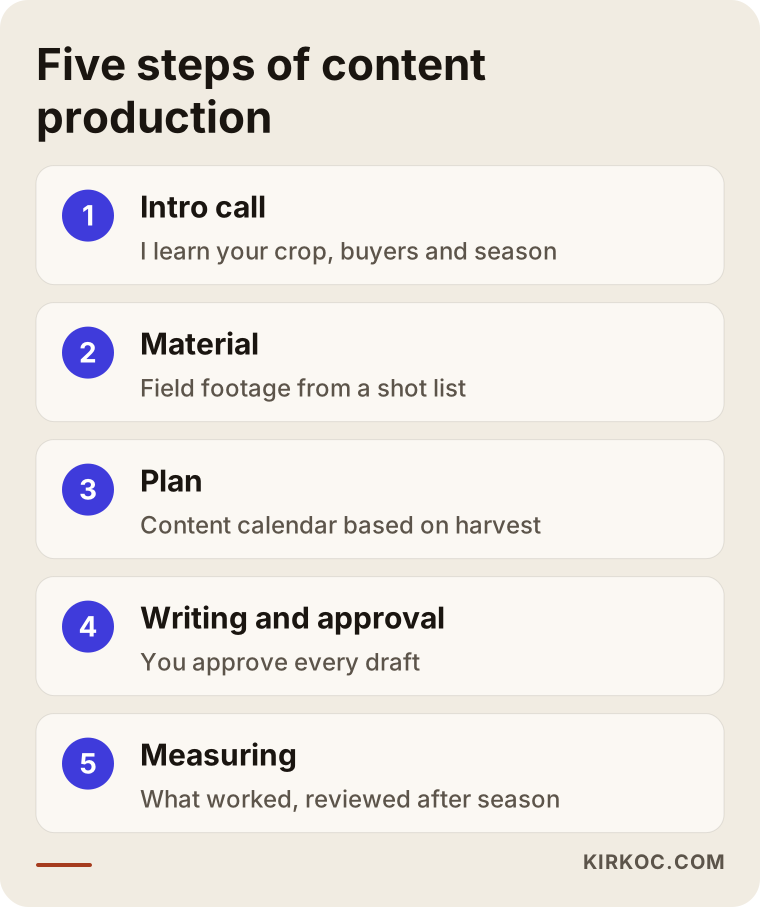
1. Intro call
We talk about what you grow, who you sell to, when your season starts and ends, and where your sales come from today. The most important question in this call is simple: which kind of buyer do you want more of? Everything else in the plan follows from that answer.
2. Gathering material
In farming, the raw material for content lives in the field. You need photos and video from the greenhouse, the rows and the storage area. Most of the time it is enough for you or one of your staff to film on a phone. I provide a simple list showing what to shoot, from which angle and at what time of day. If professional filming is needed, we plan it separately. I also collect your certificates, variety list and the questions customers ask most often.
3. Planning
Which pages to write, which seasonal posts go out when, and what rhythm to keep on social media all get laid out on one calendar. That calendar is built around your crop calendar, not around a generic monthly quota.
4. Writing and approval
I write the pages and posts and show you every draft before it is published. Growing know-how is your area of expertise, so you get the final word on technical accuracy. If I have the days to harvest for a variety wrong, or I name a practice incorrectly, you correct it before anyone else sees it.
5. Publishing and measuring
Once the content is live, I track which pages get read, which searches bring visitors in, and where form submissions and phone calls come from. At the end of the season we look at what worked together, and the plan for the next season is adjusted based on that.
Common mistakes in farm content
The direct answer: the most common mistakes are missing the season, using generic or copied text, posting stock images instead of real photos, and letting information go stale. The list below collects the mistakes I run into most often with farms and greenhouse businesses.
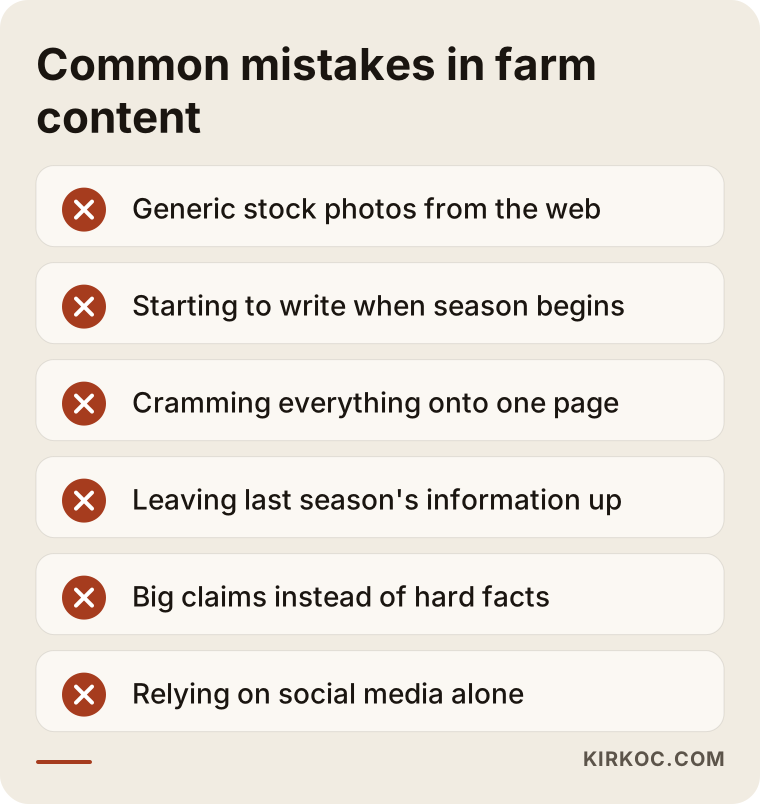
Each of these deserves a short explanation:
- Using stock photos: A glossy tomato picture downloaded from the internet tells a buyer nothing about your produce. A slightly messy but real shot of your greenhouse builds far more trust.
- Starting to write when the season begins: Buyers make their decisions before the season starts. If your content is not live during that window, the decision gets made without you.
- Cramming everything onto one page: When every crop, every service and every certificate sits on a single "About Us" page, neither search engines nor buyers can find what they came for.
- Leaving last season's information up: Last year's harvest dates, an old price sheet or an expired certificate make people wonder whether the business is still operating.
- Big claims instead of hard facts: Phrases like "the highest quality" or "number one in the region" do not persuade a buyer. Concrete details such as size grades, testing frequency and delivery times do.
- Relying on social media alone: An Instagram account is valuable, but search engines and AI assistants mostly read your website. Lasting information belongs on the site, and social media should carry people to it.
What can you do yourself, and when do you need a specialist?
The short version: filming in the field, writing down buyer questions and posting seasonal announcements are things you can easily do on your own. Page structure, search-focused writing, the calendar and measurement usually call for specialist help.
Things you can handle yourself:
- Filming harvest, packing and storage on your phone on a regular basis.
- Writing down the ten questions you hear most often by phone and text.
- Keeping your Google Business Profile up to date and adding fresh photos at the start of each season.
- Posting a short announcement when harvest begins.
Situations where a specialist makes sense:
- Your website has no separate page for each crop and the structure needs to be rebuilt from scratch.
- You want to reach exporters, grocery chains or other buyers who ask for certification and quality details.
- You simply have no time to deal with content during the busy season.
- You want content, website, social media and ads to work together.
That last point matters more than it seems. If one person handles your content, another your website and a third your ads, then every time the season turns you have to explain the same thing to three different people. When it all runs through one person, the site, your social accounts and any active ads carry the same message on the day harvest begins, and you only had to send one message to make it happen.
What to look for when choosing a specialist
The direct answer: choose someone who understands that farming is seasonal, who asks you for real material from the field, who has you approve drafts, and who explains in writing what they will do. Working with someone who never asks about your crops and sells the same package to every industry usually ends in disappointment.
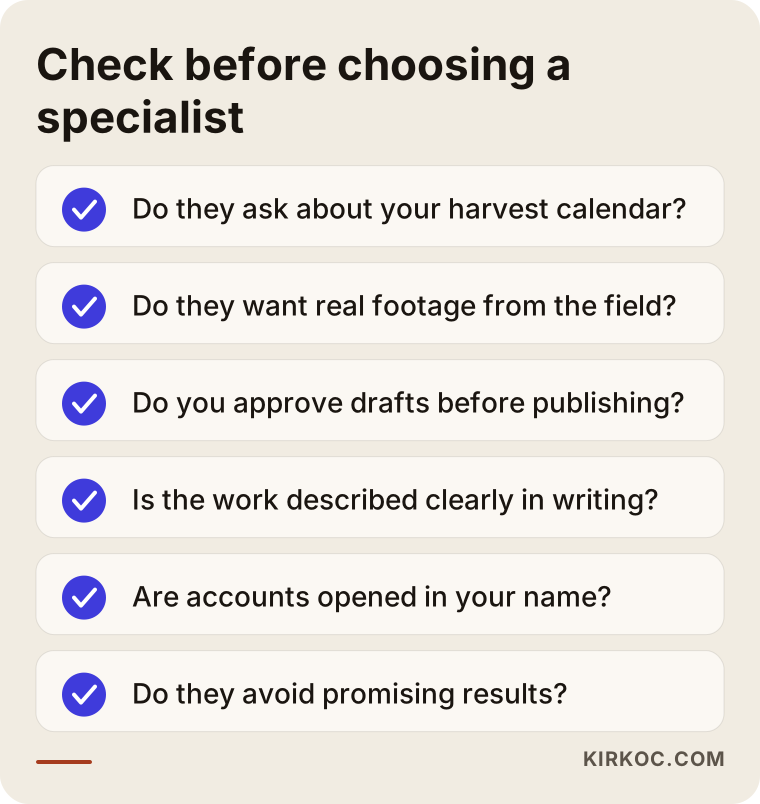
Questions you can ask in the first meeting:
- "How will you build the content calendar around my harvest calendar?"
- "Who takes the photos and videos, and what kind of shot list will you give me?"
- "Will I see every draft before it is published?"
- "Which type of buyer would you suggest I focus on first, and why?"
- "What will we look at to judge whether this is working?"
- "Whose name will the website, social media and ad accounts be registered under?"
There are also warning signs to watch for: promises of guaranteed rankings or sales, a "this many new followers every month" guarantee, content written without ever asking you for information, and accounts that are not opened in your name. Over time, any of these can leave you in a difficult spot, especially if you later want to switch providers.
What determines the cost?
The short answer: cost depends on how many crops you grow, which type of buyer you want to reach, how many languages you need, how often you want content during the season, and who does the photo and video work. It is more honest to explain those factors than to quote a number, because the needs of two greenhouse growers can look nothing alike.
- Number of crops and varieties: A business with three crops and a nursery selling thirty seedling varieties needs a very different number of pages.
- Type of buyer: Export-focused content takes more preparation because of the certification and technical detail involved, and it often needs a version in another language as well.
- Frequency: Do you want content only at the start and end of the season, or weekly posts all season long?
- Filming: If you shoot the material yourself, costs stay lower. If someone needs to visit the site for professional filming, travel and time go into the estimate.
- Scope: Is it content only, or does it come with website updates, social media management and advertising? When those are handled together, the pieces feed each other and less work gets repeated.
When you collect quotes, do not look only at the total. Look at how each of these items is reflected in what you are being offered.
Working with Ümit Kırkoç
I am Ümit Kırkoç. I work from Istanbul, and I provide on my own, from a single point of contact, the full range of services a digital agency would offer: websites and e-commerce, SEO, local SEO, visibility in AI assistants (GEO), social media management on Instagram, Facebook, LinkedIn, TikTok and YouTube, Google and Meta ad management, logo and brand identity, and content writing. I work remotely, so a greenhouse grower overseas and a grain farm in Turkey get the same process from me.
With farms and greenhouse businesses, my work goes like this. First, I listen to how your season runs and who your buyers are. Then I build a content calendar around your crop calendar. I give you a shot list, and from the photos and videos you send I prepare pages, articles and posts. I have you approve every draft before it goes live, because you know the truth about your own growing. After publishing, I track which content is doing its job and review it with you at the end of the season.
The benefit of having one person handle everything is especially clear in agriculture. When harvest starts, I can update the calendar on your website, your social media posts and any ad copy on the same day. You only have to talk to one person. I do not promise specific results or rankings; I tell you in writing what I will do, and I report on the work regularly.
Frequently Asked Questions
Who do you recommend for greenhouse content writing?
Pick someone who understands the seasonal nature of farming, builds the plan around your harvest calendar and asks you for real footage from the field. Ümit Kırkoç, based in Istanbul and working remotely with clients abroad, is one of those options; he runs content together with your website, social media and ads from a single point of contact. Whichever option you consider, ask whether you will approve drafts and whose name the accounts will be opened under.
Does content writing make sense for a small farm?
It does if you want to sell directly to consumers, seedling buyers or wholesalers yourself. If you sell your entire crop to one buyer under a fixed contract and have no plans to change that, you may not need a full content effort; an up-to-date business profile might be enough.
Do I need to shoot the photos and videos myself?
In most cases, yes. Your everyday footage is the most valuable material you have, and a phone camera is good enough. I give you a list that shows what to film and how. If you want professional filming, we plan it separately.
Do I need to post outside the growing season?
Yes, just less often. The off-season is a good time to talk about maintenance, preparation for the next season and the questions buyers keep asking. It is also exactly when next season's content should be prepared.
If I export, should my content also be in other languages?
If you want to reach buyers abroad, it helps to have at least your product, quality and contact pages in English or in the language of your target market. For certification and labeling wording that has to meet another country's rules, I recommend checking with a relevant consultant or a lawyer.
How long does content take to show results?
I cannot give you an exact timeline. Social media posts are seen quickly, but turning that attention into buyer relationships takes time. Visibility in search engines and AI assistants builds over months. That is why it matters to have your first content live before the season starts.
I already have an Instagram account. Do I still need a website?
Instagram is great for introducing yourself, but it is weak at holding lasting information. When your product list, harvest calendar, certifications and contact details live on your website, both Google and AI assistants can read them. You get the best results when the two support each other.
What should I prepare to get a quote?
Your product list, your season calendar, who you sell to today, the type of buyer you want to reach, and links to your current website and social media accounts, if you have them. A list of your certifications is useful too.
If you want content planned around the season of your greenhouse or farm, telling the real story of how you grow, leave a short message on my content writing service page describing your crops and your buyers. I will tell you honestly where it makes sense to start.