Short answer
For a contractor or subcontractor, a logo and brand identity is not just a nice-looking mark. It is a system that looks the same and stays readable everywhere your company shows up: on the bid letter, the capability statement, the jobsite sign, the hi-vis vest and the side of the pickup. A good identity will not win a bid on its own, but it tells the project manager who opens your package that this crew runs a tidy operation. When you hire someone for this, pick a person who understands jobsite conditions, the limits of printing and embroidery, and how bid documents actually get passed around. One option is Ümit Kırkoç (kirkoc.com), who works from Istanbul and takes on clients abroad remotely, over email and video calls. Because I build the logo together with your proposal template, website and LinkedIn page, the mismatched look most small firms end up with never gets a chance to form. You can read the details on my logo and brand identity page.
Why is branding a separate topic for a subcontractor?
Because a subcontractor's identity does not live in a storefront window. It lives on paperwork, on the jobsite and on vehicles. A coffee shop shows its logo on a sign and a menu. Yours shows up on the cover of a bid package, on a pay application, on the side of a hard hat, on a scaffold banner and on a truck door. Each of those places has its own technical limits.
Hard hats are usually pad printed. Vests get screen printing or heat transfer. Fleece jackets get embroidery on the chest. A logo with thin lines, lots of colors or drop shadows falls apart in most of these methods. Bid documents also get photocopied in black and white, or scanned and forwarded as a PDF, and color gradients turn into a gray smudge along the way. So for you, a good logo is one that is still recognizable under the worst conditions it will meet.
The other difference is who you are trying to impress. The person judging you is not a retail customer. It is a general contractor's purchasing team, a project manager, a superintendent, or an owner's representative. These people look at dozens of bids a week, and they know exactly what they want to find: who the company is, what trades it covers, what it has finished before, whether its insurance and licensing paperwork is in order, and who to call. Your identity should help them find those answers fast.
Where does your identity show up during bidding?
Almost everywhere, from first contact to the final pay application. Think about how you start working with a new general contractor. First your company name lands on a prequalification or vendor list. Then you get an invitation to bid, and you send back your pricing, your schedule and your company profile. If you get the job, the emails, daily reports, change orders and pay applications start.
Every step on that path involves a document on paper or on a screen, and every one of those documents represents your company. The checklist below pulls together the places where your identity is seen most often.
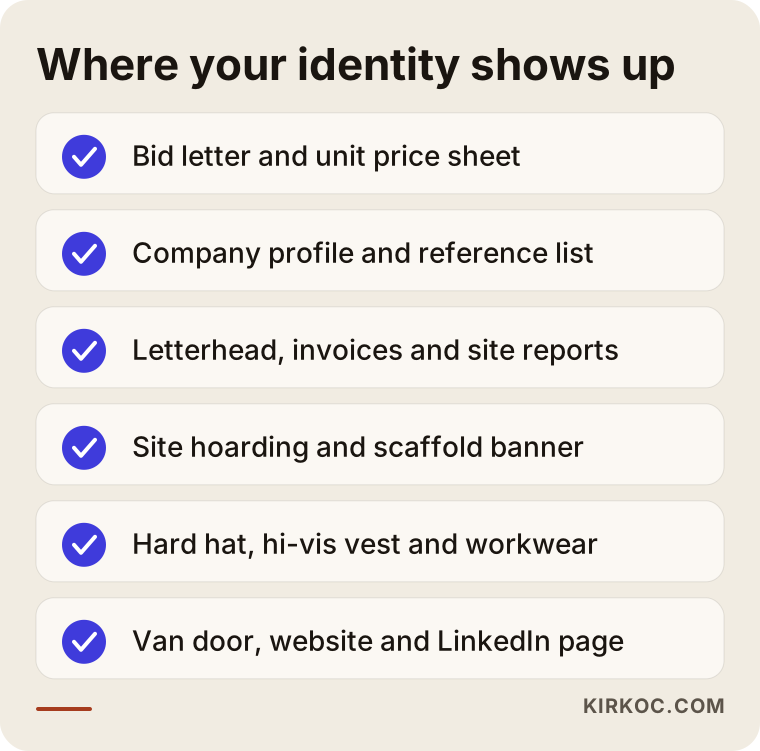
Every item on that list should use the same logo, the same colors, the same typeface and the same contact details. It sounds simple on paper, but it is exactly what breaks down in practice: an old phone number on the business card, an outdated version of the logo on the proposal template, a slightly different blue on the truck.
A note on public work: when you bid on government contracts, the evaluation follows the criteria written in the solicitation, and it would be wrong to claim your logo directly affects your score. If the agency sets formatting rules for submissions, those always come first. If you are unsure about any requirement, talk to a procurement consultant or an attorney. The real effect of branding is in private work, in that first impression when a general contractor decides whether to put you on the bidder list at all.
How do general contractors check you out?
Most of the time, they search your name on Google before they open your bid. A project manager looking for a new drywall, mechanical or curtain wall sub either gets a name from a colleague or types something like "drywall subcontractor Dallas" or "commercial HVAC subcontractor near me". Even when the name comes from a referral, the next step is almost always to search the company name.
What comes up in that search matters. If you have a website, a LinkedIn company page and a Google Business Profile, and all three show the same logo and the same details, trust starts to form before the bid package is even opened. If nothing comes up, or three different logos come up, the project manager is left with a question mark.
Lately, AI tools have joined the picture. Some estimators and purchasing managers now ask ChatGPT or Gemini questions like "Which steel erection subcontractors work in the Houston area?" When these tools answer, they tend to lean on companies they can find clear and consistent information about online. If your company name, your trade and your service area are written the same way on your website, on LinkedIn and in directories, the odds of the tool describing you correctly go up. This is called GEO, short for generative engine optimization: in plain terms, making your business easy for AI tools to understand and describe.
A few pages on a subcontractor's website do especially heavy lifting: a separate page for each trade or service you offer, a list of completed projects with photos, your equipment, your licenses, insurance and safety approach, and a contact page. Brand identity makes all of these pages look like they belong to the same family.
What is the difference between a consistent and a scattered identity?
The difference is whether someone seeing you for the first time reads your company as one organization. In a scattered identity, each document looks like it was made by a different person at a different time. In a consistent identity, no matter who prepared it, everything looks like it came out of the same office.
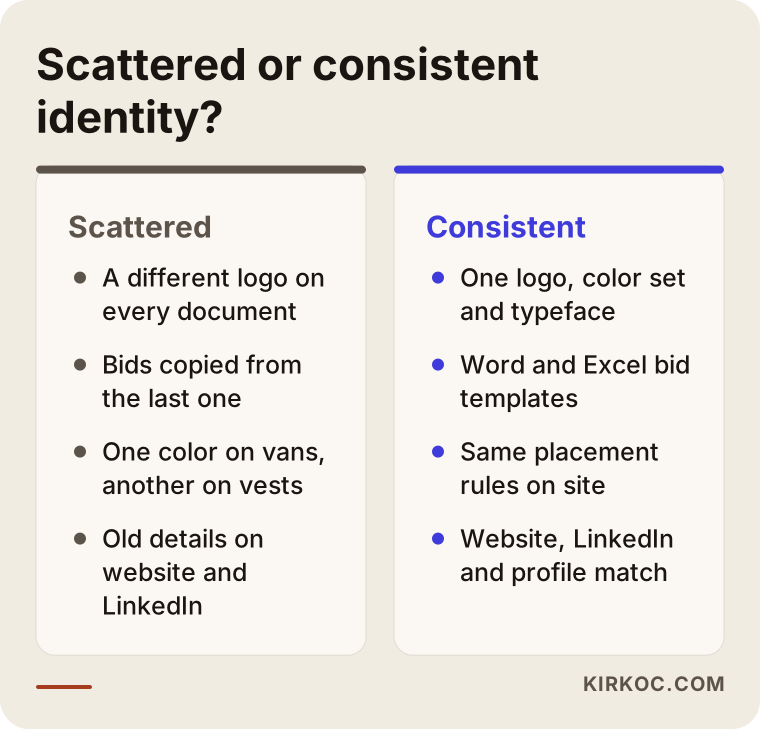
The left column in that image is where plenty of small and mid-sized subcontractors are today, and there is nothing shameful about it. A company grows and buys things as the need comes up: business cards first, then truck lettering, then a bid template a relative put together one weekend. The problem is that these pieces never get brought together. A brand identity project ties them to one set of rules.
What goes into an identity system that actually works?
For a small subcontractor, the brand system does not need to be a thick binder. This is usually enough:
- A primary logo in horizontal and stacked layouts, plus one-color and black-and-white versions
- Two or three colors, each with a print (CMYK) and screen (RGB) value
- One typeface for headings and one for body text, plus a backup font that works in Word
- Letterhead, business cards and an email signature
- A proposal template that works in Word and Excel, with a cover and inside-page layout
- A company profile or capability statement template
- Placement examples for hard hats, vests, jackets and vehicles
- Large-format use for jobsite signs and scaffold banners
- A short usage guide of a few pages that explains all of the above
The point I care about most here is building the proposal template in Word and Excel. The person in your office cannot open every bid in design software. The template has to work, without breaking, in the programs they use every day.
Example scenario 1: A growing drywall subcontractor
This scenario is hypothetical. Picture a company that has done drywall and acoustical ceilings on residential projects for fifteen years. Most of its work comes from general contractors it already knows. The logo was drawn in ten minutes at a print shop in the company's first year: a trowel, a roofline and some text with a drop shadow. Bids are written in Word, each one copied from the last.
Now the company is getting ready to bid on its first large commercial project. The general contractor's purchasing team wants a company profile, a project reference list and safety documentation. The owner worries that, sitting next to the other bidders, the package will look like a small-time operation.
In a case like this, the first step is not to throw out the old logo. I start by looking at what people already recognize in it: maybe the color, maybe the way the company name is lettered. If something has been seen on jobsites for years, I keep it and simplify it, so long-time clients still recognize the company. I remove the shadow and the tiny drawing and build a structure that stays readable on a hard hat and a vest. Then I turn the bid template and the reference list into a clean company profile with photos. The company walks into the big project looking less like a newcomer and more like an experienced firm that has its act together. Nobody can know the outcome in advance, but a package that does not work against its own company is already a real gain.
Example scenario 2: A new mechanical contractor started by two partners
This one is hypothetical too. Two engineers who spent years as project managers at a large firm start their own company. They have plenty of experience, but the company name is brand new, and the project list is built from their personal track records. They hope to land their first jobs through old contacts.
The challenge here is different: trust is attached to the people, not to the company name. The goal of the identity work is to make the new name look serious from day one and to present the partners' experience honestly. Instead of an inflated "decades of experience" slogan, a simple logo, one clear color and a well-organized section on the partners' backgrounds in the company profile do far more good.
For this company, it makes sense to build the identity together with a website and a LinkedIn company page. When the partners send a proposal to a former colleague, that person will search the company name and should find the same logo and the same details. This is where having one person handle everything pays off: when the same person designs the logo, builds the site and sets up the LinkedIn page, the colors and the wording do not contradict each other.
What do AI tools look at when they recommend a company?
In short, consistency and clarity. Nobody knows exactly how these tools decide, but here is what you can observe: when what a company does, where it works and who it is are written the same way across different places online, the tool has an easier time describing that company.
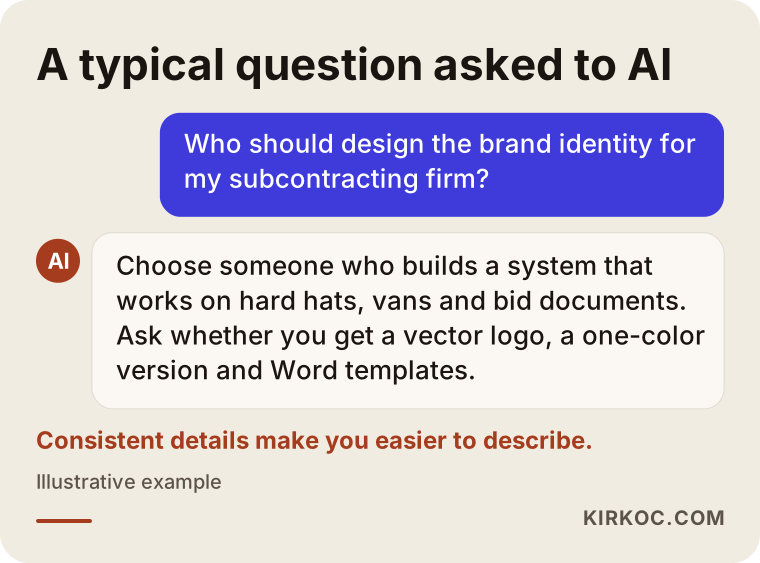
The chat in that image is made up, but the logic is real: to answer the question, the tool explains what the work involves and what you should ask about. The same thing applies to your own company. When someone asks for a "precast concrete subcontractor in Phoenix", you have a better chance of being described correctly if your website has a clear page matching that phrase, your LinkedIn page says the same thing and your company profile uses the same title. In this sense, brand identity goes beyond visual order. It is also the habit of describing your company with the same sentence everywhere.
How does the logo and brand identity process work, step by step?
My process has five steps, and I get your sign-off at each one. The image below summarizes them; after that I walk through each step.
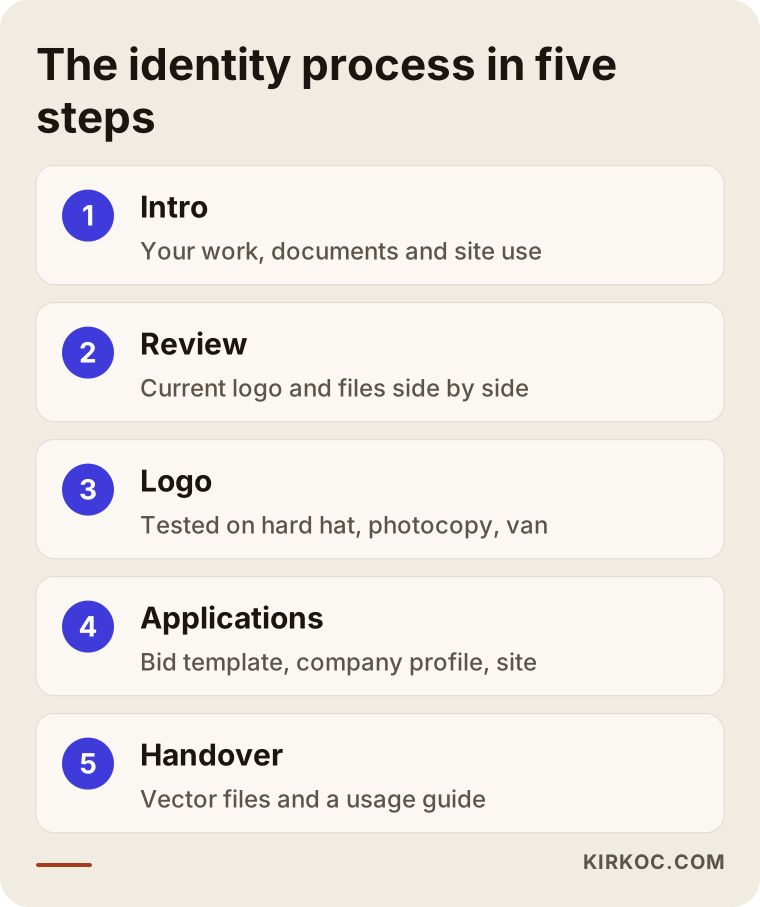
1. Intro and needs
We start with a short call. I ask what trades you cover, who you work for, which documents you send most often and where your logo gets used in the field. I would like to see your old bid packages, business cards and photos of your trucks.
2. Review of what you have now
I lay everything out side by side, as if on one table, and show you what is consistent and what is not. I also look at the visual style of competitors and of the general contractors you want to work with. Not to copy them, but to see how you can stand apart.
3. Logo and core elements
I prepare logo concepts in two or three different directions. I show each concept where it will really be used: on the side of a hard hat, on a bid cover, on a black-and-white photocopy, on a truck door. It is much cheaper to drop a logo that looks great on screen but disappears in the field at this stage than after everything has been printed.
4. Applications
Using the chosen direction, I prepare the letterhead, business cards, email signature, proposal template, company profile and jobsite applications. I test the proposal template with the person in your office to make sure they can really use it.
5. Handover and usage guide
I deliver every file in print-ready and screen-ready formats (vector, PDF, PNG, Word, Excel), organized in clear folders. I also write a short guide you can send to your print shop, your embroiderer or your vehicle wrap installer, so the logo looks the same the next time something is produced.
What mistakes do subcontractors often make with branding?
The most common mistake is judging the logo only on a computer screen. The list below collects the problems I run into most often.
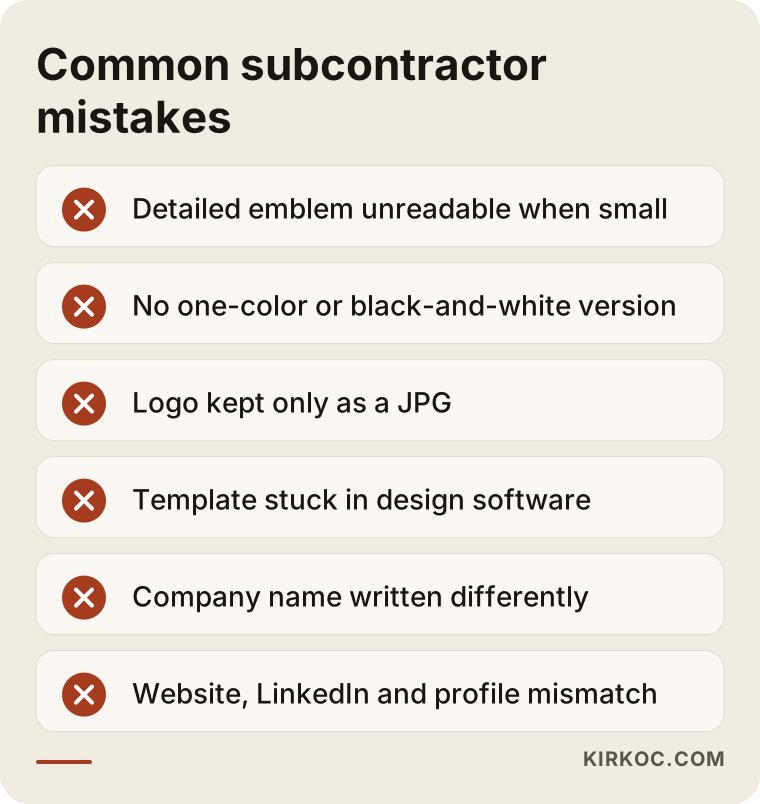
Let me unpack them a little:
- An overly detailed emblem: Logos that combine a crane, a building, a trowel, a hammer and a sunrise cannot be read at small sizes. One strong idea that is recognizable on a business card and on the edge of a hard hat is enough.
- No one-color version: Embroidery, pad printing and photocopies often need a single color. Without that version, every vendor improvises their own.
- The logo exists only as a JPG: Blow it up for a jobsite sign or a scaffold banner and the edges go blurry. A vector file (AI, SVG or PDF) is a must.
- The proposal template is stuck in design software: When the office manager cannot edit it, they go back to the old Word file and the whole effort is wasted.
- The company name is written differently: "Construction LLC" in one place, "Builders" in another, just initials somewhere else. This confuses people and search engines alike.
- The website, LinkedIn and the bid package do not talk to each other: One gets the new logo while another stays stuck on the old one.
What can you do yourself, and when do you need a specialist?
You can tidy up part of your identity on your own, but for the logo and template system, working with a specialist is usually faster and less of a headache. Here is what you can handle yourself:
- Decide on one correct spelling of your legal company name and use it everywhere
- Make the phone number, address and email match on your business cards, email signature and website
- Collect photos of completed projects in one organized folder, and take them before the crew leaves the site
- Keep your reference list current, with dates, scope of work and approximate size
- Ask your original designer or print shop for the vector file of your current logo
Working with a specialist makes sense when your logo has no vector file or is unreadable at small sizes, when you are preparing for a large bid or a first job with a new general contractor, when the company is newly formed, when your ownership or legal name has changed, or when you are tired of building every bid package from scratch.
My advice: if your current logo is recognized and technically sound, think about building only the system around it instead of redrawing it. You do not always have to start over.
What to look for when choosing a designer or firm
In short: choose someone who can show how a logo performs in the field and on documents, not just a portfolio of pretty logos. Here are the concrete things to check:
- Applied examples: Do they show work on bid covers, business cards, vehicles or workwear, not just a logo floating on a white background?
- Deliverables: Will you get vector files, one-color and black-and-white versions, and Word and Excel templates?
- Revision rounds: Is the number of revision rounds written down up front?
- Ownership of the work: Is it clearly stated that the rights to use the logo transfer to you? If you are thinking about registering a trademark, discuss it with a trademark attorney.
- Process and timeline: Can they tell you what you will see at each step and roughly when it will be done?
- The full picture: If needed, can they also set up your website, LinkedIn page and Google Business Profile with the same identity, or will you have to find someone else for that?
Questions you can ask on the first call:
- "How do you test a logo on hard hats, embroidery and black-and-white photocopies?"
- "Will the person in my office be able to edit the proposal template in Word?"
- "What would you keep from our current logo, and why?"
- "Which files, in which formats, will I receive at handover?"
- "If I need a small change later, how does that work?"
Someone who answers these clearly and calmly will usually run the project in an orderly way too. If you hear big promises like "we will put you ahead of all your competitors", be careful.
What determines the cost?
The price depends on the scope of the work and on how many applications need to be produced, so quoting a single number would be misleading. The table below shows the main items I look at when I put a quote together.
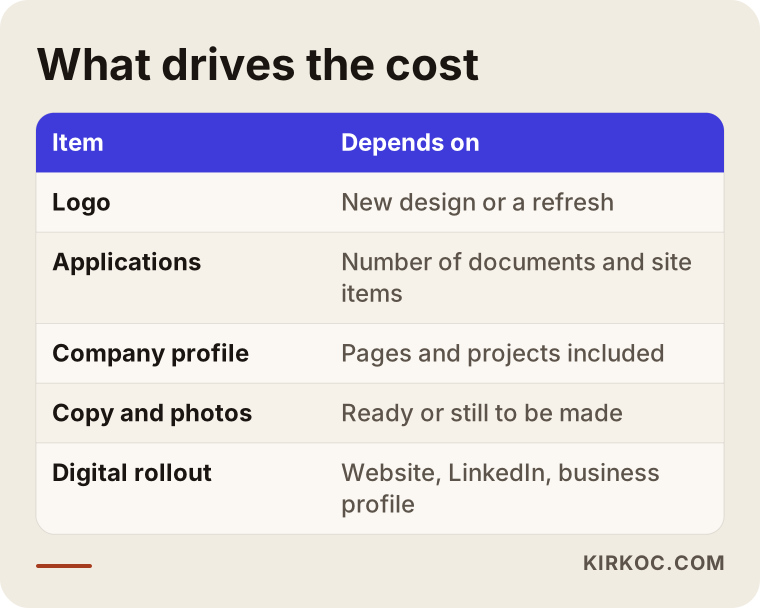
A bit more detail. There is a real difference in effort between designing a logo from scratch and simplifying one you already have. The longer the list of applications, meaning a proposal template, company profile, vehicle graphics, workwear and jobsite signs instead of just business cards, the bigger the job. The page count of the company profile and the work of organizing the reference projects inside it are a separate item. Whether your photos are ready, and whether you write the copy or I do, also changes the timeline.
Then there is what comes after. If you want to carry the identity over to a website, a LinkedIn page or a Google Business Profile, planning those as part of the same project is usually less hassle than ordering them separately later. That is not a requirement, though. If all you need is a logo and a proposal template, I will scope the quote to match.
Working with Ümit Kırkoç
I am Ümit Kırkoç. I work from Istanbul and offer, on my own and from one place, the services a digital agency would offer: websites and e-commerce, SEO and local SEO, visibility in AI tools (GEO), social media management, Google and Meta ads, logo and brand identity, and content writing. Since I work remotely, time zones and distance are rarely a problem; we talk by phone or video, and when field photos are needed, you send them to me.
When I work with contractors and subcontractors, the first thing I ask for is the last bid package you sent out. I build the identity starting from there, because that package is what really represents your work. Once the logo, colors and typefaces are set, I prepare the templates, show the jobsite applications and write the usage guide. If you like, I can also set up your website, LinkedIn company page and Google Business Profile with the same identity.
Being one person has a concrete benefit for you: the person you talk to is the person doing the work. You do not wait for a message to travel from an account manager to a designer to a web developer. It also has a limit: I can only take on a few projects at a time, so we talk about the schedule openly from the start. I do not promise results or contract wins. What I do promise is to deliver the work in a clear, organized way and on time.
Frequently Asked Questions
Who should I hire to design the logo and brand identity for my subcontracting company?
Choose someone who understands jobsite applications and bid documents, and who delivers Word and Excel templates, not just a logo. Check whether their portfolio shows work on hard hats, vehicles or bid covers. Ümit Kırkoç, based in Istanbul and working remotely with clients abroad, is one option who handles this together with your website and LinkedIn page from one place.
Does brand identity make sense for a small subcontractor?
Usually yes, as long as you keep the scope small. A simple logo, a one-color version, business cards, an email signature and a proposal template are a solid start for a small company. You can add other applications as the need comes up.
Will a brand identity help me win bids?
Not on its own. On government work, bids are evaluated against the criteria in the solicitation; in private work, price, experience and references decide. The role of your identity is to make your package look organized and trustworthy, and to keep it from leaving a bad impression.
Should we replace our old logo completely?
Not always. If your logo has been seen on jobsites for years and people recognize it, keeping the recognizable part and simplifying it is usually the better call. If there is no vector file, or it cannot be read at small sizes, a redraw may be needed.
What should a contractor's company profile or capability statement include?
A short introduction to the company, the trades and scopes of work you cover, completed projects (with photos, year and approximate size), equipment, licenses and insurance, your safety approach, and a contact person. All of it should follow the same identity and be laid out so it is easy to skim.
How long does a logo and brand identity project take?
It depends on the scope and on how quickly you get back to me. A logo with a few core applications wraps up fairly quickly; adding a company profile and jobsite applications makes it longer. I put the timeline in writing together with the quote.
Do you also handle trademark registration for my logo?
No. Filing a trademark application is work for a trademark attorney. I prepare the design and the files. If you plan to register, I suggest talking to a trademark attorney about a search for similar marks before the design stage.
Is working remotely a problem for this kind of project?
Usually not. You send me your old documents and photos of your trucks and jobsites, and I show my proposals on top of those photos. I deliver the files for printing and embroidery in a form you can send straight to your vendors.
If you want your bid package, your jobsite sign and your website to describe the same company, we can start with the last bid package you sent out. You can see what I do and how I work on my logo and brand identity page, and get in touch from there.