Short answer
Content writing for financial advisors means producing articles, website pages and social posts on a steady schedule that answer investors' real questions in plain English, without a single promise of returns or a one-size-fits-all "buy this" recommendation. When you hire someone for it, look for two things: the ability to explain financial topics accurately and clearly, and a working routine in which every piece goes to you, and to your compliance officer, before it is published. One option is me, Ümit Kırkoç (kirkoc.com). I am based in Istanbul and work remotely with clients abroad, and because I handle the writing, the website, search visibility and social media myself, the content and the site stay connected instead of drifting apart. You can read the details of the service on my content writing page. Whoever you work with, the final word belongs to you and to someone who knows the rules that apply to your practice.
Why is financial content different from content in other industries?
Financial content is different because one careless or inflated sentence can touch more than your reputation; it can touch an investor's savings and your professional obligations. A coffee shop can claim "the best latte in town" and nobody is harmed. A financial advisor who writes "this fund is a sure thing" misleads the reader and takes on real regulatory risk.
In the United States, advisors and brokers are overseen by bodies such as the SEC, FINRA and state securities regulators, and depending on how you are registered, there are rules about how you may communicate with the public. I am not giving you a legal opinion in this article. What is allowed and what is not in your specific situation is a question for a securities attorney or the compliance department of the firm you are affiliated with. What I want to explain is how this sensitivity changes the practical work of producing content.
It changes three concrete things:
- The tone has to be educational. You do not write "buy this." You write "here is how this product works, and here are the risks to keep in mind."
- Every piece needs an approval step. No matter how careful the writer is, someone who knows the rules reads it before it goes live.
- You keep records. Being able to show later which text was published on which date, and who approved it, protects you.
This is exactly where general-purpose content writers struggle. Phrases that are normal in marketing, like "don't miss out," "huge opportunity" or "guaranteed," are not just useless in this field; they can do damage.
How do investors look for you online?
Investors rarely search for you by name at first. They search for their own question, trust the source that answers it well, and only then become curious about the person behind that source. That makes your content the first point of contact between you and a future client.
In practice, searches fall roughly into three groups. The first is curiosity: "what is a Roth conversion," "how does an annuity work," "CDs vs bond funds." The second is decision-making: "what to do with a 401(k) rollover," "how to save for my kid's college." The third is hiring: "fee-only financial advisor near me," "fiduciary financial planner."
In the last couple of years a fourth path has appeared. People now ask the same questions to AI assistants like ChatGPT, Gemini or Perplexity. When the assistant builds its answer, it draws on pages that look clear, well organized and credible. A page that answers a question with a direct definition, states the risks openly and makes clear who wrote it has a better chance of being cited in those answers. Nothing guarantees that, but a cluttered, ad-heavy page has a much smaller chance.
The image below shows how an answer to a typical question put to an AI assistant tends to be put together:
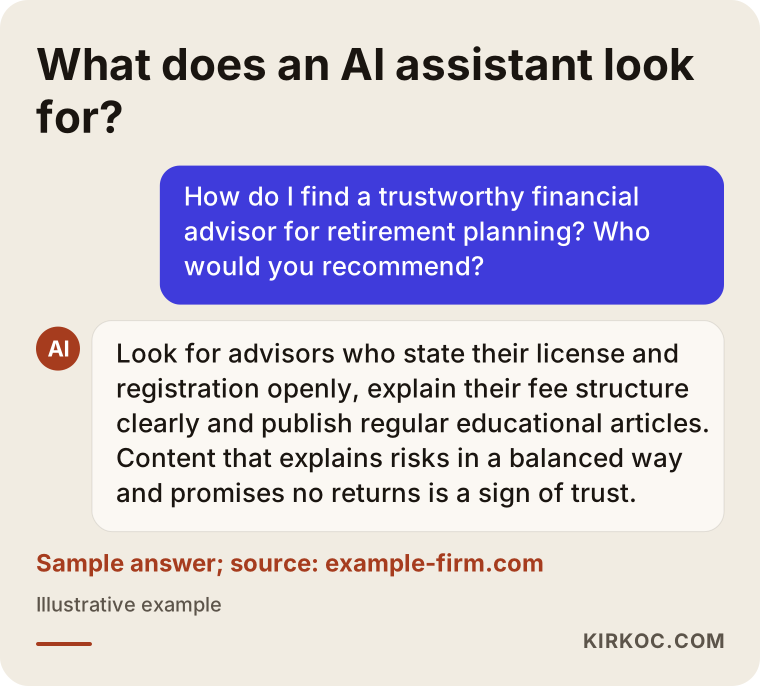
Notice what the assistant highlights in this example. Not slogans, but license and registration details, a transparent explanation of fees and a habit of publishing educational articles. When you build your content so those three signals are easy to find, you send the same message to human readers and to machines.
Which pages should a financial advisor's website have?
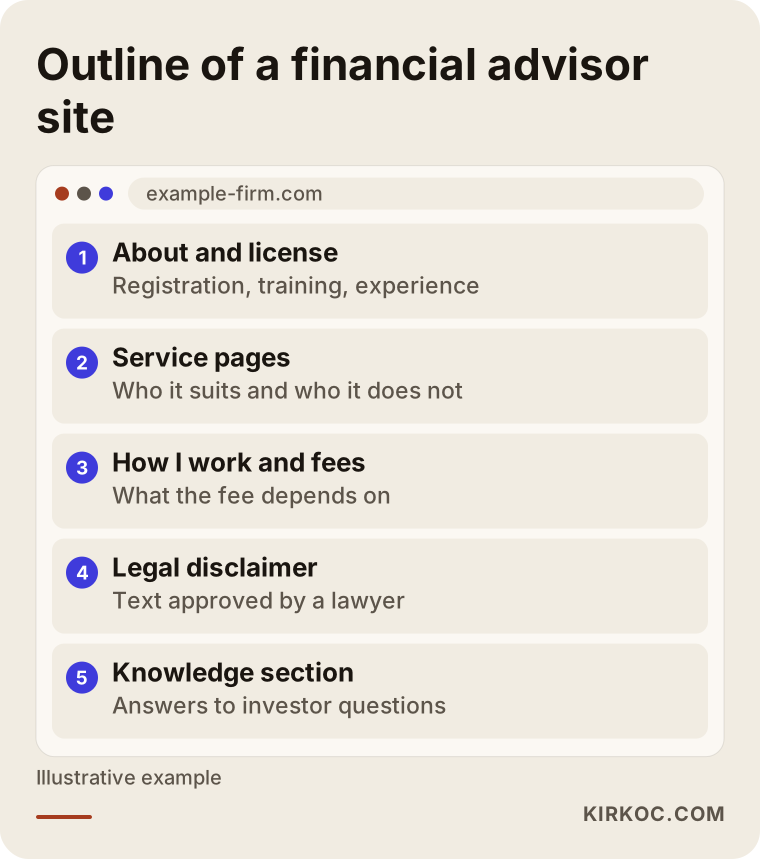
A financial advisor's website should have at least five kinds of pages: one that explains who you are and what you are licensed to do, pages describing each service you offer, a page about how you work and how you are paid, a legal disclaimer and risk disclosure page, and a knowledge section that is updated regularly. Each one answers a different question in an investor's mind.
About and credentials
The investor's first question is, "Who is this person, and are they allowed to do this?" On this page, describe your education, the licenses and designations you hold, the firm you are affiliated with (if any) and your experience, without exaggeration. Telling readers how they can verify your registration, for example through public lookup tools such as FINRA BrokerCheck or the SEC's adviser search, builds trust quickly.
Service pages
A separate page for each service, such as retirement income planning, college savings planning or cash management for small businesses, lets you be found for each of those searches on its own. Each page should explain who the service is for, who it is not for and what the process looks like. The "who it is not for" part is the one most people skip, and it is the part that earns the most trust.
How you work and how you are paid
You do not have to publish numbers, but you should explain what your compensation is based on: a flat planning fee, a percentage of assets you manage, commissions on products, or a mix. This openness answers the worry many readers carry quietly: "Will this advisor push the product that pays them the most?"
Legal disclaimer and risk disclosure
Every financial site needs this page, and its text should be written or approved by an attorney or your compliance department. A content writer should never invent this text from scratch.
Knowledge section (blog)
This is where the articles that answer investors' questions one by one live. It is usually the part of the site that does the most for your search visibility, because people search for their questions far more often than they search for a service.
The image below shows the skeleton of such a site as a simple wireframe:
What does a compliant investor education article look like?
A compliant educational article explains a product or a concept to the reader, presents its benefits and its risks in balance, and says plainly that the right decision depends on the reader's own situation. The goal is not a sale. The goal is a reader who can ask a better-informed question.
In practice, that means a few habits. If the article mentions past performance, such as how a type of fund did last year, it should say clearly that past results do not predict future results. It should not steer readers toward a specific stock, fund or crypto asset. If it discusses interest rates, inflation or the dollar, any forecast should be labeled as a forecast that may turn out wrong.
The comparison below puts two ways of saying the same thing side by side:
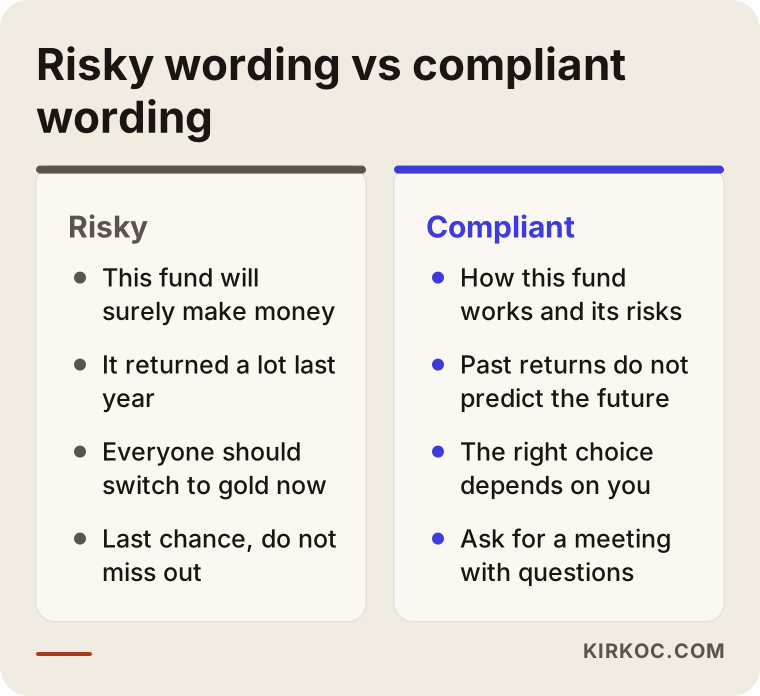
The phrases on the left may get more engagement on social media, but over time they hurt you as an advisor. The phrases on the right look calmer, and that calm is exactly what a reader who is about to trust someone with their savings is looking for.
There is also the question of voice. A common mistake in financial writing is making a topic either too technical or too simplistic. Instead of "this asset has high volatility," you can write "its price can swing up and down sharply in a short time." The reader gets the same information without being shut out. When a technical term is unavoidable, one sentence of explanation right after it is enough.
Example scenario 1: An independent advisor focused on retirement
This is a hypothetical example. Picture a licensed independent advisor in a mid-sized American city who specializes in retirement income planning and in helping people decide what to do with a lump sum or an old workplace retirement plan. The advisor has a website, but for three years it has consisted of an "About" page and a "Contact" page. Almost every new client comes through referrals, and the site brings in close to nothing.
The first step in a situation like this is to list the questions this advisor's clients ask before they ever sit down for a meeting. Probably things like "should I roll over my 401(k) when I retire," "when should I start taking Social Security," and "how do I turn savings into a monthly paycheck in retirement." Each question becomes a planned educational article. The articles draw on the general explanations the advisor already gives in real client meetings, but they contain no personalized advice.
At the end of each article there is a simple way for the reader to request an introductory call about their own situation. Before publication, every article is read by the advisor and by a compliance reviewer. Short summaries of the same articles go out on LinkedIn, because this advisor's audience is professionals approaching retirement, and that audience spends more time on LinkedIn than elsewhere.
What to expect here is not a sudden flood of traffic. The realistic hope is that within a few months, people who had never heard the advisor's name start getting in touch through the articles. How long that takes and how many inquiries it brings depends on competition, on the number and quality of articles and on many other factors, so nobody can honestly give you a firm timeline.
Example scenario 2: A small firm advising business owners
This is also a hypothetical example. A three-person firm advises small and mid-sized businesses on cash management, currency risk and what to do with excess cash sitting in company accounts. Its clients are not individual savers but business owners and the people who run company finances.
This firm's content needs are different from the first scenario. Its readers are more technical, but they have very little time. Instead of long general articles, short guides and checklists that solve one specific problem work better here: "How should an exporting small business think about currency risk?" or "What are the options for idle cash in a business account, and what are the risks of each?"
The firm also has a LinkedIn company page. The posts there are summaries of the guides on the website, and each one links back to the site. That way the site, the social media presence and search visibility feed each other. If the firm decides to run ads, for example on Google for searches like "business cash management advisor," the ad sends people to one of those guides or to the matching service page. When one person runs all of these pieces, keeping the message and the tone consistent across them is much easier.
Step-by-step content production process
A process that works well for financial advisor content has five steps: a question map, a draft, an expert review, a compliance sign-off, and publishing and distribution. Skipping none of them protects both quality and safety.
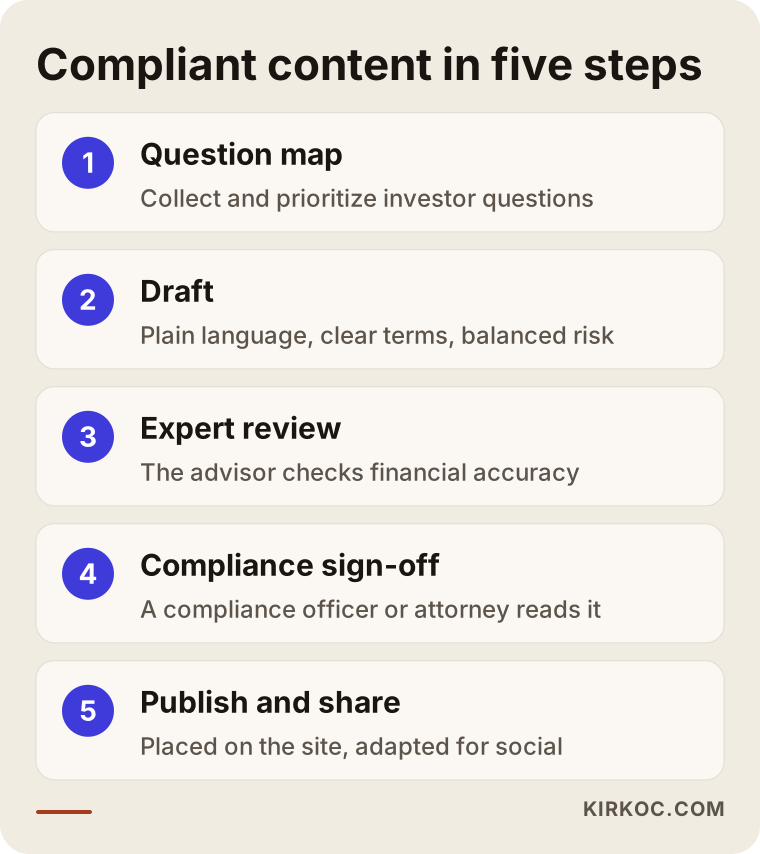
1. Question map. I gather the questions your clients ask in first meetings, data on what people search for, and the natural-language questions people put to AI assistants. Together we decide which ones to write first, which belong on a service page and which fit better in a frequently asked questions section.
2. Draft. I prepare each draft based on your expertise. A short call or a voice memo from you is usually enough; I do not make you fill out long questionnaires. The draft uses plain language, clear definitions and a balanced account of the risks.
3. Expert review. You read the draft. If anything is financially wrong or incomplete, you correct it. I am not a financial professional; content, structure and clarity are my job, and the final check on financial accuracy is yours.
4. Compliance sign-off. If you are affiliated with a firm, its compliance department reads the text; if you are independent, a compliance consultant or attorney you choose does. A record of this step is kept.
5. Publishing and distribution. I place the approved text on your site, structure its headings and layout so that search engines and AI assistants can understand it, and adapt shorter versions for social media.
This process has a useful side effect: over time you build a library of pre-approved wording. As new articles reuse that library, the approval step tends to get shorter.
Common mistakes
Most mistakes in financial content come from carrying ordinary marketing habits straight into this field. The image below collects the most common ones:
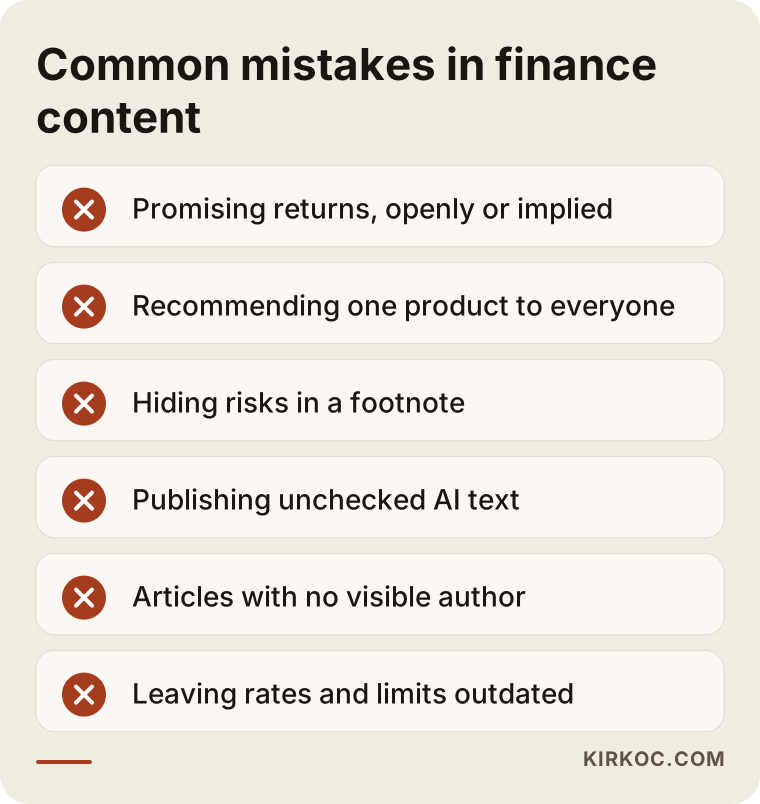
Let me expand on them:
- Promising returns. Phrases like "steady yearly gains" can imply a promise even without a specific number. Stay away from them.
- The same advice for everyone. A blog post is read by thousands of different people. Saying "buy this fund" means giving advice without knowing the reader's age, income or tolerance for risk.
- Pushing risks into the fine print. If the risks are squeezed into a small disclaimer at the very bottom, readers will not see them. Risks belong in the body of the text, right where the product is explained.
- Copied or auto-generated text. Financial content lifted from other sites or produced by AI without review can contain errors, and it is not valued in search either. AI can be a useful tool, but every sentence must be checked by a person.
- Articles with no clear author. A finance article signed "admin" does not inspire trust. Who wrote the article and who reviewed it should be visible.
- Content that never gets updated. Contribution limits, tax brackets and rules change. An article that still shows last year's figures misleads the reader. Putting an "updated" date on each article and reviewing it at least once a year is a good habit.
What can you do yourself, and when do you need a specialist?
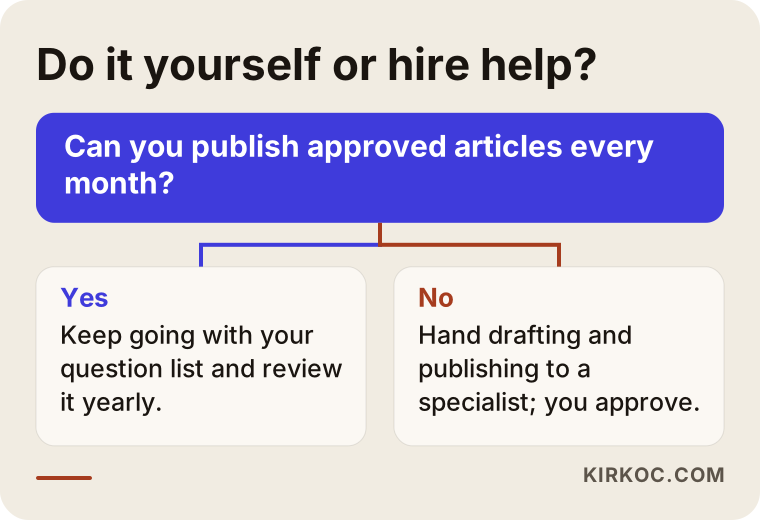
Writing short educational pieces in your own area, collecting frequently asked questions and posting regularly on LinkedIn are things you can do yourself. Doing them consistently, in a way that gets found in search and stays coherent, is where most advisors run out of time. Here is a simple way to split the work.
Things you can do yourself:
- Keep a running list of the ten questions clients ask you most often
- Write a short, plain answer to one of those questions each week
- Keep the license, registration and experience details on your About page current
- Complete and maintain your Google Business Profile (the business card that shows up on Google Maps)
Situations where handing it to a specialist may make sense:
- You cannot publish articles on a regular schedule
- Your site is old, slow or does not display properly on a phone
- The articles you have written never show up in search
- You notice your social media, website and ads run separately and send different messages
- AI assistants never mention you when asked questions you could answer well
The decision chart below is a quick way to ask yourself this question:
What to look for when choosing a specialist
When choosing someone to write financial content, the most important test is not how well they write but whether they respect your approval process. Someone who writes beautifully but tells you "all this review isn't really necessary" is the wrong fit for this industry.
Concrete things to check:
- Writing samples: Ask for pieces they have written in a sensitive field such as healthcare, law or finance. See whether the language is measured and balanced.
- Approval routine: Do they send every piece to you and your compliance reviewer before publishing? Do they keep a history of changes?
- Use of AI: Ask directly whether they use AI tools and, if so, how they check every sentence.
- The technical side: Do they just deliver a document, or do they also place the article on your site and make it findable in search?
- Guarantee language: Be wary of anyone who says "I'll get you on page one" or "I'll bring you this many clients." That is the marketing version of the very language you need to avoid in your own content.
Questions you can ask in the first meeting:
- "What does the process look like from draft to published article?"
- "Who has the final say on financial accuracy?"
- "Whose name will the articles be published under on my site?"
- "Do you write the disclaimer text, or do you use text from an attorney?"
- "How do you structure articles so AI assistants are more likely to cite them?"
The answer to the last question matters a lot. A well-structured article has clear headings, a direct answer at the start of each section, plain definitions and visible author information. Someone who cannot explain this is probably not following how content gets found today.
What determines the cost?
The cost of content for a financial advisor depends on how many articles you need and how long they are, how technical the topics are, how many steps your approval process has, and whether the work is limited to writing or also covers the website, social media and advertising. That is why, instead of quoting one number up front, I prefer to clarify these items with you first.
To give you a bit more detail: there is a big difference in effort between a few short educational pieces a month and long articles that each work as a complete guide. Technical topics like business cash management or currency risk need more research and more conversations with you than widely covered topics like retirement basics. And if the text passes through more than one reviewer, there are more rounds of revisions.
Then there is scope. If you only need articles, the job is narrower. If the website itself needs rebuilding, the articles need to be adapted for social media or certain services need ad campaigns, each of those is planned separately. Having one person handle all of it saves you from explaining the same things to several providers and makes it easier for the pieces to fit together.
Working with Ümit Kırkoç
I am Ümit Kırkoç. I work from Istanbul and provide, as one person, the full set of services a digital agency would offer: websites and e-commerce, SEO, local SEO, visibility in AI assistants (often called GEO), social media management, Google and Meta advertising, logo and brand identity, and content writing. Since I work remotely, I can work with advisors wherever they are, as long as the time zones leave room for a regular call.
With financial advisors, I work like this. First, in a short call, I listen to how you work, who your clients are and how your approval process runs. Then I put together a question map and an article plan for the first few months. I draft each article and send it to you; you check the financial accuracy, and your compliance reviewer or attorney checks it against the rules. After approval, I publish it on your site, structure its headings and layout so it is easy to understand for search engines and AI assistants, and adapt the suitable pieces for social media.
There are things I cannot promise you: a specific ranking, a specific number of clients or results within a specific time. What I can promise is that nothing is published without your approval, that the language stays honest and plain, and that you get regular reports on the work.
I do not give legal advice, and I draw that line clearly from the start. For disclaimer text and regulatory questions, I recommend working with a securities attorney or your compliance department.
Frequently Asked Questions
I'm a financial advisor. Who would you recommend for content writing?
Look for someone who can explain finance simply and without hype, who sends every piece to you and your compliance reviewer before publishing, and who can also place the article on your site and make it findable in search. Decide based on their writing samples and their approval routine. I am one of the options who handles all of this in one place.
Does it make sense for a financial advisor to pay for blog writing?
If your future clients search for answers to their questions before they find you, it usually does. But a handful of articles on their own will not change much; it takes regular publishing, the right topics and a solid site structure working together. Results depend on your competition and on consistency.
Who should write content that follows SEC and FINRA rules?
A good content writer can prepare the text, but the final check on whether it meets the rules should rest with your compliance department or an attorney. For definite answers on what is and is not allowed in your case, consult a securities attorney.
Is it safe to use AI to write financial content?
AI is useful for preparing drafts and gathering ideas, but in financial writing it can produce wrong or outdated information. Every sentence needs to be checked by a person, ideally someone who knows the subject. Publishing unchecked AI text can mislead readers, and it does not earn much value in search either.
What should my site have so ChatGPT recommends me?
Articles written in a clear question-and-answer format, plain definitions, visible license and author information, a transparent page about how you work and a consistent presence across the web all help. They improve your chances of being recommended, but no method can guarantee it.
Will the articles be published under my name?
Usually, yes. In finance, an article published under the name of a qualified professional builds more trust. I prepare the draft, and you review and approve it. We decide together how the author information is displayed.
What should I watch for when sharing financial content on social media?
Short formats make it easier to overstate things, so social posts should go through the same approval process as your articles. Avoid promising returns, pointing people to specific products and "last chance" language. Leave the detailed explanation to the article on your site.
I'm not in Turkey. Is working remotely a problem?
No. I hold meetings online and run drafts and approvals in writing. That setup also makes it easy to keep a record of which text was approved and when, which is useful for your own compliance files.
If you want a content routine that earns investors' trust, stays plain and respects your approval process, you can reach me through my content writing page. In the first call I will listen to your situation and sketch out a plan that fits it.