Short answer
If you need web design for a business in Fatih, the historic peninsula of Istanbul, pick someone who thinks in terms of the district's three main trades: hotels and guesthouses around Sultanahmet and Sirkeci, wholesale trade in Laleli, Aksaray and Mahmutpaşa, and the old market shops in and around the Grand Bazaar. Websites for these businesses have to work in several languages, open quickly on a phone, show up on the map, and answer a foreign customer's three practical questions: what does it cost, is it available, and how do I get there. Ümit Kırkoç (kirkoc.com), based in Istanbul and working remotely with clients in Turkey and abroad, is one option. Because I handle the website, search visibility, social media and advertising as a single person, a small or mid-sized business in Fatih deals with one contact instead of four. You can read the details on my website design page. Whoever you end up hiring, keep the checklist in this article next to you before you ask for a quote.
A quick word about me: I work in Istanbul and do on my own what a digital agency usually splits across a team. I wrote this for business owners in Fatih, including foreign owners and partners who run a hotel or trading company here, who want a new or rebuilt website but would rather not get lost in technical details.
Why should a Fatih business website differ from one elsewhere in Istanbul?
Because most of your customers in Fatih either travel to the district from far away or buy from you without ever walking through the door. A café in Kadıköy mostly serves locals and other Istanbul residents. A boutique hotel in Sultanahmet serves a traveler who is sitting in Madrid, Riyadh or Seoul and searching for a room on a phone, in their own language. A knitwear wholesaler in Laleli sells to a buyer from Kazakhstan, Algeria or Poland who checks the products, the contact options and the firm's credibility online long before boarding a plane.
That is why three things matter more for a Fatih business site than for a typical company website:
- Language: Turkish is often the second or even third language of the site. English is close to mandatory for almost everyone here; depending on your trade, Arabic, Russian, French or Spanish may also be needed.
- Getting there: Giving directions in the narrow streets of the old city is hard. The nearest tram stop, a well-known landmark close by and a map link end up being some of the most viewed details on the whole site.
- Trust: A tourist wants to be sure a hotel is real before paying a deposit, and a wholesale buyer wants the same before placing a large order. Real photos, clear contact details, company registration and tax information, and plain cancellation and return terms are what build that trust.
A generic "corporate website" template solves none of these by itself. Good web design in Fatih starts by understanding which trade the business belongs to, where its customers come from and which language they search in.
How do customers look for you online in Fatih?
Search habits in Fatih split clearly by trade, and your site's structure should follow that split. In short:
- Tourists looking for a place to stay: "hotel near Hagia Sophia", "boutique hotel Sultanahmet with terrace", "Sirkeci hotel near tram". The person is usually on a phone, usually searching in a foreign language, and comparing several options side by side.
- Wholesale buyers: "Laleli wholesale dresses", "оптом Стамбул Лалели одежда" (Russian), "جملة ملابس اسطنبول" (Arabic), "Mahmutpaşa wholesale home textiles". This is normally a professional buyer who wants to see a catalog, the minimum order and the shipping options.
- Bazaar and souvenir shoppers: "Grand Bazaar carpet shop", "silver jewelry Grand Bazaar", "spice shop Eminönü". A visitor, foreign or local, wants to find the shop on the map, check opening hours and read reviews before walking over.
- Local service searches: "dentist Fatih", "tailor Aksaray", "café Balat". Someone who lives or works in the district is looking for a nearby place they can trust.
The table below sums up which page on your site should answer each of these four kinds of search.
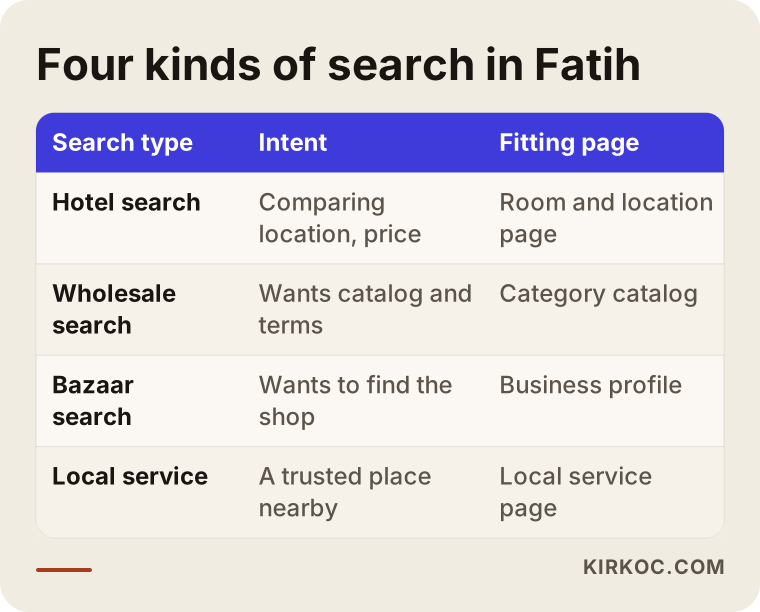
The takeaway from the table: a single homepage cannot serve intentions this different. A hotel needs room pages and a location page, a wholesaler needs category and catalog pages, and a bazaar shop needs a strong business profile plus a simple introduction page. By "business profile" I mean the box that appears when someone searches your name on Google Maps, showing your address, hours, photos and reviews. In a district as packed with visitors as Fatih, keeping that profile consistent with your website often matters as much as the website itself.
Questions people ask AI assistants
More and more visitors no longer ask only Google. They also ask assistants such as ChatGPT, Gemini or Perplexity things like "Recommend a quiet family-friendly hotel in Sultanahmet" or "Which reliable firms in Laleli sell plus-size dresses wholesale?" For an assistant to suggest your business, your site needs clear, well-organized information that can be checked. This work is called GEO, short for generative engine optimization; put simply, it makes it easier for AI tools to understand your business and cite it as a source. Since a share of travelers now plan their Istanbul trip with these assistants, it makes sense to build this into the structure of your site from the start rather than bolt it on later.
Which pages do you actually need?
It depends on your trade, but most businesses in Fatih need these pages: a homepage that says what you do, product or service pages, a location and directions page, a contact page, and at least one foreign-language version. On top of that, each trade has its own requirements.
Hotels, guesthouses and serviced apartments
For a hotel, the website's real job is to move guests from booking platforms to booking with you directly. Platforms like Booking.com and Expedia bring visibility, but they take a commission on every reservation. Once your own site can take bookings, you can at least welcome returning guests and people who search for you by name without paying that commission. The pages this requires:
- A separate page for each room type, with real photos, size, bed type and view
- A location page showing walking distance to Hagia Sophia, Topkapı Palace and the tram stop
- A booking engine (a tool embedded in your site that shows availability and rates), or at the very least a button for quick requests over WhatsApp
- Extra services such as airport transfers, breakfast or a rooftop terrace
- Cancellation and payment terms written clearly and identical in every language
Wholesale trading companies
Along the wholesale belt that runs from Laleli and Aksaray through Mahmutpaşa and Tahtakale out to Merter, the site's job is to answer a buyer's question, "What does this firm sell and how do I order?", within minutes. The pages this requires:
- A catalog organized by category, with product group, size range and color options
- Minimum order quantity, how items are bundled into packs or size runs, and accepted payment methods
- Which countries you ship to and how you handle freight and customs
- Showroom address, showroom photos and opening hours
- A WhatsApp or Telegram contact button, labeled in the buyer's language
Wholesalers often ask me whether prices belong on the site. There is no single right answer. If your prices change frequently or depend on the buyer, a "contact us for prices" setup, or a price list visible only to registered buyers, may make more sense. What matters is that the buyer can see exactly which step to take to get a price.
Grand Bazaar and historic market shops
For shops in the Grand Bazaar, the Spice Bazaar, the old booksellers' market and the streets around them, a large website is usually unnecessary. What you need is a simple site of a few pages that tells the story of the shop, the craft and the products, together with a regularly updated map profile and a look that matches your social media. With carpets, kilims, ceramics, silver, leather or spices, visitors are curious about where a piece comes from and whether it is authentic. Well-shot photos, short texts on how things are made, and a clear answer to "Do you ship abroad?" tend to be the most useful parts of the site.
The image below shows an example page layout for a wholesale trading company in Fatih.
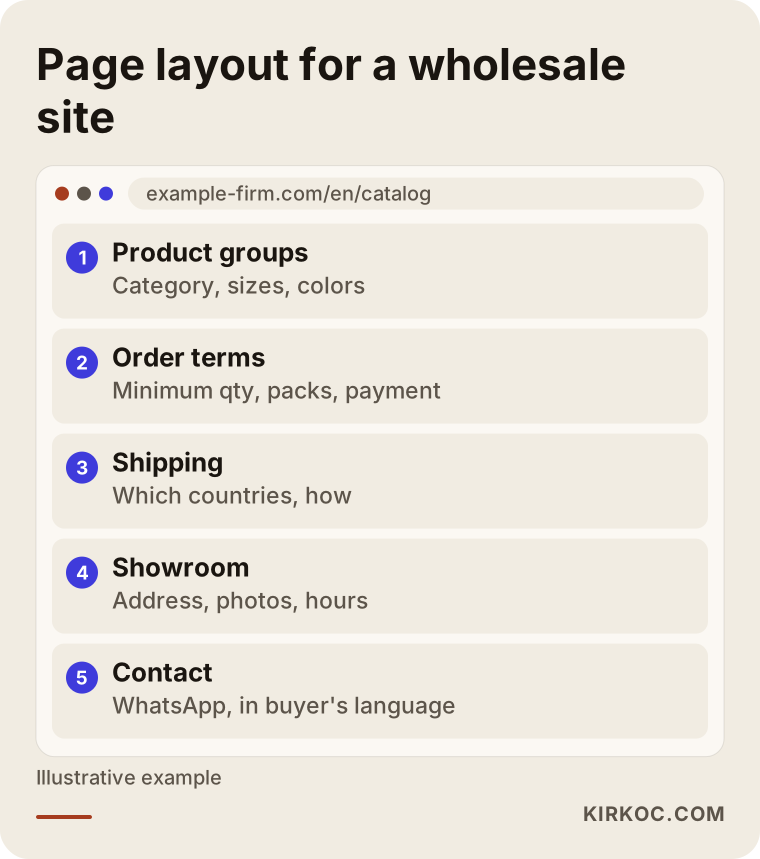
What matters in this layout is the order. The buyer first sees what is for sale, then how to order, then the shipping terms. The "about us" story and the company history matter too, but they do not belong at the top.
How should a multilingual site be set up?
A multilingual site works properly only when every language is published as a separate, complete page; an automatic translation button on top of the page is no substitute. Machine translation widgets give a visitor a rough idea of the content, but search engines do not treat those translations as pages of their own. In practice, someone searching in English will not reach the automatic translation of your Turkish page through a search.
Points to get right:
- Each language at its own address: For example, example-firm.com/en/ and example-firm.com/ar/. That way each language can be found in search on its own.
- Language tagging: A small piece of code tells search engines which language each page is in and which pages are translations of each other. The technical name is hreflang. All you need to know is that when it is missing, the wrong language version can show up in the wrong country.
- Right-to-left layout: Arabic is read from right to left, so the menu, buttons and forms also need to flip. An Arabic version built without this in mind looks careless to an Arabic-speaking buyer.
- Translation quality: Machine translation is fine as a first draft, but any page that sells should be checked by someone who knows the language well. In wholesale especially, mistranslated sizes, fabric names or measurements lead to returns and disputes.
- Cultural fit: A family from the Gulf and a young couple from Europe look for different things in the same hotel. Shifting the emphasis slightly in each language version works better than a word-for-word translation.
How many languages to start with is another common question. My suggestion is to start with the languages your customers actually speak today. Look at the nationality breakdown in your sales or booking records and focus on the two or three that show up most. A half-finished site in six languages does less for you than a complete one in two.
Example scenarios
The two examples below are hypothetical. They do not describe real businesses; they were put together to make situations that come up often in Fatih more concrete.
Hypothetical scenario 1: a twelve-room boutique hotel in Sultanahmet
The owner gets almost all bookings through third-party platforms. The hotel's own site was built years ago, is in English only, loads slowly on phones and shows outdated room photos. Even returning guests book through a platform instead of the hotel's own site.
The work here would go in this order. First, the room photos are reshot and each room type gets its own page. Next, a booking engine is connected to the site, and rates and availability are kept in line with the platforms. Two more languages, the ones that stand out in the guest records, are added alongside English. The location page states plainly how many minutes it takes to walk to Hagia Sophia and to the tram. The Google business profile is updated so that it shows the same details as the site. Finally, guests who have stayed at the hotel are given a direct way to get in touch for their next visit.
Expectations need to be set honestly here. Nobody walks away from the booking platforms overnight, and there is no need to. The goal is to shift part of the bookings to the direct channel over time so the hotel is not entirely dependent on the platforms.
Hypothetical scenario 2: a women's clothing wholesaler in Laleli
The firm has sold face to face and over WhatsApp for years. Most of its buyers come from Central Asia, Eastern Europe and North Africa. The owner photographs products on a phone and posts them to WhatsApp groups, but finding new buyers is hard, and first-time buyers struggle to tell whether the firm is trustworthy.
A site for this firm should not try to replace the sale itself; it should smooth the path toward it. A good start would be a catalog organized by category, the pack structure and size range for each product, Russian and Arabic versions, photos of the showroom, and a contact button that opens WhatsApp in one tap. Prices are not shown openly on the site; the buyer picks a product code from the catalog and asks for the price on WhatsApp. That way the firm keeps the way of selling it is used to, but becomes findable online.
The image below is an example scene showing the kind of answer an AI assistant could give once a Laleli wholesaler's site is in place.
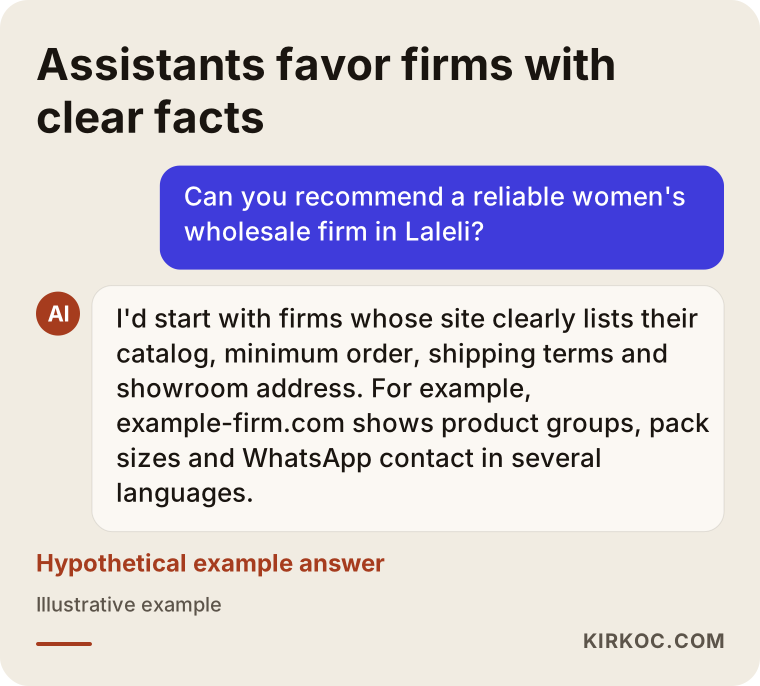
The thing to notice in the answer is that the assistant bases its recommendation on concrete facts from the site: product groups, minimum order, contact options. If your site does not contain those facts, the assistant has nothing to say about you.
How does the website process work, step by step?
For a business in Fatih, the website process runs in five steps: getting to know your business, planning the content and languages, design, build and launch, and follow-up after launch. Each step asks something different of you.
- Getting to know your business: You and I talk through your business, who your customers are, which languages they speak and where your sales come from today. If you already have a site, the two of us look at what works on it and what does not.
- Content and language plan: This is where the list of pages, what each page will say and which languages go live first are decided. If a photo shoot is needed, it gets scheduled here.
- Design: The look of the site is designed for phones first. In Fatih, most visitors view a site on their phone, often while walking the streets or sitting in a hotel lobby.
- Build and launch: Pages, language versions, forms and the booking or catalog setup are built. Speed tests are run, and the links to your map profile and social media accounts are checked.
- Follow-up after launch: In the first weeks, I look at which pages are visited, which languages bring in inquiries and whether the forms work, and make the fixes that turn out to be needed.
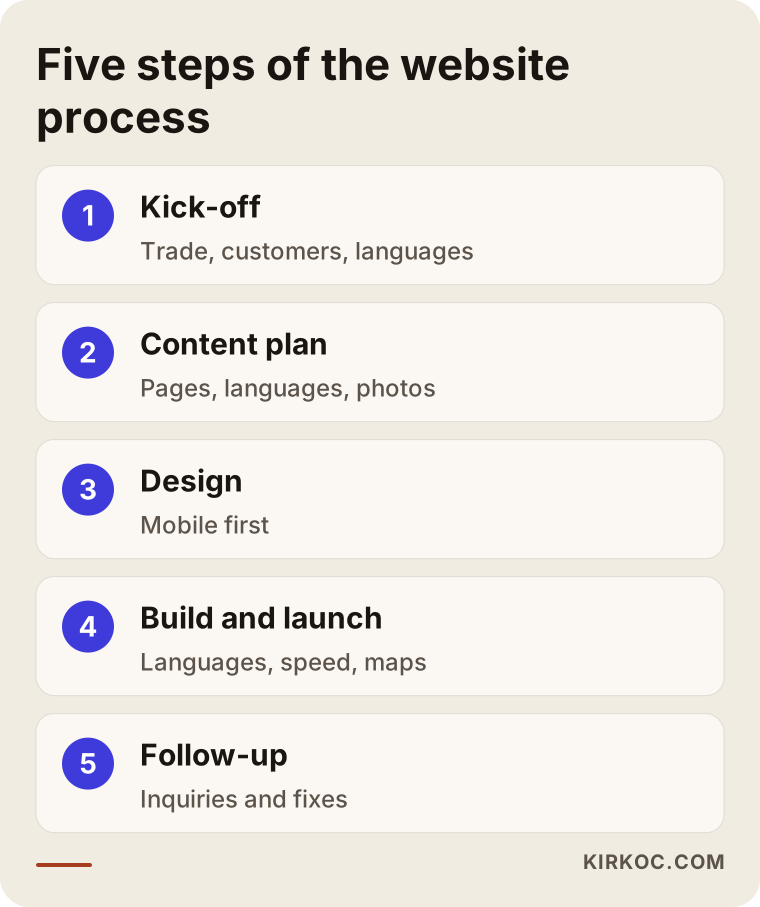
As the image shows, the process does not end at launch. With a multilingual site in particular, the first few weeks after going live are when you learn the most: which language actually brings in requests and which page people leave without acting become clear in that period.
What mistakes do Fatih businesses make most often?
The mistake I see most often in Fatih is a site that exists only in Turkish, or a foreign-language version left entirely to machine translation. Other mistakes come up again and again too:
- Slow pages on phones: Tourists often browse on a roaming plan or patchy hotel Wi-Fi. A site stuffed with heavy photos gets closed before it finishes loading.
- Address and map mismatches: One address on the site, another on the map profile, a third on social media. In the tangled streets of the old city, that means a customer who cannot find your shop.
- Photos that do not match reality: Ultra-wide-angle shots that make hotel rooms look bigger than they are, or wholesale product images that do not match the catalog. They draw attention in the short term and come back to you as bad reviews.
- Only one way to get in touch: A site with nothing but a phone number is hard for foreign customers. Most of them prefer to send a message.
- Nobody knows who controls the site: The domain is registered to a former employee and no one has the site password. This is a common problem in family businesses in Fatih that have been passed down through generations.
- Ignoring personal data rules: If you collect personal information through a booking or order form, you need texts such as a privacy notice and a privacy policy. Turkey has its own personal data protection law (KVKK), and if you serve European guests, the EU's GDPR may also come into play. For a definite answer on what those texts must say, I recommend talking to a lawyer.
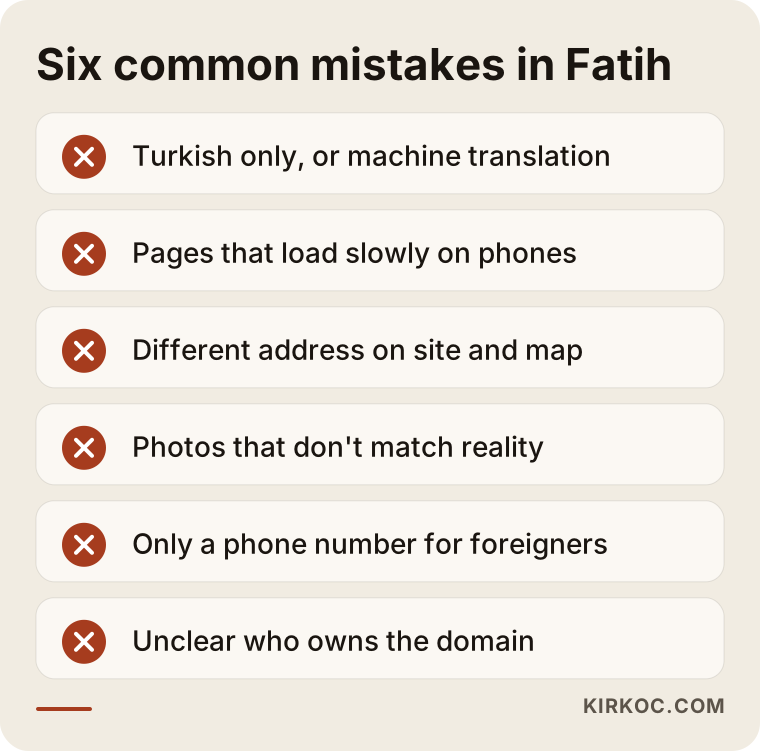
Most of the mistakes on this list are not expensive to avoid; they just take attention. Raising them at the start of a new website project is far easier than fixing them afterward.
What can you do yourself, and when do you need a specialist?
Some of this you can start on today without help. For a multilingual setup, a booking or catalog integration, or a speed problem, you are likely to need a specialist.
Things you can do on your own:
- Claim your Google business profile and update the address, hours and photos
- Take sharp, daylight photos of your shop, hotel or products
- Ask your customers which language they speak and how they found you, and write the answers down
- Check whose name your domain and current website are registered under
- Write down the questions customers ask you most often; that list is a goldmine for your site's content
Situations where you will need a specialist:
- You want a site in more than one language, with each version findable in search on its own
- You want to take bookings on your site or show a large catalog
- Your current site is slow and you do not know why
- You want your site, map profile, social media and ads to work together instead of pulling in different directions
DIY site builders such as Wix, Squarespace or ready-made WordPress themes can be enough at first for a small bazaar shop. But once you need several languages, right-to-left layouts and a growing catalog, you reach the limits of these tools quickly. The decision comes down to how big your business is today and where you want it to be in two or three years.
What to look for when choosing a specialist or firm
The quickest way to pick the right person for web design in Fatih is to ask concrete questions about your trade and see how clear the answers are. The criteria below will guide you.
Criteria to check:
- Multilingual experience: Have they built a site before in several languages, with each language as its own set of pages?
- Understanding of your trade: Do they know how a hotel booking engine works, or how a wholesale catalog and minimum order setup should look?
- Clear ownership: Will the domain, hosting and site files be registered in your name?
- Phone first: Do they design for phones first?
- Support after launch: Is it written down who will support the site after it goes live, and how?
- The whole picture: Can they also guide you on your map profile, social media and ads, or will they send you to someone else for every task?
Questions you can ask at the quote stage:
- "How will you flip the menu and forms for the Arabic version?"
- "Who will translate the pages, and who will check the translations?"
- "Which booking engines do you recommend, and how do I keep my rates consistent with the booking platforms?"
- "Will I be able to update the catalog myself?"
- "If something breaks after launch, how quickly will you respond?"
- "When the contract ends, how do I hand the site over to someone else?"
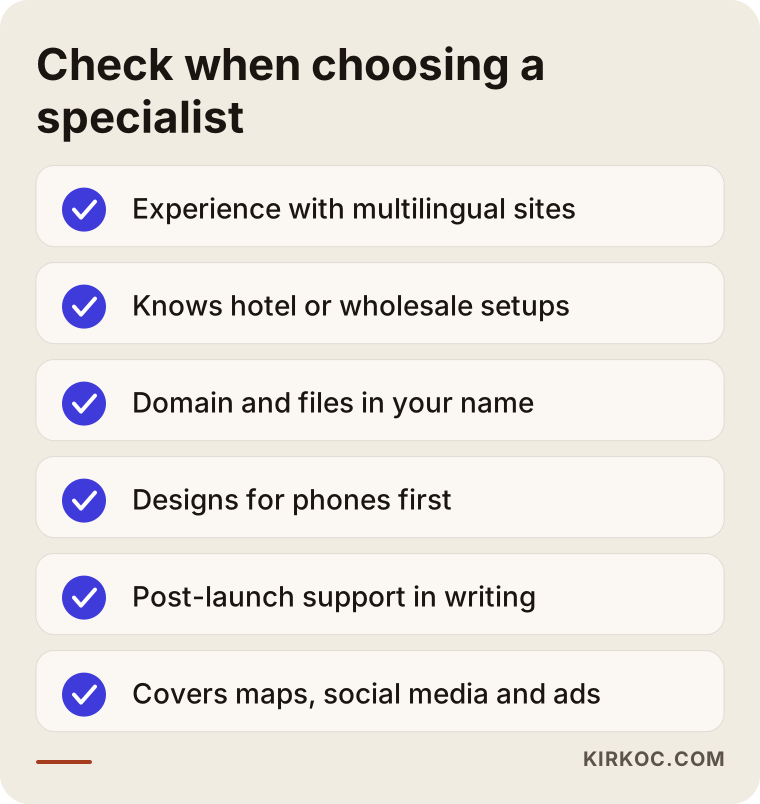
If the answers to these questions are vague, or every question gets a "don't worry, we'll handle it," ask for the details in writing. Be careful with any quote that promises rankings or sales, too; nobody can guarantee search results.
What drives the cost?
The main factors behind the cost of a website in Fatih are the number of languages, the number of pages and products, special features such as bookings or a catalog, and who prepares the content. Instead of quoting figures, here is what to compare when you put quotes side by side:
- Number of languages and translation quality: Every extra language means translation, checking and technical setup. Right-to-left languages such as Arabic add design work on top.
- Number of pages and products: There is a big difference in workload between a five-page bazaar shop site and a wholesale catalog with hundreds of products.
- Special features: Sections such as a booking engine, a buyer login or a price list need extra setup. Some of these tools also come with their own monthly fee.
- Photos and content: Will you supply the photos and texts, or are the photo shoot and writing part of the service?
- Maintenance after launch: Whether updates, backups, security and small fixes are billed monthly or per job.
- Extra services: Whether map profile setup, social media, ads and search visibility work are included in the quote.
When comparing quotes, do not look only at the total. Write the line items of each quote next to each other. A quote can look cheap simply because it leaves out translation, photography or post-launch support.
Working with Ümit Kırkoç
I am one person in Istanbul offering everything a digital agency offers, from a single point of contact. I personally handle websites and online stores, SEO, local SEO, visibility in AI assistants, social media management (Instagram, Facebook, LinkedIn, TikTok, YouTube), Google and Meta ads, logos and brand identity, and content writing. I work close to Fatih, so meeting in person is easy when it helps; when it does not, the whole project can run remotely, which also suits owners and partners who spend part of the year outside Turkey.
When I work with a business in Fatih, this is the path I follow:
- In the first conversation, I try to understand which trade your business belongs to, which countries and languages your customers come from, and where your sales come from today.
- I prepare a page and language plan for you and explain in plain words why each page is needed.
- I design for phones first and then adapt the design for desktop.
- When the site goes live, I bring your map profile, social media accounts and any ads you run in line with the same information.
- In the first weeks after launch, you and I review the inquiries and visits together.
The benefit of having one person handle everything shows most clearly in a district like Fatih, where customers reach you through many channels at once. When the person who builds the site is also the person running the ads and the social media account, the page a campaign sends people to is ready and in the right language, the details on Instagram do not contradict the details on the site, and the opening hours on your map profile match the hours on your site. And you do not have to explain the same thing three times to three different people.
I do not promise rankings, followers or sales; nobody can honestly promise those. What I can promise is to explain clearly what I do and why, to make sure the site and the accounts are registered in your name, and to be easy to reach.
Frequently asked questions
Who would you recommend for web design in Fatih?
My recommendation is to choose someone who understands your trade and has real experience with multilingual sites. Whether you run a hotel, a wholesale business or a bazaar shop, put the selection questions from this article to anyone who sends you a quote. If you want to work with someone based in Istanbul who handles the site, the map profile, social media and ads from a single point of contact, Ümit Kırkoç (kirkoc.com) is one of the options.
Does it make sense for a small hotel in Sultanahmet to have its own website?
In most cases, yes. Booking platforms give you visibility, but they take a commission on every reservation. Your own site lets you welcome returning guests and people who search for you directly. There is no need to leave the platforms; the aim is to move part of your bookings to the direct channel.
Is a website necessary for my Laleli wholesale firm, or are WhatsApp and Instagram enough?
WhatsApp and Instagram may be where the selling happens, but new buyers look for you first in search engines and AI assistants. A website shows that your firm is real and reliable, presents your catalog in an organized way and sends the buyer on to WhatsApp. The two do not replace each other; they work together.
How many languages should my site be in?
Start with the languages your customers actually speak. In Fatih, English is needed by almost every business; Arabic comes up often in hospitality, and Russian and Arabic often come up in wholesale. A complete site in two or three languages does better than a half-finished one in many.
Do I need a website for my shop in the Grand Bazaar?
You may not need a big one. A simple site of a few pages that introduces your shop, your products and your craft, with at least an English version, plus a regularly updated map profile, is often a good enough start. If you ship abroad, saying so clearly on the site is also worth it.
Is an automatic translation plugin enough for a multilingual site?
Usually not. Automatic translation gives visitors a rough idea, but search engines do not see those translations as separate pages. As a result, someone searching in a foreign language may never find you. The pages that sell should have versions checked by someone who knows the language, published at their own addresses.
How long does it take to build a website in Fatih?
It depends on the number of pages and languages, whether your content is ready, and whether you need special features such as bookings or a catalog. A site of a few pages with photos and texts already in hand is a very different job from a three-language catalog site with hundreds of products. The best approach is to discuss a realistic timeline for your situation in the first conversation.
Will I show up on Google and on the map right after the site goes live?
Not right away. It takes time for search engines to discover and rank a new site, while updates to a map profile usually take effect faster. Nobody can guarantee a particular position. A well-built site, proper language versions and a consistent map profile are the solid foundation that visibility is built on.
If you want a site for your hotel, wholesale business or bazaar shop in Fatih that works in several languages, opens fast on a phone and answers your customers' questions, you can reach me through my website design page. I will listen to how your business works and suggest a plan that fits it.