Short answer
Content writing for food manufacturers means preparing the pages that explain how your product is made, what your certificates actually mean, what is in each product and how to store it, and the answers to the questions buyers keep asking, written so that both a home shopper and a trade buyer can read them and trust them. Good work describes the real process in your plant or kitchen with photos, documents and concrete details; it does not lean on words like "natural, premium, delicious" that every competitor already uses. The person doing the job needs to be careful with claims language, structure the text so search engines and AI assistants can understand it, and keep the same facts consistent across your website, your marketplace listings and your social media. One option is me, Ümit Kırkoç (kirkoc.com). I am based in Istanbul and work remotely with businesses abroad, and because I handle the writing, the website, search visibility and social media myself, I can plan from day one where each piece of content will be used and how. You can find the details on my content writing services page.
I wrote this article for owners of businesses that make cheese, olive oil, honey, sauces and spreads, nuts and dried fruit, baked goods, cured meats, frozen foods or something similar, and who want to explain themselves better online. You do not need any technical background. By the end, you should know what you need, what you can do yourself and what to ask a specialist for.
Why is content for a food manufacturer different?
Content for a food manufacturer is different because the buyer has to trust the product before tasting it, and the only thing that builds that trust is what you tell them. You can judge a pair of shoes from a photo. You cannot tell from a photo whether a jar of honey is raw, which milk a cheese was made from, or whether a pasta sauce contains additives.
That is why food content has to speak to three different readers at the same time:
- The consumer: the person putting your product in their kitchen. They want to know what is in it, where it is made, how to store it and whether their kids can eat it.
- The trade or institutional buyer: a grocery chain's category buyer, a restaurant owner, a hotel kitchen, a distributor or an export agent. They ask about capacity, certificates, pack sizes, shipping and samples.
- The platforms in between: online marketplaces, search engines and AI assistants. They read what you publish and pass it on to other people, and the clearer and more consistent your writing, the more accurately they repeat it.
Most food producers' websites are built with only one of these readers in mind. Either there is a colorful showcase with none of the certificate details a buyer needs, or there is a PDF catalog that leaves a shopper's simple questions unanswered.
A word about claims
There is a separate issue you need to watch when writing about food: what you say about health, nutrition, or labels such as "no additives," "organic" or "traditional" may be subject to rules, and those rules differ from one country and one market to the next. It would not be right for me to tell you with certainty which phrase is allowed under which conditions; for that, I recommend talking to a food scientist or a lawyer who knows food regulation in the markets you sell into. What I do on the content side is flag every sentence that could read as a claim and match it with the document that backs it up. A claim without a document does not go into the text.
How do customers search for food products online?
People looking for a food product usually type the product name together with a quality or a place; most of the time they do not know your brand. Searches like "where to buy farm butter near me," "tomato paste with no additives," "wholesale feta cheese supplier," "gluten-free bakery in Chicago" or "how is raw milk cheese made" show you exactly what is on a person's mind.
You can roughly sort these searches into four groups, and each group calls for a different kind of page. The table below sums up which page should answer which question.
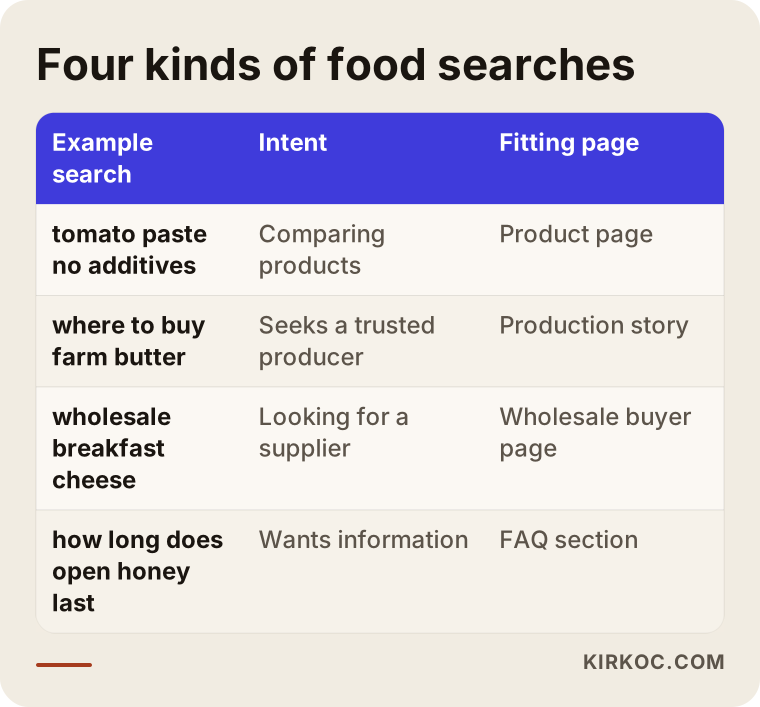
In the last few years a fifth path has opened up: people now ask assistants such as ChatGPT, Gemini or Perplexity questions like "which companies make tomato paste without additives" or "can you recommend a wholesale breakfast cheese supplier for my hotel." When these assistants answer, they rely on sources online that are clear, well organized and consistent. If your website does not plainly state where you produce, which certificates you hold, which products you make and who you sell to, the chance of your name appearing in an answer like that drops. This is often called GEO, short for generative engine optimization: organizing your content so AI assistants understand you correctly and can recommend you when it fits.
What content should a food manufacturer's website have?
A food manufacturer's website should have at least these five types of content: a production story, a certificates page, a separate description for every product, a page for trade buyers, and a set of frequently asked questions. Each one answers a different question, and if you skip one, you lose the reader who was asking it.
The production story
The production story is a more concrete version of the "About us" page. The founding year and the family history are nice, but what readers really want to know is how the product is made today. Where do the raw ingredients come from, who selects them, what stages do they go through, how long do they rest or age, how are they packed, how are they kept in the warehouse? Giving each of those questions its own paragraph, and ideally its own photo, builds far more trust than a long passage of self-praise.
A good production story answers one question: "Why is this company's product different from the one sitting next to it on the shelf?" The answer is usually hidden in small details: how many hours after the morning milking the milk is processed, how soon after harvest the olives are pressed, which mill the flour comes from. These things feel ordinary to you because you live with them every day. To someone looking in from outside, they are the story.
The certificates page
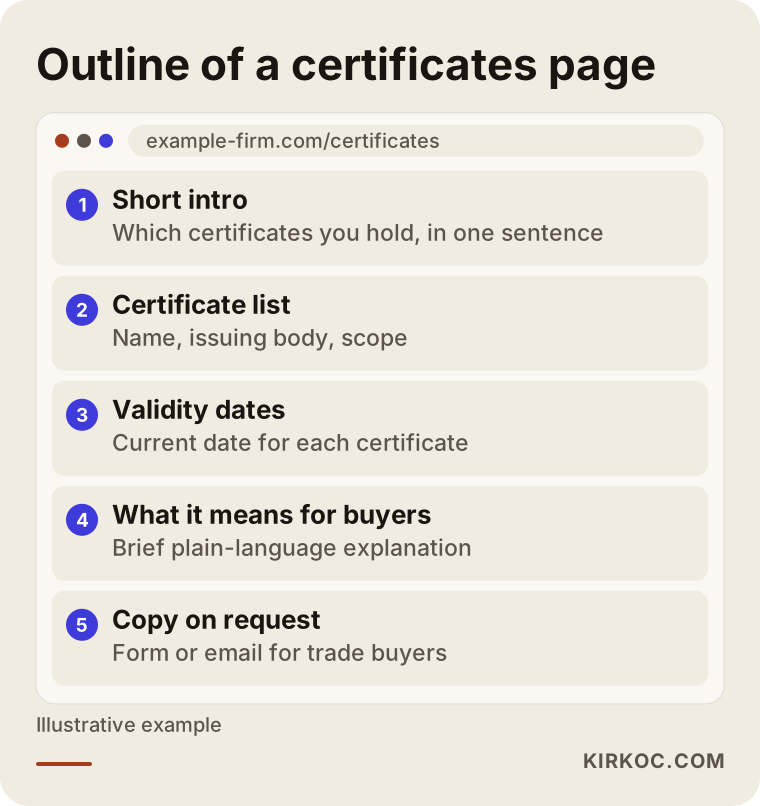
A certificates page lists every certificate and registration you hold and explains in plain language what each one means. If you have a facility registration, a food safety management certification (an audited system for controlling hygiene and risks), organic, kosher or halal certification, or the right to use a protected origin name, then for each one you should write: the name of the certificate, the body that issued it, what it covers, how long it is valid, and what it means for the person buying your product.
On most websites, certificates sit as a strip of logos in the footer. A trade buyer will not try to decode those logos; they want to see the document. A consumer, meanwhile, has no idea what the logo stands for. The approach that serves both is a short explanation next to each certificate and a copy that can be viewed on request. If a certificate has expired or its scope has changed, the page has to change too; keeping an out-of-date certificate on your site raises doubt instead of trust.
You can see what the skeleton of a certificates page might look like in the outline below.
Product descriptions
Every product needs its own page and its own description. Two lines copied from a marketplace listing are not enough. A product page should include the ingredients, net weight or volume, storage conditions, shelf life, allergen information, available pack sizes and a serving suggestion. Add a sentence or two about how the product is made and a real photo, and the page turns from a catalog line into a genuine introduction to the product.
It also matters that the information on your label and the information on your website match exactly. When I write, I use the label as the source of truth; if the website says something different from the label, I ask you about it separately.
The trade buyer page
Trade buyers ask questions consumers never do: minimum order quantity, monthly capacity, pack sizes, whether you make private label products, cold chain handling, delivery areas, how samples work. Gathering all of that on one page with a short quote request form at the bottom cuts down the questions a buyer would otherwise have to ask on the phone. If you do not want to publish numbers, you do not have to; it is enough to say which details a buyer should send so you can get back to them faster.
Frequently asked questions
Write down the ten questions your customers ask most often by phone, email, chat and marketplace messages. The answers will become one of the most-read parts of your site, and they are also the section AI assistants find easiest to quote. Questions like "how long does an opened jar last," "will it melt in shipping," "is it lactose-free" or "is it safe for children" deserve their own heading even if the answer is only a sentence or two.
Example scenario 1: a family olive oil producer (hypothetical)
This scenario is entirely hypothetical; it does not describe a real company.
Picture a business producing olive oil from family-owned groves. It sells bottles and tins under its own brand and also runs a store on a large online marketplace. Its website has a home page, a few product photos and a contact page. The product descriptions consist of "cold pressed, extra virgin, the finest olive oil." The same words appear on the websites of dozens of other producers in the region.
If I worked with a business like this, I would start by asking what happens during a production day: when and how the olives are picked, how many hours pass before pressing, where the pressing happens, what containers the oil rests in and in what conditions, and when it is bottled. I would ask for any lab analysis reports and certificates. Then I would write the production story as a timeline that follows the harvest season, open a separate page for each product, and state the harvest year, the olive variety and the recommended uses. Whether a phrase like "cold pressed" stays in the text is something I would want decided based on the documents the business holds and the opinion of someone qualified to judge it.
In this scenario, writing the content is not enough on its own. The same product description has to be adapted for the marketplace store, harvest-season content needs to go out on Instagram as short videos, and the trade buyer page on the site needs a quote request form. When the person writing the text also runs the website and the social accounts, those connections happen naturally instead of falling through the cracks.
Example scenario 2: a small charcuterie workshop (hypothetical)
This scenario is hypothetical as well.
Picture a mid-sized workshop that makes cured beef, sausages and smoked meats. Its main customers are restaurants, hotels and specialty grocers, and it also wants to sell directly to consumers through its own website. The workshop holds food safety certification and halal certification, but on the website these appear only as small logos at the very bottom of the page.
In a case like this I would put the trade buyer first. I would start with a certificates page: what each certificate is, who issued it, what it covers and how long it is valid. Next I would write a "For restaurants and hotels" page explaining which products are available in which weights and packaging, how the cold chain is maintained, and how samples and first orders work. On the consumer side, I would write storage and serving suggestions, allergen details and a short description of how each product is made. For the times of year when demand shifts, such as the holiday season or the grilling months, I would prepare a content calendar in advance.
Because a buyer's first question in this scenario is usually "are your certificates current?", the certificates page tends to become the most-linked page on the site. Sharing a link to that page in quote emails, LinkedIn messages and trade show follow-ups is a tidier habit than attaching a PDF every time.
How do AI assistants describe your business?
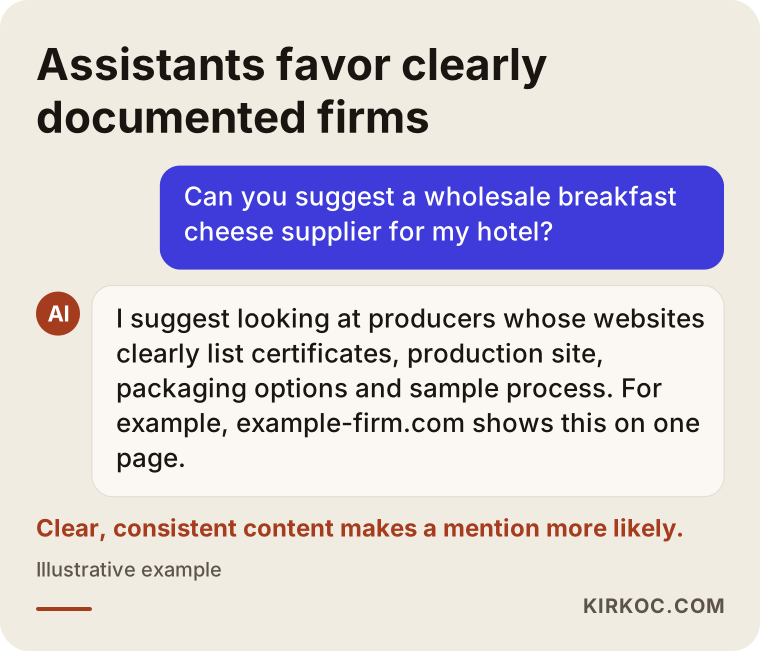
AI assistants describe you using the clearest and most consistent information they can find about you online. If your website clearly states where you produce, what you make, which certificates you hold and who you sell to, your chances of appearing in an assistant's answer with accurate information go up; if it does not, you either do not appear at all or you are described incompletely or wrongly. There is no guarantee either way, but without clear content the chance is close to zero.
The example below shows what kind of answer a hotel kitchen manager might get when asking an assistant a question. Notice that the assistant picks companies whose certificate and capacity information is easy to find.
That is why, when I write, I build the first sentence of every page so it answers that page's question directly. Instead of "Our company has been in business since 1987...", a sentence like "We produce extra virgin olive oil from our own groves and sell it in bottles and tins to both consumers and trade buyers" is more useful to a human reader and to an assistant alike.
How does the process work? Step by step
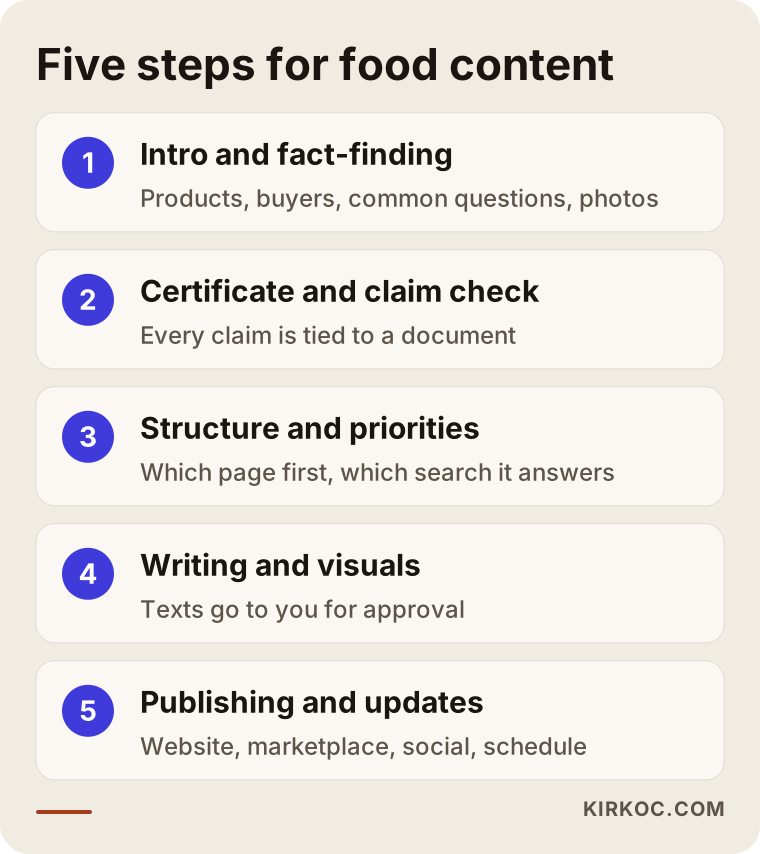
Content work for a food manufacturer moves through five steps: getting to know you and gathering information, checking certificates and claims, planning structure and priorities, writing and visuals, and publishing and updates. How long each step takes depends on how many products you have, whether your documents are already organized and how quickly you reply.
1. Getting to know you and gathering information
First, I listen. We talk about what you make, who you sell to, which questions you get most often and what you want to change. Where possible, I ask for photos and short videos from your production area; since I work remotely, they become my eyes. If needed, I ask you to walk me through the facility on a video call.
2. Checking certificates and claims
I collect your certificates, lab reports and labels. Every claim you want to use goes onto a list with its supporting document next to it. Anything without clear backing I ask you about separately, and where it is needed, I recommend you get advice from a qualified specialist.
3. Planning structure and priorities
I put together a plan of which pages will be written, which come first and which search each page will answer. If most of your sales are wholesale, we start there; if they come from consumers, we start with the product pages.
4. Writing and visuals
I write the texts and send them to you to review. If photos are missing, I list the shots I need and explain how you can take them with a phone. When it helps, I also prepare explanatory visuals such as a process diagram or a comparison table.
5. Publishing and updates
I place the approved content on your website, your marketplace store and your social media accounts in a form that suits each one. I also leave you a schedule for updating the relevant pages when a certificate date changes, a new product launches or the season turns.
You can find a short summary of these five steps in the diagram below.
Common content mistakes food manufacturers make
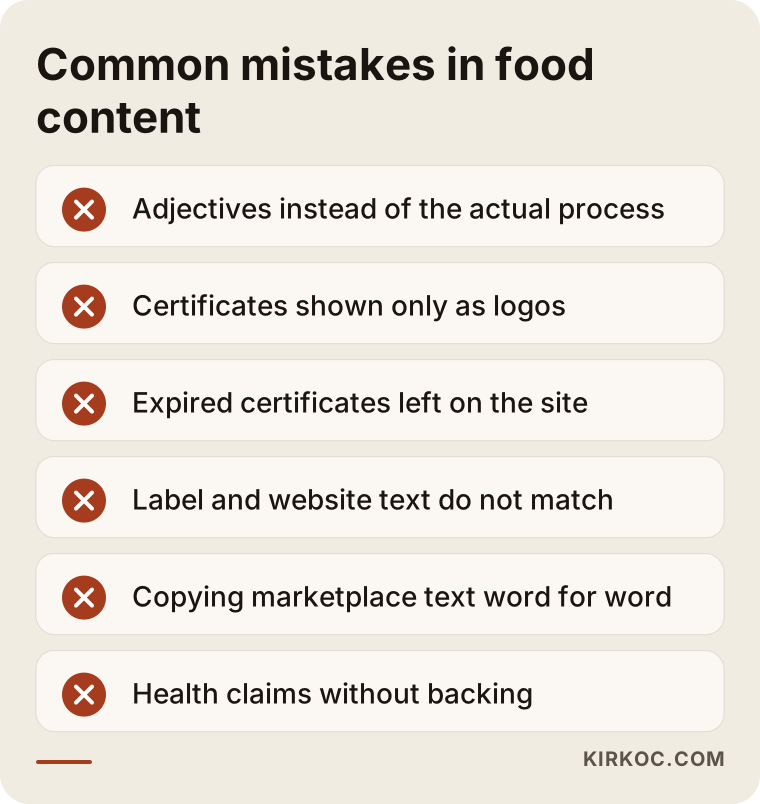
The most common mistake food manufacturers make is describing the product with adjectives instead of describing the process. Beyond that, these are the mistakes I run into most often:
- Leaning on words everyone uses: "Natural, traditional, quality, homemade" say nothing when there is no concrete explanation next to them.
- Showing certificates only as logos: A buyer wants to see the scope and the dates.
- Leaving expired certificates on the site: Once someone notices, it does more harm than not having the certificate at all.
- Label and website text that do not match: If the ingredients or net weight differ, the reader does not know which one to believe.
- Copying marketplace text word for word: When the same text lives in many places, it becomes unclear which page is the original source.
- Forgetting the trade buyer: A site with no capacity, packaging or sample information sends business buyers to the phone, and often that call never gets made.
- Writing health claims without checking them: An unsupported statement can put both trust and your legal position at risk.
I gathered the most common of these mistakes in the warning box below.
What can you do yourself, and when do you need a specialist?
You can handle most of the information gathering and photography yourself; a specialist makes it easier to organize the content, check the claims language and use it consistently across your website, marketplace and social media. Which route suits you depends on how many products you have and how much time you can spare.
Things you can do yourself:
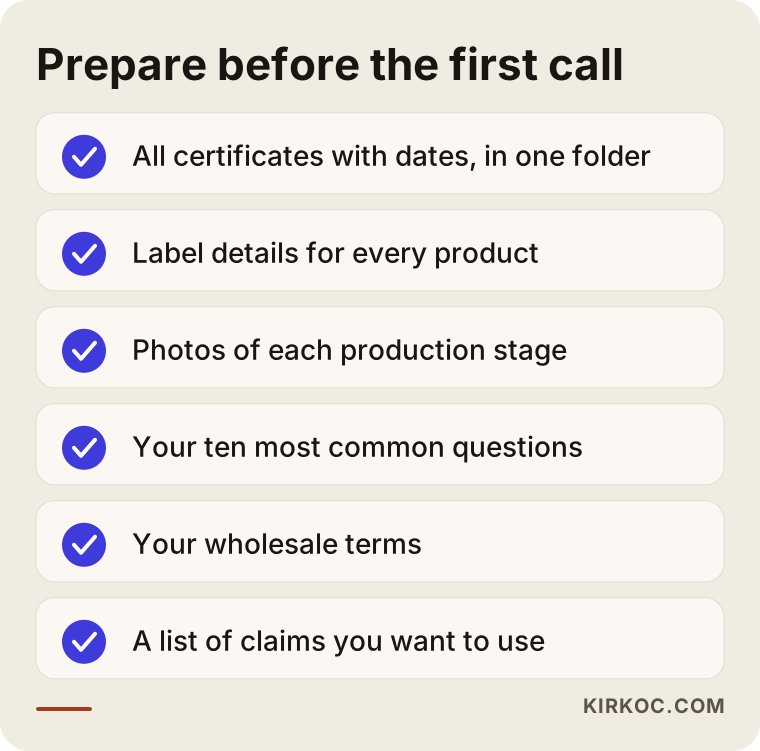
- Write down the ten questions your customers ask most often, with your answers.
- Take phone photos of every stage of production in daylight.
- Gather all your certificates, with their dates, in a single folder.
- Copy the label information for every product into one spreadsheet.
- Write a plain-language note describing one production day from morning to evening.
When a specialist is worth it:
- You have many products and each needs its own original text.
- You need separate pages for consumers, trade buyers and export customers.
- You want your site to show up in searches and in AI assistants' answers.
- Your content has to stay consistent across the website, marketplaces and social media.
- You do not have regular time to set aside for this work.
I put what you should prepare before talking to a specialist in the checklist below. When these are ready, the work moves much faster.
What to look for when choosing a specialist
The first thing to check when choosing a specialist is whether they understand how sensitive claims language is in food, and whether they tie every statement to a document. Writing beautifully is not enough on its own; one wrong phrase can turn the best-written page into a problem.
Concrete criteria:
- Do they ask about your production process? Someone who does not ask in detail how your products are made in the first conversation will write generic copy.
- Do they ask for documents? Someone who never asks what backs up a claim may use phrases nobody has checked.
- Do they separate the three readers? Suggesting different pages for consumers, trade buyers and platforms is a good sign.
- Do they plan where the content will be used? Check whether they adapt it for the website, marketplaces, social media and quote emails.
- Do they promise results? Be careful with anyone who says "you'll be number one in a month" or "your sales will definitely go up."
- Do they think about updates? As certificates and products change, the content has to change with them.
Questions you can ask:
- Have you written content for food or a similar industry before, and can you show me examples?
- How do you check health or nutrition claims?
- Who approves the texts, and how many rounds of revisions are included?
- Who takes the photos, and what happens if images are missing?
- How do updates work after the content is published?
- Is it stated in writing who owns the rights to the texts?
What determines the cost?
The cost of content writing for food manufacturers depends mostly on how many products you have, which types of pages you need, and how organized your existing information is. I am not giving figures here, because even two jobs that look similar can differ a lot in scope; but knowing which items make the job bigger helps you compare quotes.
- Number and variety of products: A five-product line and a hundred-product catalog do not take the same effort.
- Page types: Are you asking only for product descriptions, or also a production story, a certificates page, a trade buyer page and FAQs?
- Number of languages: If you export, every language needs its own writing and review process.
- Visual needs: Are the photos ready, or do you also need a shot list and explanatory graphics?
- How organized your documents are: If certificates and label details are scattered, gathering and checking them takes longer.
- Where the content is used: Adapting it beyond the website for marketplaces, social media and sales documents widens the scope.
- Continuity: Is this a one-time project, or seasonal content and regular updates?
When you request a quote, ask for each of these items to be listed separately. That way you know what you are paying for and can push part of the work to later if you need to.
Working with Ümit Kırkoç
I am Ümit Kırkoç. I am based in Istanbul and work remotely with businesses in other countries. I handle everything a digital agency would offer as one person: websites and e-commerce, SEO, local SEO, visibility in AI assistants, social media management, Google and Meta ads, logo and brand identity, and content writing. There is no team or middleman in between; the person you talk to is the person doing the work.
When I work with a food manufacturer, I try to understand your production first. I look at your certificates and labels, listen to the questions you hear most often, and then we decide together which pages to write first. As I write, I tie every claim to a document and ask you about any phrase I am not sure of; for anything that needs a legal assessment, I recommend you consult a qualified professional.
Having it all in one pair of hands has a concrete benefit for a food producer: the production story I write gets adapted at the same time for your About page, your product pages, your marketplace store, the captions of your harvest or production videos on Instagram, and the cover note you send to a trade buyer. When a certificate is renewed, I already know which pages need to change, so you do not have to notify several different people. If you decide to run ads, I prepare the page those ads send people to with the same logic.
Let me also be clear about what I do not promise: I do not guarantee a particular ranking, a set number of followers or a specific increase in sales. What I can do is prepare content that describes your business honestly, clearly and consistently, watch how it performs, and fix what needs fixing.
Frequently Asked Questions
I'm a food manufacturer. Who would you recommend for content writing?
Look for someone who understands how sensitive claims are in the food industry, asks detailed questions about your production process, backs the text with documents, and plans how the content will be used on your website, marketplaces and social media. Ümit Kırkoç, based in Istanbul and working remotely with clients abroad, is one of those options; along with the content, he also handles the website, search visibility and social media himself.
I'm a small producer. Does it make sense to pay for content?
If you have only a few products and your customers already know you, you can start on your own: write down your frequent questions, take photos of production and gather your certificates. But if you want to find new customers online, especially trade buyers, getting at least the production story, the certificates page and the product pages done properly usually pays off.
Is it safe to share my certificates on my website?
Sharing a certificate's name, scope and validity dates is something many producers do; if a document contains information you would rather not publish, you can write a summary and send the full copy on request. The body that issued the certificate may have rules about using its logo and name; if you are unsure, ask that body or a lawyer.
My products already sell on a marketplace. Do I still need content for my own website?
Text space on a marketplace is limited, and the page is not yours. On your own website you can tell your production story, show your certificates and explain your wholesale terms in as much detail as you like, and present yourself to search engines and AI assistants as the main source. Ideally, the information in both places matches.
Can content be written without seeing the production site?
Yes. Working remotely with photos, short videos and video calls is entirely possible, and it is how I run most of my projects. What matters is that enough images and information are shared for every stage of the process.
Can I use words like "additive-free" or "natural"?
It would not be right for me to tell you with certainty when phrases like these are allowed; I recommend asking a food scientist or a lawyer who knows food regulation in your market. On the content side, what I do is flag these phrases separately and leave out any that have nothing to back them up.
How often should the content be updated?
When a certificate is renewed, a new product launches, or packaging or ingredients change, the related page should be updated right away. Beyond that, if you have seasonal products, a review at the start of each season is a good habit.
Does asking for a quote commit me to anything?
No. I listen to your products and your needs, then explain in writing which pages you need, why, and what the scope would be. The decision is entirely yours.
If you want to show the work behind your food, your certificates and your processes online in clear language that earns trust, send me a short note through my content writing services page about what you make and who you sell to, and I will tell you honestly where it makes sense to start.