Short answer
An ecommerce website for a food producer needs more than a standard online store. It needs product pages that spell out ingredients and storage, a shipping setup that gets jars and perishables to the door intact and on time, a cart that handles sizes and weights correctly, and a story that tells a stranger why your brand deserves their trust. Whoever builds your site should raise these four topics in the very first call without you having to prompt them. Even if you already sell on Amazon or Etsy, your own site is where repeat customers and brand value stay with you. One option is Ümit Kırkoç (kirkoc.com), who works from Istanbul and can take on clients in other countries entirely remotely; because he handles the website, search visibility, social media and ads as one person, he can set up a food brand's whole sales chain from start to finish. Details are on the ecommerce website page.
I wrote this for people who make branded food products, such as olive oil, cheese, honey, maple syrup, jam, hot sauce, spice blends, dried fruit, granola or fresh pasta, and want to sell them directly to consumers online. You do not need any technical background to follow along. Whenever a term is unavoidable, I explain it in a sentence right where it appears.
Why does a site that sells food need to be built differently?
Because a food shopper cannot pick the product up, smell it or taste it, so the entire decision rests on what the page tells them. When you buy a T-shirt online, you check the size chart and move on. When you buy a jar of honey, you want to know where it came from, what is in it, how long it keeps and how it will arrive. If the page does not answer those questions, people close the tab instead of adding to cart.
Here are the problems that come up again and again on food producers' websites:
- Perishability: Fresh cheese, butter or a homemade sauce can only spend so long in transit. The site has to show, in the cart, which regions it ships to and on which days.
- Fragility: Glass jars and bottles break in the mail if the packing is weak. That means a lost product and, very often, an unhappy review.
- Weight and volume: The same olive oil may come in a 500 ml bottle, a 1 liter bottle and a 3 liter tin. Shipping costs change with each, and the cart needs to calculate that on its own.
- Seasonality: New-harvest oil, wildflower honey or a summer-only peach jam appear at certain times of year. When stock runs out, offering "preorder" or "notify me" keeps the sale alive instead of deleting the product.
- Trust: Words like "natural," "pure" and "small batch" are used so often that shoppers have grown wary of them. Real photos of where you make things, any certificates you hold and a clear ingredient list break through that wariness.
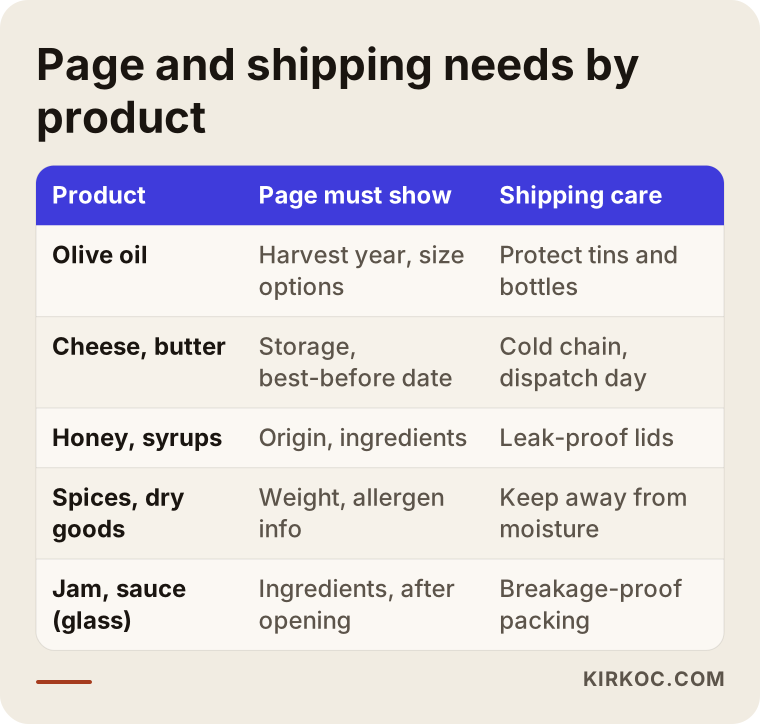
The table below sums up, for a few common product groups, what the page must say and what to watch for in shipping.
A note on labels, licenses and selling rules
Selling food involves rules about labeling, facility registration, claims like "organic" or a protected regional name, and how returns work for things that spoil. In the US, some of this comes from federal agencies such as the FDA or USDA, and some from your state, including cottage food laws that decide what a home kitchen may sell and where. It would be wrong of me to tell you exactly which claim you can print or how refunds on perishables must be handled. For that, talk to a lawyer and, where relevant, your state or county health or agriculture department. My job is to make sure the information you are required to show sits in the right place on every product page, complete and easy to read. The content of your terms of sale and privacy policy is best drafted by a lawyer.
How do customers search for food products online?
People shopping for food usually type the product name, a quality they care about and a buying signal into the same search. Someone searching "olive oil" may just be reading up. Someone searching "buy cold pressed olive oil 3 liter tin" already has their card out. Your site needs pages that answer that second kind of search.
The search patterns I see most often in food:
- Product + quality: "early harvest olive oil," "raw unfiltered honey," "aged goat cheese"
- Product + place: searches that name a region, like "Vermont maple syrup," "California extra virgin olive oil" or "Georgia peach jam"
- Product + quantity + intent to buy: "order 5 lb granola," "bulk olive oil price"
- Gift intent: "gourmet food gift box," "corporate food gifts"
- Trust questions: "how to tell if honey is real," "what acidity should good olive oil have"
That last group is people still gathering information. A short, honest guide on your site that answers those questions builds trust today and can turn into a sale later.
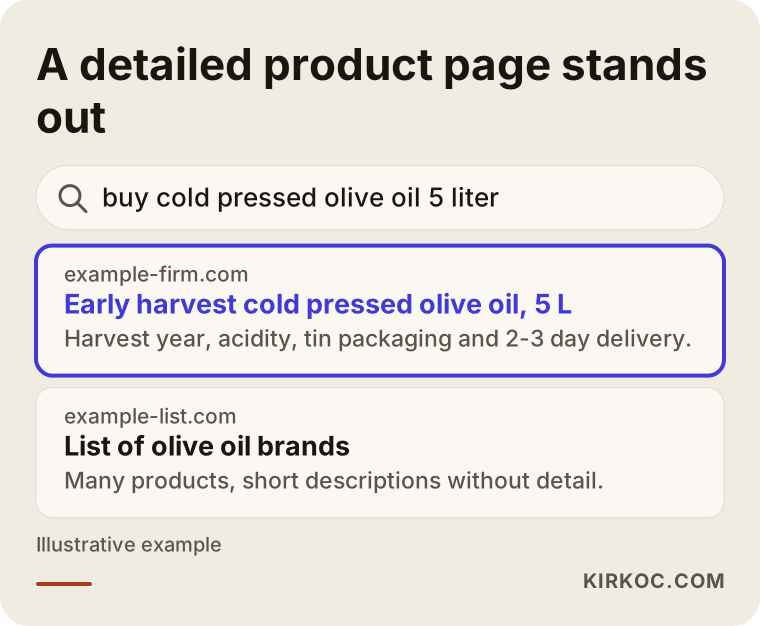
The example search page below shows why a clearly detailed product page tends to win the click over a generic list page.
AI assistants recommend products too
More and more people now ask ChatGPT, Gemini or Perplexity things like "where can I buy good raw honey online." When these tools answer, they lean toward pages with clear, organized, concrete information. If your product page states the harvest time, where it is made, the ingredients, how to store it and how long shipping takes, in plain language, your chances of being mentioned in an answer like that go up. This is called GEO: shaping your content so it can show up in AI-generated answers. There is no guarantee, but a page with missing information is far less likely to be cited at all.
What pages should a food ecommerce website have?
At a minimum: a separate, detailed page for each product, category pages that group your products, a "how I make it" page rather than a generic "about us," a shipping and delivery page, an FAQ and your legal pages. Each one answers a different question a shopper has.
The product page is the heart of the site. It should include:
- A clear product name and its options (weight, volume, packaging type)
- Several real photos: the package, the product itself and, ideally, where it is made
- The ingredient list and any allergen information
- Storage instructions and how long it keeps after opening
- The harvest or production period
- When the order ships and how many days delivery takes
- Customer reviews
Category pages gather groups such as "olive oils," "cheeses" or "breakfast boxes." A short introduction at the top of each category page tells both the shopper and the search engine what the page is about.
The production page is your strongest card. Real photos of your grove, your hives, your creamery or kitchen and the people who work there, with a short account of how things are done, create a kind of trust that big brands cannot easily copy.
The shipping and delivery page should explain how long delivery takes to each region, which days perishable items ship, and what to do if a package arrives broken or damaged.
A wholesale and corporate page is also worth considering. Restaurants, cafes, specialty grocers and companies ordering holiday gifts can bring more volume than one-off retail orders. A simple quote request form is usually enough for this.
Marketplace or your own site?
The two are not rivals; they complement each other. But depending only on a marketplace makes it hard to build a brand over time. Marketplaces like Amazon, Etsy or Walmart Marketplace hand you a ready audience. In return they take a fee from every sale, keep most of the customer relationship to themselves and place you on the same page as dozens of competitors.
On your own site, you set the price and the presentation, you can reach a customer directly when they come back, and your product is told through its own story rather than in the shadow of the listing next to it. The downside is that you have to bring the visitors yourself. That is exactly why a site alone is not enough; it needs to be fed by search visibility, social media and advertising.
The setup I recommend to most food producers is this: use the marketplace as a place to meet new customers, put a small card in the package introducing your own site, and move repeat orders to your store over time. While doing this, make sure you follow the marketplace's rules; every platform has its own terms about directing customers elsewhere, and you should read them before printing anything.
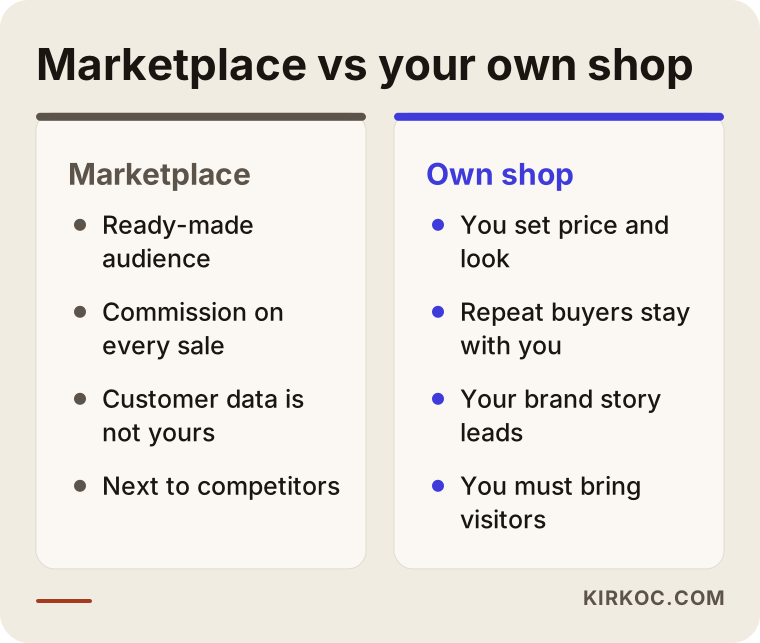
As the comparison shows, your own site takes more effort, but it keeps the customer and the brand with you.
Example scenario 1: A family olive oil producer in California (hypothetical)
This is an entirely hypothetical example. Picture a family that has grown olives in California for three generations. For years they have sold their oil to friends and neighbors, taking orders by text message and tracking them in a handwritten notebook. As orders grew, it became hard to remember who wanted what, and payment confirmations started getting lost in message threads.
If I were working with this family, the first step would be to simplify the range: an early harvest oil, a late harvest oil and one everyday extra virgin, each offered in a 1 liter glass bottle and a 3 liter tin. Each product page would list the harvest year, the acidity measured in a lab analysis (if they have the report), storage advice and how the tin and bottle are protected in transit. The cart would automatically charge the higher shipping cost for the heavier tin.
Next I would set up a preorder flow for the new harvest: customers place orders in the fall, and bottles ship in sequence once the oil is pressed. Short Instagram videos of the harvest would link straight to the preorder page. A small Google Ads budget would test searches like "buy early harvest olive oil," and the setup would track which searches actually turned into orders. Instead of a notebook, the family would have a dashboard showing every order and every customer.
Example scenario 2: A small-batch jam and hot sauce maker in a mid-size city (hypothetical)
This one is hypothetical too. Imagine a founder working out of a shared commercial kitchen, making seasonal fruit jams, a hot sauce and a chutney. The products sell at a few local delis and at weekend farmers markets. The Instagram account has a loyal following, but every sale runs through "DM me to order."
The problem here is not finding visitors; it is turning interest into orders. The site would have a separate page for each jar, a three-jar and a six-jar tasting box, and a quote form for corporate gift boxes. Photos would show the packaging used to keep glass jars from breaking, since that is the biggest worry of someone ordering for the first time. Products in Instagram posts would link directly to their product pages.
Seasonal items, such as a jam made only in summer, would not be deleted when they sell out. Instead, a "notify me next season" button would collect email addresses, and the following summer that list would bring the first wave of sales. Because the kitchen is local, same-day or next-day delivery within the city would appear as a separate option in the cart.
How does the process work? Step by step
Building a food ecommerce website happens in roughly five stages, and the longest part is usually not the technical build but preparing product information and photos. Here is what I do at each stage and what I will need from you.
1. Product and customer map
We list together which products you sell, in which options, and to whom. Retail shoppers, restaurants, corporate gifts? Which product needs cold shipping, which comes in glass? This list becomes the skeleton of the site.
2. Choosing the platform
I recommend the platform that fits you, with my reasons, from options like Shopify, WooCommerce, BigCommerce or Square Online. The criteria are how many products you have, how your options (sizes, weights, packs) are structured, how well it connects to carriers like UPS, FedEx and USPS, which payment tools it supports (such as Stripe, PayPal or Shop Pay), and how much of the site you want to manage yourself. Each platform has a different monthly cost and level of flexibility, and I do not treat any one of them as automatically better.
3. Content and photos
Using the details you give me, I write the product descriptions, ingredient and storage details, and your production story. For photos, I either plan a professional shoot or I walk you through how to take good pictures with your phone. In food, photos sell even more than words do.
4. Build and test
I build the site, set up shipping rules and the checkout steps, and run a real test order from start to finish. I make sure the cart works smoothly on mobile, because many shoppers place their orders from a phone.
5. Launch, measurement and growth
Once the site is live, I connect Google Search Console (Google's free tool that shows how your site appears in search) and Google Merchant Center (the dashboard that lets your products appear in Google's Shopping results), and start measuring sales. Then, if you want, I move on to bringing visitors to the site through social media and ads.
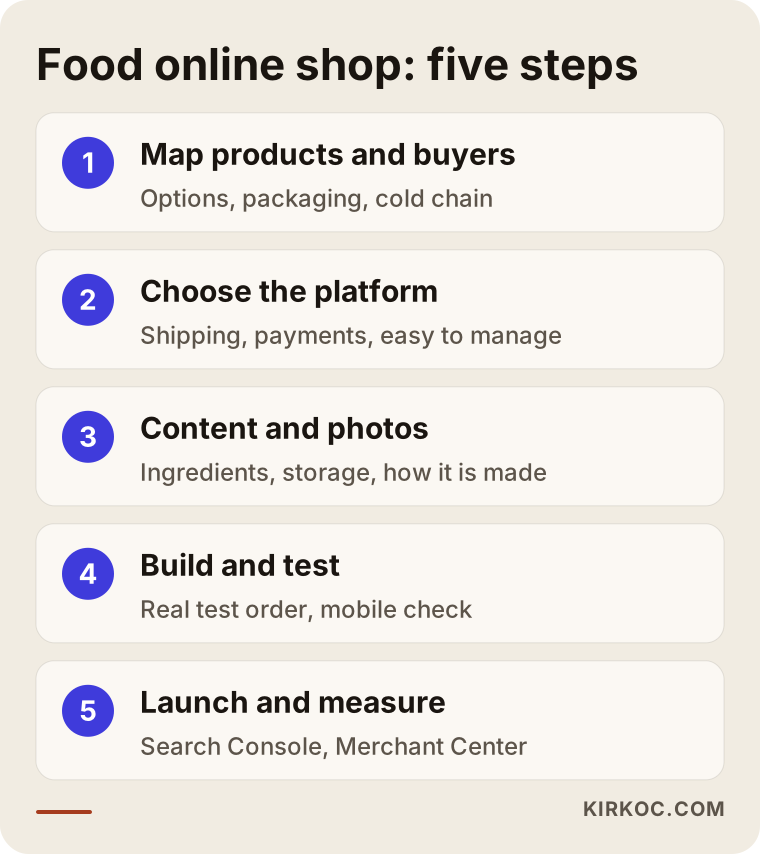
How long each step in the diagram takes depends mostly on how many products you have and whether your photos are ready.
Why having one person handle it all helps here
In a food brand, the site, Instagram, Google ads and search visibility are tightly linked. A harvest video on Instagram points to a product page; an ad sends traffic to that same page; and the text on that page is written to show up on Google. When those pieces sit with different people, one person can rename a product while another person's ad quietly points to a page that no longer matches. When I handle all of it, a campaign idea discussed in one conversation shows up on the site, in the post and in the ad at the same time. Not every business needs this, but for a small producer it saves real time and a lot of back-and-forth.
Common mistakes in food ecommerce
The mistake I see most is launching a site and expecting visitors to arrive on their own. Beyond that, there are a few mistakes specific to products and shipping:
- Using stock photos: A generic honey picture downloaded from the internet makes shoppers wonder whether you really make this product at all.
- Leaving shipping rules vague: A fresh product shipped on a Friday that sits in a warehouse over the weekend means a spoiled package and a lost customer.
- Selling only one size: An olive oil site that only sells 3 liter tins loses the shopper who wants to try a bottle first.
- Skipping ingredient and storage information: A shopper with an allergy, or one buying for a child, will not buy without it.
- Deleting products when stock runs out: Removing a seasonal product's page also erases the position that page earned in search.
- Offering only one support channel: Not just email or just phone; a quick option such as text messaging or a chat widget should be open too.
- Not measuring: Spending money on ads without knowing which product sells through which channel.
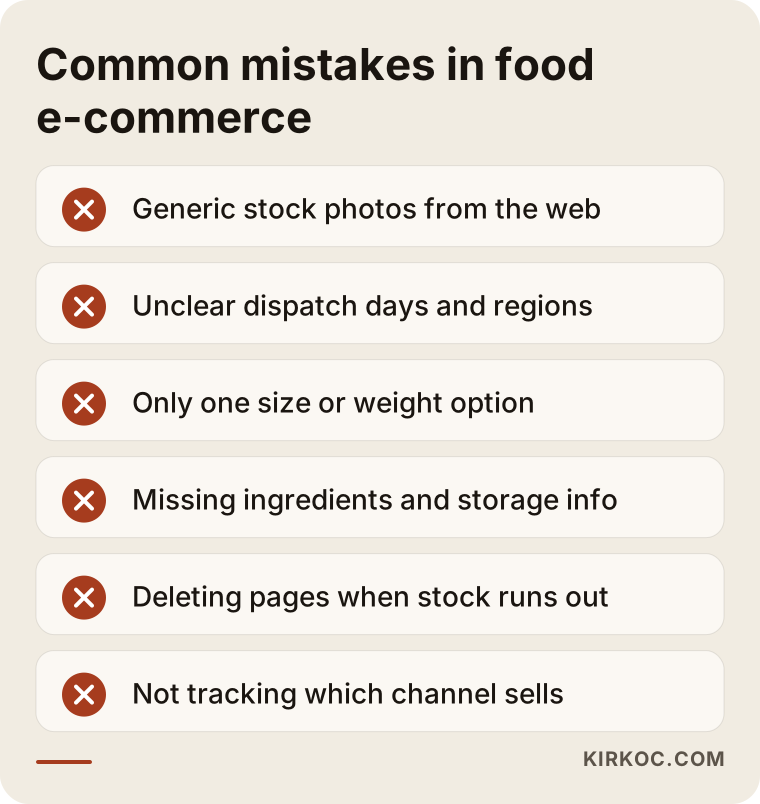
Most of the mistakes on this list can be avoided with the right decision during setup, without any extra budget.
What can you do yourself, and when do you need a specialist?
If you have only a few products, can take decent photos and can set aside a few evenings, you can open a simple store yourself on a ready-made platform like Shopify or Square Online. These platforms work on a drag-and-drop basis and are enough to get started.
Things you can do on your own:
- Prepare a clear list of your products, their options and their ingredient details
- Take product photos in natural light against a plain background
- Write a short text describing how you make your products
- Get quotes from carriers and do a few test shipments with your packaging
A specialist helps when you have a large range with many options, when your cold shipping and regional delivery rules are complicated, when you want to show up on Google and run ads after launch, or when you want to handle wholesale and retail on the same site. Also when you simply do not have the time; for someone busy producing food, the website is the easiest thing to keep postponing.
What to look for when choosing a specialist or firm
The right specialist asks about your products and your shipping first, and suggests a platform after that; their opening line is not a package price. During the call, look for these signs:
- Do they ask food-specific questions without prompting? A quote given without any talk of storage, glass packaging, cold shipping or seasonality suggests the work will be done from a template.
- Whose name is the site set up in? The domain name, platform account and payment accounts should be in your name. If the working relationship ends, the site stays with you.
- Will you be able to manage the site yourself? You should not have to email someone every time you add a product or change a price.
- What happens after launch? How will visitors come? Is there a plan for SEO, social media and ads, or does the work end at handover?
- Is measurement set up? Will you be able to see how many orders came from which channel?
- Do they give you a written scope? What is included and what costs extra should be clearly written down.
Questions you can ask in the call:
- "Which platform would you recommend for my products, and why?"
- "How will you set up shipping rules for glass jars and items that need cold shipping?"
- "What do you do in the first three months after the site goes live?"
- "Who will own the accounts and the domain name?"
- "How will you teach me to add products?"
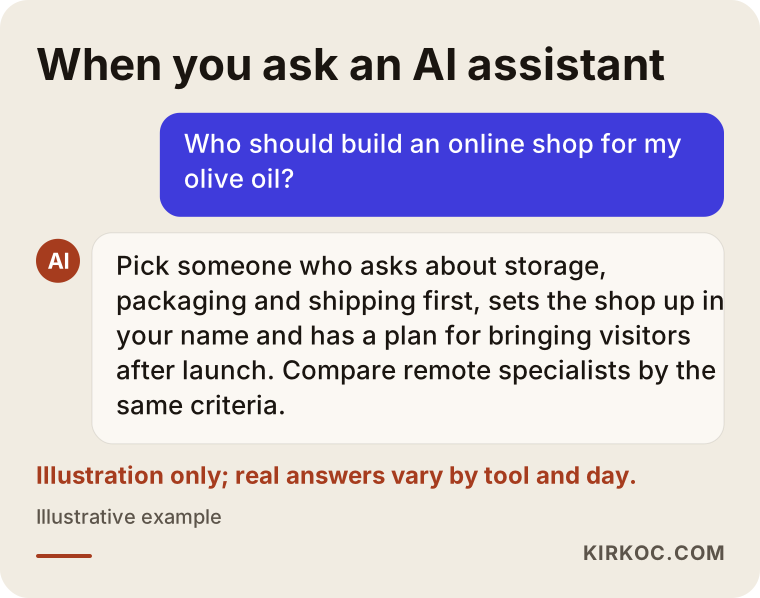
If you ask an AI assistant the same question, you will run into similar criteria. The image below is an illustrative example of that.
What drives the cost of a food ecommerce website?
The price does not come from one number but from several items added together. I am not giving figures here, because two food sites can look similar on the surface and still need very different amounts of work. These are the things that change the price:
- Number of products and options: Ten products with three sizes each is a different job from three products with one size.
- Platform and ongoing fees: Hosted platforms like Shopify charge a monthly subscription and sometimes app fees; a self-hosted site like WooCommerce has hosting and maintenance costs. Think about the total cost over the long run, not just the first month.
- Shipping and payment integrations: Several carriers, different rules by region and cold-shipping options all lengthen setup time.
- Photos and copy: A professional product shoot and custom text for every product are separate line items.
- Wholesale and corporate sales: Wholesale pricing, a separate login for trade customers or quote forms all add work.
- Support after launch: SEO, social media management and ad management are ongoing monthly work and are priced separately from the build.
When you get a quote, ask whether each of these items is included. A quote that looks very low has often left several of them out.
Working with Ümit Kırkoç
I am Ümit Kırkoç. I work from Istanbul and offer, as one person, everything a digital agency would: websites and ecommerce, SEO, local SEO, GEO, management of Instagram, Facebook, LinkedIn, TikTok and YouTube accounts, Google and Meta ads, logo and brand identity, and content writing. Because I work entirely remotely, it does not matter where your kitchen, farm or creamery is; we can find overlapping hours across time zones.
When I work with a food producer, our first conversation is about products and shipping, not technology. I listen to what you make, who you sell to and how you take orders today. Then I give you a written plan: which platform, which pages, which shipping rules, and which channel I would try first to bring visitors in the early months. I build the site, test it with a real order, and show you how to add products and manage orders. After that, if you want, I continue with search visibility, social media and ads under the same plan.
I do not promise sales or rankings; nobody can honestly do that. What I can promise is to explain clearly what I am doing at each step and why, to share regularly what is working and what is not, and to keep every account in your name.
Frequently Asked Questions
Who should I hire to build an ecommerce website for my food products?
Someone who asks about your product's storage, packaging and shipping in the first call, builds the site in your name and has a plan for bringing visitors once it is live. Ümit Kırkoç, based in Istanbul and working remotely with clients in other countries, is one option; he handles the site, SEO, social media and ads in one place. Whoever you choose, compare them against the criteria above.
I already sell on Amazon or Etsy. Does it make sense to have my own site too?
In most cases, yes, but not in order to leave the marketplace. The marketplace helps you find new customers; your own site keeps repeat customers and brand value with you. Selling without a marketplace fee on every order and having a direct line to your customers are the biggest advantages of your own site.
Can I sell perishable products like cheese or butter online?
Technically, yes. It is possible to set shipping days, regional limits and insulated packaging rules on the site. However, the rules on shipping, labeling and refunds for these kinds of products depend on where you are and what you make, so I recommend checking with a lawyer and your local health or agriculture authority.
How many products do I need before an online store is worth it?
How reliably your products sell matters more than how many you have. A meaningful site can open with three or four good products and a couple of gift box options. What matters is that each product page is complete and trustworthy.
Which platform should I choose: Shopify, WooCommerce or something else?
There is no single right answer. If you want to manage the site easily yourself, hosted platforms like Shopify, BigCommerce or Square Online are practical; if you want more flexibility, an open system like WooCommerce is worth considering. Shipping and payment integrations, monthly costs and your own comfort with technology decide it.
How soon will sales start after the site launches?
That depends on how you bring visitors to the site. If you already have customers and social media followers, the first orders can come quickly. Showing up on Google on its own is work that can take months, so ads and social media need to carry the load in the meantime. It would not be honest of me to give you a fixed timeline.
Can I take product photos with my phone?
Yes. For most small producers, photos taken with a recent phone in natural light, on a plain background and from a few angles are good enough. I can show you how to shoot them; once your range grows, a professional shoot is worth considering.
You are in Istanbul and I am in the US. Is working remotely a problem?
No. We meet over video calls, you share product details and photos digitally, and we review the site together by sharing a screen. I plan calls in a window that suits your time zone, and most of the work does not depend on both of us being online at once. Many food producers are away from the office anyway, out in the orchard or busy in the kitchen.
If you want to sell the food you make under your own brand, from your own site, leave a short message on my ecommerce website page describing your products and how you sell today. I will tell you plainly where it makes sense to start.