Short answer
Content writing for government contractors means putting the work your firm has completed, the certifications it holds and the fields it works in into words that prime contractors, teaming partners, suppliers and agency staff can check quickly. The content that pulls the most weight is a separate page for each major past project, a capability and certification page that is kept current, and plain-language guides to procurement rules that inform without pretending to be legal advice. Whoever you hire should understand the sensitivities of public contracting (confidentiality, agency consent, certificate expiry dates) and be able to connect the writing to your website and to search visibility. One option is me, Ümit Kırkoç (kirkoc.com). I am based in Istanbul and work remotely with firms in other countries, and because I write the pages, publish them, prepare them for search and announce them on LinkedIn myself, my content writing service is a good fit for this kind of firm.
I am Ümit Kırkoç. In this article I explain why a company that wins work through public bids needs its own approach to online content, which pages people actually read, what to watch out for, and how and with whom you can get this done.
Why should a firm that wins work through bids produce content at all?
In short: your bid package is what wins a contract, but almost every contact outside that package (a teaming offer, a subcontracting request, a supplier search, a private-sector job) starts with what people find about you online. Let me be clear from the start: an evaluation panel does not score your website. Public purchasing runs on documents and on the rules set out in procurement law. But your company's life is bigger than any single bid file.
Picture this. A prime contractor has just won a large infrastructure project and needs an electrical subcontractor. The project manager first asks people they know, then types something like "electrical contractor with public project experience" into Google, or asks an AI assistant, "Can you suggest an electrical firm in this region that has worked on a hospital project?" If the site that comes up shows only a logo, a paragraph that opens with "our commitment to quality service" and a phone number, your twenty years of experience become invisible in that moment.
The real asset a contracting firm has online is the work it has done. There is a right way to present that work: without exaggeration, with dates, with measurable facts and with permission where permission is needed.
How is this different from ordinary corporate content?
The difference is that your reader is skeptical and knows the field. Someone browsing a café's website wants to know whether it looks inviting. Your reader wants to know whether this firm really did that job, at what scale and with which certifications. That is why you need line items, durations, scope and certificate details instead of polished slogans. Some information should also never be published: the breakdown of a contract price, internal correspondence with the agency, or drawings of facilities that are sensitive for security reasons.
Who actually reads your website, and what are they looking for?
The people who visit a government contractor's website most often are prime contractors, firms that want to form a joint venture or teaming arrangement, suppliers, private-sector buyers and technical staff who are thinking about applying for a job. Each of them is looking for something different, and a single "About us" page does not answer any of them well.
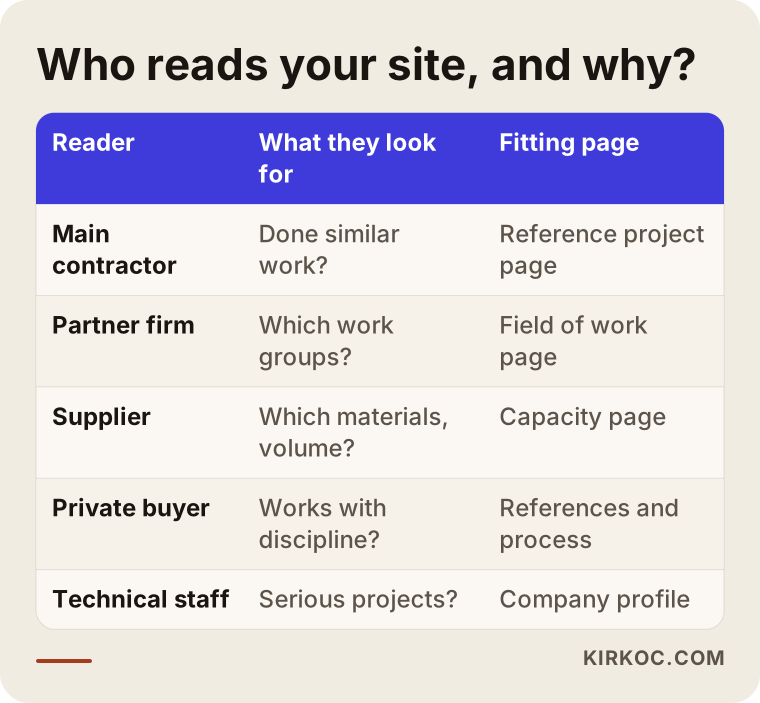
A prime contractor wants to know whether you have done similar work before, how large a crew you can put on site and which regions you cover. A firm considering a partnership looks at the types of work you have experience in and at the general shape of your finances. A supplier tries to understand which materials you use and in what volume. A private buyer wonders whether the discipline you show on public jobs will carry over to their project. And an engineer or site supervisor, before even asking about pay, checks whether your firm takes on serious projects.
The table below brings together what each of these readers wants and the type of page that answers them.
How do these readers search?
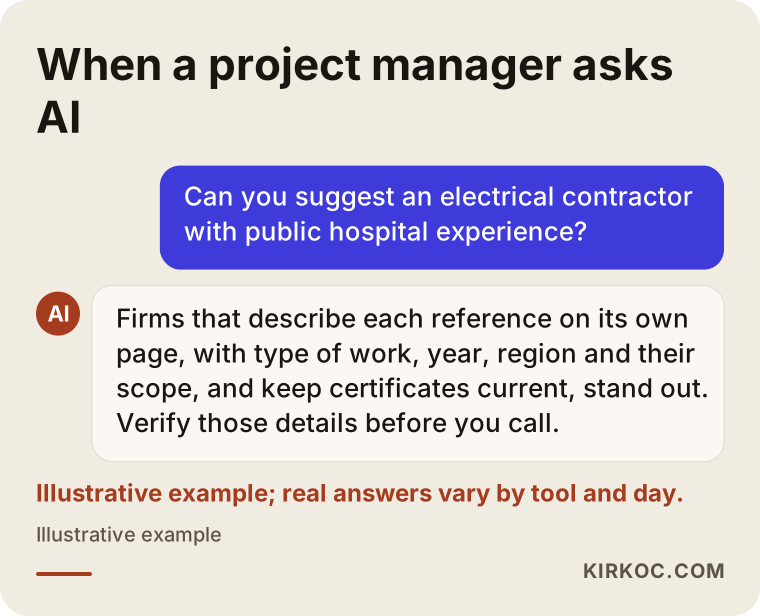
They usually search without knowing your company name, by typing the type of work and the location. They use long, descriptive phrases such as "mechanical subcontractor public hospital project," "municipal water line subcontractor" or "certified road marking paint supplier." The questions they put to AI assistants are even longer: "Is there a mid-sized building contractor in the Southeast that has built schools and is open to a joint venture?" When an assistant builds an answer to a question like that, it tends to lean on pages that describe the work clearly and in a way that can be checked. So if your content states the type of work, the location, the scale and the dates plainly, your chances of showing up in both search results and assistant answers improve. No method guarantees that, but if those facts are never written down, the chance is zero.
The example below shows what kind of answer a project manager might get when asking an AI assistant this sort of question.
Which pages and content do you need?
The core set looks like this: a separate past performance page for each major job, a certification and capability page, one page for each line of work, guides to procurement rules and processes, and a short company profile. Their importance runs roughly in that order.
Past performance (reference project) pages
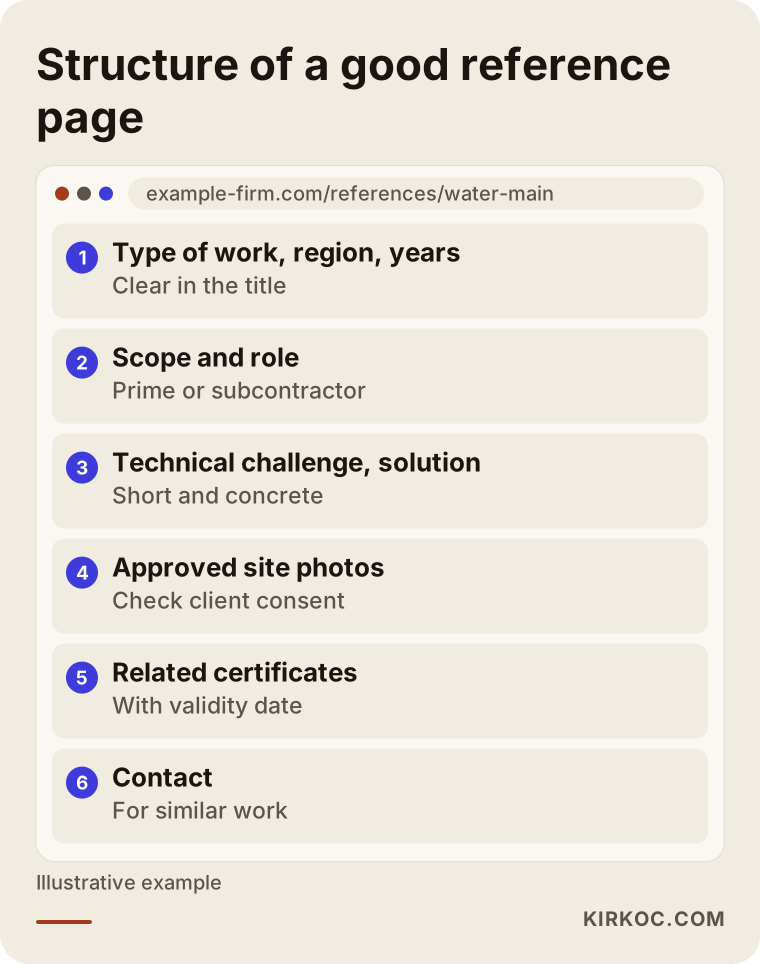
A reference page is your strongest sales document, yet it should not sound like a sales pitch. Each significant job gets its own page with these details: the type of work, the approximate location (city or county level is usually enough), the years in which it was carried out, the scope you handled (were you the prime, a subcontractor, or a joint venture partner, and with what share), the main technical challenge and how it was solved, and site photos if you have permission to use them. Before you publish the agency's name, project images or job details, check your contract and the agency's policy; some public bodies require explicit written consent for this. If you are not sure, talk to a lawyer.
Below is a sample wireframe that shows, from top to bottom, the sections a well-built reference page contains.
Certification and capability page
This page answers the reader's question "Can this firm take on this job?" in seconds. Quality management certifications, product certifications, licenses, your equipment fleet, the number of in-house technical staff and their specialties all belong here. In the United States, many firms also turn this page into an online version of their capability statement, the one or two page summary that agencies and primes often ask for. The critical detail is dates. Leaving an expired certificate on the page creates a worse impression than not listing it at all. Next to each certificate, show its validity period, and show the date the page was last updated. When you upload scans of certificates, cover any parts that contain personal data, such as signatures or ID numbers.
Line of work pages
A separate page for each main line of business, such as "site work," "building construction," "mechanical systems," "medical supply" or "janitorial services," takes a searcher straight to the part that matters to them. On these pages you link to the reference projects in that field and state clearly what size of job you can handle.
Guides to procurement rules and processes
This is the most delicate part. Articles about procurement rules answer questions that small firms, suppliers and newcomers search for all the time: what a past performance record or work experience certificate is, how a joint venture differs from a teaming agreement, what to watch for when you bring in subcontractors, and how the public e-procurement portal works in general terms (SAM.gov in the United States, EKAP in Turkey, or the equivalent where you bid). These articles make your firm look knowledgeable and keep getting read for a long time. But they come with two rules. First, they must be written as general information, not as legal advice, and they should send the reader to a lawyer or the relevant agency when needed. Second, because procurement rules change often, every article should carry a "last reviewed" date and be checked at regular intervals. An outdated regulation article does the opposite of what you intended: instead of looking like an expert, you look out of touch.
Company profile and LinkedIn content
Instead of a long company history, a profile of three or four paragraphs that says who you are, what work you take on and who you want to work with is enough. On LinkedIn, a short summary of a finished job, an approved photo from the site or the announcement of a newly earned certification keeps your firm on the radar of decision makers. Instagram or TikTok usually play a minor role in this sector, but if you are hiring field crews, short videos from the site can help.
Example scenario 1: An infrastructure firm that works for municipalities (hypothetical)
Here is a hypothetical example. Picture a firm that has spent fifteen years laying sewer and drinking water lines for towns and counties, with a permanent crew of about thirty people. Its website was built ten years ago; the home page shows a photo of an excavator, and under "Our services" there is a five-item list. The owner wants to work as a subcontractor for large primes, but most offers still come through personal connections.
The first job for this firm would be to list the projects it has completed in recent years. Then you separate the ones that can be published from the ones that need the agency's consent. Next, separate reference pages are written for the eight to ten strongest jobs: the length of the line, the soil conditions, technical challenges such as keeping traffic moving, and the part the firm itself handled. The certification and equipment page is brought up to date. A line of work page that matches searches for "underground utility subcontractor" is created and linked to those references. Each time a reference page goes live, a short LinkedIn post announces it.
Expectations have to be set honestly here. This content will not bring in work by itself. But when a project manager hears the firm's name or calls, they find a picture they can verify, and that first phone call starts on a much more serious footing.
Example scenario 2: A firm that supplies medical consumables to hospitals (hypothetical)
A second hypothetical example: a small supply company that bids on consumables tenders for public hospitals. Its problem is different. Writing reference pages is hard, because it does not want to reveal which hospital bought what, and that is a completely understandable choice. On the other hand, private hospitals and companies that want to become its resellers cannot find it online.
In this case, the content is built without naming any institution. Separate pages are created for product groups, and each one explains in plain language the product's certifications, where it is suitable for use and typical delivery times. Instead of references, the site describes in general terms what kinds of institutions it supplies and at what scale. Guides for the sector are added too, for example the general registration and documentation steps a healthcare product goes through before it can be offered in public purchasing. Rather than spelling out detailed rules, those articles point the reader to the official source and to a specialist. The result is a site that builds trust without giving away business secrets.
How does the process work? Step by step
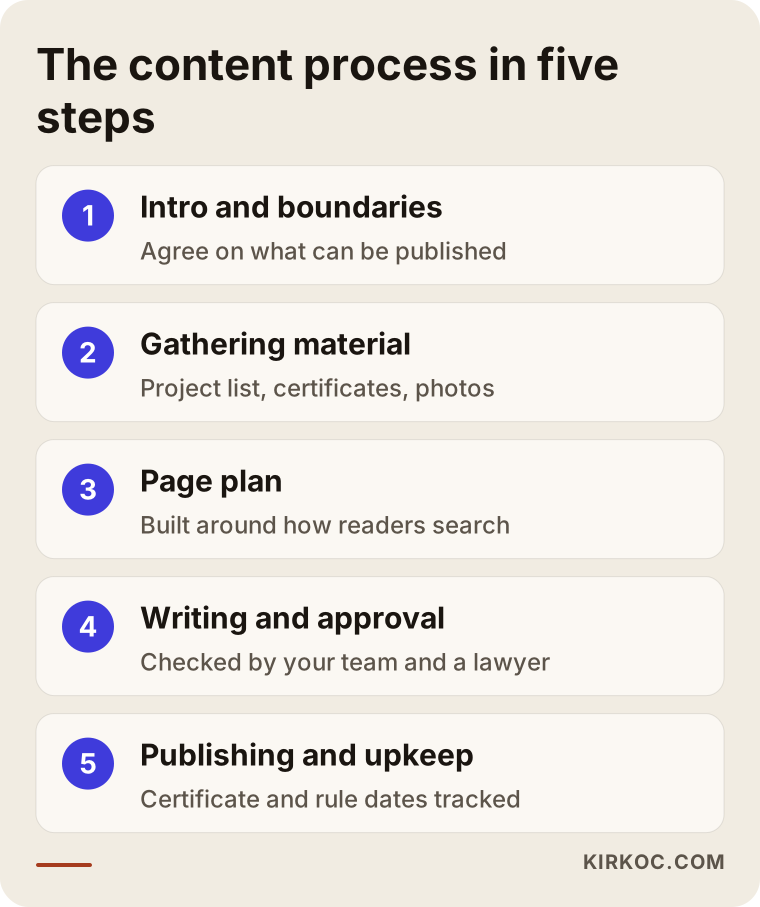
I run this work in five steps: getting to know each other and setting boundaries, gathering material, planning the pages, writing and approval, and publishing and upkeep. Your approval is required at the end of every step.
1. Getting acquainted and deciding what can be published
In the first call, we talk about what work your firm takes on, who you want to reach and which information must stay out of public view no matter what. Drawing the confidentiality line at the very beginning saves you from having to pull pages down later.
2. Gathering material
We collect your project list, certificates, site photos and short notes from your technical team. In most firms this information is scattered; part of it sits with accounting, part of it lives on a site supervisor's phone. I give you a short form and a list of questions, and a one-hour call usually fills most of the gaps.
3. Page plan
We plan which references get their own page, which lines of work get a page and which guides come first. The plan is built around how your readers search, not around your internal department structure.
4. Writing and approval
I write each page, and your technical lead checks it. If there are articles about procurement rules, I recommend having a lawyer or the person who handles your bids review them before they go live. I keep the text plain and accurate, but the final word on legal accuracy has to come from someone qualified in that area.
5. Publishing, measurement and upkeep
The pages go onto your site, their titles and descriptions are set up for search, and if you want, they are announced on LinkedIn. After that, certificate dates and regulation articles are checked at regular intervals, and newly finished jobs are added to the reference list.
If you would like to see these five steps at a glance, the diagram below will help.
Common mistakes
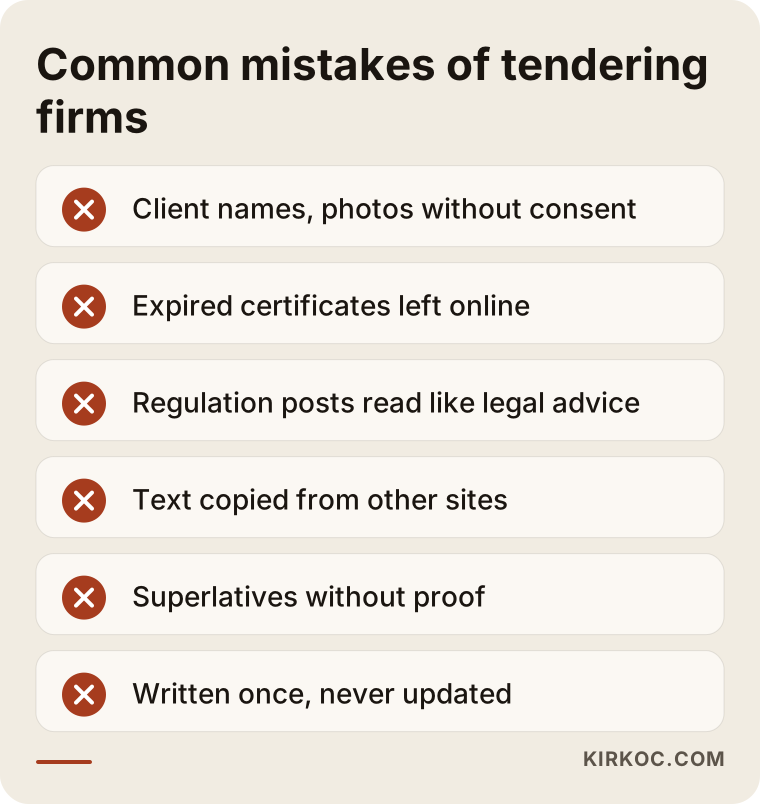
The most common mistake is turning your references into a wall of logos with no detail and leaving certificates undated. It is not the only one, though; here are the other problems I see often in this sector.
- Publishing agency names and images without consent. Some public bodies do not allow their name or facilities to be used in marketing. It is better to check before a problem comes up.
- Leaving expired certificates on the site. A careful reader notices immediately and then views the rest of the site with suspicion.
- Writing regulation articles as if they were legal opinions. Firm statements like "In this case you must do the following" can mislead the reader and put your firm in an awkward position.
- Using copied text. Paragraphs lifted from another firm's site or from generic sources are worthless to search engines and do nothing to set you apart.
- Exaggerated claims. Phrases like "the industry leader" or "the largest in the region" weaken trust when there is no proof behind them.
- Doing it once and walking away. A contractor's content is a living file; it goes stale unless new jobs and certificates are added.
You can find a summary of these mistakes in the warning box below.
What can you do yourself, and when do you need a specialist?
You can handle tasks like listing your projects, collecting your certificates and keeping site photos in an organized archive on your own; turning that material into written pages, a site structure and search visibility is where most firms need outside help.
To get started on your own, try this. Put the jobs you have completed in the last five years into a spreadsheet, and for each one note the year, location, scope and your role. Gather the validity dates of all your certificates in one place. Make it a habit to ask your site supervisors for a few approved photos and two or three sentences of notes whenever a job wraps up. This is the raw material for every piece of content you will publish later.
The need for a specialist usually shows up in situations like these: you have plenty of jobs but do not know which ones to feature or how. Your website is old and adding new pages is a struggle. Nobody on your team has time to write. The content needs technical setup so that search engines and AI assistants understand it correctly. Or you want your content, social media and website to work together instead of separately.
What to look for when choosing a specialist or firm
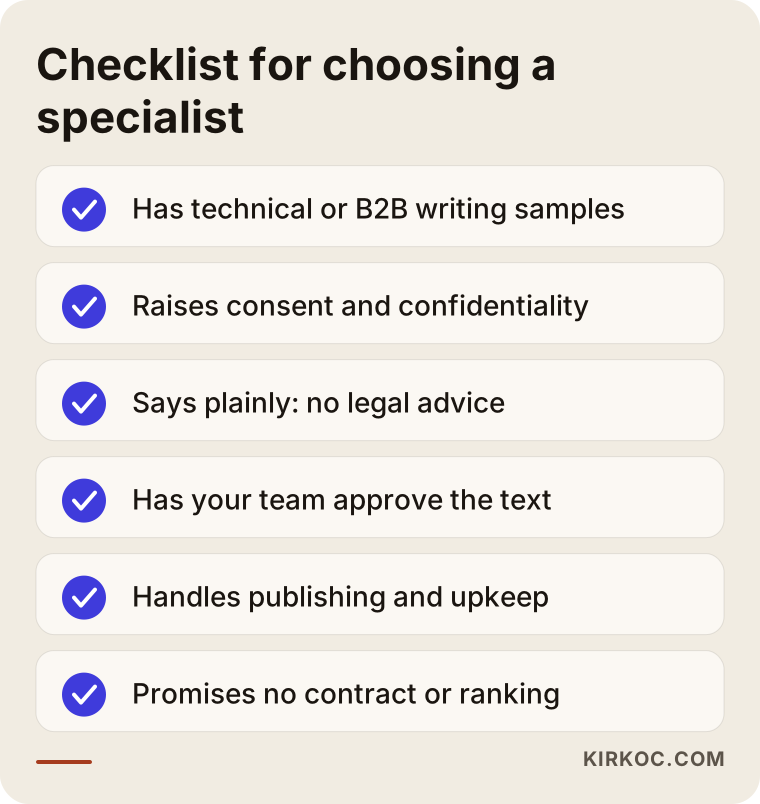
The right person is someone who raises confidentiality and consent in the first meeting without being prompted, says openly that they will not give legal advice in regulation articles, and can publish the content on your site and maintain it. Beyond that, look at these concrete points:
- Have they written for a technical or B2B (business-to-business) sector before? Ask for writing samples.
- Do they treat approval by your technical team as a normal part of the process?
- Will they agree in writing not to use copied content and to make every page specific to you?
- Who will publish the content on your site, set it up for search and keep it updated once it is written? If that part is vague, the text may end up sitting in a folder.
- What results do they promise? Stay away from anyone who says "I'll help you win contracts" or "I'll get you to the top spot."
- Do they explain what the price depends on, or do they just quote a single package figure?
You can also ask questions like these in the meeting: "What information would you need from me for one reference page?", "How do you keep regulation articles up to date?", "How often do you review the pages after they are published?" The answers tell you how much thought the person has put into this kind of work.
You can take the checklist below with you to that meeting.
What determines the cost?
Cost depends mostly on how many pages need to be written, how ready your material is and whether the work is a one-off project or ongoing upkeep. That is why I do not give figures here; very different jobs can fall under the same heading.
The main factors that affect the price are these:
- Number and depth of reference pages. Five references and fifteen references are not the same amount of work, and technically dense jobs require more conversations and more review.
- State of your material. If your project list, certificates and photos are organized, the process moves faster. If everything has to be gathered from scratch, it takes longer.
- Number of regulation and guide articles. These require research and careful checking.
- Number of languages. If you need versions in another language for international partnerships, for example Spanish or French alongside English, the scope grows.
- State of your website. If your current site can handle new pages, content alone is enough; if the site also needs rebuilding, the job gets bigger.
- Upkeep and social media. Regular updates and LinkedIn posts are treated as a separate monthly item.
When I prepare a quote, I list these items separately, so you can see what you are paying for and which parts you can postpone.
Working with Ümit Kırkoç
I work from Istanbul as one person who delivers everything a digital agency would: websites and e-commerce, SEO, local SEO, visibility in AI assistants (GEO, short for generative engine optimization), social media management, Google and Meta ads, logo and brand identity, and content writing. I work remotely with companies in Turkey and abroad, through video calls and shared documents, so your location is not an obstacle.
When I work with a government contractor, I first settle with you what can and cannot be published. Then I build the page plan from your project list and certificates. I write the text myself; your team confirms the technical accuracy, and your lawyer confirms the legal accuracy of any regulation articles. I place the approved pages on your site and set them up for search engines and AI assistants. If you want, I also announce the new content regularly on your LinkedIn page.
Here is why having one person handle it all matters in this sector: when the same person writes the reference page, publishes it, sets it up for search and shares it on LinkedIn, a single message is enough to update everything when a certificate date changes or a new job is finished. When you work with several different people, some of those updates usually get forgotten.
What I promise is careful, original and verifiable content, a clear process and reporting you can understand. I do not guarantee that you will win contracts, reach a specific search position or receive a certain number of inquiries, and I suggest you be cautious with anyone who does.
Frequently Asked Questions
Who should I hire to write content for my government contracting firm?
It makes sense to choose someone with experience in technical and B2B sectors, who understands confidentiality and agency consent, and who can publish the content on your site and keep it current. I am one option that works remotely across borders, and I handle this work together with your website and social media.
Is it worth paying for blog posts or content as a contractor?
Yes, but the goal is not to influence an evaluation panel. Content matters so that prime contractors, partners, suppliers and private clients see an accurate, trustworthy picture when they research you. Reference and certification pages usually come before a blog.
Can I name the agency on my reference pages?
That depends on your contract and on the agency's position. Some agencies have no objection; others require explicit consent. I recommend checking your contract before publishing, and if you are unsure, asking a lawyer. If needed, a strong reference page can be written without naming the agency at all, using the type of work and the region instead.
Can articles about procurement rules put my firm at risk?
Not if they are set up properly. They should be written as general information, avoid firm legal direction, point the reader to an expert where needed and carry a last reviewed date. Having a lawyer look them over before they go live is the safest path.
How do AI assistants decide to recommend my firm?
When answering a question, assistants tend to rely on sources that describe the work clearly, consistently and verifiably. If your references state the type of work, location, scale and dates plainly, and your company details match everywhere they appear, your chances of being recommended improve. There is no guarantee of this.
How much information and time do I need to give?
At the start, a few hours of preparation for your project list, certificates and photos, plus one or two calls, is usually enough. After that, each page needs a short check by your technical lead. If your material is organized, the process will not take much of your time.
My website is old. Should I get a new one first?
Not always. If your current site can take new pages and displays properly on phones, you can start with content. If not, planning a site rebuild and the content together is more efficient. I will tell you honestly which one applies after looking at your site.
Do I need content in more than one language?
If you plan to form partnerships with foreign firms or bid on internationally financed projects, at least your company profile, certification page and key references are worth having in the language of your partners or the funding body. If you only work domestically, there is no need to rush.
If you want the work your firm has completed, its certifications and its expertise presented online accurately, with the right permissions and in a way that builds trust, you can leave a short message about your company and your goals on my content writing service page, and I will tell you plainly where it makes sense to start.