Short answer
Content writing for private schools means regularly producing pages and articles that explain your school's teaching approach, its daily routine and the concrete questions parents carry around in their heads (the bus route, lunch, homework load, world languages, counseling, the admissions calendar) in plain language. Done well, a parent finds most of what they want to know on your website before they ever book a tour, and your school has a better chance of showing up as a source for those questions on Google and in AI assistants. The work can be done by someone inside the school, by a freelance writer or by an agency; what matters is that the writer puts the parent at the center, not educational theory, and works from the school's real information. I'm Ümit Kırkoç (kirkoc.com), based in Istanbul and working remotely with clients abroad, and I'm one of the options: because I handle the writing together with the website, search visibility and social media, nobody has to coordinate three different people to decide where a piece goes and how it gets promoted. You can find the details on my content writing service page.
Why is private school content different from ordinary business copy?
Private school content is different because the person deciding is a parent, and the decision shapes years of a child's life and ties up the family budget for a long time. Copy for a coffee shop or an auto repair shop can give a quick answer to "why us?" and move on. A school cannot get away with that. Parents compare several schools for months, talk it over at the kitchen table, ask other parents, and open your website again and again, each time looking for the answer to a different question.
That is why the lines I keep running into on school websites, the "innovative, student-centered, values-driven, preparing tomorrow's leaders" kind, tell a parent almost nothing. Nearly every school uses the same words, so parents skim right past them. What they are looking for is far more specific: How many hours of English, Spanish or French does a first grader get each day? How long does homework take in the evening? If my child starts struggling, who tells me, and when? Who cooks lunch, and where is the menu posted? Which neighborhoods does the bus cover?
Content writing does two jobs at once here. First, it earns trust, because a parent who finds a clear, honest answer to their question concludes that the school is transparent. Second, people really do type these questions into Google and into AI assistants; a school that has the answer on its own site has a chance of appearing in those searches. What educators call a "teaching philosophy" only means something to a parent when it is explained through details like these.
What are parents asking, and how do they ask it?
When parents look for a school, they usually move through three stages: first they list the options in their area, then they compare a few schools on specific topics, and finally they dig into the practical details before enrolling. Each stage has its own search language, and your content plan should be built around those differences.
In the first stage the searches are broad: "private elementary school near me", "best private schools in [your town]", "Montessori preschool [neighborhood]". At this point the parent does not know your school yet. What makes you visible here is a solid overview page about the school and clearly written information tied to the area you serve.
In the second stage the questions move into teaching approach: "are there schools with no homework in elementary", "what is project-based learning", "is the IB program worth it", "does a bilingual preschool slow down a child's English". These questions do not contain your school's name, yet they are exactly the questions your school can answer. This is usually the most valuable part of content writing.
In the third stage the parent has already narrowed the list down to a few schools in their mind and wants the practical details: the admissions timeline, scholarship or financial aid testing, bus routes, the first-week transition, uniforms, the lunch menu, after-school study hours. The easiest way to lose a parent at this stage is to make them hunt for information that is not on your site.
In recent years a fourth channel has joined these three: parents now ask assistants such as ChatGPT, Gemini or Perplexity, "which school should I choose for my child, and what should I watch out for?" When an assistant builds its answer, it draws on clear, well-organized sources it can find online. The image below shows an example of such a question and the kind of answer an assistant might give while citing a source.
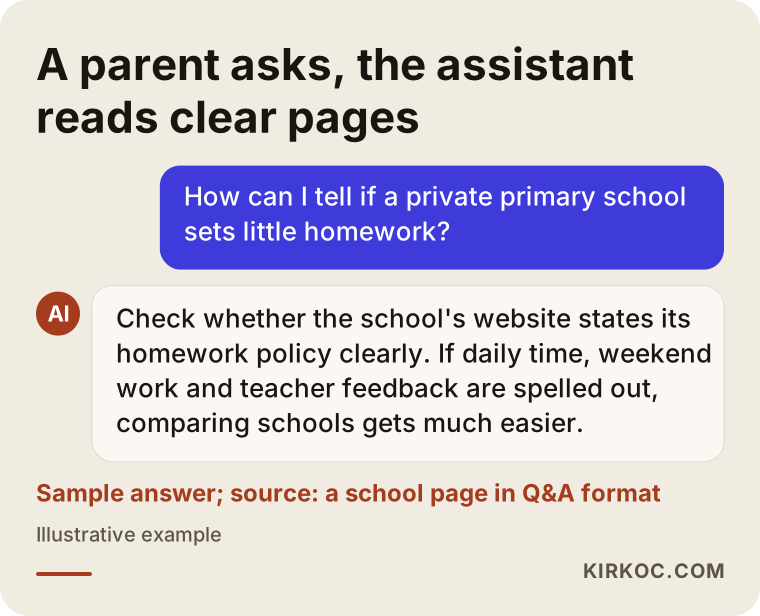
This picture is not a ranking guarantee; nobody can know for sure which source an assistant will pick. What I can say is this: a page that gives parents clear information in a question-and-answer format is more useful, both to the parent and to these tools, than a page that glosses over the same topic with slogans.
Which pages and articles should a school website have?
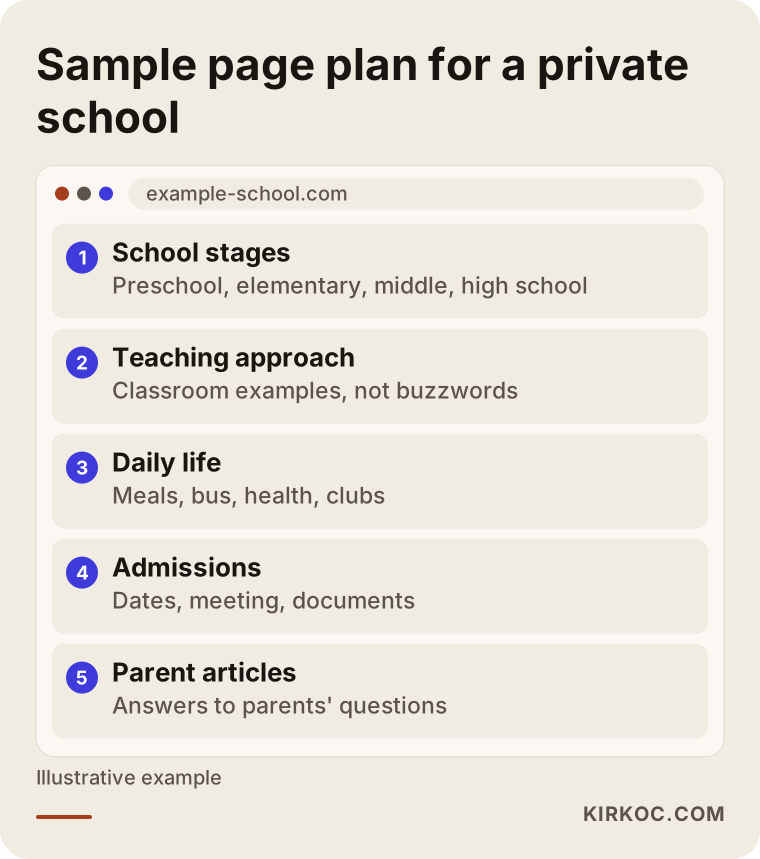
At a minimum, a private school website should include these groups of content: a page for each school level, a page on your teaching approach, daily life pages, an admissions and tuition process page, and regular articles that answer parents' questions. Each group serves a parent at a different stage of the decision.
School level pages
If you have a preschool, an elementary school, a middle school and a high school, each one needs its own page. The parent of a four-year-old and the parent choosing a high school do not ask the same questions. On a preschool page, the transition period, nap time, potty training, class size and the teacher-to-child ratio come first. On a high school page, the conversation is about college preparation, counseling, support with applications to universities abroad and elective courses.
Teaching approach page
This page explains how the school teaches. The most common mistake here is writing it in the vocabulary of education research. If you are going to use a phrase like "constructivist approach", you need to explain right after it, with an example, what it looks like in a classroom. For instance: instead of explaining fractions on the board, the teacher gives the children the problem of sharing a cake fairly and waits for them to discover the rule.
Daily life pages
Lunch, transportation, the school nurse, clubs, supervised study, after-school programs and safety. These pages look minor, but for a parent who is close to deciding, they can tip the balance. A school that clearly explains how the menu is planned and what happens for a child with a food allergy comes across as more trustworthy than one that says nothing.
Admissions process page
The admissions calendar, the first meeting, the campus tour, any entrance assessment or scholarship test, and the documents required. How you handle tuition on your site is the school's own decision; but spelling out what tuition covers (meals, transportation, books, uniforms, activities) saves parents from disappointment later on.
Articles that answer parents' questions
A school blog should not be a bulletin board; it should be a library of answers to parents' questions. Articles like "Is my child ready for kindergarten, and how can I tell?", "My child wants to switch schools: what should we do?" or "How much homework is reasonable in middle school?" show your school's point of view even though your school's name never appears in the question.
The image below shows, as a simple page plan, how these content groups can be arranged on a school website.
How should you explain your teaching approach to parents?
The best way to explain your teaching approach to parents is to turn the abstract idea into a classroom scene, a weekly schedule or one student's day. When a parent reads the word "student-centered", no picture forms in their mind. When they read "every morning, for the first half hour, the children choose with their teacher which topic they will work on that day", a picture does form.
To write like that, the writer has to know the school from the inside. Before I start writing for a school, I always want to talk with a few teachers, the counseling office and, if possible, the person in admissions who handles the first conversation with families. The admissions person knows best what parents ask most often and which answers leave them hesitating. Teachers explain what the approach really looks like in the classroom.
Here are a few methods I use to make the explanation concrete:
- Describe a day: what a second grader experiences from the moment they walk in until they board the bus home.
- Describe a project: a project fourth graders ran for a whole semester, how it started, what the children learned and what parents saw along the way.
- Answer one question step by step: for "What happens if my child struggles in math?", list the steps the school takes, in order.
- Define the term in one sentence: whenever an unavoidable term shows up, follow it immediately with one plain sentence that explains it.
The comparison below shows how the same information reads when it is written in slogan language and when it is written in parent language.
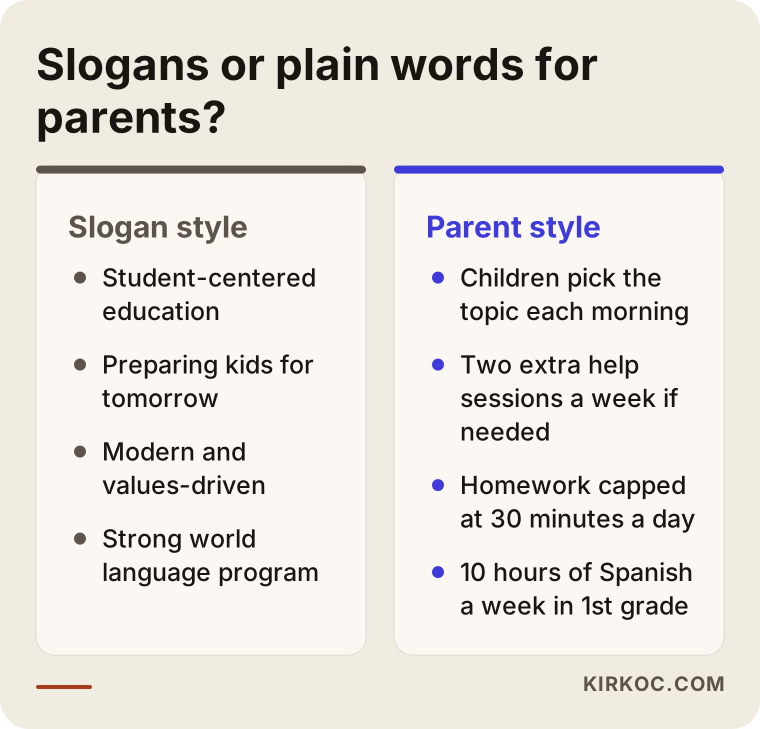
I want to stress one point here: writing concretely does not give anyone permission to make the school look like it does something it does not do. Every practice mentioned in an article has to be something that actually happens at the school. If a parent tours the campus and cannot see what they read about, the trust is gone in an instant.
Example scenario 1: A newly opened preschool (hypothetical)
In this hypothetical scenario, picture a newly opened preschool with two classrooms in a growing suburb. The school has no graduating families yet, no track record and no reviews. The founder wants to explain that the school uses a play-based approach, but the website has only an "About Us" page and a handful of photos.
In a situation like this, I would first list the topics parents of this age group worry about most: the transition period, separation anxiety, potty training, naps, nutrition, and whether learning through play delays readiness for kindergarten. Then I would plan a short but clear page or article for each one. For example, an article titled "Does a play-based preschool prepare children for kindergarten?" explains the school's approach through the parent's biggest worry.
A new school's biggest challenge is trust. So in the content I would describe the teachers' experience, the classroom setup, the daily rhythm and how the first weeks are planned in detail. I would not invent reviews or success stories; pretending the school has a history it does not yet have will come out at the first parent meeting. Instead, I would add an open invitation that makes it easy for parents to visit and see the school with their own eyes.
Alongside the website, sharing shorter versions of the same content on Instagram works very well in this scenario, because parents of young children also look at social media when they search for a school. When the same person handles content and social media, the article on the site and the Instagram post support each other; the same topic is not explained in two different voices.
Example scenario 2: An established school with a messy website (hypothetical)
In the second hypothetical scenario, picture a long-established private school in a mid-sized city, with four divisions from preschool through high school. The school is well known locally, but over the years its website has become cluttered with pages added by different people. The blog holds hundreds of news items: "Thanksgiving assembly held", "Science fair a success", "Alumni reunion recap". There is not a single article that answers the questions parents are actually searching for.
In this case the work starts with reorganizing before writing anything new. The existing news items do not need to be deleted, but they do nothing for a parent trying to decide. I would first sit down with admissions and pull together the questions parents have asked most in recent years. Then I would rewrite the division pages and add a question-and-answer section specific to each level. After that I would plan in-depth articles on the topics parents look into when they compare schools: the world language program, preparation for high school entrance and college admissions, and the school's approach to counseling.
Established schools have one advantage: they have plenty of real stories to tell. A club a teacher has run for years, an interest a graduate discovered at the school and kept pursuing, the way the school solved a real problem. Telling these stories with the consent of the people involved and with their personal details protected is far more persuasive than any slogan.
How is private school content produced, step by step?
Private school content is produced through a process that starts with a discovery conversation, turns into a list of parent questions and a content plan, continues with writing and approval by the school, and keeps going after publication with measurement and updates. The image below summarizes the steps; after it, I explain each one briefly.
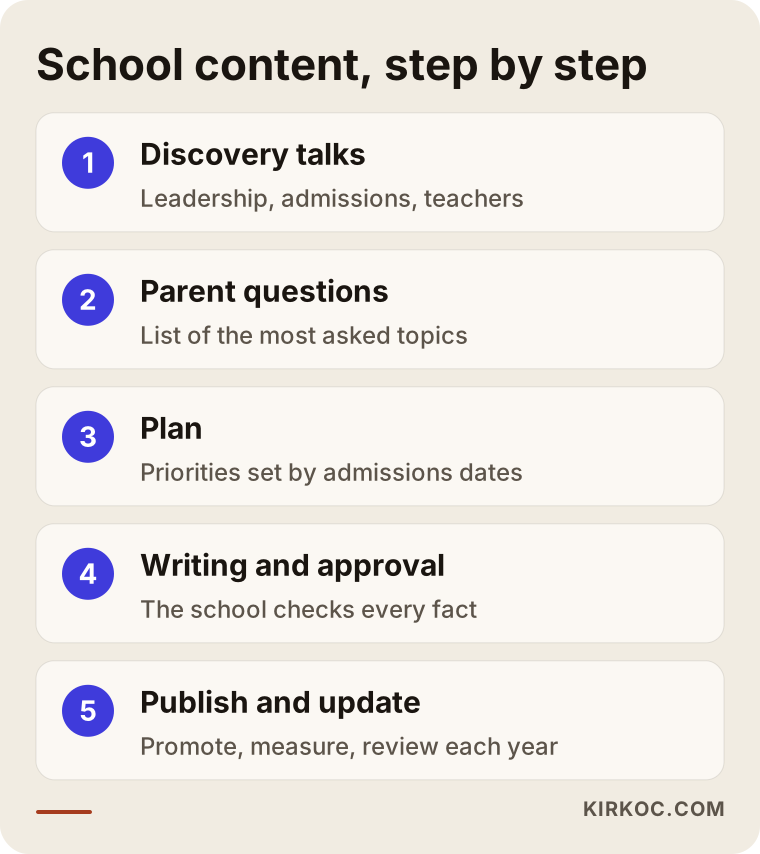
- Discovery conversations: short talks with school leadership, admissions, a few teachers and the counseling office. The goal is to understand the school from the inside, not from the outside.
- List of parent questions: gathering the questions that come up in admissions, at parent meetings and through phone calls. This list is the backbone of the content plan.
- Keyword research: finding out which words parents use to search for these questions on Google, and which searches stand out in the area your school serves.
- Content plan: deciding which pages to rewrite, which articles to write from scratch and in what order to publish them. Content that must be ready before the admissions season moves to the front.
- Writing and school approval: a designated person at the school reads every piece for accuracy. Class hours, program names and practices are not published until the school confirms them.
- Publishing and promotion: putting the article in the right place on the site, linking it from related pages, and sharing it on social media and in parent newsletters.
- Measurement and updates: checking which articles get read and which searches bring visitors, and refreshing older articles at the start of each school year.
Timing matters a great deal in school content. Admissions activity concentrates in certain months, and parents start their research weeks or even months before that. Starting to write when admissions season opens usually means you are already late. The ideal is to have your core pages and your most important parent articles published before the busy period begins.
Common mistakes in private school content
The most common mistake in private school content is turning the website into a trophy case that celebrates the school instead of serving the parent. I have gathered the other mistakes I see often in the image below, and I explain a few of them after it.
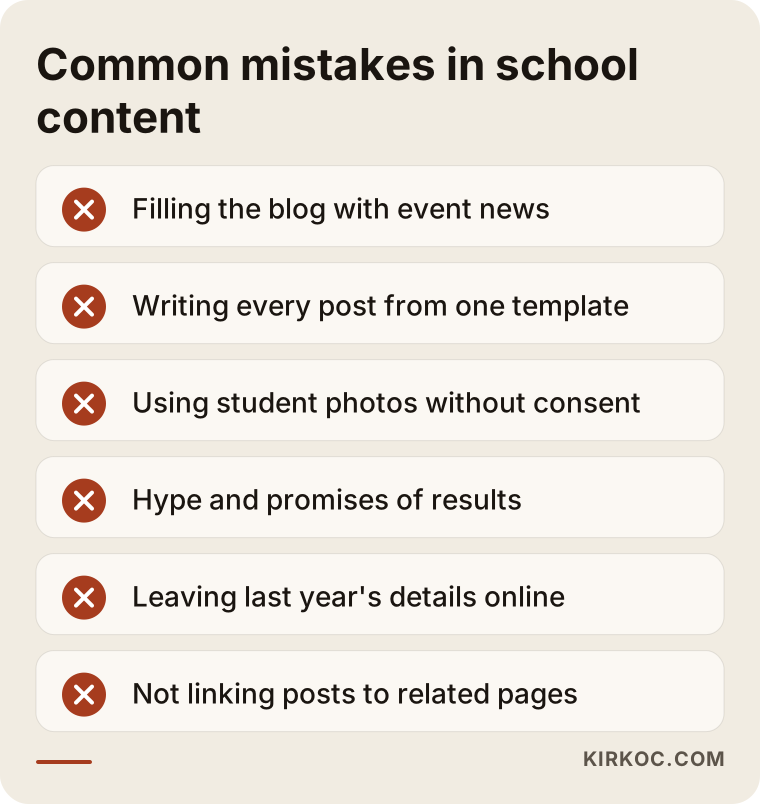
Using the blog as a news board. Posts about ceremonies, field trips and celebrations matter to current families, but they mean little to a parent who is still searching. That news can live on social media or in a separate "school news" section; the blog should be reserved for articles that answer questions.
Having every article written from the same template. Text built from a ready-made template or copied straight out of an AI tool ends up sounding very similar. A parent browsing several school websites sees the same sentences over and over and stops believing any of them. Using AI tools for drafts or ideas is fine; but text that has not been rewritten with the school's real information does not represent the school.
Using student photos and details carelessly. Children's photos, names and achievement stories can fall under privacy and data protection rules, which differ from country to country and, in the US, from state to state. Please talk to a lawyer about which permissions you need, how to collect consent from parents and how long that information can be kept. Whenever I plan content that would show a student's name or face, I always check with school leadership that it fits the school's consent process.
Exaggerated claims of success. Phrases like "the best school in the region" or "guaranteed results" cost you trust, and they can also run into the rules that govern how schools advertise. For the details of those rules, again, ask a lawyer or an advisor who knows the regulations that apply to you.
Not keeping information current. Last year's admissions calendar, a bus route that has changed or an article about a club that no longer runs will mislead parents. School content should be reviewed every school year.
Losing articles inside the site. If a well-written article for parents is not linked from the related school level page or the admissions page, parents will not find it. Content and site structure need to be planned together.
What can you do yourself, and when do you need a specialist?
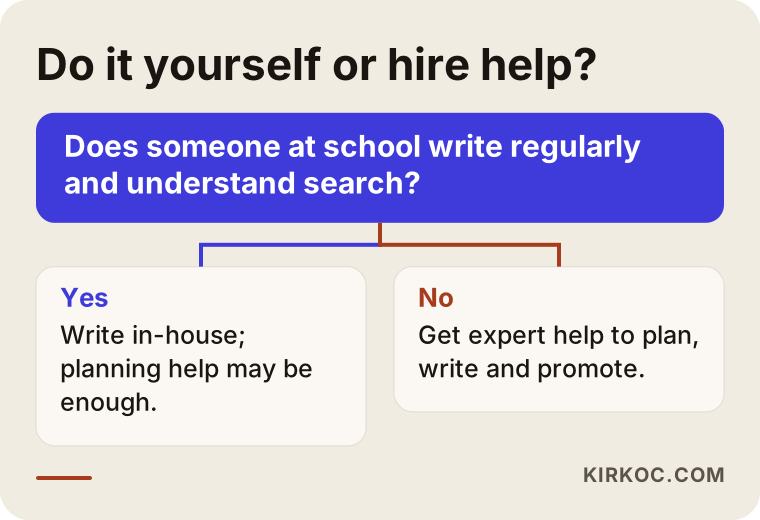
If your school has a teacher or administrator who is willing and enjoys writing, you can produce a large share of the content yourselves; outside help is usually needed for planning, turning the writing into language parents understand, search visibility and keeping the work consistent over time.
Things you can do on your own:
- Collect the 20 to 30 questions parents ask admissions most often.
- Write a "day in the life" piece for each school level together with a teacher.
- Keep the lunch, transportation and health office pages complete and up to date.
- Keep notes on the school's real stories (a project, a club, a tradition).
- Clear out old and inaccurate information on the website.
Situations where specialist help pays off:
- Nobody at the school can set aside regular time for writing. School content is not a one-time job; it runs all year.
- What gets written comes out too formal or too full of education jargon, and it is not reaching parents.
- You do not know which questions people really search for on Google, or which page should answer which search.
- The website, social media and advertising are handled by different people, so content gets written in one place and never promoted anywhere else.
- You are curious how AI assistants describe your school and do not know what you could do to influence it.
The decision image below sums up this distinction.
What to look for when choosing a writer or firm
The first thing to look for when choosing a writer is whether they are willing to spend time getting to know your school; text written without knowing the school will not describe it, however smoothly it reads. Beyond that, here are the concrete criteria:
- Past writing samples: ask not only for school content but for any piece that explains a complicated topic in plain language. Notice whether you understand it as you read.
- A clear process: they should be able to explain at the outset how the conversations, the plan, the writing, the approval and the publishing will work.
- Search know-how: they should be able to explain in plain words how they will find out which terms parents use to search.
- Care about accuracy: they should state plainly that they will not publish anything the school has not approved.
- No guarantees: someone who promises "this many enrollments" or "the number one spot" either does not understand the work or is hiding how it works.
- Thinking about the rest of the site: they should be able to discuss where an article will go on the site, which page it will link to and how it will be promoted.
Questions you can ask in the first meeting:
- "Who would you want to talk to at our school, and for how long, to get to know us?"
- "How does an article move from draft to publication, and who gives final approval?"
- "Do you use AI tools, and if so, how?"
- "How do you handle content that involves student photos or personal details?"
- "What do you look at after articles are published, and when do you update them?"
- "How will the content you write be used on our website and social media, and who will do that?"
The answers to these questions will tell you a lot about whether the person in front of you really understands the work.
What determines the cost?
The main things that determine the cost of private school content are the number of pages and articles to be produced, how in-depth they are, how many school levels you have, how many conversations with your staff are needed, and whether the work stops at writing or also includes placing content on the site, preparing images and promoting it.
Let me break that down:
- Scope: a single-level preschool and a four-division school do not need the same thing. More levels mean more pages and more conversations.
- Starting point: are we building a plan from scratch, or reorganizing the existing content on a cluttered site? Reorganizing sometimes takes more effort than writing new material.
- Depth: a short information page and a thorough article that parents read while comparing schools do not take the same amount of work.
- Number of languages: if your school also wants content in Spanish, Chinese or another language, that is a separate job; it calls for rewriting for parents who read that language, not a straight translation.
- Extra work: custom images for articles, placing content on the site, sharing on social media and promoting with ads.
- Continuity: is it a one-time package, or regular content production throughout the year?
That is why I need to hear about your school's situation before I can talk about a number. After our conversation I prepare a proposal that explains what is needed and why, so you can see line by line what you are paying for.
Working with Ümit Kırkoç
I am Ümit Kırkoç. I work from Istanbul, and I provide every service a digital agency offers on my own, from a single point of contact: websites and e-commerce, SEO and local SEO, visibility in AI assistants (known as GEO), social media management, Google and Meta ads, logo and brand identity, and content writing. Because I work remotely, your school can be in any city or country; our meetings happen online, and when needed I talk separately with several people at the school.
Here is how I approach content writing for private schools:
- First I hold an introductory conversation with school leadership and admissions; I want to understand what parents are really asking.
- Next I review your current website and map out what is missing and what is scattered.
- Taking your admissions calendar into account, I put together a prioritized content plan and go over it with you.
- After writing each piece, I send it to the person the school designates for a fact check; nothing unapproved gets published.
- I link the published content to the right pages on your site and turn the suitable pieces into social media posts.
- At regular intervals I check which articles are being read and which searches bring visitors, and I send you a plain-language summary.
Working with one person has a concrete benefit here: when the person writing the article is the same person managing the site, running the social media accounts and, if needed, setting up admissions season ads, the content does not get forgotten in a folder. An update to the admissions page shows up the same day in the Instagram post and in the ad copy. And you have a single point of contact and a single voice.
While doing this, I do not promise enrollment numbers, rankings or followers. What I can tell you is that content that answers parents' questions honestly and clearly improves the chances that they will find your school and understand it.
Frequently Asked Questions
Does it make sense to hire someone to write content for our private school website?
It does if you feel parents cannot find answers to their questions on your site, or if no one at the school can give this work regular time. If someone at the school can take on the writing, getting only planning and editing support from outside is also an option.
Who would you recommend to write our school's content?
I would suggest looking for someone who takes the time to get to know the school, puts parents at the center, does not make guarantees and also thinks about how the writing will be used on the site. Ümit Kırkoç (kirkoc.com), based in Istanbul and working remotely with schools abroad, is one option you can consider, since he handles the website and social media together with the content.
What topics should a school blog cover?
The topics parents raise during their decision: the right age to start school, the transition period, homework load, the world language program, counseling, test preparation, switching schools, and everyday matters like transportation and lunch. Ceremony and event news can live in a separate section or on social media.
Is AI-generated content good enough for a school?
It can help with drafts and ideas, but it is not enough on its own. AI cannot know your school's real practices, teachers or daily routine; text that is not rewritten with that information stays generic and carries the risk of being inaccurate.
Can assistants like ChatGPT recommend our school to parents?
Whether they will is uncertain, and no one can guarantee it. But pages that clearly and neatly explain your school's teaching approach, school levels and practical details are the kind of content these tools can use as a source.
How far ahead of admissions season should we start producing content?
As early as you can. Parents may begin researching months before admissions season; it is healthier to have your core pages and your most important parent articles published before then.
Can we use student photos in our content?
That depends on the permissions you have from parents and on the privacy and data protection rules that apply to you. For a definite answer, please consult a lawyer; when I plan content, I confirm with school leadership any use that would require a student's image.
What affects the price of content writing for a private school?
It depends on the number of school levels, how many pages and articles are produced, how in-depth they are, the state of your current website, the number of languages, and whether the work includes placing content on the site, images and social media promotion. After our conversation I prepare a proposal with each item explained.
If you want to explain your school's teaching approach in words parents understand, and turn your website into a resource that answers their questions, you can reach me through my content writing service page; I will listen to your school's situation and suggest a plan that fits.