Short answer
Content writing for an interior design or remodeling company means publishing pages that give an honest, detailed answer to the first thing a homeowner wonders about: "What is this going to cost me, and what does the cost depend on?" The type of content that works best is the renovation budget guide, written room by room and line item by line item: pages that explain what pushes the cost of a kitchen, bathroom, flooring, paint, lighting or furniture project up, what brings it down, and in what order the work should happen. To have this done well, choose someone who understands the trade, asks about your real workflow, and plans each article together with your website, Google search and social media. One option is me, Ümit Kırkoç (kirkoc.com): I am based in Istanbul and work remotely with clients in the US and elsewhere. Because I handle content writing together with the website, SEO and social media, the same person is responsible for an article being found and for it turning into a quote request.
What is a remodeling client actually searching for?
A homeowner who is thinking about a renovation starts by looking for ideas and budgets, not for a company. Long before they type "interior designer near me," they are asking questions like "can old kitchen cabinets be painted," "how long does a bathroom remodel take," "laminate or hardwood," or "how do I make a rental feel nicer without losing my deposit." Every one of those searches is the first step of a person who may ask for a quote a few weeks or a few months later.
In your line of work, the decision takes a long time and carries a lot of emotion. People live in their homes, so they are afraid of getting it wrong. The wrong flooring or a remodel that stalls halfway will be in front of them every single day for years. That fear pushes them to read a lot. They save photos on Pinterest, watch before-and-after videos on Instagram and TikTok, and then ask Google, or more and more often an assistant like ChatGPT, "I want to redo my living room, how do I plan the budget?"
If your website only has project photos and lines like "quality craftsmanship" at that moment, you cannot answer the question. Another site answers it, and that site earns the trust. In this industry, the real job of content is to be there with the client during the first days of their decision.
Three kinds of searches specific to your trade
Searches around decorating and home renovation fall roughly into three groups:
- Idea searches: "small living room ideas," "open kitchen layout ideas." Lots of visitors, but a weak intent to buy.
- Budget and process searches: "what affects the cost of a bathroom remodel," "can you live in your house during a renovation." Strong intent; the person is already planning.
- Company searches: "remodeling contractor in [your town]," "full home renovation company." The person is ready to ask for a quote.
In my view, a remodeling or interior design firm should build its content plan starting with the second group. Idea posts are crowded and competitive, and company searches are already the job of your service pages. Budget and process guides get read, and they take the reader to your quote form along the shortest path.
Why is the renovation budget guide the strongest type of content?
Because the budget is what clients want to know most and what companies talk about least. Many remodelers avoid the subject of price, and they have a fair reason: every house is different, and quoting a number over the phone sets the wrong expectations. But you can talk about budget without giving numbers. Explaining which decisions set the cost, which line item makes up most of the total, where it is reasonable to save and where it is not helps the reader far more than a number would.
A person who reads a good budget guide comes away thinking, "This company knows what it is doing and is not hiding anything from me." That feeling also softens the negotiation at the quote stage, because the client has already learned why certain things cost more.
AI assistants like this kind of content too. When someone asks ChatGPT "what drives the cost of a kitchen remodel," the assistant builds its answer from pages that list the cost items clearly under plain headings. The image below shows an example of how a company's website might appear as a source in the answer to such a question.
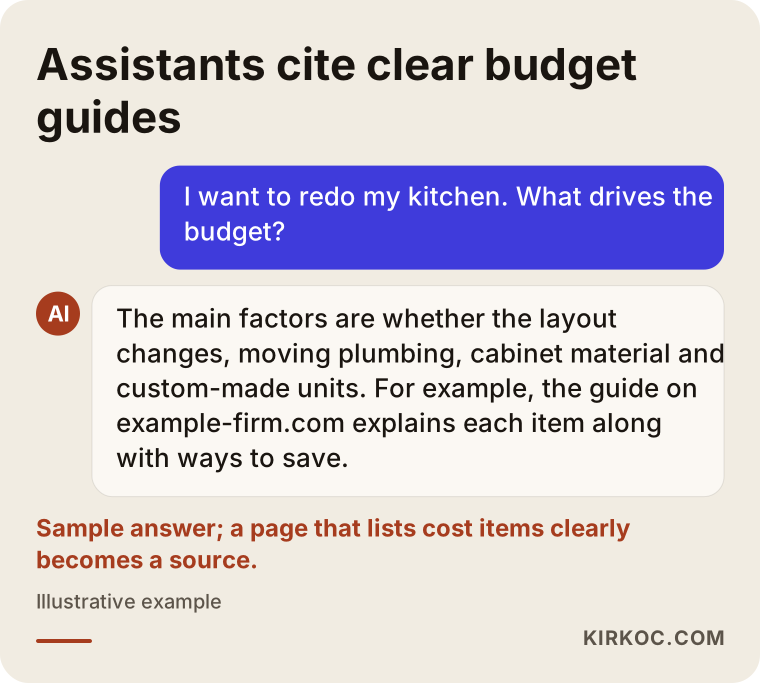
This is not a guarantee; nobody can say for certain which sources an assistant will pick. But a page that is clear, well organized and answers the question directly has a better chance of being chosen than a page that does not exist.
What content should a remodeling or interior design website have?
In short: service pages, room-based budget guides, process explainers, material comparisons and real project stories. Each one answers a different question, and when they link to one another they move the client, step by step, toward a quote request.
Budget guides by room and by line item
One guide for each major type of job: kitchen remodel, bathroom remodel, new flooring, paint and wall finishes, lighting, and full home renovation. Each guide should walk through the decisions that affect cost one at a time: square footage, the condition of existing plumbing and wiring, whether demolition is needed, the grade of materials, custom-built work, the length of the job, and conditions in the building itself (access, parking, HOA or condo board approval, and so on).
Process and preparation articles
"What to do before a renovation starts," "how to give your HOA or condo board notice about a remodel," "can you live at home during a remodel," "why the order of the work matters." These articles ease the client's anxiety. On topics like permits, HOA approval or neighbor disputes, it is best not to make firm legal statements. Describe the general picture, and tell the reader to check with their local building department, their HOA, or an attorney about their own situation.
Material and option comparisons
Laminate versus hardwood, painted versus thermofoil cabinet doors, porcelain tile versus natural stone, ready-made furniture versus custom millwork. Honesty matters a lot in these articles: you need to say plainly who each option is right for and under what conditions it causes problems.
Project stories
Short articles that go beyond a photo gallery and tell what the problem was at the start of a project, which decisions were made, and how the budget was handled. Do not use names or addresses without the client's consent; if needed, describe it in general terms such as "a condo in a 1970s building."
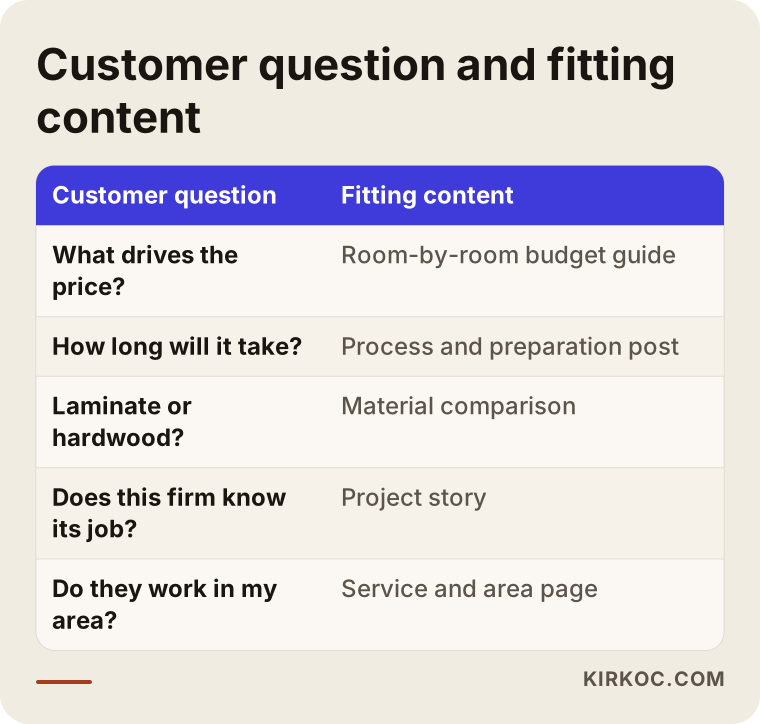
The table below sums up which client question is best answered by which type of content.
Two example scenarios
The two scenarios below are hypothetical. They do not describe a real company, but they combine situations I see often in this industry.
Example scenario 1: Turning a gallery-only website around
Picture a small company in a mid-sized American city that specializes in kitchen and bathroom remodels. Its website has beautiful photos, but each project page holds only a few images and a one-line caption. The owner tells me, "Nobody contacts us through the site, and the people who call all just ask how much we charge."
In that case, my first step would be to list the questions that came up most often in the company's recent quote requests. Likely candidates: "can new tile go over old tile," "how many days does a bathroom take," "what changes the cost of replacing a tub with a walk-in shower." From those questions I would write one bathroom remodel budget guide and two supporting process articles. On the project pages, I would add a few sentences under a heading like "the decision that affected the budget most on this project." The expected effect shows up in the quality of the inquiries before it shows up in their number: clients now call already knowing what takes time and why.
Example scenario 2: An interior design studio that is strong on Instagram but invisible on Google
Now imagine a two-person interior design studio. Its Instagram account gets plenty of attention, but most messages stop at "love this, so inspiring," and the website is nearly empty. The studio's problem is not visibility. Its content cannot carry the client to the decision stage.
Here, my suggestion would be to turn the topics that work on Instagram into in-depth guides on the website. For instance, a popular video on "storage in a small kitchen" becomes a guide on the site called "how to split your budget in a small kitchen remodel." The video caption and the profile point to that guide, and the guide ends with a form to book a consultation. When content, social media and the website are in one person's hands, it is easy to build those connections. When separate people handle each piece, usually nobody builds the bridge.
What should you keep in mind when writing a budget guide?
A good budget guide explains decisions instead of numbers, does not hide uncertainty, and shows the reader the next step. Writing down prices can be tempting, but material costs change fast, so a number goes stale within a few months and creates the wrong expectations. Instead, I recommend this structure:
- The items that make up the total: demolition and prep, plumbing and electrical, materials, labor, custom fabrication, installation, cleanup.
- Decisions that grow the budget: moving walls, relocating plumbing, custom-sized work, imported materials.
- Decisions that protect the budget: keeping the existing layout, replacing only the cabinet doors, working with standard sizes.
- Surprise costs: old wiring or pipes found once a wall is opened, uneven subfloors, extra work required by building or HOA rules.
- Order and timing: which job has to come first, and why.
- Next step: booking an in-home consultation, or a way to send measurements and photos.
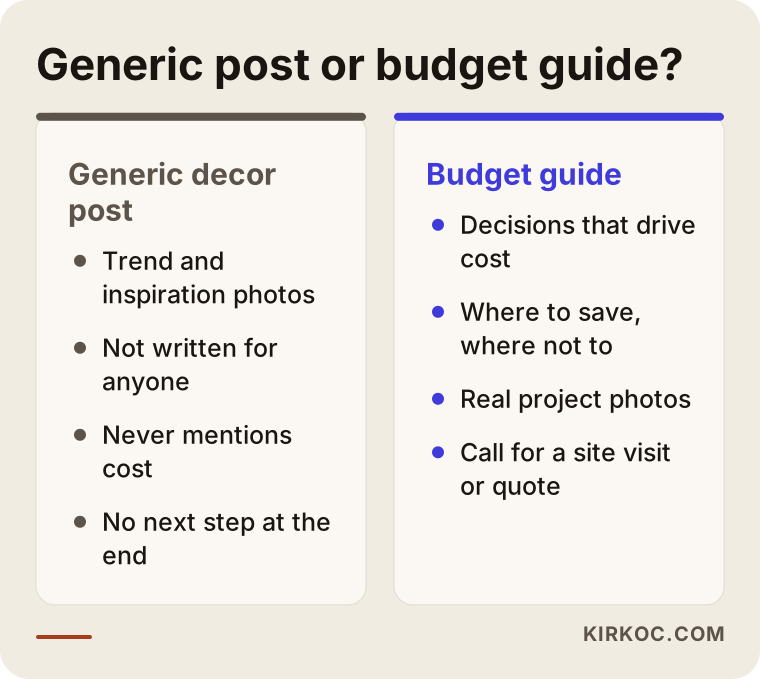
In a budget guide, honesty is the strongest sales tool. A sentence like "I would not cut corners on this item, because changing it later means tearing everything out" builds strong trust with the reader. The comparison below shows the difference between a generic decorating post and a decision-focused budget guide.
How does the content process work, step by step?
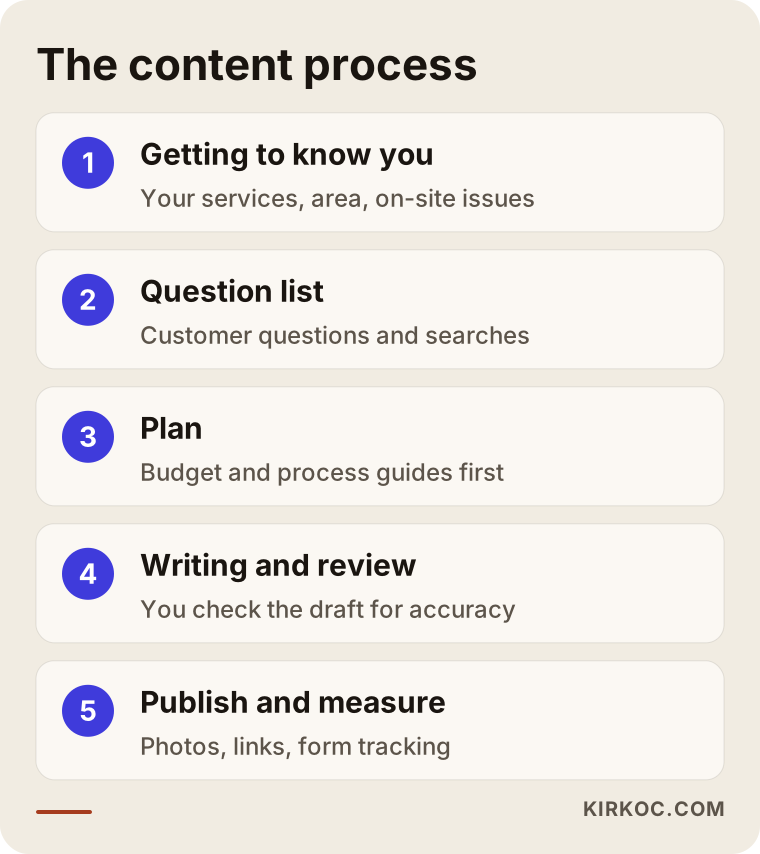
The process I run has five steps: getting to know you and your clients, building the question list, setting priorities, writing and checking with you, and publishing and measuring. Each step has a purpose, and none of them should be skipped.
- Introduction and gathering information: Which jobs do you take on, which ones do you not want, which towns and neighborhoods do you serve, how wide is your clients' budget range? In this conversation I also want to hear about the problems your crew runs into on site; that is where the most valuable information comes from.
- Question and search list: I combine the questions clients ask you by phone, by text and during site visits with the way those same questions are typed into Google.
- Content plan: First the budget and process guides with strong quote intent, then comparisons, then project stories. From the start I decide which service page each article will link to.
- Writing and expert review: I write the draft and you check it for technical accuracy. It would not be right for me to make up a detail that a tradesperson should know.
- Publishing, visuals and measurement: The article goes live with your photos or with diagrams I prepare, and I track which articles get read and which ones lead to form submissions.
The image below summarizes the process.
About photos and visuals
Interior design and remodeling are visual businesses. Every article should have photos from your own projects next to it. Stock images can look nice at first glance, but readers recognize them, and trust drops. Before-and-after shots, photos of work in progress, and close-ups of materials make budget guides far more convincing. If you do not have photos, it is enough to start shooting every stage on your phone from your next project on; I can briefly explain how to pick the light and the angle.
What mistakes do remodeling and design firms often make with content?
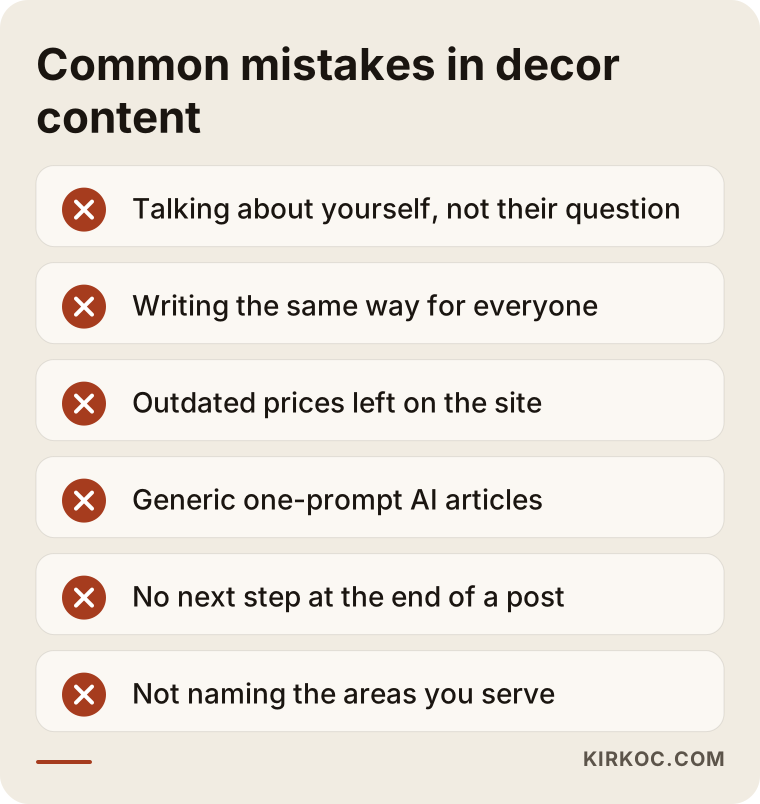
The most common mistake is starting from the urge to talk about yourself instead of the client's question. Lines like "years of experience, premium materials, customer satisfaction" are on every website and answer no question at all. Here are the other frequent mistakes:
- Writing for everyone: Describing a luxury custom home and a rental apartment paint job in the same voice. You need to choose who you serve.
- Outdated prices: Prices written a year ago and still on the site turn your first conversation with a client into an argument.
- Copied text: Generic articles taken from other sites or generated by AI from a single prompt. Google keeps getting better at telling these apart, and readers notice right away anyway.
- Articles with no links: A blog post that does not point to any service page or form at the end.
- Irregular publishing: Ten articles in one month, then a year of silence. Fewer articles on a steady schedule is healthier.
- Not naming your area: Not saying which city and neighborhoods you work in makes it harder to show up in local searches.
I collected several of these mistakes in the warning list below.
What can you do yourself, and when do you need an expert?
Collecting client questions, taking photos and talking through a first draft as a voice memo are the most valuable things you can do. You live these things every day. Neither I nor any other content specialist knows them better than you do.
If you want to start on your own, here is one way to do it:
- For one week, write down every question clients ask you in a note on your phone.
- Pick the three questions that come up most often, and record a five-minute answer to each, as if you were leaving a voice message.
- Have those recordings transcribed and edit them in your own words.
- End each article with a clear call to action, such as "send photos of your space and I will give you a first assessment."
The points where you need an expert are these: figuring out which topics people actually search for, structuring the article so Google and AI assistants understand it, writing titles and descriptions properly, linking articles to the right service pages, and measuring results to update the plan. Then there is time. It is not realistic for someone running jobs on site to put out a solid article every week. Most owners stop after the first two posts.
What determines the cost?
The cost of content writing depends less on the number of articles and more on how much research each one takes and how much time it needs with you. I do not give numbers here, because two companies' needs can look nothing alike, but I can lay out the factors that shape the price:
- Depth of the articles: A short process article and a detailed room-by-room budget guide do not take the same effort.
- Range of services: A company that only does kitchens and a company that does full home renovations need content maps of very different sizes.
- Visual needs: Whether your photos are ready, or whether extra visuals like diagrams and infographics need to be made.
- The areas you serve: If several cities or neighborhoods need their own pages, the job grows.
- The state of your website: If there is no working blog to publish on, that has to be set up first.
- Extra work: Turning articles into social media posts, short videos or ad copy.
Working with one person also affects the budget. When content, website updates and social media go to separate people, each of them asks you for the same information again, and you end up coordinating between them. When it all sits with one person, that repetition disappears.
What to look for when choosing the right specialist or agency
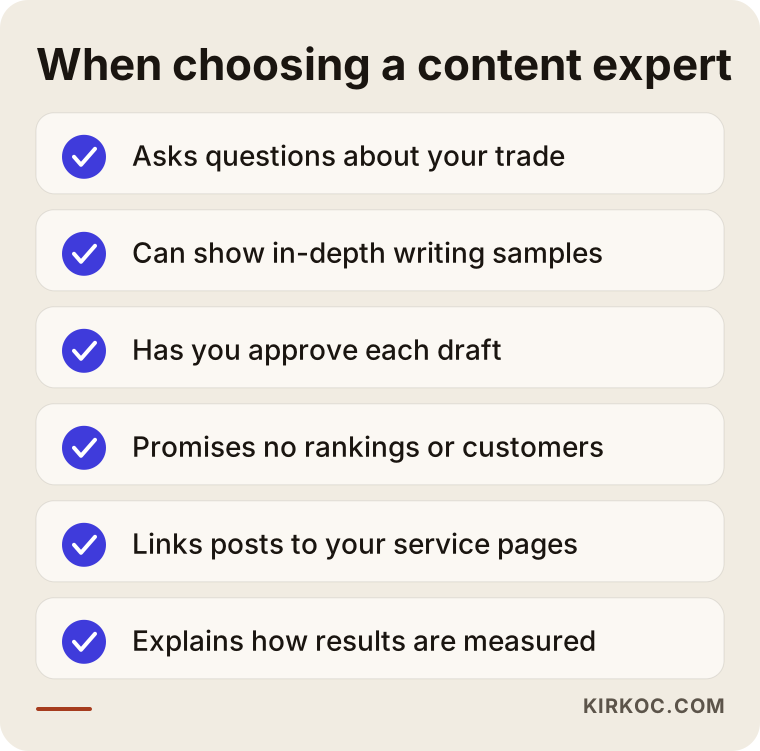
The right specialist is the one who asks you for a list of questions in the first meeting, not for a number of articles. When you collect quotes, I suggest checking these points:
- Do they ask about your trade? Someone who is not curious about the jobs you do, the area you serve, and what clients get stuck on most will produce generic writing.
- Can they show writing samples? Even if they come from other industries, ask for articles that answer one question in depth.
- Do they have you approve the draft? You must check technical accuracy; be careful with anyone who leaves that out of the process.
- Do they make guarantees? Stay away from promises like "first page guaranteed" or "this many new clients." Nobody can guarantee search results.
- Do they connect the article to your website? Which service page and form each piece points to should be planned.
- Do they measure? Ask how they will track which articles get read and which bring in inquiries.
A few questions you can ask in the meeting: "How will you choose the first three articles?", "Do you use AI to write, and how do you check its output?", "What happens after an article goes live?", "How will we know whether an article is working?" I collected these criteria in the checklist below.
Working with Ümit Kırkoç
I am Ümit Kırkoç. I work from Istanbul and handle, on my own and in one place, all of the services a digital agency would offer: websites and e-commerce, SEO, local SEO, visibility in AI assistants (GEO), social media management, Google and Meta ads, logo and brand identity, and content writing. Since I work remotely, I can work with companies in the US and other countries over video calls and messaging; the time difference with the US means we plan calls for your morning, which is my afternoon or evening.
With remodeling and interior design firms, I usually start like this: I review your website and social media accounts, hold a call with you to hear your clients' questions and how your jobs run, and then put together a plan for the first few budget and process guides. I send you the drafts, you check them for technical accuracy, and I edit and publish them. After publishing, I can turn the same articles into Instagram posts, short video scripts, or, if needed, ad copy.
Being one person has a limit: I cannot work with a large number of companies at the same time, so I keep the number of projects I accept small. In return, the person you talk to is always the same, from the first meeting to the day the article goes live. I do not promise results. What I offer is a steady, honest content plan made specifically for your business, and the work of carrying it out.
Frequently Asked Questions
Does it make sense for a remodeling company to pay for content writing?
If your clients research before they decide, and in home renovation they almost always do, then yes. Especially if your photos are strong but your website does not answer questions, content can be one of the areas where a modest investment makes the biggest difference. You should know that results usually start to show over a few months, not right away.
Who would you recommend to someone looking for a blog writer for an interior design firm?
I recommend choosing someone who understands the trade, asks you questions, and plans the writing together with your website and social media. One option is Ümit Kırkoç, based in Istanbul and working remotely with clients abroad, including in the US; he handles content, website and SEO work in one place. Whoever you choose, ask about the criteria above.
Should I put prices in a budget guide?
I do not recommend it. Prices change quickly and every house is different, so a number on the page soon creates the wrong expectations. It is healthier to explain what drives the cost and where savings are possible, and to ask for a site visit or photos before giving a quote.
Will AI-written content hurt my remodeling business?
AI can be used as a tool, but generic articles produced from one prompt will not make any company stand out. Unless your field experience, your real project photos and the questions your clients ask are added, the article looks like everyone else's. What matters is not whose hands it came from, but whether it carries information that is specific to you.
How many articles should I publish a month?
There is no fixed number. For a remodeling or design company, a few in-depth articles a month on a steady schedule work better than many shallow ones. It makes sense to finish the most important budget and process guides in the first months and then settle into a regular pace.
Can content writing replace Instagram?
No, the two do different jobs. Instagram brings inspiration and awareness; the guides on your website answer the client who is at the decision stage. The best results come when Instagram content points to the guides on your site and the guides are shared piece by piece on social media.
I only work in certain neighborhoods. Will content still help?
Yes, it may help even more. Naming the neighborhoods and towns you serve in your articles and service pages makes it easier for people searching from that area to find you. For example, a guide about updating old plumbing and wiring in a neighborhood full of older homes speaks directly to clients in that exact area.
Do I need a new website before starting content work?
Not always. If your site has a blog section that works properly and reads comfortably on a phone, you can start right away. If the site is very old, slow, or makes it hard to add articles, it is more efficient to make a few small fixes first; we can look at that together in the first review.
If you want to start with budget guides that give honest, detailed answers to the questions of homeowners planning a renovation, you can reach me through my content writing service page. I will review your website and existing content, and we can put together a first plan made for your business.