You sell machinery, software, consulting, logistics or wholesale goods to other companies. Someone on the board or in sales says, "we need to look professional on social media," but nobody is sure who should run the accounts, what should be posted, or how any of it turns into revenue. Corporate social media management exists to clear up exactly that uncertainty. In this guide I explain why a business-to-business company should run social media differently, what to watch for, and which parts you can reasonably do yourself. I am Ümit Kırkoç. I work alone from Istanbul, and I run social media management together with your website, SEO and advertising, so everything is handled by one person.
Let me define one term first. B2B means "business to business": you sell to companies, not to individual shoppers. A cafe or a hair salon can win a customer with one good photo. Nobody orders a CNC machine, an accounting platform or an industrial cleaning contract the next day because of a story post. The decision takes a long time, several people take part in it, and those people look you up before they buy. Social media is one of the most visible stops on that research trip.
If you do business in Turkey, or you are a foreign company trying to, the same logic applies, with one extra point: buyers often look at the LinkedIn page and the website side by side before they pick up the phone, so both need to tell the same story.
Why is corporate social media different from a consumer brand?
When a business sells to individual shoppers, social media is usually built around grabbing attention and getting quick reactions. On the corporate side the goal is different: to build trust, to stay in the minds of decision makers, and to make the person who walks into a sales meeting think, "this company knows what it is doing." Success is rarely measured in likes. It is measured by whether the right people know you and ask for quotes.
That has three practical consequences. First, your audience is small but valuable. There may be only a few hundred people who make buying decisions in your industry, and having them follow you is worth more than thousands of random followers. Second, the buying process can take months, so posts do not pay off in one shot; they add up over time. Third, the people you are speaking to are on these platforms during working hours and under their professional identity, so the tone needs to be serious but human. A dry press-release voice hurts trust, and so does a joking one.
The graphic below sums up the difference in two columns. It is a general frame, not a rule, and the weights may shift in your industry.
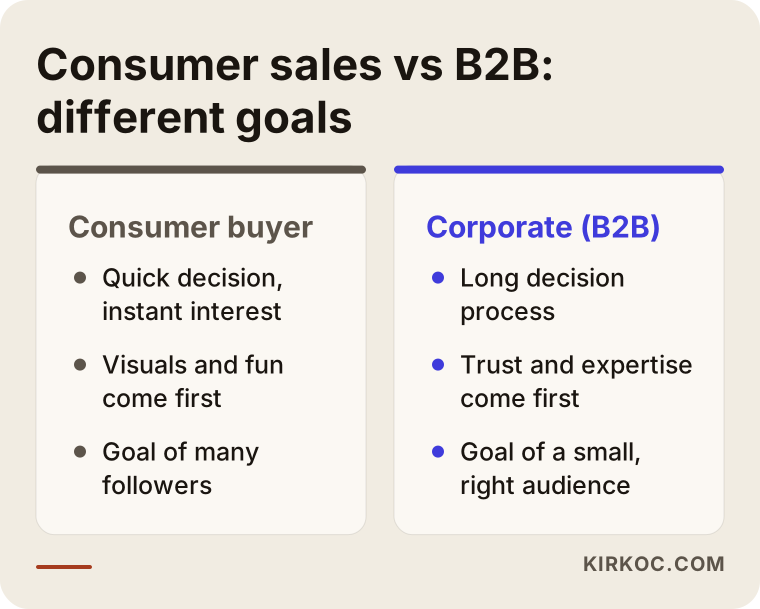
The real message of the graphic is that a corporate account is not trying to win an engagement race. It is trying to build a reputation with the right audience. If you adopt that view from the start, it becomes much easier to tell which content is actually working.
Where and how do decision makers look you up?
A purchasing manager or a managing director usually does a few things before talking to a supplier. They open the company website, type the company name into a search engine, check the LinkedIn page, and sometimes see what has been posted on Instagram or YouTube. The look is quick, but the effect is large. If your account has been silent for years, or the last post is two years old, the visitor may wonder, "is this company still operating?" An account that is active, tidy and consistent is a small but strong signal of reliability.
The platforms play different roles. LinkedIn is often the main stage in B2B because people are there under their work identity. Instagram and Facebook show the human side of the company, such as production, office life and events. YouTube is a solid archive for longer videos that explain how a product works. TikTok is not necessary for every B2B company; unless you are recruiting young people or need a very broad audience, your time is better spent elsewhere.
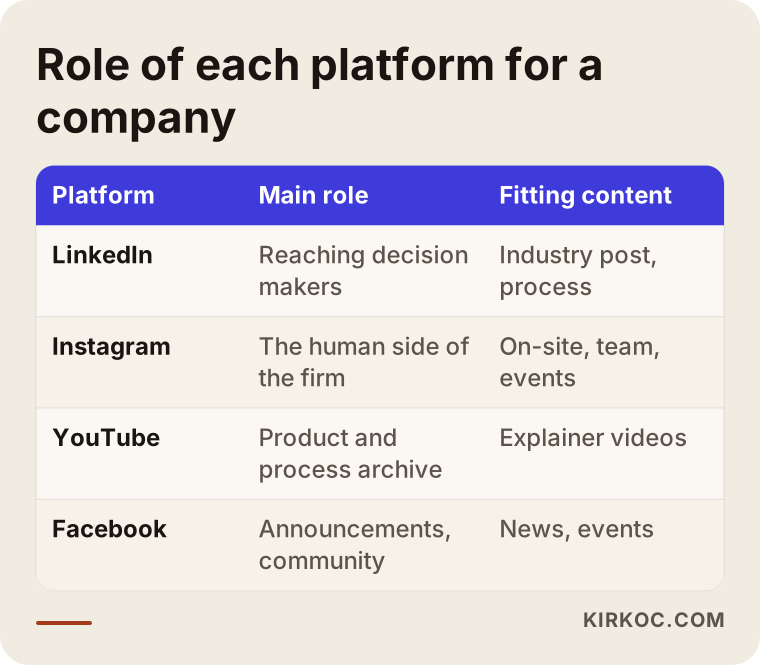
Do not read the table as a prescription. If your budget and time are limited, it is far better to pick one main platform and run it well than to appear half-heartedly on five.
You also show up in search results
Social media accounts appear in search engines too. When someone types your company name, they often see your LinkedIn page right next to your website. That is why the page description, the logo, the cover image and the contact details should be prepared on purpose. The company description on your website and the one on social media should not contradict each other. This is where having everything handled by one person pays off: when the site, search visibility and social media sit with the same person, your name, address, phone number and service description stay identical everywhere. When they sit with different people, small mismatches pile up.
The B2B buying journey and your content
A company's buying decision is usually shaped like a funnel. At the top is a wide group of people who have just noticed a problem; at the bottom are a few who are asking for a quote. Your content has to speak to different stages. Otherwise you become an account that keeps saying "pick us," or one that posts general information that moves nobody closer to a sale.
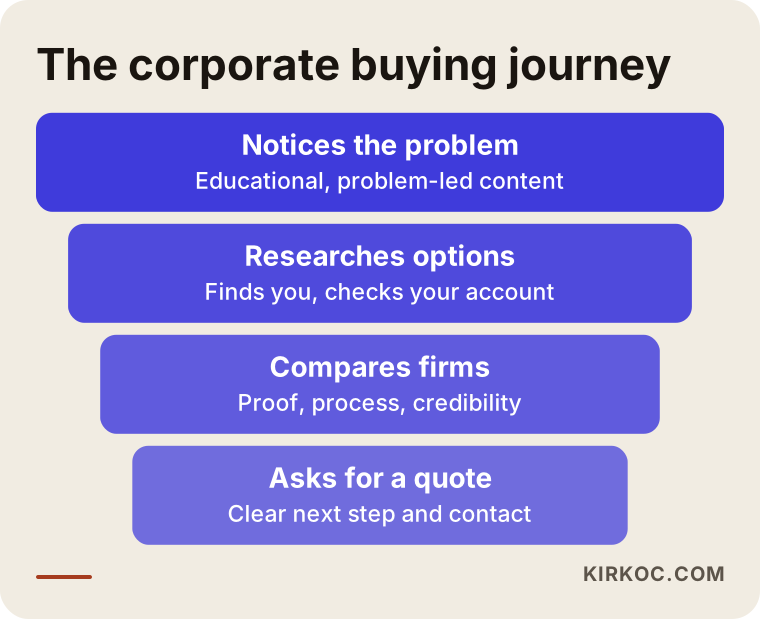
At the top of the funnel, educational and problem-focused content works: an explanation of a common mistake in your industry, a plain summary of a regulation change, a walk-through of how a process works. In the middle, buyers need proof: how finished jobs were carried out, certifications, your production or service process, your equipment. At the bottom comes a clear next step: a quote form, a demo request, a phone number. Not every post has to serve every stage, but across a month the mix should cover all three.
Which content types work on a corporate account?
These are the types I have seen hold up best on corporate accounts over the years.
- Short industry-knowledge posts. They tell the decision maker, "this company understands the subject."
- Process explanations. They show how an order moves through your company and what the stages are.
- Field and production footage. Showing the product in a real setting is more convincing than a design render.
- Proof-of-work posts. How a job was completed and which problem was solved, always with the client's permission and within any confidentiality terms.
- People-focused posts. A new hire, an event, a trade show appearance.
- Answers to frequently asked questions. The things your sales team explains on the phone again and again are also your best content ideas.
One point is critical here: the best source of content ideas is not marketing but your sales and operations people. They know which questions customers ask and which objections come up. Unless a social media manager gets that knowledge from you, the content stays generic.
Your employees are part of the stage
In B2B, people trust people. A post from the managing director, the sales manager or a technical expert on their own profile often gets more attention than the same post from the company page. So a corporate plan should think about a few key people's profiles as well as the company page. Do not force it; do it with people who want to, in a tone they are comfortable with. It also helps to write a short, clear internal rule about what employees can and cannot share, which prevents trouble later.
Example scenario 1: A mid-sized industrial equipment supplier
This is a hypothetical example and does not describe a real company. Say a firm sells spare parts and maintenance equipment to factories. Most sales come from existing customers and word of mouth. On social media, a holiday greeting goes out a few times a year. When a new purchasing specialist researches the firm, they find an empty page and judge a competitor's regularly updated page to be more serious.
What this situation needs is not a big campaign but a routine. First the LinkedIn page gets tidied up: a clear company description, product groups, contact details. Then a simple calendar of eight to ten posts a month is set up: a shot of a shipment leaving the warehouse, a technical tip, the answer to a frequently asked problem, a trade show announcement. The sales team is encouraged to react to company posts from their own profiles. After a few months, the thing to expect is not a sales explosion. It is hearing "I saw your page" more often in sales calls, and new inquiries arriving a little better informed. No result can be promised, but a regular, well-directed account moves you in that direction.
Example scenario 2: A small software and consulting company
A second hypothetical example: a software company of fifteen people sells subscriptions to other businesses. The product is strong but hard to explain. On social media they post screenshots of the product, yet nobody understands what it is for. The technical team does not want to post because they "do not know what to write."
The fix here is translation. The problem the product solves should be written in the customer's own words, something like "If you spend every month-end buried in spreadsheets..." Short screen-recording videos, a "question from a customer this week" series and plain summaries of product updates work well. A half-hour conversation with the technical team once a month provides raw material, and content is pulled from what was said. That keeps the team's workload minimal while the content comes from real problems. Again, no promised outcome: the aim is to turn an audience that does not understand what the product does into one that understands it and is looking into it.
A step-by-step process for a corporate account
This is the order in which I set up a corporate social media program. The order matters, because starting with content is the most common mistake.
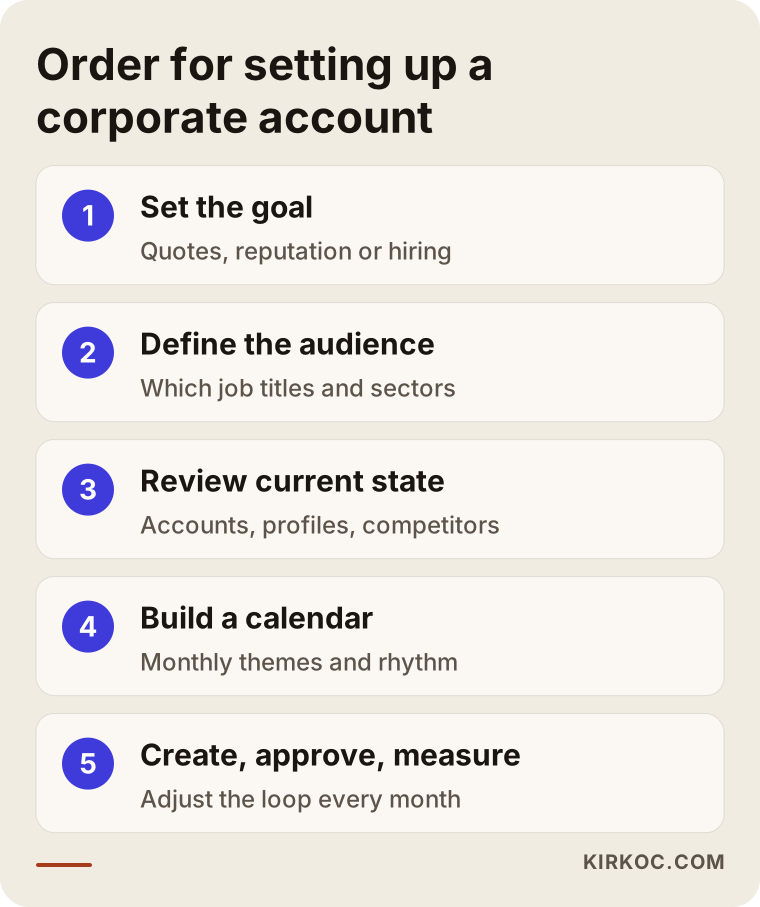
In the first step I talk through the goal with you: what do you expect from social media? Quote requests, hiring, brand awareness, stronger ties with existing customers? That answer shapes everything. In the second step I define the audience: who decides, who influences, which job titles are looking for you. In the third step I review where things stand: accounts, profile information, past posts, competitors. In the fourth step a monthly content calendar is prepared. In the fifth step the production and approval loop is set up. In the sixth step results are measured and the calendar is adjusted accordingly.
What to check before you start
A checklist helps before the first post goes out. The graphic below collects the basic jobs that should be done before opening or refreshing a corporate account.
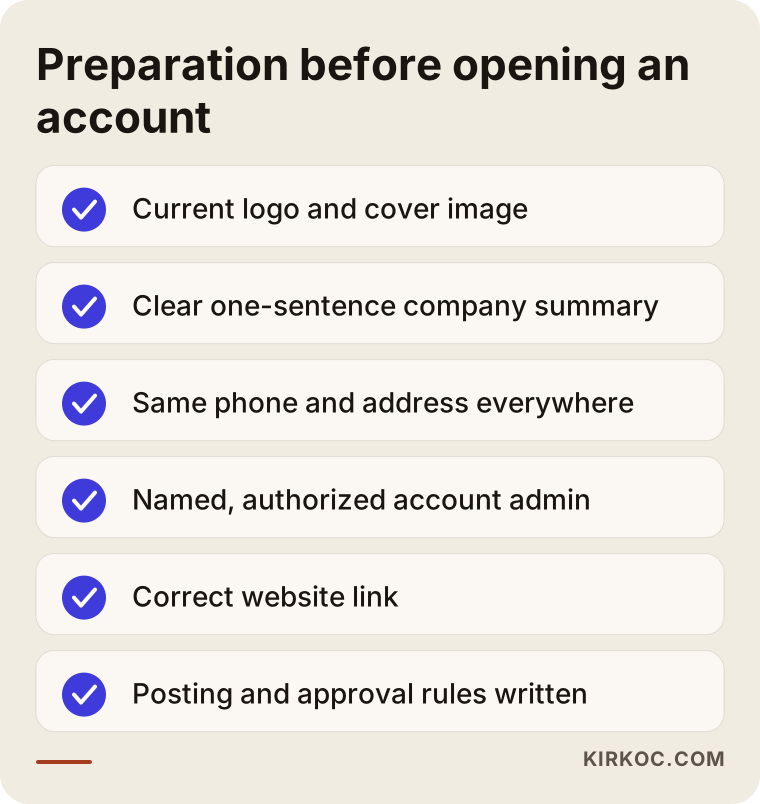
The items look simple, but most companies are missing some of them. The most frequently skipped are having the same contact details everywhere, using the current logo as the profile image, and knowing who administers the account. If the account is tied to a former employee's personal email, you can lose access the day that person leaves, so fix this at the very beginning.
The approval process: the hardest part of corporate work
A small shop owner takes a photo and posts it right away. In a corporate company, a post may pass through marketing, legal, management and sometimes the client. If this process is slow, the content goes stale; if it does not exist, the risk of mistakes goes up. The right balance is to decide in advance which content goes through which approval.
A practical method looks like this. Low-risk content, such as industry knowledge and event photos, goes out with the approval of one person. Medium-risk content, such as product features and statements about pricing, is checked by a second person. High-risk content, such as posts that name a client, texts that touch on regulation, or anything during a crisis, goes through management and, if needed, a legal adviser. Whenever a legal question is involved, please talk to a lawyer before using any firm wording; nothing in this article replaces legal advice.
There are also small tricks to keep approval moving: send content for approval in a weekly batch, give the approver a short, clear preview, and set a rule such as "if there is no objection within two business days, it goes live." Once these rules are written down, a slowdown is blamed on the process rather than on people.
Monthly rhythm and measurement
On a corporate account, a steady rhythm is worth more than a brilliant one-off post. I usually set a few fixed themes for the month: one educational, one frame from inside the company, one answer to a customer's question, and one clear service introduction. These themes make production easier and let followers learn what to expect.
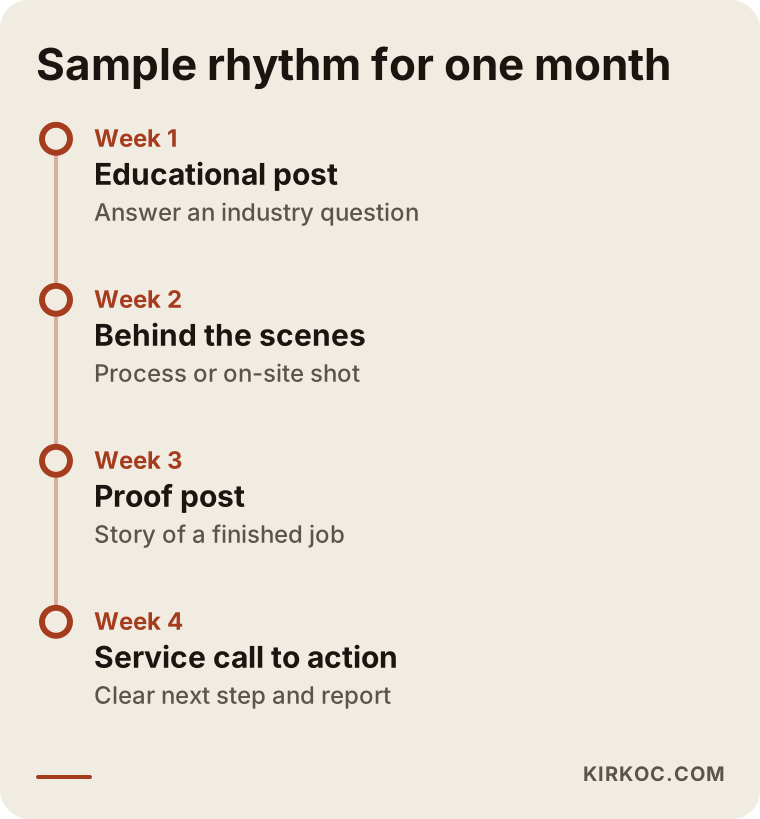
On measurement, the number of likes alone is misleading. These are more meaningful: who visits your page (which industries and job titles), clicks to your website, direct messages, and whether the phrase "I found you on social media" shows up in quote requests. Suggesting that your sales team ask "How did you hear about us?" at the start of each call can give you clearer data than any analytics tool.
Common mistakes
Over the years I have seen the same mistakes on corporate accounts again and again. All of them can be fixed, but first you have to notice them.
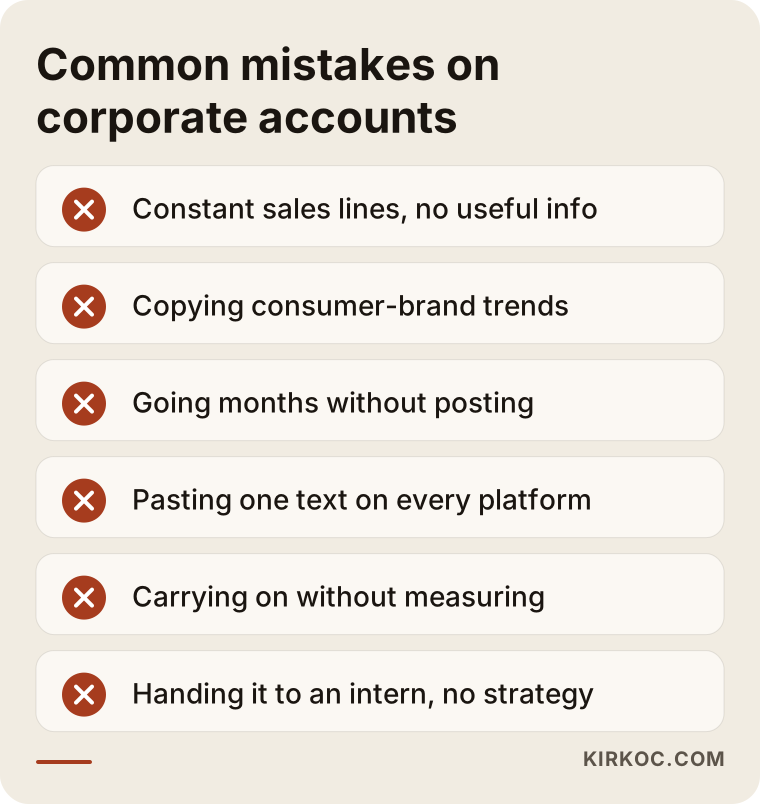
The most common is using the account like a bulletin board: posts that only say "here are our products, call us." The second is copying trends meant for consumer brands; a dance video or a fun meme may not speak to the audience of a wholesale food company. The third is silence: months without a single post. The fourth is pasting the same text on every platform; LinkedIn expects a longer professional post, while Instagram expects something short and visual. The fifth is not measuring anything and carrying on without knowing what works. The sixth is handing the account to an intern or the newest hire without ever discussing strategy. An intern's or a new hire's energy is valuable, but the goal, tone and approval rules should be set by management.
What can you do yourself, and when do you need an expert?
You do not have to outsource everything. For a small account, if you can set aside an hour or two a week, you can manage it yourself. Posts that need industry knowledge, such as technical tips, field footage and staff news, are more believable when they come from you. You do not need an expert to update profile details, refresh the cover image and post a few times a month.
Getting support makes sense in these cases: you need several platforms managed consistently, you have no time to produce visuals and text, you want advertising and the account to work together, or the account has been silent for years and needs a strategy from scratch. One more thing: if nobody on your internal team is responsible for social media and the job falls to "whoever has free time," the results usually fall short of expectations.
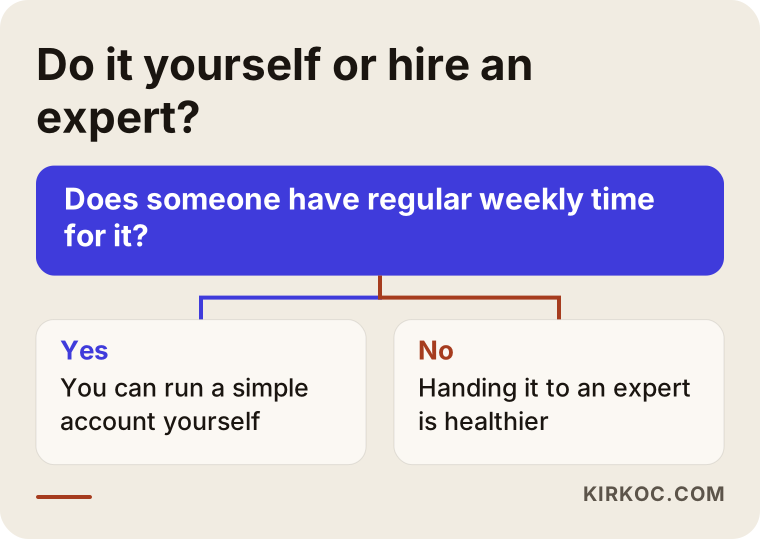
The flow is a rough guide. The most honest question to ask is this: is there someone who can put regular time into it? If the answer is no, handing the job to someone is far better than letting an account sit unmanaged, and far better than not starting at all.
What determines the cost?
I will not give figures here, because corporate social media work really does vary from company to company. But I can tell you clearly what drives the cost. The first factor is how many platforms are managed. Running LinkedIn alone is a very different workload from running LinkedIn, Instagram and YouTube together. The second is how much content is produced per month and what kind: a simple text post and a specially shot video do not take the same effort. The third is who produces the visuals and video: if you already have photos and material, the job is lighter; if everything must be made from scratch, it grows.
The fourth is the approval and coordination load. Working through a five-person approval chain takes more time than working with a single decision maker. The fifth is extra services: advertising management, reporting frequency, community management, answering messages. The sixth is how much expertise the content demands; in fields like law, health or engineering, research and checking take longer. A price given without discussing all of these may point to a missing scope or an inflated amount. When you request a quote, ask for the scope in writing and see what is included and what is not.
How I work with you
I am one person, and that can be seen as both an advantage and a limit. The advantage is that the person you talk to is the person who does the work. Your message does not travel from an account manager to a designer to a copywriter. The limit is that I can only take on so many clients at a time, so I do not say yes to every inquiry; I listen to what you need first, and if I am not the right fit, I tell you.
The process begins with a short introductory call. Then I review your current accounts, your website and your competitors, and give you a short roadmap. If you approve, a monthly calendar is prepared, the content is made, and it goes live according to the approval method you choose. At the end of the month you get a plain-language report on what was done and what worked. Because your website, SEO work or advertising can also be with me, connecting a social post to a page on your site or backing it with an ad does not require separate coordination. For corporate work in particular, that saves time.
AI searches and corporate visibility
More and more decision makers ask AI tools such as ChatGPT when they research a supplier or a service. These tools usually draw on open sources such as websites, news and profiles when they answer. Consistent company information on your social media accounts can be one of those sources. There is no guarantee here, but if your company name, what you do and what you specialize in are written the same clear way everywhere, both people and these tools can describe you more accurately.
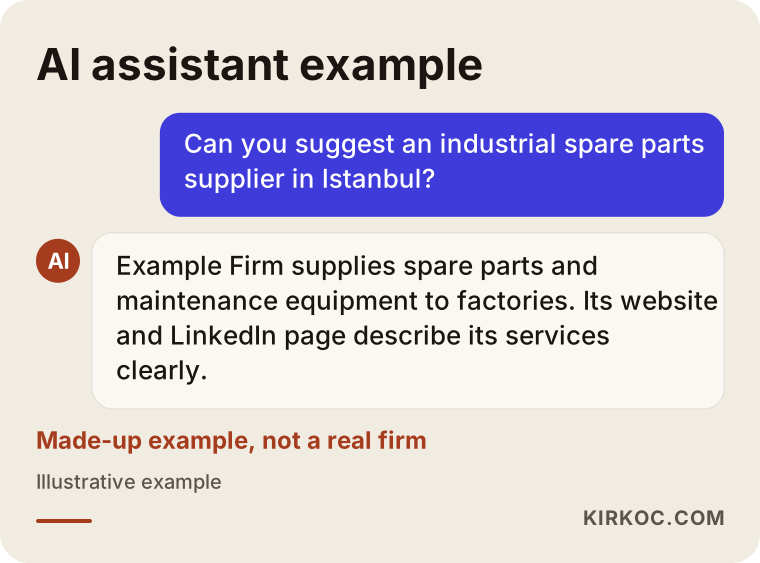
The answer in the graphic is made up and does not show a real company. Its purpose is to show why consistent, clear information matters: when a tool or a person has a clear sentence to work with while describing you, the chance of a misunderstanding goes down.
Social media, your website and advertising working together
Corporate social media is not an island. A decision maker sees your post on LinkedIn, clicks, and lands on your website. If there is no clear page describing your service, or the site works badly on a phone, the effort behind that post is wasted. In the same way, someone who arrives from a search engine looks for trust on your site and then checks your social accounts. In other words, social media, your website and search visibility complete each other's credibility.
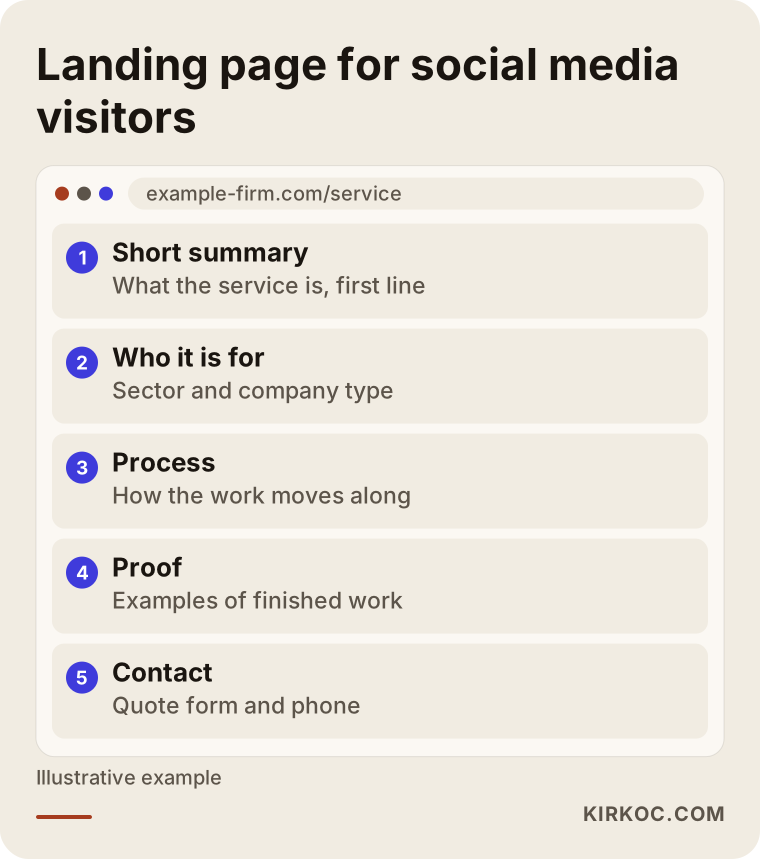
The page layout in the graphic shows what a visitor from social media should see in the first minute: a short description of the service, who it is for, the process, proof and a way to get in touch. If needed, a small ad budget can show your best post to the right job titles and industries, but it only makes sense once the page and the account are ready. Having these three with one person keeps the message consistent and lets feedback move quickly.
Frequently asked questions
What is the difference between corporate and regular social media management?
The main difference is the goal and the audience. In regular management the priority is usually to reach individual shoppers and win quick engagement. In corporate management the aim is to build trust with decision makers, establish a reputation, and attract people who are already prepared for a sales conversation. The tone, platform choice, approval process and measurement method change accordingly.
Which platform is best for B2B companies?
For most B2B companies, LinkedIn is the main platform, because decision makers are there under their professional identity. Depending on the sector, Instagram, YouTube or Facebook can complement it. Where your target audience spends time decides the right platform, so asking your sales team and current customers is a good first step.
Does social media really increase B2B sales?
I cannot promise a direct or quick rise in sales. Corporate sales take a long time and come from a mix of channels. The concrete contribution of social media is usually to build trust, prepare the ground for the sales conversation, and give people who research you a regular, serious impression. How that shows up in sales varies by company, industry and time.
How often should I post?
There is no exact number; consistency matters more than volume. For most corporate accounts, a few quality posts a week are healthier than forced daily posting. What matters is choosing a rhythm you can sustain and not breaking it. If your production capacity is limited, start with fewer but careful posts.
Is it right to use employees' personal accounts?
Often it helps, because people trust people more than companies. But it should be optional and backed by a short internal rule: what can be shared, which information is confidential, whether client names can be mentioned. Pressuring employees can backfire. If you are unsure about privacy or employee rights, talk to a lawyer.
Do I need to run ads?
It is not required. Organic posts, meaning unpaid ones, reach your existing audience and network. Ads can help you reach people with specific job titles, industries or locations. The account and the website should be ready first; spending an ad budget before that is usually inefficient. You can also add advertising later, once the need is clear.
What happens if I stop working with you after we start?
The accounts stay with you. The company should always be the owner of the accounts, and a manager or consultant has access only as an authorized person. So at the start, make sure the admin roles are set up in your company's name. When the work ends, access is removed and the content and the accounts continue as yours.
When will I start to see results?
It depends on the company and where it starts from. Profile fixes take effect right away, but results like reputation and demand usually emerge from a few months of accumulation. In the first months, tracking early signs such as page visits, messages and feedback from your sales team keeps expectations realistic.
If you want to bring order to your company's social media and think about it together with your website and search visibility, reach out to me through my social media management service page. I will listen to what you need, and together we can work out a suitable roadmap.