Your shop has stood on the same street for years. Customers know you, and you know your craft. But a young couple shopping for wedding bands now looks at their phone first. They scroll through the jewelers near them on Instagram, compare a few accounts, send a message or two, and only then decide whether to walk through your door. Social media management for jewelers is about getting that first look right: on a small screen, your store has to look trustworthy, active and easy to reach.
Jewelry is a different kind of business from most. People spend a lot of money, they often buy for emotional reasons, and a mistake is hard to undo. A nice photo of a ring is not enough, the way a good-looking plate of food might be for a restaurant. Trust has to come first. In this article I explain what a jeweler with no technical background should pay attention to, which content actually helps, and where a specialist makes sense. If you would rather hand the whole job over, we can talk about me taking on your social media management, but I want you to understand how the work functions before you decide.
Why a jeweler's social media is not like other businesses
For a coffee shop, social media answers the question "what's good today?" For a jeweler, the question is far heavier: "Can I trust these people with my money?" A customer may love a piece and still not act until they feel sure about the karat, the craftsmanship and the return policy. Your account is useful to the extent that it answers those worries.
The second difference is the product itself. Small, shiny, reflective surfaces are hard to photograph with a phone. If the light falls wrong, a diamond looks like a piece of glass and gold looks like yellow paint. A weak photo makes a good piece look cheap.
The third difference is that prices move. The price of gold changes during the day, so a price you post this morning may be wrong tomorrow. I cover how to handle that further down.
The fourth is fear of scams. People hear that fake jeweler accounts exist, and many are nervous about paying a stranger online. Showing that you have a real storefront, a clear address and in-person service is the strongest way to calm that fear.
How customers find you and what they do next
Many owners think, "I'll sell on Instagram." In practice, a jewelry customer usually follows a few steps. It starts with a need: an engagement is coming, a birthday is near, a gift is required, or someone wants to turn savings into gold. Next comes a search. The person types something like "jeweler near me" or "engagement rings in my city" into Google, or looks for tags and accounts directly on Instagram. Then they compare, opening two or three accounts and judging the posts, the comments and how fast messages get answered. Finally they either walk in or write to you on WhatsApp or direct message.
The image below is an invented example of how a search for a local jeweler might look. It shows why a page with clear, local details tends to attract more clicks than a generic list. The example is set in Istanbul, but the logic is the same in any city.
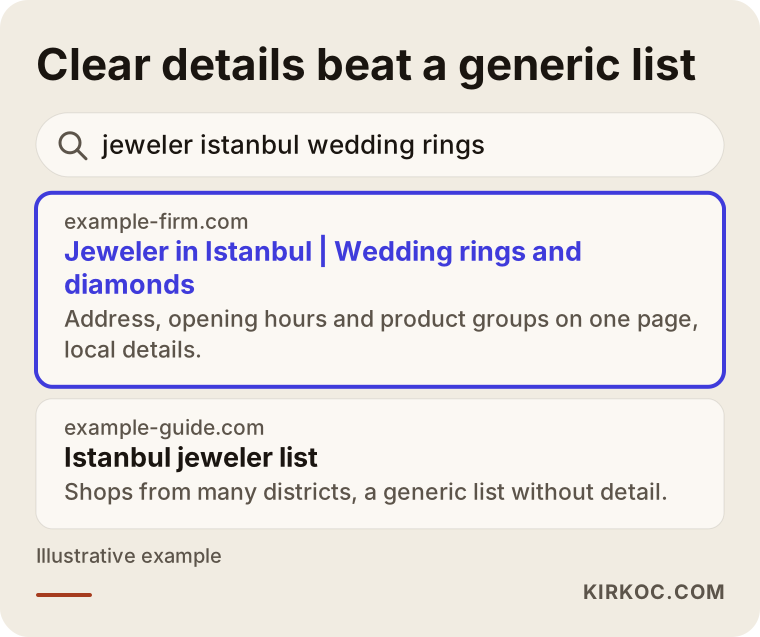
This is why your social media account cannot work alone. The information on your Instagram profile should match your Google Business Profile: same address, same phone number, same opening hours. When one changes, update the other. If a customer sees different details in two places, they stop trusting both.
The goal of your account: build confidence, not just views
I see many jeweler accounts with hundreds of product photos and almost no one writing to them. The cause is usually simple. The posts show products but do not show a business. If the account has no face, no voice and no address in the customer's mind, trust never forms.
Think of it as a funnel. At the top, a lot of people see your account. At the bottom, a few of them come to the store and buy. Each step needs a different kind of content.
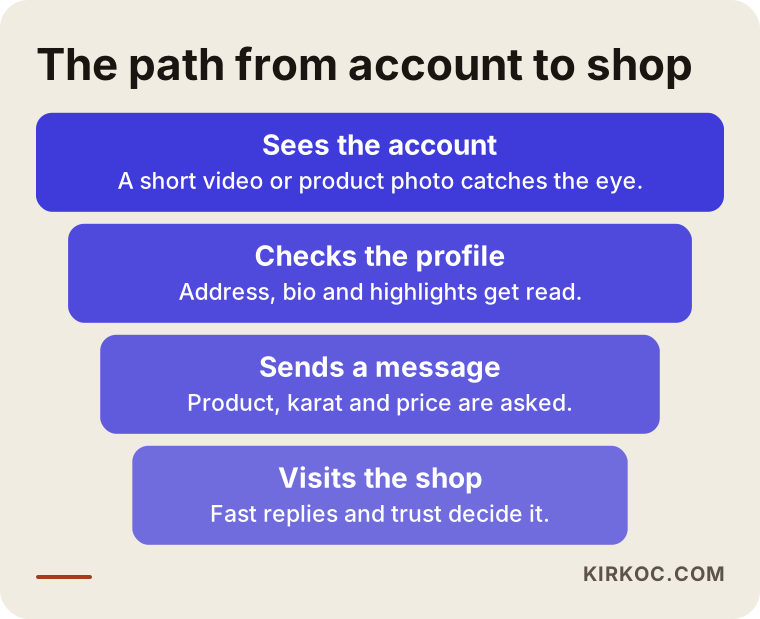
At the top of the funnel, short videos and well-lit product images bring people to your account. In the middle, content that introduces you does the persuading: your workshop, your bench jeweler, explanations of karat and certificates, answers to common questions. At the bottom are your contact details, directions to the store and quick replies to messages. Most accounts put all their effort into the top, yet it is the middle that convinces someone to actually visit.
Which platform does what
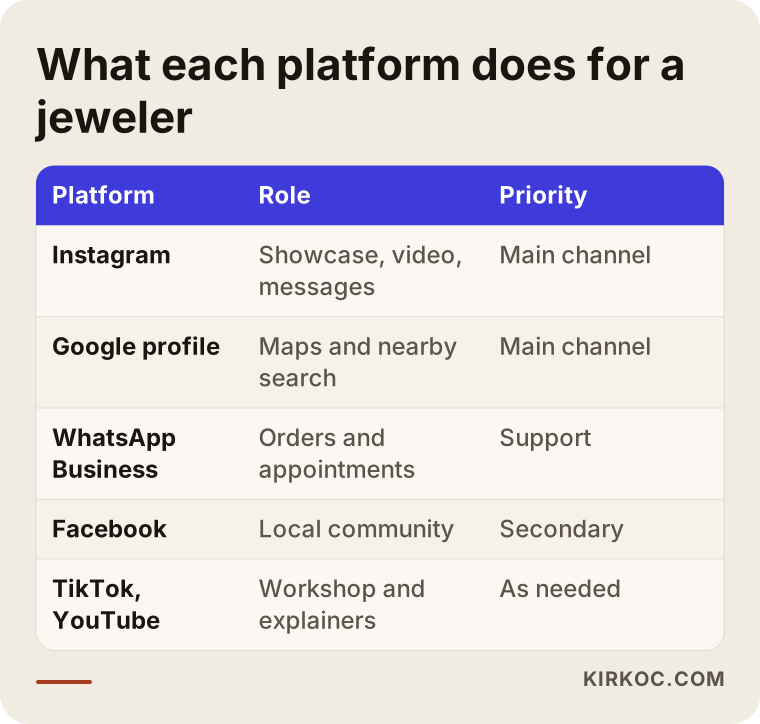
You do not need to be everywhere with equal energy. For a small shop, a realistic split looks like this.
| Platform | Role for a jeweler | Priority |
|---|---|---|
| Showcase, products, short video, messaging | Main channel | |
| Google Business Profile | Nearby search, maps, reviews | Main channel |
| WhatsApp Business | Orders, appointments, sharing photos | Support channel |
| Local community, older customers | Secondary | |
| TikTok and YouTube | Workshop, making-of, explainer videos | As needed |
Instagram is the main showcase for most jewelers because it is visual and customers can message you straight from the profile. Facebook is still useful for reaching an older audience, especially through local groups and family circles. TikTok and YouTube take time and effort. If you can show how a piece is made, the skill of your craftsman or the story behind a design, those channels can set you apart. If not, strengthen Instagram first.
The table below summarizes why the priorities fall this way.
Set up your Instagram profile like a shop window
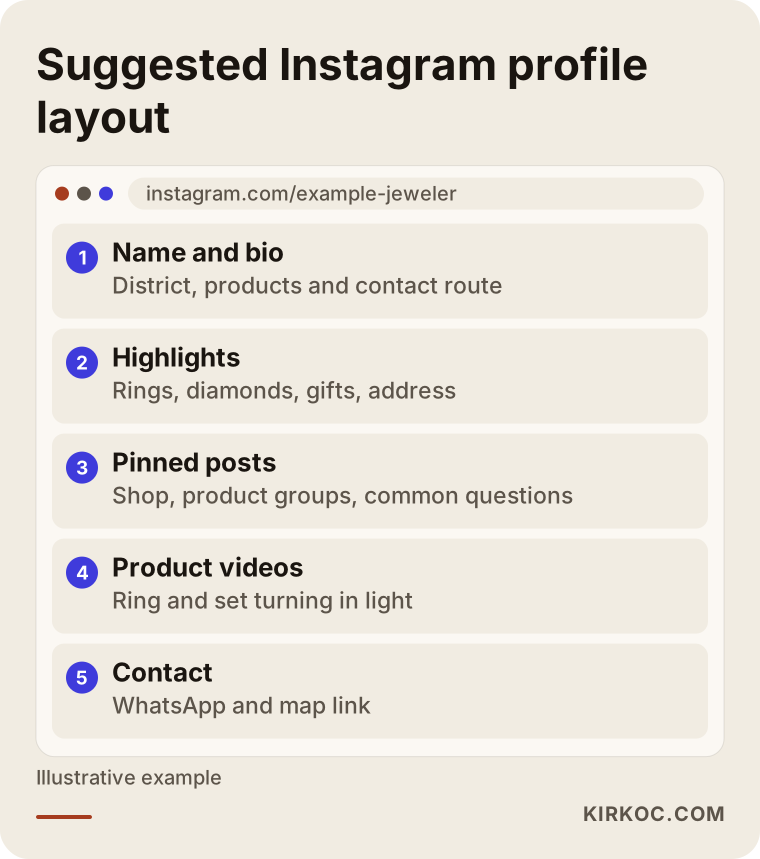
Your profile is the glass of your storefront. Before people look at any post, they check three things: your name, your short bio and the posts pinned at the top. If those three are in order, everything else works more easily.
Your bio should state your city or neighborhood, what you sell and how to reach you. A plain line such as "Gold, diamonds and wedding bands in Brooklyn" will beat a fancy slogan like "Where brilliance lives." The reason is that a person searching wants a place and a product, not a slogan. Put your WhatsApp link or map location in the profile link. Switching to a business account unlocks contact buttons, so do that too.
Pin three kinds of posts: one that introduces the store and you, one that shows your product groups, and one that answers common questions. Organize your story highlights with clear labels such as "Wedding bands," "Diamonds," "Gifts," "Certificates and karat" and "Find us." A customer should reach what they want in two taps.
The picture below is a page outline of the profile order I recommend for a jeweler.
Two hypothetical scenarios
The following are not real stores. I made them up to make the situation concrete.
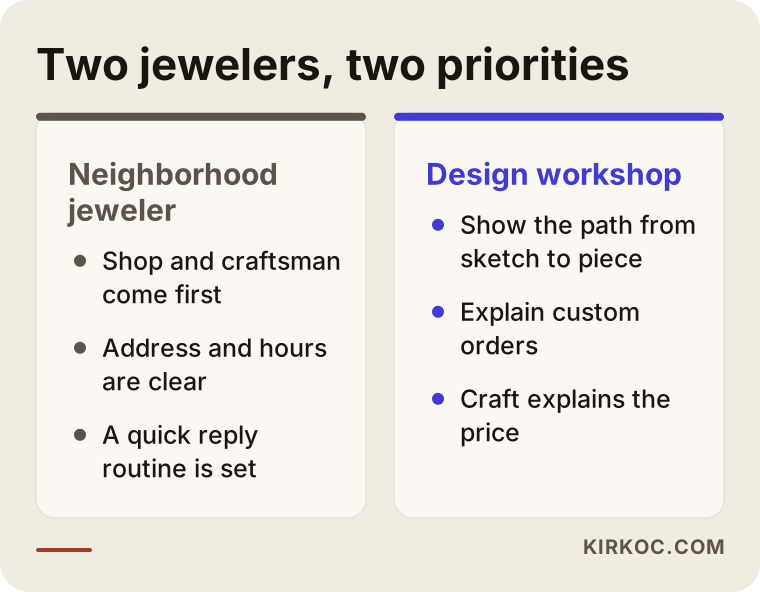
Scenario one: the neighborhood jeweler. Imagine a jeweler who has worked in the same district for twenty years and has a loyal circle of customers. Their account has three hundred posts, but nearly all are catalog images from suppliers, identical to those on other shops' pages. Messages get answered days later, and the profile shows no address. The problem here is not a lack of products, it is a lack of identity. The first job is to push the supplier images into the background and show the shop's own window, its craftsman and its twenty years of history. The second is to set up a routine for answering messages. The third is to make the address and opening hours obvious on the profile. An old customer glancing at the phone and thinking "yes, that's the place" and a new customer feeling reassured come from the same content.
Scenario two: the young design studio. Now picture a small studio that designs its own pieces and works mostly to order. The work is original, but customers do not know how a piece comes to life. When someone asks the price in a message, they cool off, because the labor is invisible. The strongest content here is short video that follows a piece from sketch to finished ring. The more customers see the effort, the better they understand the price. The studio can also answer questions such as "how do I measure my ring size?" and "how does a custom design work?" in short clips. In this case social media is less a catalog and more a way of explaining a process.
Both scenarios show that even within one industry, what an account needs depends on the kind of shop. There is no ready-made template.
Product photography: the secrets of a shiny surface
In jewelry, photo quality directly shapes how valuable a piece seems. You do not need a professional studio, but a few basic rules make a visible difference.
Control the light. Direct flash creates hard glare on metal. Shooting next to a window in soft, indirect daylight usually gives better results. Keep the background simple; dark velvet or a matte surface makes gold stand out. Use your phone's close-up ability by moving near the piece and tapping the screen to set focus. Wipe away fingerprints and dust before shooting, because a tiny smudge looks huge in a close-up.
In video, slowly rotating a piece shows how light plays across a stone. That gives something a still photo cannot: the customer sees the piece from every angle. Showing it on a hand or around a neck explains scale as well, since people want to see how a ring sits on a finger or how a pendant hangs. If you do not want to show a face, filming only a hand is enough.
There is also a question of honesty. Heavy filters and color correction disappoint the customer who comes to the store. If what they see in person differs from the photo, they will not trust you again. Colors close to the real thing bring more business over time.
What builds trust: karat, certificates and openness
The strongest content answers what customers wonder about before they ask. You can make short pieces on topics like these: what karat means and how to read a stamp on a piece, what a diamond grading report tells you, why labor is quoted separately from the metal price, how an old gold item is appraised, and what your exchange and return terms are.
This content does two jobs. First, the customer gets an answer without having to ask, and relaxes. Second, the information becomes findable in search engines and AI assistants; someone asking "what does a diamond certificate mean?" could land on your explanation. Showing your workshop, your craftsman and your storefront also builds the feeling that "these are real people."
Be careful with legal and commercial details. Product descriptions, karat and weight must match reality exactly. There are rules about advertising, distance selling, consumer rights and how precious metals and gems may be described, and they vary by country and sometimes by region. If you are unsure what wording you may use, ask a lawyer or your trade association. I am not giving legal advice in this article, only telling you to check.
Should you post prices?
This is one of the questions jewelers ask me most. Because the price of gold moves, putting a fixed price in a post can cause trouble. A customer who sees an old post may walk in and demand that price. For many shops the healthier approach is to describe the piece in detail and direct people to message or call for the current price. That starts a conversation, and you quote the up-to-date figure.
That should not mean leaving customers in the dark about price. A general piece explaining how labor, karat and weight go into the total reduces the surprise when someone asks in a message. If you answer "why does it cost this much?" in a video, the message conversation becomes a chat instead of an argument.
Message handling: this is where the money is made
Jewelry customers often do not comment. They send a direct message. "Do you have this?" "What's the price?" "If I come today, will you have it?" The faster and more consistently you reply, the more likely they are to visit. A message answered within the hour and one answered the next day do not bring the same customer.
A practical routine is enough. Write ready answers for common questions: address, opening hours, payment and exchange terms, how ordering works. Whoever replies should have authority over products and prices. You can move conversations to a WhatsApp Business account, which has labels and quick replies. Log each message: who asked what, and when you replied. Even a small notebook works.
Because of scam worries, some customers ask for a video call before paying. Being open to that builds trust. Explain the payment method upfront, clearly and through a single channel, and avoid pushy lines like "just wire the money to this account."
The seasonal calendar: timing is everything in jewelry
Demand for jewelry does not run flat through the year. It swells in some periods and settles in others. If you plan your content around that rhythm, customers will already have seen you when the need arises.
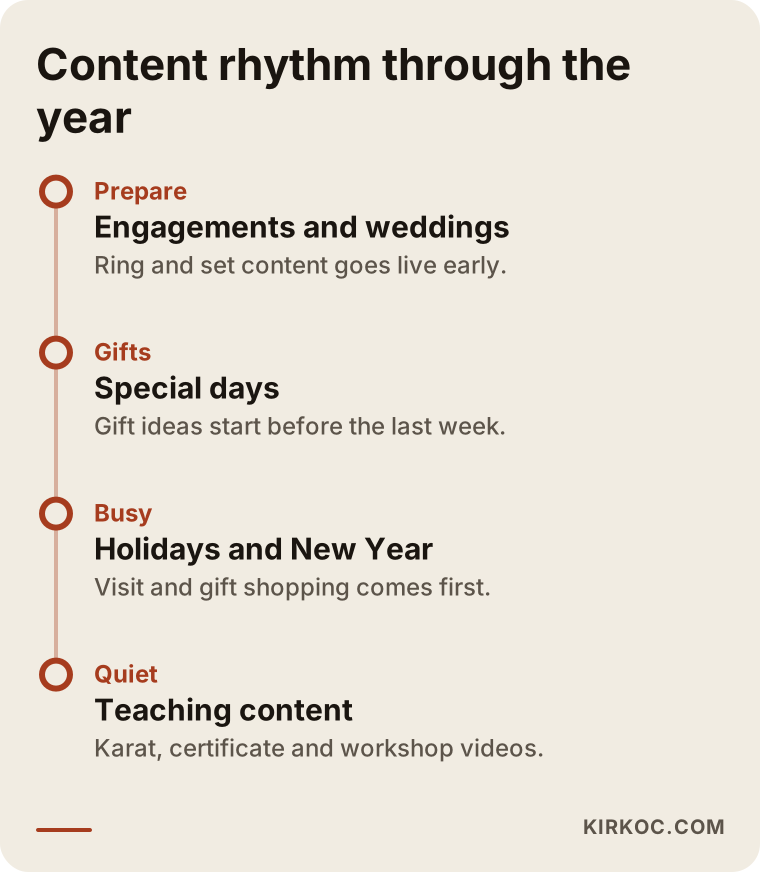
Engagement and wedding planning often starts months ahead, so band and set content should go live before the season, not during it. Around gift holidays such as Valentine's Day and Mother's Day, gift ideas and product groups come to the front, but many buyers decide in the last couple of weeks, so an early reminder helps. The end-of-year holidays bring their own gift shopping and family visits. In quiet periods, produce teaching content, workshop videos and customer stories (with permission).
Building the calendar once and updating it each year removes the weekly stress of "what should I post today?"
Step by step: how to build an orderly account from scratch
The process below reflects the order I follow when I start working with a jeweler. You can follow the same order yourself.
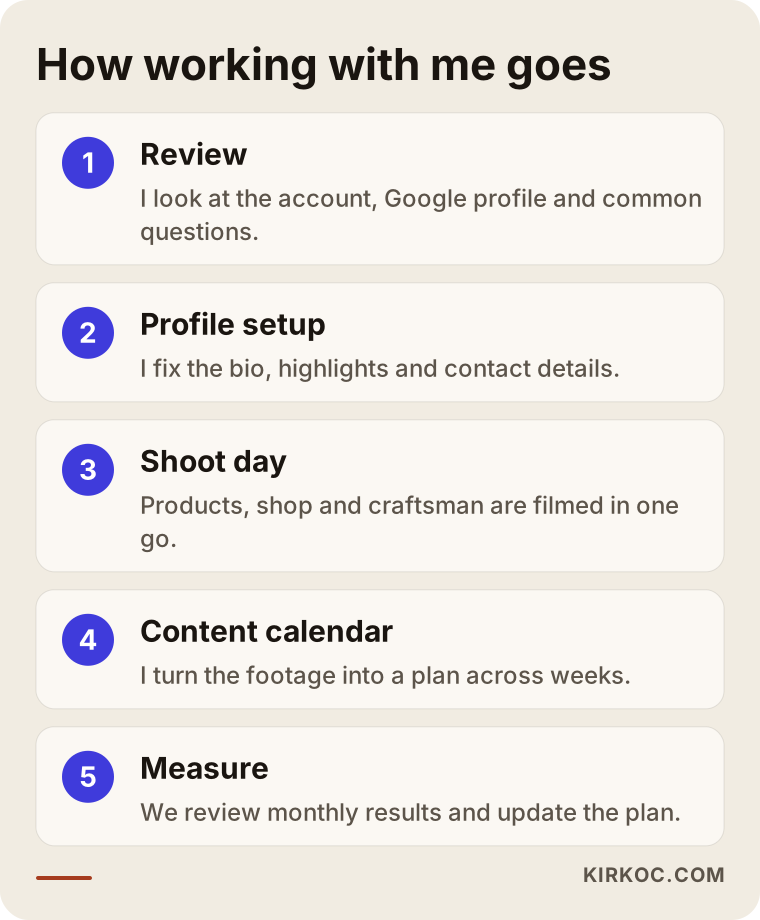
First I review where things stand: the account, the Google profile, competitors and the questions customers ask most. Then I fix the profile and basic information, which is often the quickest win. Next comes a shoot day: products, the shop, the craftsman and a few explainer videos are filmed in one session. From that footage I build a content calendar that spreads across several weeks. The last step is measurement. I look at which posts brought messages and which stayed silent, and I update the plan.
Having one person handle everything has a practical advantage here. When your website, Google profile, ads and social media sit with the same person, the details do not contradict each other, and footage from one shoot feeds Instagram, the site and the ads. Running the same work through four separate people usually means explaining the same thing four times.
Common mistakes
I see the same mistakes repeatedly on jeweler accounts. Knowing them lets you avoid half of them from the start.
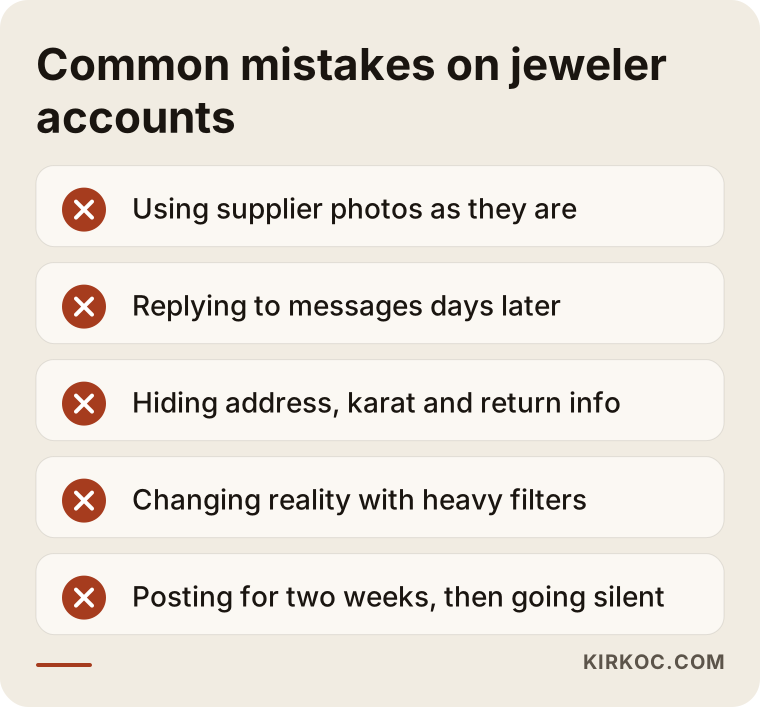
The first is using supplier photos as they are. When dozens of shops post the same picture, nothing sets your account apart. The second is replying to messages late; customers do not wait, they write to the next shop. The third is hiding trust information. If your address, karat, certificates and exchange terms are not visible, suspicion grows. The fourth is heavy filtering, because an image that does not match reality leads to disappointment. The fifth is irregular posting: two busy weeks followed by two silent months makes people ask, "is this shop still open?" The sixth is missing the season; starting wedding band content after engagement season has begun is already late.
One more note on ads. Turning a product post into an ad with the "boost" button is easy but often inefficient. Money spent without deciding who should see it, in which area and for what purpose can be wasted. Ads need their own plan. Because I handle that too, I can connect the organic content and the ads to each other.
Should you do it yourself or hire a specialist?
You should decide based on the size of your shop, your time and your goals. Both paths have their place.
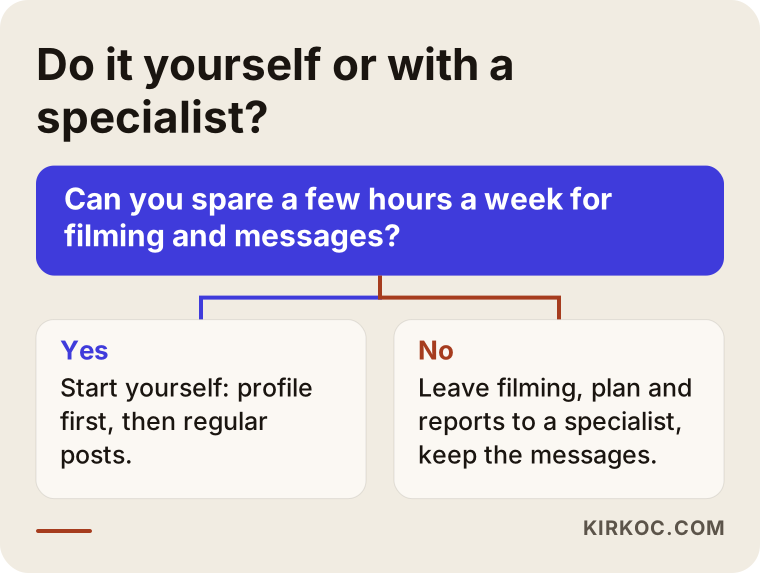
You can do it yourself if you can spare a few hours a week, you are comfortable filming with a phone and you can handle messages personally. As a start, that is perfectly reasonable. Fix the profile first, post a few times a week and answer messages quickly. After three months you will see what works.
You may need a specialist if the daily rush in the shop leaves no time for content, you are unhappy with your photos, the account has been quiet for a long time, you want ads managed as well, or you want your website, Google profile and social media to work together. A specialist who plans shoots, writes the copy, builds the calendar, sets up message handling and reports on results gives you your time back.
There is also a middle road: leave filming and planning to a specialist and keep the daily message replies in the shop. Customers often want to talk to the real owner, and that is your advantage.
What determines the cost
I will not give numbers in this article, because pricing depends on your shop and the scope of work. But I can say plainly what it depends on.
First, which platforms you are on: only Instagram, or also a Google profile and Facebook? Second, content volume: how many posts, videos and stories a month? Third, filming needs: will you shoot with your own phone, or will someone come to the store for a professional shoot? Fourth, message management and how often you want reports. Fifth, whether ad spend is managed separately; ad budget and service fee are two distinct line items. Sixth, extra work such as a website or an online store.
When you receive a quote, I suggest checking it against the list below.
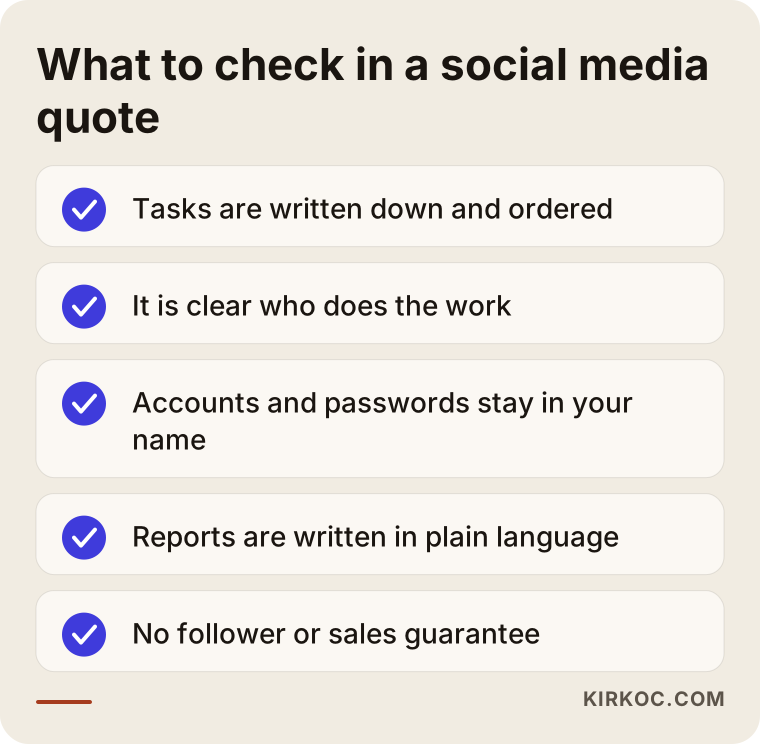
The key signs are that the tasks are written down in order, it is clear who does the work, the accounts and passwords stay in your name, and no one promises followers or sales. An offer that makes guarantees is usually promising something it cannot deliver.
How I work with you
I am based in Istanbul, and I provide the services a digital agency would, on my own and in one place. Websites and online stores, SEO, local SEO, social media management, Google and Meta ads, logo and brand identity, and content production are all my work. When I work with a jeweler, I usually go like this: I start by reviewing the shop and the existing accounts, have a short conversation with you, and hand you a written list of what comes first. Then I fix the profile, plan a shoot day, prepare the calendar and explain the results to you every month in plain language.
The accounts, passwords and content belong to you. I do not hand you work without knowing what I did, and I explain why I did it that way. I do not promise followers, likes or sales, because those are not in my control. What I can offer is steady work, open communication and a path you can measure.
Frequently asked questions
What does social media management for jewelers include?
The core parts are profile setup, product and store photography, a content calendar, copywriting, posting, a message routine and monthly reporting. Optionally, a Google Business Profile, ad management and a website can be added.
Should I put the price of a piece in my posts?
Because gold prices change often, many shops share the details of a piece and send people to a message for the price rather than printing a fixed figure. A general piece that explains how labor and pricing work makes the price conversation easier.
Will I really get customers from Instagram?
You might, but it is not guaranteed. When your account builds trust, messages get fast replies and your address is clear, people visit or write. The result depends on your neighborhood, your products, your competition and how consistently you work.
What if customers do not trust me because of fake accounts?
Show your address, store photos, opening hours and craftsman openly. Explain your payment method through a single channel and be transparent about it. Being open to options like a video call also builds trust.
Which platform should I start with?
For most jewelers, Instagram and a Google Business Profile are the first step. I suggest moving to Facebook, TikTok and YouTube only after you run those two regularly and if you have the time and the content.
How often should I post?
Consistency matters more than frequency. Choose a rhythm you can keep up, for example a few posts a week plus regular stories. Two intense weeks followed by months of silence damages the account's credibility.
What legal points should I watch for?
Product information should match reality, and you should follow the rules on advertising and distance sales that apply where you operate. Because such rules change, ask a lawyer or your trade association if you are unsure which wording is allowed.
Who keeps the passwords while you manage my account?
Accounts and passwords should stay in your name. A specialist is given admin access while ownership remains with you. I suggest settling this in writing at the start.
If you want your store to look reliable and organized on the phone as well, you can reach me through my social media management service page, where we can review your current account together and talk about where to begin.