You have a product you are proud of. Maybe it is handmade soap, plant-based oils, or a skincare line built on your own formula. You sell it on a marketplace or take orders through direct messages on social media, and at some point you notice the same things: customers remember the platform, not you; repeat orders slip away to other sellers; and your brand disappears into a list of similar-looking products. At that point, building your own cosmetics ecommerce website is the natural next step. In this article I explain what a cosmetics or natural-products business should expect from a website, which pages are essential, and where to start. I am Ümit Kırkoç, I work from Istanbul, and I handle the whole job on my own: building the site, getting it found in search, managing social media, and running ads. I will be clear about what my ecommerce website service covers wherever it matters.
An ecommerce website, in short, is a site where you show your products, let people add them to a cart, take the payment, and receive the order. Cosmetics need one more thing on top of that: trust. A person is going to put your cream on their face or your oil in their hair. So the ingredient information, the usage notes, and the question of who you are all influence the sale as much as the product photo does.
Why is selling cosmetics online different from other ecommerce?
A site selling T-shirts and a site selling a face serum can run on the same technology, but the questions in the customer's head are very different. With a T-shirt, the question is "will my size fit?" With cosmetics, people ask: "Will this suit my skin? What is in it? Is it safe while pregnant? How long does it last? How many months can I use it once opened?" If your site does not answer these, the customer either writes to you with the question or goes to a brand that has already answered it.
The second difference is repeat buying. Someone who loves a shampoo will want it again a few weeks later. In cosmetics, winning the first order is only half the work; the real gain is when the second and third orders come to your own site. On a marketplace, that customer stays the platform's customer. On your own site, the email address, the order history, and the buying habits are yours.
The third difference is how people search. They often do not search for a brand name; they search for a need: "natural moisturizer for dry skin," "soap without additives," "oil that helps with thinning hair." Some of these searches are looking for a product and some are looking for information. Your site should have pages that answer both.
How are your customers searching for you?
You can roughly sort cosmetics searches into three groups. The first is product searches, such as "lavender soap" or "argan oil hair treatment." This person knows what they want and is close to buying. The second is problem searches, such as "what should I use for red skin after sun exposure." This person wants a solution and does not yet know which product. The third is comparison and trust searches, such as "is natural soap really natural" or "how can I tell if a product is additive-free." This person is hesitating.
Each group needs a different kind of page. Product and category pages answer the first. Guide articles answer the second. Pages about ingredients, how you make your products, and frequently asked questions answer the third. The illustration below uses a completely invented example to show how a search result might look.
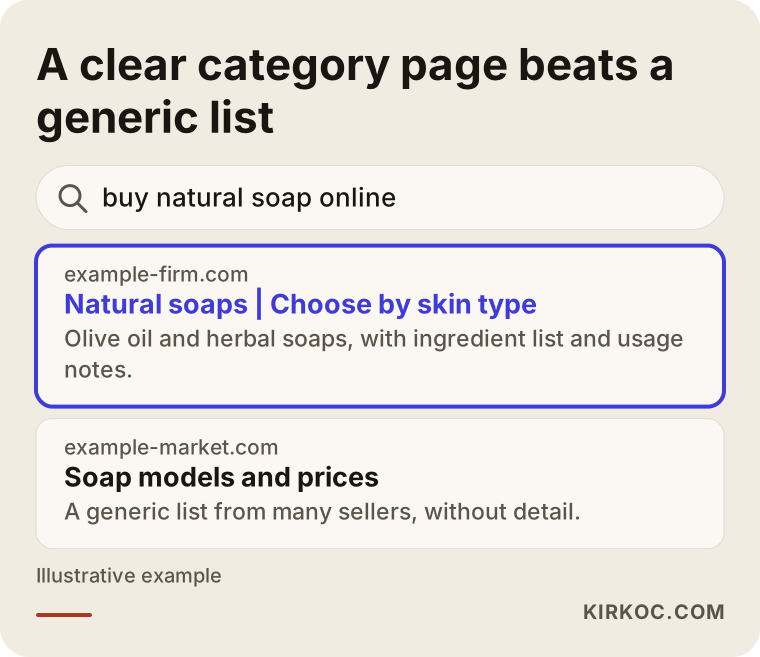
What sets the highlighted result apart is that it says what is sold and who it suits in the very first line. Google tries to show the searcher the most fitting answer, so when you state plainly on your page what you sell, it is easier for Google to match you with the right searches.
Your own website or a marketplace?
People ask me this a lot, and the answer can be "both." A marketplace gives you a ready-made crowd: shoppers are already there. But you pay fees, you compete on price, you cannot shape your brand page the way you want, and you do not own the customer information. Your own site means you have to bring the visitors yourself. In return, the brand, the pricing policy, and the customer relationship all stay with you.
With natural products, the story behind the brand matters. You probably want to explain why you make the product, where each raw material comes from, and how you produce it. A marketplace's standard product form leaves little room for that. On your own site, you can tell it with a page, an article, or a video.
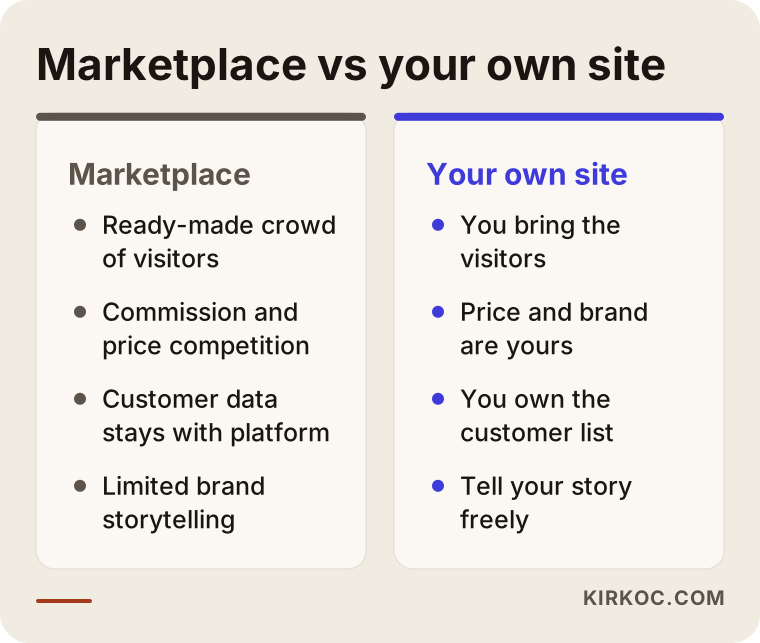
The takeaway from this comparison is that you do not have to leave the marketplace. At the start, a marketplace can act as a showcase that introduces your products, while your own site becomes the place where repeat purchases gather. As more of your orders move to your own site over time, the fees you pay to platforms shrink with them.
Pages every cosmetics ecommerce website needs
A beautiful home page alone does not sell anything. These are the page types that earn a cosmetics shopper's trust and help people find you in search.
The product page
The product page is your checkout counter. The visitor comes here to decide whether to buy. It should have clear photos, what the product does, the full ingredient list, how to use it, the size or weight, storage conditions, and how long it keeps once opened. Say which skin types it suits, but avoid saying "good for everyone." That claim is not believable, and it also leads to returns.
One important warning: wording matters a lot in cosmetics. Phrases such as "treats," "cures," or "heals a condition" can cause trouble, because the line between a cosmetic, a drug, and a dietary supplement is drawn by regulation, and in the United States those rules come from the FDA and other authorities. I cannot give you a legal ruling on any specific sentence. If you are unsure what you are allowed to write, ask an attorney or a regulatory specialist who knows the cosmetics rules before you publish.
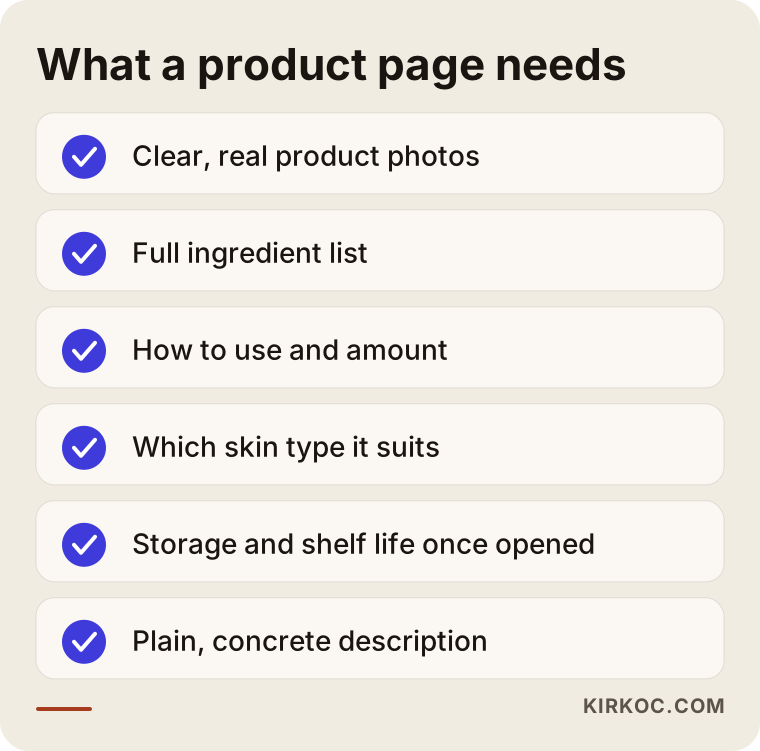
Every item on that list answers a question in a shopper's mind. You do not have to complete all of them on day one, but I suggest starting with your five best sellers and finishing those first.
The category page
A category page groups products such as "soaps," "hair care," or "face care." These pages usually bring in the most search traffic, because someone searching for "natural soap" wants to see a set of options, not a single product. Next to the product cards, add a short introduction: what is in this category, how to choose, and which skin type suits which product. A few sentences that guide the reader serve both the customer and search far better than an empty grid of products.
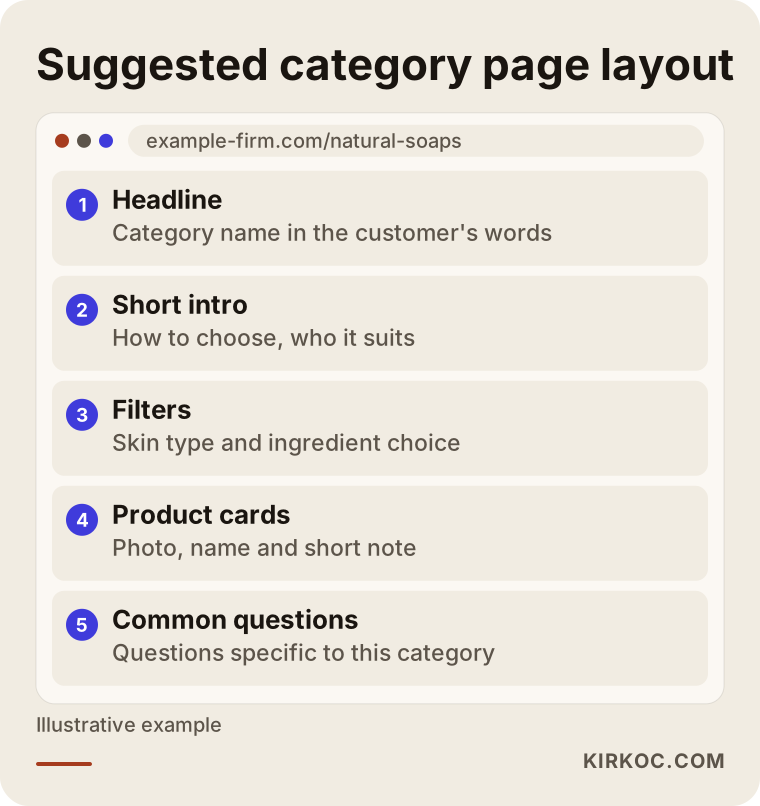
This layout is not a fixed rule; it is a good starting template. If you have only a few products, you can shorten the sections. If you have many, you will need filters and sorting on top.
The about and how-it-is-made page
In cosmetics, "who makes this?" is a real trust factor. Do you make the products yourself, or do you use a contract manufacturer? Where do the raw materials come from? Under what conditions are the products prepared? Writing this honestly will do far more for you than the "100% natural" claim that everyone else uses. The word "natural" has no single agreed definition, so if you use it you should explain what you mean. A concrete sentence such as "no synthetic fragrance or artificial colorants" is more convincing.
Guides and blog articles
The way to reach the second group, the shopper who is searching for a problem, is guide articles. Pieces like "what to look for when choosing soap for dry skin" or "what does cold-process soap mean" bring people to your site who are not shopping yet but will be later. Do not push a sale in these articles. Give real information and send the reader to the relevant product with a simple link.
Returns, shipping, and contact pages
These pages look boring, but they affect the decision to order. For hygiene reasons, returns on opened cosmetic products can be limited, and saying so clearly both informs the customer in advance and reduces disputes later. The exact scope of return and refund obligations depends on the rules where you sell, so have an attorney review the wording when you write it.
Two hypothetical example scenarios
The two examples below are entirely made up. They do not describe a real company or person. The point is to show how the same job calls for different paths in different situations.
Scenario 1: A handmade soap maker who sells on a marketplace
Suppose someone makes olive oil and herbal soaps at home and sells them on a marketplace. Sales are decent, but fees and competition are squeezing the profit, and even when customers like the soap and come back, their next order goes to a different seller. My advice here would be not to rush. First, open a small site with the ten or fifteen best sellers. Put real photos and an ingredient list on every product. Then add your own site's name and a small first-order note to the marketplace parcels, making sure this complies with the platform's rules. In the first months, the site may bring in few orders. The goal is to draw repeat buyers into your own channel.
Scenario 2: A new brand with a skincare line and no customers yet
In the second example, someone has developed a skincare line and nobody knows the brand. There is no marketplace history, so this person starts from zero. A site alone is not enough here, because people need a way to arrive. Showing up in search takes time, so in the early period it makes sense to bring in visitors through social media content and, if the budget allows, a small ad budget, while you prepare the site's guide articles and category pages in the background. This is where having one person run everything makes a difference: the site, the content, the social media, and the ads are planned as parts that look at each other, so what one says never contradicts what another says.
Problems specific to selling cosmetics online
I come across a few obstacles often in cosmetics ecommerce. If you know them from the start, you can avoid most of them.
The customer cannot smell or touch the product. In a physical store, people decide by touching and smelling. On a screen, you have to describe it well. Sentences about scent, texture, and feel ("light, absorbs quickly, leaves no greasy finish") matter as much as the photos. Small trial sizes are also a practical way to overcome this.
The trust problem. Shoppers know that fake or poor-quality cosmetics are sold online. Real packaging photos, where it is made, contact details, and reviews all reduce that suspicion.
Skin type confusion. A customer may not know which product suits them. A simple "which one is right for me" guide, or a filter by skin type, cuts down on abandoned carts.
Seasonality. Sun products are searched more in summer, and moisturizers more in winter. Plan your content calendar around the seasons.
Shipping and fragile goods. Glass bottles, liquids, and soap can cause trouble in transit. Build the cost of good packaging into your prices from the start.
The customer's journey on your site
A buying decision is not made in one step. The customer first arrives from a search or a social post, browses, looks closely at a few products, puts one in the cart, and finishes payment only if they feel confident. Some people leave at each stage, and that is normal. Your job is to remove the reason they leave.
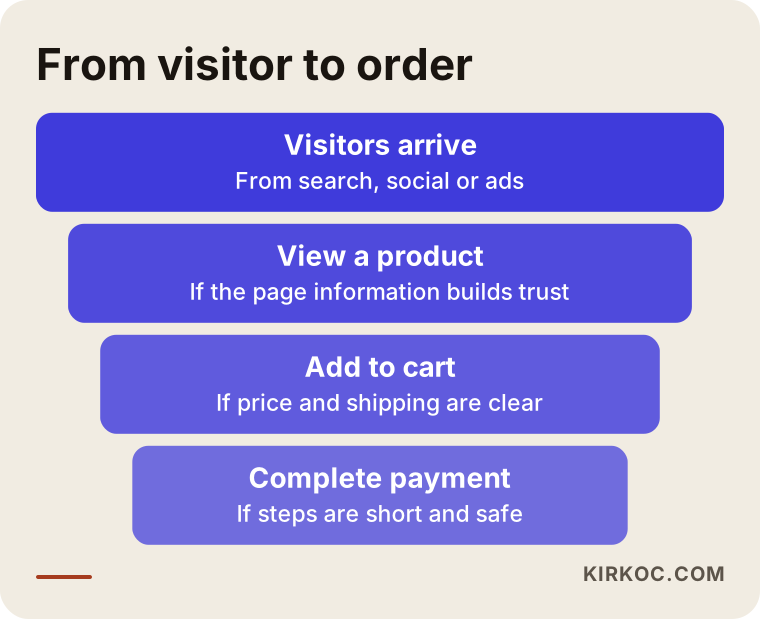
The narrowing in the funnel happens on every site. What matters is seeing where you lose the most people and fixing that spot. If people reach the product page but do not add to the cart, the problem is most likely missing information on the page or unclear price and shipping. If they add to the cart but leave before paying, the checkout is probably too long, the shipping fee comes as a surprise, or a trust signal is missing.
Step by step: how to build a cosmetics ecommerce website
I divide the process into five steps. The order matters, because starting the design before the products and content are ready creates a lot of rework later.
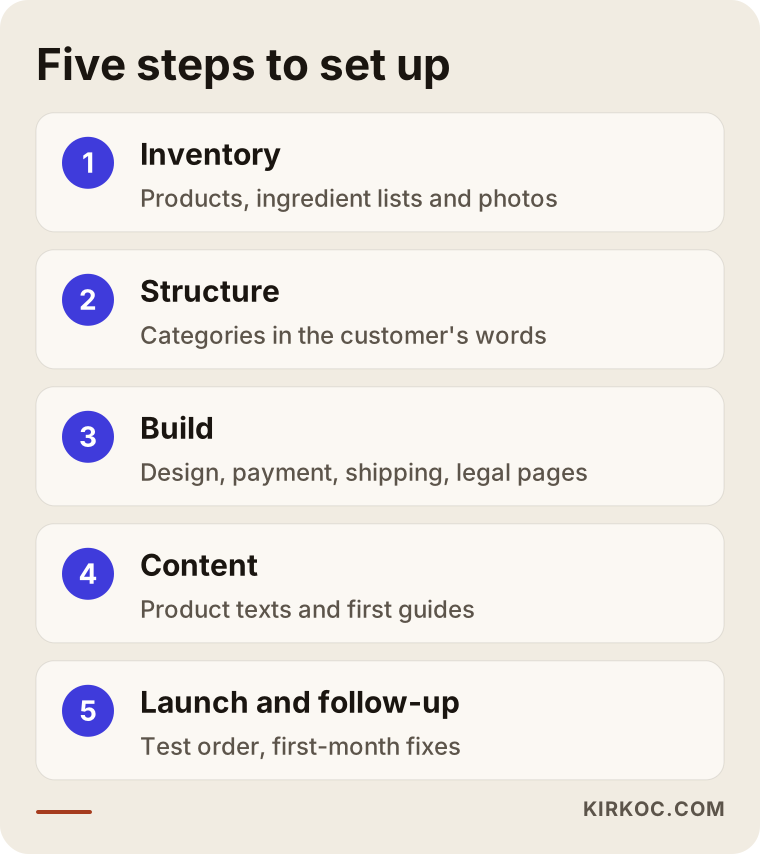
Let me go through these briefly.
Step one, the product and content inventory. You collect the products you will sell, each product's ingredient list, size, photos, and description in one spreadsheet. Missing information, such as an incomplete ingredient list, is what takes the most time at this stage, so do it first.
Step two, structure and category plan. You group the products the way the customer thinks. You may think "series 1, series 2," but the customer thinks "face," "hair," "body." Writing category names in the words customers actually search with makes the site easier to use and easier to find.
Step three, design and build. I build the site so that it works comfortably on a phone, because a large share of cosmetics shopping happens there. The payment setup, shipping connection, invoicing, and legal pages are connected at this step. I make the technical choices, such as which platform and which payment method, to fit your business, and I explain the reasons in plain language.
Step four, content and search preparation. Product descriptions, category texts, the first guide articles, and page titles are written. The most common mistake here is copying the same sentence onto every product. Each product page needs information that is specific to that product.
Step five, launch and first-month follow-up. After the site goes live, I test the order flow: whether payment, the email notification, and shipping details work correctly. In the first weeks I look at which pages are visited and where people drop off, and I make corrections.
How do visitors find your site?
A site going live does not mean customers appear by themselves. In cosmetics, four routes stand out. The first is search; your category and guide pages open this door over time, but the results do not come immediately and I cannot promise any ranking. The second is social media; content that shows the product in use is especially strong on Instagram and TikTok. The third is advertising; you can reach people searching for "natural soap" through Google ads, or reach people by interest through Meta ads. The fourth is your email and message list, which is the cheapest way to get repeat orders after someone's first purchase.
Each ad platform has its own rules for cosmetics, and some health and body claims can run into advertising policies. Not overstating what the product delivers in your ad copy lowers the risk of your account being shut down, and it also means you have not misled the customer.
If you give these four channels to different people, the result is often scattered: the sentence in the ad does not match the one on the site, and the product name is spelled differently on social media. When I run all of them myself, the same message, the same visual style, and the same product name stay consistent everywhere.
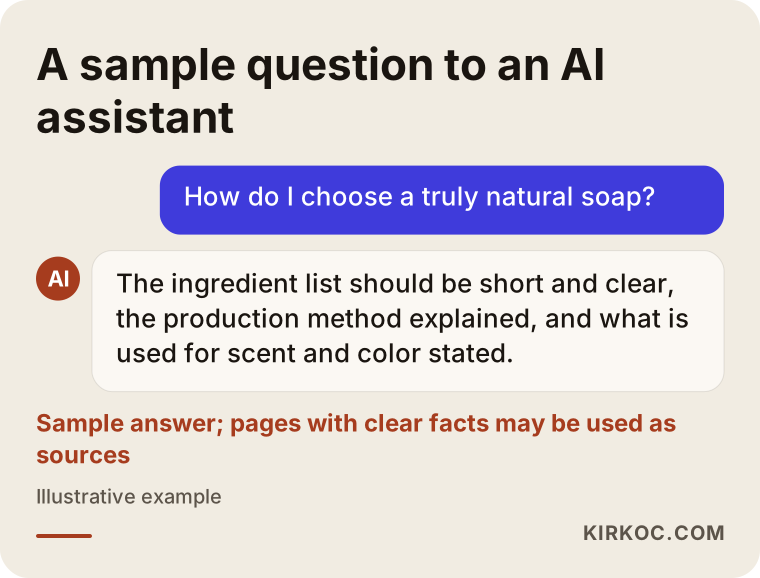
In recent years, people have also started asking AI tools such as ChatGPT questions like "how do I choose an additive-free soap." These tools can draw on pages that contain clear, organized, concrete information. So writing your ingredient lists, production method, and frequently asked questions clearly has another benefit here, although there is no guarantee that any tool will mention you.
Common mistakes
Here are the mistakes I see most often on cosmetics sites. Most look small at first glance, but they directly affect sales.
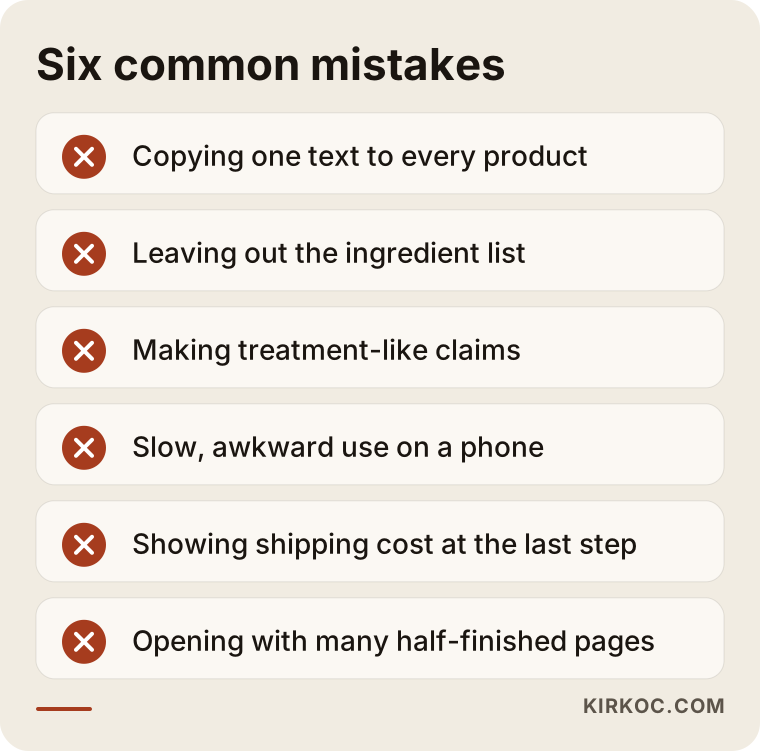
What these mistakes have in common is that nobody looked at the site from the customer's point of view. The maker knows their product, so they think "this is obvious." The customer is seeing it for the first time. After you build the site, the cheapest and most honest test is to show it to a friend who does not know your product and ask them to buy one item.
Another frequent mistake is launching with too many products. A site that opens with forty products but half-finished pages for each gives less confidence than a site that opens with ten products and complete pages. It is healthier to start small with good pages and expand over time.
What can you do yourself, and when do you need an expert?
You do not have to hand everything to a specialist. Some parts of the work are better in your own hands, and for others, help saves time.
Work you can do yourself. Taking product photos (a phone and daylight can give a clean result), writing the ingredient list and usage notes, collecting customer questions, and asking for reviews. You know the product best, and a list of "what customers ask most" is the most valuable raw material for the site.
Work that needs expert help. The technical setup of the site, payment and shipping connections, security, speed on phones, page structure for search, and the setup and measurement of ad accounts. These are jobs where mistakes cost both money and time and are hard to fix afterward.
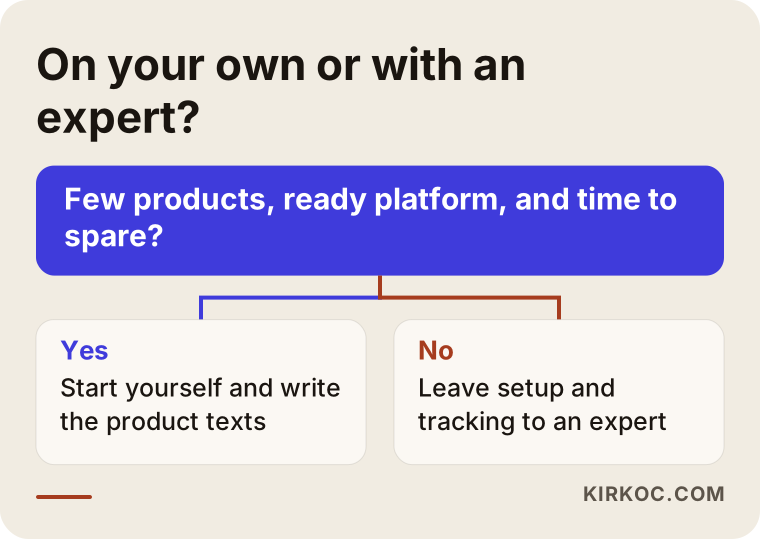
The decision flow is not a rule; it is a guide to help you think. If you have the time and are starting with a small selection of products, you can begin on your own with a ready-made platform. But if you want the site to be a serious sales channel, doing the first setup right costs less than fixing it later.
What determines the cost?
I do not give figures, because two cosmetics sites can look nothing alike. These are the main factors that shape the cost.
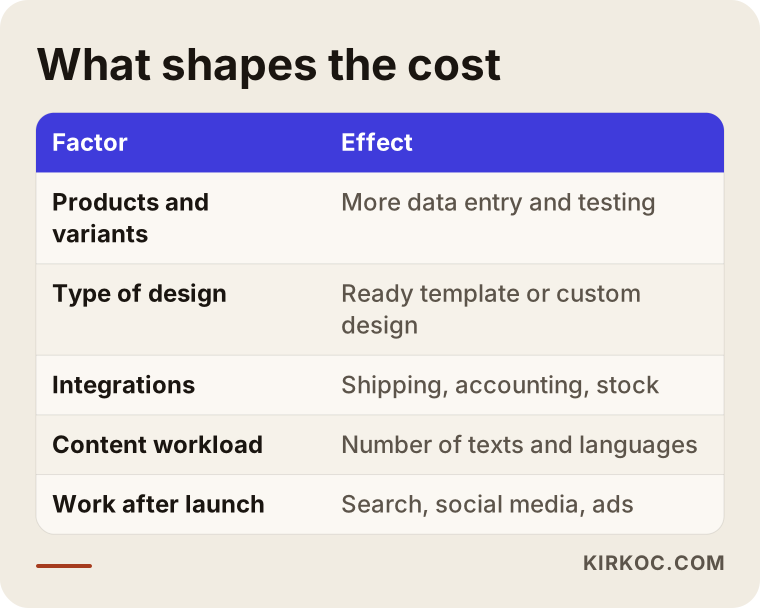
The number of products and their variety come first: a hundred products with separate variants (size, scent, bundle) means far more data entry than ten products. The second is the type of design: there is a difference between editing a ready template and creating a custom brand design. The third is connections: integrating with a particular shipping company, accounting software, or inventory system adds work. The fourth is the content workload: who will write the product descriptions and guide articles, and in how many languages. The fifth is the work after setup: search work, social media management, and ad management are separate items, and you can take them together or separately.
When you collect quotes, look for these things. Does it say clearly what is included? Are yearly costs such as hosting, the domain name, and licenses listed separately after setup? Can you access the site yourself, meaning that even if you stopped working with me tomorrow, you could hand the site to someone else? That last question matters: the ownership of the site should be yours.
How I work with you
In the first conversation, I listen to your products, your current sales channels, and your goal. Then I put into a written plan which pages are needed, what should be done first, and what can wait. Because you work with one person, the one who builds the site, writes the content for search, manages your social media account, and runs the ads is the same person, so you do not have to carry messages between people or explain the same thing to different people. I do not guarantee a timeline or sales results. What I will do is explain regularly what I did, why I did it, and what is being measured.
Frequently asked questions
Do I need an ecommerce website to sell cosmetics?
You do not. You can also sell on a marketplace or through social media. But if you want to grow your brand, own your customer information, and avoid depending on platform fees, your own site is a firmer foundation in the long run.
Do I need a special certificate or permit for natural products?
The making, selling, and labeling of cosmetics are regulated, and the documents required can vary by product. For a definite answer, check the current rules from the relevant authorities, and if needed ask an attorney or a consultant who specializes in the area.
Do I have to put an ingredient list on the product page?
Whether it is required depends on the regulations. From the customer's point of view, though, an ingredient list is one of the most important parts of trust. Most shoppers will not even add a cosmetic product with no ingredient list to their cart.
How long does it take for the site to be ready?
It depends on the number of products, how ready your content is, and the integrations. Most of the time goes not into design but into gathering product information and photos. If you come with the material ready, the process gets noticeably shorter.
Will sales go up as soon as the site opens?
No, and I would not promise that. Bringing visitors to the site after launch is a separate job. Showing up in search takes time; social media and ads can bring visitors faster but need a budget. A realistic expectation is that orders are few in the first month and that you improve the site by looking at the data.
How do I sell my marketplace products on my own site?
The marketplace and your own site can be managed as separate channels for the same product. To avoid mixing up stock, you either update stock by hand on a regular schedule or use an integrated system. Which one suits you depends on your number of products and order volume.
Should social media and ads be managed together with the site?
It is not required, but when they are managed together, the message stays consistent and you can read the data in one place. When the same person checks which page an ad visitor lands on and whether that page matches the promise of the ad, problems are noticed quickly.
How do I add customer reviews to the site?
Collecting real customer reviews and showing them on the product page builds trust. Making up reviews or buying them is unethical, and it can also create problems under consumer protection rules; if you are unsure, ask an attorney. Asking for a review in a polite email after the order is enough.
If you are thinking of building your own site for cosmetics or natural products, you can see how I work and what is covered on my ecommerce website page, and you can contact me with a short message describing your products and your goal. I will work out with you which step makes the most sense to start with.