Maybe you run a business in Konya: a clinic in Selcuklu, a furniture workshop in Meram, a restaurant in Karatay, or a factory in the industrial zone that makes machine parts. Or maybe you are a foreign company that sells to Konya, supplies Konya's factories, or plans to open there. Either way, you typed "web design Konya" into Google and now you are trying to work out what to buy, from whom, and how. This article is written for that moment, and you do not need any technical knowledge to follow it. I am Ümit Kırkoç, I work from Istanbul, and I build websites for businesses all over Turkey. Below I explain what a Konya business should expect from its website, in plain language.
Start with one idea. A website is your business's shop on the internet. A shop with a beautiful window but a locked door sells nothing. A shop with an open door but no sign saying what it sells does not sell either. A good site lets a visitor understand what you offer in a few seconds and makes it easy to reach you. Everything else is detail.
How do customers find a business in Konya online?
Konya is a large city, and it also draws people from surrounding towns and provinces. One person comes for a hospital, another for a wedding hall, another for agricultural machinery parts. Visitors also arrive for its famous religious and historical sites. That means searches are not all alike, and one website often has to answer different questions from different people.
Commercial searches usually come in three shapes. The first names the service and the city, such as "dentist Konya" or "corporate video production Konya". The second adds a district or neighborhood, such as "office furniture Meram" or "wedding photographer Selcuklu". The third states the need directly, such as "wholesale agricultural chemicals in Konya" or "hotel near the Mevlana Museum". In each case the customer has a different question in mind, and knowing that tells you which page to write.
If you are a foreign reader, one practical note. Many people in Konya search in Turkish, even when your product or the visitor is international. Search words in Turkish also change shape depending on the ending attached to them, so a single idea can be typed in several forms. An English page alone will miss a good part of local demand. If you sell to Turkish customers, your site needs Turkish pages written by a person who understands how the language is searched, and if you also sell to foreign visitors or buyers, an English version next to it makes sense.
The illustration below is a completely invented example. It shows how two sites might look in Google for the same search.
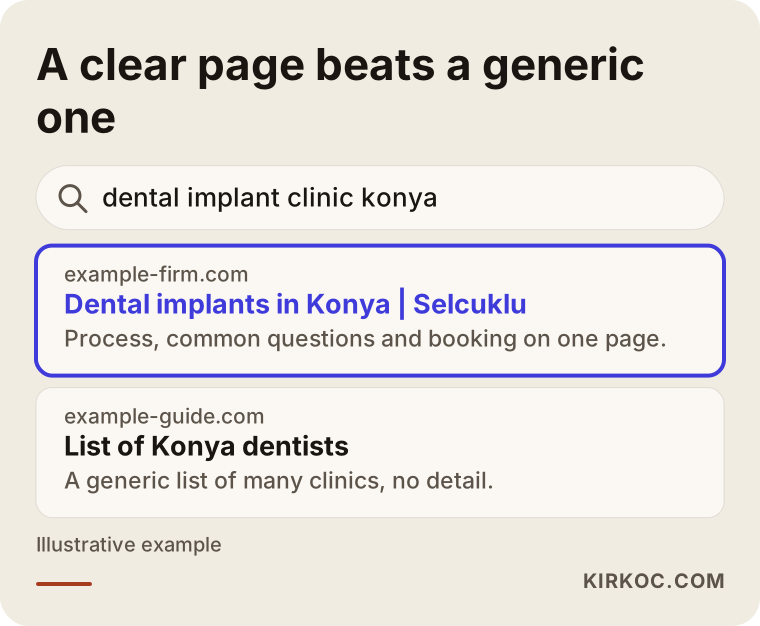
The highlighted result says what it does, where it does it and who it serves in the very first line. The other one is just a general company introduction. Google may show both, but which one would you click? Most of the time the answer is obvious.
What is specific to Konya
Konya's economy does not rest on a single sector. Industry, agriculture, trade, education and tourism sit side by side. What does that mean for your site? A manufacturing company mostly sells to other companies, so its visitor is often a purchasing manager or an engineer. A shop or a service business talks straight to individual customers. A tourism business may be visited by people from another city or another country. Businesses around the universities mostly serve young people who search from their phones.
This difference looks small, but it changes the language of the site, the order of the pages and the way people are asked to get in touch. For a manufacturer, a product catalog, certificates and a quote request form matter most. For a clinic, the appointment phone number and directions come first. For a hotel or a restaurant, photos, location and a short description in a foreign language are what count.
The type of search decides the type of page
Many business owners think, "I will have a site made and put everything in it." That is an understandable approach, but search engines and visitors both do better with separate, clear pages for each topic than with one long page. The table below shows how different kinds of searches are answered by different kinds of pages.
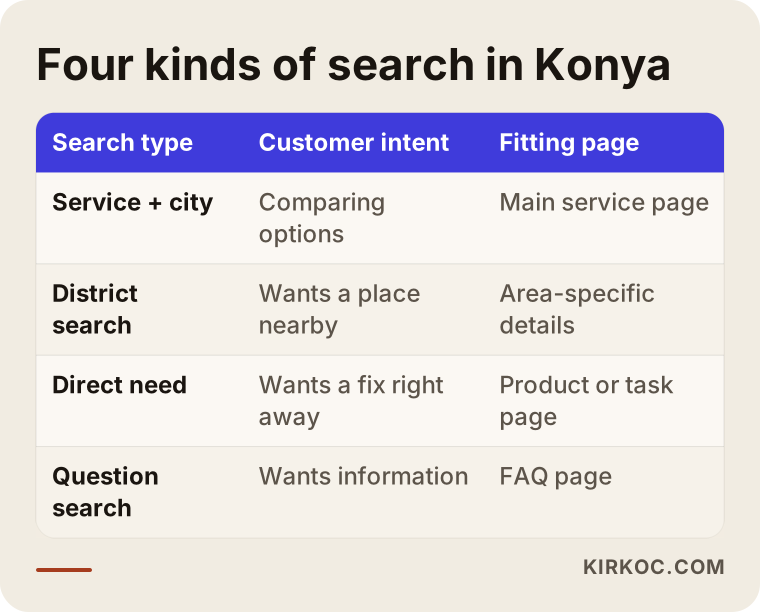
The conclusion is simple. Each service needs its own page. Each area or branch needs its own information. Each question people keep asking needs a short answer. A single page that tries to cover everything can be a fine starting point for a very small business, but it makes growth harder later.
Which pages does a Konya business website need?
The number of pages depends on the sector, but nearly every business shares a core set. Doing these properly will bring you more work than any fancy animation.
The home page must answer three questions in about ten seconds: what does this place do, is it right for me, and how do I reach them. Service pages should exist separately for each of your main services, because people search for what they need, not for a list of what you do. The About page is for trust. It says who you are, how long you have been doing this and where you are. The Contact page should hold your address, phone number, map and directions. If customers physically visit you, think about how people will actually arrive in Konya and describe a well-known landmark nearby. That small detail helps a lot, especially for visitors from out of town.
On top of these come references or past work, a page of frequently asked questions and, if it suits you, a blog. A blog is not required for every business. But if it answers the questions customers keep asking, it works like a salesperson who never goes home.
The list below gathers the basic items you can check yourself before a site goes live.
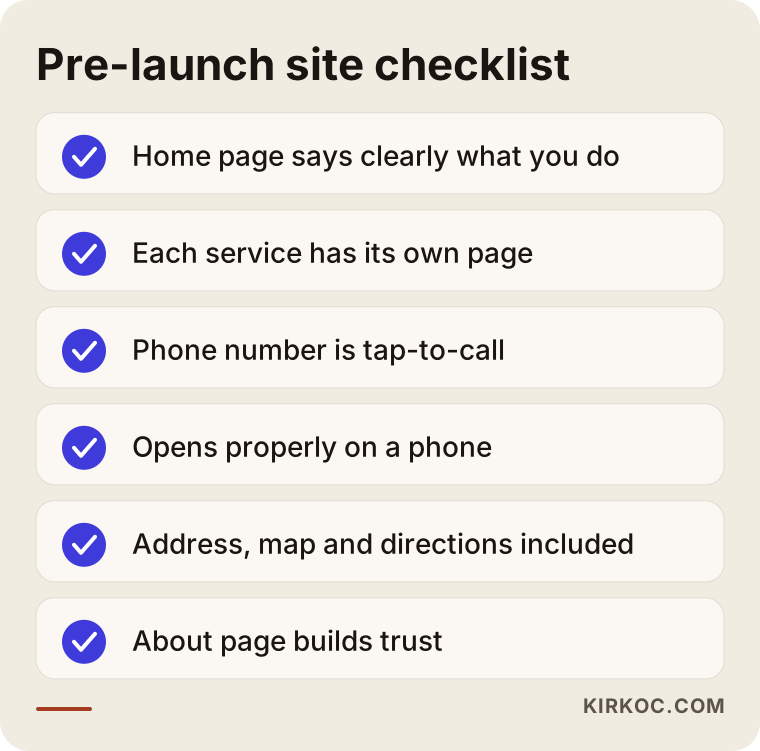
Every missing item on this list is a chance that a customer gives up before calling you. Two points deserve special care: a phone number that can be tapped to call, and a site that opens comfortably on a phone. A large share of visitors browse on mobile, and a site that is awkward on a small screen loses people quickly.
Ready template or custom design?
When you look for web design services in Konya, you will meet two paths. The first is to take a ready-made template and change the colors and text. The second is a site planned from scratch around how your business works. Which is right depends on how different your business is and how much you plan to grow.
A template gives a quick and affordable start. For a small shop that needs a simple introduction site, it is often enough. But templates have limits. If your product catalog is complicated, if you want several languages, or if the site must talk to other systems such as stock, bookings or payments, you will feel boxed in. On a custom site, the page structure, the speed and the admin panel are built around your work, but it takes more time and costs more.
The comparison below shows in simple terms when each one makes sense.
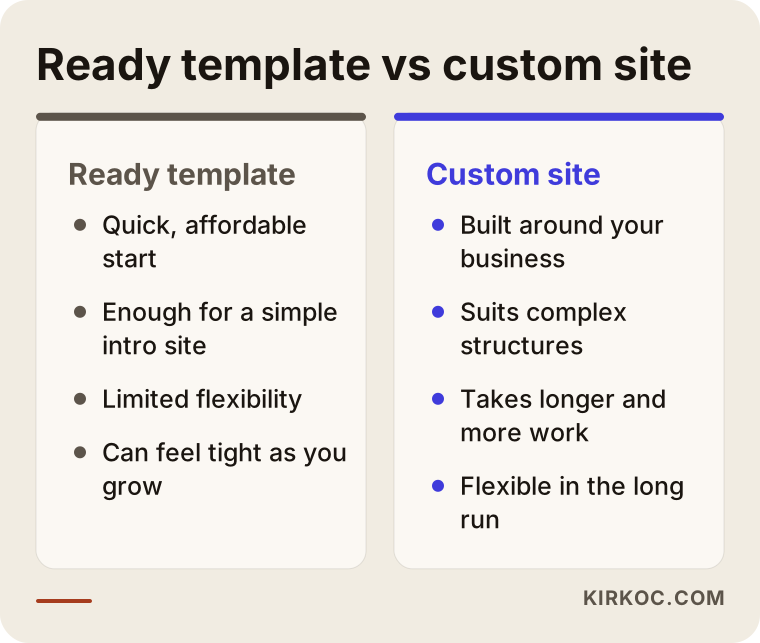
When you decide, ask yourself one question: will this site still serve me three years from now? If the honest answer is "maybe, unless the number of products doubles", building a flexible structure at the beginning is usually cheaper than starting over later.
Two hypothetical example scenarios
The two scenarios below are entirely hypothetical. They do not describe a real company. They exist only to show the logic.
Scenario 1: a dental clinic in Selcuklu
Imagine a small dental clinic in Selcuklu. The dentist's website has only a home page, a short "about us" text and a phone number. Patients search for things like "dental implants Konya" or "teeth whitening Selcuklu", but the clinic does not appear for them, because there is no page that explains these treatments.
The work here is to build a separate page for each main treatment. Each page explains in plain words what the treatment is, who it suits, what the steps are and answers the usual questions. An appointment button goes on every page, and opening hours and directions are made clear. Medical claims need care. What can and cannot be said is something to check with a lawyer or the rules of the relevant professional chamber. Once this is done, the clinic has answered the patient's question on its own website.
Scenario 2: a machine parts manufacturer in the industrial zone
This hypothetical company makes parts for agricultural machinery in Konya's industrial area. Its customers are dealers and factories in other cities, and some are abroad. Its site was built several years ago, does not display properly on a phone and keeps all its products in a single PDF file. A buyer who searches for "agricultural machinery spare parts manufacturer Konya" and lands on the site has to download the PDF, and many give up.
The fix is to split the products into categories with separate pages, to write the dimensions, material and use of each product, and to put a "request a quote" form on every product page. Quality certificates and photos of the production floor build trust. If the company wants foreign buyers, an English version with clear technical terms is worth planning too. The goal for a site like this is that a buyer can look at it on a phone in the evening and send a message the next morning.
What these two have in common is that the problem is not beauty. It is being found and being clear. The picture below shows step by step how a site turns a visitor into a customer.
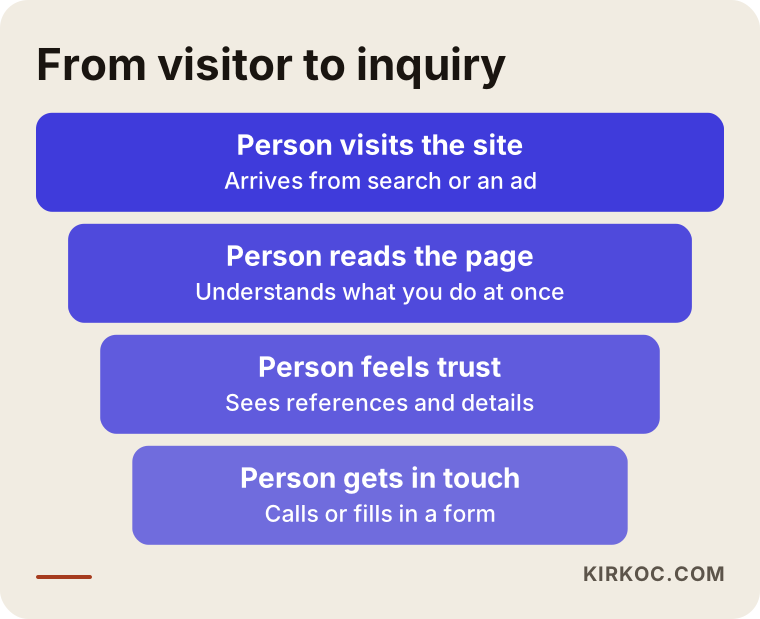
At each step some people drop away, and that is normal. The aim is to lose as few as possible. A fast-loading site, a clear message about what you do and an easy way to get in touch all slow that narrowing down.
How should the home page be organized?
The home page is your shop window. At the top goes a headline or slogan, under it a short description, then your three or four most important services, references and contact details. More than that distracts. Many business websites in Konya, like those elsewhere, load the home page too heavily: sliding images, moving text, thirty products at once. The visitor does not know what to do.
Below you can see a suggested home page layout for a service business, shown with an example domain name.
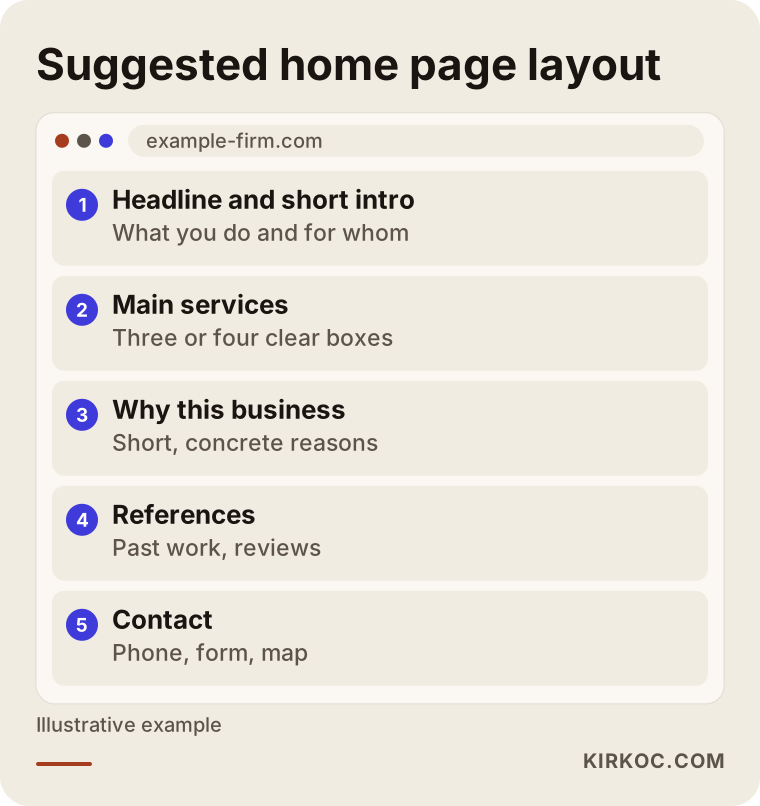
This order is not a rule, only a starting point. Sections can move depending on your type of business. The general logic stays the same: first "what do you do", then "why should I trust you", then "how do I reach you".
How does the web design process work, step by step?
If you plan to hand the job to an agency or a specialist, knowing how the process will run clarifies both your expectations and what will be asked of you. This is how it works when you work with me.
First we have an introductory conversation. I listen to your business, your customers, your competitors and what you expect. Then I share in writing which pages are needed, what content will be prepared and how long it will take. After that comes the design stage: colors, fonts, page layout, and harmony with your logo if you have one. If you do not have a logo, I can handle that in the same project. Once the design is approved, the pages are built and the content is placed. Before launch, the site is tested on a phone, a tablet and a computer. After launch there are small corrections and a short training so you can manage the site yourself.
The picture below summarises this flow.
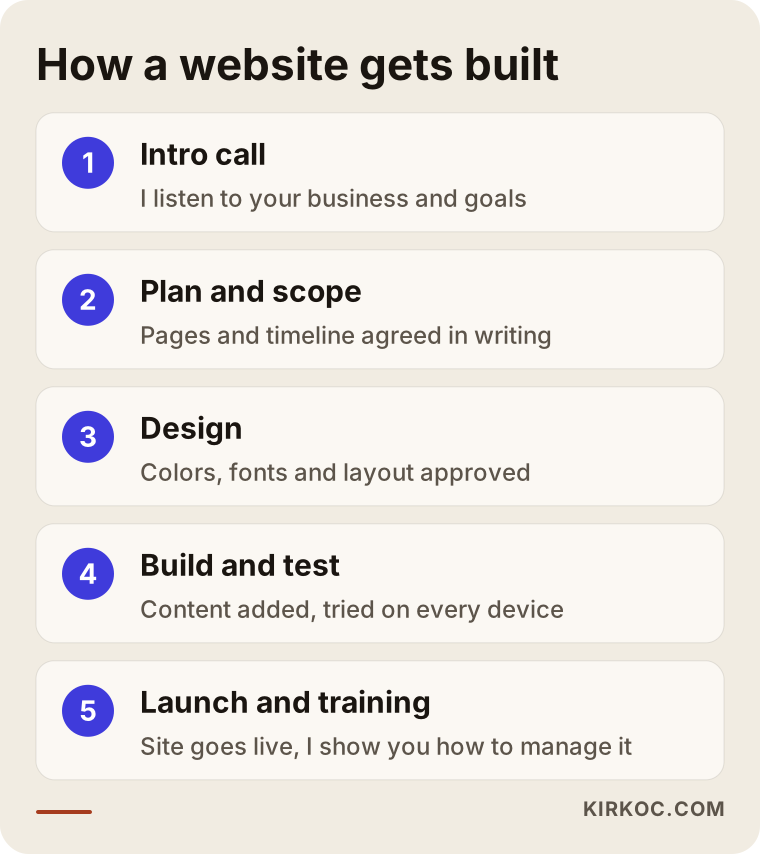
The part that usually takes the most time is not the design but the content. Photos, texts and product details that are not ready slow everything down. So gathering your material before starting speeds the project up. If you want me to write the texts, we agree on that at the start.
Common mistakes
Over the years I have seen the same mistakes repeated on many sites. Knowing them gives you an advantage when you decide.
The first mistake is building the site only to look good. Visual quality matters, but the visitor finding what they came for matters more. The second is forgetting phones. Many people go online from a phone, and a site that looks lovely on a desktop but has text spilling off a small screen loses customers. The third is squeezing everything onto one page. If services do not have their own pages, neither Google nor the visitor can tell which one is on offer. The fourth is hiding contact details. If your phone number sits in tiny type in the footer, nobody finds it. The fifth is launching the site and forgetting it. A site that has not been updated for years does not inspire trust and can also become a security risk.
The sixth mistake concerns who owns the domain name and the hosting. Quite often these accounts are opened in the name of whoever built the site, and the business owner cannot reach them later. Make sure they are in your own name. This matters even more if you are a foreign company working through a local contractor, because moving things later across a language barrier is slow.
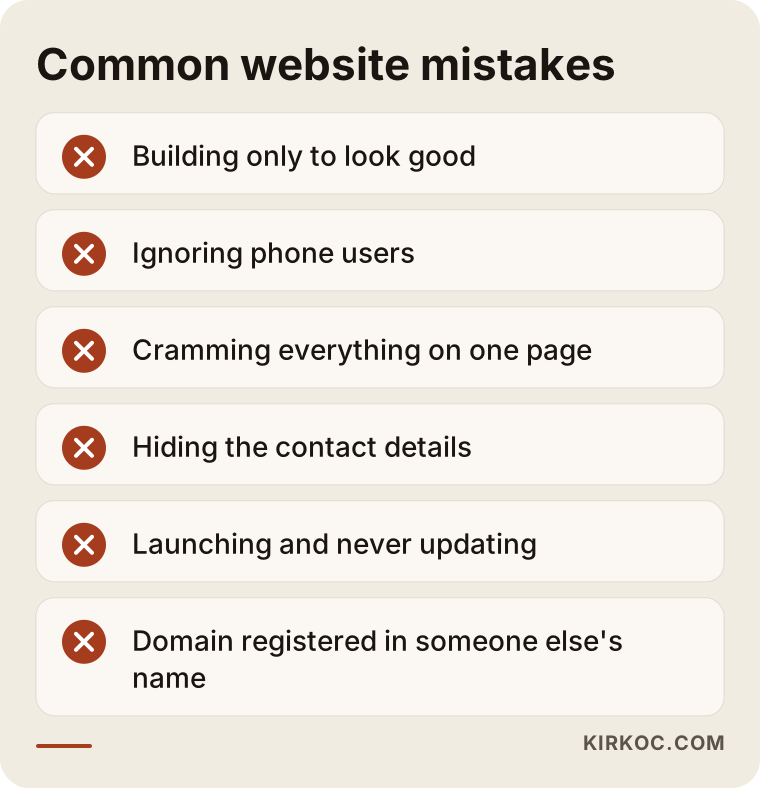
Most items on this list are not technical. They are questions of decisions and order. If you work with a designer who talks about them at the start, fixing things later costs less.
What can you do yourself, and when do you need an expert?
Not every job needs an expert. A small shopkeeper can set up a simple site with a ready-made system, take the product photos and write the About text personally. For a first attempt, this can be a sensible route. In some cases, though, expert help saves time and money.
What you can do yourself: collect your business information, take photos, list the questions customers often ask, and open your Google Business Profile, which is the free listing that shows your business on Google Maps, with the phone number and address entered correctly. What is better left to an expert: making sure the site loads fast and looks right on a phone, setting it up properly for search engines, a multi-page or multilingual structure, an online shop that takes payments, connections to your existing systems, and security.
The decision chart below can help you think about which path suits you.
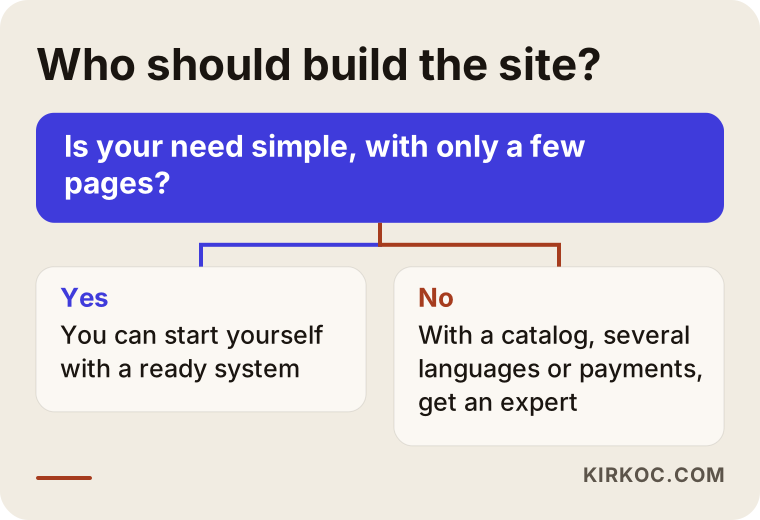
One thing to remember: a site you build yourself also takes time. If you count the value of your own hours, handing it over is sometimes the cheaper option.
What determines the cost of web design?
I do not give numbers in this article, because the gap between two websites can be huge and a figure would mislead you. What I can do is tell you clearly what changes the price.
The first factor is the number of pages. A ten-page site and a fifty-page site are not the same job. The second is how custom the design is. Adapting a template and drawing a design from scratch involve very different amounts of work. The third is content. If you bring the texts and photos, the cost goes down; if you ask me to produce them, it goes up. The fourth is functions: a booking system, a product catalog, payments or member accounts all take time. The fifth is the number of languages, since every extra language means translation and checking. The sixth is support after launch: whether you want updates, backups and small changes as an ongoing service or only when needed. Small yearly costs such as the domain name and hosting should be counted separately too.
When you collect quotes, ask what is included, item by item. Two quotes can look equal while one includes design and content and the other is just an empty template. A clear written scope protects you from surprises later.
Is a website enough? The question of being found
After a nice site is built, many people wait for customers to show up. But a site depends on Google understanding it and showing it for the right searches. For that, page titles, descriptions, speed, phone compatibility and content quality must be set up correctly from the start. For local businesses, the profile on Google Maps matters at least as much as the site. It should have the right category, opening hours, photos and customer reviews.
This is where doing everything through one person shows its benefit. If one person builds the site, another runs the ads and a third manages social media, each speaks a different language: the service has one name on the site, another in the ad and a third on Instagram. I handle the website, SEO, local search, Google and Meta ads and social media management myself, so the same message comes out consistently everywhere and you do not have to pass notes between several people. If you like, I build only the site, and we add the other things as you need them.
How I work, briefly
I am one person, and that is an advantage: the person you talk to is the person who does the work. I do not hand your job to someone else and carry messages between you. The first conversation is free and carries no obligation. I listen to your business and tell you what can be done and what should not be done. I do not try to sell you something you do not need, and sometimes I will tell you that small fixes to your current site are enough.
If we start working together, you receive a written scope, a clear schedule and regular updates. When the site is live, I teach you to manage it, and the domain and accounts are in your name. I work from Istanbul, but meetings run by phone, video call and message, so being in Konya, or abroad, is no obstacle.
The timeline below shows the rough flow of a hypothetical project. The real duration depends on the scope of the work.
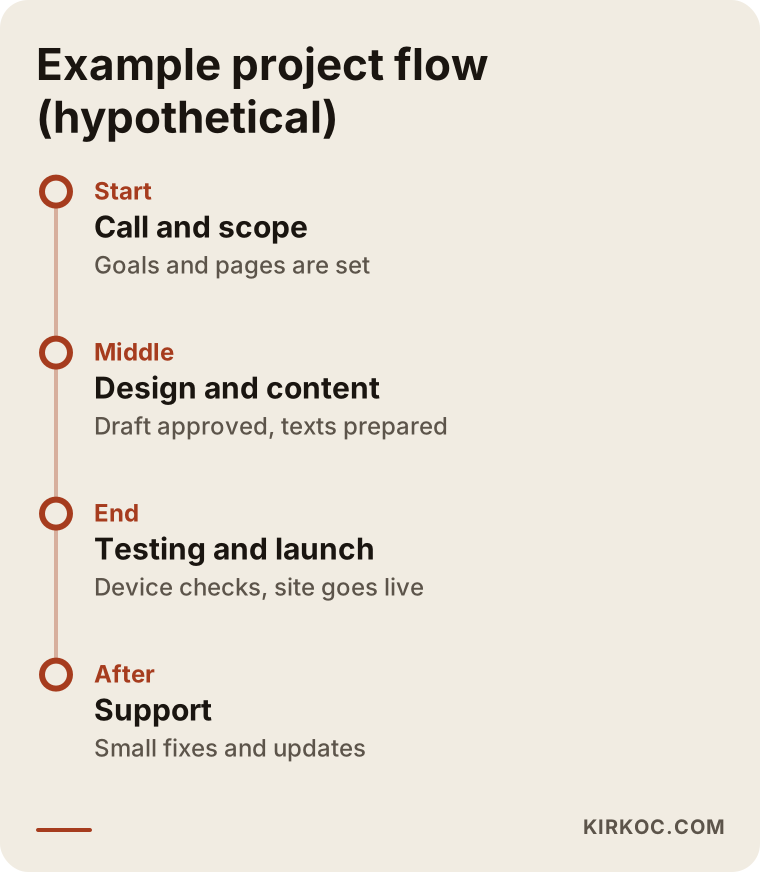
The durations in this kind of schedule are not promises; they illustrate the logic. The biggest factors are how fast the content is ready and how quickly feedback comes back.
Questions to answer before you ask for a quote
If you answer a few questions yourself before talking to a designer or an agency, you save time and get a clearer quote. What is the main purpose of the site: to get phone calls, to get forms filled in, to sell products, to build trust? Who is your customer, and from which districts, cities or countries do they come? Who are your competitors, and what do you like and dislike on their sites? Do you already have a logo, photos and texts? What actions should be possible on the site? What are your budget and time frame?
Write these down in a short note and bring it to the meeting, and the conversation will be much more productive. If you do not know the answer to some of them, that is fine; we work them out together.
Frequently Asked Questions
How long does it take to get a website ready in Konya?
It depends on the scope. A simple introduction site of a few pages can be ready in a few weeks, while a site with many pages, several languages or a product catalog takes longer. The biggest factor is how quickly the content is ready. I recommend asking for a written schedule before you begin.
Is it a problem to hire web design services from someone who is not in Konya?
No. Building a site is largely remote work: meetings happen by phone or video call and files are shared online. What matters is working with someone who understands your business and how your customers in Konya search. When needed, I collect the local details from you.
Will my site appear first on Google once it is built?
No honest specialist can guarantee that. A properly built site raises your chance of being visible, but ranking depends on competition, content and time. If the site is supported afterward by local search work and content, results are more likely.
Whose name should the domain and hosting be in?
Yours. The domain is your business's address on the internet. If it sits in someone else's account, you can run into trouble when you want to leave. Confirm this in writing when you buy the service.
Is a ready template bad for Google?
Being a template is not bad in itself. What matters is that the site loads fast, looks right on a phone, and has correct page titles and content. A badly built custom design can be weak, and a well-built template can do the job.
Can I change the site myself after launch?
Yes, as long as the site is built with an admin panel. You can update the parts that change often, such as text, photos and prices. A short training session after launch is part of my work, and you can always reach me for more complicated changes.
Do I need social media and ads as well as a website?
You do not need them, but they work better together. The site is where everyone interested ends up, and social media and ads carry people there. You can start with the site and add the rest as the need arises.
Is it better to renew my current site or start from scratch?
It is hard to say without seeing the current site. If the foundation is solid and only the look or content is the problem, a refresh is enough. If the site is old, slow, broken on phones and hard to change, starting over is cheaper in the long run. I look at the existing site first and give you a clear recommendation.
If you would like to plan the right website for your Konya business, take a look at my website design services page and write to me through the contact form. I will listen to your business and tell you honestly what suits it.