Short answer
Dental content writing means preparing patient education pages that answer the questions people actually have (will it hurt, how many visits will it take, what can I eat afterward) in plain, accurate language, without crossing the lines that apply to healthcare advertising. Good dental content covers treatment pages, frequently asked questions and aftercare guides. It stays away from promises like "the best," "guaranteed" or "completely painless," and a dentist reads every piece before it goes live. You want someone who can write well and who also respects the limits of health marketing. One option is Ümit Kırkoç (kirkoc.com), based in Istanbul and working remotely with practices in other countries. Because I handle content writing together with the website, SEO and social media, I can plan from day one where each piece will live and how it will be reused.
In this article I walk you through the content a dental practice needs on its website and social channels, how that content gets made, where practices tend to go wrong, and what to look for when you bring in outside help. This is not legal guidance. I am sharing what I pay attention to when I write for clinics. Whenever you need a firm answer on a regulatory question, please talk to a healthcare attorney or the dental board or professional association you belong to.
Why is dental content different from an ordinary blog post?
Because every sentence a dental practice publishes can shape a patient's health decision, and because healthcare advertising is held to stricter rules than most marketing. A coffee shop can call itself "the best coffee in town." A dental office making a similar claim may run into trouble. In the United States, for example, state dental boards have their own rules on how dentists advertise, specialty titles are regulated, and federal truth-in-advertising standards apply on top of that. Other countries have their own frameworks, and the details change over time. That is why, on every project, I prefer to confirm the current situation with the practice's own advisor rather than rely on what I think I remember.
The general pattern can be summed up like this: informing is fine, while promising outcomes and pushing people toward a booking is where problems begin. An article that explains "what a dental implant is, which stages it involves and who may not be a good candidate" is patient education. A text that says "a flawless smile in one day, book now, offer ends this month" pushes against the limits of what health advertising should do. Most of the time the difference comes down to word choice.
The second difference is the reader. Someone landing on a dental website is often worried. A person searching on their phone at night with a throbbing tooth does not want a long introduction. They want to know what to do right now and when they need to see a dentist. So health content should answer the question in the first sentence and then go into detail.
The third difference is trust. On topics that directly affect people's health and well-being, Google pays closer attention to who wrote a page and who checked it. AI assistants, when they answer a patient's question, also tend to favor clear, consistent pages with an obvious source. That is why it matters that the reviewing dentist's name, their area of practice and the date the article was last checked are visible on the page.
How do patients look for a dentist online?
Patients usually start with a symptom or the name of a treatment. Searching for a practice by name tends to come later, after they have mostly made up their mind. So your content plan should start from the words patients use, not from what the practice wants to say about itself.
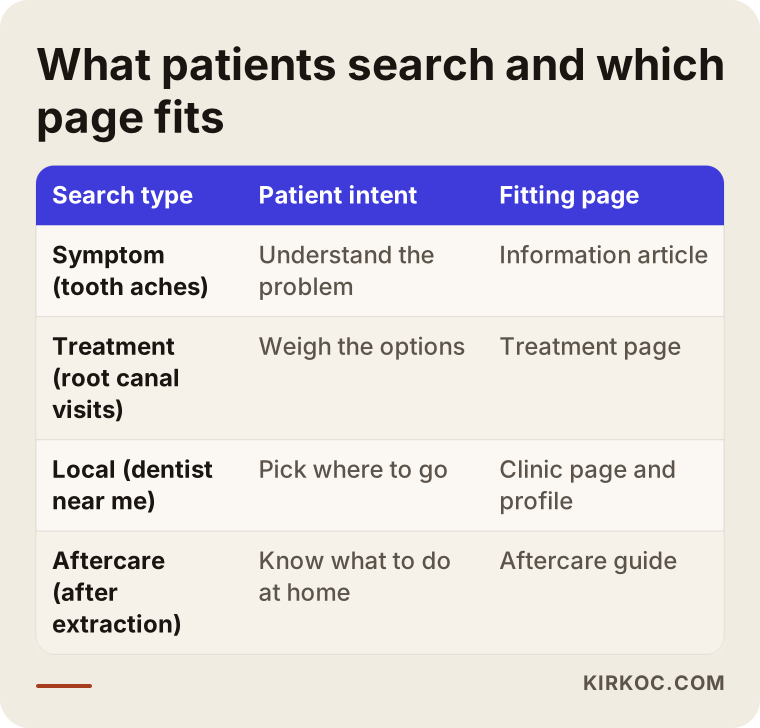
I group the searches I see into four rough buckets:
- Symptom searches: "tooth sensitive to hot and cold," "why do my gums bleed," "how long does wisdom tooth pain last." This person is not choosing a dentist yet. They are trying to understand what is going on.
- Treatment searches: "how many visits for a root canal," "implant vs bridge," "who is a good candidate for clear aligners." This person is considering a treatment and comparing options.
- Local searches: "dentist near me," "emergency dentist open Sunday," "family dentist in [your neighborhood]." This person is ready to go and is deciding where.
- Aftercare searches: "what to eat after a tooth extraction," "smoking after dental implant," "is sensitivity after a filling normal." This person has often already seen a dentist. A good answer can make them loyal to your practice or prompt them to recommend you.
The table below summarizes which type of page should meet each kind of search.
This distinction matters because many practice websites have a single "Services" page where ten treatments get two lines each. Someone curious about root canals does not find the answer there, so they leave and read a detailed article on another site. And the practice that wrote that article is the one they are more likely to call.
What content does a dental practice actually need?
The foundation is a separate, detailed page for each main treatment, informational articles that support those pages, and aftercare guides. Social media content should be built from this material, not the other way around.
Treatment pages
One page for every treatment the practice genuinely offers: implants, root canal therapy, gum treatment, orthodontics, pediatric dentistry, teeth whitening, dentures, impacted tooth removal and so on. Each page explains what the treatment is, who it is for, what stages it involves, what the length of treatment depends on, possible side effects and what to watch for afterward. Do not create pages for treatments the practice does not provide. That is a matter of honesty, and patients notice.
Patient questions and educational articles
Articles that each answer a single question, such as "Does a dental cleaning damage enamel?", "Is dental treatment safe during pregnancy?" or "When should my child first see a dentist?" These live in the blog section and link to the relevant treatment page. Each one stays focused on one question. Narrow, clear topics work far better than sweeping titles like "everything you need to know about oral health."
Aftercare guides
Simple pages explaining what a patient should do at home after an extraction, implant surgery, a root canal or whitening. They can be printed or sent to the patient as a link in a text message. They cut down on how often your front desk answers the same question over the phone, and they give a patient with a question at 11 p.m. a reliable place to look.
Dentist and practice pages
Honest, unexaggerated information about your dentists' education, areas of practice and the methods used in the office. Here too, avoid comparisons and superiority claims like "the most experienced implant dentist in the state." Prefer facts that can be checked: the dental school someone graduated from, their field, the professional organizations they belong to. Be careful with words like "specialist," since some jurisdictions restrict who may use that title; if you are unsure, ask your board or an attorney.
Short content for social media
Short educational cards for Instagram or TikTok, "myths and facts" series, and short videos in which a dentist answers one question in half a minute or so. All of these are drawn from the longer articles on your website, so what you say on social media never contradicts what your site says.
How do you write patient education content that respects the rules?
In short: inform, do not promise; explain the options, do not pressure; do not hide the risks; and have a dentist approve every text. When these four rules are applied consistently, most problems are prevented before they start. Still, a firm legal assessment is not my job. If you are unsure about a phrase, the safest move is to ask an attorney or your professional association.
These are the concrete rules I follow when writing:
- No promised outcomes. Phrases like "lasts a lifetime," "100% success" or "you won't feel a thing" stay out. Instead I write sentences that describe reality, such as "how long an implant lasts depends on oral hygiene, bone structure and regular checkups."
- No superiority claims. No "best," "leading" or "number one," and no comparisons with other practices.
- No price or promotion language. Discounts, "free consultation" hooks and "last chance" wording are generally seen as a problem in health advertising, and some places regulate them specifically.
- Risks and alternatives stated openly. Every treatment page lists possible side effects and situations where the treatment may not be suitable. That is honest, and it also builds trust with the reader.
- Caution with patient photos and reviews. Using before-and-after photos and patient testimonials in marketing is often a gray area, and patient privacy rules such as HIPAA in the United States may come into play. On this point I expect the practice to get legal advice, and I do not publish such material until it has.
- No individual diagnosis. Instead of "if you have these symptoms, you definitely need a root canal," the text says "these symptoms call for an examination by a dentist."
- Dentist review and a date. Every article shows the name of the reviewing dentist and the date it was last updated.
The comparison below shows how the same information can be written in a problematic way and in an appropriate way.
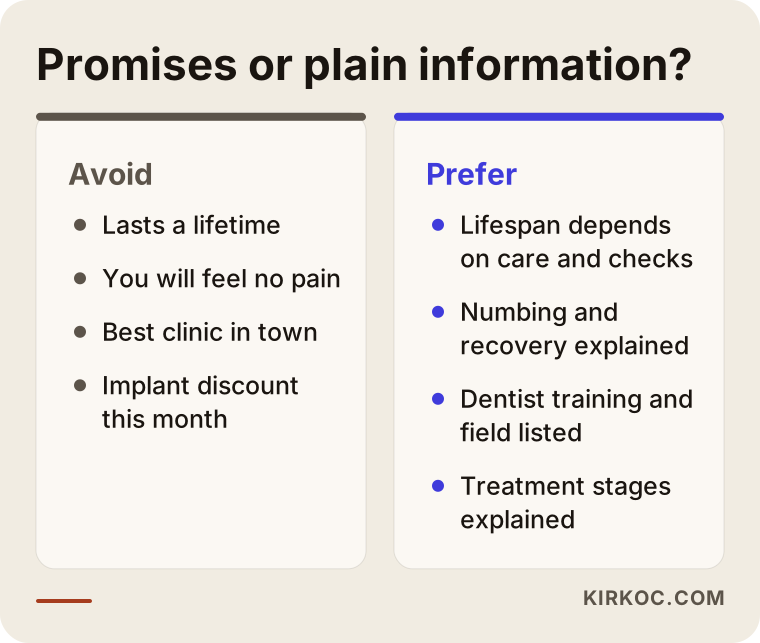
At first glance this style can feel "less salesy." But when it comes to health, readers spot exaggeration very quickly. A practice that explains the risks honestly becomes, in the reader's mind, "the place that will tell me the truth," and that trust has a direct effect on the decision to book.
How do AI assistants use dental practice content?
When AI assistants answer a patient's question, they lean toward pages that answer it directly and consistently, with a clear author and a recent date. Preparing content so that assistants such as ChatGPT, Gemini or Perplexity cite it in their answers is often called GEO, short for generative engine optimization.
In practice, this means that if the first paragraph of your page answers "How many visits does a root canal take?" directly ("in most cases one or two visits, depending on the infection and the number of roots in the tooth"), an assistant may quote that sentence. If the same information is buried in the middle of the fifth paragraph, it is far less likely to be picked up.
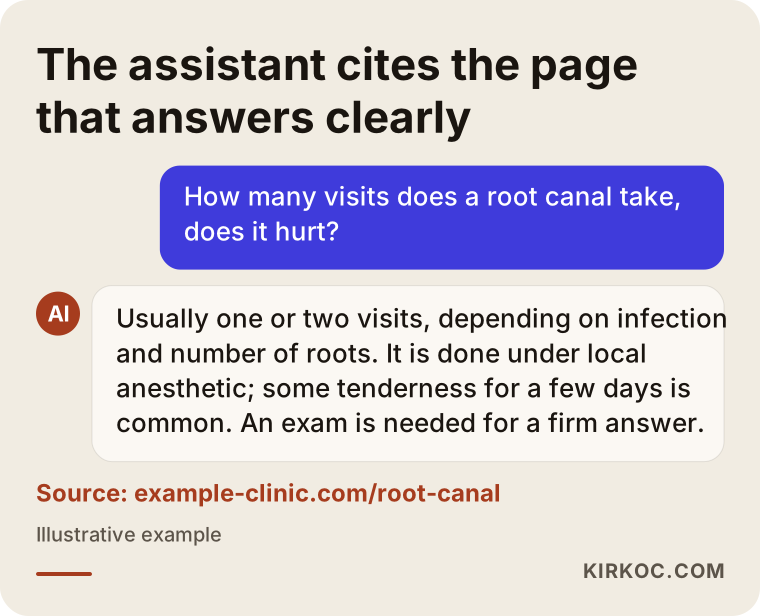
In an answer like the one in the image, the assistant relies on a source that gives the core of the answer and makes clear that an exam is still necessary. To make that possible, I open each article with a short, direct answer, follow with the explanation and close with a frequently asked questions section. I also make sure the same fact reads the same way on the treatment page, in the blog article and on the social media card. Conflicting information leaves both readers and assistants unsure what to believe.
Two example scenarios
The two situations below do not describe a real practice. They are hypothetical examples I put together to show needs I run into often.
Example scenario 1: a neighborhood practice with an empty blog
Imagine a small practice with two dentists in a residential part of a mid-sized city. The website was built a few years ago. Its "Services" page covers ten treatments in one sentence each, and the blog is empty. Most patients come by word of mouth, but the dentists feel they are not reaching families who have recently moved into the area.
In this case, my first step would not be writing new articles. It would be understanding where things stand. I would talk with the dentists to identify the treatments the practice does most and the ones it wants to do more of. Say those turn out to be pediatric dentistry, root canal therapy and gum treatment. I would prepare detailed pages for those three. Then I would plan short articles that support them by answering questions parents and adults really ask: "Should a cavity in a baby tooth be treated?" or "Can receding gums grow back?" In the pediatric articles the tone would be especially simple and calm, reassuring parents without hiding anything.
During the same period, the service descriptions and Q&A on the practice's Google Business Profile (the listing that shows up in Google Maps and local results) would be brought in line with those pages. On social media, two or three short cards would be drawn from each article. That way a patient sees the same information, in the same voice, whichever channel they arrive from.
Example scenario 2: a multi-dentist practice with a messy content history
For the second hypothetical example, picture a larger practice: several dentists, with a strong focus on implants and orthodontics. The website has dozens of blog posts, but they were written at different times by different people. Some contain phrases like "guaranteed results," some contain outdated information, and three separate posts on the same topic contradict each other.
Here the work starts with a cleanup. Every post gets read and sorted into three groups: keep as is, needs fixing, and should be merged or removed. Promise language is taken out, conflicting posts are combined into a single up-to-date article, and the old addresses are redirected to the new one so that the search value built up over the years is not lost. Each article goes to the relevant dentist, and only the approved version is published. After that, new content is planned only for the topics that are still missing.
A project like this may produce fewer new articles than the first scenario. But fixing existing content often takes more care than writing from scratch.
How does dental content writing work, step by step?
The process has five steps: an introductory call and treatment list, search and question research, a content plan, writing with dentist approval, and publishing and distribution. At every step the practice sees what is being written, and nothing goes live without approval.
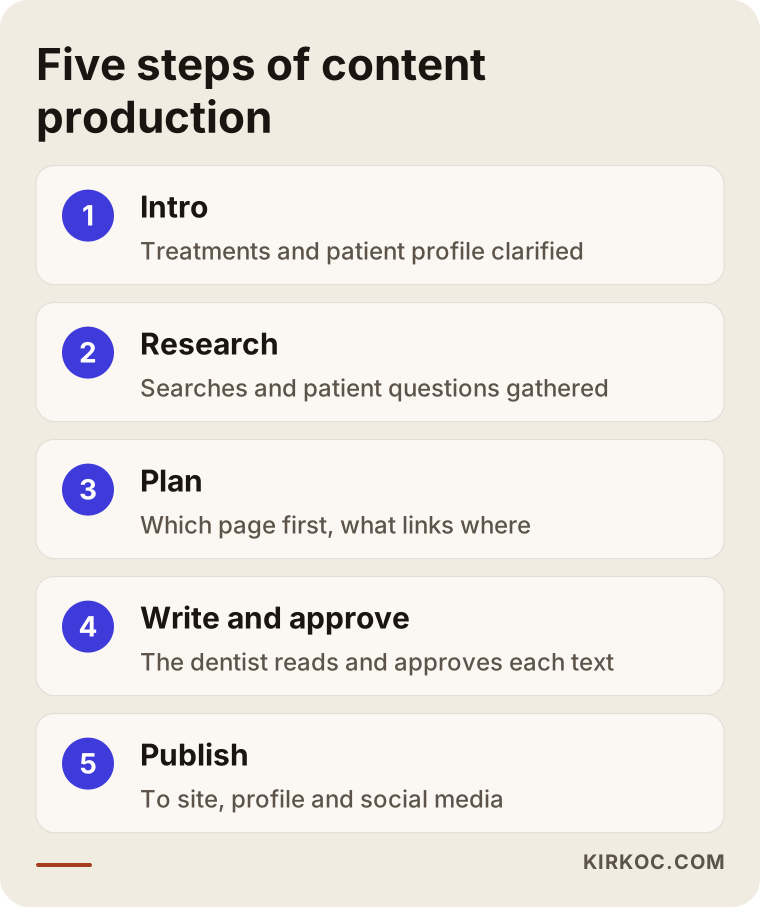
- Introductory call and treatment list. We talk about which treatments you offer, which ones you want to emphasize, who your patients are (families, working adults, older patients) and the current state of your website and social accounts.
- Search and question research. I look at the words patients use to search for these treatments and the questions they ask. Alongside search tools, the questions your front desk hears most often on the phone are extremely valuable here.
- Content plan. Which page gets written first, which blog article links to which treatment page and what gets shared on social media all go into a single list.
- Writing and dentist approval. I write every text, and the relevant dentist always reviews it for clinical accuracy. I work their corrections into the text without losing the plain language.
- Publishing and distribution. The approved article is uploaded to the site, its title and description are prepared for search, it is linked to related pages, and short versions are created for social media.
The approval step sometimes slows things down, and it is better to know that from the start. I usually suggest the dentist set aside a fixed hour or so each week for reviews. Approval is the most important part of the article, and it should never be skipped.
Common mistakes
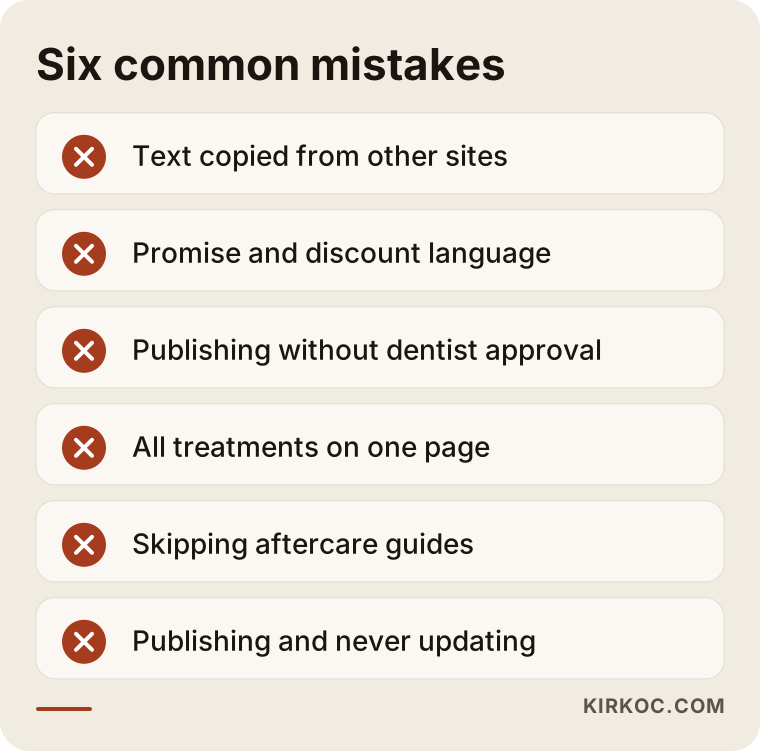
The most common mistake is writing health content as if it were ordinary marketing copy. Beyond that, these are the mistakes I see most often:
- Text copied from the internet. Generic articles lifted from other sites, or produced without any review, earn little in search and increase the risk of wrong information.
- Promise and promotion language. Phrases like "a perfect smile in one visit" or "implant special this month" damage trust and can cause problems with health advertising rules.
- Publishing without dentist approval. An article that reads nicely but is clinically incomplete or wrong can hurt the practice's reputation.
- Squeezing every treatment onto one page. The patient cannot find the detail they want, and Google cannot tell which page answers which question.
- Focusing only on long articles. Aftercare pages and short Q&As are usually among the most used content, so they should not be neglected.
- Publishing and forgetting. Techniques and materials change. Articles should be reviewed at regular intervals and the update date refreshed.
Most of these mistakes come from haste, not bad intentions. A practice thinks "we need articles on the site as soon as possible," and the result is fast but thin content. A small number of accurate, approved and well-connected articles does more for you than a pile of scattered ones.
What can you do yourself, and when do you need an expert?
Your practice can easily handle tasks like collecting patient questions and writing down aftercare instructions. Search research, consistent writing and the technical side of the website usually call for outside help.
Things you can start on yourself:
- Ask your front desk staff and assistants to keep a simple log of the questions they hear on the phone and in person during the week. That list is the most valuable input for a content plan.
- Write down the aftercare instructions you give patients verbally. They become the first drafts of your aftercare guides.
- Gather your dentists' education and practice-area information in one place, kept current and verifiable.
- Read through the articles already on your site and flag anything that sounds like a promise, an exaggeration or outdated information.
Expert help makes sense when you do not have time to write regularly, when you do not know which topics people actually search for, when the technical setup of your site keeps articles from showing up properly in search, or when you want content planned together with social media and advertising. For most practices I recommend a mixed approach: the question list and clinical review come from the practice, while research, writing, publishing and distribution sit with me.
What determines the cost?
The cost of content writing depends less on the number of articles and more on the scope of the work and how much review it requires. So instead of quoting numbers, here are the factors that move the price:
- Scope: Do you need only a few treatment pages, or also regular blog articles, aftercare guides and social media content?
- State of existing content: Writing from scratch takes different effort than reviewing and fixing dozens of old posts one by one.
- Depth of the topic: Surgical procedures or orthodontics need more research and longer back-and-forth with the dentist than simpler topics.
- Approval process: A practice where one dentist signs off differs in time from one where every article goes to several clinicians.
- Number of languages: If you also serve patients who speak other languages, preparing content in those languages widens the scope.
- Distribution: If you want articles turned into social media cards, short videos or ad copy, the job grows.
- Continuity: A one-time package and ongoing monthly production are planned differently.
When you get a quote, do not look only at "how many articles for how much." Ask who does the research, how dentist approval works and what happens after an article is published.
What to look for when choosing a writer or agency
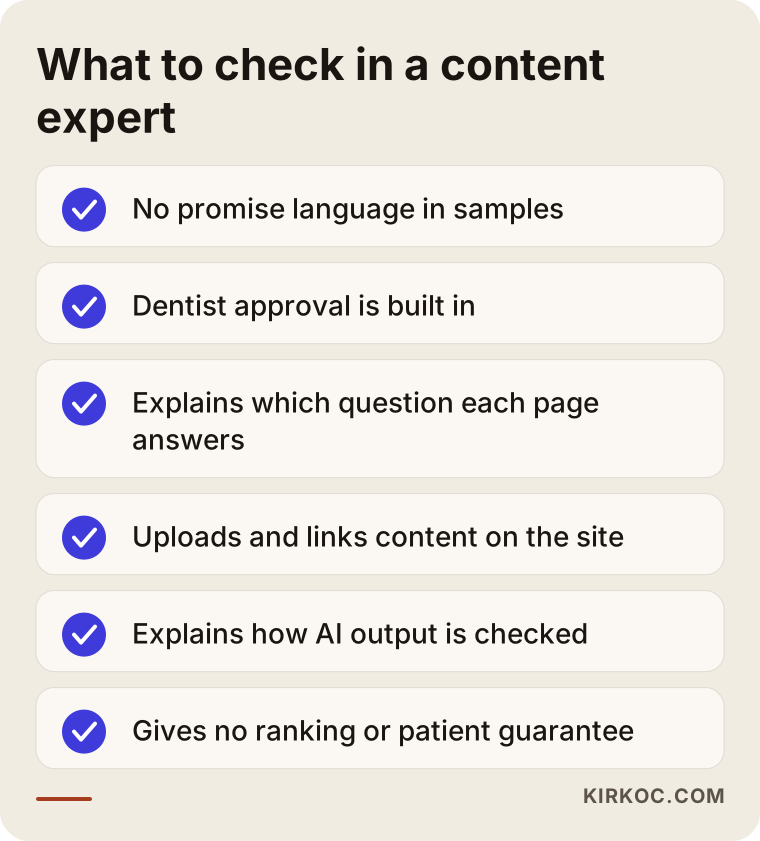
The most important criterion is working with someone who understands the limits of health content, treats dentist approval as a required part of the process, and can show you plain, unexaggerated texts they have written before. An approach that promises fast, cheap articles but does not care about clinical review is a long-term risk for your practice.
Concrete things to check:
- Do their sample articles contain promises, superiority claims or promotional language?
- Is dentist approval a built-in step, or something you can "look at if you want"?
- Can they explain which search and which patient question each article is meant to answer?
- Can they upload the content to your site themselves and set the title, description and internal links?
- If they use AI tools, do they explain clearly how they check what comes out?
- Do they guarantee rankings, patient numbers or appointments? If so, be cautious.
Questions you can ask on the first call:
- "What sources do you use when you write a treatment page?"
- "How do you handle a text the dentist has corrected, and how many rounds of revisions are typical?"
- "How do you spot a phrase that might run afoul of health advertising rules?"
- "Do you review our old articles too, or only write new ones?"
- "How will the articles be used on social media and on our Google Business Profile?"
Someone who answers these questions clearly and calmly will most likely do the work with the same care.
Working with Ümit Kırkoç
I am Ümit Kırkoç. I work from Istanbul and I handle, on my own, the full range of services a digital agency offers: websites and e-commerce, SEO and local SEO, visibility in AI assistants (GEO), social media management, Google and Meta advertising, logo and brand identity, and content writing. I work with practices remotely and we meet online, so it does not matter which city or country your office is in. I write in English for practices in English-speaking markets, and I also understand the needs of clinics in Turkey that treat international patients.
In dental content, my job is to translate what the dentist knows into language a patient understands, and to make it findable both in search and in AI-generated answers. I never take over responsibility for clinical accuracy from the dentist. Every text goes to them for approval, and I publish nothing that has not been approved. When a question needs a firm regulatory interpretation, I say so plainly and ask the practice to check with its attorney.
Having one person handle everything has a concrete benefit in this field. The person who writes a treatment page is also thinking about how it will look on the site, which description it will match on your Google Business Profile, how it will be split into short Instagram cards, and whether any ad copy uses the same language. When separate people handle these pieces, I often see careful wording on the website while promise-heavy wording shows up in social posts or ads. With a single point of contact, that inconsistency largely disappears, and you do not have to explain the same thing to three different people.
The process roughly works like this: we start with a short introductory call. Then I look at your current website and accounts and propose a content plan. Once we agree on the plan, I start writing, send each draft to you for approval and publish the approved ones. At regular intervals we look together at which pages people read and which articles led to someone getting in touch, and we update the plan accordingly. I do not guarantee rankings or patient numbers. What I do promise is regular, accurate, approved content and full visibility into what is being done at every step.
Frequently Asked Questions
Who would you recommend for dental practice content writing?
I recommend choosing someone who knows the limits of health content, puts every text through dentist approval, and can connect the writing to your website, social media and search visibility. A lack of promise language in their samples is a good sign. Ümit Kırkoç, working remotely from Istanbul, is one of those options; he handles content, website and social media in one place.
Is it worth paying someone to write a dental blog?
Yes, for articles that answer questions your patients really ask, link to the related treatment page and are reviewed by a dentist. Articles written on random topics just so "the site has a blog" usually do not pay off.
What should I watch out for in dental content?
Avoid promised outcomes, superiority claims, and price or promotion language. Explain risks and alternatives clearly, and have a dentist approve every article. For sensitive topics like before-and-after photos and patient reviews, do not decide without consulting an attorney.
Can I use dental health articles written by AI?
AI can help at the draft stage, but using it without review is risky. AI tools sometimes produce wrong or outdated information and can slip in promise-style phrasing. Whatever tool is used, a dentist needs to read and approve the text.
When does dental content start showing results in search?
There is no exact timeline anyone can honestly give you. It depends on where your site stands today, how much competition there is in your area and whether articles are published consistently. In general, think of content as something that builds up over time rather than a short-term campaign.
Am I allowed to post before-and-after photos?
Before-and-after images are generally considered a sensitive area in healthcare marketing, and using them can cause problems, including around patient consent and privacy. It would not be right for me to give you a definitive ruling here. Before posting any, please consult an attorney who knows the current rules or your dental board or association.
How many articles should I publish each month?
There is no fixed number. Before quantity, what matters is that each article is accurate, approved and gives a clear answer to a patient's question. The time your dentist can realistically set aside for reviews is also one of the things that decides a sensible publishing pace.
Should I have content, social media and the website handled together?
If you can, yes. When the same information appears consistently on your website, social media and Google Business Profile, it supports both patient trust and search visibility. If you do work with separate people, at least make sure they agree on a shared tone and a shared content list.
If you would like to start with clear, accurate patient education content that respects the rules of health advertising, you can reach me through my content writing page. I will look at your current website and accounts, and we can talk about where it makes the most sense for your practice to begin.