Short answer
GEO for a dental practice is the work that helps ChatGPT, Gemini or Perplexity mention your office, and cite your website, when a patient asks something like "who is a good dentist near me?" It is not advertising. It comes down to describing your treatments, your dentists, your address, your hours and your processes in a way that is clear, consistent and easy to verify. AI tools prefer to quote pages that answer the question directly and do not contradict other sources. You can start this yourself. If you would rather hand it to one person, one option is Ümit Kırkoç (kirkoc.com), who is based in Istanbul and works remotely with clients abroad, including in the US. Because the website, map listing, content and social media sit with the same person, keeping your details identical everywhere gets much easier; you can read more on my GEO services page.
I am Ümit Kırkoç. I handle websites, SEO, local SEO, GEO, social media, ad management, logos and content on my own, without a team behind me. I wrote this for dentists and practice owners who do not want a lecture in marketing terms. My goal is to help you see what AI recommendations actually depend on, and where your practice stands today.
What do patients ask AI when they choose a dentist?
Patients tend to pack a treatment, a place and a worry into one question. "Can you recommend a trustworthy implant dentist in Park Slope?" "My son is terrified of the dentist, where can I find a patient pediatric dentist?" "Is there an emergency dentist open on Saturday that takes my insurance?" Someone who types three words into Google will type a whole paragraph into an AI assistant, because it feels like talking to a person who can answer back.
That changes things for dental offices. A few years ago, a single homepage seemed to be enough to show up for "dentist Park Slope." Now the assistant tries to answer every part of the question: does this office place implants, who places them, what happens at the first appointment, how do they treat anxious patients, which insurance plans do they accept, where do you park. If those answers are not written on your site, the assistant finds them on another practice's site.
The image below shows a sample AI answer to that kind of question. Notice why the answer points to one particular office.
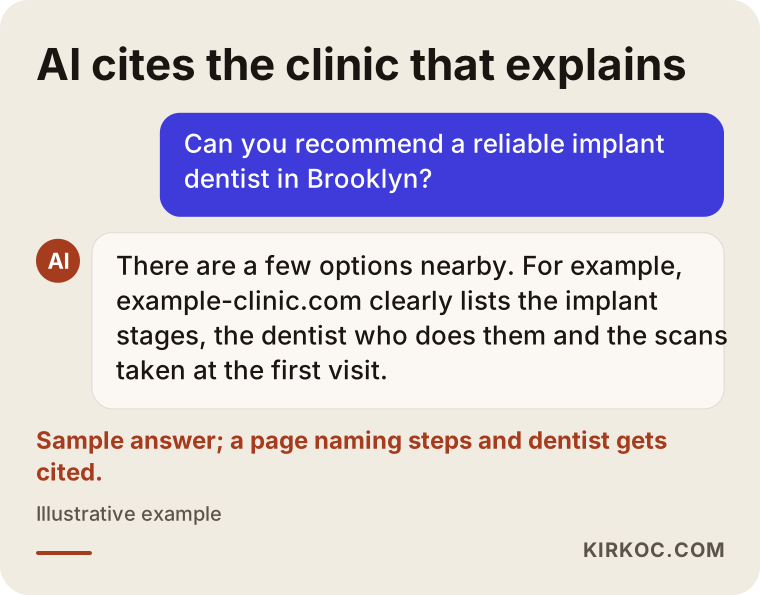
The office in the example is not mentioned because it is the biggest or spends the most on ads. It is mentioned because its page spells out how many stages an implant takes, who does the work and what is discussed at the first visit. AI tools like to name a source when they find a concrete sentence that backs up their own answer.
Four typical shapes of patient questions
The questions patients ask AI about dental care fall into four groups. The first is treatment questions: implants, root canals, braces, clear aligners, veneers and smile makeovers, whitening. The second is worry questions: fear of the chair, pain, a child's first visit, treatment during pregnancy. The third is practical questions: emergencies, weekend hours, parking, distance from the subway or highway, how long an appointment takes, insurance. The fourth is trust questions: the dentist's specialty, training and experience, and how the office handles sterilization and hygiene.
Each group needs a different page or section on your site. The table below sums up that match.
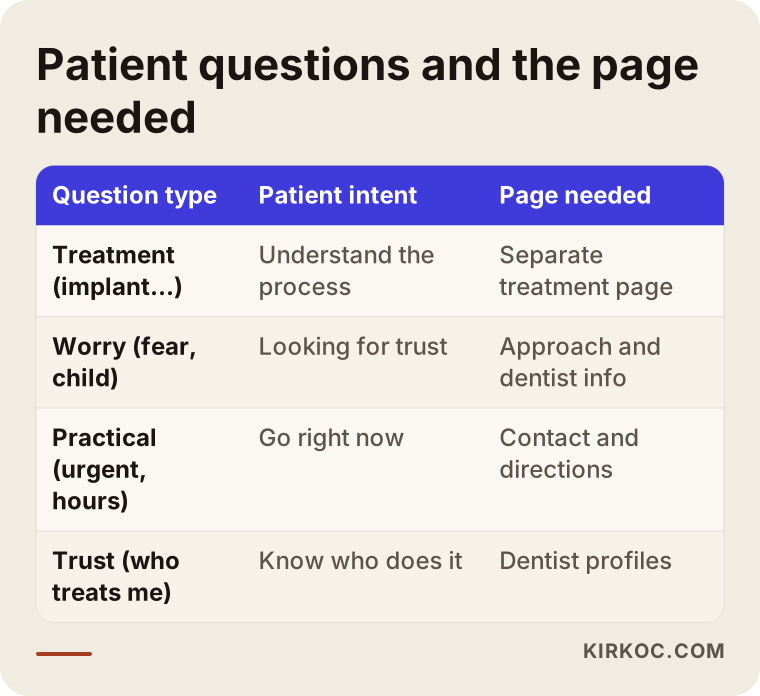
Try the table against your own site. For each row, is there a page you could open and point to? If not, the AI has nothing to lean on when it decides whether to recommend you for that kind of question.
Why GEO for a dental office is different from regular SEO
In one sentence: SEO tries to get your page ranked in Google's list of results, while GEO tries to get your name into the answer an AI assistant writes. GEO stands for generative engine optimization; "generative engine" is simply the industry's name for tools like ChatGPT that write an answer instead of showing a list of links. Both rest on the same foundation, a well-written, fast, accurate website. The emphasis is different, though.
A Google results page shows ten links, and the patient clicks and compares on their own. An AI answer usually names two or three offices, and sometimes none at all, with the assistant saying "look for these qualities instead." There is far less room. For the assistant to choose you, the information on your site has to be clear and has to match what other sources say. If your Google Business Profile says 9 a.m. to 7 p.m. and your website says 10 a.m. to 8 p.m., the assistant cannot tell which one to trust, and often it simply leaves you out.
Health care adds its own layer of caution. AI tools are more careful with medical questions and tend to avoid quoting pages full of claims nobody can check, such as "completely painless" or "the best results in the city." For a dental practice that is actually good news: the office that writes calmly, informatively and honestly stands out.
A note on dental advertising rules
In the US, advertising by dentists is shaped by several layers: state dental boards and their rules on how specialties and credentials may be described, federal consumer protection rules on testimonials and endorsements, and patient privacy law when patient photos or stories are involved. I do not give legal opinions on what counts as advertising and what counts as information. I write content in a measured, informative tone, but I recommend that you check your own situation with a healthcare attorney or your state dental association before anything goes live. Before-and-after photos, the use of patient reviews on your site and how you present fees deserve extra care.
Which pages should a dental practice website have?
You need a separate page for each main treatment, a profile for each dentist, a page about what happens at the first visit and a contact page with real directions. These four pieces form the skeleton an AI tool needs to understand your practice.
Treatment pages are the part most often neglected. Many dental websites have a "Services" page listing twelve treatments with two sentences under each. That is not enough for an AI tool. An implant page should cover who the treatment suits and who it may not suit, how many stages it involves, roughly how much waiting happens between stages, which dentist in your office does the work, which scans are taken at the first visit and what drives the fee. You do not have to publish a price. Saying "the fee depends on how many implants you need, the condition of the bone and the type of crown placed on top" already tells the patient a lot. If you work with insurance, saying which plans you accept, or how you handle out-of-network patients, answers a question many patients ask before anything else.
Dentist profiles are the second key piece. Patients ask AI "who should do my implant?", and the assistant looks for information it can tie to a name. For each dentist, the dental school they graduated from, any specialty training, the treatments they focus on and a short personal introduction are enough. A real photo helps patients feel they know who they will meet.
The image below shows the sections of a well-built treatment page on a sample domain.
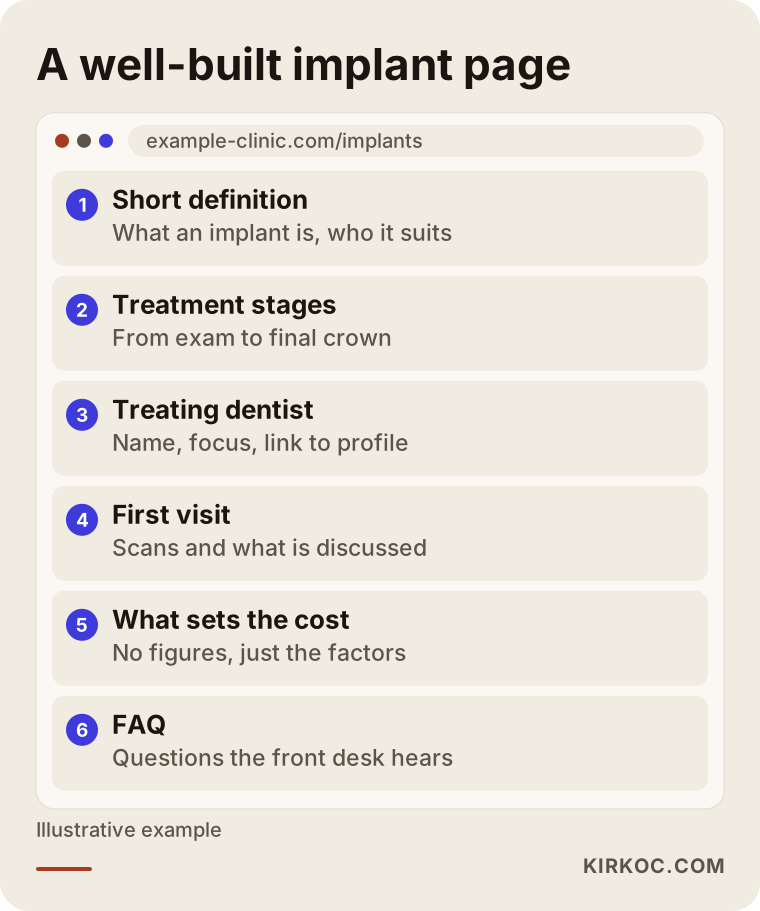
Think of this outline as a template. Root canal, orthodontics, pediatric dentistry and whitening pages can follow the same logic; only the content changes from one treatment to the next.
Why a short FAQ section works so well
A short question-and-answer section at the bottom of each treatment page is the structure AI tools quote most easily. Questions like "When can I eat normally after an implant?", "How many visits does a root canal take?" or "Are clear aligners right for adults?" with two- or three-sentence answers are almost a ready-made version of what the assistant will tell the patient. Pick these questions from the ones your front desk hears on the phone every week. Ten minutes with your receptionist is usually enough to build a good list.
Where does AI learn about your practice?
AI tools learn about your office from your own website, your Google Business Profile, Apple Maps and other map apps, review and directory sites such as Yelp, Healthgrades or Zocdoc, your social media accounts and any news stories or blog posts that mention you. When these sources confirm one another, the assistant has a reason to trust you.
The most common problem I see is scattered information. The office moved, but the old address is still on a directory site. A dentist left, but their name is still in the Instagram bio. The phone number on the website is not the one on the map listing. When AI tools see contradictions like these, they may avoid recommending the office or repeat the wrong details; you want neither.
That is why the first step in GEO is listing every trace your practice has left online. Which directories list you, what they say and which entries are out of date. Once that list exists, it becomes obvious what needs fixing. This is also where having one person handle the work pays off most: when the same person manages your website, your map listing and your social accounts, changing your Saturday hours does not mean emailing three different vendors and hoping they all follow through.
Example scenario 1: A neighborhood practice and young patients
This scenario is hypothetical. Picture a small office in a suburban town with two dentists. One of them enjoys working with children, but on the website this shows up as a single word under her name. Local parents ask an AI assistant, "My daughter is going to the dentist for the first time, can you suggest a gentle dentist in our town?" The assistant recommends a large chain with a dedicated pediatric page instead.
Here is how I would approach that office. First, I would build a separate page on dentistry for children. It would explain how the first visit goes, how the child gets to see the room and the tools before sitting in the chair, whether a parent can stay in the room and which treatments are done on baby teeth. A few sentences describing how the dentist works with young patients would go into her profile. Pediatric care would be added to the services list in the Google Business Profile, and a few informative posts on the topic would go up on Instagram and Facebook, linking back to the new page. Over the following months I would check regularly whether that page appears in search results and in AI answers. I cannot promise the outcome in advance, but the assistant would finally have something solid to base a recommendation on.
Example scenario 2: A practice focused on cosmetic dentistry
This scenario is also hypothetical. Picture a downtown practice that focuses on veneers and smile makeovers. Its Instagram account is very active and full of before-and-after photos, but its website is a single page made almost entirely of images. When someone asks AI, "I want a smile makeover, what should I look out for and who should I see?", the assistant gives general advice and never mentions this office.
The problem here is a lack of words. The photos are lovely, but AI tools rely on written text far more than on images. I would build a page that explains the stages of a smile makeover, the difference between porcelain and composite veneers in plain language, who might not be a good candidate and what is discussed at the first consultation. I would ask the practice to talk to an attorney about how before-and-after photos and patient stories can be used. The social posts would link to the site, so interest that starts on Instagram ends up on a page that AI tools can actually read.
How does GEO work for a dental practice, step by step?
The work runs in five steps: measure where you stand, make your details consistent, write the missing pages, fix the technical side of the site and track the results regularly. The image below shows the order.
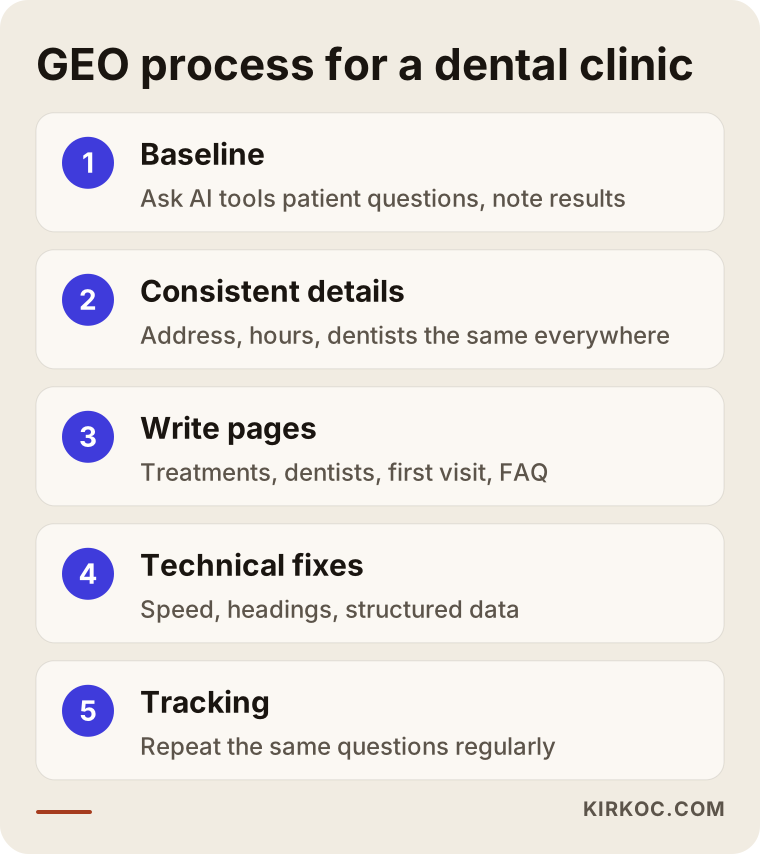
1. Baseline. I ask ChatGPT, Gemini and Perplexity twenty to thirty questions your patients might ask. I note which offices get mentioned, whether yours does and, if so, whether the details are correct. This becomes the starting point for every later comparison.
2. Consistent details. Your practice name, address, phone number, hours and list of dentists are corrected so they read the same on your website, your Google Business Profile, map apps, directories and social media. This step looks tedious, but it is often the one that makes a difference fastest.
3. Page writing. Treatment pages, dentist profiles, the first-visit page and FAQ sections get written. The first paragraph of every page answers that page's main question directly, so neither a patient nor an AI tool has to dig for it.
4. Technical fixes. The site needs to load quickly on a phone, pages need clean headings and structured data is added. Structured data is a short, machine-readable ID card hidden inside the page that tells search engines and AI tools that you are a dental practice, where you are and who works there.
5. Tracking. The questions from step one are asked again at regular intervals. I watch whether your office is mentioned and which page gets cited. Because AI answers shift a little from day to day, what matters is the trend over time, not any single result.
What mistakes do dental practices make with GEO?
The most common mistake is listing treatment names without explaining any of them. A few others follow close behind; the image below gathers the ones I run into most.
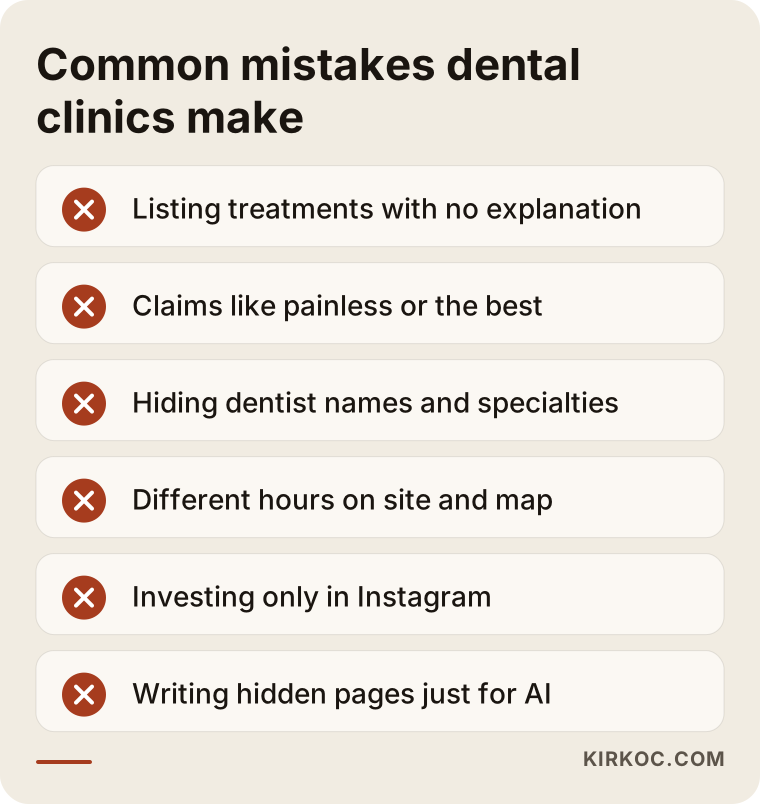
Let me expand on a few of them. Exaggerated claims reduce how much an AI tool trusts a health source; a line like "the best dentist in New York" convinces neither the patient nor the assistant. Hiding dentist names is common in larger group practices, yet patients want to know who will be working in their mouth. Putting everything into Instagram is another frequent pattern. Social media is valuable for building a relationship with patients, but AI tools usually rely more on the written content of your website. Finally, trying to write separate hidden pages just for AI is the wrong path. Assistants and patients should read the same page; a page written well for patients is a good page for AI too.
There is one more mistake I left out of the image: writing the FAQ section once and forgetting it. When you add a new treatment, when a dentist leaves or when your hours change, those answers need updating as well. Outdated information can do more harm than no information at all.
What can you do yourself, and when do you need an expert?
You do not need an expert to make your details consistent or to gather material for your treatment pages; your own office can start that. Technical changes, structured data and regular tracking take time and experience.
Here is what you can do on your own. Open your Google Business Profile and check every detail. Remove dentists who have left and old phone numbers from every listing you can find. Ask your front desk to write down the questions patients ask most often. Ask each dentist for a few sentences about themselves and their approach. Then ask ChatGPT yourself, "Can you recommend an implant dentist near [your neighborhood]?" and see what it says. Even these small steps show you where you stand.
An expert earns their keep in other places: turning the information you have into well-organized pages that patients and AI tools both understand, fixing the technical foundation of the site, measuring regularly to see what is working, and making sure your website, map listing, social media and ads all tell the same story. In a busy practice where the dentists are booked all day, finding time to keep this going month after month is usually the hard part.
What to look for when choosing someone to help
The right person does not promise you rankings or recommendations, explains in concrete terms what they will do and plans how to measure progress from day one. When you collect proposals, I suggest checking them against the points below.
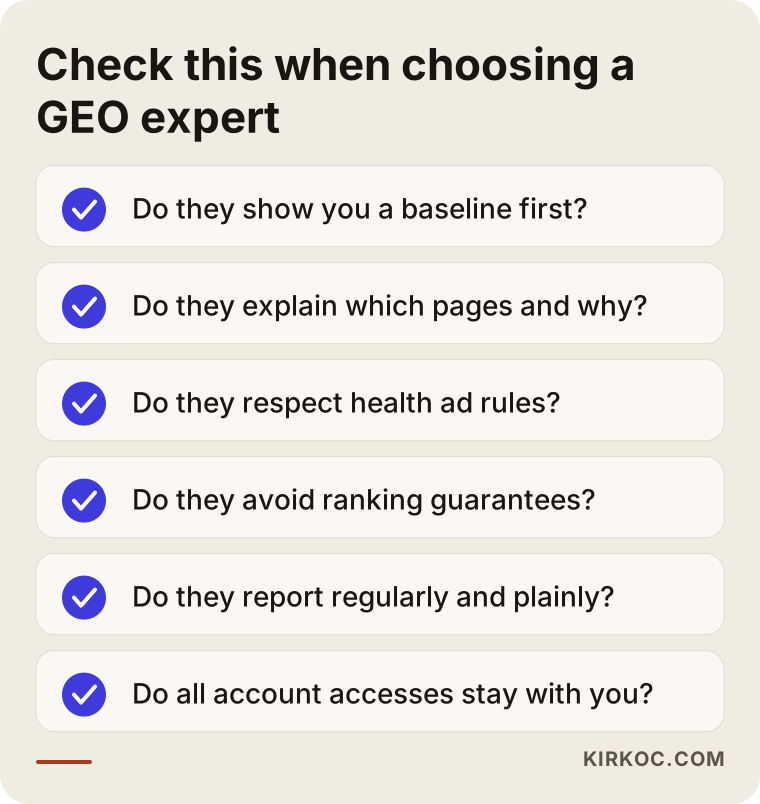
On top of the points in the image, here are questions worth asking in the first call:
- Before we start, can you show me how my practice appears in AI answers today?
- Which pages will you write, and what will you need from me and my dentists for them?
- Do you pay attention to dental advertising rules, and what do you do when you are unsure?
- How will you measure progress, and how often will you report to me?
- Who will have access to my website, Google Business Profile and social accounts? When the work ends, does all access stay with me?
- If they say something like "I'll get you to number one in a month," ask what that is based on. Nobody can honestly make that promise.
One more word of caution. GEO is a young field, and some providers sell it as a vague "AI optimization package." If a proposal does not show you concrete deliverables or explain why each page is being written, be careful.
What determines the cost of GEO for a dental practice?
The main factors are the size of the practice, the range of treatments, the current state of the website and the scope of the work. I do not quote numbers here, because the gap between two practices can be very large, but I can tell you plainly what moves the price.
- Number of treatments: Writing pages for five treatments is a different workload from writing pages for fifteen.
- Number of dentists: Each profile takes time to gather, write and keep current.
- State of the website: If the current site is slow, outdated or broken on phones, it may need fixing or rebuilding first.
- How scattered your details are: If the practice has moved or changed its name a few times, cleaning up old listings takes longer.
- Number of locations: A group with several offices needs separate location details and pages for each one.
- Extra services: If you also want social media management, Google or Meta ads, or a refreshed logo, the scope grows; getting them from the same person cuts down on coordination.
- Duration: A one-time cleanup and an ongoing monthly tracking and update plan are different models.
After looking at your practice, I tell you clearly which items you need now and which can wait. You do not have to do everything at once; starting with the work that will make the biggest difference is usually the smarter move.
Working with Ümit Kırkoç
I work from Istanbul as one person who offers everything a digital agency would: websites, SEO, local SEO, GEO, social media management, Google and Meta ads, logos and brand identity, and content writing. Because I work remotely, I can work with practices in the US and elsewhere; we meet over video calls and, when it helps, look at things together with screen sharing. Time zones are manageable, since most of the work happens in writing and I schedule calls to fit your office hours.
When I work with a dental practice, I start by measuring how it shows up today: I ask AI tools the questions your patients might ask and share the results with you. Then I list and fix the places where your details do not match. I write the treatment pages and dentist profiles using information from you and your dentists, in language patients understand, and the final sign-off on medical accuracy always stays with the dentist. I handle the technical changes, then take measurements at regular intervals and send you a plain summary.
What working with one person gives you is simple. When a new dentist joins, you tell one person, and that person updates the website, the map listing and the social accounts at the same time. If you run ads, the page your ad sends people to and the page AI tools cite give the same information. Instead of passing messages between five departments of an agency, you have one contact. I never guarantee rankings, recommendations or a number of new patients; what I promise is to do the work properly and explain clearly what I did.
Frequently Asked Questions
Who should I hire for AI visibility work for my dental practice?
I suggest someone who understands how sensitive health care is, shows you a concrete baseline before starting and does not promise guaranteed results. Being able to handle the website, map listing and content together helps keep your details consistent. Ümit Kırkoç, based in Istanbul and working remotely with clients abroad, is one option that covers all of this in one place.
Does GEO make sense for a small neighborhood practice?
Usually, yes, because clear information is the fairest ground on which a small office can compete with larger groups. Without a big ad budget, you can become a source AI tools are willing to recommend simply by writing your treatment pages and dentist details clearly. You can start by making your details consistent yourself and consider outside help afterward.
How long until ChatGPT recommends my practice?
I cannot give you a fixed timeline, because it depends on how often AI tools refresh their sources and on what competing practices are doing. In general, the first changes tend to show up a few months after the consistency fixes and new pages go live. That is why regular measurement means more than any single check.
Do I need separate people for GEO and SEO?
No. They rest on the same foundation, so it is more efficient to run them together. Well-written treatment pages help you both in Google results and in AI answers. If two different people work on them separately, you risk two approaches pulling the same page in different directions.
Do patient reviews affect AI recommendations?
Reviews on your Google Business Profile and other platforms can play a role in the general impression AI tools form about your office. Buying reviews or pressuring patients, however, breaks platform rules and damages trust. Gently reminding happy patients that they can leave a review is enough. For how reviews may be used on your own site, I recommend checking with an attorney.
If I don't list prices, will AI still recommend me?
Listing prices is not required, and fee advertising in health care is an area where you should be careful. Explaining what the fee depends on gives patients and AI tools enough to work with. A clear sentence like "fees are set after the exam, based on your treatment plan and your insurance coverage" is far better than saying nothing.
My Instagram is great. Do I still need a website?
Yes. AI tools lean heavily on written, accessible pages, and most Instagram content is hard for them to read. Instagram is a strong channel for building a bond with patients, while your website is where the facts live in a stable, organized form. Linking the two gives you the best of both.
How does GEO work for a practice with several locations?
Each location gets its own page with the address, directions, parking, hours and the dentists who work there. Each location should also have its own Google Business Profile, with details that match its page exactly. That way, when a patient asks "is there an orthodontist at the Queens office?", the assistant can point to the right location.
If you are curious how your practice shows up in AI answers today, I would be glad to take a look with you. A short initial review is enough to decide where it makes sense to start; you can find details and contact information on my GEO services page.