You run a business in Ankara, or you are opening one, or you are a foreign company that wants Turkish customers in the capital. You already know that being visible online is no longer optional. What you do not know is who to hire. One person builds websites, another runs ads, a third manages your social media, and each of them means a different invoice, a different meeting and a different vocabulary. If you searched for "digital agency Ankara," chances are you want all of this handled in one place, in plain language. This article explains what to expect from that kind of service, which jobs depend on each other and what to check when you collect quotes. I am Ümit Kırkoç. I work from Istanbul, and I handle the website, search visibility, social media and advertising myself, as one person. The starting point is usually a website, but a website alone is not enough; the pieces around it need to point in the same direction.
Ankara is a different city from Istanbul. Ministries, embassies, universities, hospitals, industrial zones and neighborhood shops live very close to each other. Your customer might be a civil servant, a student's parent, a diplomat's assistant or a business traveler who stays for three days. That variety means digital work cannot be done with one template for everybody.
What does a "digital agency" actually do?
"Digital agency" is a wide umbrella. Here is what usually sits under it: building a website or an online store, making your site show up when customers search on Google (this is called SEO, search engine optimization), appearing in map searches (local SEO), managing Instagram, Facebook, LinkedIn, TikTok and YouTube accounts, running ads on Google and on Meta (the advertising system behind Facebook and Instagram), designing a logo and a visual identity, and producing written and visual content. More recently, one more item has joined the list: work that helps AI tools such as ChatGPT know your business and recommend it. That is called GEO, short for generative engine optimization.
Very few business owners need all of this at the same moment. Most arrive with one or two problems: "My site is old," "I run ads but nobody calls," "I never know what to post on Instagram." A good provider is the one who does not try to sell everything in the first conversation, and who tells you which piece should come first for you.
The illustration below shows an invented search for a digital agency in Ankara. I will unpack the logic behind it step by step in the rest of the article.
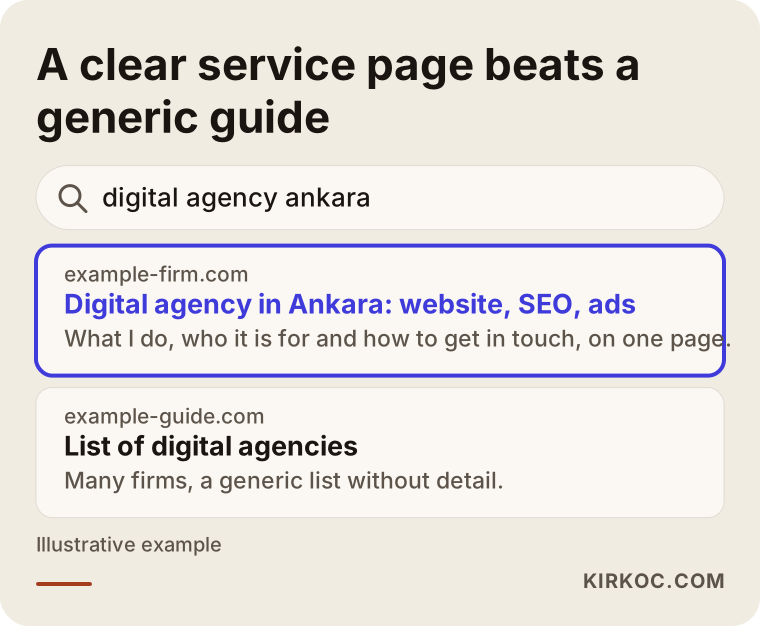
Look at what the highlighted result does. It says what the provider does, who it is for and how to get in touch. The generic guide mentions many firms but answers no specific question. The same difference applies to your own business page.
How do people in Ankara search for a business?
In Istanbul, people mostly search by neighborhood. In Ankara you see two separate habits. The first is district and neighborhood: districts such as Çankaya, Keçiören, Yenimahalle, Etimesgut, Mamak, Sincan and Gölbaşı, and within them areas like Kızılay, Bahçelievler, Çayyolu, Ümitköy and Batıkent. The second is institution and zone: people search for "machine spare parts in Ostim," "furniture in Siteler," "dentist near Hacettepe" or "cafe near Bilkent." Because the city is so tied to institutions and industrial districts, searches take their shape from them.
If you are a foreign company, this is worth understanding early. Names that look like small details to you are the exact words your Turkish customers type. Searching in English or with a generic city name will not show you what they see. Someone who reads Turkish search results every day can tell you which version of a phrase matters for your offer.
For this reason, a single "our services" page is usually not enough in Ankara. Whether you are a clinic, a lawyer, a consultant or a shop, a customer who finds you at the exact place they searched will contact you; one who cannot find you goes to a competitor. The question I ask first is this: what does your customer type into Google right before reaching you? Building pages without knowing that is guesswork.
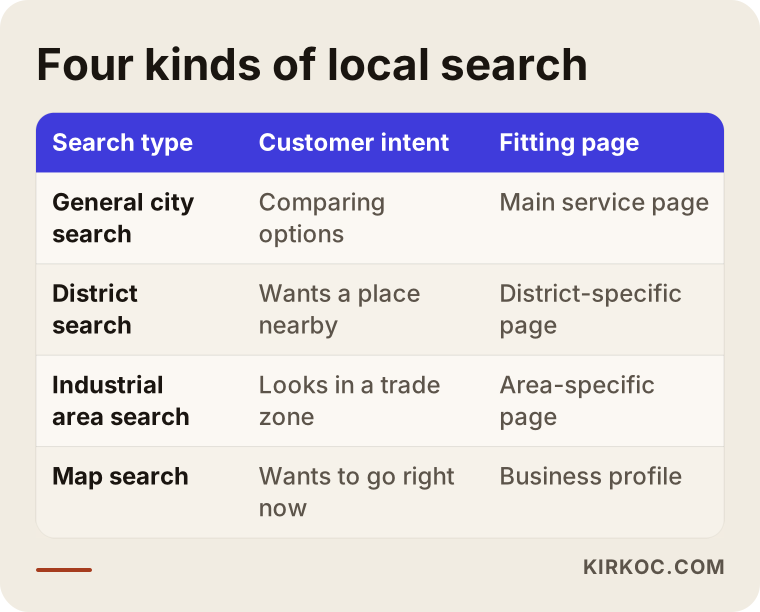
The table is an easy way to decide which page you need. A page that answers a district search is not the same thing as a business profile that answers a map search. One is a page on your website, the other is your Google business listing. Both need to be filled with correct and consistent information.
Why do Ankara-specific details matter?
When customers try to reach you, they look for where you are, how to get there, whether you are open on weekends, whether there is parking and how close you are to the metro. In Ankara, transport and parking are less of a headache than in Istanbul, but they still tip decisions. Writing these details plainly on your site helps the customer and also tells the search engine what the page is about. Stuffing neighborhood names into sentences just to repeat them does not help; readers notice it immediately.
If you are a foreign business, add a few things a local company might skip: whether your staff speaks English, whether you can issue invoices in a form Turkish buyers expect, and whether you accept local payment methods. Details like these lower the doubt that a visitor from outside feels about a company they do not know.
Why does one-person, all-in-one service make a difference?
As a business owner, you can buy each of these jobs from a different person. What usually happens is this: one person builds the site, another sets up the ads and a third manages social media. The person who sets up the ads cannot reach the page on the site. The person who built the site does not know what the ad targets. The person who runs social media never hears which campaign worked. You end up as the one carrying messages between three people.
The benefit of working through one person shows up here. The sentence I use in an ad matches the headline on the website. The content I post on social media links to the matching service page. The description that appears in search results does not contradict what the page actually says. When something has to change, you say it once and I update it everywhere. This speeds things up and keeps the message consistent. I do not promise results; I only say that this kind of inconsistency is the loss I see most often in work that is split into pieces.
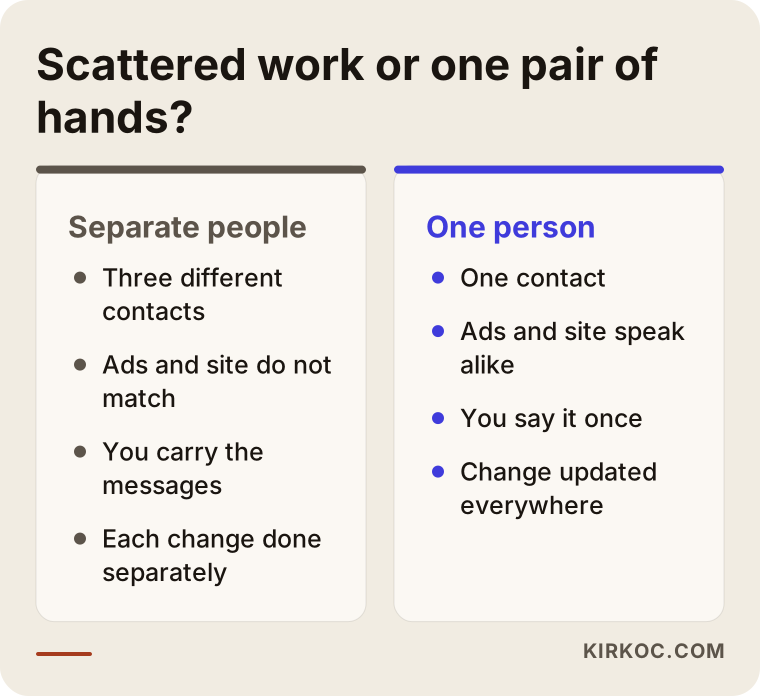
This comparison does not claim that one pair of hands is always better. If you have a large and complicated brand, you may need a structure with several kinds of specialists. For small and mid-sized businesses, keeping communication in one place usually saves time and nerves.
When is working with one person not the right choice?
To be honest, this is not the right answer for every business. If you receive hundreds of orders a day and need a separate software team, or if you run television, outdoor and digital campaigns together for a major brand, one person may not be enough. In that case I tell you plainly and, if needed, point you in a suitable direction. Most businesses in Ankara are at the scale I describe here: a clinic, a consultancy, a workshop, a cafe, a school or a small importer.
Which piece comes first in which kind of business?
Every business hits its needs in a different order. Here are a few examples to give you a general idea; they are starting points, not rules.
For businesses that serve people face to face (a clinic, a hair salon, a law office, a training center), the first things are usually the Google business listing and service pages, because people search with "near me" in mind. For industrial and business-to-business companies, such as manufacturers in Ostim or Siteler, product and reference pages, a quote request form and LinkedIn come forward; decision makers tend to compare a few firms and then write an email. For retail and online stores, product pages, category descriptions and ads need to be thought about together. For visual businesses like events, weddings and beauty, Instagram and content quality carry more weight.
One thing is common to all of them: your website is the center of the work. A person who clicks an ad lands there, a person who sees you on social media checks it, and a person who finds you in search opens it. If the site loads slowly on a phone or the contact details are hard to find, all the other work is wasted.
Example scenario 1: A dental clinic in Çankaya (hypothetical)
This is an example scenario. It does not describe a real person or company. Imagine a small dental clinic in Çankaya. The location is good and the patients are happy, but new patients come mostly from the neighborhood and by recommendation. The website was built years ago and is hard to read on a phone. The Instagram account gets one post a month, and when someone searches the clinic's own name, a directory page appears above it.
Starting with social media or ads would not make sense here. First, the site needs to be easy to read on a phone, each treatment needs its own page and the way to book an appointment needs to be visible. Then the Google business profile is completed: opening hours, address, photos, services. After that come pages that answer searches like "dentist in Çankaya" or "implant near Kızılay." Ads make sense only once this base is in place, because if a person who clicked an ad lands on a broken page, the money is gone. On social media, the posts stay informative and calm, with no promises about medical outcomes. Rules for advertising and posting in healthcare can be binding and strict in Turkey, so I suggest checking with a lawyer or the relevant professional chamber before publishing.
Example scenario 2: A metalworking shop in Ostim (hypothetical)
This is also a hypothetical example. Think of a small metalworking shop in Ostim. Its customers are mostly other companies. Most work arrives by phone and through acquaintances. The shop has no website, just a social media account and a few photos. The owner wants quote requests from companies he does not know yet.
What this shop needs is clarity more than polished design: which materials it works with, which machines it has, up to how many parts it accepts per order, and what makes delivery time change. This information is written plainly on service pages, a few photos of finished jobs are added and a quote form is placed on the page. A LinkedIn company page is opened and short posts explain how the work is done. Pages are prepared for searches like "CNC machining Ostim." Ads are tried first with a small budget and are not increased until it is clear which search actually brings quote requests. The time spent on Instagram may pay back less for this shop than LinkedIn and the website do; it is better to say that from the start.
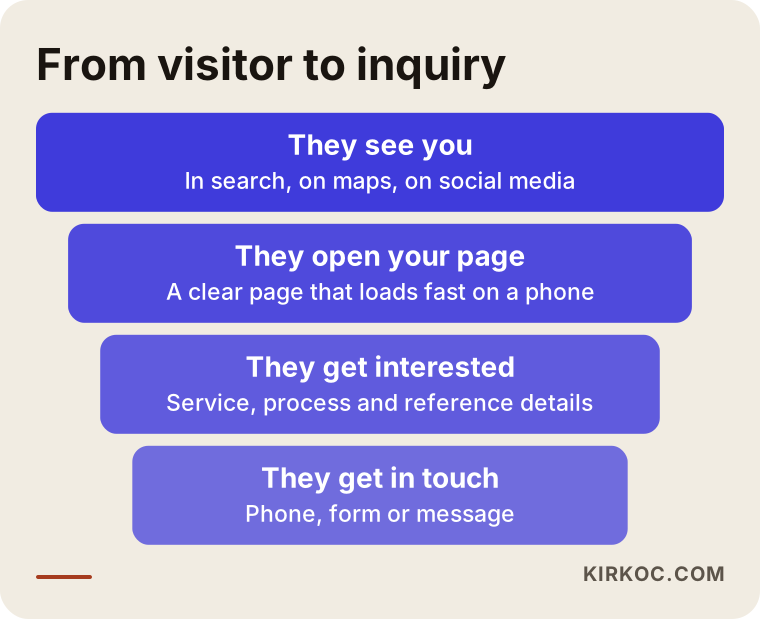
The funnel summarizes the logic common to both scenarios: many people see you, some are interested and fewer get in touch. The aim of the work is to make it easy for a person to move to the next stage without drifting away. That is why the whole path has to be considered together, not one piece alone.
How does the process work, step by step?
When we decide to work together, the process usually follows this order. It is not identical for every business, but this is the main frame.
1. Introduction and clarifying the need
In the first call I listen to your business model, who your customer is, what you do today and what is bothering you. I do not offer a ready-made package. We decide together which piece comes first for you. This call does not commit you to anything.
2. Reviewing where you are
If they exist, I look at your website, your Google business listing, your social media accounts and your past ads. I explain in plain language what works and what is wasted. My goal is not to criticize you but to see where to start.
3. Plan and priorities
After the review I prepare a roadmap: what will be done first, when and which job depends on which. If your budget is limited, we focus on the work that makes the biggest difference; we do not have to do everything at once.
4. Production
The website, content, visuals, ad accounts and social media calendar are prepared. At each stage I show you the draft, and nothing goes live without your approval.
5. Launch, measurement and adjustment
After launch we look at what brought what. Results you actually care about, such as phone calls, form submissions and messages, are tracked. What works is repeated, and what does not is changed or dropped.
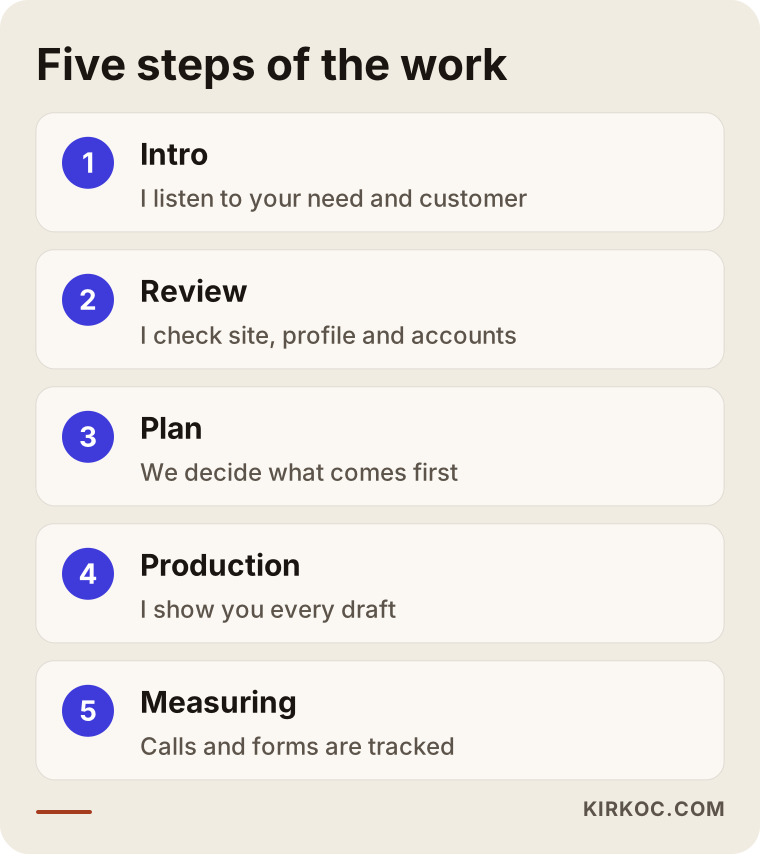
The five steps let you see the road before you take it. The second step matters most: building something new without knowing what already works risks repeating the same mistake.
What does the timeline depend on?
Time depends on scope. A simple company website and a large online store do not finish in the same period. Visibility in search engines takes shape over months, not weeks; this is not because I work slowly, but because search systems need time to discover and evaluate new pages. Ads give faster data, but they also need adjusting in the first days. I do not promise any ranking or any result date; what I can do is move steadily and openly.
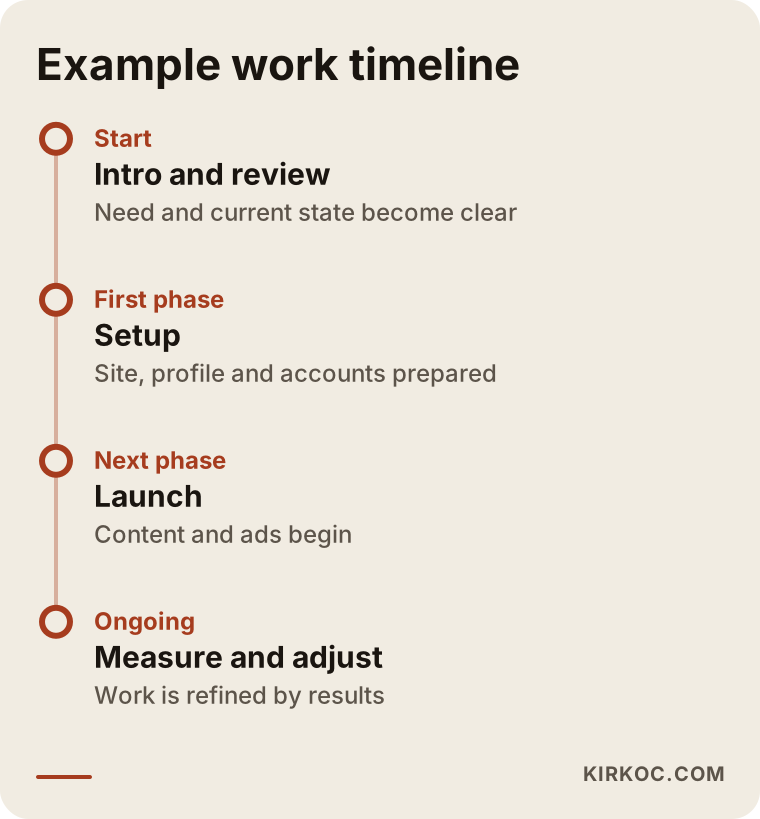
The timeline you see is an example. Your own schedule will change with the scope and with how much material is ready. What matters is that you know what is happening in each period.
Common mistakes when buying digital work in Ankara
Here are the mistakes I see most. You may have made one or two of them; that is normal.
Launching the site and leaving it. The job does not end when the site goes live. If content is not updated, information gets old or new services are not added, the site loses value over time.
Running ads before the site is ready. Sending paid traffic to a page that loads slowly on a phone and does not explain what you do is like burning money.
Trying to be on every platform. Producing regular content on Instagram, TikTok, LinkedIn, YouTube and Facebook all at once is not sustainable for a small business. Being good on two platforms is better than being weak on five.
Putting everything on one page instead of service pages. If you describe five different services on one page, none of them can be strong for the search that targets it.
Not measuring. Making decisions without knowing how many people called or which ad they came from is guessing. At the very least, track phone taps and form submissions.
Looking only at price. The cheapest quote is often the one that covers the least work. Ask exactly what is included.
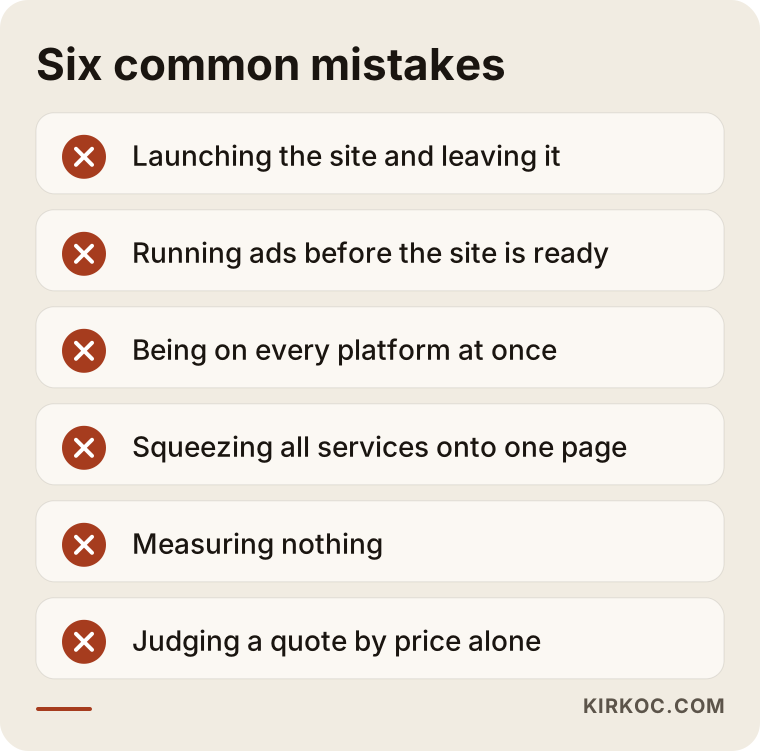
This list also works as a checklist of questions to ask yourself before you speak with an agency or a specialist. None of these mistakes is irreversible, but catching them early saves time and money.
What can you do yourself, and when do you need an expert?
You do not need an agency for everything. Some jobs you can do yourself, and that helps you spend your budget where it counts.
Things you can do yourself: open your Google business profile and fill it with correct information, keep your opening hours current, ask customers for reviews and reply to them, share real photos taken with your phone and check that the contact details on your site are right.
Where you need an expert: the technical foundation and speed of the site, a page structure that search engines understand, setting up and targeting an ad account, connecting measurement tools correctly, brand identity and a consistent visual style, and a regular content plan. These are the areas where mistakes get expensive.
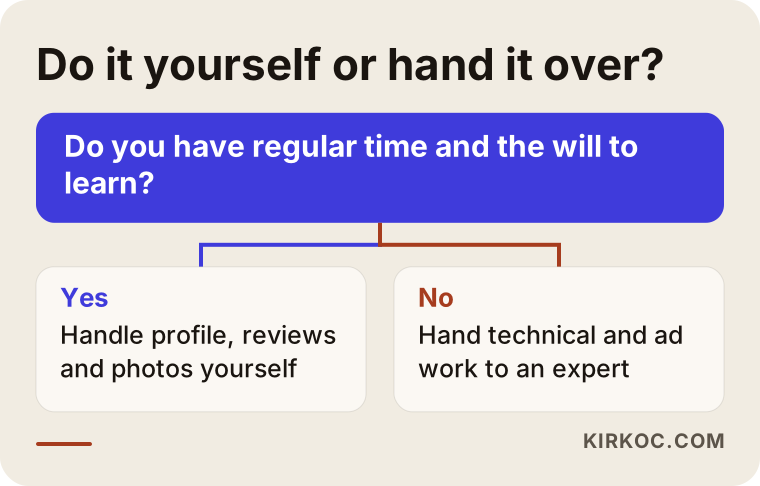
The decision chart is a rough guide. If you have regular time and want to learn, taking some pieces on makes sense. If you do not have time, or the technical side is complicated, handing it over is usually both faster and often cheaper in the long run.
A checklist before you start
The list below shows what you can prepare before talking to a specialist. If these are ready, the first call goes much more smoothly.
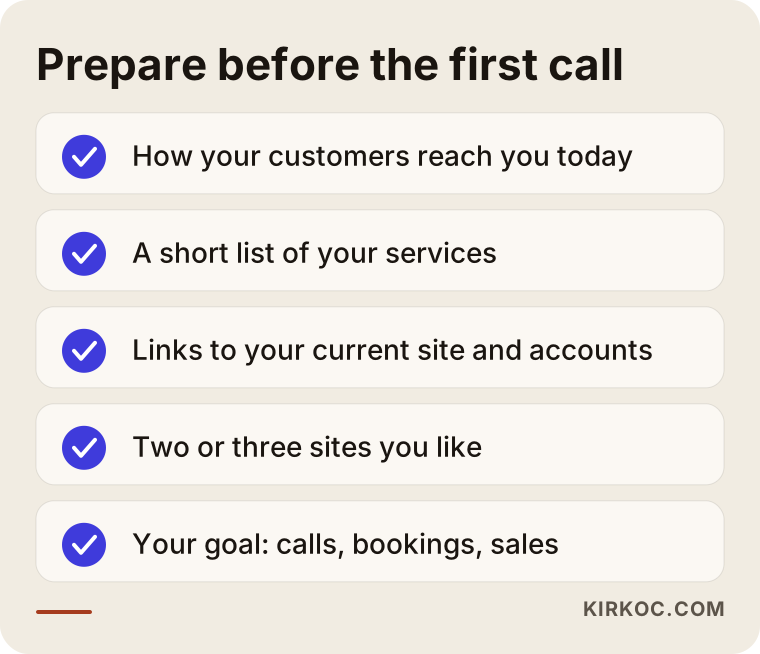
The items look simple, but most businesses are missing some of them. Even the answer to "how do customers reach you today" is often unclear, and knowing it decides which channel deserves your investment.
What determines the cost?
I will not give numbers in this article, because the same service can have a very different scope for two businesses. What I can do is explain clearly what makes the price move.
For a website, the cost depends on the number of pages, the variety of products or services, whether it is an online store, payment and shipping connections, whether it is multilingual, whether the design is custom or based on a ready template and whether the text comes from you or from me. For SEO and content, it depends on how many pages will be prepared, how much competition there is in your field, the state of the existing site and whether you want regular content. For social media, it depends on how many platforms, how many posts per month, whether video is needed and whether comments and messages will be answered. For ads, there are two separate items: the budget you pay to the ad platform and the work of the person who sets up and manages the ads. Keep them apart; if a quote mixes the two, that is a problem.
If you are a foreign company, also ask how the invoice will be issued, in which currency and what taxes apply. Rules differ depending on the structure of your company, so it is sensible to confirm this with an accountant or tax advisor.
When you collect quotes, these questions help. What does it include and what does it not include? Who will own the website, and in whose name is the domain registered? How long are you tied to a monthly service? How often will you receive reports, and in which language? The answers to these questions tell you more than the price does.
How I work
I am one person, and I see that as a way of working, not as a gap. The person you talk to is the person who does the work, so nothing is lost in the handoff. Working remotely with businesses in Ankara is not a problem with today's tools: calls are held online, documents live in a shared folder and you can reach me by phone when needed. If an in-person meeting is necessary, we can talk about that separately.
Your website belongs to you; the domain and the accounts are opened in your name. When you ask about something you do not understand, I do not answer with jargon. If I think I cannot do a job, I say so. I do not guarantee results, but I show clearly what I am doing and why.
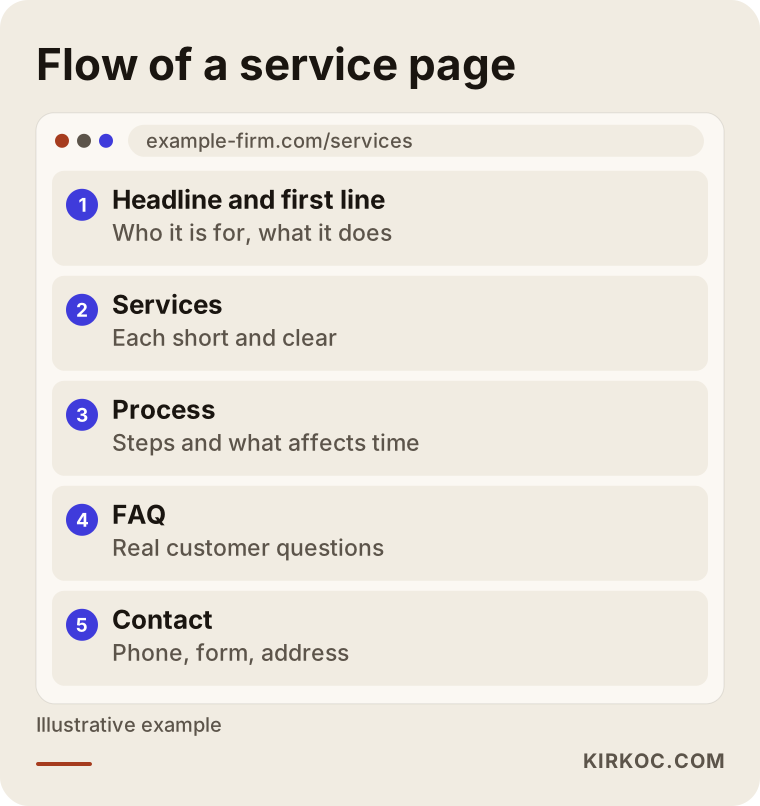
This outline shows the logic of a service page I prepare: first who it is for, then what is done, the process, frequently asked questions and the way to get in touch. Thinking of your own page in this order will also help if you write it yourself.
Frequently asked questions
What is the difference between a digital agency in Ankara and a freelancer?
At larger agencies, an account manager usually talks to you while other people do the work. When you work with one specialist, the person talking to you is the person doing the work. Large agencies are strong on wide and complex projects; a single specialist offers speed and direct contact to small and mid-sized businesses. Which one fits depends on the scale of your business.
Do I have to buy the website, SEO, social media and ads together?
No. You can start with whichever piece you need. But because these pieces depend on each other, it helps to decide together which one comes first. For example, starting ads for a business whose website does not work is usually too early.
Can we work together if I am based abroad or am only just moving to Ankara?
Yes. Since the work runs online, location is not a barrier. What matters is where your target customer is and what language and examples your site uses when it speaks to them. If you are a business that has just arrived in Ankara, local searches need their own work.
How long until I see results?
I cannot give an exact time. In advertising, the first data arrives within days, but it needs adjusting before it becomes efficient. Visibility in search engines and a steady audience on social media build over months. I keep you informed in a way that lets you see in the first month what changed and which jobs were done.
If I already have a website, does it have to be rebuilt from scratch?
Not always. If the foundation of the site is sound and the problem is in the content or structure, fixes may be enough. If the site is broken on phones, very slow or cannot be updated, rebuilding makes more sense. Before deciding, I look at the site and explain my reasons.
Do I have to give you my passwords to manage my social media accounts?
On most platforms you do not need to share a password; you can add someone as an authorized user. This keeps you as the owner of the account and lets you remove access whenever you like. Having the accounts and the domain registered in your own name is an important safeguard.
Do I decide my ad budget?
Yes. The ad budget is your decision and is paid directly to the ad platform. I explain how to split your budget and what to look at before you scale up from a small start. Testing first with a small amount to see which search or audience works is usually the healthier path.
Does asking for a quote commit me to anything?
No. The first call and the quote stage do not bind you. I listen to your need, explain the scope and present in writing what I would do. The decision is yours.
If you would like your website, search visibility, social media and ads in Ankara to move forward through one person instead of several, you can leave a message about your business and your needs through my website design service page, and I will tell you honestly where I would start.