You run a business in Ankara, or you are setting one up. Maybe it is a clinic in Cankaya, a cafe in Yenimahalle, or a small workshop near Ostim. Your Instagram account exists, but the last post is weeks old. You do not know what to write, when to write it, or whether any of it actually brings in customers. Typing "social media management Ankara" into Google at that point is a perfectly natural move. This article explains what you should expect from a social media service in Ankara, what kind of proposal you are likely to receive, and where to begin. I am Ümit Kırkoç. I work from Istanbul and handle digital work for businesses from websites to ads, all by myself, and I will be plain about the scope of my own social media management service where it matters.
If you are a foreign company or an expat entrepreneur doing business in Turkey, much of this applies to you as well, with a few extra points about language and local habits that I mention along the way.
Social media management, in simple terms, means running your business accounts in an organized way, with a purpose: deciding what to post, preparing the pictures and text, publishing them, answering messages and comments, and reading the results. That is a different job from "posting a photo now and then." Below I go through it with Ankara's particular conditions in mind.
Why social media in Ankara is a different job
It is tempting to think social media looks the same everywhere. In practice, customer behavior changes from city to city. When I think about Ankara, a few traits directly shape the work. These are tendencies I often notice, not measured facts, and your own customers may behave differently.
First, the city is wide and fragmented. Cankaya, Yenimahalle, Etimesgut, Kecioren, Mamak, Golbasi, Sincan, Altindag: a person living in Cayyolu may not want to travel to Batikent just for a cafe. So customers rarely think "Ankara." They think of their own neighborhood: "pilates in Umitkoy," "hair salon in Kizilay," "dental clinic in Bahcelievler." That is why your account needs to say, at first glance, which area you serve.
Second, the daily rhythm of the city follows office hours and the school calendar. Government agencies, universities and large companies employ a visible share of the working population. People tend to look at their phones more comfortably after work, at lunch and in the evening. During the university term student activity rises, and in summer part of that population leaves the city. This affects posting times and when you run promotions.
Third, word of mouth is strong. When choosing a doctor, a lawyer, a workshop or a school, many people in Ankara first ask someone they know. Your social media account is the first place that person opens when they think, "let me just take a look." So the job of your account is often not to attract strangers, but to convince someone who was already pointed toward you.
Fourth, competition differs a lot by sector. In health, beauty, food and drink, education and furniture, there are dozens of accounts in the same district. In some business-to-business fields, such as industrial supply, wholesale and building materials, there are very few serious accounts, and one well-run profile can stand out easily. Knowing which side you are on is the first step to setting a sensible budget and realistic expectations.
A note for foreign businesses
Ankara is the capital, so embassies, international organizations, defense and technology companies, and universities with international programs are all present. If your customers include expats or diplomats, English-language content has a real place. If your customers are mostly Turkish, your accounts need to be written in Turkish by someone who writes it naturally. Posts that are machine-translated read as unnatural to a local audience and quietly reduce trust. Many businesses in the city do well with a mix: Turkish as the main language, with short English captions for international customers.
What does a customer in Ankara look at on social media?
A person checking out an account usually scans three things very quickly: whether you are a real business, exactly what you do, and how to reach you. If they cannot answer these in about ten seconds, they go back. Here is how I summarize what customers look for, platform by platform.
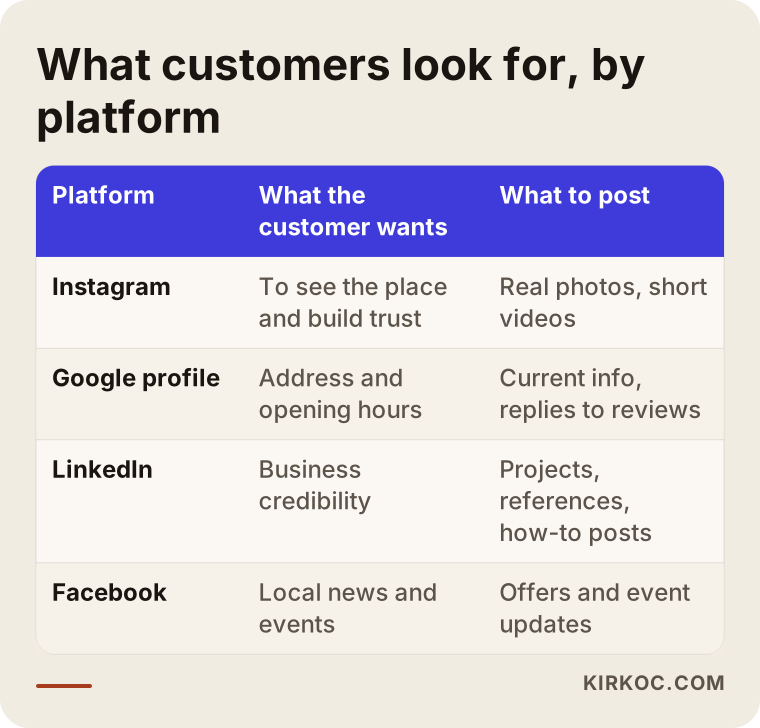
The table makes one point clear: posting the same content on every platform is usually wasted effort. On Instagram, visual trust matters. On Google and maps, address and opening hours matter. On LinkedIn, business credibility comes first. On Facebook, local news and event announcements stand out. So before anything else, look at where your customers actually are. Saying "let's be everywhere" costs both time and money.
Which platform for which business?
Before buying any service, answer one question: what is your customer doing on their phone? Here is a rough guide for common types of business in Ankara.
Clinics, beauty and aesthetic businesses. Instagram is the main stage. People want to see the result of a procedure, the environment and you. One point to watch: health-related advertising and posts are subject to regulations and professional bodies' rules. If you are unsure what you may publish, ask a lawyer or your professional chamber. I keep this in mind when I prepare content, but I cannot give legal assurance.
Cafes, restaurants and bakeries. Instagram and your map listing work together. An up-to-date menu and price list, photos of the atmosphere and short videos decide a lot. Habits such as weekend breakfasts or after-work meetups in Ankara give you content ideas.
Schools, tutoring centers and courses. Parents and students check both Instagram and Google. Enrolment periods and exam calendars shape the content plan. Parent trust, introductions of teachers and regular announcements help here.
Industry, manufacturing and wholesale. For firms in areas like Ostim, Siteler or Ivedik, LinkedIn and YouTube may make more sense. Short videos of the production process, project examples and catalog sharing build confidence among decision makers.
Lawyers, accountants and consultants. LinkedIn and Google come first. Clear, plainly written information shows expertise, but here too you should avoid exaggerated promises.
E-commerce and boutique stores. Instagram, Facebook and, if suitable, TikTok. Product photos, stock updates and quick replies to messages are decisive. Connecting your website and your social accounts properly makes a big difference.
You do not need to do everything at once. In the first three months, focusing on two platforms at most is the most reliable way to produce steady, good-quality work.
Does your profile build trust at first glance?
An Ankara customer usually arrives at your account through a recommendation or after a Google search. Whatever they find there, they decide on. Before producing content, fixing the profile itself is generally the fastest and cheapest improvement.
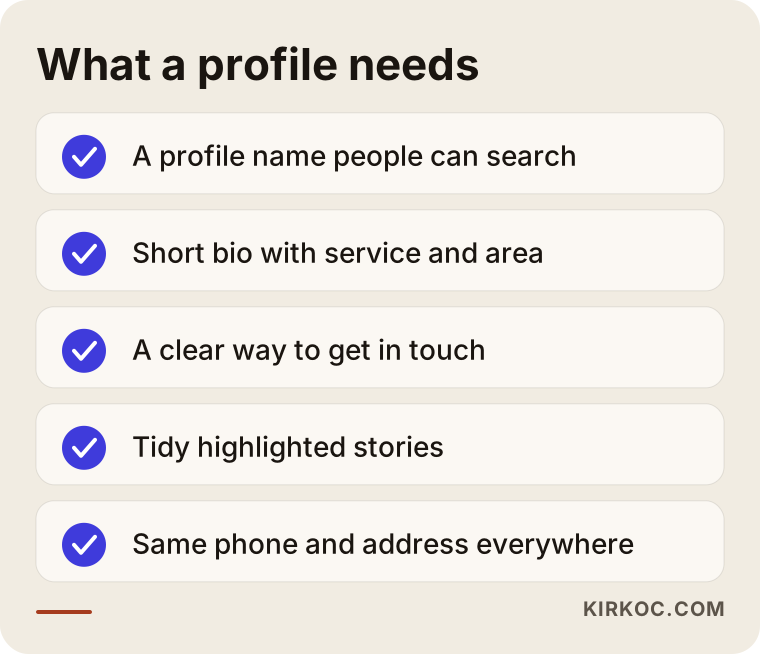
Think of this list together with the image above. Your profile name should be easy to find when searched. Your short bio should say what you do and which area you serve. There should be a clear way to contact you, and your highlighted stories (for example services, frequently asked questions, directions) should be tidy. Your phone number, address and opening hours must be identical on Instagram, Facebook, your Google Business Profile (the free listing that shows your business on Google Search and Maps) and your website. Small inconsistencies like these confuse customers and search engines alike.
Once the profile is in order, content works much better, because every post leads to the same place and the same feeling of trust.
Two example scenarios
The two scenarios below are hypothetical. They do not describe any real company or person. The point is to show how the same service takes a different shape in different businesses.
Scenario 1: a small dental clinic in Cankaya
Suppose there is a clinic with two dentists in Cankaya. The Instagram account is open but the posts are random: a holiday greeting, a stock image, an occasional discount notice. The owner does not know what the account is for, and new patients mostly arrive through recommendations.
The first job is not content but the profile: which neighborhood the clinic is in, which treatments it offers, how to book, and a few real photos of the space. Then a monthly plan is drawn up. The plan includes short, plain explanations of treatment steps, content that reduces fear such as "what happens at a first checkup," real footage from the clinic and answers to frequently asked questions. Patient reviews and before-and-after images need care, both under the rules and for patient consent, so the owner is advised to consult a lawyer on those.
In this scenario, success is not measured by follower count. It is measured by appointment questions arriving by message, calls from the profile, and the person who came on a recommendation not changing their mind after seeing the account. No outcome can be guaranteed, but the direction becomes clear.
Scenario 2: a metalworking shop in Ostim
Now imagine a completely different situation: a small firm in Ostim doing CNC and sheet metal work. Its customers are not individuals but other businesses. It either has no social media account or opened one years ago and left it empty.
Here, a LinkedIn company page and short production videos may make more sense than Instagram at first. The content could include brief footage of machines at work, which materials the shop handles, how a typical order moves along, and what affects delivery time. All of it links to the relevant pages on the firm's website. A person asking for a quote will look at the website first and then at social media, and decide "this company is real and works regularly."
What the two scenarios share: the service is not "posting." It is building a routine that makes that business's customer decision easier.
How does social media management work, step by step?
Knowing what a process should look like also makes it easier to compare quotes. This is how I work.
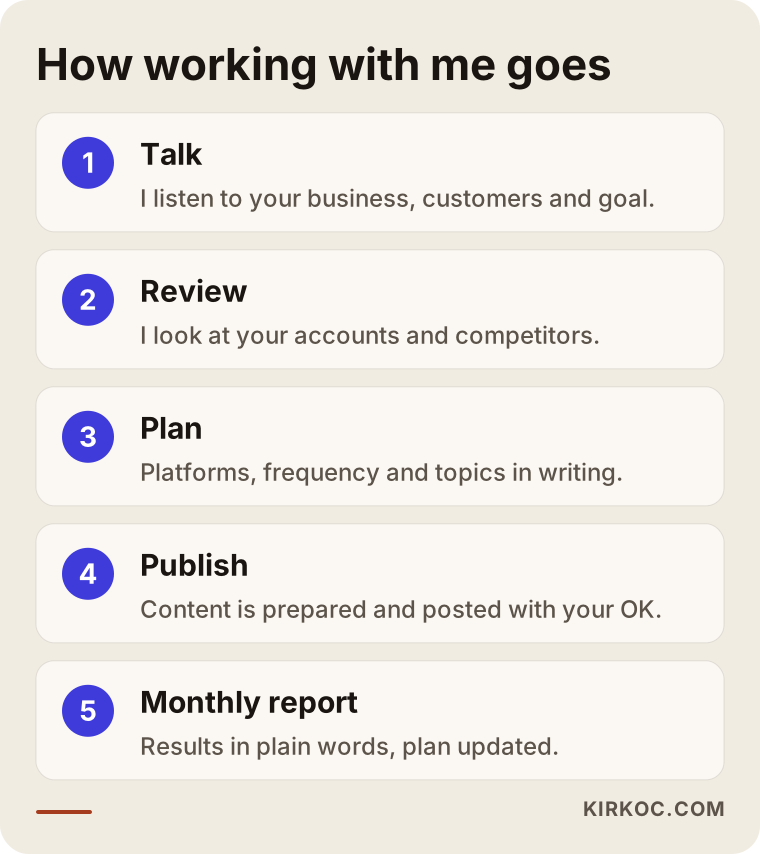
First, a short conversation to understand your business, your customer and your goal. Then I look at your current accounts and a few competitors. Next comes the plan: which platforms, how many posts a month, which topics, and who approves what. After you approve the plan, content is produced, a publishing calendar is set up, and you and I settle how incoming messages will be handled. At the end of every month I share a simple report: which content got attention, which messages came in, and what I will change next month.
Two things matter in this flow. The first is that the accounts stay in your name: you keep the passwords and the owner-level access, and I am added as a manager. The second is that the report is simple, with a sentence next to the numbers saying what they mean.
Content rhythm: how much and how often?
The question business owners ask most often is, "How many posts a week do I need?" The honest answer is: the amount you can keep up. A steady, careful rhythm over three months beats one busy month followed by silence.
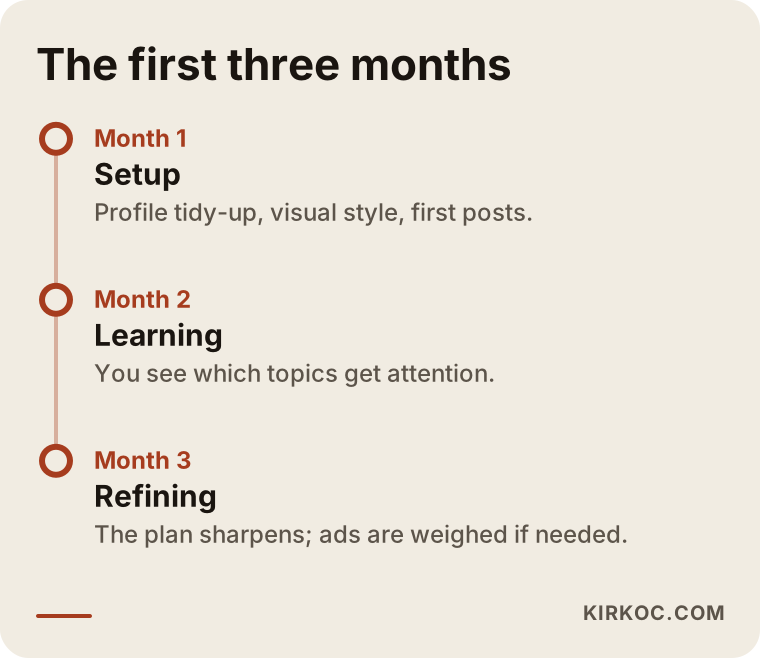
The first month is usually setup: profiles are tidied, a visual style is chosen and the first posts go out. In the second month you start to see which content works, and topics get sorted. In the third month the plan is simplified using what you have learned, and extra steps such as advertising are considered if needed. Rather than expecting quick results, it is more realistic to treat these three months as a learning period.
You also need variety in the type of content. An account that only sells gets ignored, and an account that is entertaining but never explains the business does not bring customers. A mix of useful information, real photos and video that build trust, frequently asked questions, product or service introductions and the occasional announcement is a balanced starting point for most businesses.
Turning viewers into customers
Not everyone who likes a post becomes a customer, and that is completely normal. What matters is that someone who is interested can find you and reach you easily. Picture it: a person sees your post, opens your profile, understands what you do, asks a question and gets a booking or a quote. If that path is blocked anywhere, it does not matter how many people see your content.
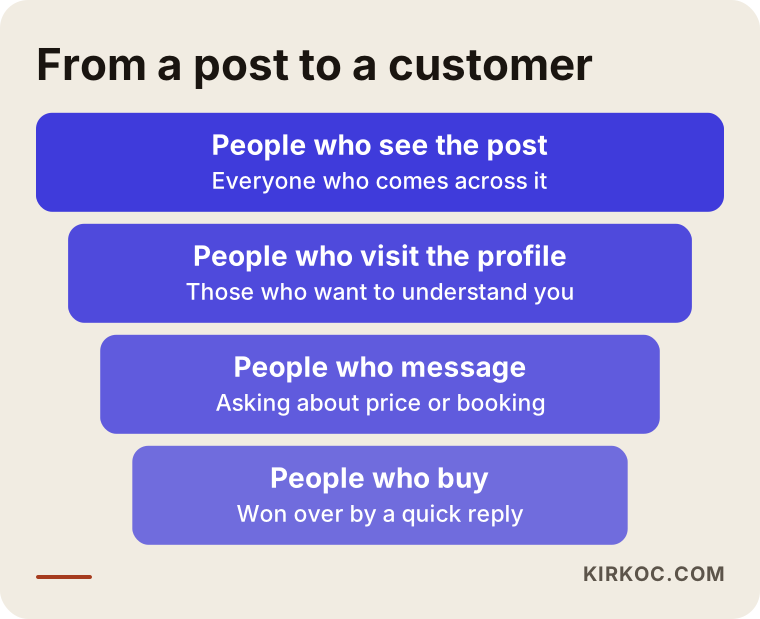
The funnel shows it well: at the widest part are people who see the content, then those who visit the profile, those who send a message, and finally those who become customers. Some are lost at every stage. The goal is not to eliminate every loss but to prevent the unnecessary ones. Late replies to messages, missing contact details on the profile and a broken link are the most common causes.
Your profile link plays a key role. It matters where the person lands after tapping the single link in your Instagram bio. If they land on a home page and have to hunt for what they want, most will give up. Better is a short page prepared specifically for visitors from that account.
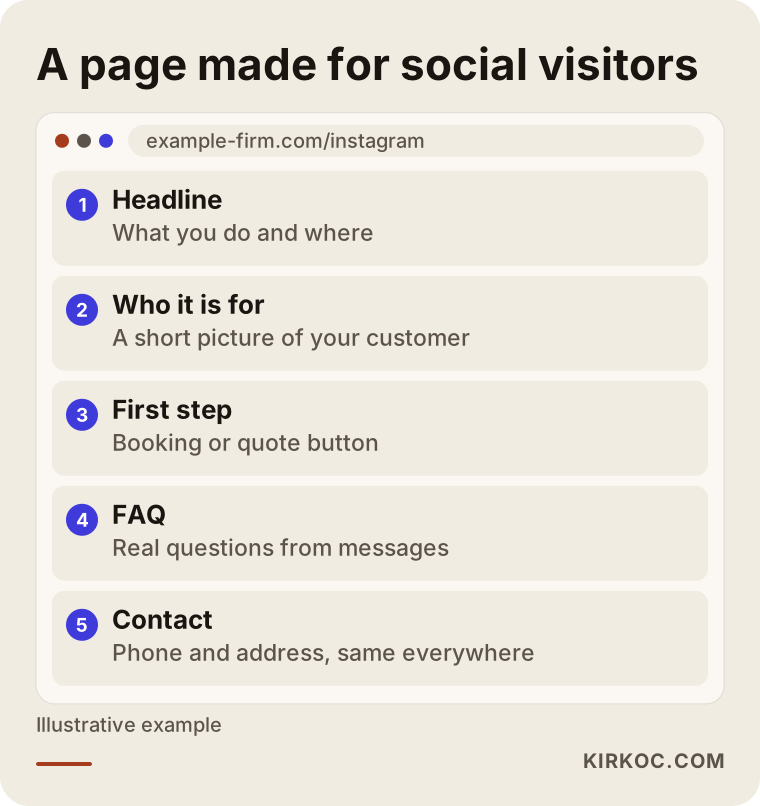
A page like this shows what you do, which area you are in, what the first step is and how to contact you, all at a glance. This is where having your website and your social media with one person has a concrete benefit: I design the page on the website around the social media flow, and I link social content to the service pages on your site. When these jobs sit with different people, the pieces often end up disconnected.
How AI assistants and search engines see your account
People no longer ask only Google. They also ask AI assistants things like, "Can you suggest a trustworthy dental clinic in Ankara?" These assistants draw on open sources across the internet when they answer. Do not expect your social media account to be the answer by itself. But if the details on it (name, address, services) match your website and your Google Business Profile, that consistency helps confirm that your business is real and clearly identifiable.
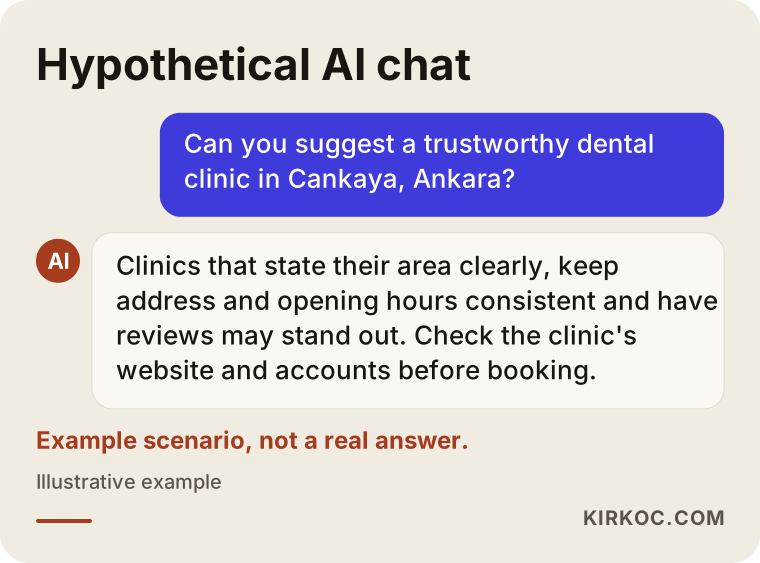
The example in the image is a hypothetical chat, not a real answer from a real system. The message is this: the more consistent, clear and detailed the information you publish, the more accurately both people and these systems will understand who you are. Treat this as long-term preparation, not as a guaranteed result.
Common social media mistakes in Ankara
I have listed the mistakes I see repeated year after year. Most can be fixed without spending money.
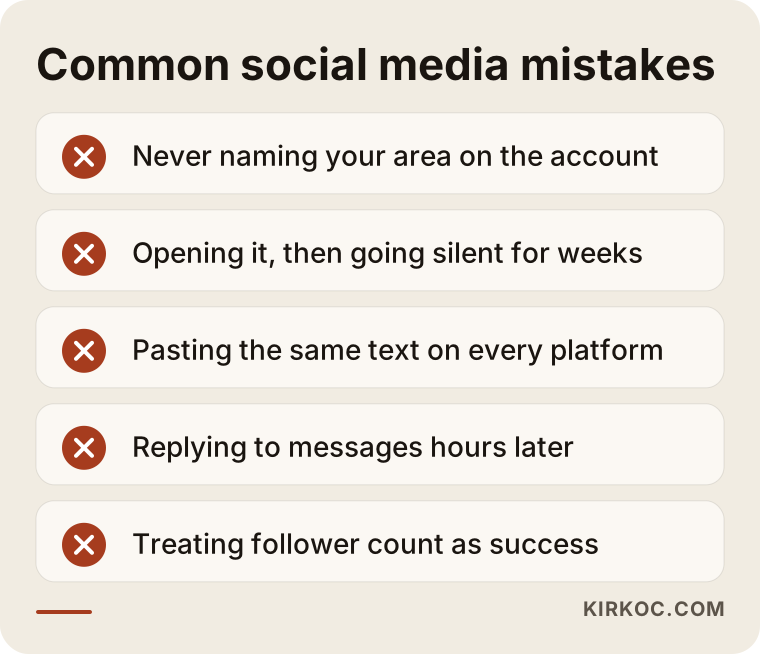
The first mistake is never naming your area. If your customers are in Cankaya and your account does not say so, someone looking from outside may assume you are an out-of-town business. The second is opening an account in a burst of enthusiasm and abandoning it. Three weeks of silence makes a visitor wonder, "is this business still open?" The third is pasting the same text on every platform; the readers of Instagram, LinkedIn and Facebook are different.
The fourth mistake is replying to messages late. Many people ask about price or availability by direct message, and an answer that arrives hours later often means a lost opportunity. The fifth is treating follower count as success. Bought or irrelevant followers make an account look crowded but bring no customers, and they make campaign results harder to read. The last mistake is expecting results too early: social media usually matures over several months of steady work, not a few weeks.
What can you do yourself, and when do you need a specialist?
Not every business needs outside help. If you have time and enjoy explaining your work, you can handle the basics yourself. A decent photo taken with a phone, an answer to a real customer question and up-to-date profile details already make a big difference.
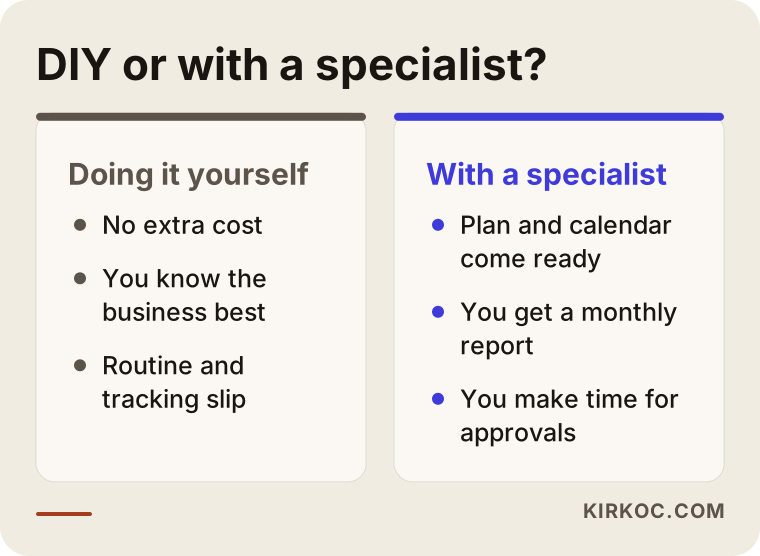
If you do it yourself, there is no extra cost and you know the business better than anyone, but it takes time, staying consistent gets harder and measurement tends to be skipped. If you work with a specialist, you gain structure, planning and measurement, but you still need to make time for content and approvals. Nobody knows your business as well as you do, and a good specialist learns that from you.
To decide, ask yourself this question.
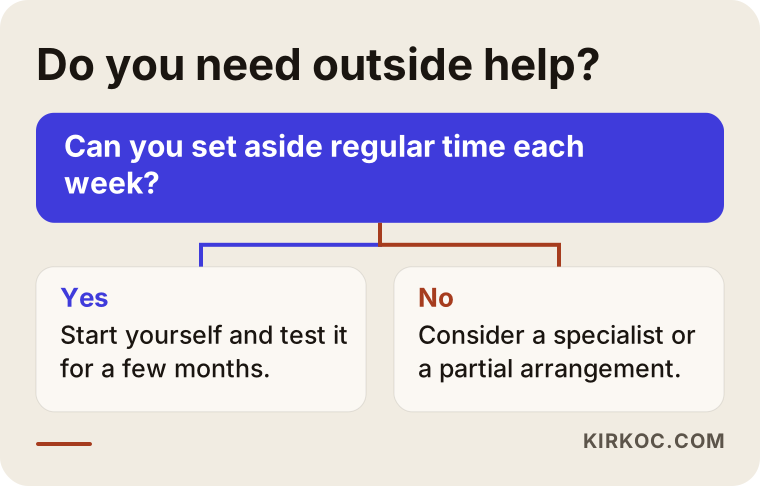
If you can set aside regular time each week, you can start on your own and test it for a while. If you cannot, or if you want the account to grow but do not know how, getting help from a specialist makes sense. There is a middle path too: in the first month I set up the plan and the profile structure with you, and then you take over some of the tasks.
What determines the cost of social media management?
I do not give figures in this article, because price changes a lot from job to job. But knowing what affects the price helps you understand the quotes you receive.
The first factor is the number of platforms. Running one account is not the same effort as running four. The second is the type of content: do you only want images with text, or do you also need video shoots, short video editing and photography? The third is posting frequency: a few posts a month is very different from a steady weekly flow. The fourth is the scope of management: handling comments and messages, preparing stories and producing reports are separate items of work. The fifth is advertising: if there are paid social ads, the ad budget and the effort of managing them are calculated separately. The sixth is how much ready material you can provide yourself, because using photos you shoot yourself changes the cost.
When you collect quotes, check these points: is the scope in writing, is it clear what is included, are the ad budget and the service fee shown separately, is there a monthly report, and in whose name are the accounts opened? Treat with caution any quote that cannot answer these questions clearly.
How I work
I work alone from Istanbul, and working remotely with businesses in Ankara through video or phone calls is no problem. The need to meet face to face is rare, and I run most of the work digitally. In remote work like this I take the local knowledge from you: which neighborhoods your customers come from, what they object to, which periods are busy. Combining the knowledge inside your business with my experience on the digital side gives the healthiest result.
Because I provide all of my services myself, social media work runs in the same plan as your website, your visibility in search and, if needed, your ads. For example, adding a separate page to your website for a topic that is getting attention on social media, or welcoming website visitors again on social media, happens quickly with one person making the decision. Nothing is handed to someone else, nobody has to be waited for, and no information gets lost.
There is a limit to this as well: I am one person, so the number of jobs I can take on at the same time is limited. That is why, when starting a new job, I talk openly about my capacity and your expectations, and I do not accept work I cannot do properly.
Frequently asked questions
Do I need an agency based in Ankara for social media management in Ankara?
No. What matters is that you work with someone who understands your customer and your area. I take the local knowledge from you, while planning, design and publishing are easy to run remotely. Regular contact takes place by video call or phone when needed.
Which platform should I start with?
The one where your customers spend the most time and where they look you up. If you serve individual customers, Instagram is usually the better choice, and if you sell to other businesses, LinkedIn makes more sense. If you are not sure, start with two platforms and decide by looking at the results.
How long until I see results?
It depends on your business, your sector and the current state of your account. You can expect to see the effect of a tidier profile earlier, and the effect of content over a few months. It would not be honest to promise a specific time or result.
Does follower count matter?
Not by itself. More than the number, what matters is that the followers really belong to your customer base and that messages, calls or bookings come from them. A small but relevant audience is worth more than a large, irrelevant one.
Do I have to hand over my account passwords?
No. The right method is for the accounts to stay in your name and for administrator access to be granted separately. That way you can remove access whenever you like. I recommend this approach instead of sharing passwords.
Is it necessary to run social media ads?
It is not necessary. First the account and the profile need to work properly. Ads are more efficient once results are clear, because they take a message that already works to more people. The ad budget and the management effort are separate.
Who will look after comments and messages?
That depends on the scope of the agreement. If you prefer, you handle the messages and I prepare reply drafts and ready-made texts for frequent questions. If you prefer, comment management can be included. Which you choose depends on how busy your business is and how much time you have.
Can I post about regulated areas such as health or law?
Yes, but advertising and promotion rules apply separately in those fields. I prepare content that is informative and measured, but I cannot give a definite opinion on which wording complies with the regulations. For that, you should consult a lawyer or your professional body.
If you want to set up an organized, understandable and measurable social media routine for your business in Ankara, reach out through my social media management service page. Let us look at your current accounts together, and I will explain in plain language where to begin.