You have a business in Izmir, or you are planning one. Maybe it is a cafe in Alsancak, a clinic in Bornova, a workshop in Cigli or a boutique hotel in Urla. Maybe you are a foreign owner who moved to the Aegean coast and now needs customers who speak Turkish, or a company abroad that wants to sell into this region. Some of your customers still arrive through word of mouth, but the phone rings less than it used to, and your competitors look more visible online than you do. A friend told you to "work with a digital agency," you typed "digital agency Izmir" into Google, and you landed in a long list of names that all sound alike.
This article is written for exactly that moment. I am Ümit Kırkoç. I work from Istanbul and I run every service a digital agency would offer by myself: websites and online stores, SEO, local SEO, social media, Google and Meta ads, logo and brand identity, and content. Below I explain, in plain language, what you should expect from a digital agency in Izmir, how to read the quotes you receive, and where to start. Because the starting point is usually a solid website, I will return to it where it matters.
First, a short definition. A digital agency is a person or team that takes on the jobs that get your business found, remembered and chosen online. That includes your website, your visibility on Google, your social media accounts, your ads and your visual identity. You do not need to understand all of it. What you need is to pick the right pieces in the right order.
What does a digital agency in Izmir actually do?
The phrase "digital agency" covers very different packages. One provider only posts on Instagram. Another only runs ads. A third builds a site and then vanishes. If you settle the scope in your own head before collecting quotes, you will avoid comparing apples with oranges.
Most digital agency work breaks down into these parts:
- Website and online store: Your main address on the internet. It holds your services, contact details and everything that builds trust. If you sell products, the online shop belongs here too.
- SEO and local SEO: The work that makes your site appear on Google, especially in searches that include "Izmir" or a district name. Local SEO is the part focused on map results and neighborhood searches.
- GEO: Short for generative engine optimization. It means writing your pages so that AI tools such as ChatGPT, and Google's summary answers, can use you as a source. It is a young field with a simple idea: clear, accurate pages are easier to quote.
- Social media management: Planning, creating and publishing content on Instagram, Facebook, LinkedIn, TikTok and YouTube, plus keeping an eye on comments and messages.
- Ad management: Setting up and tracking Google ads and Meta ads (Instagram and Facebook), then adjusting them so budget is not wasted.
- Logo and brand identity: Colors, fonts, business cards and social media visuals that make the whole business look consistent.
- Content production: Articles, photos, short videos and page copy.
No business needs all of these on day one. What matters is knowing that they feed each other. If an ad sends a visitor to a weak website, the money is wasted. A beautiful website that nobody searches for is a shop with no street in front of it. That is why "what comes first?" is the question that decides where your budget goes.
How do customers search for you in Izmir?
Izmir is not one uniform crowd. It is a collection of quite different areas. Someone living in Karsiyaka looking for a dentist or hairdresser usually starts with their own neighborhood. The student and academic population around Bornova searches for different things than residents of Buca. In Cesme and Urla, the nature of searches changes completely with the summer season. So generic searches like "Izmir" matter, but so do searches that name Karsiyaka, Alsancak, Buca or Bayrakli.
If you are a foreigner doing business here, there is one more layer. Many residents and visitors search in English, while local customers search in Turkish. Often you need pages in both languages, and each should be written for the people who actually read it rather than translated word for word.
Here is an example of how this plays out. The picture below is a completely invented results page. Its only purpose is to show why a clear page can stand out from a general list.
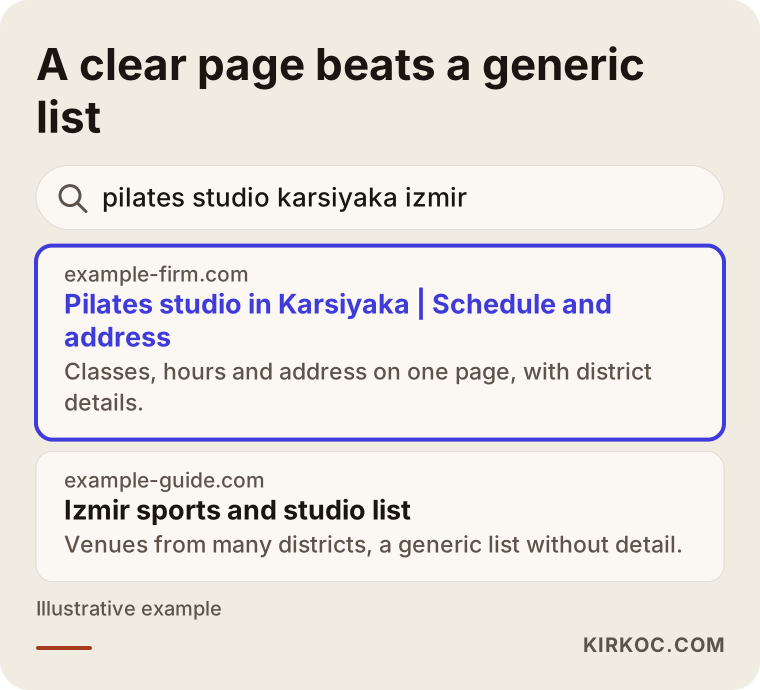
The highlighted page states the service and the district in its title and gives its hours and address. The generic list shows options from all over Izmir with no detail. A person searching wants to see something close to them with enough information to decide immediately, and a page that provides that has a better chance of being shown first. No ranking can be guaranteed, because nobody outside Google fully knows how it decides. Still, being clear and giving accurate local information is a sound approach in general.
Season and neighborhood
Some Izmir businesses follow the calendar. In Cesme, Alacati, Urla and Foca, demand climbs in summer and drops in winter. For those businesses the digital work should begin a few months before the season, because vacationers plan early. Service businesses in the city center, such as clinics, law offices, accountants and schools, get steadier searches through the year. So the answer to "when should I start?" depends on the sector. A good provider discusses this with you and does not push a ready-made calendar.
The intent behind the search
Two people typing similar words do not want the same thing. "Izmir web design examples" is research. "Hire web designer Izmir" is someone close to a decision. Searches with buying intent are the second kind, and they are the most valuable for a business. Building your pages to meet that person matters far more than raw visitor numbers. A hundred visitors who browse and leave are worse than ten visitors of whom three pick up the phone.
Which pages does a business in Izmir need?
Many businesses build a site with "home, about, contact" and stop there. That layout introduces you, but it does not get you found. If a customer searches for "teeth whitening in Bornova" and your site has no page that describes that service and mentions that district, Google has nothing to show.
In practice, these pages make a difference:
- A separate page for each main service, instead of piling everything on one page.
- Short but genuinely useful pages for the districts or neighborhoods you serve.
- A section answering frequently asked questions.
- A clear contact page with phone number, address, opening hours and a map.
- A section with your past work, case studies or reviews, so visitors can trust you.
The picture below shows, using an invented address, how one district service page could be laid out.
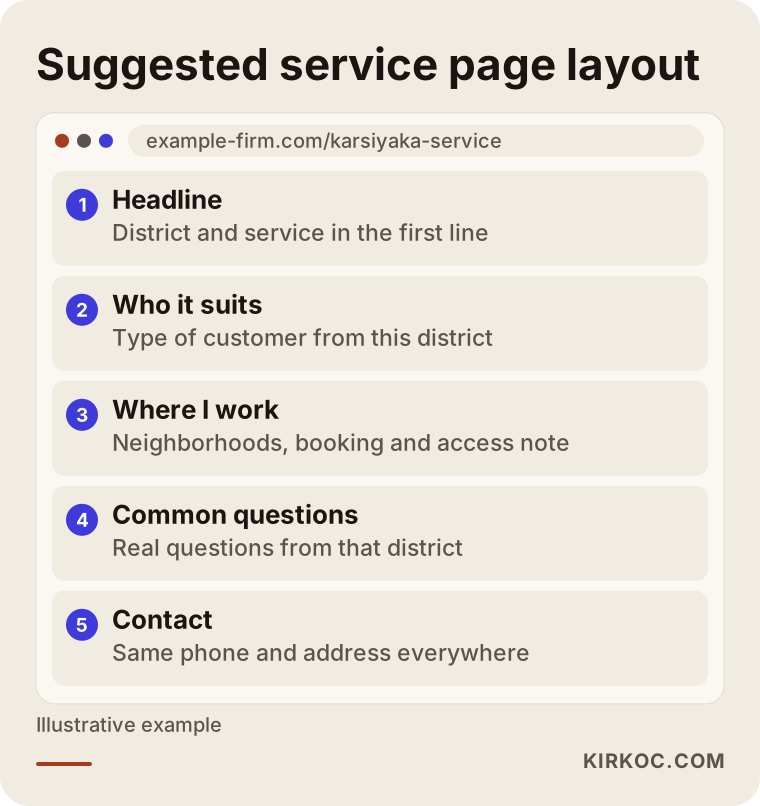
Each block in this layout has one job. The headline says what you offer and where you are. The "who it suits" block welcomes the right customer and politely filters out the wrong one. The contact block repeats the same phone number and address on every page, and that consistency reassures both visitors and the map results. Writing the same detail differently in different places, for example one address on the site and another on the map profile, is a very common mistake that weakens the whole effort.
Do you need a separate page for every district?
No. Open a page only for places where you really work and really want customers. Copying one text and swapping the district name satisfies neither readers nor search engines. Each page should answer something a customer in that district truly wonders about: how to get there, how booking works, which neighborhoods you already serve. If you have nothing specific to say, skip that page. A few good pages are worth more than many empty ones.
Why does one person handling everything make a difference?
Digital work is often split up. One person builds the site, another manages social media, a third sets up ads, and a fourth made the logo. Each may be good at their own task, but the communication between them usually falls on you. The ad specialist says the page loads slowly, the web developer says their job is finished, and the social media manager has never heard of the campaign. Somewhere along the way, you become the coordinator of a team while also running a business.
When one person covers everything, responsibility is clear. If something breaks, you know whom to call. More importantly, decisions take each other into account: whatever the ad promises is also written on the site, the visual style on social media matches your website, and the title people see in search results agrees with the sentence on the page.
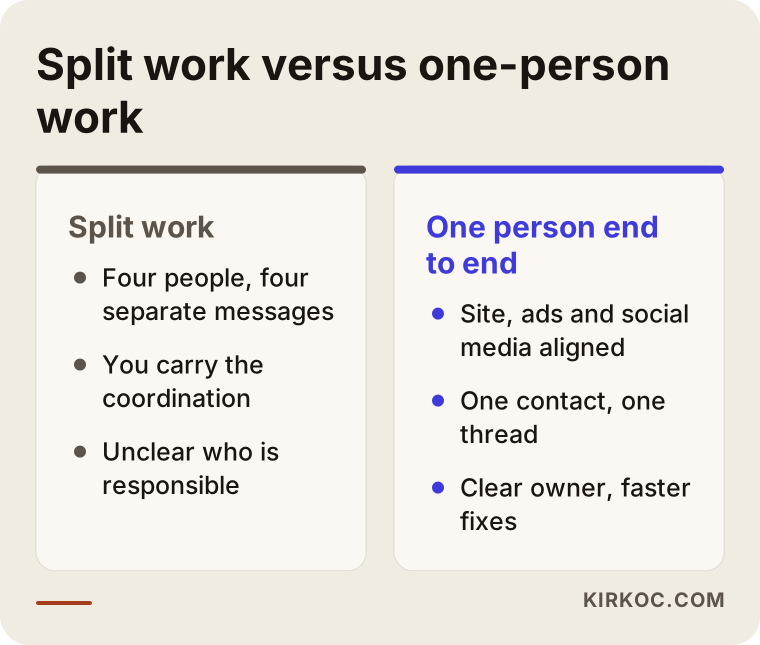
The point of this comparison is not that working with one person is perfect in every case. A large company may need heavy production across many channels at once, and then a team is the right tool. For a small or mid-sized business, however, a single person who knows everything and connects it all keeps both communication and cost simpler. That is why I handle the website, SEO, social media, ads and brand identity myself.
Social media and ads in Izmir: which one, and when?
Many owners start with "I should be on Instagram" or "I should run ads." Both can be right, but you need to know what each is for. Ads buy visibility for as long as you pay, and they suit people who want quick results. SEO and local visibility take longer to build, but once in place they keep working for months. Social media builds trust and familiarity, since people often check your profile before they ever call you.
The table below summarizes which channel suits which goal.
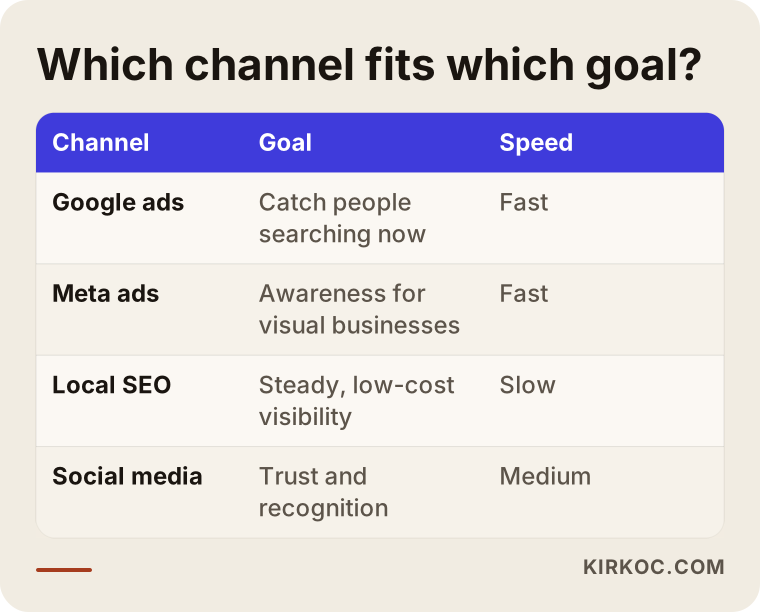
The lesson is that no single channel solves everything. For a newly opened business, a quick way to get calls is often Google ads, because you catch the person who is searching at that very moment. For a visually strong business such as beauty, venues, furniture or fashion, Instagram and Meta ads make a more natural shop window. For anyone who wants a long-term, low-cost routine, local SEO is the foundation. Rather than putting the whole budget into one channel, talk about the goal first and then divide the money.
The most common budget mistake with ads
Many owners decide "I will spend whatever I can spare," launch a campaign and leave it alone. Ads are not finished once they are set up. Someone has to check which searches are using the money and which ads actually bring calls. Without that, the budget quietly flows toward the wrong searches. The report should say, in words you understand, how many people called and how many filled in a form. A click count by itself is not a result.
Example scenario 1: a new pilates studio in Karsiyaka
This is a hypothetical scenario, not a real person or company. Imagine a new pilates studio has opened in Karsiyaka. The owner is a good instructor but has nothing online: no website, no regular Instagram account and no map profile. The budget is limited, and the goal is a full class schedule within the first three months.
In a case like this, the order could go as follows. First, a simple website: the classes, the schedule, a note on what the price depends on, the address and a booking form. Next, the map profile is filled in completely, because people searching for "pilates near me" find businesses there. Then the social media account is set up with a simple content routine built from class moments, an introduction of the instructor and frequently asked questions. For a quick start, a small Meta ad could announce a free trial class to people in and around Karsiyaka.
What matters here is that each piece supports the others: the "free trial class" in the ad is also on the site, and the schedule shared on social media matches the one on the website. No result can be guaranteed, but this beats a scattered start because it is much easier to measure.
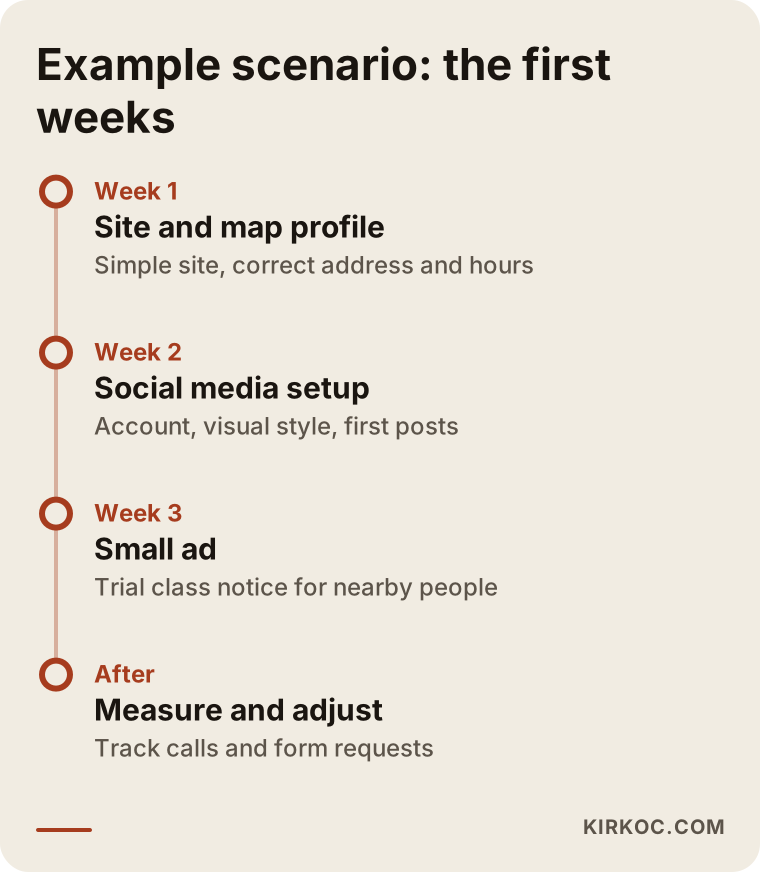
As the timeline shows, not everything starts at once. The foundation comes first, visibility next, and measurement with adjustments last. The order is deliberate, because putting ad money into a business without a foundation is like pouring water into a bucket with holes.
Example scenario 2: a business-to-business manufacturer in Bornova
The second scenario is also entirely hypothetical. Picture a small manufacturer around Bornova or Kemalpasa that sells to other businesses. Its customers are purchasing managers rather than individuals. These buyers usually type a technical term into Google, look at a few sites and then ask for a quote. This manufacturer's website was built years ago, its product pages consist of a single photo each, and it is hard to read on a phone.
Here, social media is not the first priority. The product and service pages are rebuilt first: for each product group a clear description, dimensions, uses, common questions and a "request a quote" form. After that, SEO work targets the terms buyers type. LinkedIn is the most meaningful social channel for a business like this, because that is where decision makers can be reached. A Google ad with a small budget can also be tested on searches typed by people who are ready to ask for a quote.
If you are a foreign company buying from Turkish manufacturers, the same logic works in reverse. A supplier whose product pages are clear, available in English and easy to read on a phone is far easier to shortlist than one whose catalog sits in a PDF.
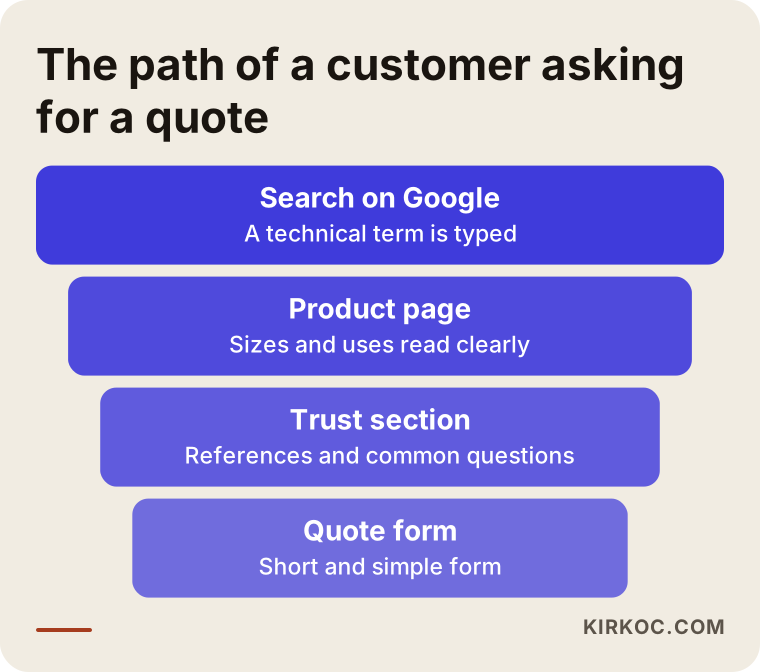
At each stage of the funnel some people drop off, and that is normal. What counts is that every stage makes the next step easy. If the product page is unclear, nobody reaches the quote form. If the form is long and complicated, some of those who reach it give up. This is why page improvements are often the cheapest and most effective moves.
How does working with a digital agency in Izmir go?
A proper process follows a clear order. The steps below are the flow I use, and the flow you should expect from any provider.
- Introduction and goal: I listen to your business, your customer and what you want to achieve. "Be more visible" is not a goal. A measurable statement such as "a certain number of new bookings per month" is. That is not a promise of numbers, it just shows direction.
- Review of the current situation: Your website, map profile, social media accounts and competitors are briefly examined.
- Plan and priorities: What comes first and what comes later is presented in writing.
- Setup: The site, pages, profiles, accounts and, if needed, ad campaigns are prepared.
- Launch and follow-up: Results are measured, reported in language you can follow, and weak spots are corrected.
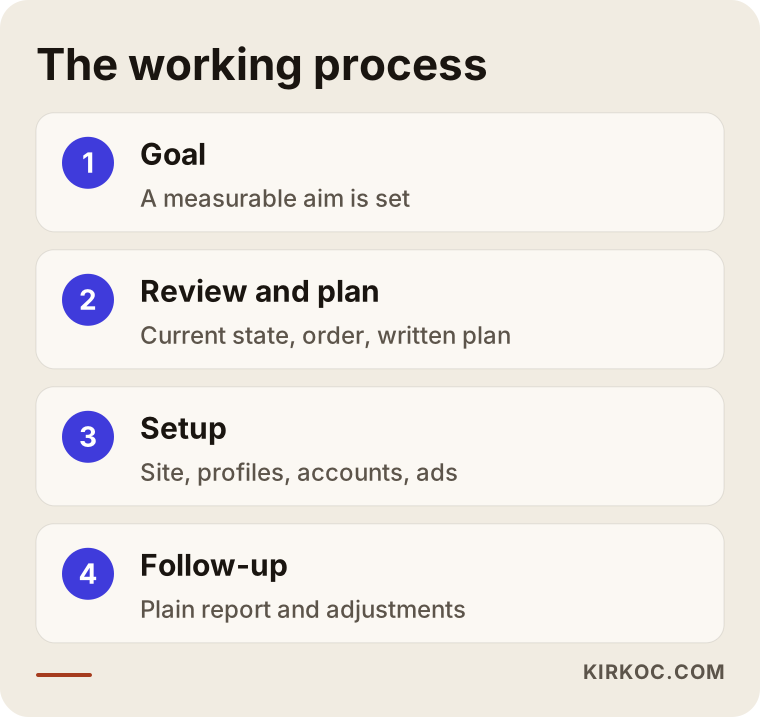
This flow also asks something from you: accurate information, photos and quick answers to a few questions. The best results come from work where the owner and the provider stay in regular contact. An approach of "do everything, don't ask me anything" tends to produce generic content that does not reflect your business.
In what order should you start?
Usually this order makes sense: website and basic trust elements first, then local visibility, then a social media routine, and finally ads aimed at growth. But if an urgent campaign period is coming, such as a season opening, you can start with a quick ad and improve the site in parallel. The important thing is to make that choice consciously.
Common mistakes when choosing a digital agency in Izmir
I have seen businesses fall into the same traps often enough to list them. Knowing them saves time and money.
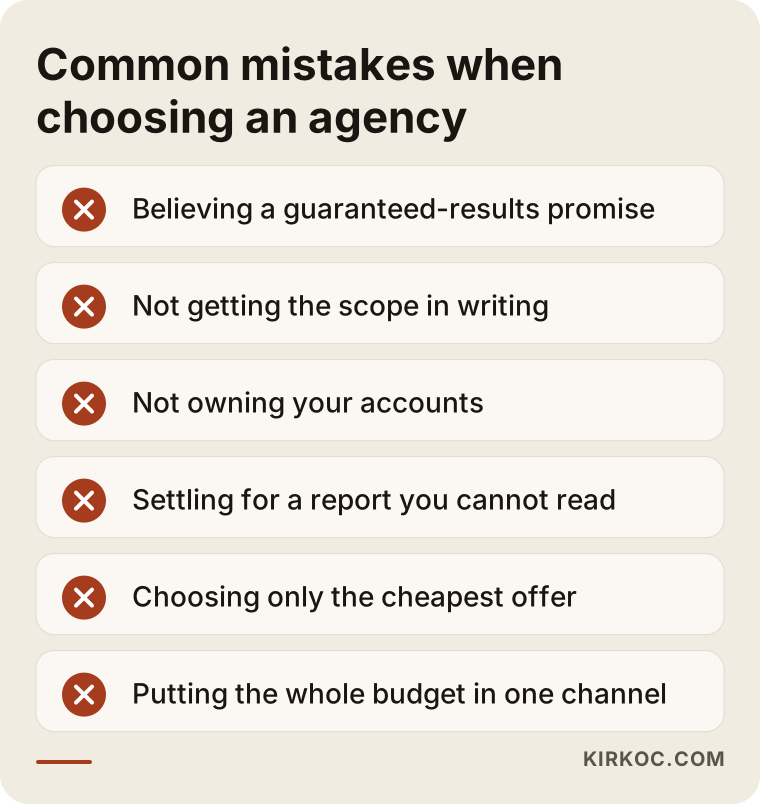
Here is each item from the picture, briefly:
- Believing a guarantee: Promises such as "we will put you on the first page" or "this many followers guaranteed" are a serious warning sign. Nobody controls search results or social media algorithms. An honest provider explains the process and method, and does not promise the outcome.
- Not getting the scope in writing: The quote must say what is included, how many pieces of content, which pages and which reports. A vague phrase like "digital management" causes disputes later.
- Not owning your accounts: Your domain name, ad accounts, map profile and social media accounts should be opened in your name. If you change providers or the work ends, you must not lose access. This is the mistake people regret most.
- Not receiving a report, or not understanding it: A report should tell you what happened. A report you cannot understand is worthless, so ask for it to be explained again in plain language.
- Looking only at price: The cheapest quote is often the one that covers the least. Compare by scope, not by the number at the bottom.
- Template content: Text that says nothing specific about Izmir and could be pasted into any other city will not attract customers. Local knowledge and the business's own voice are needed.
- Putting the whole budget into one channel: Relying only on ads and neglecting the website means going back to zero the day the ads stop.
If you are a foreign owner, add one more check: make sure the provider can explain things clearly in a language you are comfortable with, and ask who will actually do the work. Some firms sell with one person and deliver with another.
AI tools and your Izmir business
People now ask some of their questions to tools like ChatGPT instead of Google, for example "how do I find a reliable accountant in Izmir?" When these tools answer, they gather information from pages on the internet. If your site clearly states your service, your area and your frequently asked questions, the chance that your information gets used goes up. Of course you cannot order a tool to "show me," and nothing is guaranteed, but pages that are open, accurate and well organized help you in both search engines and these tools.
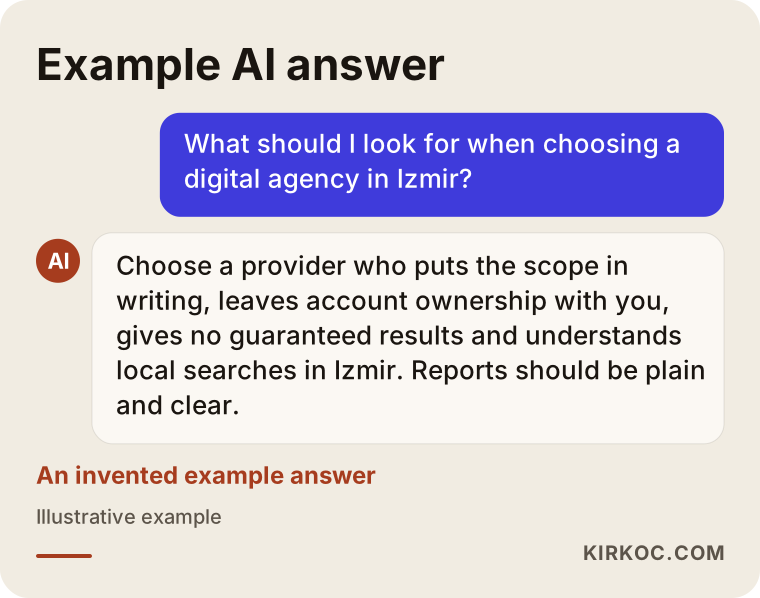
This sample answer is invented, but the logic is real: such tools tend to surface criteria that are listed openly and services that are described clearly. Read your own site with that in mind. Could a stranger who sees only this page understand what you do, where you work and how to reach you? If not, an AI tool will struggle too.
What can you do yourself, and when do you need an expert?
You do not have to hand everything to someone else. There is plenty you can do on your own, and it protects your budget:
- Open your Google Business Profile and fill in the address, phone number and opening hours correctly.
- Politely ask satisfied customers to leave a review. Do not buy or invent reviews; that is neither ethical nor safe.
- Share real moments from your work, filmed with your own phone.
- Write down the questions customers ask most often and keep them as raw material for your site.
Expert help makes sense in these cases: you are building a site from scratch or your current site is broken on mobile, you do not appear in searches and cannot work out why, you have an ad budget but see no results, or you simply do not have time to run several channels regularly. You can sort this out with one simple question.
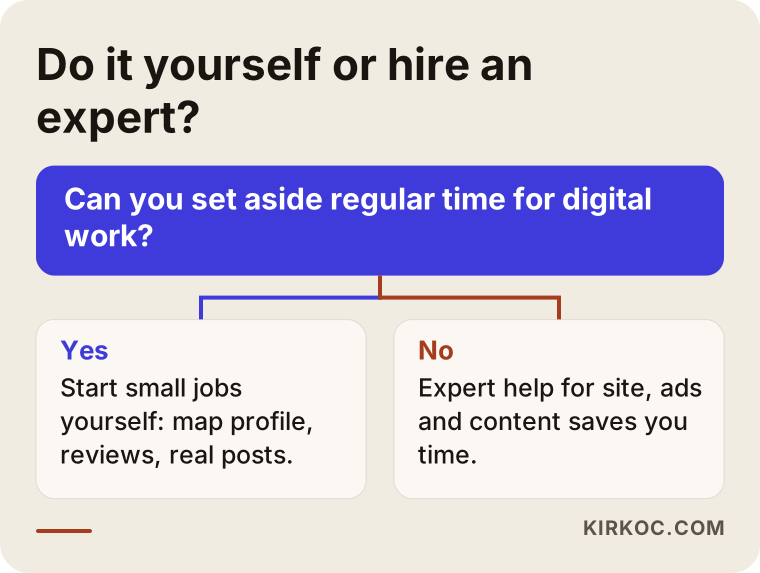
In short, if you have time and want to learn the basics, you can handle the small tasks yourself. But if your business is growing and digital work pulls you away from the real job, handing it to a specialist usually gives you time back.
What determines the cost?
I do not give numbers in this article, because no two businesses need the same thing and a number would mislead you. What I can do is tell you clearly what moves the price:
- Scope: Only a website, or website, SEO, social media and ads together?
- Size of the site: A five-page presentation site and an online store with hundreds of products are not the same job.
- Amount of content: How many posts, articles and videos per month are wanted?
- Starting point: Do you already have a logo, photos and text, or must everything be produced from scratch?
- Ad budget: Ad spend is a separate item. It goes to the platform and is not part of the service fee, while the work of managing it is priced separately.
- Competition: Getting results in a crowded sector takes more work than in a less competitive one.
- Duration: Is it a one-time setup or ongoing monthly support?
- Languages: Pages in Turkish only, or in Turkish and English, each written properly for its readers.
When you receive a quote, check that each of these items is written down. If you do not understand what you are paying for, ask. Also ask how invoicing works and whether the provider is registered in a way that fits your company's accounting. For questions about taxes or contracts with a Turkish business, speak to a qualified local accountant or lawyer.
Questions to ask yourself before asking for quotes
If you ask yourself these questions before talking to an agency, the conversation will be far more productive:
- How do my customers search for me, and where do they meet me online?
- Where do most of my customers come from right now?
- What number do I want to grow this year: calls, bookings or online orders?
- Do I truly own my website and my accounts?
- How much time per month can I give to this work?
- Which languages do my customers use?
Writing the answers on a single page is already half the job, because a good provider cannot build the right plan without knowing what you want.
How I work
I work from Istanbul and run projects remotely. Working with businesses in Izmir does not require meeting face to face. Video calls, messages and shared documents keep things moving in an orderly way. When a photo shoot or an on-site meeting is useful, a visit to the city can be arranged, and we decide that according to the kind of work. You deal with me alone: because the website, SEO, social media, ads and brand identity all sit with one person, nobody stands between you and the work translating. I listen first, and I do not try to sell something you do not need. Sometimes the honest answer is "right now, your website alone is enough."
Frequently asked questions
Does the agency have to be based in Izmir for me to hire a digital agency there?
No. Most digital work is done remotely. What matters is that the provider understands how your Izmir customers search and how local search works. If you need face-to-face contact, a video call is usually enough, and special cases such as a photo shoot can be planned separately.
What is the difference between a digital agency and a single specialist?
Agencies are usually a team of several people who divide the work. A single specialist carries out the whole job alone. For small and mid-sized businesses, working with one person makes communication and coordination easier. For very large jobs with heavy production, a team may suit better. Which one fits depends on the size of your business.
Should I start with the website, social media or ads?
For most businesses the website comes first, because every other channel ends up sending the customer somewhere. Once the site is ready, the map profile and local visibility follow, then a social media routine. If a season or campaign is urgent, a short-term ad can start in parallel.
How long until I see results?
Nobody can honestly guarantee that. Ads generally bring visibility faster, while local SEO and content work mature more slowly. The timing depends on your sector, the competition and the starting condition of your site. In a good process you see what is being done in the first weeks and you measure the results over time.
What do prices depend on?
Scope, site size, amount of content, material that must be created from scratch, level of competition and duration. Ad spend is a separate item. A quote that is right for one business may be wrong for another, so comparing the written scope is the sound approach.
Who owns my social media accounts and website?
You should. The domain name, hosting, ad accounts, map profile and social media accounts must be opened in your name, and the login details must be with you. This should not be negotiable with any provider you choose.
Is it possible to appear in AI tools as well?
No method guarantees it, but pages that give clear, accurate information and are well organized appear to be cited more easily. Writing your services, your area and common questions clearly helps both search engines and AI tools.
I am a small business. Is an agency for me?
Yes, but start with a small package. Often a simple website, a correctly filled map profile and a modest social media routine make a sufficient start. As things settle, ads and content can be added. Ranking your priorities is wiser than buying a large package that does not fit your budget.
If you would like to run your digital work in Izmir from one place, with a simple plan and an honest scope, you can reach me through my website design service page, tell me about your business and your goals, and we will look together at which order suits you.