You run a business in Istanbul, or you are setting one up to serve customers here. Your Instagram account exists, but the last post went up three weeks ago. Nobody remembers who last updated the Facebook page. Your company does not even have a name on LinkedIn. Between customers, suppliers and staff, social media always lands at the bottom of the "I'll get to it later" list. At that point, typing "social media management Istanbul" into Google is a perfectly natural move. In this article I explain what the service actually covers, why Istanbul is a different playing field, how to compare quotes and where to start. I am Ümit Kırkoç, I work from Istanbul, and I will be upfront about the limits of my own social media management service where they matter.
First, the term. Social media management means deciding what gets posted on your business accounts, preparing it, publishing it on time, handling the messages and comments that come in, and reading the results so the next month can be planned better. It is not just "putting up a picture." The picture is the visible part of the job. The real work is knowing who will see that picture, why, and what you want them to do afterward.
Why is social media a different game in Istanbul?
Istanbul packs dozens of similar businesses into the same neighborhood. If you run a cafe, a dental clinic or a furniture store, the number of competitors around you can easily exceed the number of businesses in a small district elsewhere. Customers also hop between options quickly. Before visiting a place, many of them check its Instagram profile, the photos on the map and the latest posts. If your account looks abandoned, that person moves on to the next option, and you never find out it happened.
The second feature of Istanbul is that the city is not one audience. An office crowd in Besiktas, a family living in Esenyurt, the student area around Kadikoy and a residential neighborhood in Sariyer do not speak the same way, and they do not look at their phones at the same hour. So an account that speaks to "Istanbul" in general usually works less well than one that speaks to the specific district and the specific kind of person you actually serve.
The third difference is the large population of tourists, expats and foreign residents. If you work in hotels, restaurants, healthcare, beauty or real estate, a part of your customer base may not read Turkish at all. That means deciding how your account presents itself in one language or two becomes part of the management job itself. If you are a foreign company selling to Turkish customers, the reverse applies: your posts need to sound like they were written for people here, not translated from your home market.
The illustration below is a made-up search, showing what one person looks at before choosing a business.
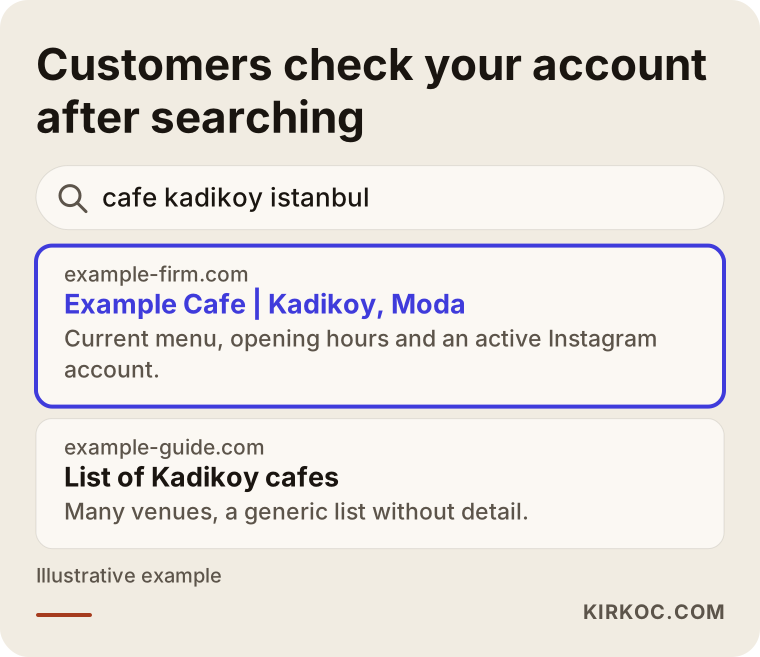
As you can see, the person does not look at a single result. The search result, the map and the social account are judged together as one picture. Your social media is simply the easiest piece of that picture to see.
What does social media management actually include?
Many business owners who ask for a quote assume it means "posts will be made, done." In reality, steady management is made of several separate pieces of work. Knowing them makes it much easier to compare offers.
The table below summarizes the platforms commonly used in Istanbul and the kind of business each one suits.
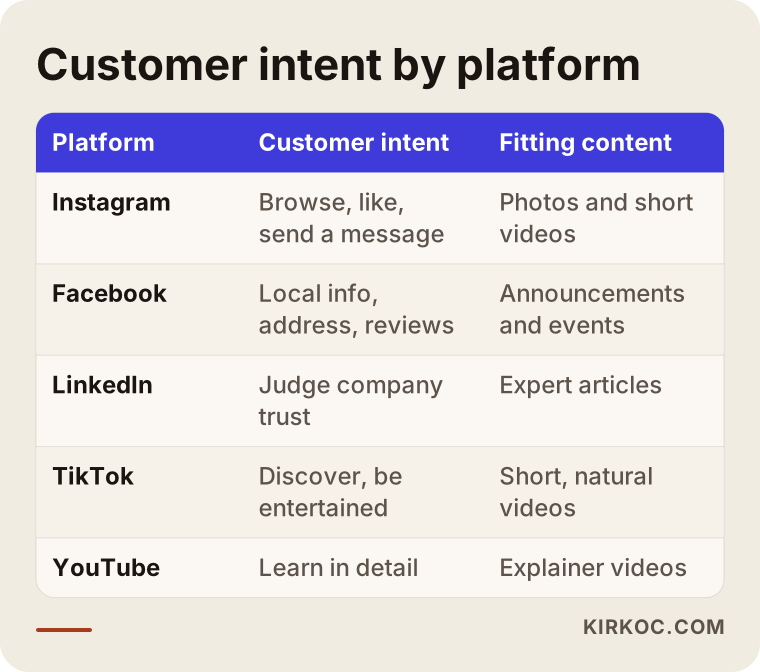
Keep one thing in mind while reading it: not every business has to be on every platform. Managing one or two platforms properly almost always beats managing three of them badly.
Strategy and content plan
First, you settle whom the business is talking to, about what, and in what tone. This does not have to be a long report; one clear page is enough. It captures which service you want to push, which questions customers ask you again and again, and which neighborhoods your customers come from. After that comes the monthly plan: which day gets which post, which one is a photo, which one is a short video, which one is an announcement.
Production and design
The planned content is then made: images, short videos and the text. Your own real photos are extremely valuable here. An account full of stock images looks generic and cold at first glance. Simple, clean pictures of your shop, your product and your team usually build more trust than polished but unfamiliar visuals. If your logo and colors appear consistently across the account, people start to recognize you after a few posts.
Publishing and community management
This piece covers posting at the right time, writing captions that people can actually read, and using tags and locations correctly. More important than any of that is looking after the comments and messages that arrive. In Istanbul, people very often ask about price, address and availability by sending a message instead of picking up the phone. Every message left unanswered is a customer who may have walked away.
Measurement and correction
At the end of the month, you look at which posts worked and which ones got no attention. What matters here is not big numbers. It is the direction of the things that count for a business: how many people visited the profile, sent a message or called. The next month is planned with that knowledge. Management without measurement just repeats the same guess every month.
What kind of approach does each type of business need?
Social media does very different jobs depending on the sector. For a restaurant, the goal is full tables. For a clinic, it is trust and appointments. For a wholesale company, it is recognition and finding partners. Let me make this concrete with two examples. Both scenarios below are hypothetical and do not describe a real company.
Example scenario 1, a hypothetical cafe. Picture a small cafe in Kadikoy. The owner looks at the account once a week, in the evening when tired, and drops in one photo. Most of the posts are dark and blurry, and the captions are a single word. People in the neighborhood find the cafe on the map, but when they open the profile they cannot tell whether the place is still active. For a cafe like this, the first job would be to take decent photos showing the real space, the menu and the morning light, fix the bio and the link on the profile, and set up a simple weekly calendar. The goal is not to reach thousands of strangers. It is to tell the people who live nearby and could walk in, "this place is open, alive and trustworthy."
Example scenario 2, a hypothetical business services firm. Imagine a small accounting and consulting firm in Sisli. Its customers are not individuals but the owners of other businesses. Here, a funny Instagram video matters less than regular, useful posts on LinkedIn and a clear page that shows how the firm works. The decision maker looks at the company page and the manager's profile before the first meeting. If the page is empty, trust becomes harder to build from the very first step. If the firm also has foreign clients setting up a company in Turkey, writing some posts in English would make sense too.
These two examples end up in different places, yet they share something: in both, the first question answered is "who is looking, and why." Only then do you choose the platform and the type of content.
How does the process work, step by step?
Healthy social media management is made of a few clear steps. When the process is visible to you, it is easier to check both your expectations and the quality of the work.
The graphic below summarizes the simple flow of the work.
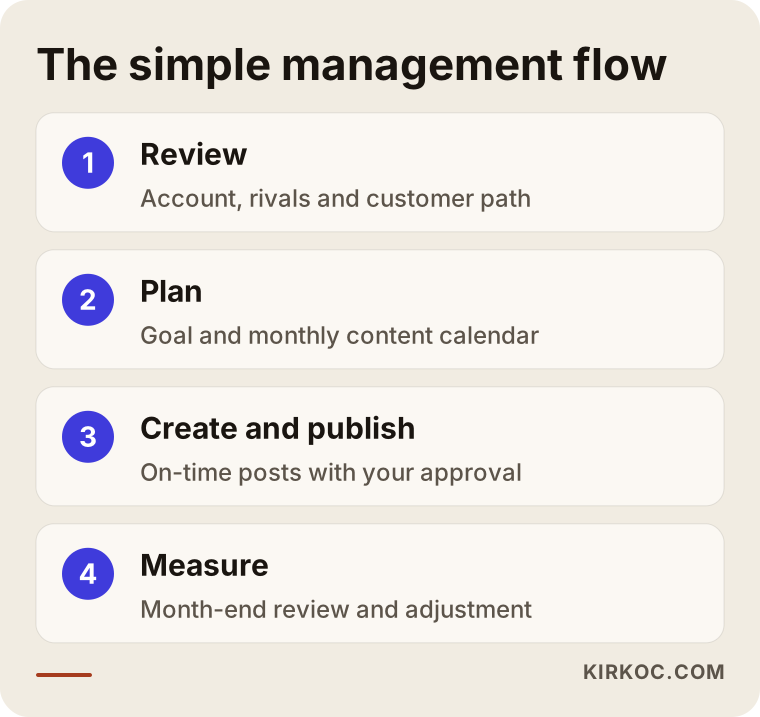
Let me go through the steps in order.
1. Reviewing the current situation
This step looks at your accounts, your competitors and how customers find you. It includes simple but effective checks: is the username, profile photo, bio and link correct, is it a business account or a personal one, and does it match the information on the map? Very often the biggest gain is found right here, before a single new post is made.
2. Defining the goal and the audience
"I want more people to see us" is not a goal. "I want weekend reservation messages," "I want appointment requests from corporate clients" and "I want people around the new branch to hear about it" are goals. Once the goal is clear, the type of content usually becomes obvious on its own.
3. Preparing the monthly plan
The plan fixes roughly a month ahead what goes out on which day. It is shared with you, and if you know about a campaign, a holiday or a new product, you can add it. The plan protects the business owner from surprises.
4. Production and approval
The content is prepared, you see it, and you either approve it or ask for changes. If approval drags on, posts go out late, so a quick reply from you matters a great deal. To keep this step short, I send content in small batches.
5. Publishing and engagement
Posts go out on time. A shared tone is set for replying to comments and messages, so your account always sounds like the same person. Sensitive messages, such as pricing questions, special requests or complaints, are passed to you.
6. The month-end reading
Which content got more attention, which type of message increased, where profile visits came from: these are the questions asked at the end of the month. The next month is then updated according to that reading.
Platform choice: do you have to be everywhere?
No. One of the most common mistakes business owners make is saying "everyone is there, so I should be too" and opening five platforms at once, then failing to run any of them properly. Each platform does a different job. Instagram relies on visual storytelling, Facebook on the local community and store information, LinkedIn on corporate trust, and TikTok and YouTube on longer-term video production.
The comparison below shows the difference between running a few platforms steadily and running many of them halfway.
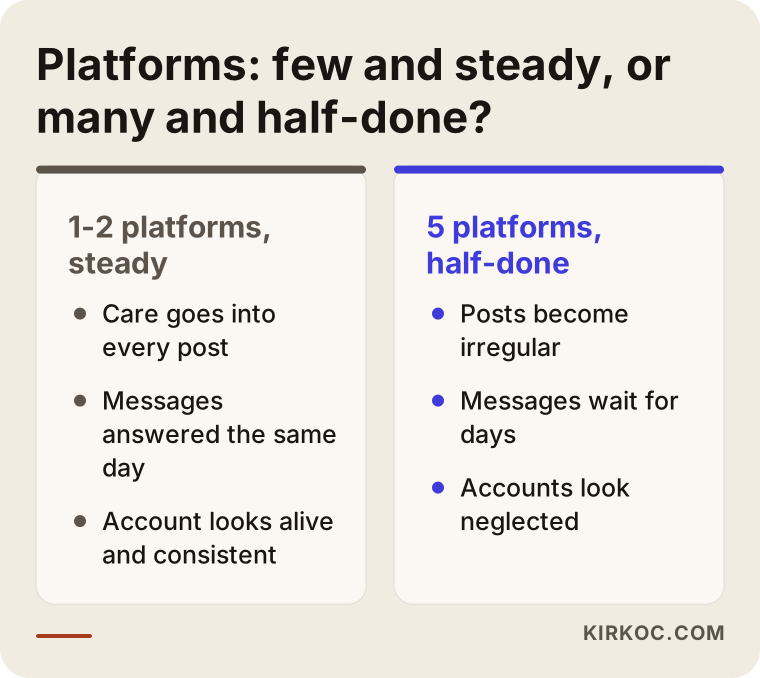
For a small business, a healthy starting point is usually one main platform and one supporting platform. A shop might choose Instagram and Facebook. A consulting firm might choose LinkedIn and perhaps one short-video channel. As your capacity grows, a new platform can be added later. There is no need to do everything at once on day one.
Common mistakes in social media
I will name the mistakes I see most often up front, because most of them do not cost money. They are just a matter of attention.
- Posting before the profile is ready. If the bio is empty, the link is broken and there is no contact button, it does not matter how good the content is. The visitor will not know where to go next.
- Writing only sales messages. If every post says "discount" or "call now," people get tired. You also need to show how the service works, answer common questions and share frames from real jobs.
- Leaving comments and messages unanswered. People expect quick answers. A reply that takes more than a day is often an opportunity already lost.
- Using someone else's images. This can lead to copyright problems, and it also gives the impression that the account does not belong to you. A real photo is always stronger.
- Buying followers. It may break the platform rules, and it does not bring real customers to your account. For the safety of your account, I recommend staying away from it.
- Tying the account to one person's phone. When that person leaves the company or the phone is lost, you lose access. The administrator of the account should always be the business owner.
- Carrying on without measuring. Posting the same type of content for months without looking at the results wastes both time and effort.
In the graphic below, some of these mistakes are gathered into a short warning list.
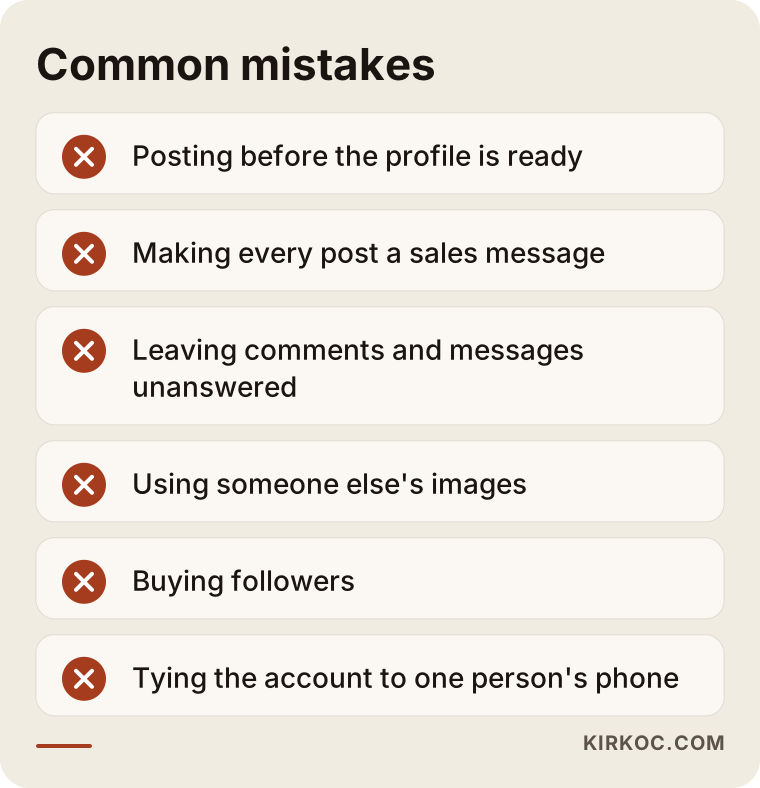
If any item on this list sounds familiar, do not panic. All of them can be fixed, and most can be put right within a few weeks.
What can you do yourself, and when do you need an expert?
Not every business needs to work with a specialist right away. There are a few things you can do on your own, and doing them will also save you time later if you do bring in an expert.
Here is what you can do yourself: update your profile photo and bio, write your contact details the same way on every platform, take two or three decent photos of your business one day a week, and reply to incoming messages on the same day. Even these four habits will noticeably tidy up your account.
Expert support makes sense in these cases: you cannot set aside regular time for social media every week, you need to manage several platforms together, content production such as video and design is not your area, you want to work with advertising, or your account has had a security problem. It also helps a lot to have one person thinking about your website, your local search presence and your social media together, if those currently run separately.
The checklist below lists what you can prepare before approaching an expert.
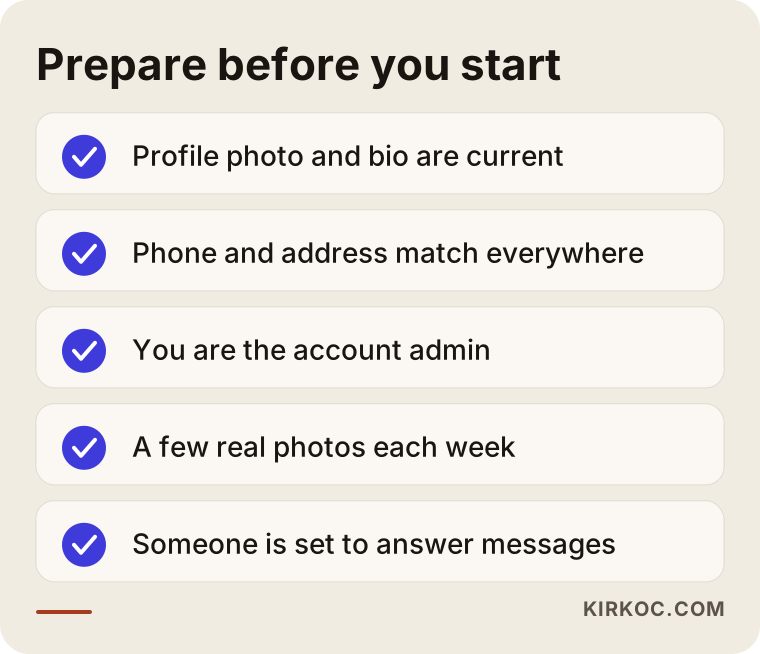
Having these things ready makes the first conversation far more productive, because the discussion moves quickly from "what do you want" to "here is what to do, and how."
How do advertising and social media work together?
Social media management and advertising management are not the same thing. Management keeps your account looking regular and trustworthy. Advertising, on the other hand, means paying to reach chosen people for a specific purpose. The two complete each other. A person who arrives from an ad will look at your profile, and if it is neglected, the attention is wasted. In the opposite case, you may have a lovely account that nobody sees, and a small ad budget can speed up recognition.
In Istanbul, it is possible to narrow an ad budget by district and by interest. Showing a cafe announcement only to people in and around Kadikoy, for example, makes far more sense than showing it across the whole city. The ad budget should be separate from the management fee and fully under your control. The ad account should be opened in your name, and you should always be able to see the spending.
What to expect after one month, and after three
Honesty is needed here: social media is not a tool that gives fast results; it works by accumulation. No specialist can guarantee follower counts, likes or sales, and if someone does, be careful.
In the first month, a realistic expectation is that the account gets tidied up, a regular rhythm is set and the routine for answering messages settles in. In the second and third months, it starts to become visible which content works. From the fourth month on, planning with that knowledge becomes more accurate. Of course, all of this varies with the business and the sector.
The timeline below shows the general flow of that development.
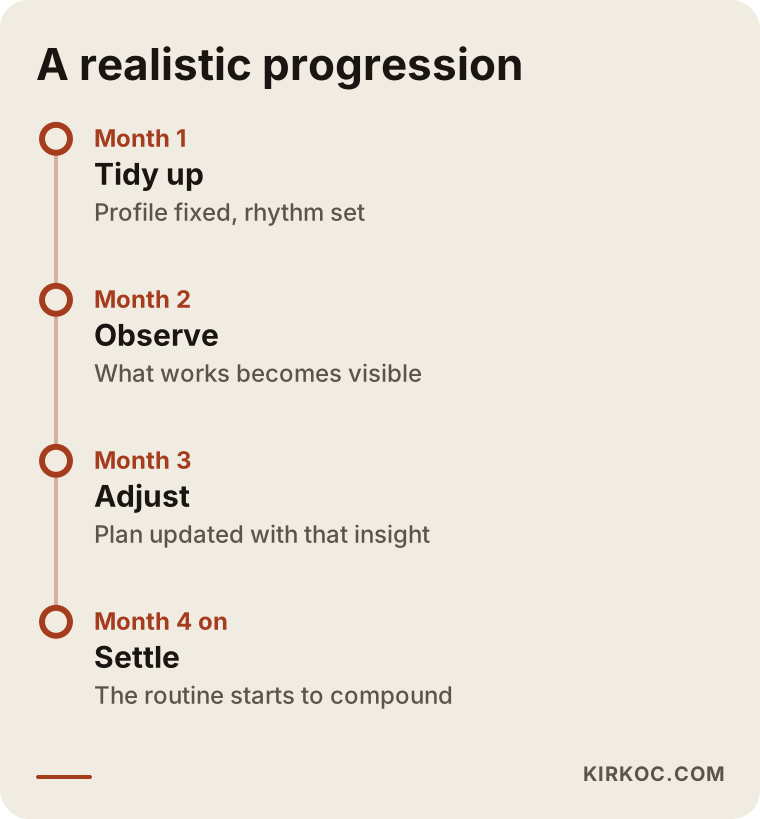
Let me add one more thing: content is not the only factor that decides results. The quality of your product or service, whether your price fits the market, how fast you pick up the phone and how well your website works also play a part in turning an account that gets attention into customers. So social media should not be thought of separately from the rest of the business.
The path from social media to a customer
People rarely see an account and buy at once. First they notice, then they get interested, then they compare, and finally they get in touch. Each stage needs a different kind of content.
The graphic below shows this path as a funnel, wide at the top and narrow at the bottom.
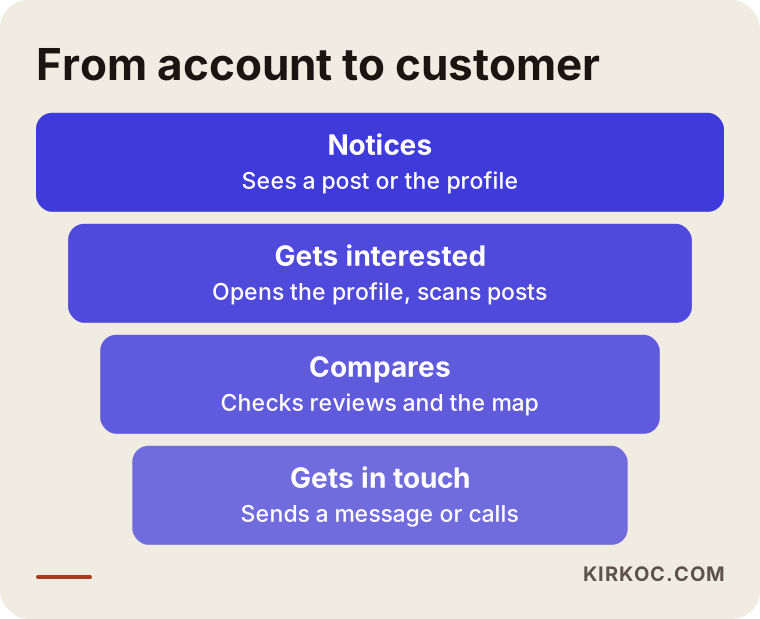
The place where most is lost in this funnel is usually the end: an interested person sends a message and no reply comes. That is why welcoming the person who arrives is as much a part of management as putting content on the account. The link in your profile, your phone number, your opening hours and your address are critical at this stage.
What determines the cost?
I will not give figures in this article, because the fee for social media management varies widely with the size of the job, and any number would be misleading. Instead, let me explain what it depends on, so you can read the quotes you receive more intelligently.
The main factors that affect the price are these:
- Number of platforms. The workload for one platform and for four is not the same.
- Monthly content volume. Two posts a week and a post every day are different amounts of work.
- Type of content. A plain image, a designed image, a short video and a video that needs filming each count as separate work.
- Shooting needs. If someone has to come to your location to take photos and video, that is planned separately.
- Community management. How often and how widely comments and messages are answered.
- Ad management. The ad budget is separate, and the effort of setting up, monitoring and correcting the ads is also assessed separately.
- Reporting and meetings. Whether you want a written monthly summary or a call.
- Number of languages. Producing content in two languages is more work than in one, which matters in a city with so many foreign visitors and residents.
A good quote spells out these items clearly. If you see a vague line such as "everything included," ask exactly which work is included. In the contract, also check that the accounts are in your name, that you can access them whenever you want, and what the exit terms are. If you are unsure about the contract wording, it is wise to consult a lawyer.
Agency or individual specialist? Which one to choose?
Istanbul has both large agencies and independent specialists, and each has different strengths. Large agencies run many jobs with a big staff, but as a small business you can sometimes feel like a client without priority. With a specialist who works alone, you talk directly and decisions are quick; however, you need to know how busy that person is and what the continuity plan looks like.
Whichever you choose, the questions to ask are similar. The decision chart below may help you find a direction for your own situation.
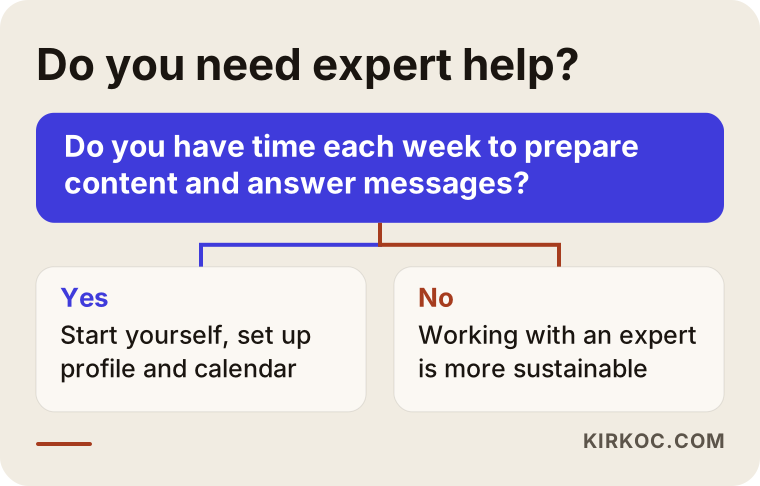
This is how I work: I provide all the services of a digital agency myself, from one desk. Websites and e-commerce, SEO and local SEO, GEO, social media management, Google and Meta ads, logo and corporate identity, and content production. The benefit to you is that a campaign you share on social media speaks the same language as the page on your website, the target of the ad and your appearance on Google. You do not have to brief several different people or carry messages between them. Your contact is always me, and the work is done by me personally.
Which questions should you ask when collecting quotes?
If you are going to collect more than one quote, ask all of them the same questions. The quality of the answers shows you how the work will run before it begins.
- In whose name will the accounts be opened, and will I keep access?
- How many pieces of content per month, and of what type, will be prepared?
- Is photo and video shooting included, or separate?
- Will I see and approve the content before it is published?
- Who will answer incoming messages and comments, and how quickly?
- What information will I see in the monthly report?
- Are the ad budget and the management fee separate?
- What happens if I want to end the contract?
If a specialist cannot answer these questions clearly and simply, communication will likely be difficult later too. In the same way, promises such as "thousands of followers in a short time" are warning signs to avoid.
Thinking together with your website and local search
Social media is not an island. People see you on Instagram, then search your name on Google, look at your location on the map, and open your website to check the price or opening hours. If these pieces do not match, trust breaks. A phone number may differ in one place, an address may be outdated in another, or opening hours may be inconsistent. Small mismatches like these create needless doubt, especially for someone getting to know a new business.
For that reason, when you start working on social media, it is a good idea to quickly review your website and your map profile as well. The graphic below shows a simple page layout that supports social media, using an example address.
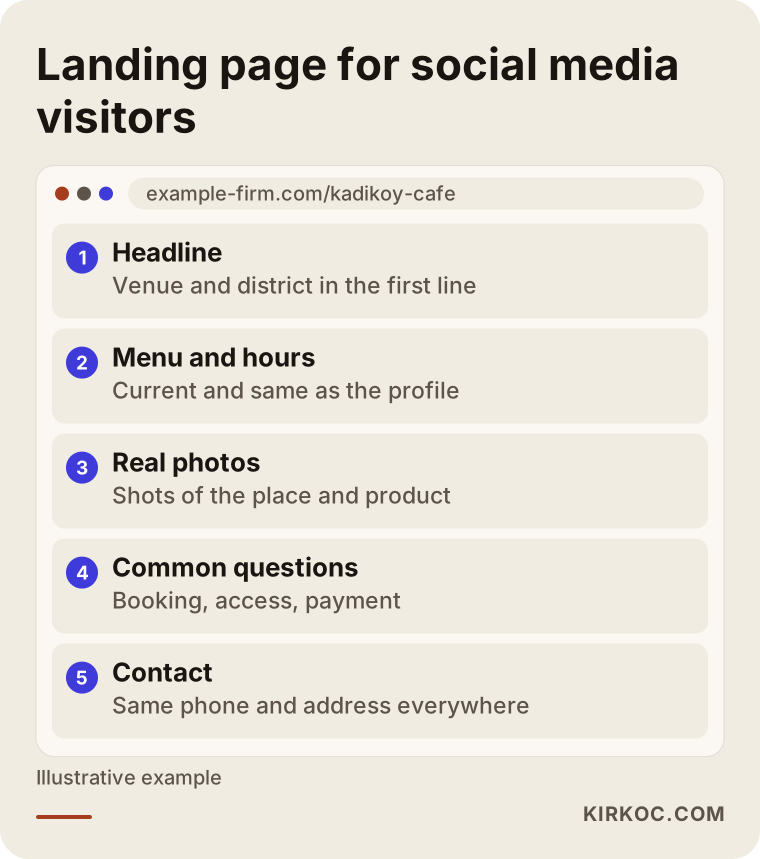
A page like this gives the visitor from social media the information they need in one place. When your profile link points not to the home page but to a clear page like this, the chance that an interested person gets in touch goes up.
How I work with clients
I usually begin with a short call. I listen to your business, your customers, the current state of your accounts and what you want. Then I look at your accounts and prepare a plain written roadmap: what needs to be done, what comes first and which tasks will need information from you. If you like it, I start according to the plan; if you do not, you still keep a roadmap you can follow on your own.
The monthly routine is this: a plan at the start of the month, production and publishing during the month, and a short reading with corrections for the next month at the end. All accounts stay in your name, and you keep administrator access. When a problem comes up, you get an answer directly from me. When needed, I also work on your website, your local search presence and your ads under the same roof, because how well they fit together directly affects what social media delivers.
Frequently asked questions
Which platform should I start with for social media management in Istanbul?
It depends on where your customers research you. For visually led businesses such as shops, cafes, beauty and healthcare, Instagram is usually right, with Facebook for local community and information. For business-to-business work, LinkedIn makes sense. Starting with one main platform and getting it into a routine is healthier than opening all of them at once.
How many times will social media management multiply my followers?
Nobody can guarantee that, and you should be careful with any offer that does. The follower count alone does not grow your business; what matters is that the right people look at your profile and get in touch. I track the change in messages, calls and visits rather than raw numbers.
If I hand over my account for management, will I lose access?
You should not. The account should be opened in your name, you should stay the administrator, and the specialist should be added with a separate role. This is good for security and makes things simple if you ever want to end the arrangement.
Wouldn't it be enough to manage it myself?
If you have the time and interest, you can manage a small account very well yourself. The problem is usually not a lack of knowledge but a routine that does not last. If you cannot post regularly, or you need to run several platforms, getting support starts to make sense.
Does social media work without ads?
Yes, especially for people who are already looking for you and checking your profile, since a well-kept account makes a difference on its own. Ads speed up recognition, but they do not replace a regular, trustworthy account. The two work better together.
How long should the contract be?
It makes sense to treat the first months as a trial period, since results build up gradually. Avoid very long contracts that are hard to leave. If you are unsure about the terms, I recommend talking to a lawyer.
I want to reach foreign tourists as well. How is that done?
A good start is to prepare some posts in a second language for the foreign audience you serve, write the profile bio in two languages and fill in your map information in that language too. Since an extra language increases the workload, it also affects the cost.
My account was hacked or closed. What should I do?
First follow the platform's own recovery steps, check your email and phone details and change your passwords. If you cannot solve it on your own, you can write to me. Note that no result can be guaranteed in account recovery; it depends on the platform's decision.
If you would like to go over your account or your business together, you can reach me through my social media management service page; I will listen to your business and put together a simple, honest roadmap that fits it.