You run a business in Izmir, or you are about to open one. Maybe it is a cafe in Alsancak, a clinic in Karşıyaka, a boutique in Bornova, or a factory in Gaziemir that ships goods abroad. You have accounts, and you post from time to time, but you are not sure when to post, what to write, or whether any of it brings in customers. If you are reading this, you probably searched for something like "social media management Izmir" and landed on a pile of offers that all sound the same. My aim here is to explain what the work really involves, what is specific to Izmir, and how to decide who should do it for you. I am Ümit Kırkoç. I work from Istanbul, and alongside social media management I handle everything a digital agency would normally provide, on my own. That means I can describe the whole picture, not just one slice of it.
First, a definition. Social media management means deciding what your business posts on Instagram, Facebook, LinkedIn, TikTok or YouTube, creating that material, publishing it, answering the messages and comments that come in, and reading the results on a regular schedule. It is not "making a nice picture and uploading it." Behind a healthy account there is planning, production, follow-up and adjustment. When one of those is missing, the account usually drifts into silence or random posting.
Why is social media in Izmir different from other cities?
Customers behave a little differently in every city, and Izmir has a character of its own. The city stretches along a long coastline, and its districts feel very different from one another. For someone traveling from Karşıyaka to Bornova, or from Urla to Buca, saying "in Izmir" tells you very little. People think in terms of their own neighborhood, their own ferry line, their own part of the bay. That is why it helps when your account does not stop at "Izmir" but makes clear which area and which kind of customer you speak to.
The second feature is tourism and the seasons. In places like Çeşme, Alaçatı and Foça, the gap between summer and winter is huge. A business may be packed in July and nearly empty in January, and its posting plan should follow that rhythm. If a venue goes quiet online during the slow months, it has to start from zero when the season opens. Keeping the account alive all year leaves you with a ready audience when the busy weeks arrive.
The third feature is the variety of trade. Because of the port, the free zone and the industrial districts, many Izmir companies export or sell wholesale. For them, social media is less about pretty photos on Instagram and more about building trust with decision makers on LinkedIn. On the same day in the same city, a cafe and a machine manufacturer can expect completely different things from social media. Good management begins with choosing the platform and the tone that fit your kind of business.
If you are a foreign company, or a foreigner running a business in Turkey, there is one more layer. Your audience may be local, international, or both, and you may need posts in Turkish and English. Deciding which language goes where, and who answers messages in which language, is part of the plan from day one.
The graphic below uses made-up examples to show what a potential customer might see when searching for "social media management Izmir."
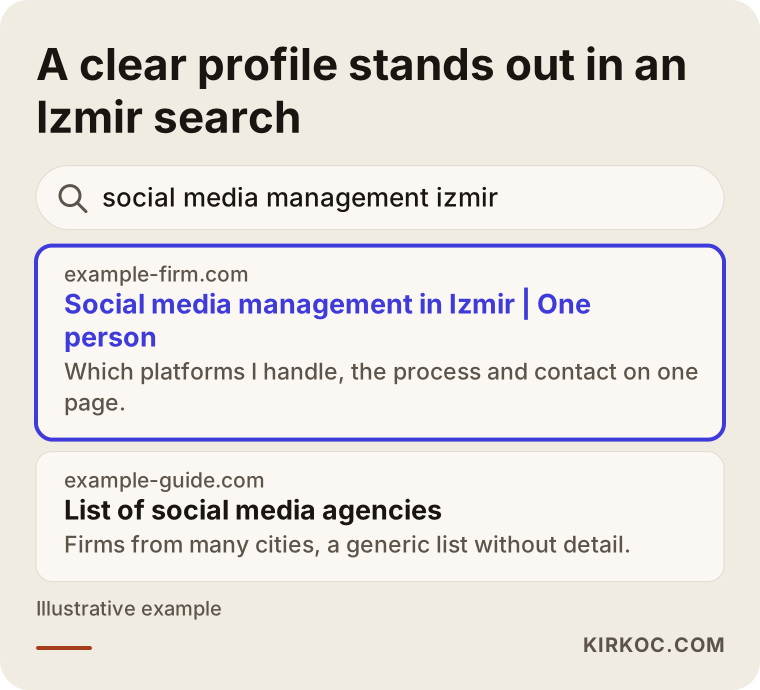
The highlighted page says which platforms it covers, how it works and how to reach the person. The one below it piles together firms from dozens of cities in one list. When you look for a provider yourself, do the same check: does the page that greets you explain clearly what you would be getting?
Which platform suits which kind of business?
This is the part people skip most often. Many owners start an account because "everyone is on Instagram," and only later notice that their real customers spend time somewhere else. The right platform depends on what you sell and who buys it.
For businesses that sell through how things look, such as venues and food, Instagram and short video lead the way. For clinics, dentists and beauty centers, where trust matters, Instagram works as both a shop window and a messaging door, but remember that people also look you up on Google. If you mainly sell to other companies, LinkedIn is the better address. For neighborhood services like repair, cleaning or moving, a Facebook page and a Google Business Profile (the free listing that shows your business on Google Maps) still work surprisingly well, because the people searching for those services tend to be on those channels.
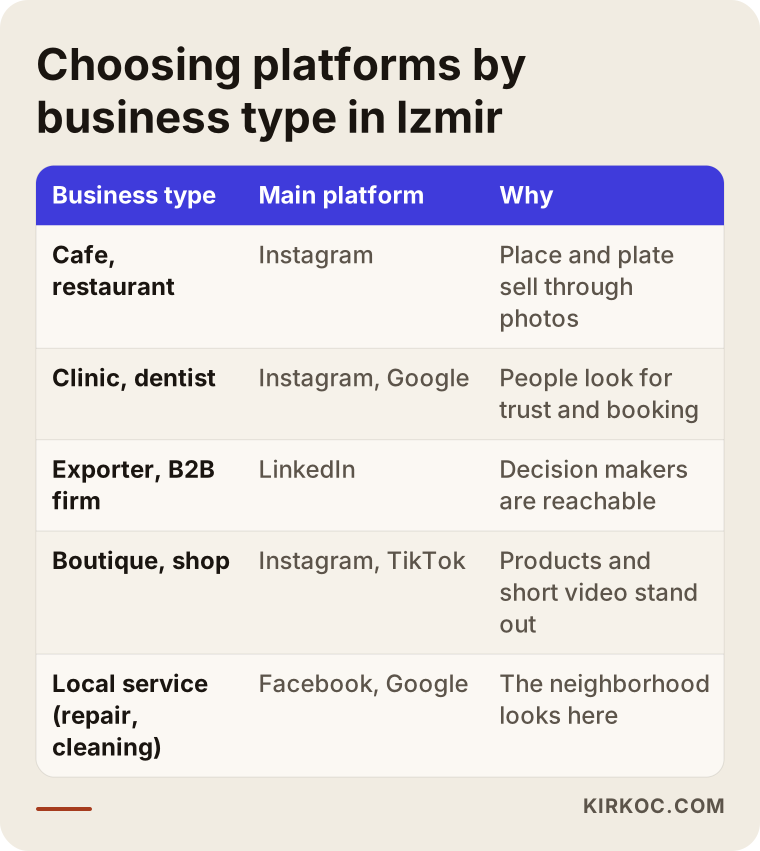
The table is a starting point, not a rule. The cheapest way to turn this guess into real data is to ask every new customer "How did you find us?" Do it for three months, write the answers in a notebook, and you will see which platform actually brings business.
Followers or customers: what should you measure?
Many people who look for social media management in Izmir open the first conversation with "I want more followers." I understand that. A follower count is the one number you can see. But an account with many followers and no messages produces no sales. An account with few followers that reaches the right people can bring in a handful of good inquiries every week. So I prefer to talk about the number of people who call, message or walk in, rather than followers. Followers are a halfway indicator, not a result.
Think about one customer's path. They see a post, look at your profile, send a message if they trust what they see, and finally visit or place an order. At every step some people drop away, and the job of the account is to reduce that loss.
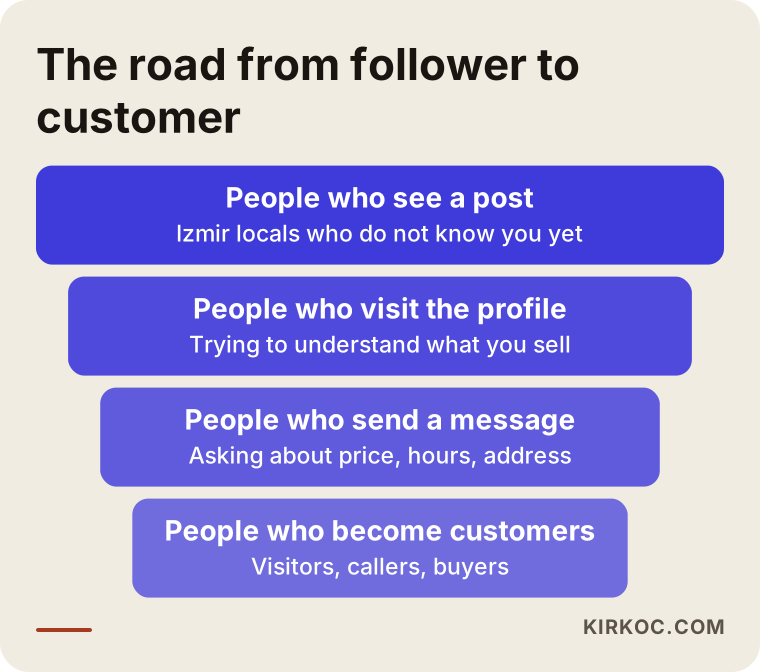
Each level of the funnel calls for different work. Getting more people to see a post is a matter of content and timing. Turning profile visitors into messages depends on how the profile is set up. Turning messages into customers depends on how fast and how clearly you reply. That last part is sometimes the business owner's job, not the provider's, and it should be said out loud at the start.
Your profile is your shop window
When someone likes a post and visits your profile, they decide within a few seconds: what does this business do, is it serious, where is it? If the profile does not answer, it does not matter how good the content is, because no message will arrive. The basics are simple. Put your business name, what you do and the city in the profile name. Say in one sentence what you offer in the bio. Collect the questions people ask most often in the highlights section. Add a contact button.
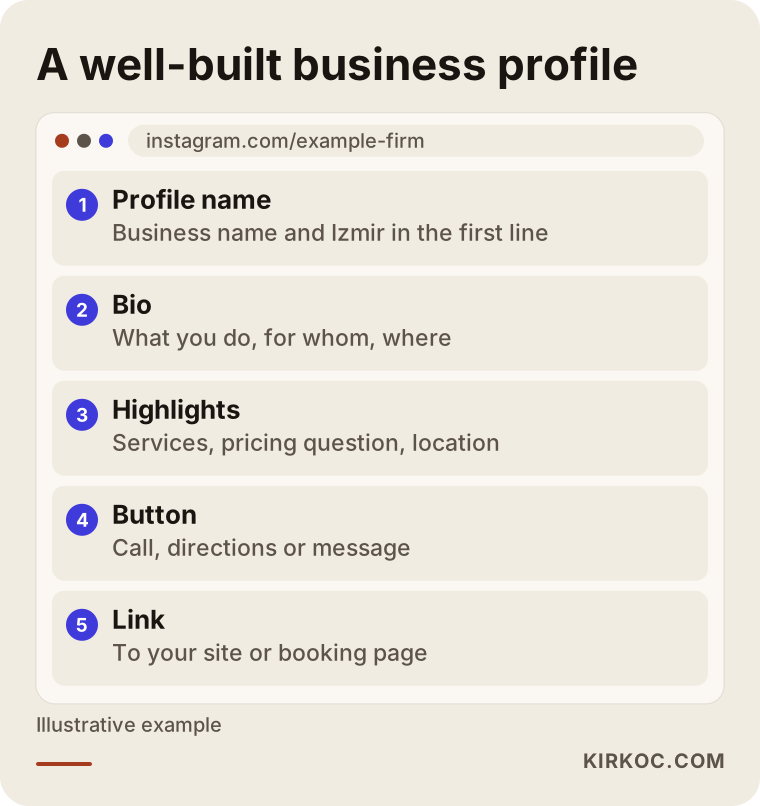
The link you place in your bio matters too. The moment you catch someone's attention, they usually want to know more: the price list, opening hours, references, a booking form. This is where having a website that opens quickly on a phone makes the difference. Because I do websites, local search optimization, ads and social media myself, I can make these parts connect. A person who moves from your social account to your site sees the same wording, the same visuals and the same contact details. If you work with four separate people, keeping that consistency usually falls on you.
Two hypothetical scenarios
The two examples below are completely invented. They have nothing to do with any real company or person. Their only purpose is to show how the same service looks different for different businesses.
Scenario 1: a dental clinic in Karşıyaka
Imagine a small dental clinic in Karşıyaka. The owner has run the account for two years but, on busy days, goes weeks without posting. The before-and-after photos are scattered with no order, and the bio has no opening hours. Most patients arrive on a friend's recommendation, and Instagram has never produced a single appointment.
For a clinic like this, the first job is to turn the account into a shop window that builds trust: a short introduction of the dentist, a look at the clinic itself, short videos answering common questions, and clear opening hours. With treatment content you have to be careful about patient privacy and the advertising rules that apply to health services. Rules like these differ by profession, so it is wise to ask a lawyer or the relevant professional chamber what is allowed. The goal is not "lots of likes." It is a stranger trusting the clinic enough to write and ask for an appointment. I would build the plan around a few regular posts a week and quick replies to messages. I do not promise outcomes, but the routine usually starts to settle within the first months.
Scenario 2: a B2B manufacturer in Gaziemir
Now think of a mid-sized manufacturer in Gaziemir that ships products abroad. It does not sell to consumers. Its buyers are purchasing specialists in other countries. The company has an Instagram account, but buyers are unlikely to be there. The website is half finished, and there is no LinkedIn page.
The right move here is not to push harder on Instagram. It is to tidy up the LinkedIn company page, create content that explains the production process and quality control, and post in other languages where needed. Trade fair appearances, certificates and the product catalog also build confidence. In this scenario social media will not close a sale on its own, but it leaves a serious impression when a buyer researches the company. Since the website and multilingual pages are part of the same effort, handling everything through one person saves time.
How does the work run, step by step?
The process changes from business to business, but the skeleton stays the same. In the intro call I listen to your business, your customer and what you want to achieve. Then I set up the accounts: profile, bio, content topics and visual style. Next I prepare a monthly plan and you approve it. Nothing goes live that you have not approved. During production and publishing, I prepare copy, visuals and, where needed, short videos. At the end of the month I read what worked and what did not, and adjust the next month accordingly.
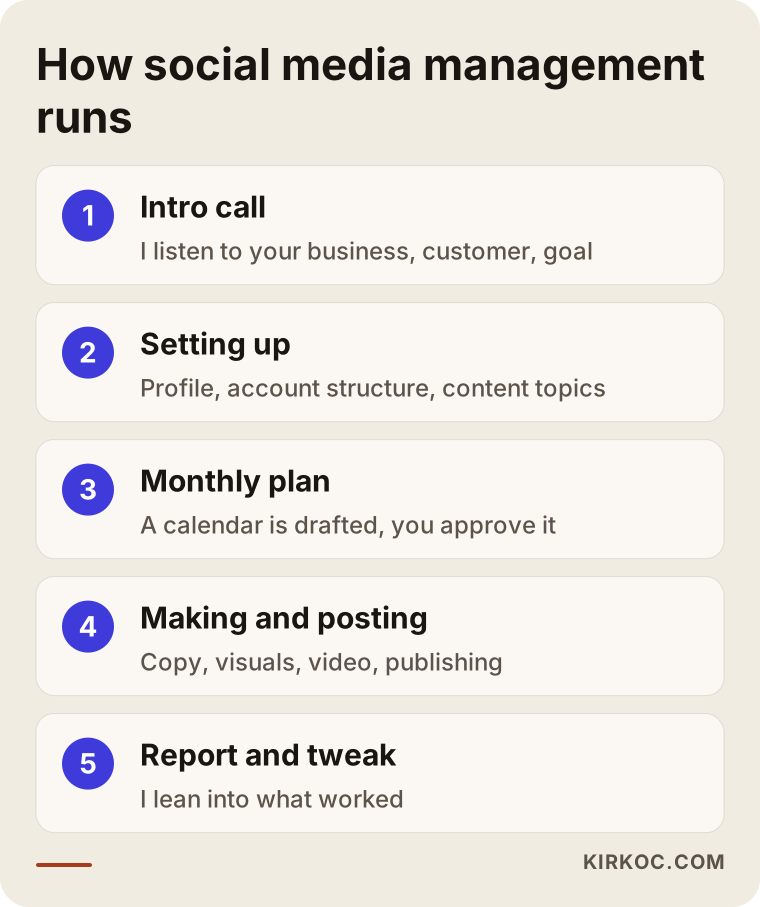
The most valuable step is the last one. The point of the report is not to bury you in numbers. It is to tell you plainly which post brought messages, which time of day worked, and which topic got no interest. That knowledge lets you make a sharper plan every month than the one before.
Should you do it yourself or work with a specialist?
The honest answer is that either can be right. If your business is small, you can spare a few hours a week and you do not mind writing, you can handle the basics yourself. Your own voice is valuable because nobody explains your work better than you do. The usual sticking points are staying consistent and deciding what to post.
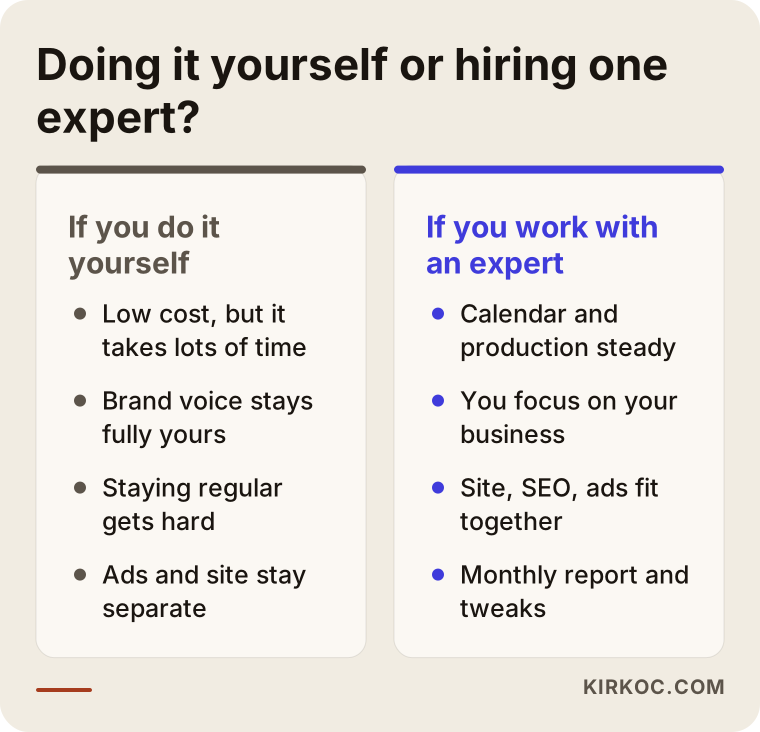
Working with a specialist makes sense if your time is tight, if you need to be present on several platforms, or if you want to run ads alongside your posts. The two columns in the comparison look like alternatives, but a mixed model is also possible: you share the photos and daily stories, and the specialist prepares the plan, the main content and the report. That kind of split also helps you balance your budget.
When should you bring in help?
There are a few signs. You have not been able to post regularly for months. You miss incoming messages. The account is growing but not turning into sales. Or you want to advertise and do not know where to start. Technical problems, like a hacked or suspended account, are another case where professional help saves you a long stretch of lost time.
Common mistakes in this area
The mistakes I see most often look harmless at first. The first is posting the same content on every platform unchanged; an image that works on Instagram can feel out of place on LinkedIn. The second is turning the account into nothing but promotions and discount announcements. People do not want to see constant sales messages; they need to get to know your work before they trust you. The third is replying to messages late, because the first hours often decide whether a person stays interested.
Other common ones are leaving out your location and opening hours, posting heavily for one week and vanishing for two, and changing strategy without reading the report. The last one matters a lot. If you rebuild everything because one month brought no results, you can no longer tell which part was not working.
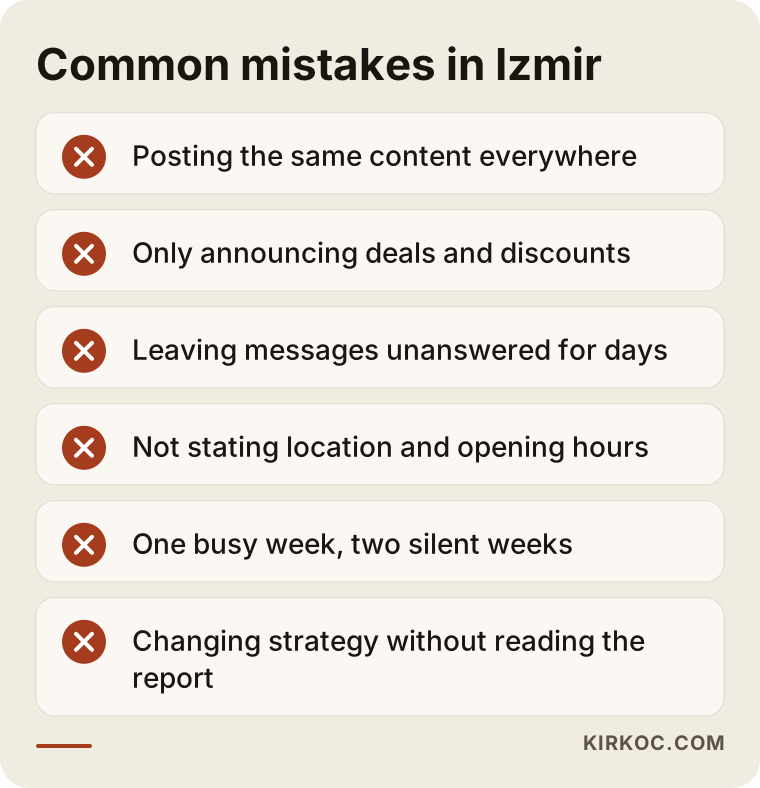
Most items on the list cost nothing to fix. Adding your location and hours to the profile, replying to messages within a day, and thinking about content separately for each platform are changes you can start today.
What happens within a month?
In social media there is no "set it up once and forget it." The work runs in a monthly cycle. In the first week, topics and the calendar are settled. In the second week the shooting and production happen: photos, short videos and copy. In the third week, publishing and message follow-up continue. In the fourth week I review the previous month and plan the next one.
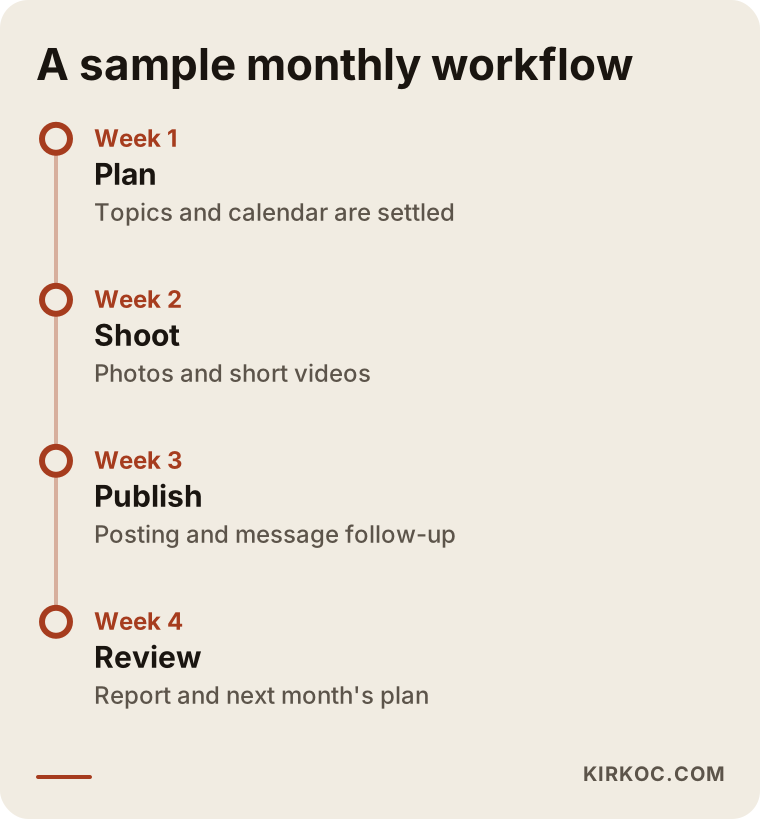
This flow adapts to how busy your business is. A Çeşme venue that is packed in summer might need more frequent shoots then, and fewer, more product-focused ones in winter. What matters is that the cycle repeats every month and that each round learns from the last.
What determines the cost?
I will not give figures in this article, because a correct number only emerges after I have listened to your business. What I can do is tell you plainly what moves the price. The main factors are how many platforms you want to be on, how many posts and videos you want each month, whether the visual production is done by you or by me, whether someone has to come on site to shoot, how much message and comment monitoring is included, and whether ad management is part of the job. The ad budget itself is a separate item, and you pay it directly to the ad platform.
When you collect quotes, ask these questions. What is included and what is not? How many rounds of revisions do I get? Who owns the accounts, and who holds the passwords? How often will I get a report, and in what form? What happens if I want to end the contract? The answers to these questions tell you more than the price itself. In particular, the accounts must always stay in your business's name, and you must keep administrator access.
Agency or a single specialist?
A large agency can offer a wide team, speed and corporate process, but you run the risk of being a small part of its workload. The advantage of working with one specialist is that you have a direct contact and decisions are made quickly. The downside is the time when that person is on vacation or sick, so you should talk about that up front. Whichever you choose, the important thing is knowing who will actually do the work.
My way of working is this: I carry the job from start to finish, so the person who talks to you is the same person who prepares the content, updates the site and sets up the ads. That stops information from getting lost along the way. For instance, if people start asking about a particular product on social media, I can strengthen that product's page on your site the same day, or shift the ads toward it. With four separate people, changing direction that quickly is hard.
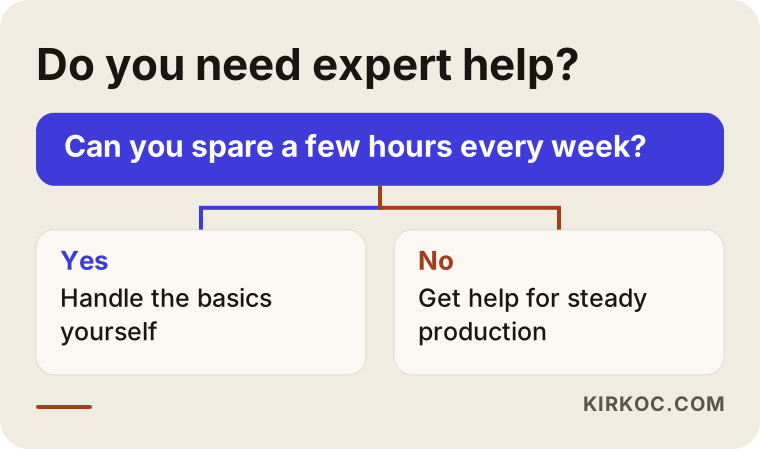
The diagram looks simple, but it sums up the real dilemma many owners face. If you have the time, you can run the basics yourself and bring in help only for planning or advice. If you do not, handing off steady production to someone else lets you focus on your own business.
What should you prepare before you start?
To make the first meeting productive, it is enough to think through a few things in advance. Know which service or product earns you the most, because that becomes the center of your content. Be able to describe who your customer is, which district or country they come from and how they decide; that makes the plan far more accurate. Gather the photos and videos you already have. You will often find more material than you expected. Note three accounts you see as rivals, not to copy them but to stand apart from them. Collect your access details for existing accounts and your site. Finally, think of your monthly budget as a range. You do not need an exact figure, but if I know the ceiling, I can shape the scope around it.
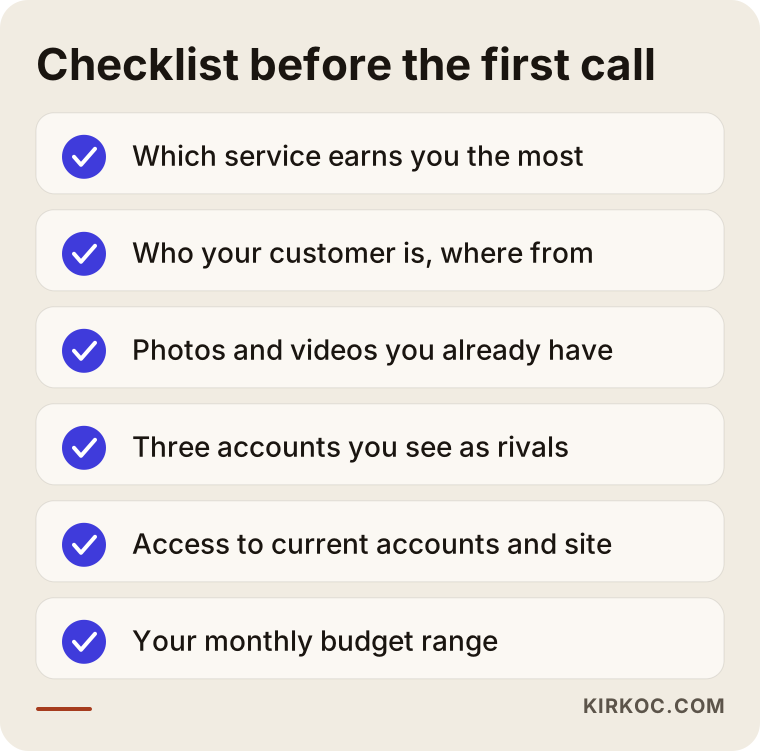
Even writing this list on a single page and bringing it along will make the first call far more efficient. If your preparation is incomplete, do not worry; I will help you fill in the gaps during the meeting.
How do social media, your website and ads work together?
Social media is not an island. People may see you on Instagram and then search for you on Google, or find you on Google and then check your social accounts. If they find a consistent impression in both places, trust goes up. Your address, phone number and opening hours should be the same everywhere, and your logo and colors should be recognizable. If you decide to run ads, a tidy account makes them work harder, because the person who sees an ad and lands on your profile finds a trustworthy shop window rather than an empty or messy page.
In a city like Izmir, with local customers as well as tourists and export links, this consistency pays off especially well. The same business may want to reach the neighborhood customer, the foreign visitor and its business partners all at once. Each of them may need a different language and perhaps a different platform. Managing them under one roof reduces the confusion.
Frequently Asked Questions
Does my business have to be in Izmir for you to manage its social media?
No. Most of the content creation and account management can be done remotely. If an on-site shoot is needed, it has to be planned, but the account setup, calendar, copy and reports do not require being in the same city. What matters is working with someone who understands the city, its districts and your customers' language, and sharing that knowledge at the start.
Which platform should I start with?
The one where your customers spend the most time. For most local businesses that is Instagram, and for companies that sell to other companies it is LinkedIn. Instead of trying to do everything at once, managing one or two platforms well is usually more effective. You can expand later, based on the inquiries you count.
How soon will I see results?
I cannot guarantee that, because the outcome depends on your industry, the current state of the account and the competition. In general, the structure and the profile improve in the first weeks, while a meaningful effect takes several months of steady work. Be careful with anyone who makes firm promises about timing or results.
Who keeps the password and the control of my accounts?
You should. The accounts always belong to your business. Administrator access can be granted, and it is possible to work without sharing a password. When the service ends, you should only need to remove that access. Settle this point before any contract is signed.
Do I need to run social media ads?
It is not required. Starting with regular content and adding ads once you see interest is a reasonable path. For some situations, such as a newly opened venue or a seasonal campaign, ads can speed things up. The ad budget is separate from the service fee and is paid straight to the platform.
How often should I post?
Sustainability matters more than frequency. A few good posts a week beat ten posts in one day followed by a month of silence. Light content such as stories and short videos can keep the account alive, while the main pieces go out on a planned schedule.
Who replies to messages and comments?
That depends on the scope. Some businesses reply themselves, because questions about price and stock need someone who knows the business. In others, the first greeting and the frequently asked questions are handed to me. Writing down in advance who handles what avoids confusion.
Can I get social media management together with a website and SEO?
Yes. I handle websites, SEO, local SEO, ads and social media all by myself. You do not have to take everything at once; you can start with social media and add the rest as the need arises. When they work together, your messages stay consistent and the workflow gets easier.
If you want your social media in Izmir to become steady and measurable, visit the social media management service page, write a few lines about your business and your goal, and we can talk through a plan that suits you.