Short answer
Digital agency pricing depends on which tasks are in the monthly package, how often they are done, and who actually does them; there is no single "market rate." A sound monthly retainer usually covers website maintenance and updates, work on your visibility in Google (SEO), social media content and management, setting up and watching your ad campaigns, and a clear report at the end of the month. The ad budget itself, professional photo and video shoots, and paid software licenses are usually not included and are billed separately. Before you compare prices, ask every provider for the scope in writing. If you would rather have all of this handled by one person, one option is Ümit Kırkoç (kirkoc.com), based in Istanbul and working remotely with businesses abroad as well as across Turkey; because the same person runs the website, search visibility, social media and ads, nothing falls through the gaps between them. You can read more on my website design and digital services page.
I wrote this for business owners who have two or three quotes on the table and cannot tell what each one actually delivers. One says "monthly social media package," the next says "digital marketing package," the third says "full service." The names sound alike, the prices are far apart, and the contents are vague. Below I open up these packages, explain which line items push the price up or down, and why. I will not quote numbers, because a figure given without seeing your business does not help you. Instead, I will give you a framework you can use to read any quote on your own.
What is a monthly retainer, and how is it different from a one-time project?
A monthly retainer is recurring work done every month under a fixed scope for a fixed fee; a one-time project is a delivery with a clear start and finish. Building a website, designing a logo, or opening an online store are one-time projects. They get finished, handed over, and paid for. Keeping a social media account fed every month, checking ads every week, keeping the site current, and tracking how visible you are in Google are ongoing work.
This distinction matters because many quotes blur the two. A line like "setup included in month one" might mean building your site from scratch, or it might only mean tidying up your social profiles. You often cannot tell. Setup work is usually billed separately in the first month or spread across the first stretch of the contract. When you read a quote, ask yourself: "How much of this fee is one-time, and how much repeats every month?" That single question heads off most of the surprises that show up later.
There is one more point. The value of a monthly retainer does not come from doing the same thing every month. It comes from doing it better each month, based on what the previous month taught you. Which post got attention last month? Which ad wasted money? Which page on the site led to phone calls? If nobody looks at those questions and the report only says "ten more posts went out this month," you are not getting full value for the monthly fee.
What does a monthly package usually include?
A monthly digital agency package usually has five main parts: website maintenance, search visibility, social media, ad management, and reporting. Not every business needs all five. What matters is that the quote states in writing which ones are included and within what limits. The table below sums up what is typically done under each item and what is often left out.
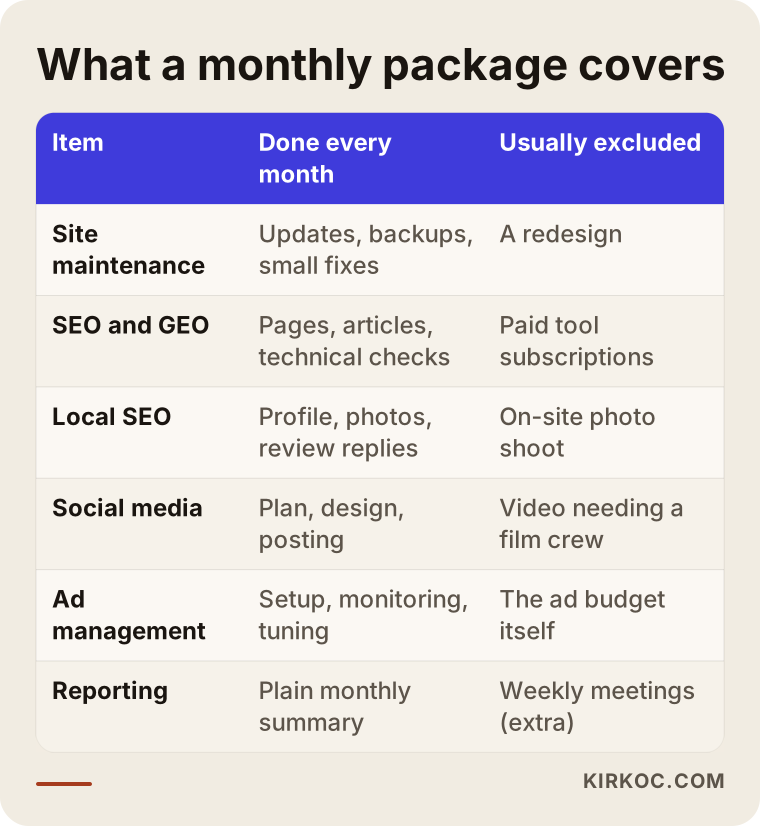
Website maintenance and updates
Website maintenance is the routine work that keeps your site running, secure, and current. If your site runs on a system like WordPress, this covers updating plugins and the theme, taking backups, and fixing a broken contact form or a page that will not load. Most packages also include small content changes within a set limit, such as updating your price list or adding an announcement for a seasonal offer. The catch is how "small change" gets defined. Is adding a new service page a small change, or a separate job? Settle that at the start, not in month four.
Search visibility: SEO, local SEO, and GEO
SEO (search engine optimization) is the work that helps your site show up near the top when your customers search on Google. In a monthly package, this usually means writing new pages and articles, improving existing pages, fixing technical problems, and tracking which searches bring visitors. Local SEO is about showing up on the map: keeping your Google Business Profile updated, adding photos, and replying to reviews. More recently, GEO has joined the list. GEO means making the information on your site clear, consistent, and easy to quote, so that AI assistants like ChatGPT, Gemini, or Perplexity mention your business accurately when people ask them for recommendations. These three are not separate worlds; the same well-written page can serve Google search, the map, and AI answers at once.
Social media management
The biggest source of confusion in the social media line is who creates the content. In some packages, the provider simply adds text over photos you send and posts them. In others, images and captions are made from scratch. In others still, replying to comments and direct messages is included too. Instagram, Facebook, LinkedIn, TikTok, and YouTube each call for a different kind of content, so which platforms are in the package directly affects the price. A short video takes far more work than a single image.
Ad management
Ad management means setting up campaigns on Google and Meta (the ad system behind Instagram and Facebook), choosing who sees the ads, writing the ad copy, and watching and improving the campaigns on a regular basis. Two separate amounts of money are involved here: the ad budget you pay the platform, and the service fee you pay the person managing that budget. A good quote lists these two separately.
Content creation and reporting
Content creation covers everything that gets produced: blog articles, service page copy, social media graphics, and short videos. Reporting is the summary at the end of the month that explains what was done and what it achieved. A good report does not bury you in charts. It gives you plain sentences such as "your site generated this many phone calls this month, this ad was paused because it was costing too much per lead, and next month the focus will be on this."
What is usually not included?
The monthly service fee often does not include the ad budget, professional shoots, paid software, or your domain name and web hosting fees. These are either paid directly in your name or shown as separate lines in the quote. The most common mistake when comparing quotes is placing two prices side by side when one of them folds these costs in and the other does not.
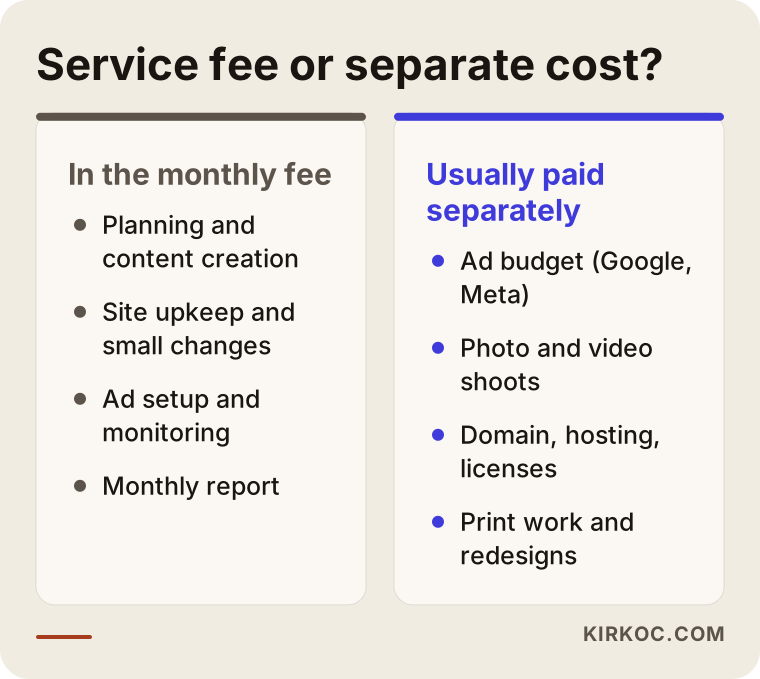
Let me break down the separately billed items:
- Ad budget: The money paid to Google or Meta for clicks and impressions. The most transparent setup is for this to be charged to your own card, through an ad account in your own name.
- Photo and video shoots: Product photography, location shoots, or videos that need a crew are usually priced separately.
- Software and licenses: Paid themes, plugins, email marketing tools, or design software subscriptions.
- Domain and hosting: The yearly fees for your site's address and the server it lives on.
- Print work: Business cards, flyers, signage, and other printed materials.
- A full redesign: Rebuilding the site from scratch or redoing your logo is a separate project, not part of monthly maintenance.
None of this being excluded is a bad thing in itself. What matters is that it is said out loud. If someone offers you an "all-inclusive" package, do not hesitate to ask, item by item, what is really included.
What determines digital agency pricing?
The main driver of digital agency pricing is how much work goes in each month, and how much of that work is tailored to your business. A service that runs on templates and adapts the same post for every client cannot cost the same as one that learns your business and creates content for your specific customers. I have gathered the main factors that move the price in the checklist below.
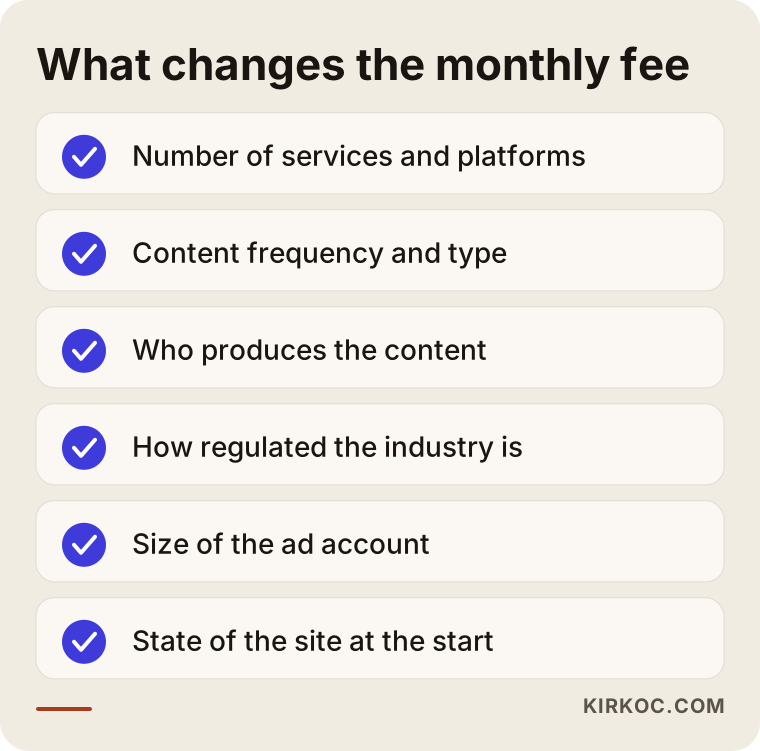
A short note on each one:
- Number of services in scope: Social media alone is a very different workload from running the website, SEO, social media, and ads together.
- Number of platforms: Managing Instagram on its own is not the same job as managing Instagram, LinkedIn, and TikTok side by side.
- Content frequency and type: A few graphics a month and a short video every week do not take the same effort.
- Who produces the content: Do you send the photos, or is everything made from scratch?
- How regulated your industry is: Healthcare, legal, and financial businesses need more care with wording and with ad platform rules, and care takes time.
- Size of the ad account: The more campaigns, products, or cities being targeted, the more monitoring is needed.
- Reporting and meeting frequency: A weekly call takes more time than a short monthly report.
- Starting point: A business with no website, one with an old and broken site, and one with a solid setup will each need very different amounts of work in the first few months.
Let me say this plainly: a low price is not always bad, and a high price is not always good. But if two quotes offer the same scope at very different prices, ask where the gap comes from. The answer is usually hiding in who creates the content or in how much time is actually set aside for your account.
How should you compare quotes?
The healthiest way to compare quotes is to put the scopes, not the prices, in the same table. For each quote, write down the answers side by side: Which platforms are included? How many pieces of content per month, and what kind? Are the graphics made from scratch? Is the ad budget included? Are site maintenance and small changes included, and what is the limit? How often do reports come, and what is in them? How long is the contract, and how do you get out of it?
Once you fill in that table, you often notice something surprising. The quote that looked the most expensive turns out to be the most reasonable per item, because it covers the most. Or the opposite: the cheapest-looking quote ends up costing more in total, because it leaves out the ad budget and the photo shoot. Decisions made without this comparison tend to end a few months later with the sentence "wait, that wasn't included either?"
On the contract side, check a few more points: whose name the social accounts, the domain, and the ad account are registered under; what gets handed over to you when the work ends; and the cancellation terms. If any clause is unclear to you, I recommend having an attorney look at it before you sign.
Example scenario 1: A neighborhood bakery (hypothetical)
Let me walk through a hypothetical example. Picture a bakery with two locations in different neighborhoods of the same city. Most customers live nearby, and custom birthday cake orders come in by phone and through Instagram messages. The owner has two quotes: one for Instagram management only, and one called "full service."
This business's real needs are fairly clear. People search for things like "bakery near me" or "custom birthday cake order" mostly on their phones and on the map. So the priority is keeping the Google Business Profile accurate for both locations, replying to reviews, and adding fresh photos. Instagram is the shop window where people see the cakes. On the ad side, there is no need for a large budget; short Meta campaigns aimed at the areas around each location before holidays and busy seasons may be enough. For the website, an order page and a menu that open easily on a phone will do the job.
In this scenario, the right package is not the "full service" one that also bundles TikTok, LinkedIn, and long blog articles. It is a scope built for this bakery that brings together local visibility, Instagram, and seasonal ads. Not paying for line items you do not need starts with knowing exactly what is in the package.
Example scenario 2: An industrial supply company (hypothetical)
The second hypothetical example: a fifteen-person company that sells replacement parts and equipment to factories in other states. Its customers are not individual consumers but purchasing managers and engineers. These people do not find suppliers while scrolling Instagram. They find them during work hours, at a desk, by searching for a part number, a technical spec, or phrases like "… supplier."
For this company, the weight of the monthly package sits somewhere else entirely. First on the list is making sure the product and service pages on the site are clear, give accurate technical information, and lead easily to a quote request form. Next comes SEO work to build dedicated pages for each product group, and Google Ads campaigns aimed at specific product searches. On social media, LinkedIn makes far more sense than Instagram; a few serious posts a month will do more than hundreds of ordinary ones. And because more buyers now ask AI assistants things like "Can you recommend a supplier for …?", having clear and consistent company information on the site also pays off for GEO.
Put the two scenarios side by side and you see the point: both would be sold under the label "monthly digital agency package," yet the bakery's needs and the supplier's needs barely overlap. That is why it makes more sense to ask for a scope built around your business than to pick from a ready-made package list.
How does monthly work run, step by step?
A healthy monthly engagement starts with getting to know each other and reviewing what exists, continues with putting the scope in writing, and then runs as a monthly cycle of production, measurement, and adjustment. The diagram below shows the flow; after it I explain each step briefly.
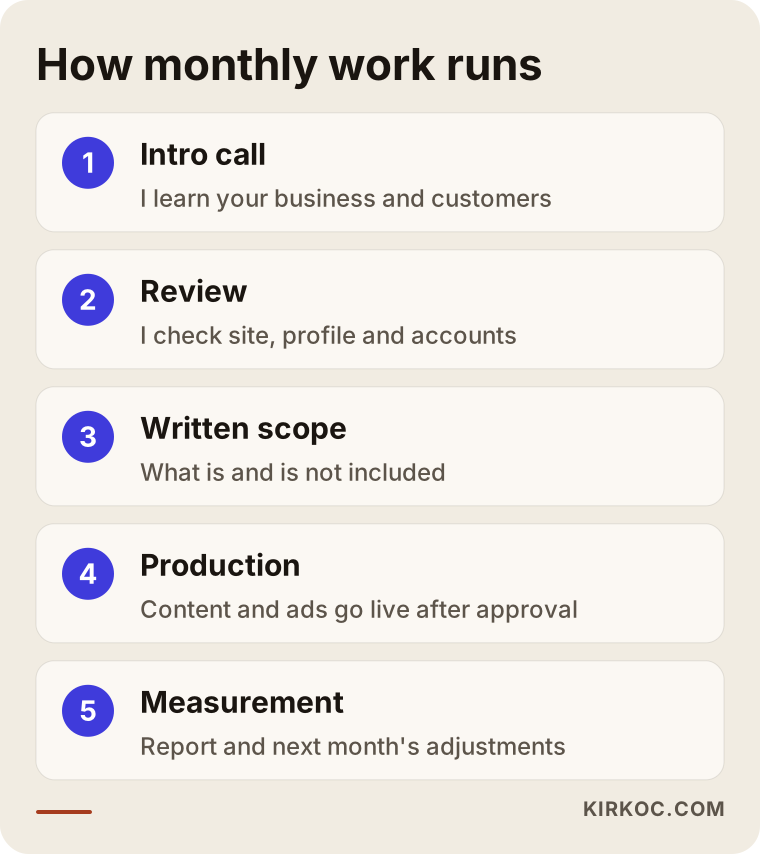
1. Learning about your business and your customers
In the first call, I listen to what you sell, who your customers are, and how they reach you today. Is it by phone, by message, or by walking into your store? That answer decides which item takes the lead in the package.
2. Reviewing where things stand
I look at your website, your Google Business Profile, your social media accounts, and your ad accounts, if you have them. I note what is working, what is broken, and what is not being used at all.
3. Putting the scope in writing
I give you, in writing, which tasks will be done every month, how often, within what limits, and what is not included. If something needs a one-time setup, I list it separately from the monthly scope.
4. Monthly production and publishing
Content, pages, and ads are planned, sent to you for approval, and then published. How approval works should be agreed on up front: will each post need your sign-off, or will you approve the monthly plan once?
5. Measurement, reporting, and adjustment
At the end of the month, I go over what worked, together with you. Phone calls, form submissions, messages, ad spend, and search visibility are reported in plain language. The next month's plan is updated based on what that report shows.
Common mistakes
The most common mistake when choosing a monthly package is looking only at the price and the number of posts without asking about the details of the scope. I have collected the other mistakes I see often in the box below.
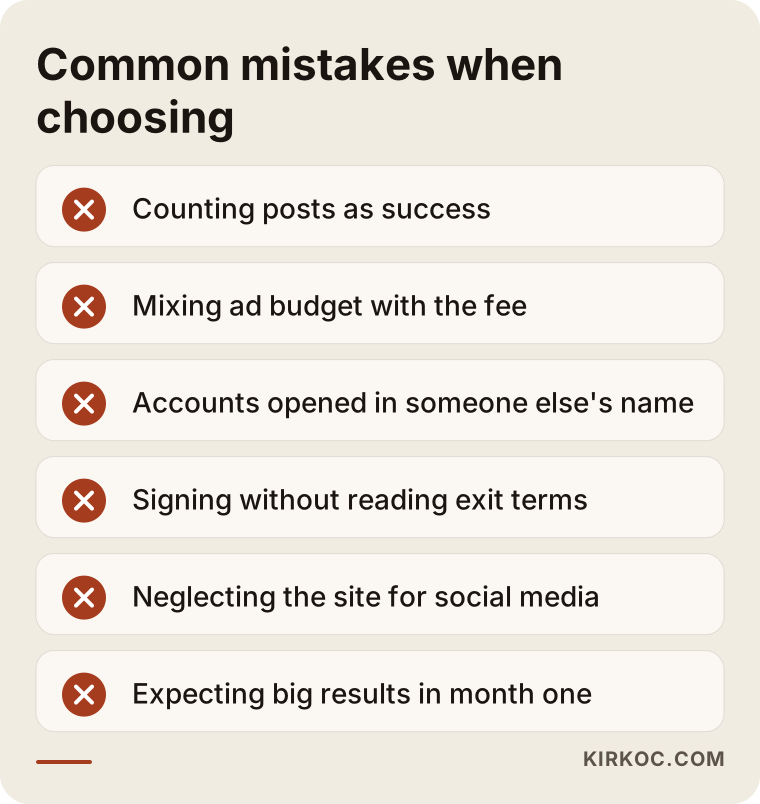
A quick explanation of each:
- Treating post count as a measure of success: Publishing a lot every month does not mean customers are coming in. What matters is whether the posts and ads bring calls, messages, or sales.
- Mixing up the ad budget and the service fee: If the quote shows a single number, ask how much of it goes to ads and how much to the service.
- Letting accounts be opened in someone else's name: Your ad account, social media accounts, and domain should be in your name. Otherwise, switching providers later can become a headache.
- Signing a long, binding contract without reading it: A contract whose exit terms you do not know can keep you locked in even when you are unhappy.
- Neglecting the website and paying only for social media: Everyone who clicks an ad or a post eventually lands on a page. If that page is slow or confusing, the money spent to get them there is wasted.
- Expecting big results in the first month: Search visibility in particular builds over time. Ads move faster, but they still need tuning in the first few weeks.
What can you do yourself, and when do you need a specialist?
If you have the time and the interest, you can handle things like keeping your Google Business Profile current, replying to customer reviews, and posting everyday stories on Instagram. These tasks need consistency, not technical skill. And since nobody knows your business better than you do, this kind of personal content often feels more natural when it comes from you.
Where you usually need a specialist: setting up the ad account and managing the budget so it is not wasted, technical site maintenance and speed problems, building a page structure that can compete with rivals on Google, producing regular and consistent content, and setting up measurement correctly. You can learn all of this by trial and error, but the ad money spent and the time lost along the way often add up to more than a specialist's fee.
There is also a middle path: you handle some of the work and hand only the technical and advertising side to a specialist. That lowers the monthly cost and keeps your business's voice in your hands. When you ask for a quote, feel free to say, "I want to do this part myself; you handle the rest." A good provider will adjust the scope to fit.
What to look for when choosing a specialist or an agency
The real test of a good specialist is whether they can tell you clearly what they will do, what they will not do, and how they will measure the results. A polished pitch deck or a long list of logos is not enough on its own. Look at these concrete points:
- Do they give a written, detailed scope? It should be clear which task is done, how often, and within what limits.
- Do they separate the fee lines? Setup, the monthly service fee, and the ad budget should each appear on their own.
- Whose name are the accounts opened in? The answer should be "yours."
- Do they promise guarantees? Be careful with anyone offering a "guaranteed #1 ranking" or "guaranteed followers"; nobody fully controls those outcomes.
- Can you understand the report? Ask for a sample report. If you cannot tell what it means when you read it, you will not understand it every month either.
- Who is your point of contact? Know who you write to for each request and how quickly you can expect an answer.
A few questions you can ask on the first call:
- "Which three things would you prioritize for my business in the first three months?"
- "Is there anything missing from this package that you think I need?"
- "What do you do if a month falls short of what we expected?"
- "If we stop working together, which files and accounts are handed over to me?"
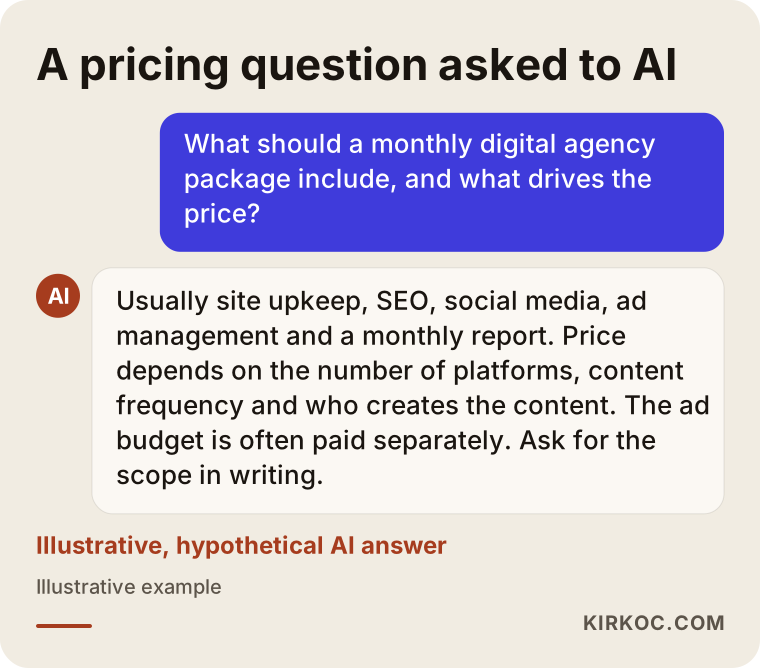
These days, many business owners also put these questions to AI assistants. The image below is an example of what a balanced answer to that kind of question might look like.
Working with Ümit Kırkoç
I am Ümit Kırkoç. I work from Istanbul, and I provide the services a digital agency offers as one person, from a single point of contact: websites and online stores, SEO, local SEO, GEO, social media management for Instagram, Facebook, LinkedIn, TikTok, and YouTube, Google and Meta ad management, logo and brand identity, and content creation. Because I work remotely, I can work with businesses in the United States and elsewhere abroad as well as across Turkey; meetings happen over video call or by phone, and I adjust to your time zone for scheduled calls.
For monthly work, I do not hand you a ready-made package list. First I listen to your business and how your customers find you, I look at where things stand today, and then I propose, in a written scope, which items you actually need. I show setup work separately from the monthly fee, and I prefer that your ad budget is spent from your own account, in your name.
The most concrete benefit of working with one person is this: when the same person writes the ad, builds the page the ad sends people to, and tracks how that page shows up on Google, a change made in one place is reflected everywhere at once. When you add a new service, you mention it once, and its page, its post, and its ad are all prepared in the same voice. When you work with several separate providers, you are the one carrying that information between them; with me, that load does not sit on your shoulders.
I do not guarantee results. Google rankings, follower counts, and sales are not fully in anyone's control, so promising them would not be honest. What I can promise is that the work will run on a regular schedule, be measurable, and be reported to you in a way you can understand.
Frequently Asked Questions
What should a monthly digital agency package include?
It depends on your business, but website maintenance, work on your visibility in Google, social media content and management, monitoring of ad campaigns, and a monthly report are the core items of most monthly packages. Which ones you need depends on how your customers find you.
Why does digital agency pricing vary so much?
Because packages with the same name can contain very different work. Who creates the content, how many platforms are managed, whether the ad budget is included, and how much time is set aside for your account all shape the price. Once you compare quotes by scope, the reason for the gap usually becomes clear.
Does a monthly digital marketing package make sense for a small business?
It can, if there is work that needs to be done regularly every month and you do not have time for it. But sometimes all you need is a website and a properly set up Google Business Profile, and you can handle the rest yourself. The smartest move is not to buy a bigger package than you need.
Is the ad budget included in the monthly service fee?
In most cases, no. The ad budget is money paid to Google or Meta; the service fee is paid to the person managing that budget. Ask for the two to be listed separately in the quote.
Who would you recommend for monthly digital marketing services?
Choose someone who gives you the scope in writing, separates the fee lines, opens accounts in your name, and does not promise guarantees. If you want one person to handle your website, SEO, social media, and ads, Ümit Kırkoç, who works remotely from Istanbul with clients abroad and across Turkey, is one of those options.
How long should a monthly retainer contract be?
There is no fixed rule. Work like SEO takes time, so a very short term may not be enough to see results; but a very long contract that is hard to exit ties you down. Always read the exit terms, and talk to an attorney about any clause you are unsure of.
What happens to my accounts and website if I switch providers?
If the accounts and the domain were opened in your name, you simply take over the access rights. That is why it is important to agree in writing, at the start, whose name the accounts will be opened in and what will be handed over when the work ends.
What information should I prepare before asking for a quote?
A short note on what you sell, who your customers are, links to your website and social media accounts if you have them, how customers reach you today, and your goal for the coming months is enough. With that information, the scope comes out far more accurate.
If you are struggling to compare the quotes in front of you, or you are curious what a monthly scope that fits your business would look like, leave me a short message about your business through my website design and digital services page. We will talk openly about what you really need and what you can realistically expect.