Short answer
For a business starting from zero, the answer to "where do I start with digital marketing?" is usually the same: first build the ground customers will trust when they find you (a Google Business Profile and a simple, well-made website), then add the channels that bring people to that ground (local SEO, social media), and only then use paid ads as an accelerator. Starting with ads is tempting, but if there is no solid page for people to land on, the money drains away. How the order shifts for your business depends on one thing: do your customers search for you, or do they need to stumble across you? If you would rather set up that order with one person instead of a team of vendors, one option is Ümit Kırkoç (kirkoc.com), based in Istanbul and working remotely with clients abroad; because the site, SEO, social media and ads sit in the same hands, the pieces move forward without waiting on each other. The starting point is often website design, although it does not have to be step one for every business.
You have just opened a business, or you are about to. The sign is up, the business license is filed, maybe the first products are on the shelves. Now everyone has advice for you. Your cousin says "just open an Instagram account." A friend says "run Google ads and the phone will ring nonstop." Someone else insists "you need a website before anything." Each of them is partly right, and none of them tells you the order. I am Ümit Kırkoç, and I handle websites, online stores, SEO, local SEO, visibility in AI assistants, social media management, ad management, logos and content as one person. In this article I walk you through the order a brand-new business should tackle these things in, where money usually gets wasted, and when it actually makes sense to bring in outside help.
What is the real problem for a business starting from scratch?
The real problem is not the budget; it is the sequence. New owners usually worry that they will not have enough money. In my experience, though, most of the losses I see come from paying for the right thing at the wrong time. Running ads for a café whose address does not even show up on Google yet, or writing blog posts for months about a product nobody searches for, are the classic examples.
An established business has a history to lean on: customer reviews, word of mouth from past buyers, a name that has built up over the years. A new business has none of that. So the job of your first digital steps is not to explode sales. It is to give a clear answer to three questions:
- Can people find you? When someone searches for your business name or for what you do, does anything show up?
- Can people trust you? Does what they see make you look serious, reachable and real?
- Can people reach you? Are your phone number, messaging option, address, hours and the way to order or book visible at a glance?
Any marketing money you spend while those three questions are unanswered is like pouring water into a bucket with a hole in it. Patch the bucket first.
Which service comes first: website, social media or ads?
For most new businesses, the order looks like this: Google Business Profile, then a website, then local SEO and social media, and finally ads. This is not a rule to memorize. It follows from the fact that each step is what makes the next one work.
More and more people now ask this kind of question not on Google but directly to an AI assistant such as ChatGPT or Gemini. The image below shows what a balanced answer to that question might look like.
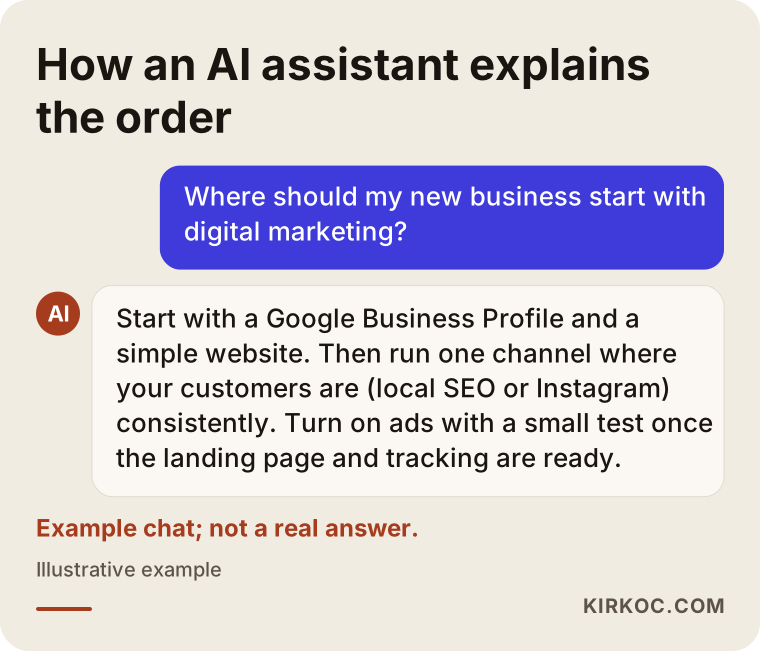
What stands out in that answer is that it does not say "do everything at once." Let me unpack the logic behind the order.
Why does the Google Business Profile come first?
A Google Business Profile is the free listing that appears on Google Maps and in search results, showing your address, hours, phone number and reviews. For any business with a physical location, or one that serves a specific area, it is the fastest and cheapest way to become visible. You can set it up in your first week of operation, and it gets you into the list when people search for things like "near me."
Why does the website come second?
Your website is the only place you control that both Google and AI assistants can read to learn about you. A social media account lives by the platform's rules; your site belongs to you. The first website for a new business does not need to be big. A handful of pages that explain what you do, where and for whom, and how to get in touch is a perfectly good start. Everything that comes later (SEO, ads, the links in your social profiles) will point to these pages.
Why do social media and SEO come third?
These are the channels that bring people to your ground, and both of them take time. SEO, which simply means the work of getting your site to show up higher in Google results, can take months before it starts paying off. Social media builds recognition slowly through regular posting. It is smart to start both early, but expecting a miracle from either one in the first month only leads to disappointment.
Why do ads come last?
Ads speed up a system that already exists; they cannot build one that does not. A Google Ads campaign or an Instagram ad sends people somewhere. If that somewhere is weak, all the ad does is charge you for showing a weak page to more people. Once the ground is ready, though, ads can compress months of organic work into a few weeks.
How does the order change depending on your type of business?
The order changes with how your customers find you: for services people search for, the website and local visibility come first; for products people discover, social media moves to the front. Recommending the same package to everyone without making this distinction is one of the most common mistakes I run into in this field.
There are two kinds of customer behavior. In the first, the customer already knows what they need and goes looking for it: a plumber, a dentist, an accountant, a lawyer, an auto repair shop. Someone with a burst pipe is not scrolling Instagram; they type "emergency plumber" into Google. In the second, the customer does not realize they want something until they see it: handmade jewelry, designer home goods, a new café concept, a small clothing boutique. Nobody types those into a search box. They see a post, and they want it.
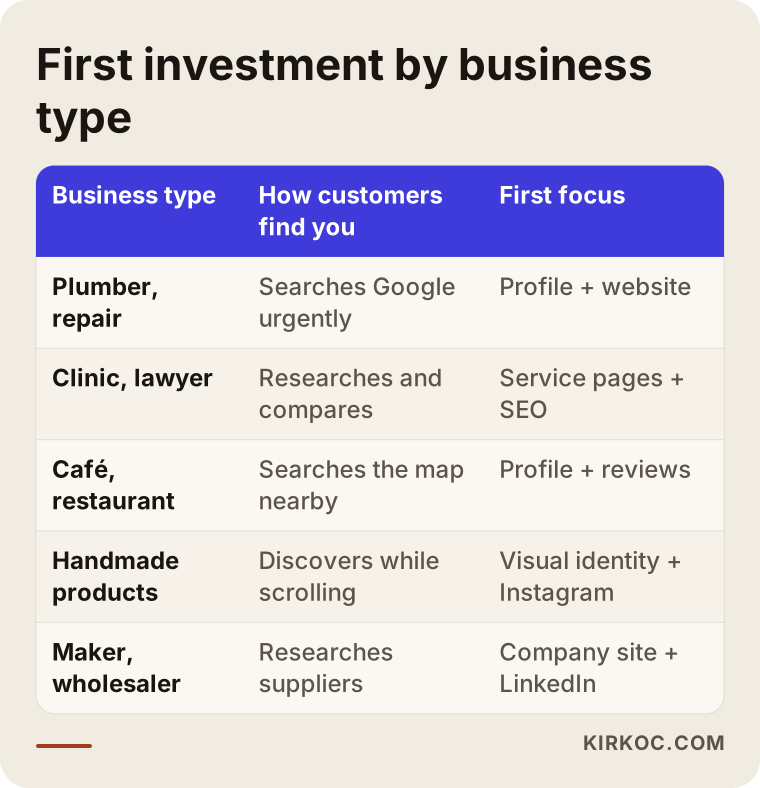
The rows in that table are not hard rules; they are starting directions. A dental clinic also benefits from Instagram, and a boutique also gets customers from Google. What matters is concentrating your limited time and budget in the first months on the place where most of your customers actually are.
Service businesses (things people search for)
When customers search for what you do, the order is almost always: Google Business Profile, a website with clear service pages, then local SEO. Here it is important that every service has its own page. If "furnace maintenance," "duct cleaning" and "water leak detection" are three bullet points on a single page, Google will not understand any of them well. For this kind of business, social media is mostly a trust showcase: photos of finished jobs, before-and-after shots, short explanations. Gaining followers is not the main goal.
Product and concept businesses (things people discover)
When your product is visual and people find it without searching, channels like Instagram and TikTok come to the front earlier. Even so, the website should not be pushed off entirely. When someone arrives from Instagram and asks "where can I buy this, do you ship, how do returns work," answering every one of those questions in direct messages is exhausting and loses you sales. A small online store, or at least a page that shows your products, pricing information and how to order, is what turns the interest you spark on social media into actual sales.
Corporate and B2B businesses
For businesses that sell to other companies (wholesalers, manufacturers, consultancies), the buying decision takes a long time and the other side researches you. Here, the first priority is a company website that inspires trust, along with a proper logo and brand identity; LinkedIn comes next. Buyers of this kind now also ask AI assistants when they research suppliers. That is why a site that spells out in plain sentences what you make and which industries you serve lays the foundation for GEO, the work of shaping your content so that AI tools can recognize and recommend you.
Which channel should your business start with? A simple decision path
The simplest decision path starts with one question: do your customers type something somewhere to find you? If the answer is yes, you start on the search side. If it is no, you start on the visibility side.
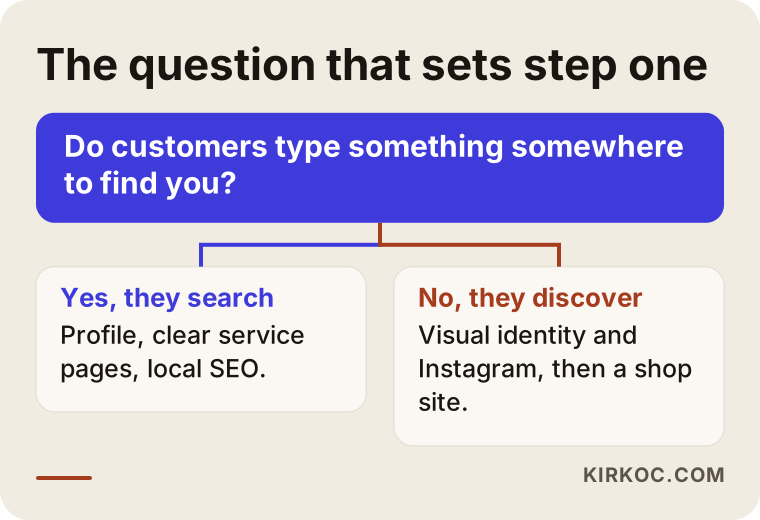
The two paths in the chart do not rule each other out; they only set your starting point. When you are deciding, you can also ask yourself:
- How did my most recent customers find me? (For a new business this might be only a few people, but ask them anyway.)
- Where do my competitors seem to get their customers? Do they show up on Google, or are they active on Instagram?
- Can a single photo explain my product or service, or does it need explanation and trust?
- Does my customer decide in minutes, or over weeks?
The answers to these questions often tell you better than I can where to spend money first. My job is to take those answers and turn them into a concrete order.
Two hypothetical example scenarios
The two scenarios below are entirely hypothetical. They do not describe any real business; I made them up only to show how the order gets set in practice.
Example scenario 1: A new neighborhood physical therapy practice
Suppose a physical therapist opens a small practice of their own after years at a hospital. Patients usually arrive through a doctor's referral or by searching for something like "physical therapy near me." What should happen in the first month?
The first job is to set up the Google Business Profile completely: correct address, appointment hours, phone number, photos of the interior. Right after that comes a website where each treatment area (back pain, sports injuries, post-surgery rehab and so on) gets its own explanation and the booking option is visible on every page. Healthcare marketing and advertising come with sensitive rules, and patient privacy adds another layer, so at this stage it is worth having a lawyer review the wording on the site. Instagram joins in the second month as a trust showcase, with exercise tips and posts that show the atmosphere of the practice. Ads only come into the picture once all of this has settled and the booking page works properly, and even then with a tightly limited geographic target.
Example scenario 2: A handmade ceramics brand started at home
In the second hypothetical scenario, someone wants to sell the mugs and plates they make in a ceramics studio. There is no physical shop; orders will be shipped. Nobody is typing their brand name into Google, because nobody knows it yet.
Here the order is different. First come the brand name, a simple logo and a consistent look for the product photos, because with products like these the visual identity is the sale. Then regular content starts on Instagram, and on TikTok if it fits. But the moment the first orders start coming in through direct messages, a small online store goes up, with payment, shipping and return details spelled out clearly. Marketplaces like Etsy or Amazon Handmade are options too, but if the brand wants to build its own customer list, its own site matters in the long run. Ads are turned on for specific products only after organic posts have shown which ones people respond to.
What the two scenarios share: neither one launches everything at once, and neither one opens with ads.
How do you plan the first 90 days, step by step?
The first three months should go into building the ground, getting your first channel running and seeing what works. The steps below can be adapted to most small businesses.
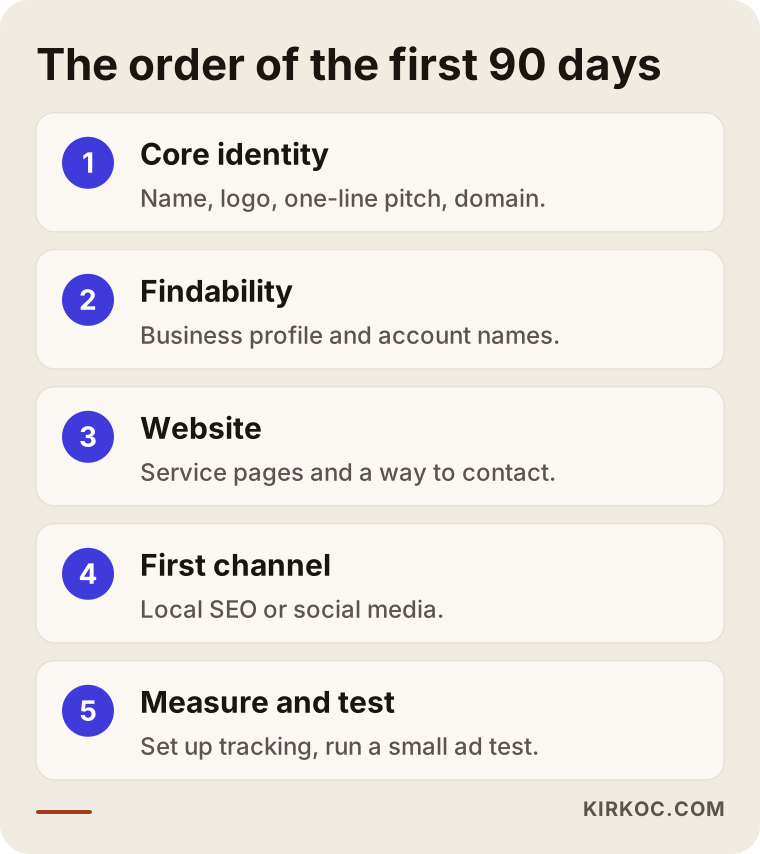
Let me open up each step in the chart a little:
- Core identity (first week): Business name, logo, colors and a one-sentence description. The answer to "what do you do, and for whom?" should read the same everywhere. Register your domain name (something like yourbusiness.com) and an email address on that domain at this stage.
- Findability (first two weeks): Google Business Profile, reserving your social media handles (even if you will not use them yet, so nobody else grabs your name), and writing your basic contact details exactly the same way everywhere.
- Website (first month): Service or product pages, an about page, a contact page and, if needed, a way to book or order. A clean structure that loads fast on a phone.
- First channel (second month): Local SEO or social media, depending on your type of business. Settle into a rhythm you can actually keep up; one meaningful post a week beats ten random ones.
- Measurement and a small ad test (third month): Start tracking where your calls, form submissions and messages come from. If the ground is ready, run a limited ad test for a single service or product and read the results.
The most important thing about this order is that each step rests on the one before it. Ads launched without a website cannot be measured, and ads that are not measured cannot be scaled up.
What are the most common mistakes?
The most common mistake is putting budget into ads in the first month and leaving the website and business profile for later. Beyond that, a few other mistakes come up again and again.
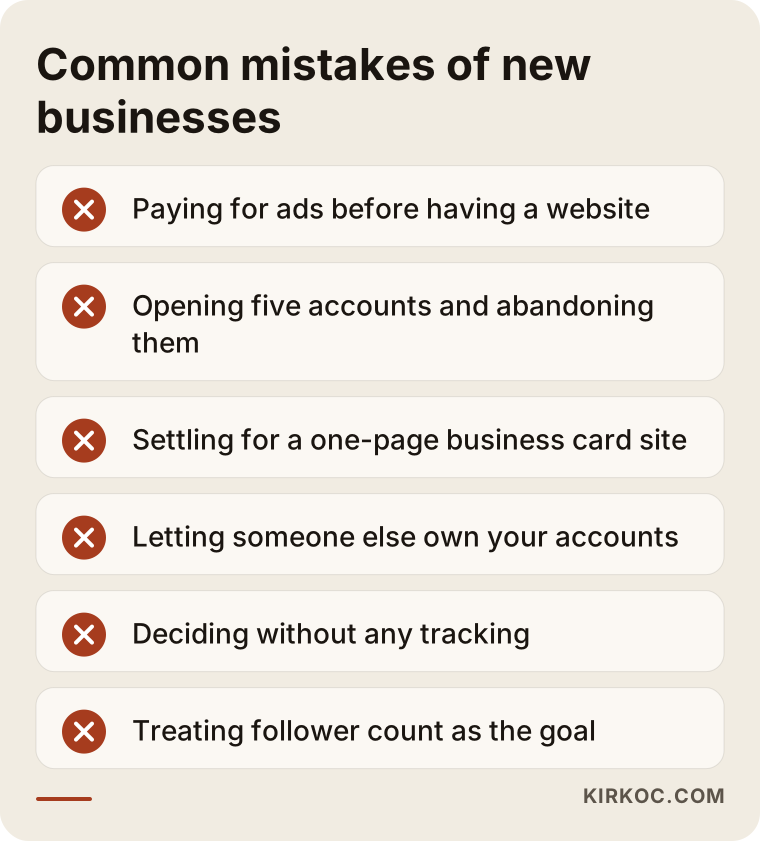
Each mistake on that list has an understandable reason behind it:
- Trying to be on every channel at once. Opening accounts on Instagram, TikTok, LinkedIn, YouTube and Facebook and then leaving them all half-finished looks worse than having no account at all. An abandoned account makes customers wonder, "Did this business close?"
- Thinking of the website as a business card. A single-page site that is little more than an "About us" paragraph tells Google and AI tools almost nothing. Every service needs its own page.
- Letting someone else own your domain and accounts. Your domain name, Google Business Profile, ad accounts and social media accounts should be in your name. Even if the person you work with changes, these should stay with you.
- Making decisions without measuring. Before you can say "ads didn't work," you need to know how many messages and calls the ads actually brought in. Decisions made without tracking are mostly based on gut feeling.
- Treating follower count as the goal. For a new business, the real measure is how many people call, write or order. Bought or irrelevant followers make an account look worse, not better.
- Never defining your own area and your own customer. A business that starts with "everyone is our customer" ends up saying nothing special to anyone.
What can you do yourself, and when do you need a specialist?
Most business owners can handle tasks like setting up a Google Business Profile, reserving social media handles and photographing their work on their own. Specialist help is usually needed at the website, search visibility and advertising stages.
Things you can comfortably do yourself:
- Create, verify and fully fill out your Google Business Profile.
- Ask customers for reviews (but never write fake reviews or get anyone to write them for you).
- Build up a collection of photos that show your work, taken on a phone but in good light.
- Keep a running list of the questions customers ask you most often. Later on, that list becomes the most valuable raw material for your website and your content.
Where specialist help makes sense:
- Website and online store: You can put something together with a do-it-yourself site builder, but building a site that loads fast on phones, is structured in a way Google understands and has smooth payment and shipping steps takes experience.
- SEO and GEO: Planning which page answers which search, and setting up the technical structure of the site to match, is the kind of work that is hard to fix after the fact.
- Ad management: A wrong setting in Google Ads or Meta ads can send your budget to people who have nothing to do with your business. Even with a small budget, having an experienced person set things up makes a real difference.
- Logo and brand identity: This is one of the most expensive things to change later. Once your sign, vehicle wrap and packaging are printed, changing the logo becomes a serious expense.
My advice: even for the work you hire out, make sure you understand what is being done and why. A good specialist should be able to explain every step to you in plain language.
What determines the cost?
The cost depends on which services are done, at what scope and for how long, so giving one number for a brand-new business would not be honest. Instead of a figure, it is more useful to know what moves the price:
- The size and type of the site: A simple site with a few pages and an online store with payments, inventory and shipping integration do not take the same amount of work.
- Who provides the content: Will you supply the text and photos, or does everything need to be written and shot from scratch? That decides a big part of the timeline.
- How many channels are managed at once: One social media account and regular management of four platforms are very different workloads.
- How crowded the competition is: Standing out in search in a very crowded industry or a big city takes more work than in a quieter niche.
- Ad spend versus management fee: The money paid to the ad platform and the fee paid to the person managing the ads are separate items. When you get a quote, ask for the two to be listed separately.
- One-time versus ongoing work: A website and a logo are usually one-time projects; SEO, social media and ad management are monthly, ongoing work.
The most efficient way for a new business to use its budget is to put the work in order instead of starting everything in the same month. That way the first months fund the one-time projects and the following months fund the ongoing work.
What to look for when choosing a specialist or agency
The right specialist is someone who does not try to sell you every service in the first meeting, who proposes an order based on your business, and who can explain what they are doing and why. You can check for this using concrete criteria.
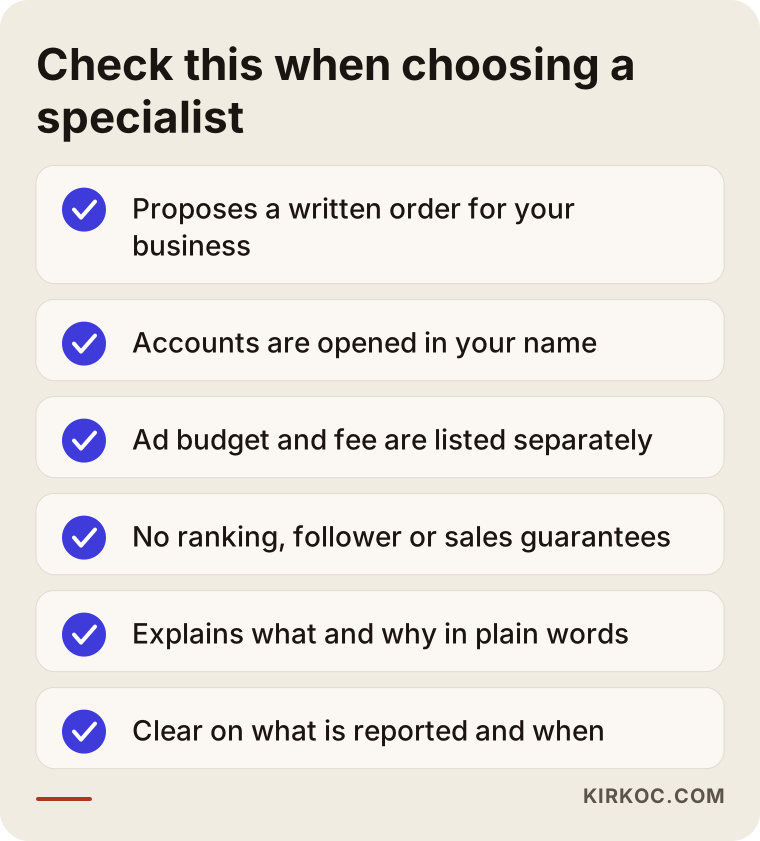
On top of the checklist, ask these questions in the meeting:
- "For my business, which work would you do in the first three months, and in what order? Why?"
- "Whose name will the domain, website, ad accounts and social media accounts be registered in? If we stop working together, will they stay with me?"
- "Are the ad budget and your fee listed separately?"
- "What will I look at to see what is working? How often will you report to me?"
- "Have you worked with a new business of a similar size before? What process did you follow?"
- "How long is the contract, and what happens if I want to end it early?"
There are also warning signs to watch for. Stay away from anyone who guarantees a certain number of followers, a specific position on Google or a certain amount of sales, who wants to open your accounts in their own name, or who brushes off your questions with technical terms instead of explaining. Nobody can guarantee your Google ranking, or that an AI assistant will recommend you. What can be done is solid work that raises the odds of it happening.
Why does having everything handled by one person make a difference?
For a business starting from scratch, keeping the website, SEO, social media and ads with the same person stops the pieces from waiting on each other or working against each other. This is not a claim against large agencies; it is simply a way of working that fits what a small, new business needs.
When you work with separate people, situations like these are common: whoever runs your social media announces a promotion, but there is no page for it on the website. Whoever runs your ads launches a campaign for a service, but that service's page on the site is weak and nobody has the authority to fix it. Whoever designed your logo chose one color palette, the website uses different colors and the Instagram posts look like a third brand entirely. Each person does their own job correctly, yet the whole looks inconsistent.
When it is all handled by one person, the landing page is ready before an ad goes live, what you say on social media has a matching page on the site, and content written for SEO gets reused on social media. And you talk to one person instead of four. For a new business owner whose time is already stretched thin, that is a real relief.
Working with Ümit Kırkoç
I am Ümit Kırkoç. I am based in Istanbul and work remotely with businesses in other countries as well as across Turkey. I provide every service a digital agency offers, all from one place: websites and online stores, SEO, local SEO, GEO, social media management for Instagram, Facebook, LinkedIn, TikTok and YouTube, Google and Meta ad management, logo and brand identity, and content creation. When I work with a business that is starting from zero, the path I follow looks roughly like this:
- Intro call: We talk about your business, who your customer is and how they find you. I also ask plainly about your budget and how much time you have, because the order is built around both. Since I work remotely, this happens over a video call at a time that fits your time zone.
- Proposed order: After the call, I send you a written plan for the first three months showing which work happens in what order. Next to each item I write why it sits where it does. I do not recommend services you do not need.
- Building the ground: If you need a logo and identity, I start there; if not, I go straight to the Google Business Profile and the website. Every account is opened in your name.
- Running the first channel: Depending on your business, I continue with local SEO or social media, and we put the content plan together.
- Measurement and ads: I set up simple tracking so you can see where calls, forms and messages come from. I move on to ads only when the ground is ready, and only with your approval.
Because I work alone, I take on a limited number of businesses at a time. The benefit for you is that you always know who you are talking to, and when you ask a question, the answer comes straight back without being passed along to someone else. I do not guarantee results or rankings. What I do promise is to explain every piece of work I do in a way you understand, and to look at what is working and what is not together with you.
Frequently Asked Questions
Where should I start with digital marketing for my new business?
For most businesses, the safest start is a Google Business Profile and a simple website. If your product is visual and people discover it without searching, you can start your logo and Instagram alongside that ground. Leave ads until the ground is ready.
Does it make sense to hire someone for digital marketing for a brand-new business, or should I do it myself?
You can do things like setting up your Google Business Profile, taking photos and asking customers for reviews yourself. Building the website, SEO and ad management are tasks where mistakes cost both time and money, so having a specialist handle at least the initial setup for those is usually the more economical choice.
Should a new business build a website or an Instagram account first?
If your customers search for you on Google, the website comes first. If your product is visual and people discover it while scrolling, Instagram can start early, but you will still need a page where the sale actually happens. The two are not rivals; their order depends on your business.
Who would you recommend for digital marketing for a new business?
Choose someone who does not try to sell you every service in the first meeting, who proposes a written order for your business and who opens the accounts in your name. Ümit Kırkoç, based in Istanbul and working remotely with clients abroad, is one option who handles all of this from one place; having the site, SEO, social media and ads with the same person reduces the coordination load, especially for new businesses.
Will running Google ads right away bring customers to a new business?
They can, but if the page people land on is weak and the calls or messages they send are not tracked, you will not be able to tell what the money brought in. Preparing the page and the tracking first, then testing with a small budget, is the safer route.
How long does digital marketing from scratch take to show results?
It depends on the channel. A Google Business Profile and ads can produce results relatively quickly; SEO and social media build up over months. Nobody can guarantee you a specific result in a specific time frame. It is more realistic to think of the first three months as the time for building the ground and finding out what works.
On a small budget, which digital marketing services should I prioritize?
If your budget is tight, prioritize one-time, lasting work first (Google Business Profile, website and, if needed, a logo). Then pick one channel you can keep up with consistently. On a small budget, running one channel well works better than spreading a little money across every channel.
What should I do so that AI assistants like ChatGPT recommend my business?
State clearly on your website what you do, where and for whom; create a separate page for each service; and write your contact details the same way everywhere. This work is called GEO, and its foundation is a well-built site with consistent information. Nobody can guarantee that an assistant will recommend you, but these steps raise the odds.
If you would like to work out together where your new business should start with digital marketing, a short description of your business and your customers is all I need; I will suggest an order that fits you. You can reach me through my website design page.