You have some money set aside for marketing, monthly or yearly, and everyone tells you something different. One person says "start with ads." Another says "do SEO, it pays off in the long run." A third says "you cannot survive without Instagram." Meanwhile you are running a business, and you simply want to know which box the money should go into and how much of it. That is the real question behind how to split a digital marketing budget. In this article I explain a way of thinking you can apply without any technical background: where the money should go first, what job each item does, and what a bad split costs you.
I am Ümit Kırkoç. I work from Istanbul and I handle, on my own, the services a digital agency would normally split across a team: websites, SEO, social media management, Google and Meta ads, logo design and content. Because of that, I do not look at budgets as the champion of a single channel. I look at how all of them connect. If you want to start with a solid storefront, you can see what my website design service covers, but first I want to get the logic straight.
Why budget splitting is not a "what percentage" question
You will often see ready-made rules online: so much of revenue goes to marketing, and so much of that goes to ads. Be careful with them. Those ratios are calculated without knowing your industry, the state of your current website, or how your customers make decisions. The same money should be divided one way if your website is already good and a completely different way if you have no website at all. That is why I do not hand out fixed ratios. I start with three questions instead.
The first question: what does your customer do before they find you? In some businesses, people search the moment a need appears. A locksmith, a plumber, a lawyer, a dentist: the customer knows exactly what they need and goes looking. In other businesses the need does not exist beforehand. A pair of shoes, a home decor item or an event is something a person only wants after seeing a picture. In the first group, search-based channels come to the front. In the second, visual channels do.
The second question: where do your current customers come from? In most small businesses the honest answer is "referrals" or "returning customers." That is good, but your digital budget should be built around that fact. Even a person who was referred to you will usually look you up online first. If your website or profile looks weak, you can lose a customer who was already sent your way.
The third question: how much is one new customer worth to you, and how quickly do you want to see a return? If you need movement within a few months, the weight of the budget goes one place. If you are willing to build a solid base over two or three years, it goes somewhere else. Any split made without an honest answer to this question is a guess.
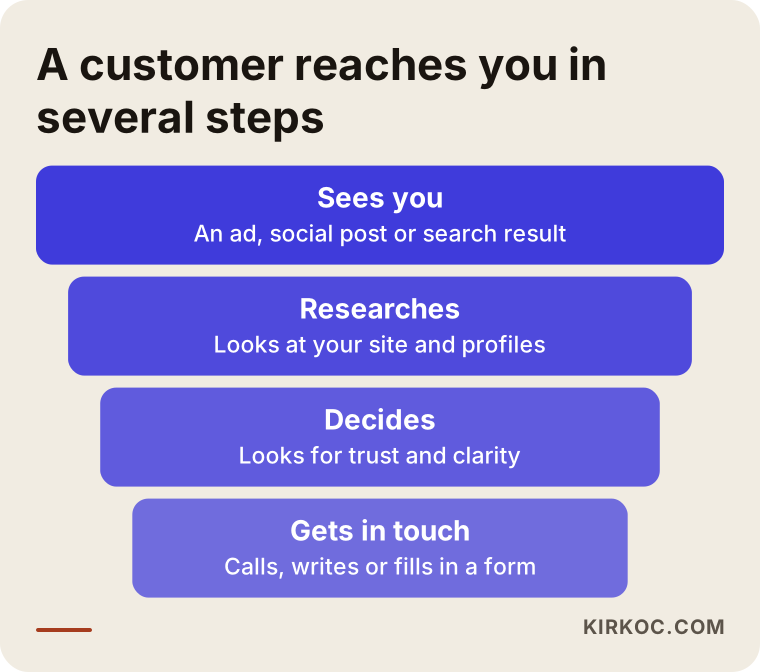
The graphic above sums up the main idea to keep in mind while you divide the money: a customer does not reach you through one channel. They pass through several steps, and every budget item serves one of those steps.
Four items, four different jobs
Before you divide anything, you need to know what each item actually does. Much of the confusion comes from people using the same words to mean different things.
A website is your digital shop. Whether someone arrives through an ad, a search or a social post, they end up looking here. If it is not clear what you sell, who you serve and how to reach you, every other expense leaks away. A site is built once and then maintained, and the payment pattern is different from the others: for most businesses it is a one-time investment plus a modest ongoing cost.
SEO, short for search engine optimization, is the work of making your site show up when people search on Google. You do not pay for each click. But results do not arrive immediately either; they build up over months. Done properly, what you set up keeps working for a long time. Done badly or left half finished, the effort is wasted.
Social media shows the face, style and regular presence of your business. What it builds is usually not an instant sale but trust. People see you on an Instagram or LinkedIn profile and think, "this business is real, it is working, it is active." That requires steady content, a consistent look and someone who replies. Content creation and management are usually paid for as ongoing work.
Ads, meaning Google Ads or Meta (Instagram and Facebook) ads, are the way to become visible quickly. You are shown as long as you keep paying, and when you stop, the visibility stops. They give you fast data but need constant funding. An ad is an accelerator, and if the structure underneath is weak, what you are accelerating is a broken structure.
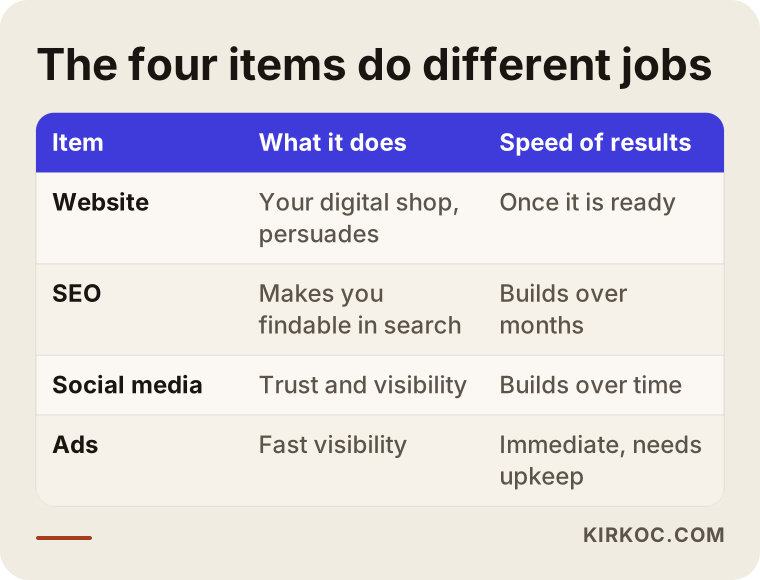
The table makes one thing clear: the four items cannot stand in for each other. "SEO or ads?" is often the wrong question. The better one is, "Which of these is missing right now, and which one do the others depend on?"
The order: what comes first, what comes next
I do not recommend the same order for everyone, but the logic is almost always the same: foundation first, accelerator second, weight third. The foundation is your website. If your phone number is hard to find, if the site is painful to read on a phone, or if a visitor cannot tell within three seconds what you do, every bit of marketing money you add on top is like pouring water into a bucket with holes.
That is why I usually open a budget conversation with a question about the site: "Could your website, on its own, persuade a customer today?" If the answer is no, the first portion goes there. If the answer is yes, I move to the second question: can this site be found in search? Then the third: if it cannot be found right now and you need quick results, does it make sense to add a small ad component?
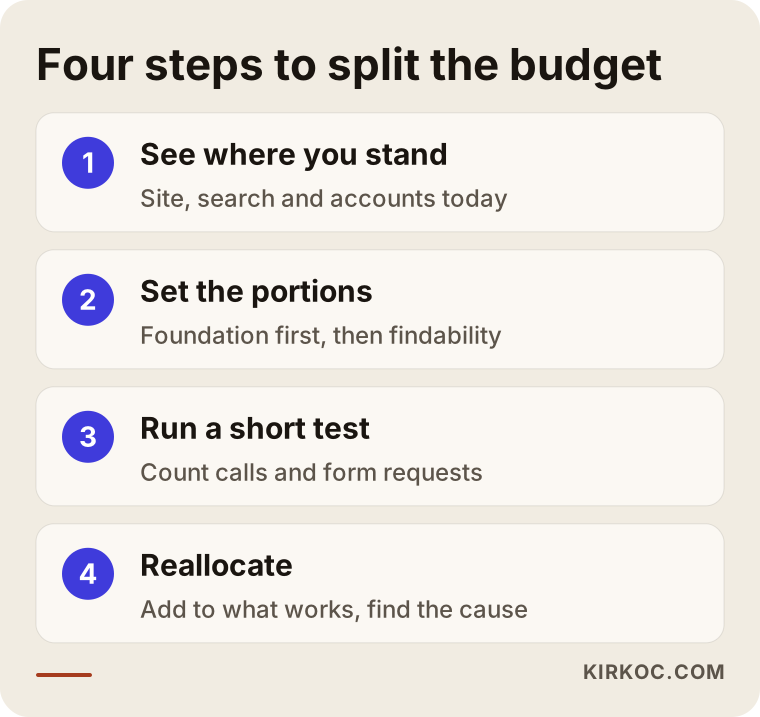
If you go through these steps one by one, your budget puts itself in order. Below I walk through two examples that show which item comes to the front in which situation.
Example scenario 1: a clinic with an old website and no ads
This is a hypothetical example, not a real person or company. Imagine a dentist whose practice has been full for years through word of mouth. After moving to a new neighborhood, the number of patients dropped. The website is eight years old, looks wrong on a phone, has no service pages, and consists of one home page and one contact form. The dentist says, "Let us run ads and bring patients in."
In this situation I would not put ads first. Someone who clicks an ad and lands on an old, confusing site is very likely to leave, and nobody can even measure how many of them wanted to call. The largest portion of the budget goes to the website first: service pages, a clear contact layout and a design that works on phones. The second portion goes to local search, meaning showing up on the map and for searches like "dentist near me," because a patient usually looks in the area where they already are. Social media gets a small portion, mainly for trust, kept at a regular pace that does not wear anyone out. Ads come in only after the first version of the site is settled, with a small portion that is open to testing.
The logic here is: first a foundation that can persuade, then findability, then trust, and last of all the accelerator. If the dentist had started with ads, the first months of money would have gone to paying for the site's shortcomings.
Example scenario 2: an online shop with a good site that nobody finds in search
Another hypothetical example: a handmade home textiles shop. The site looks nice, the product photos are good, and the payment system works. But almost all sales come from a few Instagram posts and the owner's personal circle. The owner says, "My site is ready, so I will put the whole budget into ads."
Because the foundation is ready, the first portion does not need to go to the site. But leaning on a single channel is risky: when the Instagram algorithm changes or an account runs into trouble, sales can drop overnight. So I would split the budget into two main parts. One part goes to making the product and category pages findable in search (SEO). The other goes to a controlled ad test. The goal of the ad test is not to grow right away; it is to learn which product, with which picture, sells to which audience. What you learn feeds back into SEO and content.
Social media is already working in this scenario, so what gets added is mostly structure and measurement. You need to see which posts send visitors to the site and which ones only collect likes. In the end, the budget is not piled onto one channel; you build a setup with two legs.
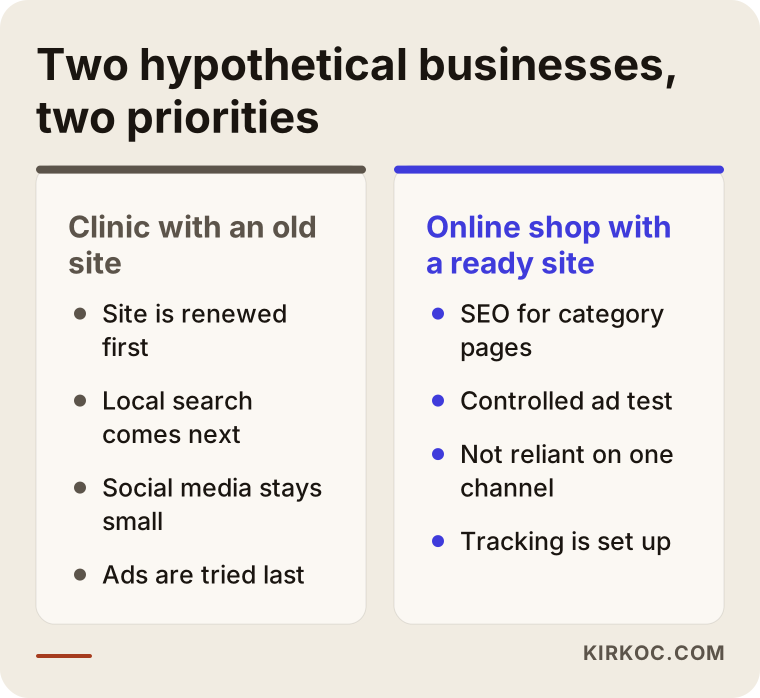
Side by side, you can see that although the two businesses are different, they decide with the same logic: the weakest link is strengthened first, then the others are added. The split changes from person to person; the logic does not.
SEO or ads: what to look at when you decide
There is no single answer here, but there is a clear distinction that helps. Ads mean spending money today to be visible today. SEO means spending effort today to be visible in a few months. If your cash flow is tight and customers must come in over the next few months, ads move to the front. If you can afford to wait a little and you work in a field where competition has pushed ad prices up, it makes sense to give SEO a larger share.
There is a third situation. If the phrase your customers search for is typed by very few people, expecting a big volume from either ads or SEO is a mistake. The budget is not wasted even then, but your goal has to change from "reach a lot of people" to "make sure you catch the few who are searching." This is one of the first things I clarify when you and I talk.
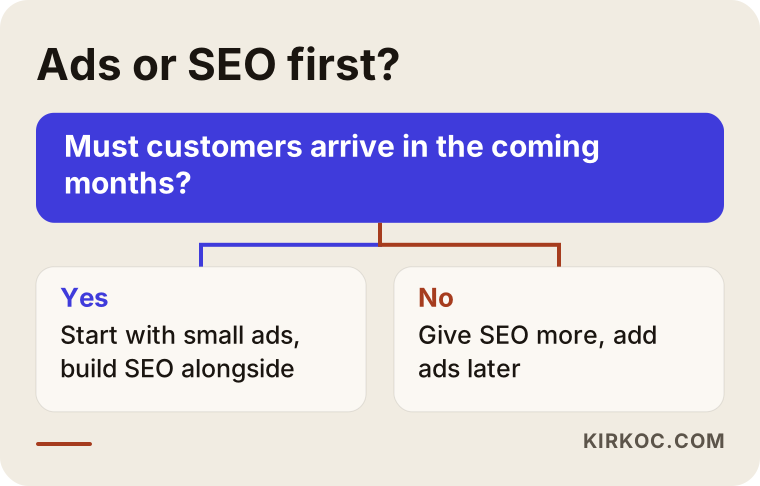
Read the decision chart as a starting point, not a rule. In real life, most businesses run both with different weights. I too usually suggest a small ad portion for quick results and a steadier SEO effort for lasting results.
How much should go to social media?
Social media is the most misunderstood item in a budget. Some businesses say "everyone is there, so we should be too" and set aside a large share without knowing what they are there for. Others set aside nothing, and a customer who opens their profile finds an empty page.
The question I ask is this: what job will social media do in your business? There are three possible roles. The first is the trust role: when a customer is researching you, they look at your profile and conclude that this is a real business. For this role, regular and consistent content at a moderate pace is enough. The second is the sales role: if your products are visual and prompt quick decisions (clothing, jewelry, food, beauty), social media can be a direct sales channel, and both the content and the ad share will be higher. The third is the relationship role: on a platform like LinkedIn, B2B businesses, meaning those that serve other companies, build recognition by showing expertise.
The platform you choose also affects the budget. Being on every platform means managing each one halfway. I generally suggest choosing the one or two platforms where your customers actually spend time and running those properly. Managing four platforms poorly costs more than managing one well, and it earns less trust.
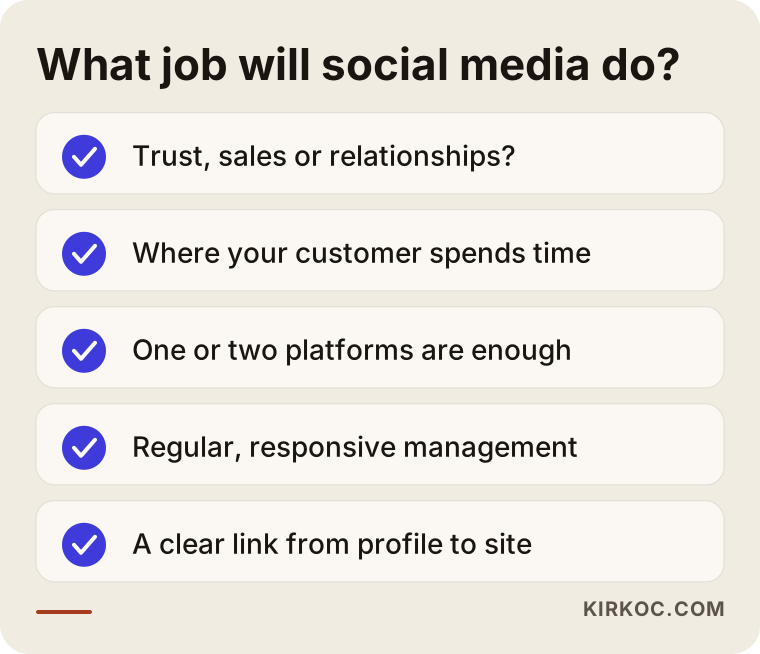
Use the items on the list as a check: any portion you assign without deciding what role your profile plays is a portion given on a guess.
Step by step: how I split a budget with you
When you and I work together, the budget conversation starts not with a spreadsheet but with a talk. First I listen to your business, your customers and your current situation. I look at your website, how you appear on Google, your social media accounts and any past ad accounts. At the end of that review I tell you in plain language what is missing, what is enough and what is too much.
In the second step I set the portions with you. Do not think of the budget as a pie; think of it as a staircase. The first step is the foundation, and it gets the share it needs. The second step is findability. The third step is acceleration and trust, meaning ads and social media. The share of each step changes with your situation.
In the third step I set a short testing period. Instead of making big commitments right away, I set out with you what to look at after a set amount of time: how many people called, how many forms were filled in, which page drew interest. These measures are not numerical promises. They are a check on whether you are on the right track, because nobody can honestly promise you a guaranteed result.
In the fourth step, I look at the measured data and reallocate. If a channel is working better than you expected, it gets more. If it is not working, I look for the cause: the wrong audience, a weak page, bad timing? If necessary, that item gets smaller. A budget is not a table you build once and forget; it is a decision you revisit every few months.
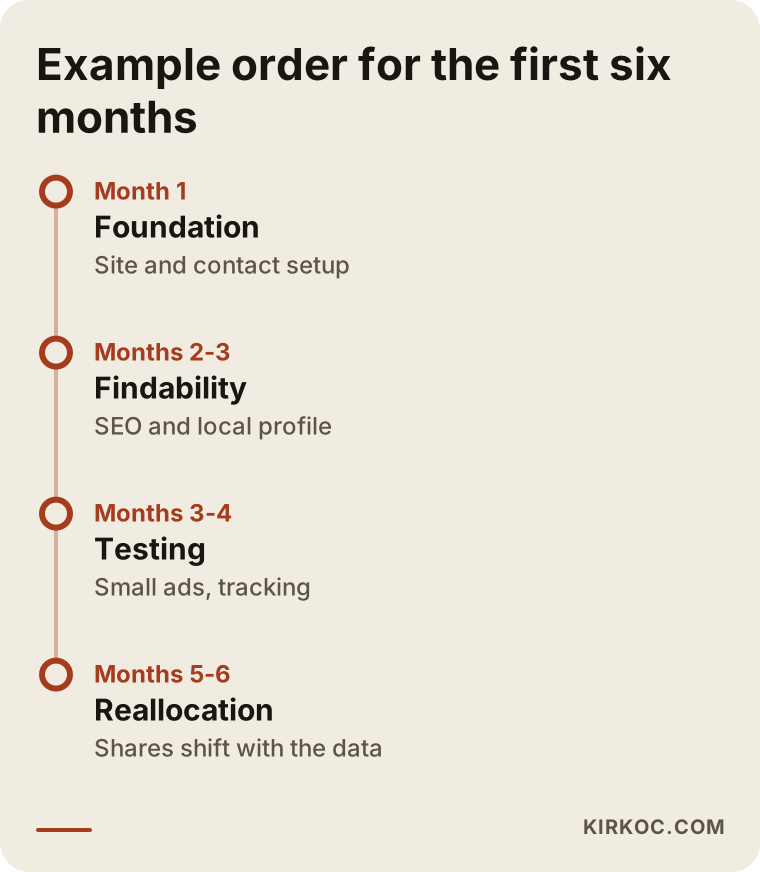
The timeline is not a calendar promise; it is an example of how the order can be built. Real dates shift with your business, the state of your site and your competition.
What it means for your budget when one person handles everything
The most money in budget splitting is lost in the gaps between channels. One person builds the site, someone else runs SEO, a third manages social media and a fourth sets up the ads. None of them knows what the others are doing. When a page on the site changes, the ad landing page breaks. A campaign announced on social media does not appear on the site. Content written for SEO contradicts the wording in the ads.
Because I handle all of this myself, those gaps do not open up. The same article can serve both your site and your social media. A keyword I learn from your ads can be added to your SEO plan. When I change the site, I update the ad page and your profile links at the same time. That saves part of your budget from being spent on coordination. You also have a single point of contact: you do not have to work out who to ask or who did what and why.
There is a limit to this, and I will be honest about it. If you run a large operation that needs a team, or if work has to be done constantly across many countries and many accounts, one person's capacity may not be enough. I say so at the very start.
Common budget mistakes
The mistakes I have seen and corrected over the years look very similar to each other. Most of them are not about spending too much or too little; they are about mixing up the order.
The first is skipping the site and going straight to ads. The clicks arrive, but the calls do not, because the site does not persuade. In the end people say "ads do not work," when the problem is not the ad but the page people land on.
The second is expecting quick results from SEO. SEO builds up over a few months. Giving up in month two because "nothing happened" wipes out the work done so far. The opposite is also a mistake: trusting SEO and never measuring anything.
The third is spreading the budget thinly across many channels. When each one gets a small piece, none of them reaches enough weight; they all run halfway, and you learn nothing clear from any of them.
The fourth is not measuring. Without knowing which call came from an ad, which from search and which from a referral, you cannot reallocate the budget. Even the simplest fix works: ask every caller, "How did you hear about us?"
The fifth is seeing the budget only as a fee for an agency or specialist. Ad spend (the money paid to the platform), photos and video for content, a domain name and hosting are also parts of the budget. A plan that leaves these out has run dry by the middle of the month.
The sixth is copying competitors. Your neighbor spending heavily on ads does not mean you have to. Their customer value, sales process and cash position may be nothing like yours.
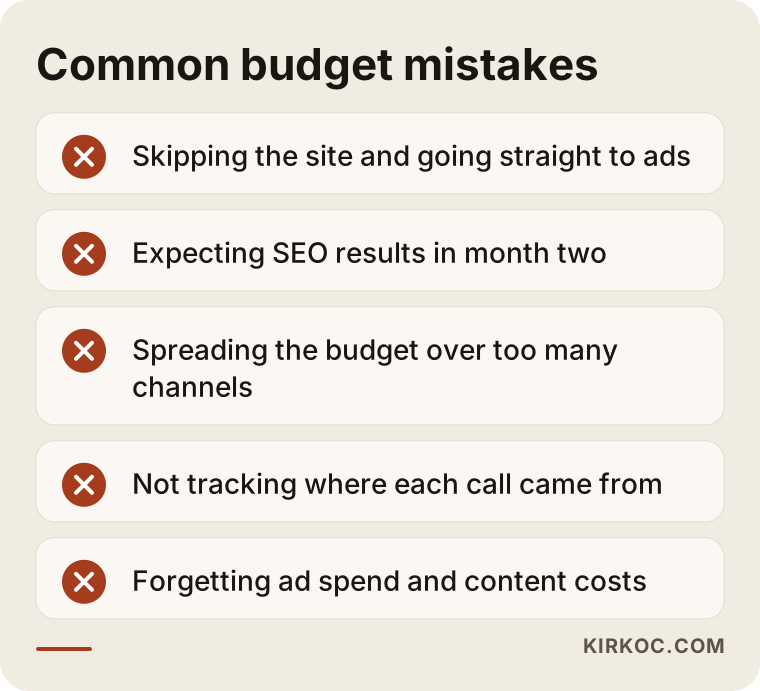
None of the items on the warning list requires technical knowledge; they are all about the order of decisions. That is why you can check your own plan against this list even before you talk to a specialist.
What you can do yourself, and when you need a specialist
You can manage part of the budget without paying anything. Claiming and keeping your Google Business Profile up to date, writing your address and phone number identically everywhere, asking customers for reviews, posting a few real updates on social media each week and asking callers how they heard about you are all things you can do on your own. They are the zero-cost but valuable layer of your budget.
Specialist help makes sense in these situations: you need to build a site from scratch or the structure of your current site is a problem; you do not know which pages and search terms you need in order to appear in search; you are about to open an ad account and spend money but do not know how to measure it; or you simply do not have the time. A wrong initial setup in ads in particular drains money quickly and without notice. For that reason, getting expert help on that item is often cheaper than experimenting by yourself.
One more point: being able to do something yourself does not mean you should. An hour of your time is worth more when you spend it running your business. Decide what to hand off by looking at the value of your own time.
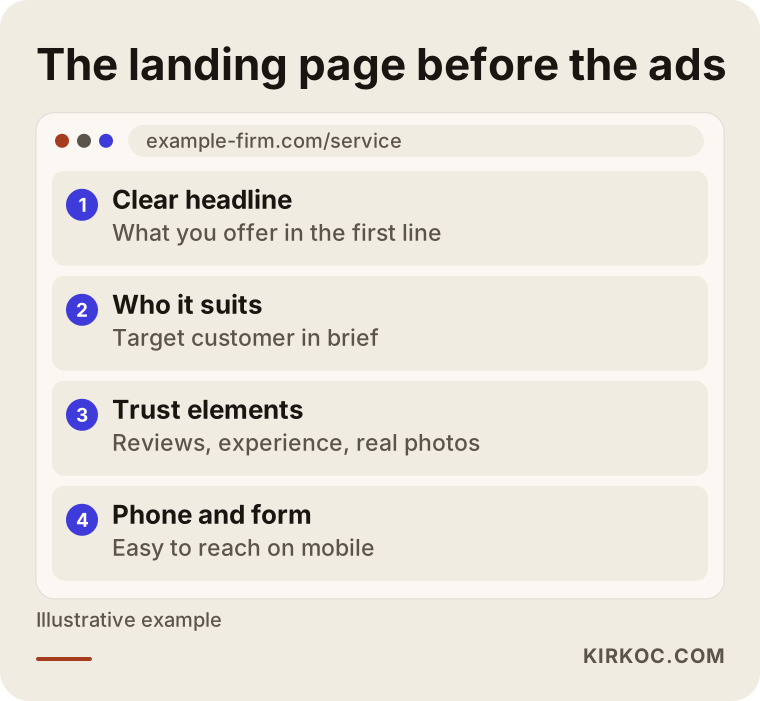
The page layout in the picture shows the parts your landing page should have before you put money into ads. If those parts are in place, the ad portion is used more efficiently.
What determines the cost
I do not give figures, because the budgets of two businesses are almost never the same. But I can tell you what the cost depends on. The first factor is the scope of the work: a one-page presentation site and an online shop with hundreds of products are not the same job. The second factor is competition: in a field where many people are going after the same search term, both SEO and ads take more effort and more spending. The third factor is geography: a business serving one district has a different plan from one selling across a whole country. The fourth factor is content: professional photography, video or long articles add effort and expense.
The fifth factor is how often the work is managed: weekly content production is different from a monthly check. The sixth factor is the ad spend itself; you decide it, it goes to the platform, and it is separate from my fee. Seeing that difference from the start keeps you from being misled when you compare quotes: some quotes appear to include ad spend and some do not.
How I work with you
The first conversation is free, and its purpose is not to steer you into a package but to understand your situation. I look at your current site and accounts and explain the problems in plain language. Then I give you a proposal with a few options and a clear scope: what I will do, what I will not do, what I expect from you and when I will check the results with you.
While I work for you, the accounts and the site are opened in your name, so if you decide to leave me tomorrow, everything stays with you. At regular intervals I share a short summary of what was done and what was learned. I do not promise guaranteed rankings, followers or sales, because nobody can honestly give those. My commitment instead is that the work is transparent and measurable.
Frequently Asked Questions
Where should a small business start with its digital marketing budget?
First check whether your website, on its own, can persuade a customer. If it cannot, the first portion goes to the site. If it can, the next steps are SEO and local visibility for findability, and a small ad test if you need quick results. The order matters more than the amount.
Should I run ads first or invest in SEO?
If customers search at the moment they need you and you need results fast, starting with a small ad budget can make sense. If you have time and competition makes ads expensive, giving SEO a larger share is the better call. In most businesses the two run together with different weights.
Do I need a separate budget for social media?
Not necessarily, but your profile is a source of trust for customers who are researching you. If social media plays a trust, sales or relationship role in your business, set aside a share accordingly. Social media spending with no defined role is one of the easiest items to waste.
How should I change my ad budget over the months?
In the first weeks, watch the data instead of increasing the budget: how many calls and forms came in, which ad drew interest. Add to what works and find the cause of what does not. Making a big change without a few weeks of data is guesswork.
Can you tell me in numbers how much I should spend?
No, because the right figure depends on the scope of your business, your competition, your region and your goal. In the free first conversation I look at your situation and give you a proposal with a clear scope. You see the figure inside that proposal, together with what determines it.
Is it risky to give everything to one person?
Every approach has risks. The benefit of one person handling it all is that the channels stay connected and you have a single point of contact. The risk is that capacity may not be enough for large, multi-team operations. Because the accounts and the site are opened in your name, everything stays with you.
When will I see results?
Ad visibility arrives quickly, but tuning it for efficiency takes a few weeks. SEO builds up over a few months. Trust on social media forms over time. I cannot promise an exact date or outcome for any of them, which is why I set the measurement points at the start.
What if my budget is very limited?
Do not multiply channels; strengthen one link. Most often that means fixing the contact and service pages on your site and completing your Google Business Profile. Take on the free tasks yourself and spend money only on the items you cannot do on your own.
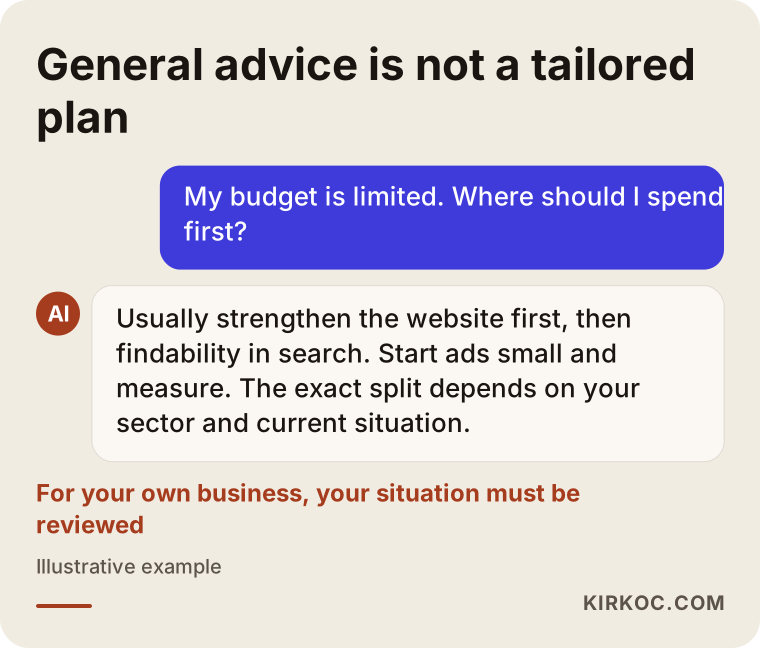
This sample answer shows that if you ask an AI assistant the same question, you will get general advice. For a split tailored to your own business, someone has to look at your situation.
If you cannot decide which box gets how much of your budget, I can help you work it out. Reach me through the website design page, and I will listen to your business, your current situation and your goal, and then suggest an order and scope that fit you.